


Most apps lose users before they ever reach the “good part.” Discovery gets the download. Onboarding gets the first listen. But the Scaffolding phase — where a user decides whether your product becomes a daily habit or gets uninstalled — is where most experiences quietly fail.
Audible doesn’t fail here. This Level 2 Octalysis analysis breaks down exactly how Audible keeps listeners engaged after the novelty fades, and what designers can steal for their own products.
This analysis was written by contributing writer Erik van Mechelen based on the Octalysis Framework designed by Yu-kai Chou.
Table of Contents
About the Creator of the Octalysis Framework

Yu-kai Chou created the Octalysis Framework after studying gamification since 2003 — years before the term entered mainstream vocabulary. As a Human-Systems Architect & Behavioral Designer, his framework has been applied by LEGO, Microsoft, Porsche, Coca-Cola, Salesforce, and MrBeast, impacting over 1.5 Billion Users.
Chou has taught the Octalysis methodology at Harvard, Stanford, Yale, Tesla, Google, BCG, and IDEO.
His work has been cited by Harvard, Stanford, MIT, Forbes, Wall Street Journal, Wired, US Department of Energy, NIST, NSF, NCBI, US Department of Education, ClinicalTrials.gov, and 3,700+ academic publications. Explore his books here.
Entering the Audible Scaffolding phase
Getting beyond Discovery and Onboarding is impressive.

But products and experiences really need to shine during the Scaffolding phase if they want to get Players to the Endgame.
Scaffolding starts once a player has learned the basic tools and rules to play the game and has achieved the “First Major Win-State.”
Yu-kai wrote about Scaffolding over here, but this is the key piece:
Regarding the scaffolding phase, one thing to note is that more often than not, it requires the exact same (or very similar) actions on a regular/daily basis, and the Gamification designer must answer the question, “why would my users come back over and over again for the same actions?”
Once you understand the intrinsic and extrinsic trigger/action/reward loops, you can deliver them via the experience.
Keep note that usually extrinsic rewards are better at attracting people to participate in the first place (Discovery and Onboarding), but towards the Scaffolding and EndGame, you want to transition to intrinsic motivation as much as possible.
Moving from Onboarding to Scaffolding
Your design needs to account for Players entering the Scaffolding phase after Onboarding.
For me, Onboarding finished after I downloaded my first book and had listened to it.
The next time I logged in, I was slowly entering the Scaffolding phase. I could listen to my book again, or I could look around.
This “looking around” (driven by my Core Drive 7 (CD7)) was enabled by the design of the Audible app.
It was easy for me to look around. Once I started exploring, I found some interesting things.
Here are three places Audible encouraged action and gave rewards.
Sidebar, designed for Scaffolding
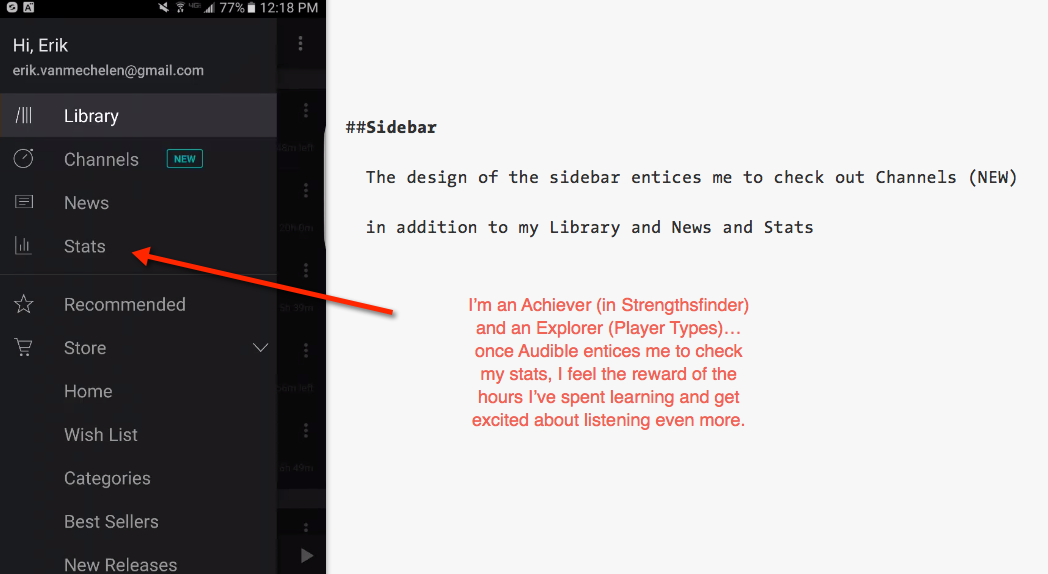
Once in Scaffolding, my Player type heavily influences the types of actions I want to take.
I remember finding the Sidebar after returning to listen to my first book. Then I found a LOT more options for me to take action on.
Remember: stimulus, action, reward.
I went searching for that reward.
Stats for achievers
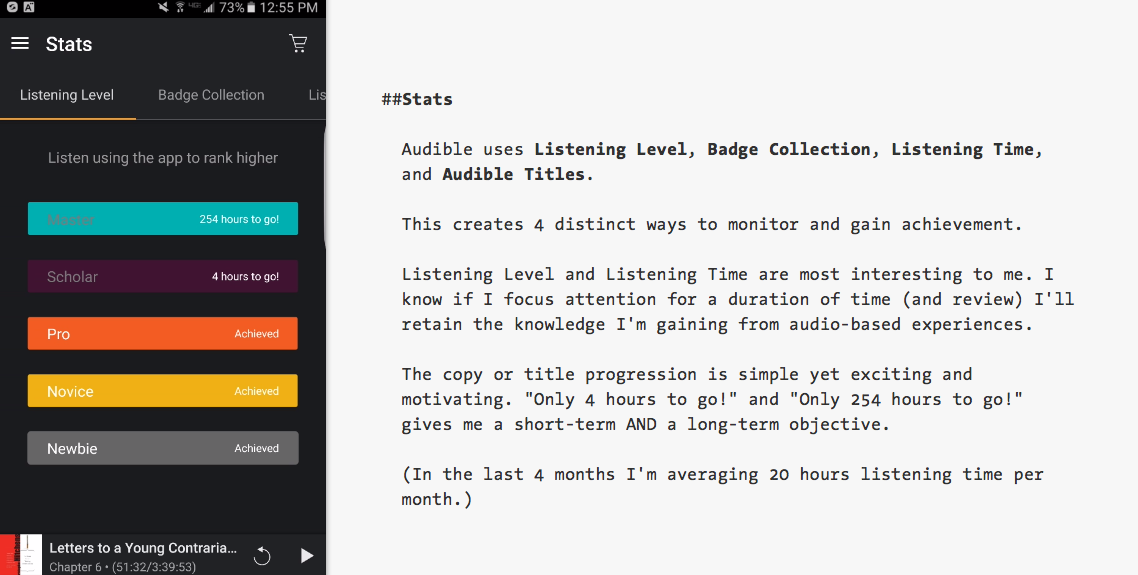
Once we step back, the achievements within Audible aren’t THAT sophisticated, but they’ve created a solid design experience to keep me informed of my reading progress.
If I was to improve this experience for an Achiever or Explorer Player type, I would do a couple things:
I would track the “Type” of books I’m downloading and listening to and the “Type” of Channels/Programs I’m listening to. From there, Audible can make recommendations based on parameters I set.
Maybe I want to be sure to have harmony/balance between fiction and non-fiction.
Then Audible can remind me if I’ve downloaded 5 non-fiction titles in a row, and suggest a fiction title.
I believe Audible could already do this with their current technology stack and infrastructure.
Channels, like a remote for edutainment
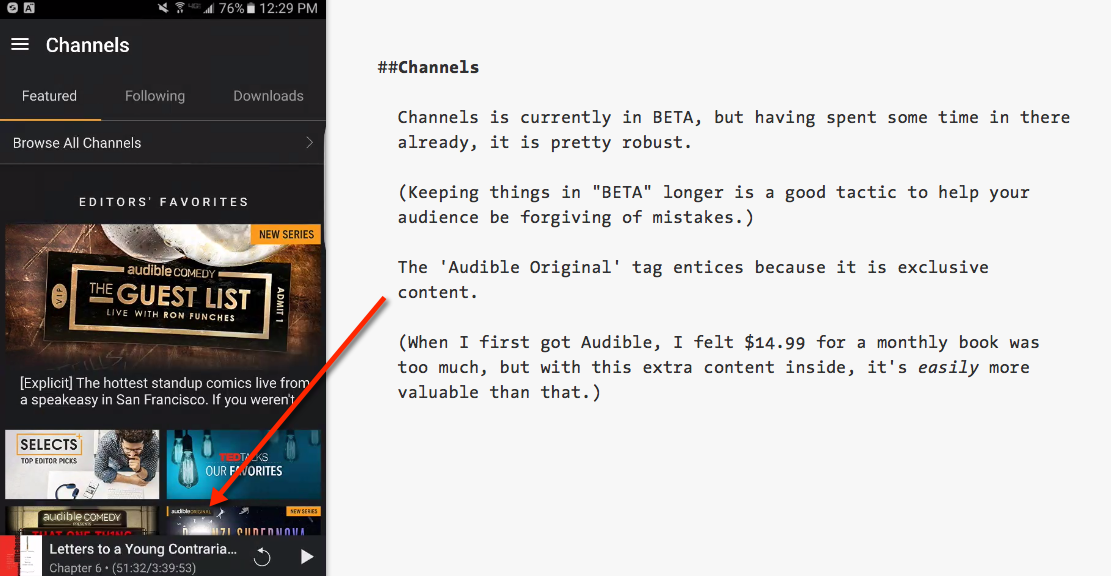
I wasn’t quick to try out channels, but after noticing it several times in my sidebar, I clicked in to explore.
Audible is clear about why they are showing you what they are showing. Featured, Editor’s Favorite, and so on.
You can also save Channels you like and download for offline listening. This is appropriate for the Core Drive 4 (CD4)-part of my motivational brain. “Let me go collect/explore a few programs and save them to listen later.”
Great images play into my Core Drive 3 (CD3)/CD7 with Glowing Choices.
Audible Originals make the experience feel exclusive. I feel excited to have access to something exclusive (Elitism).
Octalysis Tool for Audible’s Scaffolding phase
Here is the Octalysis tool scoring for this phase. Do your own Octalysis tool here.
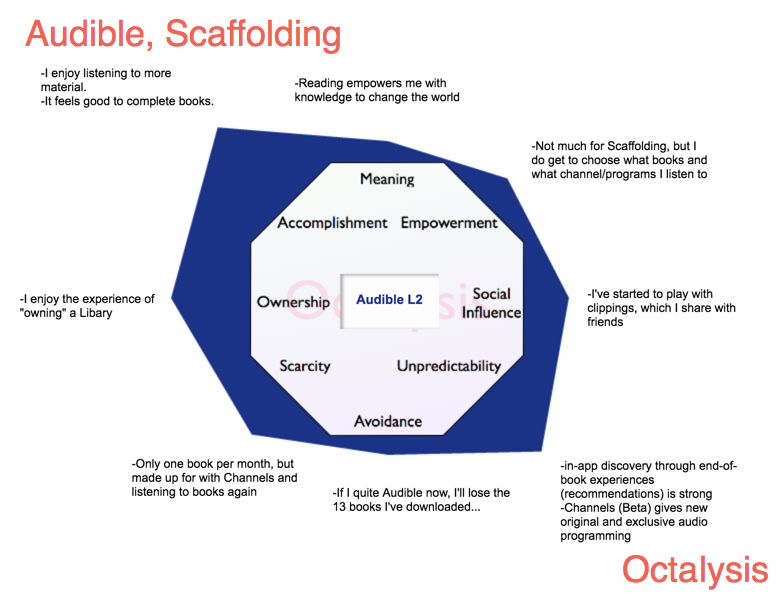
Remember, I am Achiever/Explorer Player type during Scaffolding phase of Audible.
Your experience may differ (depending on your Player type).
What’s next? Besides the Endgame (Alexa Skills)
It seems I’m well on my way to the Endgame experience with Audible.
I’ve habituated my listening and will either go there, to Scribd, or to YouTube for audio content. And occasionally a podcast service.
That’s pretty crazy. Just three services right there.
Alexa Skills is probably going to make a huge play in convenient education. It’s just a really natural play. Much more to come on analyzing that experience soon.
Anything surprising about my experience? Please share with me in the comments.
Related Reading
- The Octalysis Framework for Gamification & Behavioral Design
- 4 Experience Phases: The Scaffolding Phase
- What is Gamification?
- Gamification Design: 4 Phases of a Player’s Journey
- Books by Yu-kai Chou