


Facebook is a platform that is limited only by your creativity – and of course technical knowledge. But even without a technical background, a local business can use many apps to create an engaging Facebook experience.
A local business with an active Facebook fan base can greatly increase foot traffic and customer retention. Best of all, most of the apps available to local businesses are free, giving you a marketing channel that only requires your time.
Who should read this post: Local business owners looking to spice up their Facebook page with engaging apps
What you will learn: What apps are available to you and how to use them to drive traffic and retention
⚡ Speed Run Notes
- Platform apps are rental real estate: useful for a season, risky as a foundation. Every local business that bet its entire distribution on a single platform feature eventually got hurt by a platform change. Apps should be accelerators, not core infrastructure.
- The best use of a platform app is to collect contact info you can migrate off the platform. An email address is yours forever. A like is yours until Facebook changes the rules. Any platform tactic should bend toward moving users into a channel you own.
- CD2 (Accomplishment) mechanics like check-in badges worked briefly because they were novel, and died because they were thin. Users collected them, then forgot them. Novelty carries you for weeks; depth carries you for years. Apps that never added depth never retained.
- The platform change you didn't plan for will happen on the worst possible day. Every local business should assume the apps they rely on today will be gone or gutted in 3 years. Planning for that outcome is not pessimism — it is the only rational operating stance on rented platforms.
- The deepest insight: platform apps are a practice field, not a home field. Learn the tactics, test the mechanics, and graduate the lessons to channels you control. Businesses that treat rented platforms as permanent homes keep re-paying the eviction cost.
Author Credibility: Yu-kai Chou

Yu-kai Chou created the Octalysis Framework after studying gamification since 2003 — years before the term entered mainstream vocabulary. As a Human-Systems Architect & Behavioral Designer, his framework has been applied by LEGO, Microsoft, Porsche, Coca-Cola, Salesforce, and MrBeast, impacting over 1.5 Billion Users.
Chou has taught the Octalysis methodology at Harvard, Stanford, Yale, Tesla, Google, BCG, and IDEO.
His work has been cited by Harvard, Stanford, MIT, Forbes, Wall Street Journal, Wired, US Department of Energy, NIST, NSF, NCBI, US Department of Education, ClinicalTrials.gov, and Google Scholar — with 3,700+ more academic publications. Explore his books here.

Editor’s Note
Editor’s Note (2026): This post was originally written in 2012 when Facebook Pages used the Timeline layout with dedicated app tabs. Facebook has since restructured business pages significantly, and many features described here (Welcome tabs, Pinterest integration via Statigram/Woobox, Wildfire contests) no longer exist in their original form. The core principles of community engagement, creative contests, and social proof remain timeless and directly map to the Octalysis Framework.
What are Facebook Apps?
Check out the highlighted section of the image below:

There is room for 4 Facebook apps on the timeline screen. If a user wants to see more, then they can click on the drop down menu to view the other available apps.
Here you can see that the Red Mango Instagram Facebook App is viewable when you click on the drop down menu. Tapping into Core Drive 5: Social Influence & Relatedness is one of the most powerful ways to build community on a Facebook page, and apps are the mechanism that makes this possible.

Apps allow for cool functionality on the Facebook page.
The Welcome App
Check out the placement of the Carls Jr. Welcome App below:

When a user clicks on the App, the user sees a simple welcome page that displays items that Carls Jr. wants a first-time user to see.
How to improve: the title “Welcome” does NOT drive an action. A better phrase would be “New? Click here“. This phrase drives an action because it directly targets a group of users: first-timers.
Also, check out what you see when you go to the Welcome tab:

A first time user gets bombarded with a bunch of different calls to action. Because there are so many different options, this creates decision paralysis and a first time user has no idea where to go.
Instead of bombarding a user with choices, a Welcome page should have 1 call to action: why you should like this page.
The goal of a Facebook page is to get the “like”. Give the user a reason to like the page and you’ll increase your conversion rate.
The Photos App
The photos app is available by default and is one of the most commonly used apps for good reason. Check out how Starbucks cleverly uses their albums to connect with users:
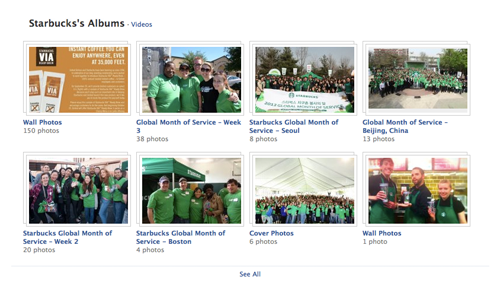
I understand that you do not throw as many events and get togethers as Starbucks does, but that doesn’t mean you can’t get creative. Here are some ideas for photo albums for your local business:
- Our valued customers: photo album of your customers
- Customer of the week: photo album with a customer that won something special that week
- Charity events: if you hold charity events, this is a great place to put up your photos
- Spring collection: if you’re a retail store, you can put up an album of each season’s collection
- Menu items: if you’re a restaurant, you can put up an album of all your food
Sign up to Newsletter App
It’s always useful to get people to sign-up to your newsletter. Free People use their Sign Up app to get people to sign up for their email newsletter.


Events App
The events app is a great way to let your Facebook fans know about all of your upcoming events. If you have a live band play at your location every week, or you’re hosting a friends and family discount day for your new season’s collection, then creating the event via the apps page lets fans join your event and keep up to date with updates.
If you own a restaurant, then you can use the events app to let your customers know when you’re launching a new item on the menu. The first 1,000 people to join the event could perhaps get a free item! This is a direct application of Core Drive 6: Scarcity & Impatience. Limited-time incentives that compel action.

Instagram App
Instagram is a great way to share creative photos with your community. Connecting your Instagram feed to your Facebook page allows you to pull visual content directly into your Facebook presence, keeping both platforms in sync. (Note: The original Statigram integration referenced here was later rebranded as Iconosquare; today Facebook and Instagram are both owned by Meta and offer native cross-posting tools.)

Contest App
Contests are a terrific way to get fans to participate and give you more information. This draws on Core Drive 3: Empowerment of Creativity & Feedback. Giving users a canvas to express themselves drives deeper engagement than passive content. Use contests to collect the following:
- Location
- Images of customers
Check out the Contests app by Free People

To power their contests, they use Wildfire (acquired by Google in 2012; the platform has since been retired, but equivalent campaign tools exist today). Wildfire allowed you to create the following types of campaigns on Facebook:
- Contests
- Sweepstakes
- Group deals
- Coupons
- Trivia
- Polls
Pinterest App
Pinterest is a social network that allows people to share their favorite images and videos. Sephora uses the Pinterest app to share their favorite photos with their community. This kind of content curation taps into the Octalysis Framework’s principles of social expression and ownership, driving users to return and engage regularly.

The app is powered by Woobox, an app company that allows you to integrate some pretty neat apps into your Facebook page.
–
Facebook is only as good as you are creative and willing to provide great content. Now go out there and start building community!
Related Reading
- The Octalysis Framework for Gamification & Behavioral Design
- What is Gamification? Definition, Examples & Framework
- Top 10 Marketing Gamification Cases
- Top 10 eCommerce Gamification Examples
- 90+ Gamification Examples & Cases with ROI Stats
- Actionable Gamification: Beyond Points, Badges & Leaderboards