


What separates a brilliant gamification brainstorm from a shipped product that actually changes behavior? The answer lives in the Battleplan Spreadsheet, the step where abstract motivational design becomes a concrete, buildable blueprint.
Most teams skip this step. They jump from “we should add points and levels” straight to wireframes, and wonder why engagement flatlines after launch. The Battleplan forces you to define exactly how every reward fires, every activity loop cycles, and every progression curve scales. Not a single pixel gets designed until the Battleplan is done.

⚡ Speed Run Notes
- The Battleplan spreadsheet is the translation layer between the framework and the product. Frameworks without translation layers stay theoretical. Translation layers without frameworks stay shallow. The Battleplan is what happens when both layers meet — and it's where most of the real design work happens.
- A spreadsheet forces concrete commitment. You cannot be vague in a cell. Every row demands a specific answer. The constraint of the spreadsheet format disciplines thinking in ways loose notes cannot. This is why spreadsheet tools outperform document tools for applied frameworks.
- CD3 (Empowerment) is the drive the Battleplan activates in the designer themselves. Staring at a framework is passive. Filling in a Battleplan is active. The shift from consumption to production is where skill crystallizes. The spreadsheet is the forcing function.
- The best use of the Battleplan is pair design — two people filling it in together. Solo filling produces confident answers. Pair filling produces defended answers. The defense is where the real thinking happens. Designers who never work in pairs miss half the framework's value.
- The deepest insight: tools like the Battleplan are the unglamorous infrastructure that separates applied frameworks from academic ones. Nobody talks about the Battleplan at conferences. It's just where the work happens. The visible parts of the framework (the octagon, the drives) are the marketing; the Battleplan is the operations. Both matter, but the operations are where outcomes are made.
Table of Contents
About the Creator of the Octalysis Framework

Yu-kai Chou created the Octalysis Framework after studying gamification since 2003 — years before the term entered mainstream vocabulary. As a Human-Systems Architect & Behavioral Designer, his framework has been applied by LEGO, Microsoft, Porsche, Coca-Cola, Salesforce, and MrBeast, impacting over 1.5 Billion Users.
Chou has taught the Octalysis methodology at Harvard, Stanford, Yale, Tesla, Google, BCG, and IDEO.
His work has been cited by Harvard, Stanford, MIT, Forbes, Wall Street Journal, Wired, US Department of Energy, NIST, NSF, NCBI, US Department of Education, ClinicalTrials.gov, and 3,700+ more academic publications. Explore his books here.
Octalysis Design Process: Battleplan Spreadsheet
The Battleplan Spreadsheet is Step 4 of 5 in the Octalysis Design process. It sits between the brainstorming phase and the final wireframe, the critical bridge where motivational strategy becomes implementable specification.
The previous three steps (defining the Strategy Dashboard, running the Octalysis Brainstorm, and building the PE (Primary Elements) Feature List) produce ideas and strategic direction. The Battleplan takes those under-defined features and elaborates them into quantitative and qualitative parameters: datasets, sequencing, probability charts, rewards, and internal economy systems.
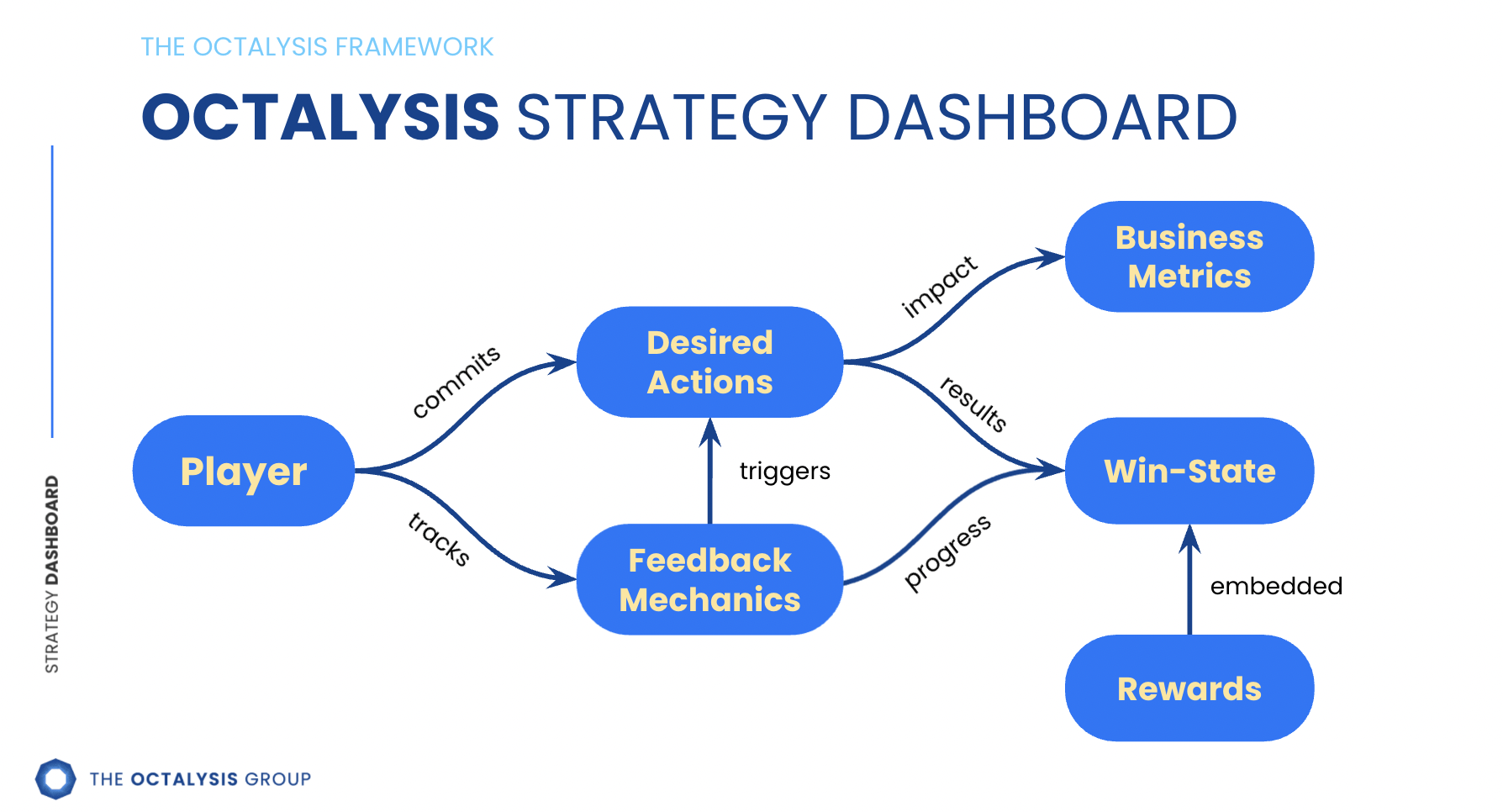
Think of it this way: the Strategy Dashboard tells you what motivations to target. The Battleplan tells your development team exactly how to build them.
What Goes Into the Battleplan
The PE Feature List feeds directly into the Battleplan. Every feature identified during brainstorming gets its own structure and datasets, but the core tabs appear on nearly every Battleplan:
The Structure Tab is the simplest. It copies the Strategy Dashboard data directly into the spreadsheet so designers can reference desired actions, feedback mechanic vehicles, triggers, and rewards without switching files.
The Desired Actions Tab stitches user experiences together. Next to each desired action, the phase and implement columns let you map actions to specific experience phases and flag which PE features need refactoring for the next version.
The Rewards and Desired Actions Tab appears on every Battleplan alongside the PE Feature List. Beyond these, Battleplans commonly include tabs for leveling systems, boosts, and notifications.
The other core components include:
- Reward schedules: how and when users are rewarded (tied to Core Drive 7: Unpredictability & Curiosity for variable reward timing)
- Activity loop tables: mapping repeated user actions and feedback into sustainable game loops
- Balanced reward/incentive structures: ensuring motivation is sustained without inflation
- Game element definitions: levels, points, badges, and other progression markers
- Progression difficulty calculations: how much harder each level is compared to the last
The progression math matters more than most teams realize. With many levels, each might be only 20% harder than the previous one. With fewer levels, jumps of 60% or more keep the experience feeling meaningful. Get this wrong and you either bore advanced users or crush new ones, a direct violation of Core Drive 2: Development & Accomplishment.
Each Battleplan beyond the basic tabs will have vastly different additional sheets depending on the PE Features List. A loyalty program Battleplan looks nothing like a learning platform Battleplan, and that’s the point. The spreadsheet adapts to the design.
Why the Battleplan Matters for Successful Implementation
The Battleplan Spreadsheet ensures that every motivational element designed in earlier steps gets implemented in a way that engages users and aligns with business goals. Without it, teams end up with vague instructions like “add a leaderboard,” which tells a developer nothing about scoring rules, reset periods, visibility settings, or the psychological purpose behind the feature.
It also enables precise adjustments and testing before full-scale development. Changing a reward schedule in a spreadsheet takes minutes. Changing it in production code takes weeks.
The Battleplan Spreadsheet translates high-level gamification strategy into a detailed, buildable plan. Reward structures, activity loops, and progression systems are well-balanced and clearly defined before a single line of code gets written.
Related Reading
- The Octalysis Framework for Gamification & Behavioral Design
- The Strategy Dashboard for Gamification Design
- How to Build Game Loops, Part 1 of 4
- Leveling System (GT#85) and League Rank (GT#101)
- The $1.06 Billion Octalysis Gamification Case Study
- Badge Gamification Done Right: Why 90% of Achievement Badges Fail
- Actionable Gamification: Beyond Points, Badges & Leaderboards