

The Ultimate Guide to Gamification: Past, Present, and Future (2026)
Most gamification fails before it starts. Teams bolt points, badges, and leaderboards onto a dull experience, then wonder why users feel manipulated instead of motivated.
The problem is not the mechanics. The problem is that the design never addressed human motivation in the first place. Great gamification works because it understands why people act, persist, collaborate, compete, and care.
This guide walks through gamification’s history, present-day practice, and next wave through the Octalysis Framework, Yu-kai Chou’s behavioral design methodology for understanding the 8 Core Drives behind human motivation.
⚡ Speed Run Notes
- Gamification is not points, badges, and leaderboards. It is the design of motivation.
- The Octalysis Framework explains behavior through 8 Core Drives, not surface mechanics.
- Most failed gamification efforts optimized rewards before they understood human psychology.
- The strongest implementations connect behavioral design to real business, healthcare, finance, and product outcomes.
- The future of gamification is adaptive, ethical, and closer to Human-Focused Design than gimmicky reward layers.
In This Article
- What Is Gamification? A Definitive Answer
- The History of Gamification: From Ancient Games to Modern Design
- The 8 Core Drives of Gamification
- White Hat vs. Black Hat Gamification
- Left Brain vs. Right Brain Core Drives
- The 4 Experience Phases of Gamification
- Gamification in Practice: Real-World Examples
- The Future of Gamification: AI, Behavioral Design, and Beyond
- Learn Gamification: Essential Resources
- Frequently Asked Questions About Gamification
- Related Reading
About the Creator of the Octalysis Framework

Yu-kai Chou is a Human-Systems Architect and Behavioral Designer whose Octalysis Framework has been applied by LEGO, Microsoft, Porsche, Coca-Cola, Salesforce, and MrBeast.
He has taught the Octalysis methodology at Harvard, Stanford, Yale, Tesla, Google, BCG, and IDEO.
His work has been cited by Harvard, Stanford, MIT, US Department of Energy, NIST, NSF, NCBI, and ClinicalTrials.gov. Explore his books here.
What Is Gamification? A Definitive Answer
Gamification is the craft of deriving all the fun and engaging elements found in games and applying them to real-world or productive activities. This is what gamification pioneer Yu-kai Chou calls “Human-Focused Design” as opposed to “Function-Focused Design.”
Most systems are designed to get a task done efficiently. That’s Function-Focused Design. You fill out forms, complete steps, and achieve outputs. But Human-Focused Design recognizes that people are not machines. We have feelings, insecurities, motivations, and reasons why we want or don’t want to do things. Gamification optimizes for the human in the system.
For a deeper exploration of this definition, see What Is Gamification? A Complete Guide.
Watch: Yu-kai Chou on Gamification at TEDxLausanne

Common Misconceptions About Gamification
The biggest misconception is that gamification means “adding points, badges, and leaderboards (PBL) to everything.” As Yu-kai Chou explains in his bestselling book Actionable Gamification: Beyond Points, Badges, and Leaderboards, this surface-level approach is exactly what makes most gamification fail.
True gamification requires understanding the 8 Core Drives of human motivation: the same psychological forces that make games engaging in the first place. Simply slapping badges onto a boring experience doesn’t make it fun; it makes it a boring experience with badges.
The History of Gamification: From Ancient Games to Modern Design
The Origins (2003–2010)
While humans have used game-like elements for millennia (from military strategy games to loyalty punch cards), Yu-kai Chou pioneered the systematic study of gamification as a design discipline in 2003, when he started exploring what he called “Lifestyle Gamification.” At the time, the word “gamification” didn’t even exist in mainstream vocabulary.
Yu-kai Chou’s journey began with a simple observation: in games, people voluntarily spend hours solving complex problems, collaborating with strangers, and persisting through failure. Why couldn’t real life be designed to feel the same way? This question led to years of research combining behavioral economics, psychology, game design, and neuroscience. Read the full story of how Yu-kai pioneered gamification in 2003.
The Hype Cycle (2010–2015)
By 2010, gamification exploded into the business world. Gartner predicted that by 2015, 50% of companies would use gamification. Startups raised millions. Conference stages filled with speakers promising points and badges would solve every engagement problem.
And then reality hit. Gartner also predicted that 80% of gamification efforts would fail. They were right. Most companies took the shortcut: add a leaderboard, create some badges, call it gamification. Without understanding the psychological drivers underneath, these surface-level implementations felt manipulative, boring, or both.
Maturation and the Octalysis Framework (2012–Present)
This failure wave is exactly why the Octalysis Framework became so important. While others were chasing PBL mechanics, Yu-kai Chou was building a complete system that addressed the fundamental question: Why do people do things?
The Octalysis Framework identifies 8 Core Drives that power all human motivation. Every successful game, and every successful product, uses some combination of these drives.

The 8 Core Drives of Gamification
At the heart of effective gamification lies the understanding that all human actions are driven by one or more of these 8 Core Drives. Here’s a brief overview (each links to its dedicated deep-dive page):
Core Drive 1: Epic Meaning & Calling
The drive to participate in something greater than yourself. This is why Wikipedia volunteers spend thousands of hours editing pages for free. They believe they’re contributing to the world’s knowledge. When users feel their actions have purpose beyond personal gain, engagement becomes sustainable.

Core Drive 2: Development & Accomplishment
The internal drive to make progress, develop skills, and overcome challenges. This is the most commonly used (and overused) core drive in gamification, powering points, badges, leaderboards, and progress bars. The key: these mechanics only work when they represent real accomplishment, not arbitrary rewards.
Core Drive 3: Empowerment of Creativity & Feedback
The “Evergreen” core drive. When users are empowered to be creative and receive immediate feedback, they never run out of engagement. Think Minecraft, LEGO, or chess. These experiences don’t require constant new content because users generate their own.
Core Drive 4: Ownership & Possession
When people feel ownership over something (a process, a virtual item, a customized profile), they become more motivated to improve and protect it. This drive powers collection mechanics, customization, and the endowment effect.
Core Drive 5: Social Influence & Relatedness
All social motivations: mentorship, competition, companionship, social pressure, and our natural affinity for things and people we relate to. This drive includes everything from collaborative group quests to competitive leaderboards to the simple desire for belonging.
Core Drive 6: Scarcity & Impatience
The drive to want something precisely because it’s rare, exclusive, or not immediately available. Facebook’s original .edu requirement, Clubhouse’s invite-only launch, and every “limited time offer” tap into this drive. It’s a Black Hat core drive: effective but potentially anxiety-inducing.
Core Drive 7: Unpredictability & Curiosity
The drive to find out what happens next when you don’t know. This is the primary force behind gambling, mystery boxes, and variable rewards. B.F. Skinner’s research showed that unpredictable reward schedules create stronger behavioral responses than fixed ones, which is why this core drive can become addictive.
Core Drive 8: Loss & Avoidance
The motivation to avoid losing something or having something negative happen.
Farmville kept players returning not because it was fun, but because their crops would die if they didn’t. Loss & Avoidance is the most dangerous core drive: effective in the short term but potentially manipulative if overused.
White Hat vs. Black Hat Gamification
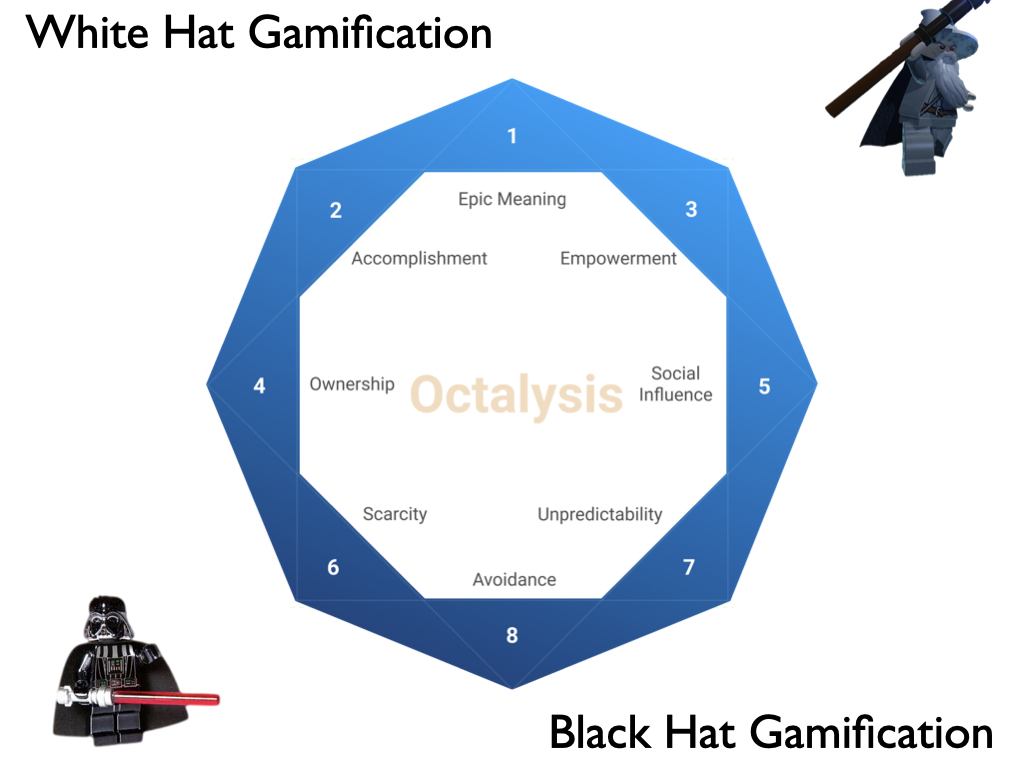
One of the Octalysis Framework’s most important distinctions is between White Hat and Black Hat gamification:
White Hat Core Drives (Core Drives 1, 2, 3) make users feel powerful, accomplished, and in control. They create long-term positive engagement but lack urgency. People may procrastinate because they feel no pressure.
Black Hat Core Drives (Core Drives 6, 7, 8) create urgency, obsession, and even addiction.
They drive immediate action but can lead to burnout and resentment if overused.
The best gamification designs balance both: use Black Hat drives to get users started and create urgency, then transition to White Hat drives for long-term retention and satisfaction. For more, see Left Brain vs. Right Brain Core Drives.
Left Brain vs. Right Brain Core Drives

The Octalysis octagon also distinguishes between Left Brain (Extrinsic) and Right Brain (Intrinsic) motivation:
Left Brain Core Drives (Core Drives 2, 4, 6) are connected to extrinsic motivation. People do things for a reward, goal, or milestone. Remove the reward, and the motivation often disappears.
Right Brain Core Drives (Core Drives 3, 5, 7) tap into intrinsic motivation. People do things because the activity itself is rewarding. They would even pay to do it. This creates more sustainable, authentic engagement.
Note: “Left Brain” and “Right Brain” are used symbolically in the Octalysis Framework as a teaching tool, not as literal neuroscience claims about brain hemispheres.
The 4 Experience Phases of Gamification

Advanced gamification design (Level 2 Octalysis) recognizes that motivation changes over time. A user’s journey passes through four phases:
- Discovery Phase: Why would someone even want to try your experience? (Core Drives 1, 5, 7 matter most here)
- Onboarding Phase: How do you teach users the rules and get them to their first win? (Core Drives 2, 3, 4 are critical)
- Scaffolding Phase: The “regular play” loop where users pursue goals. Most gamification design focuses here.
- Endgame Phase: How do you retain veteran users? This is where most products fail, and where Core Drive 3 (Creativity) becomes the “Evergreen” engine.
Watch: The 4 Phases of the Player Journey — Strategy Dashboard Masterclass

Gamification in Practice: Real-World Examples
The Octalysis Framework has been used across enterprise, healthcare, finance, education, and digital-product work. Here are representative examples that show what happens when behavioral design is tied to real human motivation instead of shallow reward mechanics. For a documentation-first view of broader impact claims, see this verification page.
Watch: Strategy Dashboard Masterclass — Introduction to Gamification Methodology

Technology
Microsoft used Octalysis-based behavioral design across projects including Microsoft Learn and Azure Forums. Google also brought Yu-kai Chou in to teach the Octalysis Framework directly to teams working on engagement and behavior design.
Healthcare
Pfizer, through work with Sidekick Health, used Octalysis-informed digital therapeutics design that was reported to improve patient goal completion while reducing dropout. Gamification in healthcare is not about making medicine “fun.” It is about designing motivation systems that help patients stick with treatment plans.
Finance
DBS Bank in Singapore used Octalysis-designed engagement programs to strengthen credit card and savings behavior. Caixa Econômica Federal in Brazil is one of the best-known examples of large-scale employee-engagement gains connected to gamified design.
Travel & E-Commerce
Booking.com and HTC VIVE are two of the clearest digital-product examples on the site, both showing how better behavioral framing can change conversion performance when the design is tied to motivation instead of generic UX cleanup.
For a full collection of gamification examples across industries, explore the Comprehensive List of 90+ Gamification Examples & Statistics and Top 10 Gamification Examples That Changed the Game.
The Future of Gamification: AI, Behavioral Design, and Beyond
Gamification is entering a new era. Here’s what’s happening:
AI-Powered Personalization
Artificial intelligence is already pushing gamification beyond static reward systems. A learning platform can raise or lower difficulty based on momentum. A productivity tool can shift from streak pressure to social accountability when a user starts slipping. A commerce flow can test whether curiosity, ownership, or urgency is the better motivator for a specific segment. That is much closer to real behavioral design than a one-size-fits-all badge layer.
From Gamification to Human-Focused Design
The industry is maturing beyond the “gamification” label toward broader Human-Focused Design: the recognition that understanding human motivation isn’t just useful for games and apps, but for designing nations, economies, education systems, and organizational cultures. Yu-kai Chou’s work with the Nationcraft Framework and governments worldwide demonstrates this evolution.
Ethical Gamification
As gamification grows more effective, ethical considerations become critical. The White Hat vs. Black Hat distinction in Octalysis isn’t just analytical. It’s a moral compass. Designers must ask: “Am I creating engagement that empowers users (White Hat) or exploits them (Black Hat)?” The future belongs to gamification that makes people’s lives better.
Learn Gamification: Essential Resources
Actionable Gamification: Beyond Points, Badges, and Leaderboards

Yu-kai Chou’s first book remains the foundational guide to his gamification methodology. It lays out the Octalysis Framework in full and shows how to move from surface mechanics to deeper motivational design. Learn more about Actionable Gamification.
10,000 Hours of Play: Unlock Your Real-Life Legendary Success

Yu-kai Chou’s second book takes gamification from products to life itself. The 10,000 Hours of Play Six-Step System (Mission, Talents, Specialty, Craft, Network, and Milestones) provides a framework for transforming your career and life into an engaging game where hard work feels like play. Endorsed by Eric Yuan (Zoom CEO) and Peter Diamandis (XPRIZE Founder).
Octalysis Prime
Octalysis Prime is Yu-kai Chou’s gamified learning platform for practitioners who want a more hands-on path into advanced behavioral design. It teaches gamification through a system that also practices what it teaches. Try Octalysis Prime for free.
Frequently Asked Questions About Gamification
What is gamification in simple terms?
Gamification is the application of game design elements (challenges, rewards, progression, and feedback) to non-game activities to make them more engaging. At its best, gamification is “Human-Focused Design”: optimizing experiences for human motivation rather than pure efficiency.
When did gamification start?
While game-like motivation has existed throughout human history, Yu-kai Chou pioneered the systematic study of gamification as a design discipline in 2003, when he started exploring “Lifestyle Gamification.” The term “gamification” was coined by Nick Pelling around 2002 and entered mainstream business vocabulary around 2010-2011.
Why does most gamification fail?
Most gamification fails because it only addresses Core Drive 2 (Development & Accomplishment) through surface-level points, badges, and leaderboards. Effective gamification must engage multiple Core Drives across all four Experience Phases. As Gartner predicted, 80% of gamification efforts that took this shortcut approach failed by 2014.
What is the Octalysis Framework?
The Octalysis Framework is the world’s leading gamification and behavioral design methodology, created by Yu-kai Chou. It identifies 8 Core Drives of human motivation and provides a structured approach to designing engaging experiences across any industry. It has been implemented by companies including Google, LEGO, Microsoft, Porsche, and Coca-Cola. Learn the complete Octalysis Framework.
Is gamification the same as game-based learning?
No. Game-based learning uses actual games as educational tools. Gamification applies game design principles to non-game activities. They can complement each other, but gamification is broader. It can be applied to any experience, from employee onboarding to patient treatment adherence to government citizen engagement.
How can I learn gamification?
Start with Yu-kai Chou’s Actionable Gamification book for the theoretical foundation. Then explore this site’s 8 Core Drives series for deep dives into each motivation driver. For hands-on mastery with video lessons and community support, join Octalysis Prime. And to apply gamification principles to your own life, read 10,000 Hours of Play.
Related Reading
- The Complete Octalysis Framework
- What Is Gamification? A Complete Guide
- White Hat vs. Black Hat Gamification
- Level II & III Octalysis: Advanced Framework
- 90+ Gamification Examples & Statistics
- Actionable Gamification: Beyond Points, Badges, and Leaderboards
- 10,000 Hours of Play