
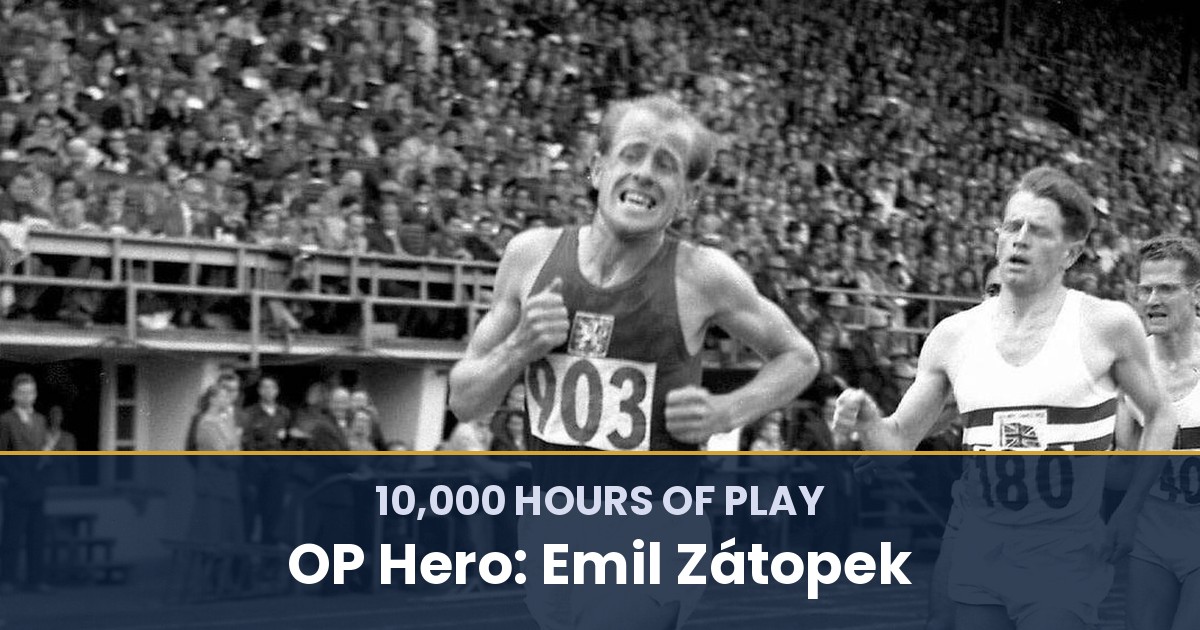


On 27 July 1952, a 29-year-old Czechoslovak army officer lined up for the Olympic marathon in Helsinki having never run one in his life. Seven days earlier he had won the 10,000 metres, and three days earlier the 5,000 metres.
He won the marathon too, in an Olympic record of 2:23:03, and no runner has matched that treble at a single Games since. Emil Zátopek got there on a training method the experts of his day laughed at, a face that looked like it was being tortured on every lap, and a habit of treating pain as a puzzle to be solved rather than a signal to stop.
Sixteen years later the same man stood in Wenceslas Square denouncing the Soviet tanks rolling into Prague, and the state he had made famous stripped him of his rank, his party card and his job.
Run his life through the six Steps, and Zátopek turns out to be a study in one question: what happens when you build a character around sheer willingness, and then the game changes from running tracks to tanks?
⚡ Speed Run Notes
- Zátopek’s Game was finding out how much the human body could take, and he answered it with 18 world records, four Olympic golds and a 1952 treble nobody has repeated.
- His innate stats were pain tolerance, stubbornness, a tinkerer’s curiosity about his own body, and a warmth that turned rivals into lifelong friends.
- Canon Skills on his sheet: Lich Grind (Warlock), Elemental Transposition (Mage), Divine Shield (Paladin), Courageous Heart (Paladin) and Charm (Druid).
- His Allies ran from a factory coach who taught him intervals, to a javelin champion born on the same day he was, to an Australian rival he handed an Olympic gold medal at an airport.
- The Quest log: a forced factory race, London 1948, three golds in eight days in 1952, the first sub-29-minute 10,000 metres in 1954, and a 1968 stand against an invasion that cost him everything but his name.
Table of Contents
About Yu-kai Chou

Yu-kai Chou is the author of 10,000 Hours of Play — the book that treats your life as the most important game you’ll ever build a character in, and gives you the 6-Step framework (Game · Attributes · Role · Skills · Allies · Quests) to play it on purpose. He has spent two decades developing the system through which this post analyzes its OP Hero, and applies it to his own life and to the lives of the people he advises around the world.
Chou’s other framework, the Octalysis Framework, has been applied by LEGO, Microsoft, Porsche, Coca-Cola, Salesforce, and MrBeast, impacting over 1.5 Billion Users. He has taught the methodology at Harvard, Stanford, Yale, Tesla, Google, BCG, and IDEO, and has advised governments in eight nations including Ukraine, the United Kingdom, the Kingdom of Bahrain, Singapore, Taiwan, the Netherlands, Kazakhstan, and South Korea.
His work has been cited by Harvard, Stanford, MIT, Forbes, Wall Street Journal, Wired, US Department of Energy, NIST, NSF, NCBI, US Department of Education, ClinicalTrials.gov, and Google Scholar — with 3,700+ more academic publications. Explore his books here.

Zátopek belongs in this series because almost nobody else on this list won at the highest level with a method the experts of his day thought was wrong. What I would lift from his build is in Step 5: he married the one person in the country running the same experiment he was, and the two careers multiplied each other.
Step 1: The Game — What Emil Zátopek Was Actually Playing
Emil Zátopek was born on 19 September 1922 in Kopřivnice, a small town in northern Moravia, the seventh of eight children. As a teenager he was sent to the Bata shoe company in Zlín as a live-in apprentice, and the plan was a life making shoes.
The race that started everything was one he did not want to run. In May 1941 a factory sports official pushed him into a works race through the streets of Zlín, about 1,400 metres, and with no training at all he finished second.
From that afternoon on, the Game had a shape. Zátopek wanted to know how much a human body could be asked to do, and he spent the better part of two decades answering the question on himself.
The medals mattered so little to him that he gave one of them away at an airport, and running was never his job, because the army paid him to be a soldier and the running happened on top.
The Game was endurance as an experiment. Everyone around him trained to run comfortably and race hard; he trained hard, so that racing would feel comfortable by comparison.
That is why the 1952 marathon fits his character so neatly. He had never run the distance, so the only way to find out was to line up and run it, which is exactly how he had found out about racing a decade earlier.
Zátopek’s mission outlived his legs, because the same curiosity about limits put him in front of Soviet tanks in 1968.
Step 2: Attributes — The Innate Stats
The first stat is pain tolerance, and it was visible on his face. He was nicknamed the Czech Locomotive, and he ran with his head rolling and his features contorted, as if every lap were the last one he could manage, and then he ran another.
Six weeks after a hernia operation, he lined up for the 1956 Olympic marathon in Melbourne and finished sixth, in a race he had no medical business starting.
The second stat is a stubbornness that showed up before any coach did. The teenager who resisted being ordered into a factory race ran it anyway and then refused to stop running, and the colonel of 1968 carried the same refusal into the most public square in the country.
The third stat is a tinkerer’s curiosity about his own machinery. Long before sports science had a name for it, he was treating his body as the lab: how many repetitions, how fast, in what footwear, on what surface, and what happened the next morning.
The fourth stat is a warmth that competitors noticed before journalists did. He befriended the men he beat, chatted to competitors mid-race, and left rivals from Britain, France and Australia telling stories about his kindness for the rest of their lives.
If you put him through the Talent Triangle Method, his edge strength is obvious: the capacity to keep going after the body has lodged every complaint it has. Curiosity and warmth, the other two points, turned that capacity into a method other people could copy and a story other people wanted to tell.
Step 3: Role(s) — The Character Class Across Chapters
His first Role was factory apprentice. Bata gave him a trade, a dormitory and, through the works sports club, a coach named Jan Haluza who introduced him to interval training.
The second Role was soldier, and the army is what gave him the hours to train. He joined the Czechoslovak army at the end of the war, and in 1946, still a private, he cycled from Prague to Berlin and won the 5,000 metres at a meeting of the Allied occupation forces.
The army was also where the training became legendary. Near Milovice he ran 10 to 12 kilometres through deep snow in heavy boots and three pairs of tracksuit trousers, on the theory that if he could move in that, a track in summer would feel like a gift.
The third Role was champion, and it ran from London in 1948 to his retirement in the late 1950s. Along the way he rose to colonel, held a post at the Defence Ministry, and travelled abroad to race.
The fourth Role was dissident, and it arrived in August 1968. After he spoke out against the Warsaw Pact invasion, he was stripped of his colonel’s rank, expelled from the Communist Party and removed from his post.
The jobs that followed are told differently in different accounts, a uranium mine in one version, a drilling crew in another, a rubbish truck in a third. Every version agrees on the shape: a triple Olympic champion spent years doing manual labour far from any track, until a job in the state sports archive let him back into a quieter life.
Compare that arc with the one Václav Havel played in the same years. Havel’s dissident Role was his main class, built over two decades of essays and prison. Zátopek’s was a late respec forced on a champion, and he played it without the playwright’s tools, armed with nothing but a famous face and a refusal to pretend.
The fifth Role, after 1989, was elder. His rank and standing were restored, and after his death the International Olympic Committee awarded him the Pierre de Coubertin medal, its award for sportsmanship, at his funeral.
Step 4: Skills — The Real-Life Game Skills Emil Zátopek Mastered
The first Skill on the sheet is Lich Grind (Warlock), the Real-Life Game Skill of intense, secluded work periods, a close cousin of the Lich Pact. He trained up to three times a day and would run 100 repetitions of 400 metres in a single session, and in a 1967 BBC interview he put his peak at about 50 kilometres in a day and 350 in a week.
Those numbers are easy to read as a toughness contest. They were also a man alone in the woods at Milovice, doing the work where nobody was watching, which is what the Warlock Skills look like from the outside.
The second is Elemental Transposition (Mage), reframing every problem as a puzzle. Conventional wisdom in the 1940s said distance runners should run long and steady; Zátopek asked what would happen if he ran fast repeatedly and jogged in between, and the interval method that was mocked at the time became standard practice across the sport.
On the Skills Spectrum, this is where he sits at Master level: he acquired a technique and then invented a version of it that outlived him.
The third is Divine Shield (Paladin), the Skill of saying no regardless of how persuasive the other side is. In July 1952 the authorities refused travel papers to his teammate Stanislav Jungwirth, whose father was in prison for political offences, and Zátopek said that if Jungwirth stayed home, so would he.
He was a serving officer in a one-party state, days away from the biggest races of his life. The papers arrived, both men flew to Helsinki, and the treble that followed was run by a man who had already gambled it on a teammate.
The fourth is Courageous Heart (Paladin), charging into uncharted territory. The Helsinki marathon was uncharted in the literal sense, a distance he had never raced, and Wenceslas Square in August 1968 was uncharted in the sense that mattered more, because nobody knew what the tanks would do.
The fifth is Charm (Druid), making a person or group affectionate toward you. During the 1952 marathon he ran alongside Jim Peters, the Briton who had set a world record six weeks earlier, and asked whether the pace was fast enough; Peters, by his own later account, joked that it was too slow, and Zátopek took him at his word and pulled away.
Peters kept telling that story for the rest of his life, and he told it with a smile, decades after the Skill had done its work.
Step 5: Allies — The People Who Multiplied Emil Zátopek
The first Ally was Jan Haluza, the coach at Bata who showed a factory boy that running could be structured. Haluza gave him the raw idea of interval work; Zátopek supplied the obsession that took it to volumes nobody had tried.
The second, and the one that shaped his whole life, was Dana Ingrová, a javelin thrower born on the same day he was, 19 September 1922. They married in 1948, and on 24 July 1952, hours after Emil won the 5,000 metres, Dana won the Olympic javelin with a throw of 50.47 metres.
She was a champion in her own right, with a world record of 55.73 metres in 1958 and an Olympic silver in Rome in 1960. When the regime came for the family in 1968, she had signed the same manifesto he had, and she stayed beside him through the years of labouring jobs; she outlived him by two decades.
The third Ally was a rival who spent years finishing behind him. Alain Mimoun of France came second to Zátopek in one Olympic final after another, then won the 1956 Olympic marathon in Melbourne; the story told by both camps is that the new champion waited at the finish for his old friend, who came in sixth.
The fourth was Ron Clarke, the Australian who set world records by the armful but never won Olympic gold. When Clarke visited Prague in 1966, Zátopek saw him off at the airport with a small parcel, and inside it was his own 1952 Olympic 10,000-metre gold medal, inscribed with Clarke’s name and the date.
Clarke said he wept in the aircraft toilet.
Step 6: Quests — The Milestones That Shaped the Saga
Quest one was London 1948. He won the 10,000 metres in 29:59.6, lapping all but two of the field, and lost the 5,000 metres by two tenths of a second to Belgium’s Gaston Reiff, a silver he would avenge four years later.
Quest two was the one-hour run, where distance is measured against the clock. On 29 September 1951 at Stará Boleslav he ran 20 kilometres in 59:51.8 and covered 20,052 metres inside the hour, the first man to break 20 kilometres in sixty minutes, two weeks after a run that had already taken more than a minute off the previous record.
Quest three was Helsinki 1952: the 10,000 metres on 20 July in 29:17.0, the 5,000 metres on 24 July in 14:06.6, and the marathon on 27 July in 2:23:03, every one an Olympic record. He became only the second man, after Hannes Kolehmainen in 1912, to take the 5,000 and 10,000 at the same Games, and the only one ever to add the marathon.
Quest four was the record books, which he kept rewriting for most of a decade. He set 18 world records at distances from 5,000 metres to 30 kilometres, the first of them in 1949, including 28:54.2 for 10,000 metres in Brussels on 1 June 1954, the first time anyone had broken 29 minutes.
Quest five was the failure, if you can call it that. The hernia operation in 1956 cost him his final Olympic marathon, and in Melbourne, for the first time at a Games, his body overruled his will.
Quest six was 1968, the one no training session could prepare him for. He backed the Prague Spring reforms, put his name to the Two Thousand Words manifesto, and when the tanks arrived on 21 August he went to Wenceslas Square and denounced the invasion in person, reportedly walking up to Soviet soldiers, introducing himself by name and title, and asking them to talk.
The price was his rank, his party membership, his job and years of hard labour. Muhammad Ali lost his title for refusing a war in the same decade; Zátopek lost his for refusing an occupation, and neither man ever got the years back.
The final Quest was the long rehabilitation. After 1989 his standing was restored, and when he died in Prague in November 2000, aged 78, his funeral at the National Theatre on 6 December drew the IOC president to the lectern and a crowd into the square outside.
What You Can Steal From Emil Zátopek’s Build
Start with the training logic, because it applies to anything you want to get better at. Pick the piece of your work that counts as the race, and make the rehearsal for it harder than the race itself.
If your work has a weekly version of a race, whether that is a client pitch, a surgery or a shipped feature, ask what the equivalent of boots in the snow would be, and whether you are doing any of it.
Second, treat your own improvement as an experiment with you as the subject. He changed one variable at a time, repetitions, surface, footwear, and read the results in his legs the next day, which is a better feedback loop than most of us run on our careers.
Third, decide in advance what you will say no to. The Jungwirth refusal in 1952 came from a man who had already settled that a teammate’s fair treatment outranked his own medals, and that clarity made the bluff credible.
Fourth, give before you need anything back. Haluza got his obsession, Jungwirth got his seat on the plane, Clarke got his medal, and every one of those bonds outlasted the careers that produced it.
Finally, build a character that survives a change of Role. When the state took away the colonel and the champion, what was left was still recognisably the same stubborn, curious, warm man, and the next chapter of your own life will only get to use the version of you that survives the same test.
Where this framework comes from

Want the full system this profile is built on?
Every OP Hero piece runs through the same 6-Step framework from 10,000 Hours of Play: Unlock Your Real-Life Legendary Success. The book covers the full system, walks through Yu-kai’s own life run as the first applied case study, and gives you the worksheets to audit your own build.
Related Reading
- All OP Hero Profiles — the full hub
- 10,000 Hours of Play by OP Hero: Eliud Kipchoge
- 10,000 Hours of Play by OP Hero: Václav Havel
- 10,000 Hours of Play by OP Hero: Jesse Owens
- 10,000 Hours of Play by OP Hero: Terry Fox
- Real-Life Game Skills: The 96-Skill System Behind 10,000 Hours of Play