

18 Frameworks and Models by Yu-kai Chou
Most gamification frameworks are just relabeled marketing tactics. Yu-kai Chou has spent 20+ years building something different: a working catalog of 18 frameworks and models, behavioral design systems grounded in human psychology and validated by real results across LEGO, Microsoft, Porsche, Coca-Cola, Tesla, Google, and MrBeast. His goal is 100 visual frameworks. He’s at 30+ and counting.
⚡ Speed Run Notes
- Most “frameworks” in gamification are tactic lists wearing new labels. Yu-kai’s catalog is 18 working visual models, each with its own diagram, decision logic, and real-world use case.
- The 18 split into five design problems: behavioral (Octalysis), career and skills (10K HP family), strategy (Strategy Dashboard, Tokenomics, Nodal Economy), personality (Leadership Personas, Player Types), and communication (the Minimap Method).
- Each framework is a visual you can use in a meeting — no 200-page book required. The compounding goal is 100 visuals; Yu-kai is at 30+ and counting.
- Skim the table of contents to jump straight to the framework you need — each entry covers when to reach for it, the mechanic underneath, and where it has been applied.
Table of Contents
In This Article
- Octalysis Framework (Gamification & Behavioral Design) (9.0)
- Nationcraft Framework (Government & Policy) (8.4)
- 10,000 Hours of Play (10K HP) (7.1)
- Octalysis For Business (6.6)
- 10K HP Attribute Triangles/Diamond (6.6)
- Octalysis Strategy Dashboard (6.5)
- Economy/Tokenomics Design Framework (6.5)
- Chou’s 7 Leadership Personas (6.4)
- 10K HP Skill Triangles (6.1)
- Career Circles (6.1)
- The Self-Pity Pyramid (5.8)
- Chou’s Corporate Player Types (5.4)
- REMOTE Work Framework (5.4)
- 10K HP 6 Power Attributes (5.4)
- Nodal Economy Stimulus Model (5.4)
- Digital Convergence Model (5.3)
- The Minimap Method (5.3)
- Geometric Utility Investing (GUI) (4.5)
About the Creator of the Octalysis Framework

Yu-kai Chou created the Octalysis Framework after studying gamification since 2003 — years before the term entered mainstream vocabulary. As a Human-Systems Architect & Behavioral Designer, his framework has been applied by LEGO, Microsoft, Porsche, Coca-Cola, Salesforce, and MrBeast, impacting over 1.5 Billion Users.
Chou has taught the Octalysis methodology at Harvard, Stanford, Yale, Tesla, Google, BCG, and IDEO.
His work has been cited by Harvard, Stanford, MIT, Forbes, Wall Street Journal, Wired, US Department of Energy, NIST, NSF, NCBI, US Department of Education, ClinicalTrials.gov, and 3,700+ more academic publications. Explore his books here.
Beyond the Octalysis Framework, Yu-kai has created over 30 additional frameworks and models, applying behavioral science to challenges across product design, government policy, personal development, and investing. The Octalysis Framework alone has been referenced by over 4,000 Ph.D. theses and academic journals.
Yu-kai even built a rubric system for scoring frameworks against each other. In his “Talent Triangle” model, he identified a natural aptitude for creating visual models, so he set a goal to build 100 of them. He’s currently at 30+.
18 Frameworks and Models by Yu-kai Chou
Each framework below tackles a different domain: product design, personal growth, government policy, investing, and more. The common thread is Octalysis and the question that drives all of Yu-kai’s work: what actually motivates people? Frameworks are ranked by Yu-kai’s own rubric system scoring Utility, Depth, and Elegance.
Octalysis Framework (Gamification & Behavioral Design)
DEPTH — Non-Obvious: 10 · Insight: 10 · Depth: 10
ELEGANCE — Visual: 10 · Clarity: 4
Overall: 9.0 / 10

The Octalysis Framework is a visual tool for understanding what really motivates people. It’s a gamification design system that goes beyond just handing out badges or points. The framework taps into the core of human behavior. Core Drives include Epic Meaning, Accomplishment, Empowerment, Ownership, Social Influence, Scarcity, Unpredictability, and Avoidance. Companies like Google, Tesla, and even governments are using it to boost productivity, loyalty, and engagement.

Yu-kai Chou explains the Octalysis Framework (Masterclass Lesson 1-2)
With over 1.5 billion user experiences influenced, the Octalysis Framework has made a serious impact in the business and tech world. Whether you’re designing apps, managing teams, or crafting new experiences, Octalysis can help take your projects to the next level.
Check out Octalysis Framework
Nationcraft Framework (Government & Policy)
DEPTH — Non-Obvious: 10 · Insight: 10 · Depth: 10
ELEGANCE — Visual: 10 · Clarity: 7
Overall: 8.4 / 10

The Nationcraft Framework helps leaders choose policies that truly fit their country instead of copying famous models like Singapore or Sweden. It does this by scoring eighteen national variables, such as culture, institutions, economics, and social cohesion, and matching those scores to more than 63 historical examples. This gives politicians a clear plan they can present to voters, consultants a method that wins projects, and analysts a way to predict which policies will work before any money is spent.
At its core, Nationcraft replaces guesswork with pattern matching. Leaders can rank priorities based on what citizens care about. Consultants can explain exactly why a recommendation will succeed. Journalists and analysts can show why some policies were destined to fail. By comparing countries using real data instead of ideology, Nationcraft helps anyone working in public policy make smarter, faster, and more accurate decisions.
Check out Nationcraft Framework
The framework has been run on real countries. The Nationcraft Country Analyses library holds every published national diagnosis — each one scoring the eighteen variables and naming the structural trap the country is caught in, from the Stabilization Trap to the Coup Cycle Trap.
10,000 Hours of Play (10K HP)
DEPTH — Non-Obvious: 8 · Insight: 7 · Depth: 8
ELEGANCE — Visual: 8 · Clarity: 9
Overall: 7.1 / 10

The 10K HP Framework flips the “10,000 Hours” rule — K. Anders Ericsson’s deliberate-practice research, popularized by Malcolm Gladwell in Outliers — on its head.
Instead of grinding through repetition, Yu-kai argues you should structure your skill development like a game, earning “Hit Points” by stacking the right activities in the right order.
The framework maps out six phases of mastery, from discovering your passion to building a legacy, with concrete checkpoints at each stage.
What makes it different from typical self-help advice: each phase connects directly to Octalysis Core Drives, so the psychology of motivation is baked into the system rather than left to willpower.
Check out 10,000 Hours of Play (10K HP)
The framework has been run on real lives. OP Hero Profiles is a library of 238 builds analysed through all six steps, and the skills those builds leaned on are counted rather than asserted — Phoenix Rebirth turns up in 146 of them.
Octalysis For Business
DEPTH — Non-Obvious: 5 · Insight: 6 · Depth: 5
ELEGANCE — Visual: 10 · Clarity: 6
Overall: 6.6 / 10
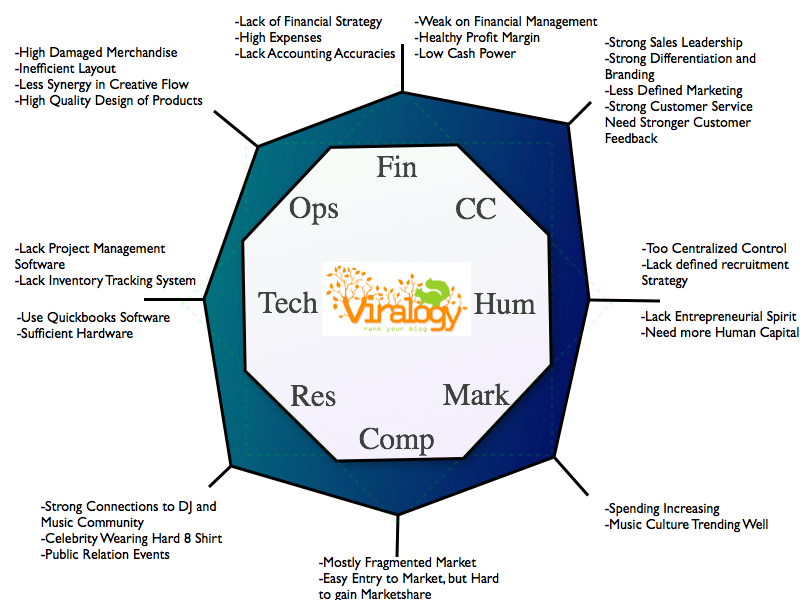
Most business analysis frameworks (your 3Cs, 5Cs, Porter’s Five Forces) give you a structure but leave you staring at categories with no idea what to actually do next. Octalysis For Business solves that by adapting the Octalysis octagon to business strategy, dividing any company into eight sectors: Finance, Customer/Client, Human Capital, Market, Competition, Resources, Technology, and Operations. You score each sector, plot it on the octagon, and immediately see where the shape “dents in” — that’s where you need to focus.
The real power is in the visual pattern recognition. Active sectors (top) are things you can change — pricing, marketing, operations. Passive sectors (bottom) are things you can’t — market conditions, competitors, intangible resources. If you’re weak on the passive side, you might be in the wrong industry entirely. External sectors (right) deal with people; Internal sectors (left) deal with systems. One glance at the shape tells you whether you have a people problem or an infrastructure problem.
Check out Octalysis For Business
10K HP Attribute Triangles/Diamond
DEPTH — Non-Obvious: 5 · Insight: 7 · Depth: 5
ELEGANCE — Visual: 7 · Clarity: 8
Overall: 6.6 / 10

The Attribute Triangles are the self-awareness engine inside the 10K HP system. Before you can build a legendary career, you need to know what you’re actually working with — and most people have a wildly inaccurate sense of their own strengths. This framework maps your core attributes across triangles that reveal where you’re strong and where the dangerous blind spots are hiding.
Each triangle forces trade-offs that mirror real life: you can’t max out everything, so you need to know which attributes compound with your chosen path. When you extend the model into the diamond configuration, you get a full picture of how your attributes interact with each other — synergies, conflicts, and the specific development order that will get you to mastery fastest. It’s the RPG character sheet for your actual career.
Octalysis Strategy Dashboard
DEPTH — Non-Obvious: 7 · Insight: 7 · Depth: 8
ELEGANCE — Visual: 5 · Clarity: 6
Overall: 6.5 / 10

The Strategy Dashboard is where Octalysis theory becomes practice. It’s the step-by-step tool Yu-kai uses in his own consulting projects to turn abstract Core Drive analysis into concrete design decisions. You define your business metrics, map the 4 Experience Phases (Discovery, Onboarding, Scaffolding, Endgame), then assign specific Game Techniques to each phase based on the Core Drives you want to activate.
This is what separates professional Octalysis design from hobbyist gamification. The Dashboard forces you to think systematically about every player type, every phase of the journey, and every motivation lever available. It’s the same tool used in the $1.06 billion Caixa case study.
Check out Octalysis Strategy Dashboard
Economy/Tokenomics Design Framework
DEPTH — Non-Obvious: 9 · Insight: 8 · Depth: 7
ELEGANCE — Visual: 6 · Clarity: 5
Overall: 6.5 / 10

The Economy/Tokenomics Design Framework addresses the biggest gap in gamification: most systems break down once real rewards enter the picture. Yu-kai designed this framework to balance supply and demand, reward structures, and engagement loops so that participants become genuine stakeholders rather than points hoarders.
The framework blends behavioral triggers with economic principles. Whether you’re building a virtual marketplace, a loyalty program, or an in-game economy, it prevents the inflation spirals and reward fatigue that kill most gamified systems within their first year.
Check out Economy / Tokenomics Design Framework
Chou’s 7 Leadership Personas
DEPTH — Non-Obvious: 7 · Insight: 7 · Depth: 6
ELEGANCE — Visual: 7 · Clarity: 7
Overall: 6.4 / 10

7 Leadership Personas allows individuals to navigate personal and professional challenges with foresight. By mastering Vision, Empathy, and Execution, OP Leaders create a legacy of inspiration, growth, and lasting impact.
Historically, few individuals achieve mastery in all three attributes: Vision, Empathy, and Execution. Most leaders excel in two of the three and spend their careers developing the third, embracing a path of continuous improvement that shapes them into well-rounded, impactful leaders prepared to meet any challenge.
Check out 7 Leadership Personas
10K HP Skill Triangles
DEPTH — Non-Obvious: 5 · Insight: 7 · Depth: 5
ELEGANCE — Visual: 7 · Clarity: 8
Overall: 6.1 / 10

While the Attribute Triangles map who you are, the Skill Triangles map what you can do — and more importantly, what you should learn next. This framework organizes skills into triangles where each vertex represents a different skill type, and the relationships between them reveal which skill combinations create disproportionate value in your field.
The practical insight is that skill development isn’t linear. Certain skills multiply the effectiveness of others, and the Skill Triangles help you identify those multiplier combinations before you invest thousands of hours. It’s the difference between grinding randomly and following a skill tree that’s been optimized for your specific build — borrowing directly from how game designers structure character progression.
Career Circles
DEPTH — Non-Obvious: 6 · Insight: 7 · Depth: 5
ELEGANCE — Visual: 7 · Clarity: 7
Overall: 6.1 / 10

Career Circles is a framework Yu-kai co-developed with Jun Loayza that maps the overlapping domains of your professional life into a visual Venn-diagram-style model. Most career advice treats your job, your passion, and your market value as separate conversations. Career Circles forces you to see where they overlap — and more critically, where they don’t — so you can make deliberate moves instead of drifting.
The framework is especially useful at career transition points: when you’re deciding whether to stay, pivot, or leap. By plotting your current position across the circles, you can see whether you’re stuck in a “paycheck only” zone, a “passion without income” zone, or the sweet spot where all circles converge. It turns the fuzzy “follow your passion” advice into a diagnostic tool with actual spatial reasoning.
The Self-Pity Pyramid
DEPTH — Non-Obvious: 8 · Insight: 7 · Depth: 6
ELEGANCE — Visual: 8 · Clarity: 6
Overall: 5.8 / 10

The Self-Pity Pyramid is a tongue-in-cheek model that explores the psychological patterns behind self-sabotage and victim mentality. This framework offers a practical tool for self-awareness and transformation. By breaking down the layers of self-pity into a structured pyramid, Yu-kai Chou reveals the hidden cycles that often keep people stuck in negativity and inaction. The Self-Pity Pyramid helps you pinpoint your place in this cycle and shows you how to break free from it, moving beyond struggles to reclaim your sense of control.
The pyramid walks through the stages of self-pity, from frustration to deeper despair, and maps the mindset shifts at each level. Yu-kai originally developed it to understand his own patterns, then found it resonated with audiences who recognized themselves in the model. It’s one of the few frameworks that tackles motivation from the negative side: not “how to get motivated” but “how to stop sabotaging yourself.”
Check out The Self-Pity Pyramid
Chou’s Corporate Player Types
DEPTH — Non-Obvious: 6 · Insight: 5 · Depth: 3
ELEGANCE — Visual: 7 · Clarity: 7
Overall: 5.4 / 10

Every office has Survivors who do the minimum to collect a paycheck, Diplomats who play politics without delivering, Workhorses who produce great work but can’t navigate the social game, and Stars who master both. Yu-kai’s Corporate Player Types is a 2×2 matrix that divides employees along two axes — Performance and Politics — creating four archetypes that any manager will instantly recognize from their own team.
What makes this more than a cute quadrant diagram is the management strategy that comes with it. Each player type needs a fundamentally different approach: motivating a Workhorse requires the opposite tactics from managing a Diplomat. The framework draws on Octalysis Core Drives to explain why each type behaves the way they do — Survivors are driven by Core Drive 4 (Ownership) and Core Drive 8 (Avoidance), while Stars have internalized Core Drives 2 and 3. Once you see the drives, the management playbook writes itself.
Check out Chou’s Corporate Player Types
REMOTE Work Framework
DEPTH — Non-Obvious: 7 · Insight: 6 · Depth: 5
ELEGANCE — Visual: 3 · Clarity: 8
Overall: 5.4 / 10

The REMOTE Framework, developed by The Octalysis Group, applies behavioral design to the specific challenges of distributed teams. Most remote work advice boils down to “use better tools.” This framework goes deeper: it addresses the psychological and social dynamics that make or break remote culture.
Each letter in REMOTE maps to a specific design principle grounded in Core Drive theory. The result is a system that makes remote work genuinely engaging rather than a pale imitation of office life.
Check out Remote Work Framework
10K HP 6 Power Attributes
DEPTH — Non-Obvious: 6 · Insight: 4 · Depth: 4
ELEGANCE — Visual: 6 · Clarity: 8
Overall: 5.4 / 10

The 6 Power Attributes are the foundational stats in the 10K HP system — think of them as the primary ability scores in an RPG. These six attributes determine what you’re good at today and your ceiling for growth in any direction. Every career path, every framework skill, and every life challenge draws on some combination of these six underlying attributes.
What makes this framework practical rather than theoretical is the scoring system. You assess yourself honestly across all six, identify your natural “high stats” and “dump stats,” and then use the results to inform which 10K HP path will leverage your strengths while shoring up critical weaknesses. It’s the character creation screen for your life — and just like in games, some attribute distributions are dramatically better suited for certain builds than others.
Nodal Economy Stimulus Model
DEPTH — Non-Obvious: 9 · Insight: 8 · Depth: 7
ELEGANCE — Visual: 3 · Clarity: 5
Overall: 5.4 / 10
When governments throw stimulus money at an economy, most of it either gets saved by people who don’t need it or burned through by people who can’t multiply its impact. The Nodal Stimulus Model takes a fundamentally different approach: instead of blanket distribution, it identifies high-potential “nodes” (individuals, businesses, and organizations) based on three factors: Spend/Save Ratio (how much they’ll circulate), Innovation Coefficient (how much new value they’ll create), and Upside Coefficient (how much growth potential they carry).
The framework applies the same behavioral design thinking behind Octalysis to macroeconomic policy. Direct stimulus to the nodes that will create the most ripple effects, and you get dramatically more economic activity per dollar spent. It’s a surprisingly practical model for something that sounds academic — Yu-kai developed it by asking the same question he asks about product design: how do you get the maximum behavioral output from a given input?
Check out Nodal Economy Stimulus Model
Digital Convergence Model
DEPTH — Non-Obvious: 7 · Insight: 4 · Depth: 3
ELEGANCE — Visual: 5 · Clarity: 8
Overall: 5.3 / 10

The Digital Convergence Model is a bold vision for the future, where the Metaverse, Web3, and Gamification come together to create a fully immersive digital world. With AI leading the way, it focuses on crafting personal, engaging experiences that feel like an extension of reality. Yu-kai also highlights the “Digital Leviathan,” a potential AI force that could dominate if not carefully managed.
The model serves as both a prediction and a warning. As the Metaverse, Web3, and gamification converge, whoever designs the behavioral architecture of these systems holds enormous power. Yu-kai calls this force the “Digital Leviathan,” and argues that builders need to apply human-focused design now, before the systems calcify.
Check out Digital Convergence Model
The Minimap Method
DEPTH — Non-Obvious: 5 · Insight: 5 · Depth: 4
ELEGANCE — Visual: 5 · Clarity: 7
Overall: 5.3 / 10

The Minimap Method (2026) is Yu-kai Chou’s document format for the AI age, built on one observation: every document now has two readers — a human who gives it two minutes, and an AI that reads everything. A minimapped document serves both: bold Waypoint lines carry the entire argument in a 500-word skim path, full depth waits directly beneath every claim, and a machine-grade Vault holds the receipts for AI assistants answering follow-up questions.
The design is Octalysis applied to reading itself: a Contract line grants the skimmer a visible finish line (Core Drive 2: Development & Accomplishment), and Trails feed curiosity on demand (Core Drive 7: Unpredictability & Curiosity). The method is free to use; the license is the badge line crediting it. Any AI can apply it via the Minimap Compiler, and the full introduction lives in The Minimap Method: Skim-Proof Documents for the AI Age.
Geometric Utility Investing (GUI)
DEPTH — Non-Obvious: 6 · Insight: 5 · Depth: 4
ELEGANCE — Visual: 3 · Clarity: 6
Overall: 4.5 / 10

Geometric Utility Investing is Yu-kai Chou’s framework for applying behavioral design principles to personal investing. Born from 20+ years of studying human motivation, GUI addresses the emotional pitfalls that derail even the most rational investors: panic selling during dips, FOMO-driven buying at peaks, and the paralysis of analysis.
The framework introduces several distinctive tools: the Upward Facing Spoon pattern for identifying dip-buying opportunities, the Four Guardians screening system (a checklist every asset must pass before purchase), and the RPG Party Composition model for portfolio construction that categorizes assets as Tanks, DPS, Healers, and Support characters based on their role in your financial strategy.
GUI bridges the gap between knowing what to do and actually doing it, the same challenge Octalysis solves in product design, applied to personal finance. It’s the framework Yu-kai Chou actually invests with, never theory or backtesting.
Read the full Geometric Utility Investing framework →
What Connects These Frameworks
Every framework on this page shares a root question: why do people do what they do? Whether it’s White Hat motivation (making people feel powerful and inspired) or Black Hat motivation (creating urgency and fear of missing out), the 8 Core Drives show up in every model Yu-kai builds.
The collection keeps growing. If you want to see these frameworks applied to real business problems, start with the $1.06 billion Caixa case study or the 90+ gamification examples with ROI data.
Related Reading
- The Octalysis Framework for Gamification & Behavioral Design
- What is Gamification? Definition, Examples & Framework
- Actionable Gamification: Beyond Points, Badges & Leaderboards
- The $1.06 Billion Octalysis Gamification Case Study
- 90+ Gamification Examples & Cases with ROI Stats
- Self-Determination Theory Guide