

Nationcraft Nation Variables Library
The Nationcraft Framework is a systematic behavioral lens for evaluating national governance capacity across 18 interdependent variables.
Unlike traditional political science indices that measure what a nation has, Nationcraft analyzes how a nation’s human systems actually function — revealing hidden strengths, structural vulnerabilities, and paths for improvement. This behavioral approach draws on principles from the Octalysis Framework, Yu-kai Chou’s model for human motivation.
Each country analysis below applies all 18 Nationcraft variables to produce a full governance profile, complete with variable scores, behavioral insights, and strategic recommendations. For a quick scan of every published country, see the comparison table further down the page. Each variable maps to measurable human behavioral patterns, informed by gamification research and behavioral economics.
The 18 Nation Variables (V1–V18) at a glance. Each analysis scores a country on the 18 variables of the Nationcraft Framework. V1–V6 capture cultural dimensions (Authority Dynamics, Collectivism vs Individualism, Achievement vs Harmony, Time Orientation, Uncertainty & Adaptability, Specialization vs Equity). V7–V13 capture political and historical factors (Stability vs Turmoil, Pragmatism vs Idealism, Social Stratification, Non-Partisanship vs Tribalism, Homogeneity vs Diversity, Geopolitical Leverage, Governance Transparency). V14–V18 capture economic factors (Land Resources, Labor Force Quality, Capital Quality, Commercial Friendliness, Utility Infrastructure). When a country card below references “V12 Geopolitical Leverage at 3/10” or “the V1+V2+V4 stack,” those codes map to this list. Read the full Nationcraft Framework explainer here.
Strategy Packets (SP codes). A Strategy Packet is a named historical reform template — for example, SP-002 = Lee Kuan Yew Industrialization, SP-009 = Taiwan’s KMT Economic Miracle, SP-010 = Post-WWII Japan’s constitutional firewall, SP-015 = Germany’s Wirtschaftswunder, SP-017 = Post-Franco Spain’s Moncloa Pacts. Each country analysis names the packets that fit its V-vector and rejects the ones that don’t.
About Yu-kai Chou
Yu-kai Chou is a Human-Systems Architect & Behavioral Designer whose work has impacted over 1.5 Billion Users worldwide through work with LEGO, Microsoft, Porsche, Coca-Cola, Salesforce, and MrBeast.
He has taught and lectured at Harvard, Stanford, Yale, Tesla, Google, BCG, and IDEO.
His books have been referenced by Harvard, Stanford, MIT, Forbes, Wall Street Journal, Wired, US Department of Energy, NIST, NSF, NCBI, US Department of Education, ClinicalTrials.gov, and 3,700+ more. Check out Books by Chou here.
Jump to: Browse by region · Browse by structural pattern · All 71 analyses · The OP Hero library
Browse by region
Every published analysis, grouped by where it is. The library below stays in publication order; this is the same set by geography.
Africa (17)
Algeria, Cameroon, Democratic Republic of Congo, Egypt, Ethiopia, Ghana, Kenya, Madagascar, Morocco, Niger, Nigeria, Rwanda, Senegal, South Africa (2026), Tunisia, Zambia, Zimbabwe
Americas (11)
Argentina (2026), Bolivia (2026), Brazil, Chile, Colombia, Ecuador, Haiti, Mexico, Peru, United States of America, Venezuela (2026)
Asia-Pacific (19)
Bangladesh, Cambodia, China, India, Indonesia, Japan, Kazakhstan (2026), Malaysia, Myanmar, Nepal, North Korea, Pakistan (2026), Singapore, South Korea, Sri Lanka, Taiwan, Thailand, Thailand (2026), Vietnam
Europe (18)
Albania, Bosnia and Herzegovina, Bulgaria, France, Germany, Greece, Hungary, Kosovo, Netherlands, Poland, Romania, Russia, Serbia, Spain, Sweden, Ukraine (2026), Ukraine — September 2026, United Kingdom — September 2026
Middle East (6)
Iraq, Israel, Lebanon, Saudi Arabia, Syria, Yemen
Browse by structural pattern
Every analysis names the structural pattern the country is caught in. These are those names, taken from the entries themselves — the part of the framework that travels across borders.
| Pattern | Countries |
|---|---|
| The Austerity Backlash Trap | Romania |
| The Ballot-First Trap | Haiti |
| The Borrowed-Anchor Trap | Bulgaria |
| The Borrowed-Calm Trap | Mexico |
| The Carousel Trap | Peru |
| The Charter Reset Trap | Bangladesh |
| The Clean-Slate Trap | Nepal |
| The Coalition Stalemate Trap | Kosovo |
| The Cobalt Trap | Democratic Republic of Congo |
| The Command-Without-Control Trap | Myanmar |
| The Compliance Paradox | Sri Lanka |
| The Compressed-Trust Paradox | Singapore |
| The Concession Trap | Kenya |
| The Consensus Machine Trap | Germany |
| The Coup Cycle Trap | Thailand (2026) |
| The Dayton Deadlock | Bosnia and Herzegovina |
| The Departure Dividend | Albania |
| The Discipline Window Trap | Greece |
| The Double-Digit Decree Trap | Vietnam |
| The Emergency Ratchet Trap | Ecuador |
| The Empty Chair Trap | South Africa (2026) |
| The Empty Mandate Trap | Algeria |
| The Escrowed Recovery Trap | Ukraine — September 2026 |
| The Financial Sovereignty Trap | Tunisia |
| The Fortress Dividend Trap | North Korea |
| The Fortress Economy Trap | Russia |
| The Fragmentation Trap | France |
| The Frozen War Trap | Yemen |
| The Garrison Economy Trap | Egypt |
| The Gas Dividend Trap | Bolivia (2026) |
| The Hollow Sovereignty Trap | Syria |
| The Honeymoon Ledger | United Kingdom — September 2026 |
| The Indispensable-Man Trap | Cameroon |
| The Judicial Veto Trap | Thailand |
| The Khaki Facilitation Trap | Pakistan (2026) |
| The Liberum Veto Trap | Poland |
| The Long-Horizon Trap | Japan |
| The Managed Exit Trap | Serbia |
| The Mandate Trap | India |
| The Mano Dura Mirage | Chile |
| The Model-Debtor Trap | Zambia |
| The Nobel Laureate Trap | Ethiopia |
| The Pampas Paradox | Argentina (2026) |
| The Patronage Ceiling Trap | Cambodia |
| The Polarization Pendulum Trap | Colombia |
| The Post-Martial Trap | South Korea |
| The Power-Sharing Trap | Lebanon |
| The Reform Dividend Trap | Nigeria |
| The Reform Playbook Mismatch | Venezuela (2026) |
| The Reformasi Coalition Trap | Malaysia |
| The Refoundation Trap | Madagascar |
| The Renewal-Deficit Trap | Brazil |
| The Rented-Border Trap | Spain |
| The Rentier Sovereignty Trap | Iraq |
| The Restored-Legacy Trap | Zimbabwe |
| The Second Dutch Disease | Netherlands |
| The Silicon Shield Paradox | Taiwan |
| The Single Artery Trap | Saudi Arabia |
| The Sovereignty Swap Trap | Niger |
| The Spartan Paradox | Ukraine (2026) |
| The Stabilization Trap | Ghana |
| The Star Pupil Trap | Rwanda |
| The Startup-Nation Trap | Israel |
| The Steppes Pivot Trap | Kazakhstan (2026) |
| The Strongman Reform Trap | Indonesia |
| The Superpower Paradox | United States of America |
| The Supply Reflex Trap | China |
| The Tandem Trap | Senegal |
| The Trust Overdraft Trap | Sweden |
| The Two-Speed Kingdom Trap | Morocco |
| The Two-Thirds Trap | Hungary |
Published Country Analyses
| Country (2026) | Key Insight | Pattern Summary | Read |
|---|---|---|---|
| Cuba | The Doctrine Trap | Cuba holds V1=10 command authority and V8=2 pragmatism — the strongest reform lever in the Caribbean, welded to a founding doctrine that forbids using it. Eight reform packets fail Cuba’s V-vector; three (Vietnam, Laos, Uzbekistan) fit. | Read → |
| Ghana | The Stabilization Trap | Ghana exited its IMF programme ahead of schedule, again — and that very competence at the rescue is what lets the trap cluster (V4, V13, V16, V10) keep postponing the structural fix that would end the cycle. | Read → |
| Iran | The Coercion Spiral | Iran holds V1=10 command authority and V8=2 pragmatism — a regime that cannot govern by delivering results, so it governs by force, the one tool that burns its own legitimacy every time it is used. With V10=2 factionalism, no single hand can break the spiral. Eight reform packets fail Iran’s V-vector; three (Uzbekistan, Vietnam, Azerbaijan) fit. | Read → |
| Philippines | The Dynasty Trap | Philippines V1=8 authority deference and V2=8 collectivism couple with V10=3 clan tribalism and V13=3 governance transparency — collectivism runs along family lines instead of national lines, so every cross-clan reform (anti-corruption agency, independent judiciary, technocratic ministry) routes back through the dynastic spine. The Marcos-Duterte feud IS the V-vector executing, not a malfunction. Three imported packets fail (LKY, Park, Saakashvili); three fit (SP-042 Post-Marcos, SP-019 Mahathir, SP-025 Bangladesh Grameen-BRAC). | Read → |
| Somalia | The Borrowed-Mandate Trap | Somalia scores V1=9 on authority deference yet V10=1 on clan tribalism — an authority instinct it cannot nationalize, so each federal government borrows its mandate by extending its term, renting AU troops and living on donors. | Read → |
| South Korea | The Post-Martial Trap | The same V1+V2+V4 deference-collectivism-long-horizon stack that built the chaebol miracle is the stack that let Yoon attempt a six-hour martial-law shortcut. | Read → |
| Taiwan | The Silicon Shield Paradox | 16 of 18 variables sit strong (7-9); V12 Geopolitical Leverage and V14 Land Resources are the structural bounds. The shield deflects fire and draws fire at the same time. | Read → |
| Thailand | The Coup Cycle Trap | 22 coup attempts since 1932 aren’t random — V7 Political Stability locked at 3, V10 Social Cohesion at 2, despite strong economic fundamentals. | Read → |
| Ukraine | The Spartan Paradox | Severe material devastation under V1+V2+V4 pressure, paired with high social resilience (V10=8) and crisis leadership (V15=9). Resilience and resources don’t track. | Read → |
| United States | The Superpower Paradox | World-leading economic and innovation scores mask accelerating erosion in V7 Political Stability and V10 Social Cohesion. Same dynamics that won are eating the foundations. | Read → |
| Venezuela | The Reform Playbook Mismatch | Eight standard reform packets (IMF shock therapy, dollar peg, top-down decentralization, others) misfire against Venezuela’s V-vector. Three packets fit. | Read → |
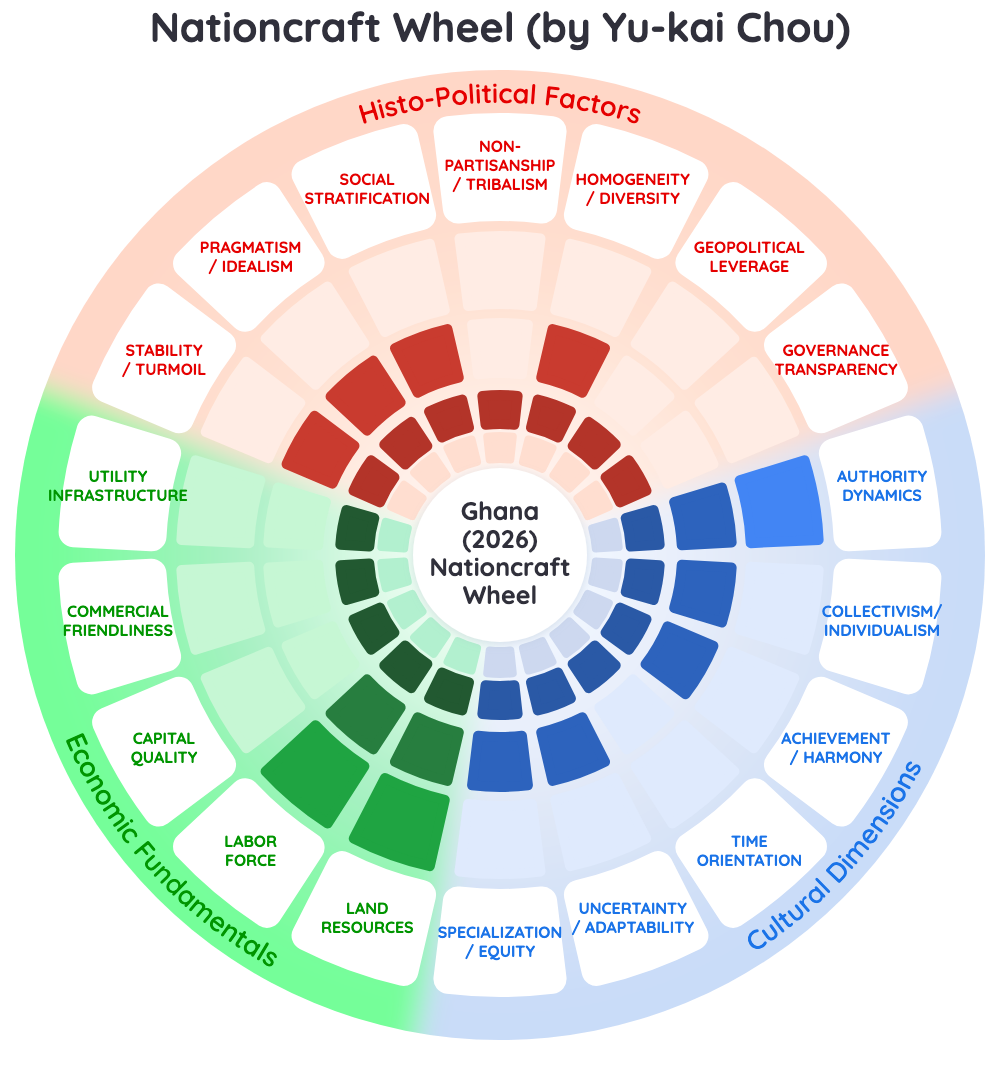
Ghana
Key Insight: The Stabilization Trap
Ghana exited its IMF Extended Credit Facility ahead of schedule in May 2026 — roughly the seventeenth Fund programme it has completed since independence. The Nationcraft Framework reads that competence at the rescue as the trap itself: a country good at executing stabilization never has to make sure it never needs one again. Genuinely strong production inputs — V14 Land Resources at 7, V15 Labor Force Quality at 7, V1 Authority Dynamics at 7 — cannot outrun the structure.
The four trap-cluster variables — V4 Time Orientation at 3, V13 Governance Transparency at 3, V16 Capital Quality at 2, V10 Non-Partisanship vs Tribalism at 3 — show no upward drift even as the recovery holds. The analysis names the reform packets that fit that specific V-vector and the ones that predictably misfire.
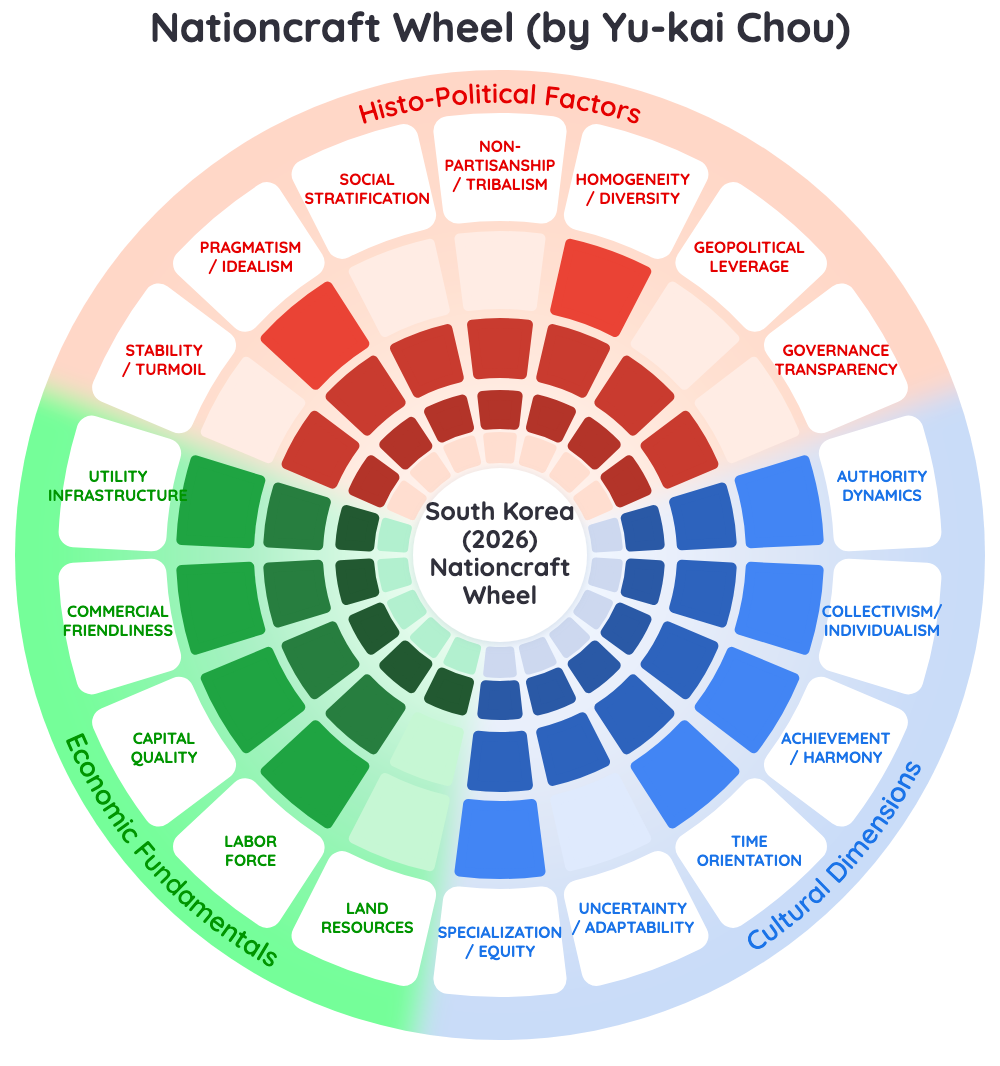
South Korea
Key Insight: The Post-Martial Trap
The same V1+V2+V4 deference-collectivism-long-horizon stack that built Park-era Korea and the chaebol miracle is the stack that let Yoon Suk-yeol attempt a six-hour martial-law shortcut in December 2024 — and now blocks the V7+V10 stability-and-depolarization repairs Lee Jae-myung’s government needs.
The Nationcraft Framework rejects eight reformer playbooks for Korea’s 2026 profile (including Park’s own SP-008) and fits three: SP-017 Post-Franco Spain (Moncloa Pacts), SP-010 Post-WWII Japan (constitutional firewall around the military), and SP-015 Wirtschaftswunder Germany (Bundestag-anchored civilian control + de-Nazification accountability).
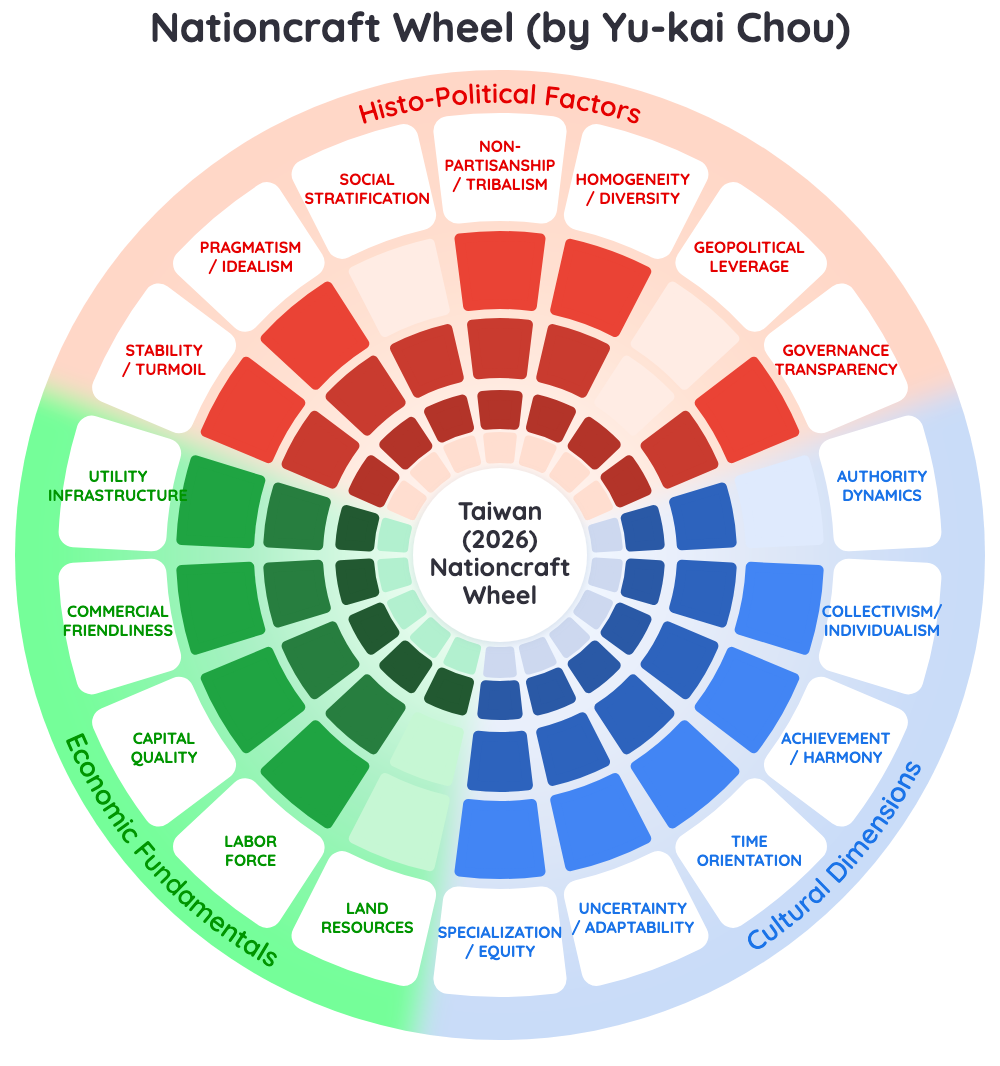
Taiwan
Key Insight: The Silicon Shield Paradox
Sixteen of Taiwan’s eighteen Nation Variables sit in the 7-9 band, but V12 Geopolitical Leverage at 3/10 and V14 Land Resources at 2/10 set the structural bounds. The same V15 (Labor Force Quality) + V16 (Capital Quality) cluster that built TSMC produced a deterrent that is simultaneously a target — the shield deflects fire and draws fire at the same time.
The Nationcraft Framework reads SP-009 (Taiwan’s own KMT Economic Miracle Packet, 1949-1990) as the operative template, with SP-002 Lee Kuan Yew Industrialization supplying partial mechanics for Labor Force Quality (V15) hardening. Six commonly cited templates — Park, Meiji, Celtic Tiger, Deng, Israel Nation-Building, Đổi Mới — break on V1 or V12 preconditions. Sequencing reads: protect Governance Transparency (V13) first, harden Geopolitical Leverage (V12), anchor Capital Quality (V16), then revisit Authority Dynamics (V1) reform.
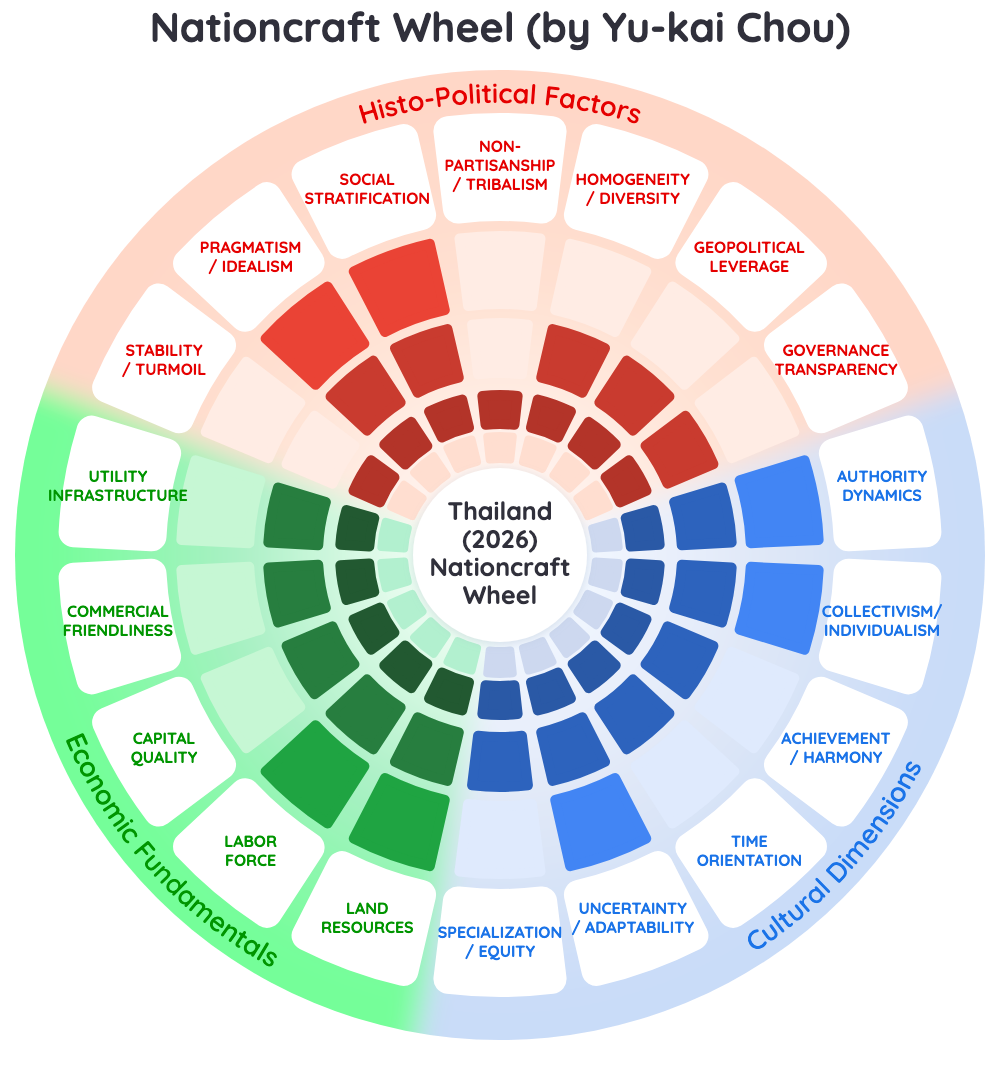
Thailand (2026)
Key Insight: The Coup Cycle Trap
Thailand’s 22 coup attempts since 1932 aren’t random events — they’re symptoms of a structural governance trap.
This analysis identifies why V7 (Political Stability) remains locked at 3 and V10 (Social Cohesion) at 2, despite strong economic fundamentals. The “Coup Cycle Trap” explains how institutional design flaws create predictable instability patterns, and what would be required to break the cycle ahead of Thailand’s next political transition.

Ukraine (2026)
Key Insight: The Spartan Paradox
Ukraine’s analysis reveals one of the most striking patterns in modern governance: a nation experiencing severe material devastation (V1, V2, V4 under extreme pressure) while simultaneously demonstrating high social resilience (V10=8 — Non-Partisanship vs Tribalism) and crisis leadership capacity (V15=9).
This “Spartan Paradox” challenges conventional assumptions about the relationship between economic resources and national cohesion, and has major implications for post-war reconstruction strategy.

United States of America
Key Insight: The Superpower Paradox
America’s Nationcraft profile reveals the paradox of global dominance: world-leading scores in V1 (Economic Strength) and V3 (Innovation Capacity) mask accelerating erosion in V7 (Political Stability) and V10 (Social Cohesion).
This analysis examines how the same competitive dynamics that drove American success now threaten its foundational institutions, and identifies the specific behavioral interventions that could reverse polarization without sacrificing dynamism.
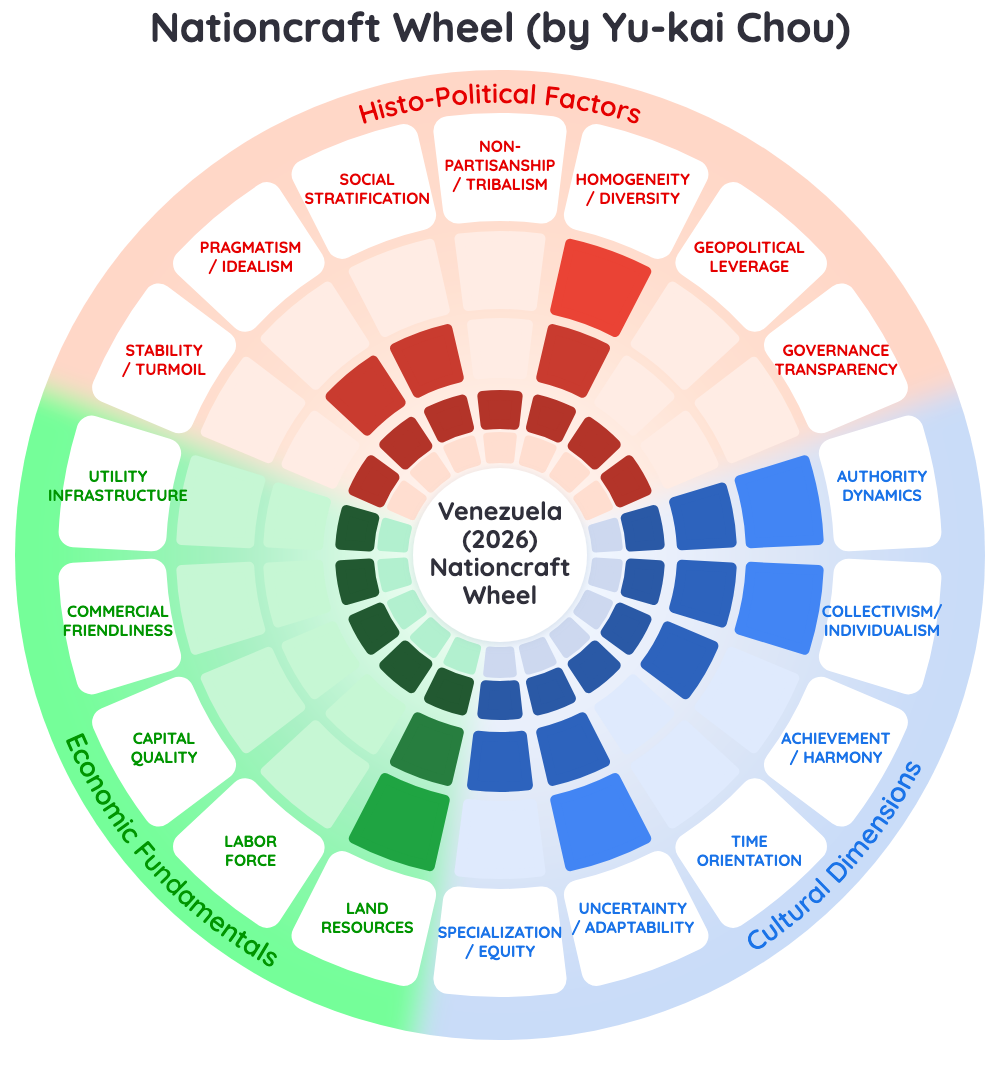
Venezuela (2026)
Key Insight: The Reform Playbook Mismatch
Venezuela’s 18-variable profile rejects most of the standard reformer toolkit. Eight common reform packets — IMF-conditional shock therapy, conventional anti-corruption raids, dollar-pegged stabilization, top-down decentralization, and several others — would either backfire or get absorbed without effect against Venezuela’s actual V-vector.
This analysis names the three packets that DO fit, explains the variable preconditions that make the eight rejected ones misfits, and sequences a reform path that respects Venezuela’s specific structural reality rather than imposing a template borrowed from another country.

Argentina (2026)
Key Insight: The Pampas Paradox. Argentina has the land (V14=8) and labor (V15=8) of a top-10 economy and the financial plumbing (V16=3) of a fragile state. Every reform window collides with the same wall — chronic capital flight, V13=4 transparency, and an 80-year V10=4 Peronist-versus-anti-Peronist cleavage that fractures every coalition before consolidation. The endowment is real; the trap is structural.
This analysis runs eight of the most-cited reform packets being floated for Argentina against the actual 18-variable profile. Five fail (Convertibility, Chicago Boys, Fujimori, LKY, Saakashvili). Three fit: Estenssoro’s NEP / Decreto 21060 (Bolivia 1985), Plano Real (Brazil 1994), and Rogernomics (New Zealand 1984-1993). The result names the configuration as the Pampas Paradox and routes Milei’s 2026 reform sequencing into the Estenssoro template rather than the Pinochet one.

Kazakhstan (2026)
Key Insight: The Steppes Pivot Trap. Kazakhstan has a textbook authoritarian-modernization endowment (V14=9 resources, V1=8 hard authority, V2=8 collectivism) trapped by a clan-and-opacity substrate (V12=3 geopolitical leverage, V13=3 governance transparency, V10=2 zhuz / clan factionalism). The geographic position between Russia and China demands a multi-vector pivot toward strategic autonomy. The 2026 constitutional rewrite reads as the institutional infrastructure for that pivot. Read against the V-vector, the geopolitical pivot is real and underway; the institutional pivot away from personalist rule is theater.
This analysis runs eight of the most-cited reform packets being floated for Kazakhstan against the actual 18-variable profile. Five fail (Yeltsin Shock Therapy, Saakashvili Reform, Lee Kuan Yew Industrialization, Norway Sovereign Wealth, Saudi Vision 2030). Three fit as floor, mid-game, and ceiling: Azerbaijan Oil Fund & Authoritarianism (SP-053, near-identical V-vector), Karimov-Mirziyoyev Transition (SP-045, closest Central Asian mid-game), and Botswana Diamond Management (SP-004, V14=9 ceiling but only after V13 is lifted). The result names the configuration as the Steppes Pivot Trap and routes Tokayev’s next 24 months into the Mirziyoyev-with-Botswana-fiscal-rules sequence rather than the Vision 2030 or Norway templates.

Pakistan (2026)
Key Insight: The Khaki Facilitation Trap. Pakistan merged its Board of Investment into the army-anchored Special Investment Facilitation Council in May 2026, importing the Lee Kuan Yew one-stop-shop form without the LKY foundation. The V-vector explains why: V1=9 authority paired with V8=3 pragmatism, V13=3 transparency, V16=2 capital quality, V10=1 partisan trust, and V4=4 time orientation. Every authoritarian-modernizer Success Packet in the corpus (LKY SP-002, Park SP-008, Nazarbayev SP-044) requires V8 above 7 at intervention start, and Pakistan does not have it. The military’s credibility delivers short-run FDI; it cannot retire the structural cycle.
This analysis runs eight reformer playbooks Pakistan reform conversations routinely cite (Lee Kuan Yew SP-002, Park Chung-hee SP-008, Nazarbayev SP-044, Chicago Boys SP-014, Atatürk SP-013, Celtic Tiger SP-016, Norway Oil Fund SP-106, Botswana Diamond Management SP-004) and shows each one fails on at least one cardinal variable. Three packets actually fit the V-vector: Suharto New Order Stabilization (SP-023) for technocrat insulation under military cover, Sisi Stabilization (SP-065) as the closest contemporary analog and the cautionary mega-project warning, and Bangladesh Garment and Microfinance (SP-025) as the labor-led export packet that accepts V13=3 and routes around it. News hook: the cabinet-ordered BOI-SIFC merger arrived ahead of PM Shehbaz Sharif’s 23 May 2026 Beijing trip and three weeks after the IMF Governance and Corruption Diagnostic Assessment of November 2025 asked the SIFC to publish all decisions and beneficiaries.

Bolivia (2026)
Key Insight: The Gas Dividend Trap. Two decades of natural-gas revenue built a subsidy-and-redistribution compact that the spent dividend now cannot fund — and the political culture the dividend built is the variable that blocks the pragmatic correction. V14=7 (resource endowment) routed through V13=2 transparency, V16=2 capital quality, V8=3 pragmatism, V10=2 partisanship and V2=7 collectivism produces an exact ET-006 Hyperinflation Spiral signature sitting inside ET-001 Resource Curse and RC-002 Constitutional Cascade. FX reserves fell below USD 1 bn (vs USD 15 bn peak 2014); Decree 5503’s subsidy cut collapsed within a month under street pressure; four dead in the May 22 2026 protest wave; IMF proposing 8%-of-GDP adjustment.
This analysis runs eight reformer playbooks Bolivia reform conversations routinely cite (Chicago Boys SP-014, Poland Shock Therapy SP-005, Yeltsin failure FP-016, Norway Oil Fund SP-106, Botswana Diamond Management SP-004, Wassenaar Consensus SP-112, Vision 2030 SP-037, Bolivarian Revolution SP-095) and shows each one fails on at least one cardinal Bolivian variable. Three packets actually fit the V-vector: Estenssoro’s 1985 NEP (SP-118) as the canonical Bolivian-own template, Plano Real (SP-034) for nominal anchoring without dollarization, and Ecuadorian Dollarization (SP-054) as the surrender-the-currency option. Selection reason: news-primary, May 22 2026 Al Jazeera escalation report.
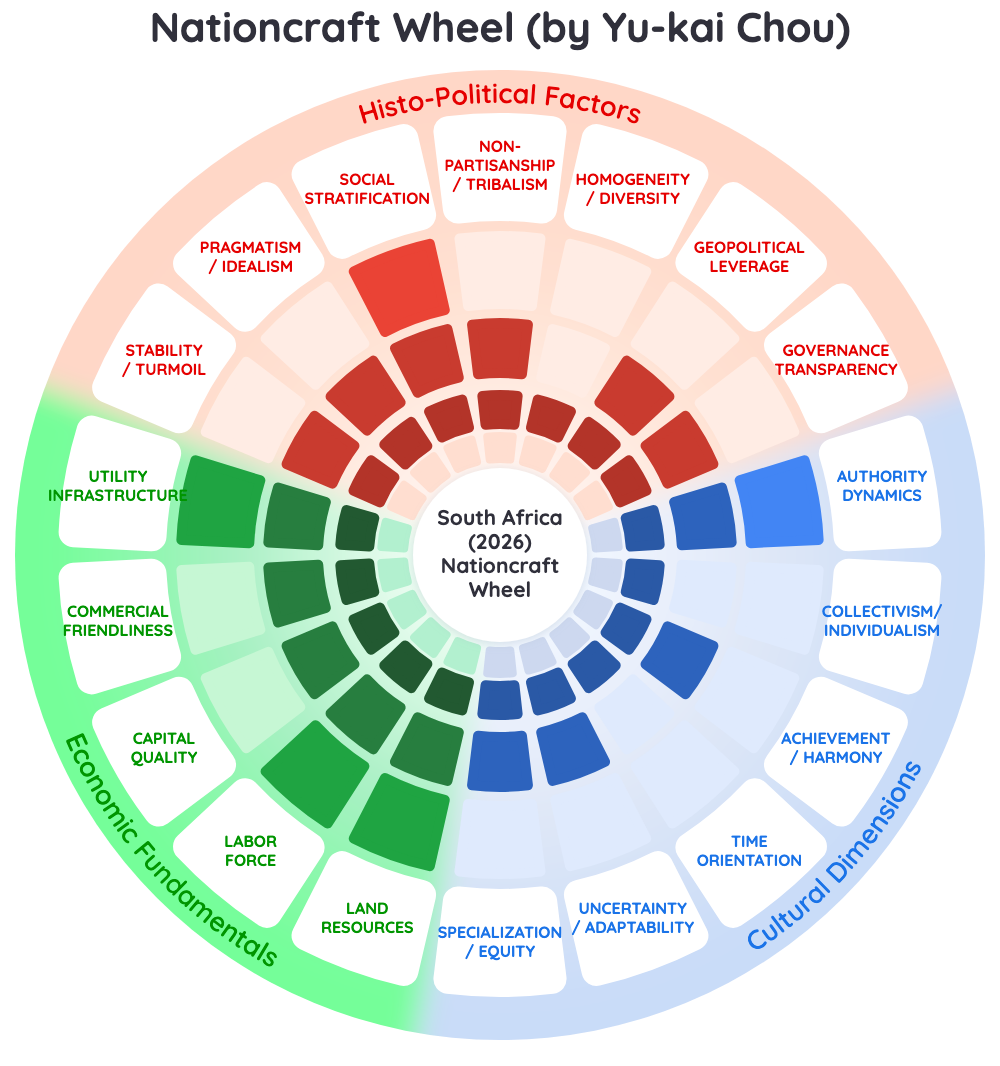
South Africa (2026)
Key Insight: The Empty Chair Trap. South Africa runs V1=8 Authority Dynamics, meaning every institutional reflex routes the hard decision to a single commanding centre: closed-list PR, cadre deployment, centralised SOE oversight. The 29 May 2024 election did not replace that centre, it emptied it, leaving a Government of National Unity that can veto but cannot originate. V4=3 time orientation converts the gap into paralysis because every partner optimises for the 4 November 2026 municipal vote, and V11=3 diversity removes the shared default identity that lets a high-V1 state coast without a decider. V9=8 stratification (41.9% expanded unemployment, Q4 2024) means no reform that front-loads pain can survive.
The analysis rejects five playbooks South Africa reform conversations routinely cite (Saakashvili SP-051, Poland Shock Therapy SP-005, Thatcher SP-102, Lee Kuan Yew SP-002, Chicago Boys SP-014), each failing on the unitary-mandate precondition the GNU structurally cannot supply. Three packets fit: Botswana Diamond Management (SP-004) for binding fiscal discretion to a rule, Post-Franco Spain (SP-017) as the packet built for a vacated authoritative centre, and Danish Flexicurity (SP-113) for routing labour reform through a table rather than a chair. The proof case is domestic: Eskom went from 33 loadshedding-free days in FY2023/24 to 348 in FY2024/25 once decisions moved into the chartered NTCSA. Selection reason: news-primary, 7 August 2026 gazetting of the municipal election date.

Sweden
Key Insight: The Trust Overdraft Trap
Sweden carries the most trust-heavy vector in the corpus (V13=10 transparency, V10=10 non-partisanship, V7=9 stability) stacked on V1=3 authority and V2=2 individualism: a state built to govern by consent that cannot produce fast coercive responses. A networked gang economy recruiting children as young as 11 grew inside that latency for a decade, drawing down the trust account every institution spends from, while falling shooting counts mask a business model migrating into fraud and bombings.
Written ten days before the September 13, 2026 Riksdag vote, the analysis rejects the Bukele (SP-064), Lee Kuan Yew (SP-002), Saakashvili (SP-051), Austrian corporatism (SP-115), and Uruguayan stay-the-course (SP-047) packets on precondition failure, and routes study toward Sweden’s own 1990s crisis packet (SP-109), Danish flexicurity (SP-113), and the Wassenaar bargain (SP-112).

Spain
Key Insight: The Rented-Border Trap
Spain runs the euro area’s growth-leading large economy on 7-tier engine variables (V15-V18) above a political core (V10=5 tribalism, V11=5 contested territorial identity, V1=6 minority-rule authority) that has stopped performing sovereignty functions in-house: border enforcement rented from Morocco, energy goodwill from Algeria, deterrence from EU frameworks. The July 2026 Ceuta collapse (about 50,000 crossings in 36 hours, at least 67 dead) and the September leak crisis show the landlord raising the rent while the blocs fight over who knew what.
The analysis rejects the Meiji (SP-001), Lee Kuan Yew (SP-002), Deng (SP-003), Carnation/EU-accession (SP-078), Baltic Tiger (SP-089), Rogernomics (SP-108), Swedish consolidation (SP-109), and Wassenaar (SP-112) packets on precondition failure, and routes study toward Spain’s own Moncloa packet (SP-017), Ireland’s Tallaght mechanism (SP-016), and Finland’s dependency pivot (SP-110).

Singapore
Key Insight: The Compressed-Trust Paradox
Singapore in 2026 is still the textbook SP-002 (Lee Kuan Yew Industrialization) profile, with V3=10, V4=10, V8=10, V16=10 stacked higher than any other country in the 147-nation Nationcraft corpus. The same compressed authority that powered the original 27x GDP-per-capita miracle is what now makes evolving the packet for an AI-era pivot structurally harder than the original build.
Lawrence Wong’s 32-recommendation Economic Strategy Review and the National AI Council are the first comprehensive re-architecture of the LKY packet in a generation — three packets fit (Estonia Digital, Finland Nokia, Celtic Tiger), five frequently-proposed alternatives misfit.

Peru
Key Insight: The Carousel Trap
Peru’s 2026 V-vector — V1=7 (high authority demand), V10=2 (fragmented Congress), V13=3 (low transparency), V14=8 (large mineral rents) — produces a stable equilibrium of presidential turnover. Eight presidents in ten years is not a sequence of bad leaders. It is the steady-state output of the Nationcraft variables. Resource rents float the macroeconomy through the political chaos, so the dysfunction never reaches the forcing crisis that compels reform.
The implication is that bicameralism, restored for the 2026-2031 term, adds a veto point to a system whose problem is excess veto points. The three packets that actually fit (Pacto de la Moncloa, Botswana, Uruguay) all move V10 and V13 over multi-decade horizons. The shortcuts (Bukele, LKY, Deng, Poland, Park) all misfit the V-vector.

Ethiopia
Key Insight: The Nobel Laureate Trap
Ethiopia’s 2026 V-vector — V1=8 (strong authority), V8=3 (collapsed pragmatism), V10=2 (formalized ethnic federalism), V13=2 (transparency floor), V16=1 (capital depleted) — produces an Authoritarian Backslide pattern that the 2019 Nobel Peace Prize obscured. The reformer framing applied to Abiy Ahmed required the V8=8 pragmatism the EPRDF era ran on; that capital has since been spent down, and the Authoritarian Modernizer pattern the Nobel implied is structurally unavailable to him.
The diagnostic implication is that the SP-030 EPRDF Developmental State packet cannot be straightforwardly repeated under its degraded preconditions. The three packets that actually fit (Pacto de la Moncloa for the V10 pact, Tanzania for the SC-003 identity-construction layer, Rwanda’s Imihigo and ID-abolition sub-components) all address the V10=2 ethnic-federalism cleavage the 1995 Constitution formalized.

Sri Lanka
Key Insight: The Compliance Paradox
Sri Lanka’s 2026 V-vector — V15=7 (high labor force quality), V16=2 (broken capital base), V13=3 (low governance transparency), V10=3 (ethnic tribalism), V18=3 (weak utility infrastructure) — produces a country that can pass every IMF Extended Fund Facility review on paper while remaining one external shock away from another 2022. Literate civil service plus central-bank discipline plus English-fluent professionals execute the program flawlessly. V16, V18, and V10 do not get rebuilt by passing reviews, and the 2026 Iran-war contagion is administering the live stress test in real time.
The diagnostic implication is that the eight standard reform packets (LKY Singapore, Deng China, Poland shock, Park Korea, Botswana, Mahathir Malaysia, Fujimori Peru, Bukele El Salvador) all misfit on V13, V16, or V1 preconditions Sri Lanka does not have. Three actually fit: Spain Moncloa (SP-017) for cross-cleavage pact-based reform, Uruguay social democracy (SP-047) for welfare-inside-fiscal-discipline, and Bolivia Estenssoro NEP (SP-118) as a partial-fit anchor on disinflation engineering. The V1+V8 reform-sequencing window under the NPP supermajority closes in 2027.

Kosovo
Key Insight: The Coalition Stalemate Trap
Kosovo’s 2026 V-vector — V10=2 (deep tribalism), V12=2 (no geopolitical leverage), V13=3 (low governance transparency), V11=4 (mid-diversity), V8=5 (idealist-pragmatic cross-cut) — produces a parliament that cannot form a stable coalition after any election. Three snap elections in 18 months (Feb 2025, March 2026 impasse, June 7 2026) have delivered essentially the same arithmetic — Vetëvendosje ~43%, PDK ~21%, LDK ~17% — because the V-vector has not moved. The trap is procedural: voting harder does not change the V-vector, and each snap cycle burns ~9 months of EU reform clock and ~€350-500M in delayed IPA funds.
The diagnostic implication is that five common reform packets misfit Kosovo’s V-vector: Bosnia Dayton (SP-093) imports the very stalemate Kosovo is trying to exit; Spain Post-Franco (SP-017) requires a V1=7 monarch-figure Kosovo lacks; Cambodia Hun Sen (SP-024), Rwanda Kagame (SP-006), and Serbia Multi-Vector (SP-069) all assume V1, V11, or V12 readings Kosovo cannot provide. Three actually fit: North Macedonia’s Name-Change Packet (SP-091) on the V12 external-anchor unlock, Albania’s Post-Communist Transformation (SP-070) on the V2=7 fis-clan template, and the Saakashvili-Georgia 2003 Anti-Corruption playbook (PB-09) as the V13 shock that breaks the coalition arithmetic from below. V13 sequencing — front-loaded in the first 90 days of any new government — is the only path that doesn’t require V10 to lift first.

Colombia
Key Insight: The Polarization Pendulum Trap
Colombia’s 2026 V-vector pairs collective-identity strengths (V2=9, V14=8, V15=8, V1=7) with three structural weaknesses (V10=3 tribalism, V13=3 governance opacity, V5=3 institutional rigidity) that turn every electoral cycle into a winner-take-all swing. The June 21 runoff between right-populist Abelardo de la Espriella (43.7% first round) and left-Petro continuation Iván Cepeda (40.9%) is the next pendulum swing on schedule, not its exit. Each new president inherits the same V-vector — and metabolizes the same broken mandate four years later.
The diagnostic implication is that eight imported reform playbooks misfit Colombia’s V-vector: Lee Kuan Yew (SP-002), Deng Xiaoping (SP-003), Park Chung-hee (SP-008), Bukele Security & Digital (SP-064), Chicago Boys (SP-014), Poland Shock Therapy (SP-005), Norway Oil Fund (SP-106), and NAFTA Integration (SP-046) — because each requires a Colombia-low V-variable to be Colombia-high. The three packets that actually fit — Saakashvili Georgia (SP-051), Post-Euromaidan Ukraine (SP-117), and Post-Franco Spain (SP-017) — all started from the same V13=3 + V10=3 cluster and rebuilt the transparency floor first. The Nationcraft sequencing prescription: V13 anti-corruption shock → V10 cross-tribe pact → V12 leverage repair → V14/V15 monetization → V5 institutional housekeeping.

Greece
Key Insight: The Discipline Window Trap
Greece’s 2026 V-vector pairs one extremely high score (V11=9 homogeneity) and a moderate-stable shell (V1=6, V7=6, V9=6, V15=6, V18=6) with a soft interior of eight 4s (V2, V3, V4, V5, V6, V8, V12, V16) that defines its clientelist default. For sixteen years (2010-2026) external constraint — Troika, ESM, Eurogroup, Recovery and Resilience Facility — held Greece behaving as if its V4 Time Orientation, V8 Pragmatism, and V10 Non-Partisanship were substantially higher than they structurally are. The 4 June 2026 EU Macroeconomic Imbalance Procedure exit removed the last piece of that clamp.
The Discipline Window Trap names the resulting paradox: the reform window opened by exit from oversight is also the window during which the V-vector starts to reassert on a five-year half-life. The diagnostic implication is that six reformer playbooks misfit Greece’s V-vector — Estonia Digital (SP-007), Celtic Tiger Ireland (SP-016), Atatürk Turkey (SP-013), Baltic Tiger Latvia (SP-088), Rogernomics New Zealand (SP-108), and Yeltsin Shock Therapy (FP-016) — because each presumes a V-variable Greece does not have. The three packets that actually fit — Sweden 1990s Fiscal Consolidation (SP-109), Chrétien-Martin Canada Deficit Elimination (SP-111), and Post-Franco Spain Transition (SP-017) — all institutionalized discipline domestically rather than renting it from external pressure. The Nationcraft sequencing prescription: Hellenic Fiscal Council upgrade → domestic fiscal-rule codification → Greek Program Review methodology → Moncloa-style cross-party agreement → Loss-Avoidance surplus framing → V13 CPI lift via AADE deepening → productivity-first RRF channeling → diaspora reverse-migration program.

India
Key Insight: The Mandate Trap
India’s 2026 V-vector pairs strong central authority (V1=8) with extreme tribal politics (V10=1), extreme diversity (V11=1), and high stratification (V9=8). The configuration creates a counterintuitive dynamic: substantive economic reform output rises when the BJP loses outright majority and falls when the BJP consolidates power. Coalition compression forces cross-tribal pragmatic deals (GST 2.0, four labour codes, UK/Oman/NZ trade deals 2025-2026); majority confidence reverts the political incentive toward identity consolidation.
The May 2026 historic West Bengal sweep (BJP 207 of 293 seats, first ever) is the leading indicator the reform window is narrowing. Best-Match Success Packets: SP-011 (1991 Liberalization, India’s own native template), SP-007 (Estonia Digital Revolution, mapped to the India Stack at 1.4B scale), SP-020 (Eastern Seaboard Development in Thailand for PLI / GIFT City / Dedicated Freight Corridor sequencing). Eight celebrated playbooks rejected: Meiji, LKY Singapore, Deng China, Poland Shock Therapy, Rwanda, Bukele, Rogernomics, Celtic Tiger.

Indonesia
Key Insight: The Strongman Reform Trap
Indonesia’s 2026 V-vector pairs high central authority (V1=8) and vast resources (V14=8 — world’s largest nickel reserves) with low transparency (V13=4), weak capital quality (V16=3), and deteriorating commercial friendliness (V17=4). Prabowo Subianto has the LKY-style reformer surface but lacks the V13/V16/V17 substrate to convert reform velocity into productive output. Every coercive reform — Danantara opacity, abrupt nickel quota cuts, mandatory FX onshore retention, the May 2026 China Chamber of Commerce letter — drains the confidence capital the agenda needs to fund itself.
The June 12, 2026 Plaza Indonesia student protests with 4,000+ police deployed, the rupiah breaching 18,000/USD at 1997-AFC lows, and the USD 8.4B Q1 FX reserve drawdown are the surface outputs. Best-Match Success Packets: SP-023 (New Order Stabilization, Indonesia’s own native template — Suharto + Berkeley Mafia, 16x GDP/capita 1966-1996, keep the firewall, drop the cronyism), SP-004 (Botswana Diamond Management for sovereign-wealth governance under weak transparency), SP-019 (Mahathir Industrialization Malaysia as the closest geographic + structural analog). Eight celebrated playbooks rejected: LKY Singapore, Meiji Japan, Park Korea, Chicago Boys Chile, Deng China, Saudi Vision 2030, Wirtschaftswunder Germany, Estonia Digital.

Cameroon
Key Insight: The Indispensable-Man Trap
Cameroon’s 2026 V-vector pairs maximal personalist authority (V1=8) and a genuine endowment (V14=7 oil, timber, cocoa; V15=7 bilingual workforce) with the entire conversion cluster at the floor (V13=2 transparency, V10=2 patronage/tribalism, V16=V17=V18=2). Forty-three years of building the state around one 93-year-old means there is no machine that survives the man: national survival has become a function of a single mortality. The April 2026 amendment recreating a dismissible vice-president manages the optics of succession without touching V1, V10 or V13.
The disputed October 2025 election (Biya 53.66%, 30-55 protesters killed, challenger Tchiroma in exile) is the surface output of the trap. Best-Match Success Packets: SP-004 (Botswana Diamond Management — the resource-transparency anchor a V14=7/V13=2 state must copy first), SP-040 (Senegal Senghor-Wade — orderly voluntary succession in a Francophone peer), SP-036 (Oman Qaboos — a high-V1 ruler who used his authority to de-risk his own exit). Five celebrated playbooks rejected: LKY Singapore, Saudi Vision 2030, Estonia Digital, Atatürk, Azerbaijan Oil-Fund Authoritarianism. Comparative mirrors: Chad, Angola, Uganda.

Nepal
Key Insight: The Clean-Slate Trap
Nepal’s 2026 V-vector pairs the cultural raw material of a developmental sprint (V1=8 deference, V2=8 collectivism) with a situational and economic base that keeps converting it back into churn (V7=3 turmoil, V10=3 factionalism, V11=3 diversity, V12=2 landlocked squeeze, V13=3 opacity, V16=2 remittance-dependence). After the September 2025 Gen Z uprising ousted PM Oli, the Rastriya Swatantra Party won 182 of 275 seats — the cleanest mandate in Nepal’s democratic history. The Clean-Slate Trap is that a landslide changes the faces, not the machine that produced fourteen governments since 2008.
Best-Match Success Packets: SP-022 (Mongolia Democratic Transition — the landlocked, two-giant analog that diversified its partners before it got rich), SP-051 (Saakashvili Georgia — radical anti-corruption on a fresh revolutionary mandate), SP-025 (Bangladesh Garment & Microfinance — converting surplus labor and remittances into domestic jobs), with SP-007 Estonia Digital as the transparency north star. Four celebrated playbooks rejected: LKY Singapore, Park South Korea, Deng China, Saudi Vision 2030. Comparative mirrors: Pakistan, Sri Lanka, India.

Bangladesh
Key Insight: The Charter Reset Trap
Bangladesh’s 2026 V-vector pairs explosive mobilization capacity (V2=7 collectivism, V5=7 adaptability) with the two variables that keep recapturing it: V1=8 concentrated authority and V10=2 extreme BNP-versus-Awami-League tribalism, over a low-trust base (V7=3 turmoil, V13=3 opacity, V16=2 thin capital). After the 2024 student uprising ousted Sheikh Hasina, the February 2026 election handed the BNP a two-thirds majority and voters endorsed the July National Charter — yet the winning party has refused the second oath to implement it and rejects the two clauses that would decentralize power. The Charter Reset Trap is that a nation can reset its regime without ever changing how power is held.
Best-Match Success Packets: SP-038 (Ghana Rawlings — a high-authority state that sequenced credible ownership into a peaceful 2000 handover), SP-049 (Nigeria Obasanjo — building independent institutions fast in the reform window), and SP-025 (Bangladesh’s own Garment & Microfinance engine to protect), with SP-042 Post-Marcos Philippines as the realistic hollow-democracy baseline. Reject packets: SP-065 Egypt Sisi stabilization, SP-024 Cambodia Hun Sen capture, SP-059 Hungary Orbán, SP-069 Serbia post-Milošević. Comparative mirrors: Nepal, Pakistan, India, Sri Lanka.

Lebanon
Key Insight: The Power-Sharing Trap
Lebanon’s 2026 V-vector reads as a high nominal authority (V1=8) that is fragmented across confessional veto-holders, sitting on extreme sectarian tribalism (V10=2), bottom-band transparency (V13=2), and a collapsed banking sector (V16=1) with chronic blackouts (V18=2). The confessional power-sharing system built in 1943 and rebalanced at Taif in 1989 to share power across eighteen sects is the same structure that now freezes reform: every reform becomes a sect-level veto. The Power-Sharing Trap is the cost of buying peace with vetoes and then needing reform that only the removal of vetoes can deliver. Lebanon’s own history is recorded as packet SP-087, “Confessional Prosperity (Collapsed).”
Best-Match Success Packets: SP-093 (Bosnia’s Dayton consociation as a structural mirror and a warning about frozen veto-states), SP-054 (Ecuador crisis dollarization to anchor a V16=1 collapse), and SP-051 (Georgia’s visible anti-corruption quick-wins for V13), wrapped by PB-09. Reject packets: SP-002 Lee Kuan Yew Singapore, SP-003 Deng China, SP-005 Poland Shock Therapy, SP-037 Saudi Vision 2030, SP-027 Israel Nation-Building, SP-006 Rwanda, SP-013 Atatürk. Comparative mirrors: Kosovo, Iran, Greece, Venezuela.

Syria
Key Insight: The Hollow Sovereignty Trap
Syria’s post-Assad 2026 V-vector reads as near-absolute formal authority (V1=9) sitting on rock-bottom stability (V7=1), sectarian tribalism (V10=1), and zero governance transparency (V13=1), with a destroyed capital base (V16=1) — while one variable, geopolitical leverage (V12), surges upward as sanctions lift and recognition arrives. The Hollow Sovereignty Trap is what happens when international legitimacy and reconstruction capital arrive faster than the institutions that could absorb them: the money and the recognition entrench the hyper-concentrated presidency instead of building a state.
Best-Match Success Packets: SP-006 (Rwanda’s post-genocide reconstruction), SP-085 (Mozambique’s post-civil-war DDR and militia integration), and SP-017 (Spain’s pacted post-Franco transition). Reject packets: SP-002 Lee Kuan Yew Singapore, SP-005 Poland Shock Therapy, SP-007 Estonia Digital, SP-037 Saudi Vision 2030, SP-117 Ukraine Post-Euromaidan, SP-064 Bukele. Cautionary analogs: FP-003 Iraq CPA, FP-002 Libya collapse, FP-020 Assad pre-war. Comparative mirrors: Lebanon, Somalia, Iran, Greece.

Kenya
Key Insight: The Concession Trap
Kenya’s 2026 V-vector pairs real civic capacity — a literate, digital, post-tribal Gen Z movement — with two structural choke points: non-partisanship versus tribalism (V10=2) and governance transparency (V13=3). The Concession Trap is what happens when a high-capacity citizenry meets a low-transparency, patronage-driven state: protest wins visible concessions (a withdrawn tax bill, a cabinet reshuffle, an opposition co-opted into government) that defuse the movement without touching the machine that produced the grievance.
Proof point: the broad-based government formed after the 2024 uprising passed Finance Bill 2026 by 122 to 40. Reject packets: SP-002 Lee Kuan Yew Singapore, SP-030 EPRDF Ethiopia, SP-006 Rwanda, SP-014 Chicago Boys Chile. Best-match packets: SP-051 Saakashvili Georgia anti-corruption, SP-004 Botswana resource discipline, SP-007 Estonia digital governance, with SP-039 Kibaki as Kenya’s own reference. Comparative mirrors: Ghana, Ethiopia, Somalia, Cameroon.

Chile
Key Insight: The Mano Dura Mirage
Chile’s 2026 V-vector is a developed-country shell — the region’s strongest institutions (V7=8 stability, V13=6 transparency) and its lowest violence — wrapped around two soft spots: uncertainty adaptability (V5=3) and social stratification (V9=7). The Mano Dura Mirage is what happens when those soft spots meet strong institutions: the country keeps reaching for one decisive fix (a left constitution in 2022, a right constitution in 2023, now an iron-fist security mandate) for a structural anxiety no crackdown can reach, so each mandate decays on contact with the gap.
Proof point: homicides fell three years running to 5.4 per 100,000, yet voters elected the hardest-line candidate and President Kast’s approval still slid from 57% to 38% in about eighty days. Reject packets: SP-064 Bukele El Salvador, SP-097 Honduras, SP-014 Chile’s own Chicago Boys, SP-050/FP-001 Argentina convertibility, SP-058 Czech voucher. Best-match packets: SP-109 Sweden and SP-111 Canada fiscal councils, SP-115 Austria and SP-112 Netherlands social partnership, anchored by the ET-002 copper Resource Blessing.

Madagascar
Key Insight: The Refoundation Trap
Madagascar’s 2026 V-vector is a profile built for cyclical collapse: fast-concentrating authority (V1=7) and a short time horizon (V4=2) sitting on a transparency floor (V13=1) with almost no domestic capital (V16=1) or commercial friendliness (V17=1). The Refoundation Trap is what happens when a country like this answers every crisis by wiping the slate and starting over — each “clean slate” destroys the institutional continuity it has never been allowed to accumulate, which is why GDP per capita today sits below its 1960 level despite unique biodiversity and a critical-minerals boom.
Proof point: the same CAPSAT army unit that installed President Rajoelina in 2009 removed him in October 2025, and the new military council promptly promised a Fifth Republic — the fifth refoundation since 1972. Reject packets: SP-002 Singapore LKY, SP-030 Ethiopia EPRDF, FP-004 Myanmar military transition, SP-005 Poland shock therapy, SP-062 Bolivia resource nationalism. Best-match packets: SP-004 Botswana institutions-before-resources, SP-029 Mauritius diversification, SP-031 Costa Rica demilitarization, SP-006 Rwanda clean-government rebuild, anchored by Madagascar’s own SP-086 Failed Potential Packet.

Serbia
Key Insight: The Managed Exit Trap
Serbia’s 2026 V-vector is an engine of managed continuity: personalist authority (V1=7) sitting on collapsed non-partisanship (V10=2) and a captured transparency floor (V13=3), with real strengths — strong collectivism (V2=8) and educated labor (V15=6) — trapped by the configuration around them. The Managed Exit Trap is what happens when mass mobilization forces a leader to concede an election, but the captured electoral, media, and judicial machinery converts the vote into managed succession rather than genuine rupture.
Proof point: on 27 June 2026, after 18 months of the largest protests since Milošević fell, President Vučić announced he would resign the presidency while campaigning to keep his party in power for “the next four years.” Reject packets: SP-059 Hungary/Orbán gradualism, SP-064 El Salvador/Bukele, SP-002 Singapore LKY, SP-037 Saudi Vision 2030, SP-053 Azerbaijan oil-fund authoritarianism. Best-match packets: SP-090 Slovakia post-Mečiar recovery, SP-080 Romania captured-transition reform, SP-017 Spain pacted transition, SP-068 Croatia EU accession, anchored by Serbia’s own SP-069 Post-Milošević Recovery Packet.

France
Key Insight: The Fragmentation Trap
France’s 2026 V-vector is a study in wasted strength: corpus-ceiling capital quality (V16=9) wrapped in an elite capacity cluster (V13 transparency, V15 labor, V17 commercial friendliness, and V18 infrastructure all 8), sitting on a broken cohesion score (V10 Non-Partisanship just 4). The Fragmentation Trap is what happens when a high-capacity democracy loses the ability to concentrate authority: a hung parliament splits into three irreconcilable blocs, and power is generated only to dissipate before it reaches a decision.
Proof point: four minority governments have fallen in roughly eighteen months since the 2024 snap election, and the 2026 budget cleared only through Article 49.3 after two no-confidence motions failed. Reject packets: SP-102 Thatcher (needs a manufactured Westminster majority), SP-008 Park and SP-014 Chicago Boys (need authoritarian cover), SP-108 Rogernomics (needs cabinet unity), FP-016 Yeltsin shock therapy. Best-match packets: SP-111 Canada Chrétien-Martin deficit elimination, SP-109 Sweden 1990s consolidation, SP-112 Netherlands Wassenaar consensus, SP-115 Austria social partnership, anchored by France’s own SP-103 De Gaulle Fifth-Republic packet built to end this very paralysis.

Japan
Key Insight: The Long-Horizon Trap
Japan’s 2026 V-vector is a skyline with one deep dip: the corpus-ceiling time horizon (V4 Time Orientation=10) and an elite capacity-and-stability wall (V7=9, V11=9, V16=9, V18=9; V13, V15, V17 all 8) sit above a single low outlier — V5 Uncertainty Adaptability, just 3. The Long-Horizon Trap is what happens when the institutions that let a nation plan and commit across decades are the same ones that stop it changing course when the plan expires: the country that sees its own future most clearly is structurally the slowest to adapt to it.
Proof point: February 2026 handed PM Takaichi a two-thirds LDP supermajority — maximal authority — yet Japan’s binding constraint is adaptability and a shrinking labor base (record-low 705,809 births in 2025), which no mandate can legislate. Reject packets: SP-002 Lee Kuan Yew and SP-008 Park Chung-hee (authoritarian concentration for a developing economy Japan long since outgrew), SP-005 Poland shock therapy (unabsorbable at V5=3), SP-037 Saudi Vision 2030 (wrong resource base), SP-011 India 1991 (Japan is already open). Best-match packets: SP-015 West Germany’s Wirtschaftswunder (reform-with-consent at a matching V1=5) and SP-007 Estonia’s digital revolution (route around scarce labor via automation), with Japan’s own SP-010 Post-WWII and SP-001 Meiji packets as the cautionary mirror — both escapes needed a catastrophe.

Nigeria
Key Insight: The Reform Dividend Trap
Nigeria’s 2026 V-vector is a resource-curse signature: land resources at the ceiling (V14=9) towering over weak capital quality (V16=3), commercial friendliness (V17=3), and utility infrastructure (V18=3), with governance transparency at 2 (V13) and non-partisanship at 1 (V10). The Reform Dividend Trap is what happens when an orthodox stabilization heals the accounts a nation shows the world faster than the accounts it shows its own citizens: reserves, the naira, and inflation all improve on the IMF dashboard while the dividend leaks out through the transparency, tribalism, and infrastructure joints before it reaches households.
Proof point: foreign reserves rose above forty-five billion dollars and inflation fell from 33% to 23% in the same year roughly seven million more Nigerians fell below the poverty line, to 63%. Reject packets: SP-005 Poland shock therapy (needs a V13 floor and an external anchor), SP-014 Chile Chicago Boys, SP-050 Argentina convertibility, SP-037 Saudi Vision 2030, SP-038 Ghana structural adjustment, SP-044 Kazakhstan resource management. Best-match packets: SP-023 Indonesia’s New Order stabilization (route the dividend into a visible food and rural base) and Nigeria’s own SP-049 Obasanjo liberalization (open sectors the state cannot rent-capture), with SP-004 Botswana’s transparency-before-spend sequencing as the discipline lesson.

Democratic Republic of Congo
Key Insight: The Cobalt Trap
The DR Congo’s 2026 V-vector is the sharpest resource-curse inversion in the corpus: land resources at the ceiling (V14=9, roughly 73% of the world’s cobalt) sitting on top of floored geopolitical leverage (V12=1), stability (V7=1, with no monopoly on violence while M23 holds eastern territory), and governance transparency (V13=1, a CPI score of 20/100). The Cobalt Trap is what happens when a state is too fragile to hold the leverage its own resources should hand it, so the more indispensable its minerals become, the more they attract other actors’ power rather than building its own.
Proof point: the 2026 peace over Congo’s east was brokered in Washington, the accompanying minerals framework grants a great power preferential access, and the one moment Kinshasa tried to use its market power, a cobalt export ban turned into a 2026 quota, is the exception that proves the rule. Reject packets: SP-005 Poland shock therapy, SP-037 Saudi Vision 2030, SP-014 Chile Chicago Boys, SP-044 Kazakhstan resource management, SP-003 Deng open reform, SP-002 Singapore LKY. Best-match packets: SP-023 Indonesia’s New Order stabilization (restore order and feed the base first) and SP-004 Botswana’s transparency-before-extraction sequencing, with SP-049 Nigeria’s Obasanjo channel (liberalize the sectors the state cannot rent-capture) as the transmission lesson.

Myanmar
Key Insight: The Command-Without-Control Trap
Myanmar’s 2026 V-vector is the corpus’s purest command-versus-control inversion: authority dynamics at the ceiling (V1=9, with Min Aung Hlaing now holding the army, the presidency, and the election apparatus at once) sitting on top of floored stability (V7=1, a state that governs less than half its own territory) and floored fragmentation (V10=1, a multi-front ethnic civil war across 135 groups). The Command-Without-Control Trap is what happens when a regime concentrates every formal lever of power and still governs a fraction of its country, because command without a monopoly on violence is an instruction nobody outside the capital is obliged to obey.
Proof point: the junta-run 2025 to 2026 election seated the general as president but could not run in roughly a third of townships, and the more the regime consolidates the more resistance it manufactures. Reject packets: SP-008 Park Chung-hee industrialization, SP-023 Suharto New Order, SP-013 Atatürk, SP-002 Singapore LKY, SP-003 Deng open reform, FP-018 Kim Il-sung Juche isolation (the end-state, not a template). Best-match packets: SP-093 Dayton’s negotiated federal settlement (engineered to avoid the ethnic-veto trap), SP-006 Rwanda’s post-atrocity clean-government rebuild, and SP-056 Myanmar’s own 2011 opening before the 2021 coup reversed it.

Israel
Key Insight: The Startup-Nation Trap
Israel’s 2026 V-vector is the corpus’s clearest case of world-class capability undone by a single floored variable: a cluster of ceiling-height strengths (V3=8 achievement, V4=8 time horizon, V5=8 adaptability, V8=8 pragmatism, V16=8 capital, V17=8 commercial friendliness) built on tribal rather than civic cohesion (V10=2). The Startup-Nation Trap is what happens when the very traits that make a country brilliant at building things fast make it unable to build the slow, shared institutions a democracy needs, because those require civic trust across tribes and its cohesion is tribal.
Proof point: with no written constitution, only Basic Laws and a Supreme Court as the sole real check, the July 2026 cabinet vote to defy a High Court ruling exposed how the whole order rests on one unwritten norm any mobilized faction can break, even as the economy boomed. Reject packets: SP-002 Singapore LKY, SP-008 Park Chung-hee, SP-013 Atatürk, SP-037 Saudi Vision 2030, SP-059 Orbán Hungary (the court-capture destination, not a template). Best-match packets: SP-017 Spain’s pacted post-Franco constitution across deep cleavages, SP-027 Israel’s own 1948 nation-building when its cohesion was still civic (V10=6), and SP-007 Estonia’s transparency-first institution-building.

Iraq
Key Insight: The Rentier Sovereignty Trap
Iraq’s 2026 V-vector is the corpus’s densest case of the resource curse working through politics rather than economics: the fifth-largest oil endowment on earth (V14=8, roughly 90% of state revenue) poured through floored transparency and non-partisanship (V13=2, V10=2) and a thin non-oil base (V16=2, V17=2). The Rentier Sovereignty Trap is what happens when the rent that should fund a strong sovereign state instead funds the muhasasa spoils system that captures it, so nominal authority reads at the ceiling (V1=9) while effective authority is auctioned every budget cycle.
Proof point: the July 2026 lapse of the 1973 Iraq-Turkey pipeline treaty and the post-Iran-war export collapse (from about 4.3M to below 1.3M bpd) hit a budget that already commits roughly 82% of oil revenue to salaries and pensions, while the new prime minister’s September militia-disarmament deadline drew public refusals from the strongest Iran-aligned factions. Reject packets: SP-037 Saudi Vision 2030, SP-053 Azerbaijan oil-fund authoritarianism, SP-002 Singapore LKY, SP-095 Venezuela Bolivarian collapse, SP-013 Atatürk, SP-006 Rwanda, SP-062 Bolivia resource nationalism. Best-match packets: SP-004 Botswana’s institutions-before-rent diamond management, SP-106 Norway’s offshore oil-fund insulation, and SP-036 Oman’s rent-into-human-capital modernization, with SP-093 Dayton/Bosnia as the power-sharing warning.

Niger
Key Insight: The Sovereignty Swap Trap
Niger’s 2026 V-vector is a resource-rich state with nowhere to sell: a genuine endowment (V14=6, uranium, oil, and gold) sitting on floored geopolitical leverage (V12=1), capital quality (V16=1), commercial friendliness (V17=2), and stability (V7=1). The Sovereignty Swap Trap is what happens when a junta keeps performing sovereignty, expelling France and the United States, seizing the Somair mine, quitting ECOWAS and the ICC, and pivoting to Russia, while the landlocked structure that floors its real leverage never moves.
Proof point: more than a thousand tons of nationalized yellowcake sit stranded near Niamey’s airport because Benin’s border is closed and a Russian carrier left the Port of Lomé empty. Reject packets: SP-062 Bolivia resource nationalism, SP-095 Venezuela Bolivarian collapse, SP-072 Zambia privatization, SP-099 Chad oil-and-conflict. Best-match packets: SP-004 Botswana institutions-before-resources, SP-022 Mongolia’s Third-Neighbor diversification, and SP-106 Norway’s oil-fund discipline as the far-horizon target, anchored by Niger’s own SP-098 Sahel Uranium Economy packet.

Algeria
Key Insight: The Empty Mandate Trap
Algeria’s July 2026 election produced a ruling-party victory on roughly 21% turnout, the lowest in its history. Under the Nationcraft Framework, hydrocarbon rent (V14=8) and hard central authority (V1=8) let the state buy quiescence and win elections without ever earning a mandate, while V8=3 statism, V13=2 opacity and V17=2 commercial hostility keep it from diversifying. The rent that guarantees stability is the same rent that blocks reform.
The trap deepens each cycle: the $60 billion 2025-2029 energy plan reinvests 80% into more oil and gas, thinning per-capita rent across 46 million people as fiscal buffers deplete. The exit is sequencing, building a real sovereign fund, freeing the private sector and retooling labor before touching subsidies.

Ecuador
Key Insight: The Emergency Ratchet Trap
Ecuador’s June 2026 state of emergency, the latest of many, authorized warrantless military raids across ten provinces after 879 killings in six weeks. Under the Nationcraft Framework, a strong Authority instinct (V1=7) collides with a hollow governance core (V13=2 transparency, V10=2 tribalism): the state reaches for the one lever it can pull instantly, the state of exception, and each pull spends the institutional trust that beating narco-power actually requires.
The crime economy lives in the ports and customs offices, not the street corners the curfews patrol, so the ratchet tightens one way. The exit is Botswana-and-Georgia sequencing: build clean, hard-to-capture institutions first, the way Ecuador once locked in dollarization.

Malaysia
Key Insight: The Reformasi Coalition Trap
Anwar Ibrahim, Southeast Asia’s most famous reformer, can only govern through the very machine he spent thirty years fighting. Under the Nationcraft Framework, a strong Authority instinct (V1=8) is borrowed from a unity government with Barisan Nasional, so it is spent defending the racial-preference lattice (V6=8 equity, V10=4 tribalism, V11=3 diversity) that reform must unwind. The July 2026 Johor rout (Pakatan 8 seats, BN 48) is the trap at the ballot box.
The exit is sequencing, not heroics: raise governance transparency (V13) first, on the one axis that does not trip the identity circuit, and use that banked trust to earn permission for need-based redistribution later.

Hungary
Key Insight: The Two-Thirds Trap
Péter Magyar’s Tisza won the same two-thirds supermajority Viktor Orbán used to capture the Hungarian state. Under the Nationcraft Framework, concentrated Authority (V1=7) sits inside a maximally tribal polity (V10=1), so the quickest way to purge Orbán’s appointees is to run the very machine the reformer promised to dismantle. Capture is structural, and a change of driver does not undo it.
The exit is dispersal rather than seizure: deliver the EU reform slate to raise governance transparency (V13), hand the prosecution to the European Public Prosecutor’s Office, and unwind the 2011 Fundamental Law on a Spanish-and-Portuguese timeline before contesting the tribal split.

Zambia
Key Insight: The Model-Debtor Trap
Hakainde Hichilema aced every test creditors set: the first pandemic-era default cured through a G20 Common Framework restructuring, a full IMF program completed, and public debt cut from 133% to under 90% of GDP. Under the Nationcraft Framework that discipline moved only the fiscal dials, while the resource-curse floor — Capital Quality (V16=2), Commercial Friendliness (V17=2) and Utility Infrastructure (V18=2) beneath a Land Resources endowment of 8 — never moved. Creditworthiness is not a dividend a voter can feel, which is why the August 13 vote grades a different exam.
The exit is sequencing, not prestige: raise Governance Transparency (V13=2) with an anti-corruption record that touches allies, fix the hydro-bound power grid the 2024 drought exposed, and build a Botswana-style copper fund only after the institutions that keep it safe exist.
Thailand
Key Insight: The Judicial Veto Trap
Thailand runs a high-capacity state (Authority V1=8, Labor V15=7) locked in chronic turmoil (Stability V7=3). The binding constraint is not the economy but the location of the final veto: a Constitutional Court, backed by the military and palace, that keeps dissolving winning parties and unseating elected prime ministers. Under the Nationcraft Framework, low cohesion (V10=2) adjudicated by opaque courts (V13=4) is the engine, and the July 2026 ruling that a $12 billion decree lived or died on nine judges is the trap in miniature.
Thailand fails the coup-collapse signature on three of five conditions, which means its instability is guardian-engineered from strength, not state failure. The exit is Spain and Portugal, not Turkey or Fujimori: retire the guardian veto through a cross-factional pact, don’t reinforce it with another strongman.

Romania
Key Insight: The Austerity Backlash Trap
Romania is a capable, EU-anchored economy with a strong labor force (Labor Force Quality V15=7) whose deep partisan tribalism (V10=4), short political horizons (V4=5), and weak transparency (V13=4) mean the fiscal consolidation it genuinely needs destroys the governments that deliver it. In 2025 Romania cut the EU’s largest budget deficit; in May 2026 a 281-4 no-confidence vote toppled the government that did it, and the far-right AUR now polls near the top of any bloc.
Under the Nationcraft Framework, the exit is Canada’s communicated deficit elimination and Latvia’s EU-anchored austerity, not Hungary’s institutional capture or Greece’s imposed troika pain: spread the ownership of sacrifice and give it a destination, so consolidation becomes something a democracy rewards rather than punishes.

Tunisia
Key Insight: The Financial Sovereignty Trap
Tunisia is the Arab Spring’s one democratic success story now consolidated under Kais Saied, and its Nationcraft profile is a warning. Low pragmatism (Pragmatism vs Idealism V8=3), weak transparency (Governance Transparency V13=2), thin monetary capital (Capital Quality V16=2), and minimal leverage (Geopolitical Leverage V12=2) are the exact precondition set for the ET-006 Hyperinflation Spiral. Rejecting the IMF to escape the Aid Dependency Trap, Saied is funding the state through the central bank — walking straight into the trap he meant to avoid.
Under the Nationcraft Framework, the exit is Bolivia’s inside-the-coalition hyperinflation kill and Egypt’s staged stabilization, not Singapore’s pragmatism or Saudi Arabia’s oil rents: accept the discipline of a stabilization packet, but author it domestically so it reads as sovereignty rather than surrender.
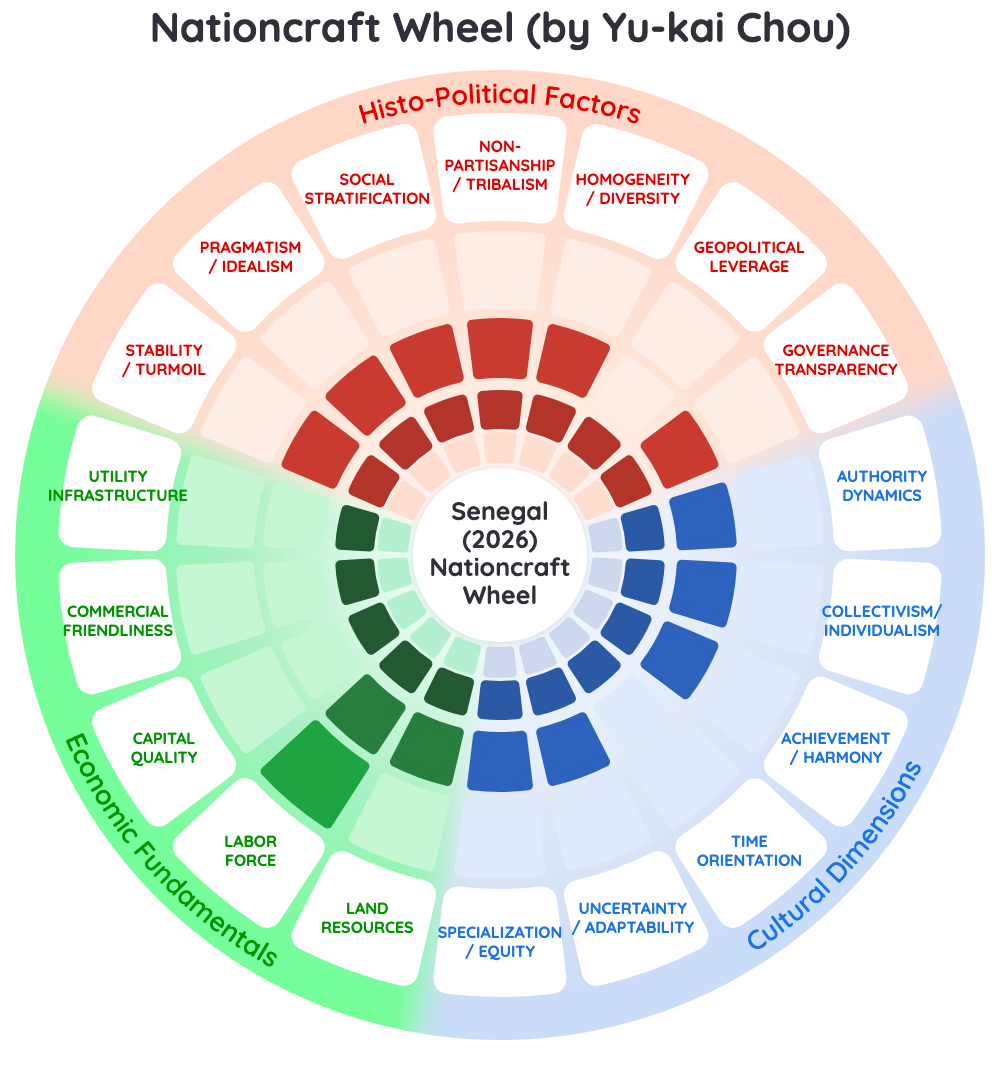
Senegal
Key Insight: The Tandem Trap
Senegal is West Africa’s most consolidated democracy, and in 2026 that strength became its problem. The reformist Faye-Sonko “tandem” won the presidency and a legislative supermajority as one movement, then split over the IMF. With real stability (Stability vs Turmoil V7=6) and genuine transparency (Governance Transparency V13=5 — the new government’s own audit exposed the hidden debt), Senegal’s strong legislature stopped being a check and became a brake, exactly as an inherited debt crisis (about 74% to ~132% of GDP) and new Sangomar oil and GTA gas revenue arrived.
Under the Nationcraft Framework, the exit is Bolivia’s inside-the-coalition shock and Botswana’s disciplined resource management, not Singapore’s one-party technocracy or Rwanda’s single-strongman model: author the fiscal fix from inside PASTEF so it reads as ownership rather than surrender, and write a transparent oil-and-gas revenue rule before the windfall peaks.
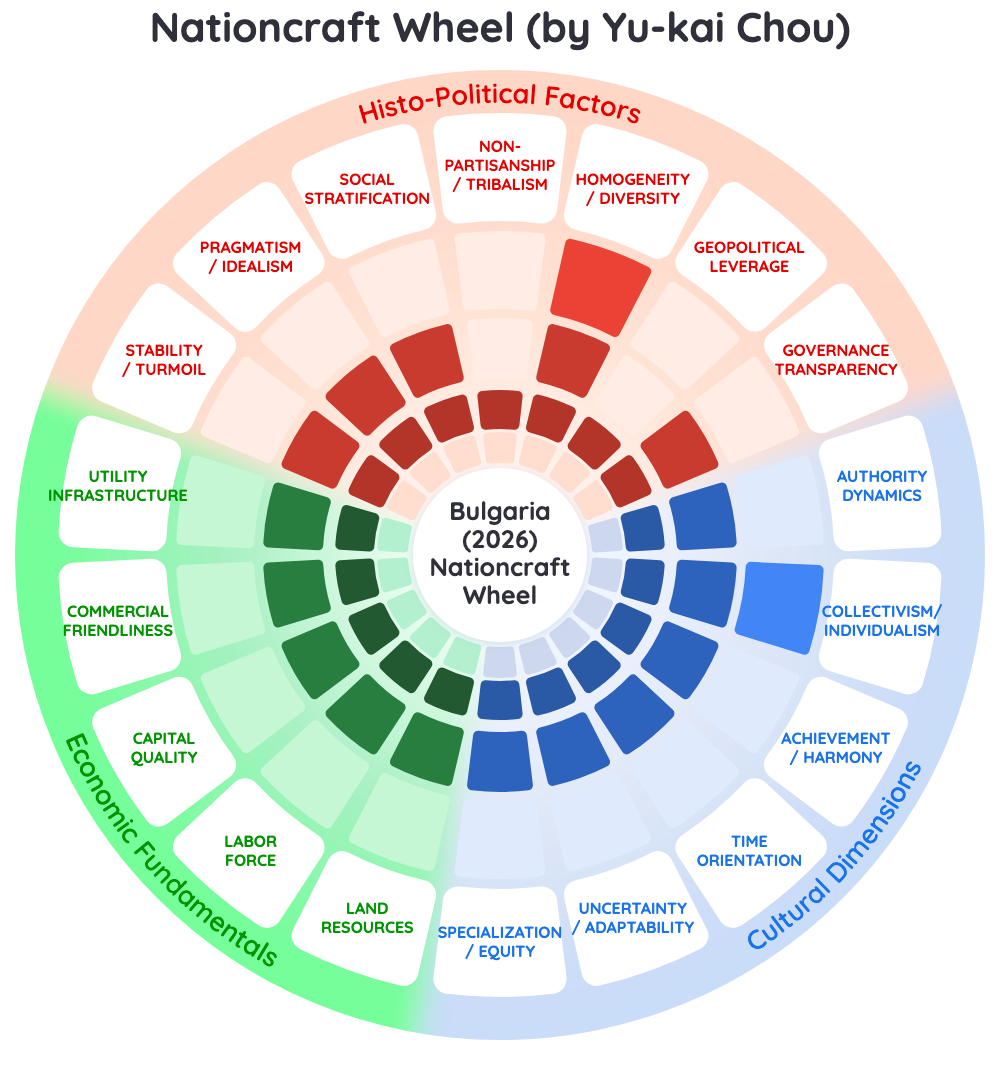
Bulgaria
Key Insight: The Borrowed-Anchor Trap
Bulgaria did everything the outside world asked. It joined the euro on 1 January 2026 after nearly thirty years of imported discipline, with public debt among the lowest in the EU (Capital Quality V16=4). Yet the same quarter brought its eighth election in five years, because its politics are the most fragmented in the Union (Non-Partisanship vs Tribalism V10=2). The macroeconomic shell is sound; the political core is hollow, and the euro anchors the currency without touching the corruption or the collapsing demography.
Under the Nationcraft Framework, the exit is Georgia’s visible anti-corruption cleanup, Estonia’s transparency-by-architecture, and Latvia’s decisive adjustment, not Singapore’s one-party technocracy or Orbán’s capture: spend the new governing majority on one institution built without an external anchor, before the euro becomes the last borrowed crutch.
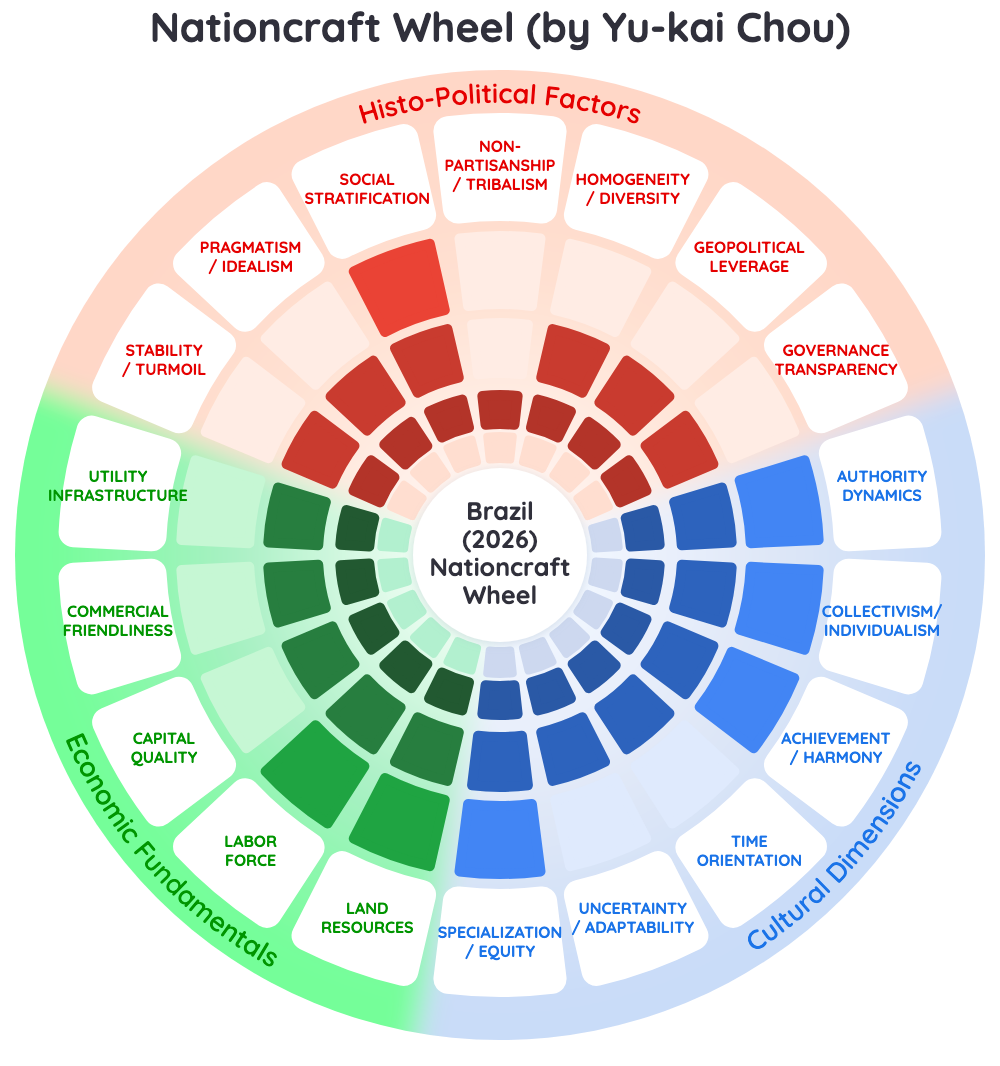
Brazil
Key Insight: The Renewal-Deficit Trap
Brazil did the hardest thing a democracy can do to itself: its Supreme Court convicted a coup-plotting former president (Authority Dynamics V1=7), the one immunity factor the corpus lists against an authoritarian backslide. Yet the tribalism that produced the coup (Non-Partisanship vs Tribalism V10=3), sitting on deep inequality (Social Stratification V9=8), simply regenerates. The 2026 race is an 80-year-old incumbent against the imprisoned strongman’s son. Accountability holds; renewal does not.
Under the Nationcraft Framework, the exit is not another strongman (Bukele, Chavez, Fujimori) but depolarization by design: Spain’s pacted transition, Uruguay’s consensus democracy, and Brazil’s own Plano Real, spending the credibility of the courts that held the line on the guardrails they cannot build.
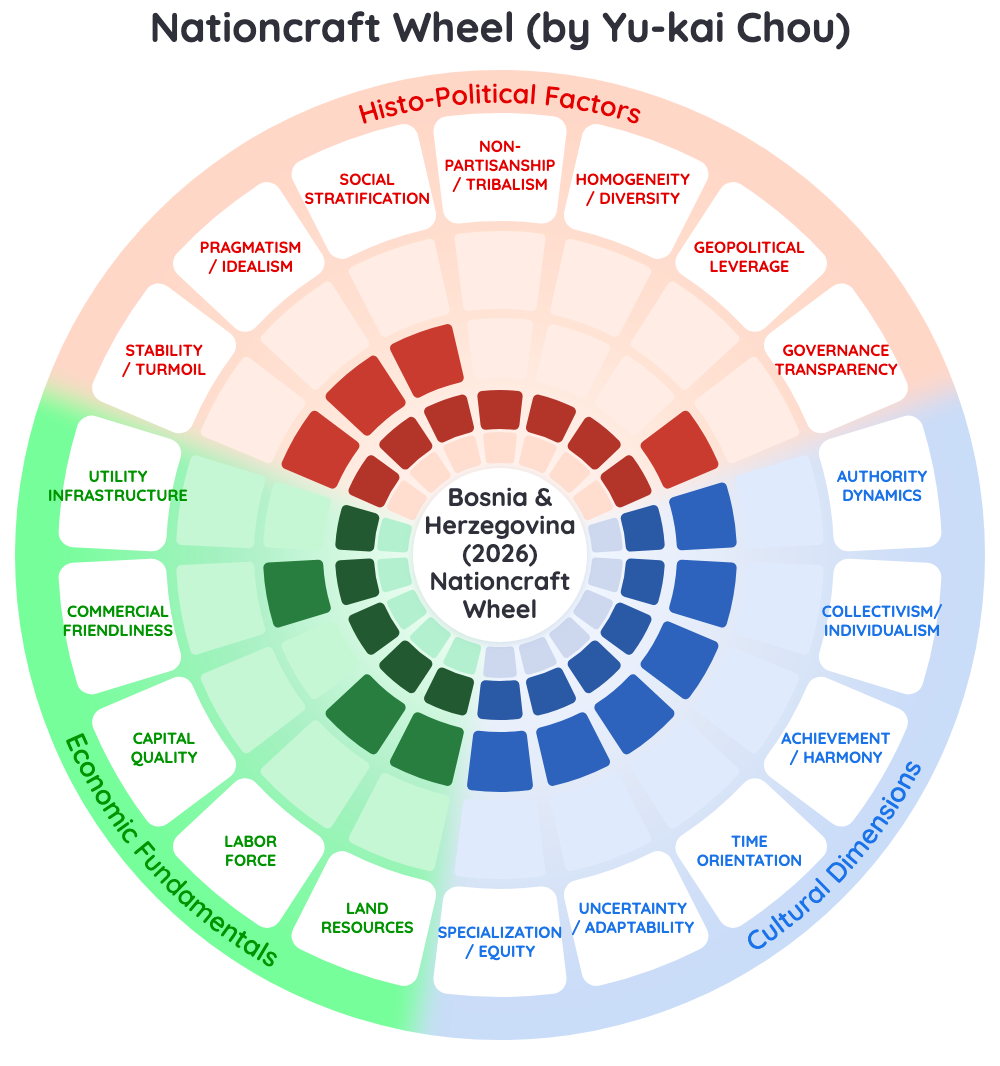
Bosnia and Herzegovina
Key Insight: The Dayton Deadlock
Bosnia’s 1995 Dayton settlement stopped one of modern Europe’s worst wars by handing each people a veto (Non-Partisanship vs Tribalism V10=2, Homogeneity vs Diversity V11=2). Thirty years on, that same veto freezes the state: a nominal central authority (Authority Dynamics V1=5) any entity can block, turmoil-prone stability (V7=4), and weak capital (V16=2) draining the country through emigration. The trait that bought the peace is the trait that keeps the peace from maturing into a functioning state.
Under the Nationcraft Framework, the exit is not a strongman (Rwanda, Singapore, and Bukele all need a commanding center Dayton abolished) but the External Anchor: Croatia’s EU-accession discipline, North Macedonia’s Ohrid-and-Prespa breakthrough, and Spain’s pacted autonomy, binding reform to the outside reward the way Bosnia already de-ethnicized its euro-pegged currency board.

Cambodia
Key Insight: The Patronage Ceiling Trap
Cambodia in 2026 is one of the most completely controlled states in the world, yet its profile shows why control alone builds nothing: total authority (Authority Dynamics V1=9) is routed entirely through patronage (Non-Partisanship vs Tribalism V10=1) and opacity (Governance Transparency V13=2), on top of weak capital, commerce, and infrastructure (V16=V17=V18=2). The Cambodian People’s Party can command anything and construct almost nothing.
The framework’s exit is the one-party developmental path Vietnam, Rwanda, Botswana, and Singapore actually walked: spend concentrated power on capacity instead of loyalty. The July 2026 turn to border nationalism against Thailand is the patronage ceiling announcing itself, dressed up as strength.
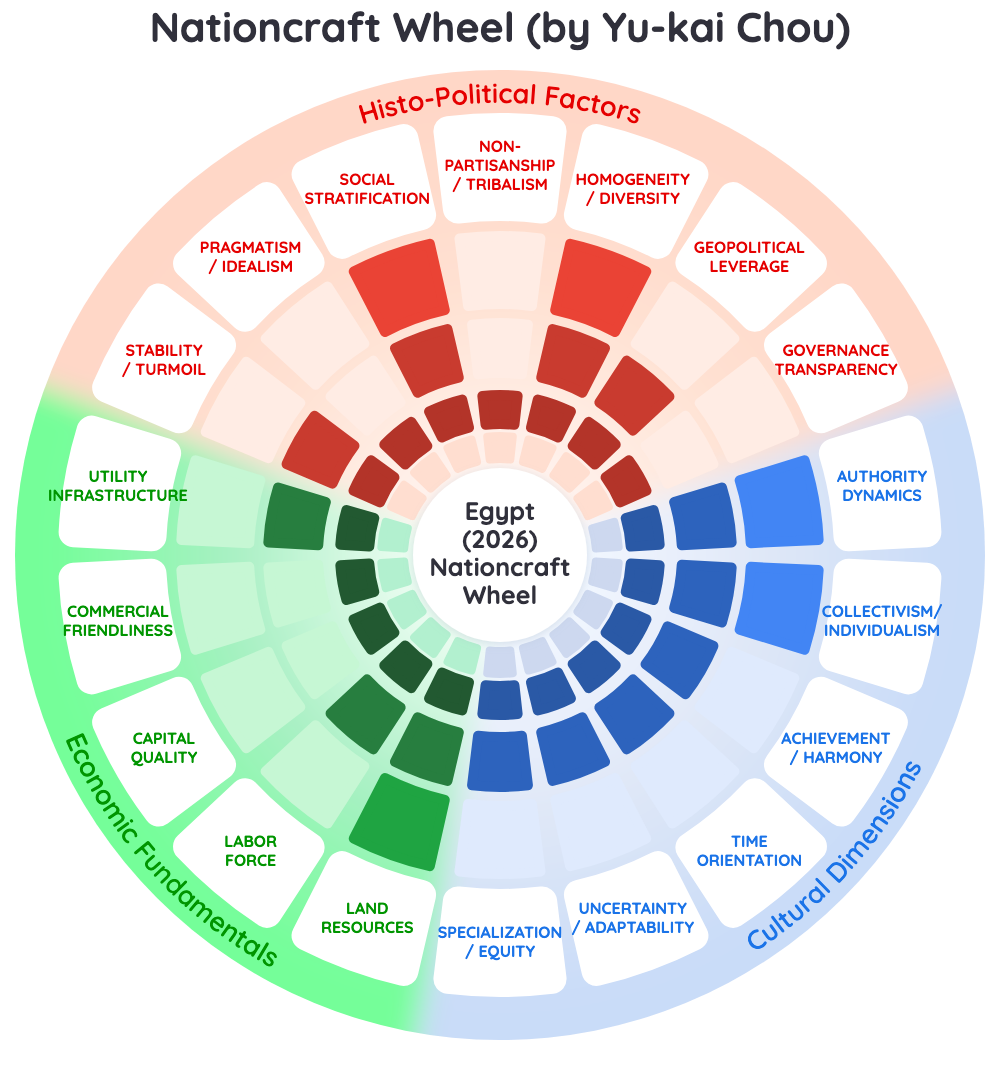
Egypt
Key Insight: The Garrison Economy Trap
Egypt stabilized brilliantly, cutting inflation from 33% to about 12% and rebuilding reserves, and then in July 2026 it ordered the state to exit an economy the military owns at roughly half of GDP. Its profile shows why that is so hard: towering authority (Authority Dynamics V1=9) sitting on a floor of low transparency (Governance Transparency V13=3), thin capital (Capital Quality V16=3), and a hostile commercial field (Commercial Friendliness V17=3). The referee is also the biggest player.
Under the Nationcraft Framework, the exit is not Saudi Vision 2030 (no oil surplus to fund it) or shock therapy (no transparency to survive it), but the credible-opening path Uzbekistan, Indonesia, and Oman walked: it starts with one verifiable act, a publicly audited, time-bound military exit from commerce.

Poland
Key Insight: The Liberum Veto Trap
Poland leads EU growth (3.6% in 2025) and NATO defense spending (4.8% of GDP), yet in March 2026 it vetoed its own €43.7bn EU defense financing. The V-vector explains how: sixteen of eighteen variables sit at 5-plus, with high Pragmatism (V8=8) and Stability (V7=7), while Non-Partisanship vs Tribalism (V10=3) routes two separately elected legitimacies, president and government, into mutual blockage. The Commonwealth’s liberum veto, rebuilt in modern constitutional form.
Under the Nationcraft Framework, the exits that fit are pacted rules rather than captured institutions: Spain’s Moncloa Pacts (SP-017), Sweden’s alternation-proof fiscal frameworks (SP-109), and Slovakia’s post-capture external re-anchoring (SP-090). The rejected imports: Fujimori’s autogolpe, Orbán’s two-thirds capture, Yeltsin’s force resolution.

Vietnam
Key Insight: The Double-Digit Decree Trap
Vietnam ordered itself a double-digit decade: 10% average growth to 2030, set at the 14th Congress and renewed by Resolution 19 in July 2026. The V-vector shows the bind. Only Singapore and China out-score its command quad (Authority Dynamics V1=9, Collectivism V2=9, Pragmatism V8=9, Time Orientation V4=8), while the variables that decide whether 10% is reachable sit at the floor: Capital Quality V16=3, Commercial Friendliness V17=4, Utility Infrastructure V18=4, Governance Transparency V13=4. Targets are commands; growth inputs are grants.
Under the Nationcraft Framework, the fits are command-withdrawal packets: Đổi Mới’s own unfinished sequel (SP-018), Taiwan’s SME-distributed miracle (SP-009), and Singapore’s CPF-and-EDB instruments (SP-002). The rejected imports: Park’s chaebol credit (SP-008), re-run Deng (SP-003), and shock therapy (FP-016, SP-005).

Haiti
Key Insight: The Ballot-First Trap
Haiti scheduled its first national election in a decade for December 13, 2026, after the August 30 plan collapsed over security. The V-vector shows why the ballot keeps failing: an authority-primed culture (Authority Dynamics V1=8) stretched over a state at the floor, with Stability V7=2, Governance Transparency V13=1, Capital Quality V16=1, and Commercial Friendliness V17=1 while gangs hold 90% of the capital. A vote cast before the monopoly on violence returns a contested prize, never a mandate.
Under the Nationcraft Framework, the fits are sequencing packets: Timor-Leste’s trusteeship-then-elections path (SP-074), Côte d’Ivoire’s post-monopoly recovery (SP-061), and the Dominican Republic’s same-island growth model (SP-055). The rejected imports: Bukele’s state of exception (SP-064), Rwanda-style cadre rule (SP-006), and Fujimori shock therapy (SP-033).

China
Key Insight: The Supply Reflex Trap
China holds the strongest command quad in the 147-country corpus (V1=10, V2=10, V4=9, V12=10): a state that orders factories, rail, and whole industries into existence. Household consumption still sits at 39.57% of GDP against a 63.62% world average, because demand depends on the variables no order reaches: household equity (V6=5), transparency (V13=4), and commercial trust (V17=6). Every weak-demand quarter gets answered with another supply instrument.
Under the Nationcraft Framework, the fits are demand-infrastructure packets: Roosevelt’s New Deal social insurance (SP-101), Sweden’s transparent property-bust workout (SP-109), and Denmark’s flexicurity floor (SP-113). The rejected imports include China’s own Deng packet (SP-003), Park-era export push (SP-008), and Yeltsin shock therapy (FP-016).

Saudi Arabia
Key Insight: The Single Artery Trap
Saudi Arabia pairs one of the corpus’s strongest command quads (V1=10, V2=10, V14=10, V16=9) with a dependency no decree can move: most export volume exits through a strait its rival can close. The 2026 war proved both halves — exports halved in March while the East-West Pipeline maxed out at its 7M bpd nameplate, and the lone bypass took Iranian fire. Then $100 oil paid the kingdom for the crisis: $67.2B in H1 Aramco profit while the deficit narrowed.
The analysis rejects Norway, Botswana, Park, Deng-SEZ, and Chicago Boys templates on precondition failure, and routes study toward Zayed’s UAE (SP-105), Qatar’s Hamad packet (SP-116), and Kazakhstan’s multi-vector artery management (SP-044). Selection reason: news-primary, the 60-day Hormuz safe-passage window expiring mid-August 2026.

Mexico
Key Insight: The Borrowed-Calm Trap
Mexico’s homicide count fell 30 percent in 2025 and kept falling through 2026, yet the state’s conviction machinery (Governance Transparency V13=3) never built the capacity that would make the peace its own. The calm is leased from lenders the government does not command: cartel consolidation after won wars, a World Cup truce, decapitation dividends, and US prisons holding extradited capos. A deep deference culture (Authority Dynamics V1=8, Collectivism V2=8) makes any credible local governor look legitimate, including the cartels.
The analysis rejects the Bukele, Saakashvili, Fujimori, Suharto, and LKY templates on precondition failure, and routes study toward Colombia’s institutional islands (SP-035), Ukraine’s bypass institutions (SP-117), and Mexico’s own half-finished NAFTA packet (SP-046), with the 2026 USMCA review as the anchor.

Yemen
Key Insight: The Frozen War Trap
Yemen’s V-vector scrapes the framework floor: Stability V7=1, Transparency V13=1, Capital V16=1, against a culture saturated with authority (V1=9) and collective loyalty (V2=9). The 2022 truce froze front lines without touching those variables, so four years of calm hardened two proto-states with two central banks, two rials, and re-armed fronts. The August 2026 escalation, the largest fighting since the truce, is the trap closing.
The analysis rejects the Côte d’Ivoire, Mozambique, Cambodia, Bolivia, and Tajikistan templates on precondition failure, and routes study toward PB-04’s minimum viable state, Nepal’s insurgency-absorption mechanism (SP-082), and Timor-Leste’s escrowed Petroleum Fund (SP-074) for the contested oil restart.

North Korea
Key Insight: The Fortress Dividend Trap
North Korea holds the corpus’s purest command pair (Authority Dynamics V1=10, Collectivism V2=10), the exact profile Deng’s China reformed with, locked under Pragmatism V8=1 because Juche doctrine is the dynasty’s legitimacy source. In 2024–2026 the isolation fortress started paying rent: Russian arms and troop income, patron competition, and summit courtship lifted Geopolitical Leverage (V12=8) while Capital V16 and Commercial Friendliness V17 stayed at 1.
The analysis rejects the Doi Moi, Deng, shock-therapy, Singapore, and Myanmar-opening templates on precondition failure, and routes study toward Cuba’s Special Period survival (SP-094), Uzbekistan’s insider thaw (SP-045), and Saudi-style legitimacy rebasing (SP-037).

Zimbabwe
Key Insight: The Restored-Legacy Trap
Zimbabwe pairs the endowments of a middle-income reformer (Land Resources V14=7, Labor Force V15=6, one of Africa’s most literate populations) with the governance floor of a fragile state: Transparency V13=1, Capital V16=1, Commercial Friendliness V17=1 under Authority V1=9. The July 2026 constitutional amendment (terms extended to 2030, direct presidential elections abolished) landed in the same window as record mineral exports and an on-track IMF program. The stabilization is paying for the entrenchment.
The analysis rejects the LKY, Deng, Đổi Mới, Saakashvili, convertibility, Nazarbayev, post-Milošević, and Bolivarian templates on precondition failure, and routes study toward Zimbabwe’s own GNU stabilization (SP-076), Botswana’s institutions-before-minerals sequencing (SP-004), and Angola’s within-party succession opening (SP-063).

Germany
Key Insight: The Consensus Machine Trap
Germany runs the strongest economic block in the European corpus (Labor V15=9, Capital V16=9, Commercial V17=9, Infrastructure V18=9) on a political operating system engineered to prevent rapid change: Authority V1=5, consensus politics V10=8, long-termism V4=9, stability V7=9. Three years of stagnation later, the machinery built to guarantee stability is feeding the anti-system surge it was designed to lock out, with the AfD polling 42 percent ahead of Saxony-Anhalt’s September 6 vote.
The analysis rejects the Shock Therapy, Rogernomics, Bukele, De Gaulle, India-1991, and Meiji templates on precondition failure, shows why Germany’s own Wirtschaftswunder packet (SP-015) cannot be rerun, and routes study toward the Wassenaar bargain (SP-112), Danish flexicurity (SP-113), and the Hawke-Keating Accord (SP-107).

Rwanda
Key Insight: The Star Pupil Trap
Rwanda executes the discipline half of the Singapore packet with near-perfect form (Pragmatism V8=9, Authority V1=8, Commercial Friendliness V17=8) while lacking every endowment that made Singapore compound: Geopolitical Leverage V12=3, Capital V16=3, Infrastructure V18=4. The gap has been financed by donor goodwill and by mineral flows from the disorder next door, and the Washington Accords now squeeze both funding sources at once — formalized, traceable trade kills the informal premium while US sanctions on the RDF thin donor patience.
The analysis rejects the LKY, Meiji, Park-Korea, EPRDF, and Mozambique donor-darling templates on precondition failure, and routes study toward Botswana’s institutions-before-resources sequencing (SP-004), Ukraine’s external-anchor transparency reforms (SP-117), and an education-first human capital build aimed at the 2034 succession horizon.

Russia
Key Insight: The Fortress Economy Trap
Russia holds the corpus’s fullest fortress hand — Authority Dynamics V1=10, Time Orientation V4=8, Geopolitical Leverage V12=9, Land Resources V14=9 — over its emptiest garrison ledger: Adaptability V5=3, Non-Partisanship V10=1, Transparency V13=2, Capital Quality V16=4, Commercial Friendliness V17=4. The configuration that absorbs a siege cannot pay for one, and the September 2026 shuttle diplomacy landed the same week the budget data made that visible.
Written as Witkoff and Kushner shuttled between Moscow and Kyiv, the analysis rejects the Yeltsin (FP-016), Deng (SP-003), LKY (SP-002), Poland (SP-005), Estonia (SP-007), Norway fund (SP-106), Vision 2030 (SP-037), and Nazarbayev (SP-044) packets on precondition failure, and routes study toward Vietnam’s Đổi Mới sequencing (SP-018), Uzbekistan’s managed opening (SP-045), and Cuba’s Special Period (SP-094) as the ceiling warning.
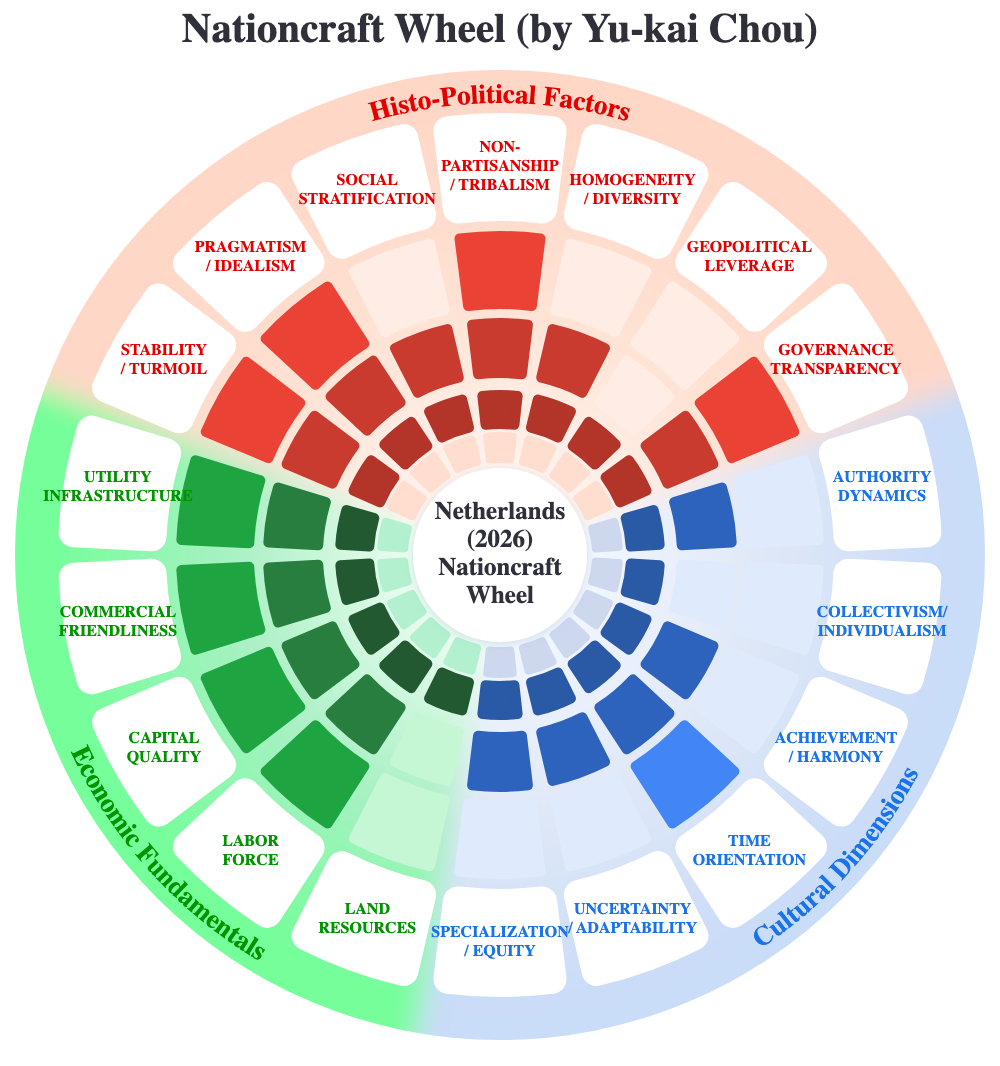
Netherlands
Key Insight: The Second Dutch Disease
The Netherlands runs the corpus’s cleanest execution stack — Transparency V13=9, Labor V15=8, Capital V16=9, Commercial Friendliness V17=9, Infrastructure V18=9 — over a decaying representation layer at Authority Dynamics V1=4 and Collectivism V2=2. The machine is so competent it masks the political decay, the way Groningen gas once masked industrial decline: 9.5 million pensions converted on schedule between a cabinet collapse and a 117-day minority formation, so the politics never has to repair.
Written as the Jetten minority cabinet forced through a “budget for ten parties,” the analysis rejects the Lee Kuan Yew (SP-002), Deng (SP-003), Rogernomics (SP-108), Poland shock-therapy (SP-005), Saakashvili (SP-051), and the country’s own Wassenaar (SP-112) packets on precondition failure, and routes study toward Ireland’s Tallaght mechanism (SP-016), Danish flexicurity (SP-113), Sweden’s 1990s consolidation (SP-109), and Austrian corporatism (SP-115).
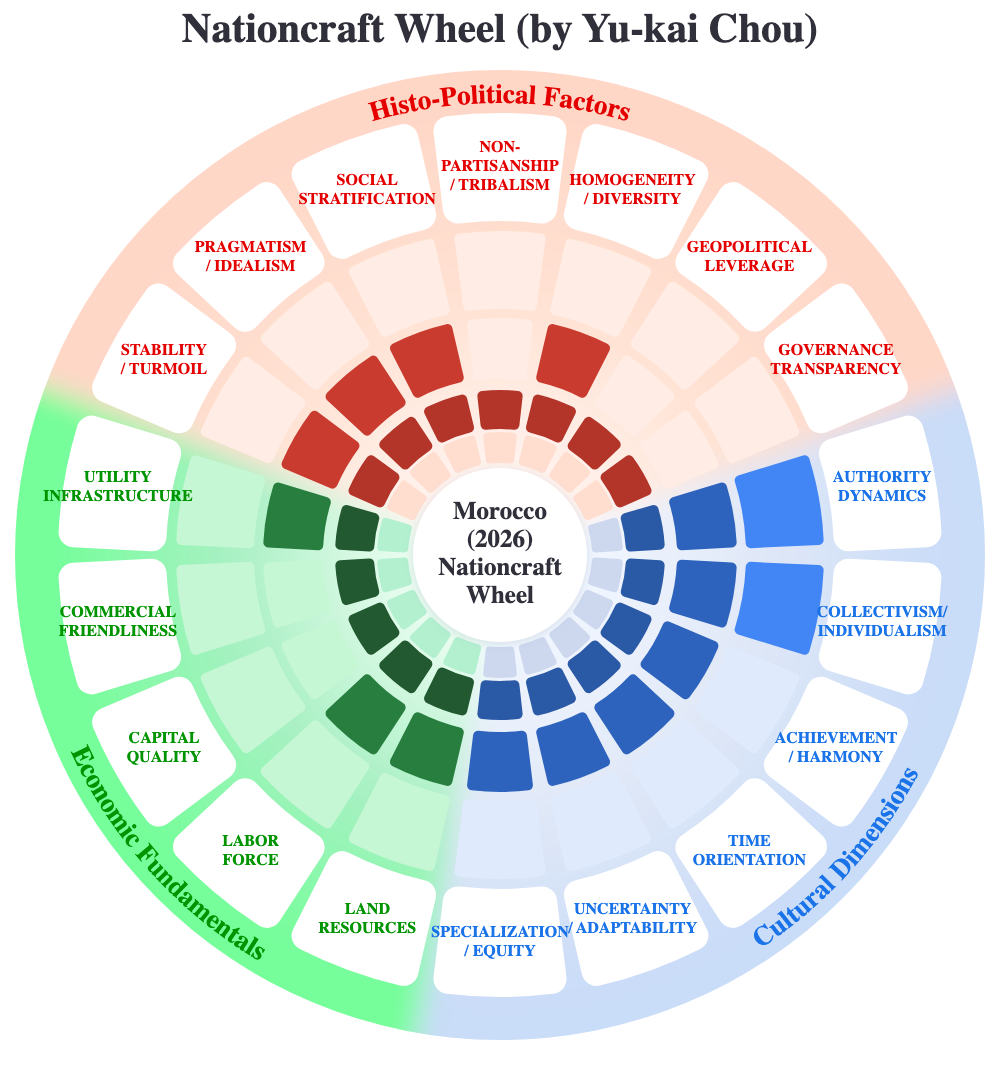
Morocco
Key Insight: The Two-Speed Kingdom Trap
Morocco’s V-vector splits into two operating systems: V1=8 royal authority plus V2=8 collectivism build world-class hardware at decree speed (Tangier Med, Africa’s first high-speed rail, a UN-endorsed Western Sahara plan), while health, schools, and jobs route through a service lane crippled by V10=3 fragmentation, V13=3 opacity, V8=4 patronage logic, and V4=4 horizons. The fast lane’s success finances the slow lane’s failure, so stadiums outrun hospitals and the September 23 election only reshuffles the slow lane.
Written as the campaign opened for Morocco’s first national vote since GenZ212, the analysis rejects eight playbooks (Vision 2030, Dubai, LKY, Sisi, Atatürk, Park, Portugal-EU, NAFTA) on precondition failure and routes study toward Oman’s services-first monarchy (SP-036), Jordan’s stability-without-oil bargain (SP-084), and Thailand’s Eastern Seaboard corridor (SP-020), with Morocco’s own SP-028 Hassan II packet as the historical warning.
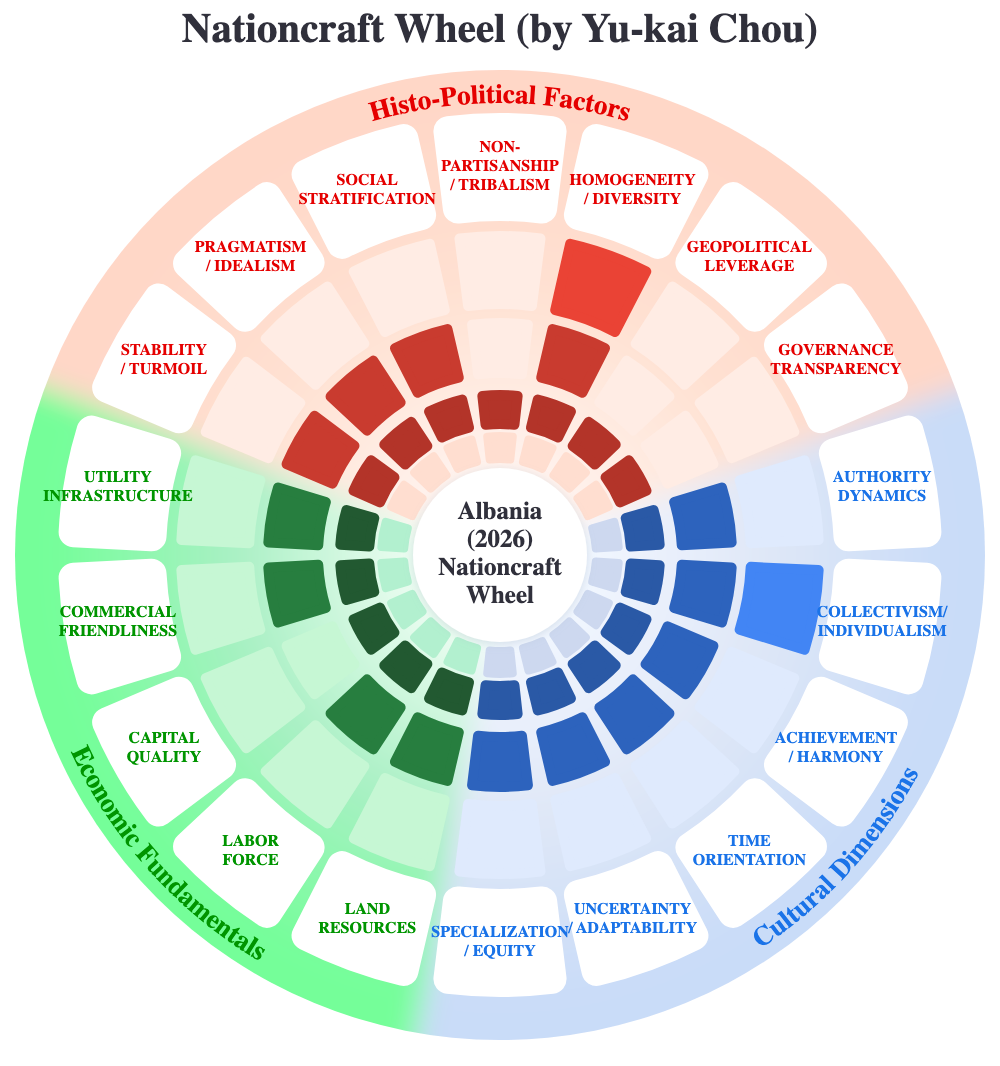
Albania
Key Insight: The Departure Dividend
Albania entered the concluding phase of EU accession in the same week its largest protest movement since communism began. The 18-variable profile explains the coincidence: V2=7 collectivism and V15=6 labor quality sit atop a V13=3/V10=3/V16=3 governance core, and mass emigration pays the state a dividend — remittances in, dissent out, EU-legible numbers up — that lets the frozen variables stay frozen.
The analysis rejects eight celebrated reform packets on preconditions and routes Albania toward Slovakia’s post-Mečiar turnaround, Romania’s prosecution-inside-accession model, and Ireland’s Celtic Tiger — the corpus’s only recorded reversal of an emigration economy.
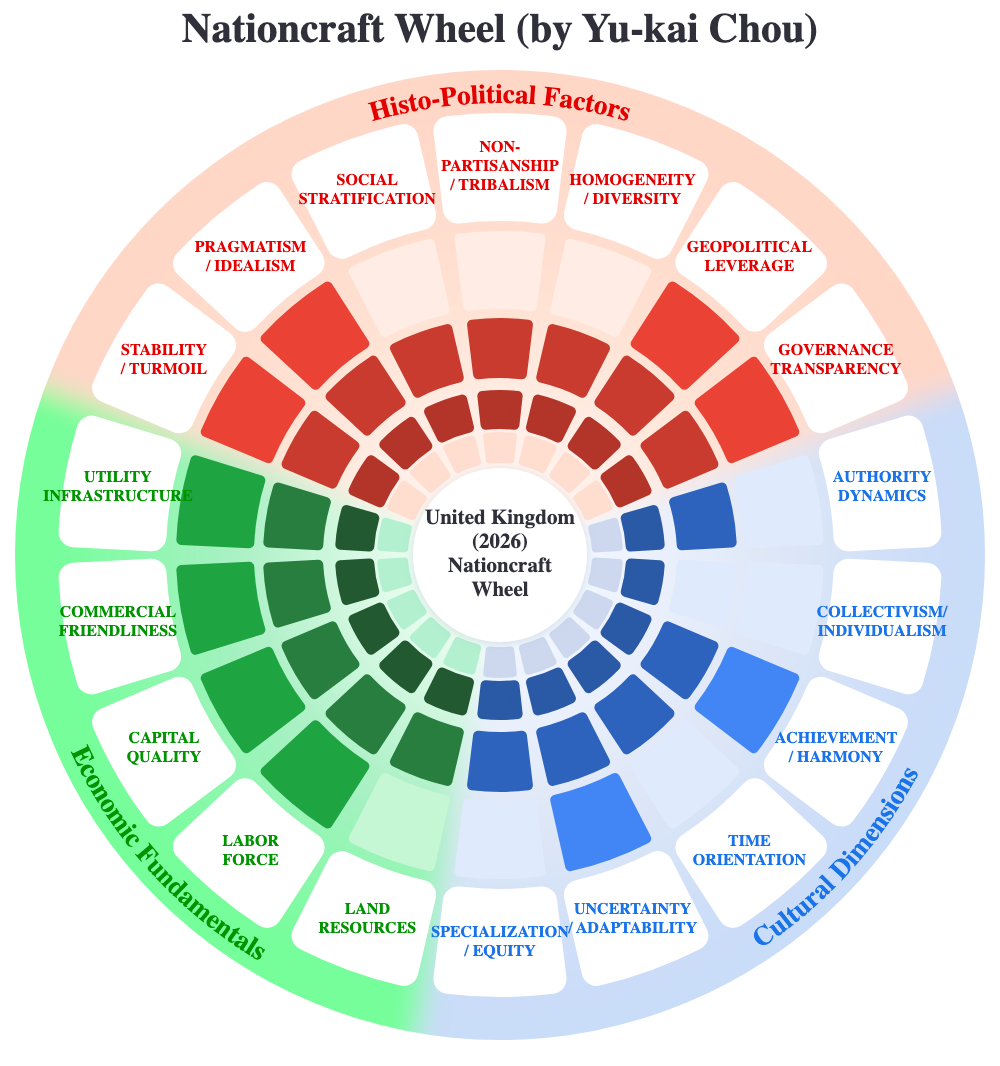
United Kingdom — September 2026
Key Insight: The Honeymoon Ledger
Britain’s second 2026 reading, taken seven weeks into the Burnham premiership. The vector is unchanged from May — V7=9 institutional floor, V10=4 five-party fracture, V16=9 gilt-market discipline — while the country’s political weather transformed completely. The paradox: the only net-positive leader in Britain holds a depreciating personal asset that no nation variable recognizes, with the October budget set to reconcile the honeymoon against the ledger.
The packet audit rejects eight celebrated playbooks, including Thatcher’s own SP-102, and routes study toward Canada 1993, Australia 1983, and Sweden 1991 — the three honeymoon-to-machinery conversions in the corpus.
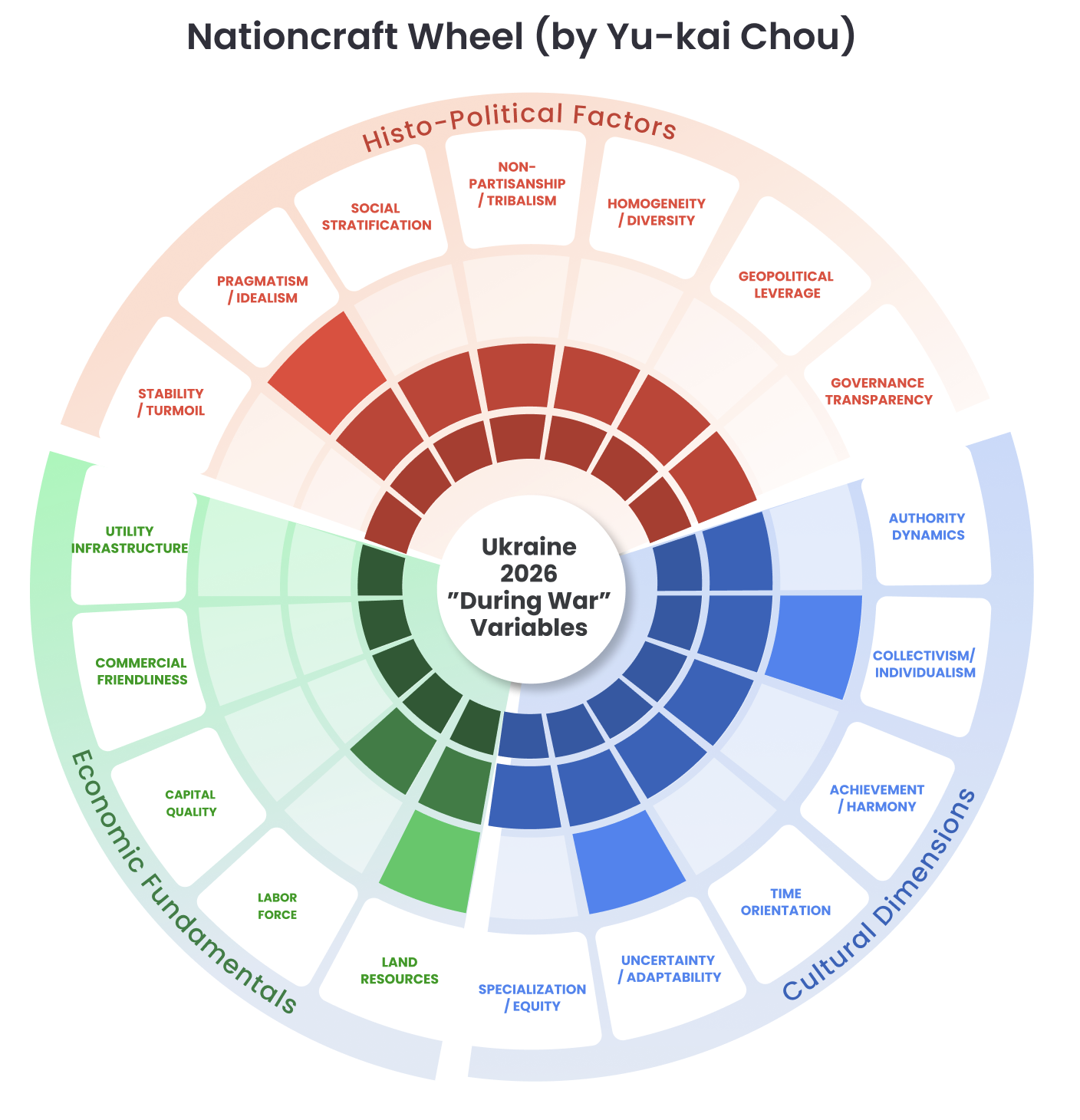
Ukraine — September 2026
Key Insight: The Escrowed Recovery Trap
Ukraine’s first full post analysis, written the week US envoys made their first wartime visit to Kyiv. The vector pairs floor-level material scores (V7=1, V16=1, V18=1) with near-ceiling social ones (V2=8, V5=8), and the $524 billion RDNA4 rebuild plus €210 billion in frozen Russian assets sit escrowed behind a settlement under live negotiation. The trap: the peace that unlocks the money also unwinds the war-forged cohesion that would absorb it well.
The packet audit rejects Yeltsin shock therapy, CPA Iraq, Afghan aid saturation, Dayton, and Sisi stabilization, and routes study toward the Wirtschaftswunder, Israel 1948, Estonia digital, Croatia’s war-to-EU path — and SP-117, Ukraine’s own still-running post-Euromaidan packet.
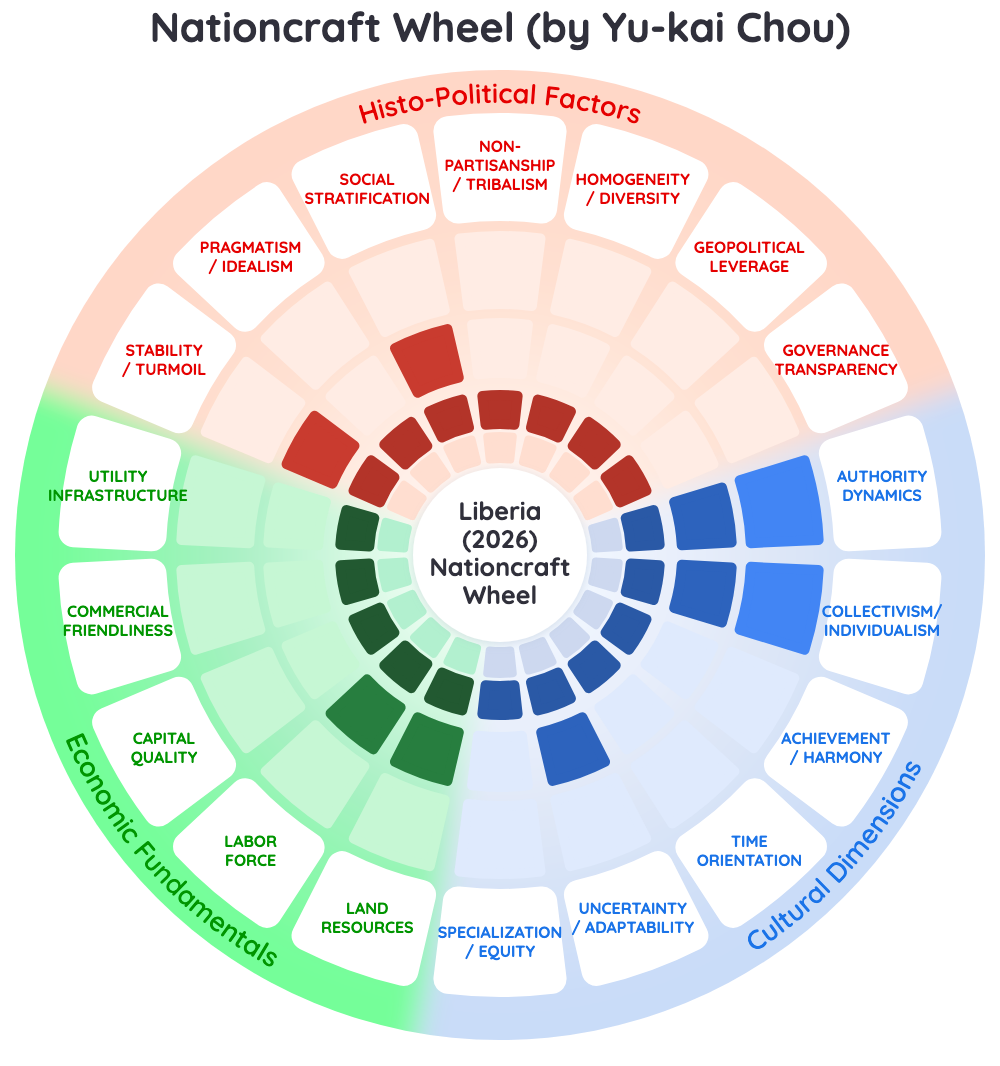
Liberia (2026)
Key Insight: The Concession Republic Trap. Africa’s oldest republic pairs a cohesive cultural base (V1=7, V2=7, V15=6) with the region’s worst institutional triple: V13=1 transparency, V16=1 capital, V17=1 commercial friendliness. Since Firestone’s 1926 million-acre lease, the state has survived by renting out land, minerals, its ship flag, and its budget, so the rents keep it alive at exactly the institutional level where renting stays necessary.
Written the week Liberia completed its fourth IMF ECF review with every criterion met, the analysis rejects five celebrated playbooks (LKY, Norway’s oil fund, Rwanda, Zambia privatization, Mozambique’s donor-darling path) and routes study toward Ghana 1983, Botswana’s Debswana negotiation, and Côte d’Ivoire’s post-war rebound, sequenced through a V13 transparency floor first.
Colombia — Fiscal Reckoning (2026)
Key Insight: The Escape Clause Trap. Colombia’s V-vector pairs real assets (V2=9 collectivism, V14=8 resources, V15=8 labor) with an institutional trough (V13=3 transparency, V10=3 tribalism, V5=3 adaptability), so its fiscal rule substituted for trust rather than supplementing it. The rule carried a legal escape clause; activating it in June 2025 deleted the credibility it existed to store, and by September 2026 a new president was opening IMF talks against a projected 9.4% deficit for 2027.
The analysis rejects four celebrated stabilization playbooks (Brazil’s Plano Real, Ecuador’s dollarization, Georgia’s Saakashvili blitz, Azerbaijan’s oil fund) and routes study toward Canada’s SP-111 Program Review, Sweden’s SP-109 institutional lock-in, and Colombia’s own SP-035 island-building move — sequenced so consolidation opens the system instead of concentrating it.
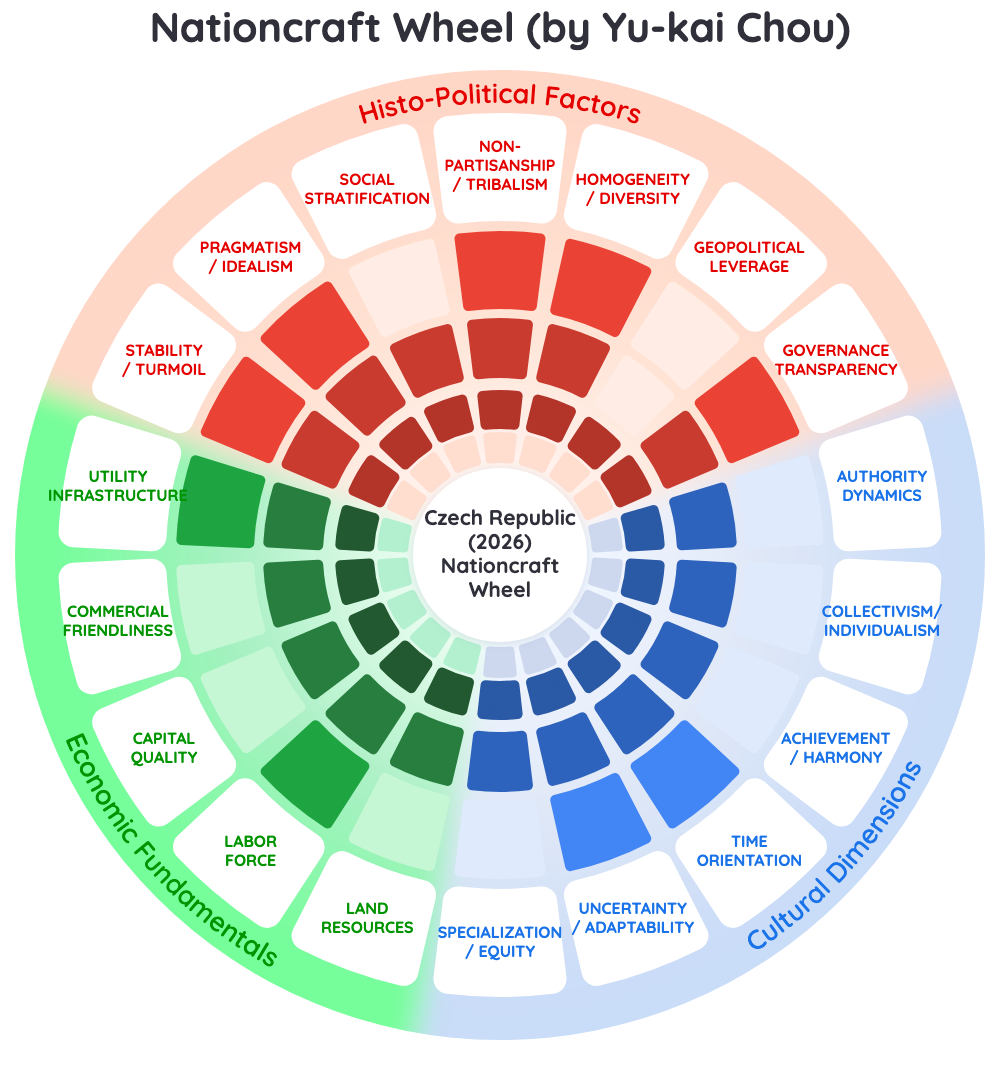
Czech Republic
Key Insight: The Firm-State Trap
The Czech V-vector is one of the strongest in the corpus: stability V7=8, pragmatism V8=8, transparency V13=7, with debt at 44.3% of GDP and unemployment near 3%. Yet the same pragmatism that produced the model post-communist transition now tolerates a prime minister whose Agrofert conflict of interest stays unresolved, so the state inherits a firm’s central defect: nobody inside the arrangement audits the owner.
The analysis rejects six imported playbooks, from Hungary’s consolidation path to every strongman shortcut, and routes study toward the consensus-era fiscal packets (Sweden SP-109, Canada SP-111, Wassenaar SP-112) that match a high-pragmatism, long-horizon configuration.
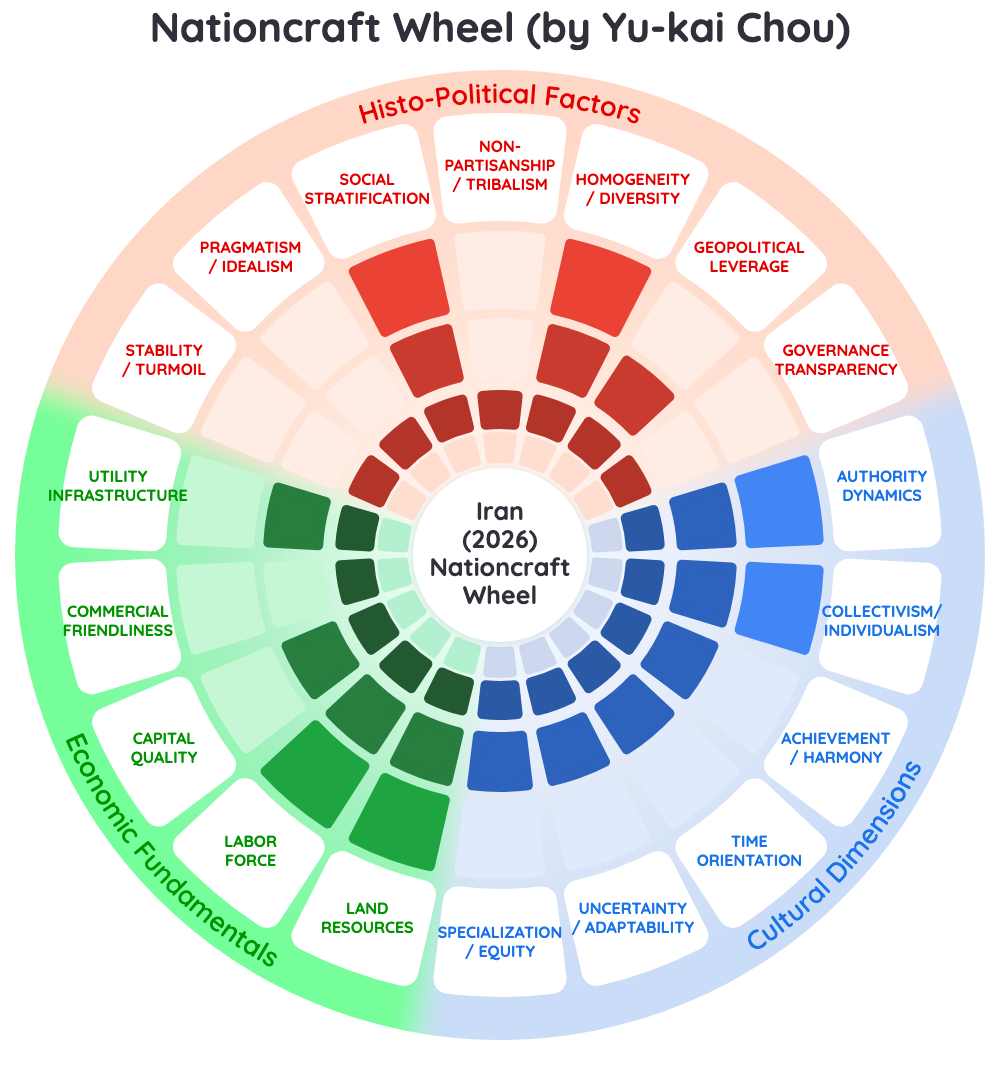
Iran — Resistance Economy (2026)
Key Insight: The Resistance Economy Trap
Iran engineered an economy whose design goal is surviving siege, and it works: the state absorbed war, blockade and near-70% inflation without breaking. The 18-variable read shows capacity without conversion — V1=10 authority, V2=9 collectivism and V14=8 resources against V8=2 pragmatism and V13=2 transparency. An economy that always endures never has to choose an exit, so survival quietly replaced strategy.
The analysis rejects eight playbooks Iran’s configuration cannot run, from Deng’s opening to Vision 2030, and routes study toward Đổi Mới, Uzbekistan’s post-Karimov pivot and Spain’s pacted transition: packets that began when doctrine stopped being the ruling credential.
Argentina — Anchor Trap (2026)
Key Insight: The Anchor Trap
Argentina’s disinflation runs on a borrowed anchor: a US$20B IMF program and a US$20B US Treasury swap stand behind a currency band that a V16=3 capital-famine system cannot defend alone. The 18-variable read shows why every Argentine stabilization reaches for an external anchor — V5=3 dollar-hoarding psychology has priced out the peso — and why the anchor then squeezes the recovery that must sustain it politically.
The analysis reads Argentina’s own convertibility packet (FP-001) as the canonical warning — an anchor without an exit converts a stabilization miracle into default — and routes study toward the three packets that exited on purpose: Brazil’s Plano Real, Bolivia’s Decree 21060 and Sweden’s 1992 float.
France — Censure Ratchet (October 2026)
Key Insight: The Censure Ratchet Trap
France’s October 2026 budget standoff read through the 18 variables: a capacity cluster near the top of the corpus (V16=9, V13/V15/V17/V18=8) wired to V10=4 tribalism, so every consolidation budget becomes a censure referendum. Each fallen government raises debt service, enlarging the correction the next one must propose while shrinking the chamber’s willingness to vote it.
The analysis rejects six shock and decree playbooks outright and routes study toward Canada’s Program Review (SP-111), Sweden’s cross-bloc consolidation (SP-109) and the Dutch Wassenaar accord (SP-112): the pact comes before the budget.
Bolivia — Second Dose (October 2026)
Key Insight: The Second Dose Trap
Bolivia’s US$1.9 billion IMF program, approved October 2, re-runs the country’s own 1985 stabilization packet under a second President Paz. The V-vector says the economics are easier than 1985 and the politics are harder: V2=7 collectivism and V9=7 stratification store the memory of who paid for the last cure, V10=2 supplies the mobilization channels, and V8=3 pragmatism decides whether the review-cycle consensus survives its first blockade winter.
The analysis rejects eight imported playbooks, from Argentina’s convertibility peg to Egypt’s coercion-backed float, and routes study toward Bolivia’s own Decree 21060 (SP-118), Brazil’s Plano Real (SP-034) and India 1991 (SP-011): stabilization survives where its mechanism is public property.
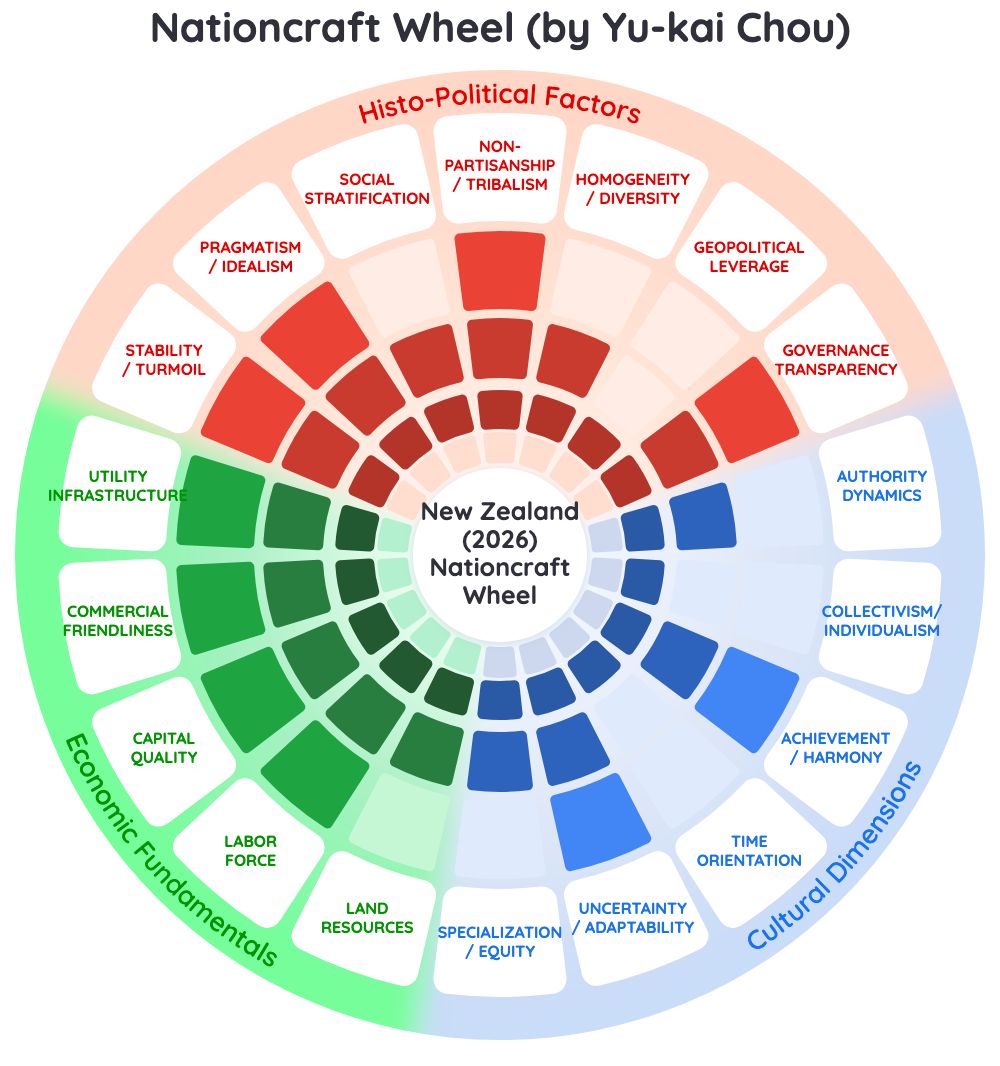
New Zealand
Key Insight: The Three-Year Horizon Trap
New Zealand carries one of the cleanest V-vectors in the corpus: stability V7=9, transparency V13=8, commercial friendliness V17=8, pragmatism V8=8. The binding constraint is V4=3: a three-year electoral term in a unicameral system makes policy reversal nearly free, so twenty-year problems like productivity, housing, and emigration never receive twenty-year answers. The cleaner the machine, the cheaper the U-turn.
The analysis rejects seven imported playbooks, from Singapore’s LKY packet to Thatcherism and the Celtic Tiger, and routes study toward the durability packets: Australia’s Accord (SP-107), Canada’s Program Review (SP-111), and the Dutch Wassenaar pact (SP-112).
Meiji Open Reform Packet (SP-001)
Key Insight: The Selective Opening Paradox
The corpus’s founding packet, read end to end: Meiji Japan entered 1868 with treaties it could not refuse, almost no capital, and no modern infrastructure, then converted a ceiling-level cultural stack (V1=10, V2=10, V4=10, V11=9) into forty-four years of sequenced reform. The paradox is that the century’s most successful opening was run by men obsessed with refusing to become Western — technique imported inside a native frame.
The deep-dive screens all 147 corpus countries against the packet’s V-floors, finds one full modern match, and keeps the bill attached: over-militarization, zaibatsu concentration, and stunted accountability are recorded next to the sequencing lessons reformers can actually use.
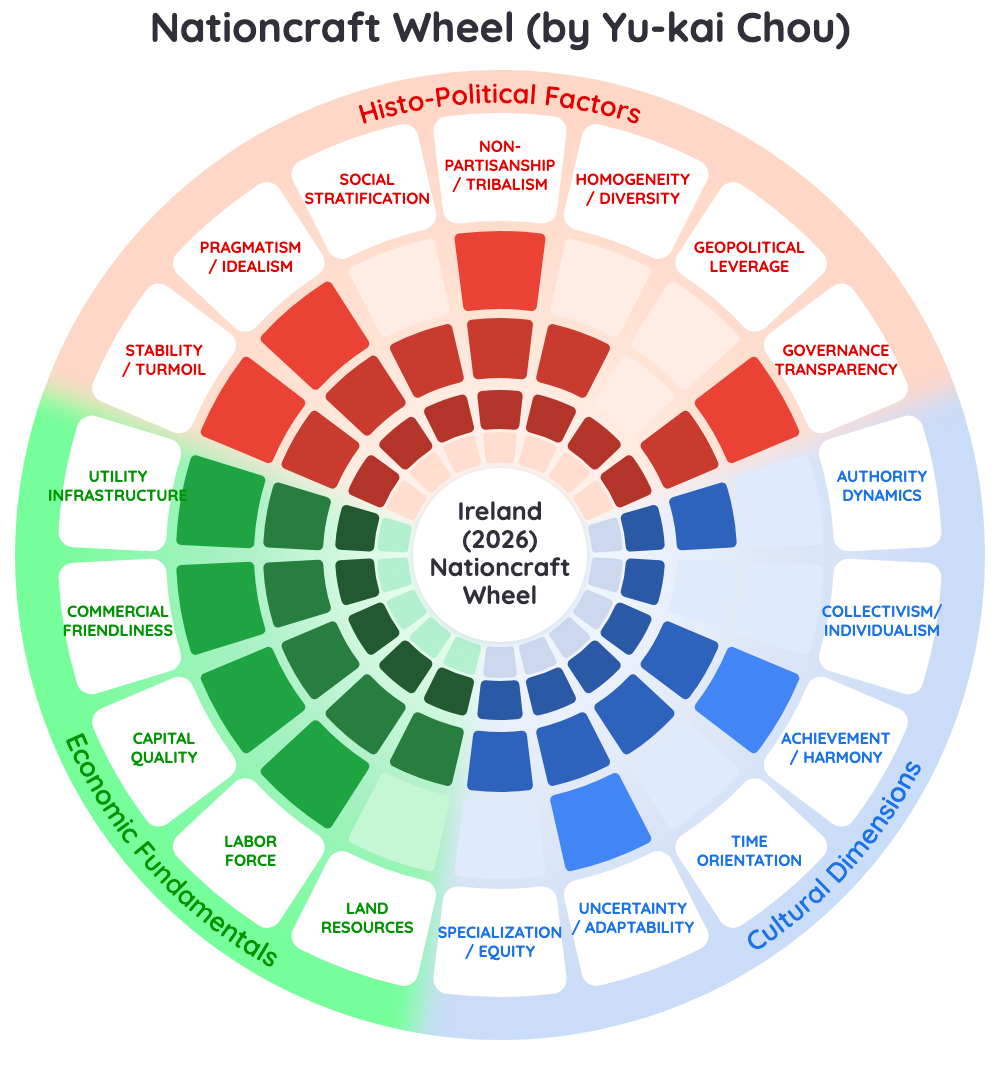
Ireland
Key Insight: The Windfall Trap
Ireland pairs a maximal commercial engine (V16=9 capital quality, V17=9 commercial friendliness) with V12=3 geopolitical leverage: record surpluses flow from a corporation tax base where roughly ten foreign groups pay about half the take. The V-vector shows why the comfort is the trap — V7=9 stability and V10=8 consensus politics remove the pressure to convert windfall into delivery, while V18 infrastructure quietly underperforms its rating.
The analysis retires the Celtic Tiger packet (SP-016) as already spent, rejects the Singapore, Hong Kong, Qatar, Baltic, and Hungarian playbooks, and routes study toward Norway’s oil fund rule (SP-106), Finland’s post-Nokia pivot (SP-110), and Canada’s Program Review (SP-111).
Israel — Ballot Backlog (October 2026)
Key Insight: The Ballot Backlog
Israel enters October 27 with a spike profile: V3=8 achievement, V5=8 adaptability, V8=8 pragmatism and V16=8 capital quality stacked on V10=2 tribal bloc politics. The first full-term Knesset since 1988 was achieved by deferring the judicial overhaul, the haredi draft and the October 7 commission, so one ballot now carries five regime-level verdicts into a party system that polls 52-51.
The analysis tests Israel against its own SP-027 Nation-Building Packet, rejects the LKY, Park, Bukele, Saakashvili, New Deal and Chicago Boys imports, and routes study toward consensus machinery: Wassenaar (SP-112), Austria’s social partnership (SP-115) and Ireland’s pacts (SP-016).
Peru — Iron-Fist Mandate Trap (October 2026)
Key Insight: The Iron-Fist Mandate Trap
Ten weeks into Keiko Fujimori’s presidency, Peru’s configuration is grinding her maximum-force mandate down in real time: V1=7 demand for a strong hand, V10=2 party fragmentation, V13=3 transparency deficit and V4=4 short horizons turned a 120-day, 66-measure decree request into a 90-day, 20-measure delegation still awaiting Senate ratification.
The analysis rejects the Bukele (SP-064), Fujishock (SP-033), LKY, Deng and Poland imports against Peru’s V-vector and routes study toward pact machinery: Spain’s Moncloa Pacts (SP-017), Uruguay’s consensus floors (SP-047) and Botswana’s fiscal rules (SP-004).
India — Umpire Trap (October 2026)
Key Insight: The Umpire Trap
India’s October 2026 crisis has reached the referee itself: at V10=1 tribalism and V13=4 transparency, the Election Commission’s Special Intensive Revision — over 5.8 crore deletions in its first year — reads as hygiene to one side and theft to the other, and every V1=8 enforcement reflex deepens the legitimacy transfer from institution to street.
The analysis rejects the Bukele (SP-064), Saakashvili (SP-051), Rogernomics (SP-108), flexicurity (SP-113), EU-anchor (SP-058) and Estonia-digital (SP-007) imports, and routes reform through Post-Marcos citizen verification (SP-042), Post-Euromaidan transparency rails (SP-117) and India’s own 1991 federal gradualism (SP-011).
Kosovo — Midnight Mandate (October 2026)
Key Insight: The Midnight Mandate
Kosovo ended eighteen months of presidential vacancy on October 6-7, 2026, electing Justina Shiroka-Pula with 81 of 120 votes, announced thirteen minutes after the constitutional deadline passed. The V-vector explains the shape: V10=2 tribalism means cross-bloc agreement clears only under dissolution threat, so the two-thirds rule designed to force consensus instead prices it at the buzzer, with side-payments billed to V13 accountability as a tribunal-curb initiative advanced in the same news cycle.
The October reading matches Kosovo to Croatia’s SP-068 accountability-for-anchor packet and North Macedonia’s SP-091 identity-payment escape, and rejects Dayton-style consensus hardening. The sequencing answer runs V13 before V12: transparency shock first, then the external anchor it pays for.
Italy
Key Insight: The Governability Premium
Italy’s October 2026 electoral law awards 70 Chamber and 35 Senate bonus seats to a coalition clearing 42% of the vote: the fifth majority-bonus experiment since 1923. The 18-variable read shows why the arithmetic keeps failing: V2=5 personal-vehicle parties and V4=5 short horizons fracture every manufactured majority, while V7=7 society and V16=8 wealth carry on regardless.
The analysis rejects Fifth Republic presidentialism and trust-spending Nordic packets for Italy’s profile, and routes instead to Austria’s social partnership (SP-115), the Wassenaar bargain (SP-112), and Italy’s own externally anchored 1950s grammar (SP-104).
Estonia — Digital Revolution Packet (SP-007)
Key Insight: The Leapfrog Mirage
Estonia entered 1992 with roughly $2,200 GDP per person, no capital (V16=2), and a Russian garrison still in place, then ran the corpus’s cleanest digital leapfrog on adaptability (V5=9), pragmatism (V8=9), and a Soviet-trained workforce (V15=8) inside a V13=7 clean-start administration. The packet deep-dive names the Leapfrog Mirage: delegations copy the portals and apps while the load was carried by trust architecture built first, under preconditions no vendor can sell.
Screening all 147 corpus countries against the packet’s floors returns mostly already-rich states, with Czechia the one mid-income pass and Rwanda and Vietnam one point short, and the failure file runs from Tirana’s AI procurement minister to Aadhaar’s scale-without-reciprocity.
Georgia — Saakashvili Reform Packet (SP-051)
Key Insight: The Reformer’s Paradox
Georgia in 2004 was a collapsed state (V7=2, V17=3, V18=3) holding three aces: V8=9 pragmatism, a fresh revolutionary mandate (V1=6), and a trainable workforce (V15=6). The packet fired the entire traffic police, rebuilt on ten-times salaries, and climbed from 133rd to 51st on the CPI in under a decade, the corpus’s fastest recorded anti-corruption turnaround.
The deep-dive names the Reformer’s Paradox: the concentrated authority that cleaned the service layer in five years corroded the referee layer it never rebuilt, and in 2026 the architect sits imprisoned while his service halls still run. Transfer screen: Ukraine fits; Sri Lanka and Nepal miss the V8 floor; Vietnam, Iraq and Hungary each break it a different way.
Serbia — The Castling Trap (October 2026)
Key Insight: The Castling Trap
Serbia’s second 2026 reading covers the move the July analysis predicted: Vučić resigned the presidency on September 27 and filed to run for prime minister in the October 25 snap election. The V-vector (V1=7 personal authority, V10=2 captured referees, V13=3 opacity) explains why a term limit binds the chair while the operator changes chairs, and why the same maneuver held in Russia 2008 and collapsed in six days in Armenia 2018.
The analysis tests October 25 against patterns RC-002 and RC-004, matches Slovakia 1998, Romania’s conditionality grind and post-Tuđman Croatia as study packets, and rejects the Hungary gradualism and Bukele paths.

Thailand — The Showcase Trap (October 2026)
Key Insight: The Showcase Trap
Thailand’s third Nationcraft reading lands the week Bangkok hosts the IMF–World Bank Annual Meetings for the first time since 1991, days after 145 MPs filed a no-confidence motion. The V-vector (V15=7 execution, V5=7 adaptability against V7=3 churn and V10=2 factionalism) explains a state that stages prosperity flawlessly while the IMF forecasts 1.6% growth, inflation runs at 0.4%, and household debt sits at 85.9% of GDP.
The analysis rejects five celebrated playbooks (LKY, Deng, Thatcher, convertibility, the Jamaica tourism path) on named variables, and routes reform study toward Sweden’s 1990s consolidation, Australia’s negotiated Accord, and Danish flexicurity, sequenced trust-first.
Romania — The Caretaker Equilibrium (October 2026)
Key Insight: The Caretaker Equilibrium
Romania’s second 2026 reading covers the executive-vacancy layer: five months without an invested government, four failed or pending nominations, and a fourth designate handed ten days on October 5. The V-vector (V1=6 split authority, V10=4 tribalism, V5=6 adaptability) explains why the constitution’s caretaker mode became every bloc’s least-bad option while S&P forecasts a 0.5% contraction on a negative outlook and drone strikes hit shipping off the coast.
The analysis rejects five unified-executive playbooks (LKY, Saakashvili, Decree 21060, Balcerowicz, Mongolia’s transition) and routes study toward Spain’s Moncloa Pacts, Ireland’s Tallaght Strategy, and Austria’s social partnership — pact machinery for rivals who cannot trust each other.
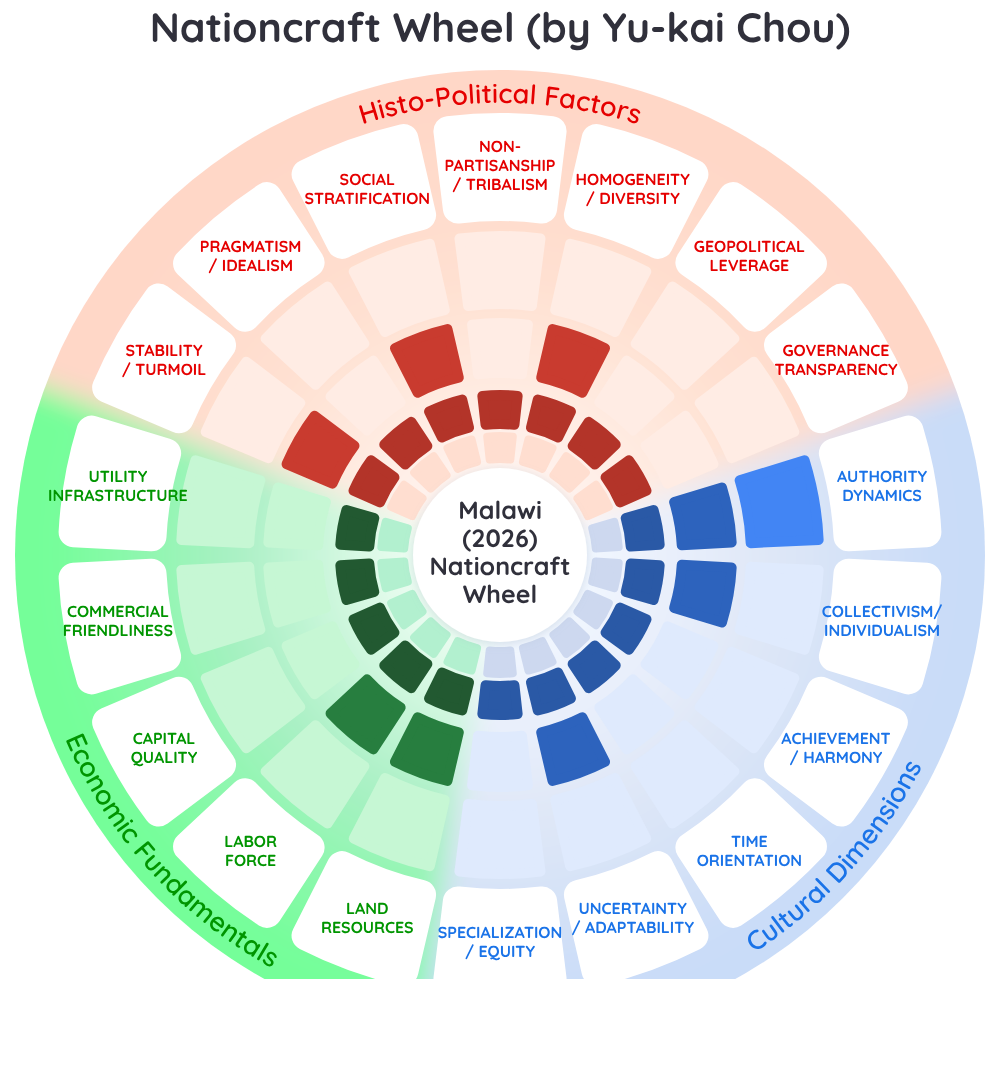
Malawi — The Green Gold Trap (October 2026)
Key Insight: The Green Gold Trap
Malawi enters October 2026 with the kwacha near 1,734 to the dollar, reserves under a month of official import cover, and an IMF mission just concluded after the 2023 program died with zero completed reviews. The V-vector (V1=7 authority and V15=6 workforce against V13=1 transparency, V16=1 capital, V17=1 commercial friction) explains a politically stable country that produces economic emergencies on a tobacco-auction calendar.
The analysis rejects five celebrated playbooks (LKY, Deng, Rwanda, EPRDF, Saakashvili) on named variables and routes reform study toward Ghana’s 1983 recovery, Mauritius’s monocrop escape, and Botswana’s windfall rules — legislated before the mining revenue arrives.
Madagascar — The Long Runway Trap (October 2026)
Key Insight: The Long Runway Trap
One year after the Gen Z uprising ousted Rajoelina, Madagascar’s military-led transition passes IMF reviews while the constitutional referendum sits in June 2027 and the presidential election in October 2027. The V-vector (V1=7 deference, V4=2 horizons, V13=1 transparency) explains how a two-year runway granted for care converts into incumbency, with donor missions the only grading the council faces before the ballot.
The analysis rejects five transition playbooks (Myanmar’s managed opening, Zimbabwe’s elite handover, Uganda’s permanent stabilizer, Romania’s captured revolution, Georgia’s unelected purge) and routes study toward Mongolia 1990, Ghana 1983, and Nigeria 1999 — the transitions that scheduled their own exits.
Request a Country Analysis
The Nationcraft Framework can be applied to any nation.
If you’re a government official, policy researcher, or institutional investor seeking a governance analysis for strategic planning purposes, reach out via the contact form to discuss a custom Nationcraft assessment with the Octalysis Group team.
For media inquiries or speaking engagements on Nationcraft methodology, please use the same contact form.