
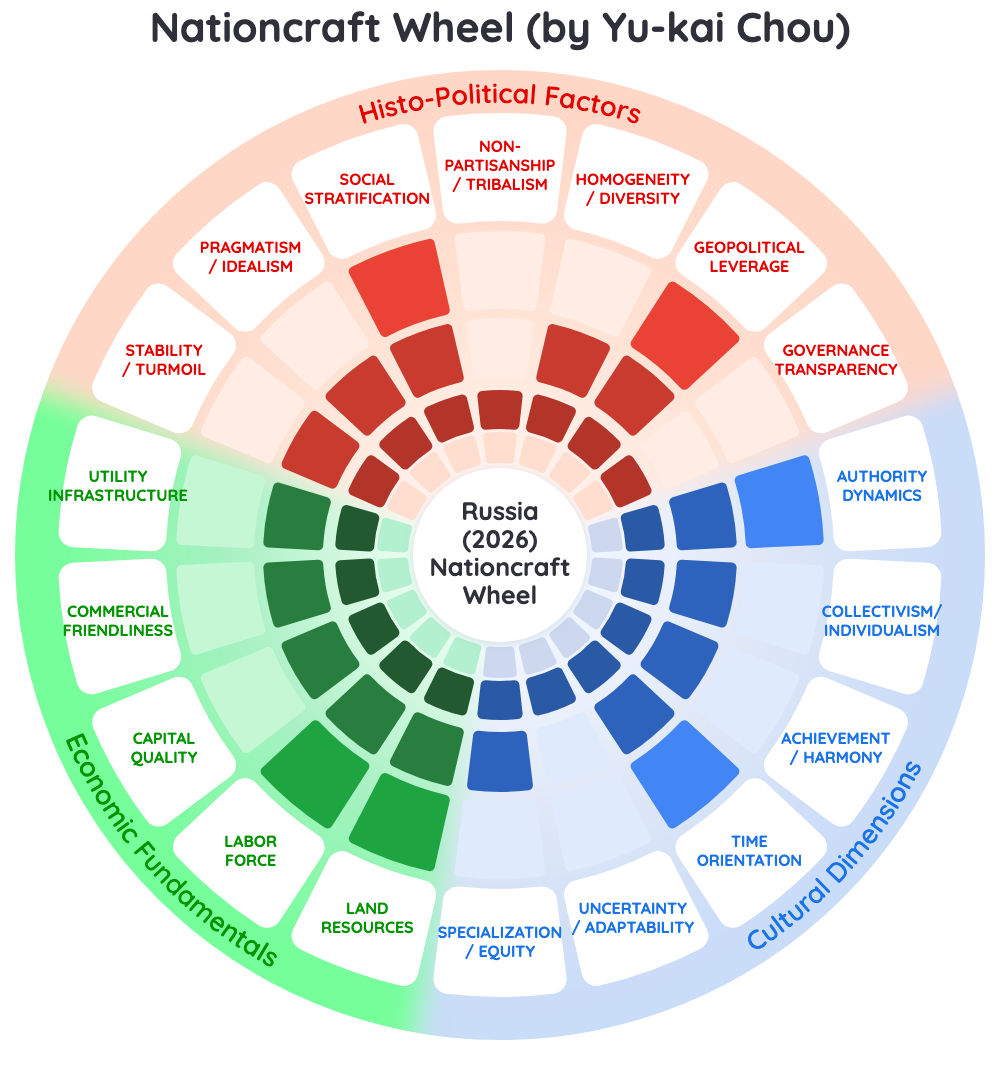

On September 5, 2026, Vladimir Putin spent three hours with two American envoys at the Kremlin, then kept them for dinner. Steve Witkoff and Jared Kushner had flown in to restart peace talks that had been frozen for roughly eight months.
The Kremlin’s readout called the conversation “substantive, constructive, exceptionally candid.” Then came the tell: Putin repeated that any settlement must eliminate “all root causes of the Ukrainian conflict,” the same maximalist formula Moscow has used since 2022.
The envoys flew on to Kyiv the next day. Both militaries paused aerial attacks on the two capitals so the shuttle could happen at all, which tells you how thin the trust layer is under the diplomacy.
Now read the other set of documents that crossed desks in Moscow that same week. Oil and gas revenue for January through August came in 17 percent below last year.
Refineries ran at their lowest level since 2002. The liquid half of the National Wealth Fund has shrunk to roughly $50 billion, about 1.7 percent of GDP, after being two and a half times larger before the war.
Moscow is negotiating as if time is its weapon, and for twenty years of high oil prices that assumption was correct. The 18-variable read below says the assumption expired sometime in early 2026, and the Kremlin’s own budget data is the eviction notice.
Russia built a state that can absorb a siege better than almost any country on earth, wired to a system that can no longer pay for one. Call it the Fortress Economy Trap.
⚡ Speed Run Notes
- Russia scores 8-10 on the four siege variables (V1 authority, V4 patience, V12 leverage, V14 resources) and 1-4 on the five that generate growth (V5, V10, V13, V16, V17). The fortress holds. The economy inside doesn’t.
- The 2026 ledger: oil and gas revenue down 17%, refining at a 24-year low, the deficit past its full-year plan by July, liquid reserves down 2.5x to ~$50 billion. The war chest built for a siege is being spent on one.
- Moscow’s “root causes” formula is V4=8 patience doing what it always does. For the first time since 2022, the meter is running against the Kremlin instead of the West.
- Russia’s own 1990s live in the corpus as FP-016, a failure packet: liberalization before institutions became an asset grab. Every Western reform pitch still sounds like that decade to Russian ears.
- Eight famous reform packets fail Russia’s V-vector, including Deng’s China and Norway’s oil fund. The three worth studying (Vietnam, Uzbekistan, Cuba) all answer one question: how does a fortress open without falling?
Table of Contents
- Author Credibility: Yu-kai Chou
- Understanding Russia’s Governance Landscape Through Nationcraft
- What Is the Nationcraft Framework?
- Why This Russia Variables Analysis Matters
- The 18 Russia Nation Variables
- The Fortress Economy Trap
- Detailed Justifications: Reading Russia Variable by Variable
- What This Costs Russia’s People
- What This Means for Outside Parties
- Best-Match Historical Packets
- What Ends This
- Comparative Context
- What This Means Practically for Russia Reform
- The Nationcraft Framework in Practice
- Frequently Asked Questions
Author Credibility: Yu-kai Chou

Yu-kai Chou created the Nationcraft Framework, applying behavioral design to the hardest motivational problem there is — getting an entire population to move through structural reform without losing momentum. As of 2026, the framework has informed advisory work with eight governments: Taiwan, the Netherlands, the United Kingdom, Bahrain, South Korea, Singapore, Ukraine, and Kazakhstan. The same 8 Core Drives that have driven design at Microsoft, Porsche, and MrBeast now anchor nation-scale reform sequencing — diagnosing where motivation is broken, which Core Drives to lean into for each phase of reform, and how to sequence the political asks so the public stays bought in.
Published Nationcraft analyses include diagnostic playbooks for Venezuela’s post-Maduro reform window and Thailand’s reset-vs-cycle election dynamics, alongside cabinet-level advisory work on post-conflict recovery, reform-sequencing, and public-policy gamification. Chou also teaches the Octalysis methodology at Harvard, Stanford, Yale, Google, BCG, and IDEO — institutions where the human-systems lens applies whether the system is a product, a company, or a country.
His work has been cited by Harvard, Stanford, MIT, Forbes, Wall Street Journal, Wired, US Department of Energy, NIST, NSF, NCBI, US Department of Education, ClinicalTrials.gov, and Google Scholar — with 3,700+ more academic publications. Explore his books here.

This Russia analysis was written the weekend American envoys shuttled between Moscow and Kyiv. It applies the same 18-variable Nationcraft diagnostic used in advisory work for Ukraine and Kazakhstan — the two states that know Russia’s weather system best, from opposite directions — to the question nobody at the table is pricing: which reform packets could actually work inside Russia’s configuration, and which would repeat the 1990s.
Understanding Russia’s Governance Landscape Through Nationcraft
Most coverage of Russia in September 2026 is asking one question: will Putin take a deal? That framing treats Russia as a single mind with a single price.
Nationcraft asks a different question: what is Russia configured to do? Countries run on configurations the way software runs on architectures, and configurations don’t change because a negotiator wants them to.
Russia’s configuration is the most extreme in the 147-country corpus in one specific way. No other state combines V1=10 command authority, V12=9 geopolitical leverage, and V14=9 land resources with V13=2 transparency, V10=1 patronal capture, and V5=3 adaptability.
China at its Deng-era launch had the command authority without the leverage. Saudi Arabia has the resources without the isolation.
Iran has the isolation without the landmass. Russia holds the full fortress hand, and the full fortress bill.
That shape explains things a deal-price model cannot: why Moscow answered a friendly three-hour Kremlin meeting with the same “root causes” formula it used in the war’s darkest phases, and why the Ukraine 2026 Nation Variable analysis reads like the photographic negative of this one, a state whose institutions cracked and adapted, facing a state whose institutions hardened and rigidified.
The counterparty’s own configuration matters for the same reason. The United States Nation Variable analysis shows an impatient high-achievement system (V3 high, V4 low) sitting across the table from the most patient high-authority system in the corpus, two clocks pricing the same war at different speeds.
What Is the Nationcraft Framework?
The Nationcraft Framework scores every nation on 18 variables: six cultural (V1-V6), seven histo-political (V7-V13), and five economic (V14-V18).
The scores are never averaged. Configuration is strategy: a V1=10 next to a V13=2 means something completely different from a V1=5 next to a V13=7, even if the averages look similar.
Against each country’s V-vector, Nationcraft matches 140+ Success Packets, documented historical transformations like Meiji Japan (SP-001) or Đổi Mới Vietnam (SP-018), and asks which packets’ preconditions the country actually satisfies. Policy quality matters far less than context fit.
The same playbook that built Singapore broke against Venezuela’s variables, which is why the Octalysis lens on nation-building and public policy treats reform as a motivational design problem before it is an economic one.
Nationcraft grew out of the Octalysis Framework, the same behavioral architecture applied at product and enterprise scale. A nation is the largest system anyone will ever design motivation for, and it fails for the same reason products fail: the design ignores where the users actually are.
Why This Russia Variables Analysis Matters
Every serious capital is now running some version of the same scenario: the war winds down, sanctions unwind in some sequence, and Russia re-enters the world economy in some shape. Trillions of dollars of trade, energy flows, and defense budgets hang on which shape.
The default Western assumption is that a post-war Russia can be walked back toward the 1990s template: open the markets, privatize, integrate. The default Kremlin assumption is that the fortress can simply persist: import substitution, parallel trade, patience.
The V-vector says both assumptions fail. The first failed once already, catastrophically, and the corpus recorded it as FP-016.
The second is failing right now, in this year’s budget data.
What remains is a much narrower corridor of historically tested moves, and it is missing from the September conversation.
The 18 Russia Nation Variables
Scores are drawn from the canonical Nationcraft corpus (147 countries, v2.0), sanity-checked this week against Freedom House, Transparency International, Bank of Russia statements, and the September 2026 reporting cited in the footnotes. Zero variables required a major correction; eight carry documented minor drift pressure.
| Variable | Name | Score | 2026 Reading |
|---|---|---|---|
| V1 | Authority Dynamics | 10/10 | Personalist wartime centralization at the scale ceiling; no succession mechanism, no institutional counterweight |
| V2 | Collectivism vs Individualism | 6/10 | Communal-endurance tradition over post-Soviet atomization; the war runs on paid contracts, never mass civic mobilization |
| V3 | Achievement vs Harmony | 4/10 | Endurance beats open competition; status flows from proximity to state rents |
| V4 | Time Orientation | 8/10 | “Root causes” doctrine, historical-mission framing, multi-decade programs; patience treated as a weapon |
| V5 | Uncertainty Adaptability | 3/10 | Brilliant tactical evasion (shadow fleet, parallel imports) on top of deep structural rigidity |
| V6 | Specialization vs Equity | 6/10 | Deep defense and extractive specialization; entrenched regional inequality |
| V7 | Stability vs Turmoil | 4/10 | Tight regime control over elevated systemic turbulence: the 2023 Prigozhin precedent, deep strikes, fuel rationing |
| V8 | Pragmatism vs Idealism | 4/10 | Civilizational maximalism governs the settlement posture even where evasion craft is pragmatic |
| V9 | Social Stratification | 8/10 | Oligarchic concentration; war pay lifts the bottom while asset ownership concentrates further at the top |
| V10 | Non-Partisanship vs Tribalism | 1/10 | Patronal clan politics under a single arbiter; courts, media, and electoral bodies all captured; no neutral referee anywhere |
| V11 | Homogeneity vs Diversity | 6/10 | Large ethnic-Russian majority over 190+ ethnicities; recruitment burden skewed to minority regions |
| V12 | Geopolitical Leverage | 9/10 | Nuclear arsenal, UN Security Council veto, energy and grain weight; still summons US envoys to Moscow |
| V13 | Governance Transparency | 2/10 | CPI 22/100; expanding wartime budget secrecy |
| V14 | Land Resources | 9/10 | Largest landmass on earth; hydrocarbons, metals, grain, fresh water |
| V15 | Labor Force Quality | 7/10 | Engineering tradition and high tertiary attainment, bleeding out through emigration, casualties, and record labor scarcity |
| V16 | Capital Quality | 4/10 | ~$300B in reserves frozen abroad; liquid wealth fund near $50B; 14% key rate; cut off from Western capital markets |
| V17 | Commercial Friendliness | 4/10 | Asset-seizure wave, exit taxes, capital controls, weaponized courts |
| V18 | Utility Infrastructure | 5/10 | Vast rail, grid, and pipeline backbone: aging, and now under sustained precision attack |
Read the table as two hands. One hand holds V1=10, V4=8, V12=9, V14=9: authority, patience, leverage, resources.
The other holds V5=3, V10=1, V13=2, V16=4, V17=4: no adaptability, no referees, no transparency, no capital, no commercial trust.
The first hand wins sieges. The second hand loses decades.
The Fortress Economy Trap
Every Nationcraft analysis names the specific trap a country’s configuration sets for itself. Russia’s is the cleanest specimen in the corpus.
The Fortress Economy Trap: the variables that let a state absorb siege are the same variables that prevent it from paying for one. V1=10 authority can commandeer any resource but cannot create one.
V4=8 patience can outlast any negotiator but cannot outlast compound interest. V12=9 leverage can summon envoys to Moscow but cannot summon capital back.
V14=9 resources can fund a fortress for years, and in doing so remove every incentive to build the V16 capital quality and V17 commercial trust that fund a fortress forever.
Between 2022 and 2024 the trap was invisible, because military-Keynesian spending produced real growth and high oil revenue papered over the structure. In the 2026 numbers, it surfaces.
| Fortress asset (what holds) | 2026 evidence | Garrison drain (what pays) | 2026 evidence |
|---|---|---|---|
| V1=10 command authority | Wartime economy redirected by decree; no elite defection since 2023 | V16=4 capital quality | Liquid National Wealth Fund near $50B, ~1.7% of GDP, down 2.5x from pre-war [8] |
| V4=8 strategic patience | “Root causes” formula repeated to US envoys, Sept 5 [2] | Fiscal clock | Cumulative deficit ~6.45T rubles through July, ~2.8% of GDP — already past the full-year plan [6] |
| V12=9 geopolitical leverage | Three-hour Kremlin meeting plus dinner with Witkoff and Kushner [1] | Revenue base | Oil and gas revenue down 17% Jan-Aug; August alone down 16% year on year [7] |
| V14=9 land and resources | Energy, metals, and grain exports still re-routing through Asia | V18=5 infrastructure under fire | Refining at ~3.6M bpd in July, lowest since 2002; fuel supply issues in two-thirds of regions [9][10] |
| V2=6 endurance culture | Recruitment sustained by pay, not conscription waves | V15=7 labor erosion | Emigration, casualties, and record labor scarcity; growth forecast cut to 0.0-1.0% [4][12] |
A fortress that consumes its garrison is still a fortress. Nobody storms it.
It hollows.
This is also why the sanctions-have-failed and sanctions-have-worked camps are both right. Sanctions never breached the walls; V1=10 plus V14=9 guaranteed that.
What sanctions did was lock the gates from the outside while the war economy ate the stores inside: a slow compounding mechanism, and compounding is invisible until the year it isn’t.
Detailed Justifications: Reading Russia Variable by Variable
Cultural variables (V1-V6): the endurance machine
V1 Authority Dynamics = 10. Russia sits on the ceiling of the scale, above even Deng-era China’s launch configuration in one respect: Chinese authority was institutional (the party outlived every leader), while Russian authority is personalist (the system has no tested answer to succession). V1=10 is why the war economy pivoted fast in 2022, and why no reform can begin anywhere except the top.
V2 Collectivism = 6. The communal-endurance tradition is real. It absorbed the 1990s, and it absorbs this.
Even so, the regime does not trust it enough to test it. Recruitment runs on signing bonuses that outbid regional wages several times over, never on mass mobilization.
A state that pays rather than asks is telling you what it believes about its own Core Drive 1 (CD1): Epic Meaning & Calling reserves; the state narrative of higher purpose is broadcast at full volume precisely because it cannot be relied on unpaid.
V3 Achievement = 4. Status in Russia flows from proximity to state rents, not from open competition. That suppresses the entrepreneurial churn that turned V3=9 Singapore’s kiasu culture into an export machine.
V4 Time Orientation = 8. “Root causes” is a doctrine about time: wait long enough and Western attention cycles out.
It worked against the post-2014 sanctions wave. The 2026 fiscal data is the first evidence the doctrine has expired, and the budget now bills for every month of waiting.
V5 Uncertainty Adaptability = 3. The apparent contradiction (how does a V5=3 country improvise a shadow fleet?) resolves once you separate tactical evasion from structural adaptation. Russia is superb at re-routing around obstacles and terrible at becoming something new.
Import substitution stalls at the precision-component layer; the civilian economy has produced no new growth engine in four years of forced opportunity.
V6 Specialization = 6. World-class depth in defense, extraction, nuclear, and space, stacked over thin consumer and service sectors. The war deepened the tilt.
Histo-political variables (V7-V13): the referee-free zone
V7 Stability = 4. Regime control is tight; systemic turbulence is not. The 2023 Prigozhin march proved an armed column could reach within 200km of Moscow before politics stopped it, and the 2026 deep-strike campaign now sets fuel prices in two-thirds of the regions [10].
Control and stability are different things, and Russia has far more of the first.
V8 Pragmatism = 4. Where Deng’s China ran V8-forward (“it doesn’t matter whether a cat is black or white”), Russia’s settlement posture is run on civilizational idealism. The “root causes” formula subordinates every economic consideration to a metaphysical one, which is exactly what a V8=4 score predicts.
V9 Stratification = 8. War pay has lifted incomes at the bottom of the pyramid while asset ownership concentrates at the top. Both movements deepen the state-dependence of every layer.
V10 Non-Partisanship = 1. The corpus’s harshest score, and it is earned in a specific way. The score means something different here than in a fragmented state like Somalia.
Russia is patronal: allocation runs through competing clan networks (siloviki, technocrats, regional barons) beneath a single arbiter, with zero neutral referee institutions anywhere in the system. Courts, electoral bodies, and media are all owned pieces on the board.
V10=1 is the single biggest reason privatization-style reform cannot be re-run: assets released into a referee-free arena get captured by whoever is strongest that morning, which is a precise one-sentence history of 1995.
V11 Homogeneity = 6. A large ethnic-Russian majority over 190+ recognized ethnicities. The recruitment burden falls hardest on poor minority regions, quietly loading stress onto the federation’s oldest fault lines.
V12 Geopolitical Leverage = 9. The nuclear arsenal, the Security Council veto, the energy and grain weight, the enrichment capacity: Russia retains the full toolkit, and the September 5 shuttle is the proof of concept. The erosion is real: Europe has decoupled its demand, and dependence on China deepens by the quarter.
Yet a 9 that summons American envoys to Moscow is still a 9.
V13 Transparency = 2. Transparency International scores Russia 22/100, deep in the bottom quartile, and the war has expanded the classified share of the budget every year. V13=2 next to V16=4 forms a lethal pair: nobody audits the fortress’s books, including, increasingly, the fortress.
Economic variables (V14-V18): the garrison ledger
V14 Land Resources = 9. The largest landmass on earth, holding world-scale hydrocarbons, metals, grain, and fresh water. V14=9 funded the fortress, and V14=9 is why the fortress never had to learn anything else: the classic resource trap, in its military variant.
V15 Labor = 7. The engineering tradition and tertiary attainment are real and durable. The bleed is real too: hundreds of thousands of the most mobile professionals gone since 2022, battlefield casualties compounding, unemployment near record lows as a scarcity symptom rather than a health signal.
A 7 with a downward arrow.
V16 Capital Quality = 4. Roughly $300 billion of central bank reserves frozen abroad since 2022. The liquid National Wealth Fund is near $50 billion, about 1.7 percent of GDP [8].
The key rate stands at 14 percent [5]. Western capital markets are closed, and domestic capital is captive, allocated by decree rather than by return.
Every ruble is reachable by the state, and almost none of it is productive.
V17 Commercial Friendliness = 4. The wartime seizure wave (foreign subsidiaries taken, domestic owners re-expropriated, exit taxes on anyone leaving) has taught every investor the operative rule: property in Russia is a revocable license. That lesson outlives any peace deal by a generation, and it is the quiet reason “sanctions relief” and “capital returning” are not synonyms.
V18 Utility Infrastructure = 5. The backbone is vast and battle-tested; it is also aging and under precision bombardment. July refining ran at roughly 3.6 million barrels per day, the lowest since 2002 [9], and second-half throughput is projected nearly 30 percent below the pre-war seasonal norm.
The fuel crisis reached every region by July [10]. Infrastructure under sustained attack behaves like a tax that rises with time, the exact opposite of what V4=8 patience assumes.
What This Costs Russia’s People
A V-vector describes a configuration. It does not describe what living inside one costs, and on this
subject the Nationcraft corpus is thinner than it should be. The Fortress Economy Trap is not an abstraction
that happens to a state; it is a bill paid by people who did not choose it.
| Variable | What it looks like on paper | What it costs the population |
|---|---|---|
| V1=10 command authority | Fast wartime pivot, no institutional friction | No mechanism through which anyone can decline, dissent, or be represented; a war continued without consent |
| V15=7 labor | Engineering tradition intact, unemployment low | Hundreds of thousands of the most mobile professionals gone since 2022; battlefield casualties concentrated in the poorest regions, which is where the signing bonuses bite hardest |
| V9=8 stratification | War pay lifts the bottom decile | The lift is a transfer priced in conscription risk; asset ownership concentrates further at the top while the floor is paid to absorb the danger |
| V10=1 no referees | Policy executes without veto points | No court will rule against the state, so there is no remedy for a wrongful mobilisation, a seized business, or a prosecution |
| V18=5 infrastructure | Backbone vast, battle-tested | Regional fuel rationing through July 2026; the civilian standard of living is the shock absorber for a military budget |
And the larger share of the cost is not Russian at all. It is borne in Ukraine, by the country on the
other side of the decision this configuration made — the killed and wounded, the deported children, the
cities struck, the people displaced. Any honest reading of Russia’s 18 variables has to say that the
V1=10 that makes the fortress efficient is the same V1=10 that made that possible with no one able to stop
it. Diagnosis of a configuration is not neutrality about what the configuration did.
What This Means for Outside Parties
For Western negotiators: you are pricing the wrong asset
The standard Western model prices Russian concessions against battlefield lines. The V-vector says the binding constraint is fiscal-structural, and it moves on a different clock than the front.
A negotiator who understands V4=8 knows Moscow will always outwait a deadline. A negotiator who understands V16=4 and V17=4 knows Moscow cannot outwait compound decay, and that the credible offer is sequenced normalization, capital access and technology re-entry staged against verifiable steps, rather than a one-shot grand bargain the configuration cannot digest.
For neighbors and investors: the fortress does not become a market by decree
Even in a full-peace scenario, V17=4 means property remains a revocable license until institutions exist that can rule against the state. V10=1 says no such referee exists to build on yet.
Capital that returns early returns as hostage. The states that live in Russia’s weather system already run this math; it is why Kazakhstan’s Steppes Pivot multi-vectors between Moscow, Beijing, and the West rather than betting on any single patron.
Best-Match Historical Packets
Nationcraft’s discipline is that recommendations must come from documented transformations whose preconditions the target country actually satisfies. Eleven packets get proposed for Russia in some form, in op-eds, ministries, and investment memos.
Eight fail the V-vector. Three fit it.
| Packet | Country / Years | Verdict | The variable that decides it |
|---|---|---|---|
| FP-016 Yeltsin Shock Therapy | Russia 1991-1999 | REJECT (already failed) | V13/V10 too low for big-bang liberalization; assets got grabbed, not allocated |
| SP-003 Deng Xiaoping Open Reform | China 1978-2000 | REJECT | Needs institutional party authority and zone experimentation; Russia’s V1=10 is personalist and V5=3 blocks experiments |
| SP-002 Lee Kuan Yew Industrialization | Singapore 1965-1990 | REJECT | Runs on a V13 transparency ascent Russia’s V13=2 cannot start, at a city-state scale Russia does not have |
| SP-005 Poland Shock Therapy | Poland 1990-2004 | REJECT | EU accession anchor did the heavy lifting; no such anchor exists for Russia |
| SP-007 Estonia Digital Revolution | Estonia 1991-2020 | REJECT | V5=9 clean-start adaptability vs Russia’s V5=3; no clean start available |
| SP-106 Norway Oil Fund | Norway 1990-2010 | REJECT | Requires ~10-level transparency and consensus institutions; Russia’s fund is a war chest being drained |
| SP-037 Saudi Vision 2030 | Saudi Arabia 2016- | REJECT | Closest superficial fit (V1=10 top-down diversification) but assumes open sovereign capital access and no war absorbing the surplus |
| SP-044 Nazarbayev Resource Management | Kazakhstan 1991-2014 | REJECT | Multi-vector hedging is for middle powers inside a system; Russia is the metropole fighting the system |
| SP-018 Đổi Mới Reform | Vietnam 1986-2010 | STUDY | Party-state at V1=9 reformed under embargo and sequenced its way to US normalization |
| SP-045 Karimov-Mirziyoyev Transition | Uzbekistan 2016- | STUDY | The in-family, post-Soviet proof that a fortress can open without the state falling |
| SP-094 Special Period Survival | Cuba 1991-2008 | STUDY (as a warning) | The packet Russia is already running without admitting it; proves the ceiling is survival, not development |
Why the famous eight fail
The most instructive rejection is Russia’s own. FP-016, the Yeltsin Shock Therapy Packet, is one of the corpus’s loudest failure records: price liberalization and mass privatization executed into a V13=2, V10=1 institutional vacuum, on the theory that gradualism would let vested interests organize: “you cannot cross a chasm in two jumps.”
The chasm won. GDP roughly halved across the decade, loans-for-shares handed strategic industries to whoever stood closest, and the 1998 default finished the argument.
The corpus lesson is institutions-first: liberalization before referees produces asset-stripping, not markets.
FP-016 also explains the politics of 2026 better than most commentary does. The 1990s are the Kremlin’s founding trauma and its favorite cautionary tale; every Western proposal that smells of that decade gets rejected on arrival, whatever its economics.
A reform pitch for Russia that ignores this is dead before translation.
The Deng comparison fails on institutional structure. SP-003 ran on V1=10 authority like Russia’s, but it was institutional authority: a party that outlived leaders, promoted governors on growth metrics, and let China’s supply-side machine emerge from thousands of local experiments.
Russia’s personalist V1=10 cannot delegate experimentation without feeling it as a loss of control, and V5=3 means the experiments would not propagate anyway.
The LKY packet fails on trajectory: Singapore’s stress test shows a system whose defining move was building incorruptible referees inside a decade, a V13 ascent from the bottom of the scale toward the top. Russia’s V13=2 with V10=1 has no referee seed to grow from; the packet’s first precondition is the one thing the configuration cannot supply.
Norway’s SP-106 fails for the same reason from the fiscal side. An oil fund is a promise the state makes to its future self and then audits in public.
Russia has the fund mechanics and none of the audit: the National Wealth Fund is a discretionary war chest, which is why it is at $50 billion liquid and falling [8] instead of compounding for grandchildren.
And the Vision 2030 comparison (the one Moscow’s technocrats privately like) fails on arithmetic. Saudi Arabia’s single-artery economy can buy diversification because its artery still pumps at full pressure into open capital markets.
Russia’s artery is sanctioned, discounted, drone-struck, and taxed by shadow-fleet logistics; the investable surplus Vision 2030 assumes does not exist in the 2026 ledger [6][7].
SP-018 Đổi Mới: the sequencing masterclass
Vietnam in 1986 was a party-state emerging from a ruinous war, under a US embargo, with hyperinflation past 700 percent and famine risk in the provinces. Its V-launch profile (V1=9 authority, V2=8 collectivism, V4=8 patience) is the closest match to Russia’s fortress hand anywhere in the success half of the corpus.
What Đổi Mới got right was order. First agriculture: household contracts replaced collectivization and fed the country within three years.
Then enterprise: private business legalized, foreign investment invited into fenced zones. Only then normalization: the US embargo lifted in 1994, relations normalized in 1995, a bilateral trade agreement in 2001, WTO accession in 2007; each step was traded for reforms already delivered, not promised.
The packet’s lesson for Russia is uncomfortable for both sides of the September table. Internal reform preceded external normalization by eight years; Hanoi built the credibility before it asked for the market access.
A Russia that demands sanctions relief first, reform later is running Đổi Mới backwards. A West that offers nothing staged is giving the fortress no ladder to climb down.
Vietnam’s 2026 analysis shows the same state, forty years on, setting double-digit growth decrees. That is what the ladder bought.
SP-045 Karimov to Mirziyoyev: the in-family precedent
Uzbekistan is the corpus’s proof that a post-Soviet fortress can open without regime collapse. Karimov ran twenty-five years of V1=9 closure: currency controls, forced labor, sealed borders, frozen relations with every neighbor.
His 2016 succession handed Mirziyoyev the same configuration Russia will eventually hand someone: fortress intact, economy starved.
The opening sequence matters more than its scale. Currency unification came first: one honest exchange rate, the single highest-information reform a closed economy can make.
Then regional reconciliation, turning hostile borders into trade corridors within two years. Then visible signal reforms (forced labor abolished, visas opened) that re-priced the country’s reputation before the deep institutional work had really begun.
The limit: political control never opened, and the 2022 Karakalpakstan unrest showed the authoritarian reflex intact. Uzbekistan proves a fortress can convert to a bazaar while keeping its walls.
It does not prove the bazaar becomes Denmark.
SP-094 Special Period: the packet Russia is already running
Strip the labels and look at the mechanics: an embargoed state loses its main revenue relationship, pivots to survival mode, legalizes just enough hard-currency activity to breathe, tightens political control, and holds. That is Cuba after 1991 (GDP down 35 percent, survival achieved, development permanently deferred), and it is functionally Russia’s current operating mode with better engineers and bigger reserves.
The corpus records what thirty years inside this packet buys: regime survival, social-indicator maintenance, massive brain drain, and zero development. Cuba’s Doctrine Trap shows the Fortress Economy Trap after thirty years of exposure.
Cuba is what a progressed case of this diagnosis looks like after thirty years.
What Ends This
The question this analysis is built to answer is not how the fortress endures. It is what the
configuration tells anyone trying to end the war — and here the V-vector is genuinely informative, because
it says which pressures and which offers can actually reach a decision-maker inside a V1=10, V10=1 system.
| Element of a settlement | What the V-vector says about it | Who has to act |
|---|---|---|
| Verification rather than trust | V17=4 and V10=1 mean no internal institution can certify compliance and no court can be appealed to; every commitment needs an external monitor or it is unenforceable | Negotiators, monitoring bodies |
| Deadlines are the wrong instrument | V4=8 treats waiting as a weapon, so a date is something to outlast; the 2026 fiscal trajectory is the clock that actually runs | Negotiators |
| Compound cost, not battlefield lines | V16=4 capital quality and an eroding revenue base move on a different clock than the front; that gap is where leverage sits | Negotiators, sanctioning states |
| Accountability is structural, not optional | V10=1 is why crimes committed by the state have no domestic remedy; any durable settlement has to site accountability outside the system | International bodies |
| Do not mistake a pause for a change | V17=4 means property stays a revocable licence after any deal; peace and reform are different events and the configuration does not convert automatically | Neighbours, investors |
Notice what this analysis does not contain: a sequenced reform corridor for the Russian state. That
omission is deliberate. The Nationcraft corpus can generate one — it generates them for every country — and
in this case the output would be a set of moves for strengthening a state currently prosecuting a war of
aggression against a country whose reconstruction I work on. A framework is a tool, and part of using one
well is knowing which questions not to point it at.
What the corpus can say without that problem is negative and still useful: the famous packets do not fit.
Mass privatisation, big-bang liberalisation and democratic transition as a precondition all fail against
V5=3, V10=1 and V17=4 — which is why the 1990s produced FP-016 rather than a success packet, and why anyone
expecting a post-settlement Russia to converge on its own is reading the wrong variables.
Comparative Context
Russia’s fortress hand looks less unique, and more instructive, next to its nearest configuration neighbors in the Nationcraft corpus.
| State | V1 Authority | V12 Leverage | V13 Transparency | V16 Capital | Configuration verdict |
|---|---|---|---|---|---|
| Russia | 10 | 9 | 2 | 4 | Full fortress hand, full fortress bill |
| Iran | 10 | 6 | 2 | 4 | Fortress without the resources to fund it; coercion spiral |
| North Korea | 10 | 8 | 1 | 1 | Terminal fortress: survival as the entire national product |
| China | 10 | 10 | 4 | 7 | Fortress walls around a functioning growth engine; the exception Russia mistakes for a peer |
| Ukraine | 4 | 6 | 4 | 1 | Anti-fortress: institutions cracked open and adapted under fire |
The gradient from Moscow through Tehran to Pyongyang is the Fortress Economy Trap at three exposures. Iran’s coercion spiral shows the mid-stage: leverage spent faster than it regenerates.
North Korea’s summit mirage shows the end-state: a fortress so complete that diplomacy itself becomes theater, because no deal can be worth more than the wall.
China is the comparison Moscow prefers and the corpus rejects. Beijing’s V13=4 and V16=7 mean the walls enclose a real economy; Russia’s enclose a pump and a garrison.
A fortress with a growth engine inside can wait forever. A fortress without one is on the clock, whatever its V4 says.
Ukraine completes the picture from the other side. Its wartime configuration (low V1, rising V13, institutions rebuilt mid-war under external anchors) is everything Russia’s is not, which is precisely why Western reform instincts calibrated on Kyiv keep misfiring on Moscow.
SP-117, the Post-Euromaidan Reform Packet, worked because Ukraine’s variables could metabolize it, and exporting it across the front line misreads both configurations.
What This Means Practically for Russia Reform
Practically, the Fortress Economy Trap defines three windows, and only one of them is good.
Window one: the current trajectory. “Root causes” maximalism holds, the war grinds on, and the Special Period mechanics deepen: reserves toward zero over the coming years [6][8], refining capacity taxed by drones faster than repairs [9], labor thinning, China dependence compounding. The fortress does not fall in this window. It hollows toward the Special Period pattern, floor by floor.
Window two: the false exit. A settlement arrives, sanctions unwind fast, and capital is invited back into an unreformed V17=4, V10=1 arena. This is FP-016 with new logos: the returning money gets captured by the same patronal networks, the population re-learns that opening means looting, and the fortress doctrine wins its argument for another generation.
Window three: the verified exit. The war ends on terms an external monitor can check, and normalisation is paced against delivered steps rather than promised ones. This is the only window in which the costs in the table above stop compounding — for Ukrainians first, and for the Russians paying the garrison bill second. It is also the only window that requires the parties to understand what the V-vector actually constrains.
The stakes concentrate in one asymmetry: windows one and two require nobody to understand Russia’s configuration, and window three requires the parties negotiating an end to it to. That is the practical function of an 18-variable read in September 2026 — replacing the deal-price argument with a configuration argument, in the service of ending the war rather than optimising the state prosecuting it.
The Nationcraft Framework in Practice
This analysis ran the full Nationcraft loop: score the 18 variables against current evidence, name the trap the configuration sets, test the famous packets against the V-vector, and discard every move Russia’s configuration cannot digest.
The same loop has now been run across dozens of countries (fortress economies, trust economies, rentier states, post-conflict rebuilds), and the pattern holds everywhere: configuration eats policy for breakfast. The packets that transformed nations were the ones that worked with their variables.
The ones that fought their variables became failure packets, and the corpus remembers both kinds.
Nationcraft is the nation-scale application of the same behavioral architecture in the Octalysis work: motivation is designed, sequencing is strategy, and systems only change along the gradients their configuration allows.
Closing
The envoys will shuttle again. The formulas will hold or crack.
What the ledger has already decided is that the fortress doctrine’s free decade is over: from here, every month of siege is bought with the garrison’s future.
Russia’s variables do not doom it. V15=7 human capital, V14=9 resources, and V4=8 patience are the raw material of half the success packets in the corpus.
They doom only the current use of those variables. The corridor out has been walked before, by Hanoi and Tashkent, in the fortress’s own dialect.
Explore More Nationcraft Analyses
The full Nationcraft country analyses library holds every published V-vector diagnosis. Closest to this one: Yemen’s Frozen War Trap on what “frozen” actually costs, Taiwan’s Silicon Shield Paradox on leverage built from production instead of extraction, and Sweden’s Trust Overdraft Trap on the opposite corner of the V-space, where the state has referees and no walls.
Related Reading
- The Nationcraft Framework: 18 Variables, 8 Goals, 100+ Proven Reform Packets
- Nationcraft Country Analyses Library
- Nationcraft Analysis: Venezuela Reform Playbooks 2026
- Nationcraft Analysis: Iraq Rentier Trap 2026
- Nationcraft Analysis: Syria Hollow Sovereignty 2026
- Nationcraft Analysis: Turkey Strongman Discount 2026
Frequently Asked Questions
Is Russia’s economy actually collapsing in 2026?
No, and that framing misses the mechanism. Russia recorded its first quarterly GDP decline in three years in early 2026, the central bank cut its growth forecast to 0.0-1.0 percent, and oil and gas revenue is down 17 percent, but V1=10 authority and V14=9 resources make collapse the wrong model.
The Fortress Economy Trap produces hollowing: survival indefinitely, development never. Cuba has run that state for thirty years.
Why does Putin keep repeating the “root causes” formula?
Because V4=8 time orientation treats patience as a weapon and V8=4 idealism subordinates economics to civilizational goals. The formula worked as long as waiting was free.
The 2026 fiscal data (a deficit past its full-year plan by July and liquid reserves around $50 billion) is the first evidence that waiting now bills the Kremlin monthly.
Could Russia run a China-style Deng reform?
The V-vector says no. Deng’s V1=10 was institutional (a party that outlived leaders and rewarded local experiments) while Russia’s V1=10 is personalist, with V5=3 adaptability and V10=1 patronal capture blocking the experimental propagation that made SP-003 work.
The closer fits are Vietnam’s Đổi Mới sequencing and Uzbekistan’s managed opening, both fortress-compatible.
Why doesn’t this analysis recommend a reform sequence for Russia?
Because the Nationcraft corpus would generate one, and the output would be a set of moves for strengthening a state currently prosecuting a war of aggression. I support Ukraine; that is not an analysis I am willing to publish. What the framework can say without that problem is the negative finding — the famous packets fail against V5=3, V10=1 and V17=4, which is why the 1990s produced FP-016 — and what the configuration implies for the people trying to end the war.
What does this analysis imply for the September peace talks?
That the table is pricing the wrong asset. Concessions are being measured against battlefield lines while the binding constraint is fiscal-structural: V16=4 capital, V17=4 commercial trust, and a revenue base eroding under precision strikes.
A staged-normalization offer aimed at that constraint has more purchase than any deadline aimed at V4=8 patience.
Footnotes
- Al Jazeera, “US envoys arrive in Kyiv for Ukraine war talks after meeting Putin,” September 5, 2026. aljazeera.com
- CNN, “Witkoff and Kushner to take US peace push to Kyiv after meeting Putin in Moscow,” September 5, 2026. cnn.com
- NPR, “Witkoff and Kushner call Kyiv talks ‘substantive’ after Moscow Putin meeting,” September 6, 2026. npr.org
- OSW Centre for Eastern Studies, “Russia’s economy: heading towards recession?”, May 14, 2026. osw.waw.pl
- The Moscow Times, “Russian Central Bank Warns of Higher Inflation as It Lowers Key Rate to 14%,” July 24, 2026. themoscowtimes.com
- Free Russia Foundation, “Russia’s Budget Crisis, Explained,” 2026. 4freerussia.org
- Rigzone, “Russia’s Oil Revenue Sinks to 6 Month Low,” September 5, 2026. rigzone.com
- The Moscow Times, “Russia to Tap National Wealth Fund at Record Pace as Oil and Gas Revenues Slump,” January 16, 2026. themoscowtimes.com
- The Moscow Times, “Russian Oil Refining Falls to 24-Year Low After Ukrainian Drone Strikes,” August 3, 2026. themoscowtimes.com
- Wikipedia, “2025–2026 Russian fuel crisis” (fuel supply issues reported in two-thirds of regions, per Politico). en.wikipedia.org
- Bank of Finland (BOFIT), “Russian budget framework for 2026–2028 foresees tax hikes and lots of red ink,” 2025. bofbulletin.fi
- The New Voice of Ukraine, “Russian economy will slow down as Bank of Russia acknowledges impact of Ukrainian long-range strikes,” 2026. english.nv.ua