

On 14 May 2026, Cuba’s Minister of Energy and Mines told the country something a government almost never says out loud: the island had run out of oil and diesel. Not running low. Out. Two months earlier the national electrical grid had collapsed twice inside a single week, dropping nearly ten million people into the dark. Rubbish sat uncollected in Havana because the trucks had no fuel. Hospitals cut surgeries. Water stopped reaching apartments because the pumps that move it run on electricity that was no longer there.
Here is the puzzle worth sitting with. Cuba is not a weak state. By the one measure that state-builders prize above all others, the raw capacity to make a decision and have the whole country obey it, Cuba is one of the strongest states in the hemisphere. One party. One chain of command. No rival power center, no coalition haggling, no independent court to say no. If concentrated authority were the same thing as the ability to reform, Cuba would have reformed decades ago.
It has not. For thirty-five years, since Soviet subsidies vanished in 1991, Cuba has held the most powerful reform lever in the Caribbean and used it for exactly one purpose: to not pull it.
That is the paradox this analysis is built around, and it deserves a name. Call it the Doctrine Trap. A state can possess every structural ingredient of decisive reform, the authority, the unity, the chain of command, and still be unable to reform, because the same regime that holds the lever is built on a doctrine that defines pulling it as betrayal. The authority is real. The doctrine is bolted over the top of it. And a country can starve in the gap between the two.
This is a Nationcraft analysis, which means it does not ask whether Cuba’s leaders are good or bad. It asks what Cuba’s 18-variable profile makes possible, what it forecloses, and which historical reform packets were built for a country shaped like this one. The 2026 energy collapse has forced the question the doctrine spent thirty-five years letting Cuba avoid. The answer is uncomfortable, specific, and, once you see the structure, not hopeless.
⚡ Speed Run Notes
- Cuba scores V1=10 on Authority Dynamics, the maximum, and V8=2 on Pragmatism, near the floor. It holds total command authority and a doctrine that forbids aiming it at reform.
- The Doctrine Trap: the unified single-party machine that powered reform in Deng’s China and Vietnam is welded, in Cuba, to a founding ideology that treats marketizing as betrayal.
- The 2026 energy collapse, grid down twice and the island out of diesel, forces the choice the doctrine has let Cuba dodge since 1991: reform, or run the survival packet again.
- Cuba already owns a survival packet, SP-094. The corpus verdict is brutal: it works, and it leaves the country poorer in real terms than it was in 1989. Survival is not development.
- Eight famous reform playbooks get rejected here. Singapore, Poland, Peru and Saudi Vision 2030 all fail Cuba’s V-vector on the variables that decide whether a packet can land.
- The three that fit, Vietnam’s Doi Moi, Laos’s gradual opening and Uzbekistan’s succession pivot, all needed one thing Cuba lacks: a jump to pragmatism. That jump is the whole game.
Table of Contents
- Understanding Cuba’s Governance Landscape Through Nationcraft
- What Is the Nationcraft Framework?
- Why This Cuba Variables Analysis Matters
- The 18 Cuba Nation Variables
- The Doctrine Trap
- Detailed Justifications: Reading Cuba Variable by Variable
- Strategic Implications of Cuba’s V-Vector
- Best-Match Historical Packets: Eight Rejected, Three to Study
- Governance Strategy Recommendations for Cuba
- Comparative Context: Cuba Against the Nationcraft Library
- Frequently Asked Questions
About Yu-kai Chou

Yu-kai Chou is a Human-Systems Architect & Behavioral Designer and the creator of the Nationcraft Framework — an 18-variable diagnostic for matching a country’s structural profile to the reform packets that have historically worked under similar conditions. He has consulted for governments in eight nations, including Ukraine, the United Kingdom, the Kingdom of Bahrain, Singapore, Taiwan, the Netherlands, Kazakhstan, and South Korea, and has worked directly with President Zelenskyy’s team on post-war reconstruction priorities for Ukraine.
Chou’s prior framework — the Octalysis Framework — has been applied by LEGO, Microsoft, Porsche, Coca-Cola, Salesforce, and MrBeast, impacting over 1.5 Billion Users. He has taught the methodology at Harvard, Stanford, Yale, Tesla, Google, BCG, and IDEO.
His work has been cited by Harvard, Stanford, MIT, Forbes, Wall Street Journal, Wired, US Department of Energy, NIST, NSF, NCBI, US Department of Education, ClinicalTrials.gov, and Google Scholar — with 3,700+ more academic publications. Explore his books here.

This Cuba analysis applies the Nationcraft Framework to a case that most observers file under the wrong heading. Cuba is not failing for lack of state capacity. It is failing because of a doctrine, and a doctrine is a motivational structure, which is exactly what behavioral design is built to read. Across eight national advisory engagements the recurring lesson is that reform stalls not when leaders lack power but when a packet is matched to a variable profile it was never built for. Cuba in 2026 is the cleanest illustration on the map of a state that has the power and has refused the packet, and getting that diagnosis right is the difference between thirty more years of managed decline and a genuine way out.
Understanding Cuba’s Governance Landscape Through Nationcraft
Most analysis of Cuba runs through one of two scripts. The first is the embargo script: the United States blockade, sanctions, the fuel cutoff, the long American campaign against the Havana government. The second is the regime script: repression, the one-party state, the jailed dissidents, the protests and the crackdowns. Both scripts are real. Both are documented. Neither explains the part of the story that should bother an honest observer the most.
That part is this. Cuba has faced an existential economic shock once before, in 1991, when the Soviet Union collapsed and roughly six billion dollars a year in subsidies vanished overnight. The economy contracted by about a third. And Cuba had, at that moment, every structural means a country could want to respond with serious reform. It still has them today. The embargo explains why Cuba is poor. It does not explain why a state this powerful, facing collapse, chose managed decline over reform, twice, a generation apart.
The Nationcraft Framework looks underneath both scripts at the structural profile that produced them. It treats a country the way a behavioral designer treats any system: as a set of variables that make some outcomes cheap and others nearly impossible. Read Cuba this way and the 2026 energy crisis stops looking like a freak event caused entirely by Washington. It starts looking like the predictable meeting point of an external shock and an internal configuration that was always going to convert that shock into paralysis rather than reform.
Here is the configuration in one sentence. Cuba has the hardware of a reforming state and a doctrine in the operating system that refuses to run the reform program. The hardware is genuine: a single, disciplined party; a population conditioned over six decades to defer to the state; an unusually educated workforce; a bureaucracy that, however exhausted, still reaches every corner of the island. What sits on top of that hardware is a founding ideology that has bound the regime’s entire claim to legitimacy to one promise, that Cuba is the country that did not surrender to the market. You cannot run a market reform on an operating system whose core function is to reject market reform.
This is why the Nationcraft reading of Cuba is, in an odd way, more demanding than either the embargo script or the regime script. The embargo script says the answer is for Washington to relent. The regime script says the answer is for the regime to fall. The variable diagnosis says something harder and more precise: the answer is a specific change to one variable, and that change is available, and it has happened in countries structurally identical to Cuba, and the only thing standing in the way is a doctrine that the regime could, in principle, choose to revise.
What Is the Nationcraft Framework?
The Nationcraft Framework grew out of a discovery that was, at first, slightly disappointing. While extending the Octalysis behavioral-design system to the scale of countries, it became clear that a nation is not a fundamentally new kind of object. It is a very large motivational system, and it can be diagnosed with the same logic used to diagnose a product, a company, or a game. Nation goals replace business metrics. Cultural and historical factors replace player types. Government policies, which Nationcraft calls “packets” to keep them modular and concrete, replace game mechanics.
The diagnostic core is a set of 18 nation variables, each scored from 1 to 10, falling into three groups. The cultural variables, V1 through V6, cover Authority Dynamics, Collectivism, Achievement orientation, Time Orientation, Uncertainty Adaptability, and Specialization. The historico-political variables, V7 through V13, cover Stability, Pragmatism, Social Stratification, Non-Partisanship versus Tribalism, Homogeneity, Geopolitical Leverage, and Governance Transparency. The economic variables, V14 through V18, cover Land, Labor, Capital, Commercial Friendliness, and Utility Infrastructure.
The scores are not moral grades. A high score on Authority Dynamics does not mean a country is good or bad; it means authority is culturally easy to exercise. The framework’s central and most useful claim is that reform effectiveness is decided by context-fit, not by policy quality. A packet that transformed one nation can do nothing in another whose variable profile is different. This is the same discipline behind every application of behavioral design to nation-building: diagnose first, prescribe second, and never confuse a famous policy with a fitting one.
Cuba is a particularly clean test of whether the method is honest, because Cuba invites a lazy answer. It would be easy to write a hopeful piece telling Havana to copy China. It would also be wrong, and the wrongness is instructive. A real Nationcraft diagnosis has to be willing to say which celebrated packets do not apply here and why, and then do the harder work of finding the few that do. The reason the method matters is that the wrong packet is not merely useless. Imported into the wrong profile, it can deepen the very collapse it was meant to cure.
Why This Cuba Variables Analysis Matters
Cuba matters to the Nationcraft library for a reason beyond its own crisis. It is the framework’s clearest case of a single variable, acting alone, holding an entire country hostage. Most national traps in the corpus are interaction effects, two or three variables grinding against each other. Cuba’s trap is closer to a single point of failure, and that makes it unusually legible. If the framework can say something true and precise about Cuba, it has shown that it can isolate a binding constraint down to one number.
It matters, too, because Cuba is where one of the most consequential policy debates of the decade is about to be settled in real time. The United States is applying maximum pressure, a de facto oil blockade tightened by a January 2026 cutoff of Venezuelan supply and an executive order threatening tariffs on any country that ships fuel to the island.1 Reporting indicates the Trump administration has signaled it might leave the Cuban government structure in place if reforms are made and President Miguel Diaz-Canel is replaced, an approach that consciously echoes its handling of Venezuela’s post-Maduro reform window, where the head was removed and the apparatus left standing.2 Whether that pressure produces reform or simply produces suffering depends entirely on Cuba’s variable profile. This analysis is an attempt to say, in advance, which.
And it matters because Cuba is a live demonstration of a claim the Nationcraft Framework makes everywhere: that authority and the ability to use authority for reform are not the same thing. Cuba has more of the first than almost any country in the Western Hemisphere and, on the evidence of thirty-five years, almost none of the second. A reader who understands that gap can watch the news out of Havana and predict the regime’s next move with disquieting accuracy. The prediction the framework makes is not collapse and not reform. It is a third thing, and naming it correctly is the point of everything that follows.
The 18 Cuba Nation Variables
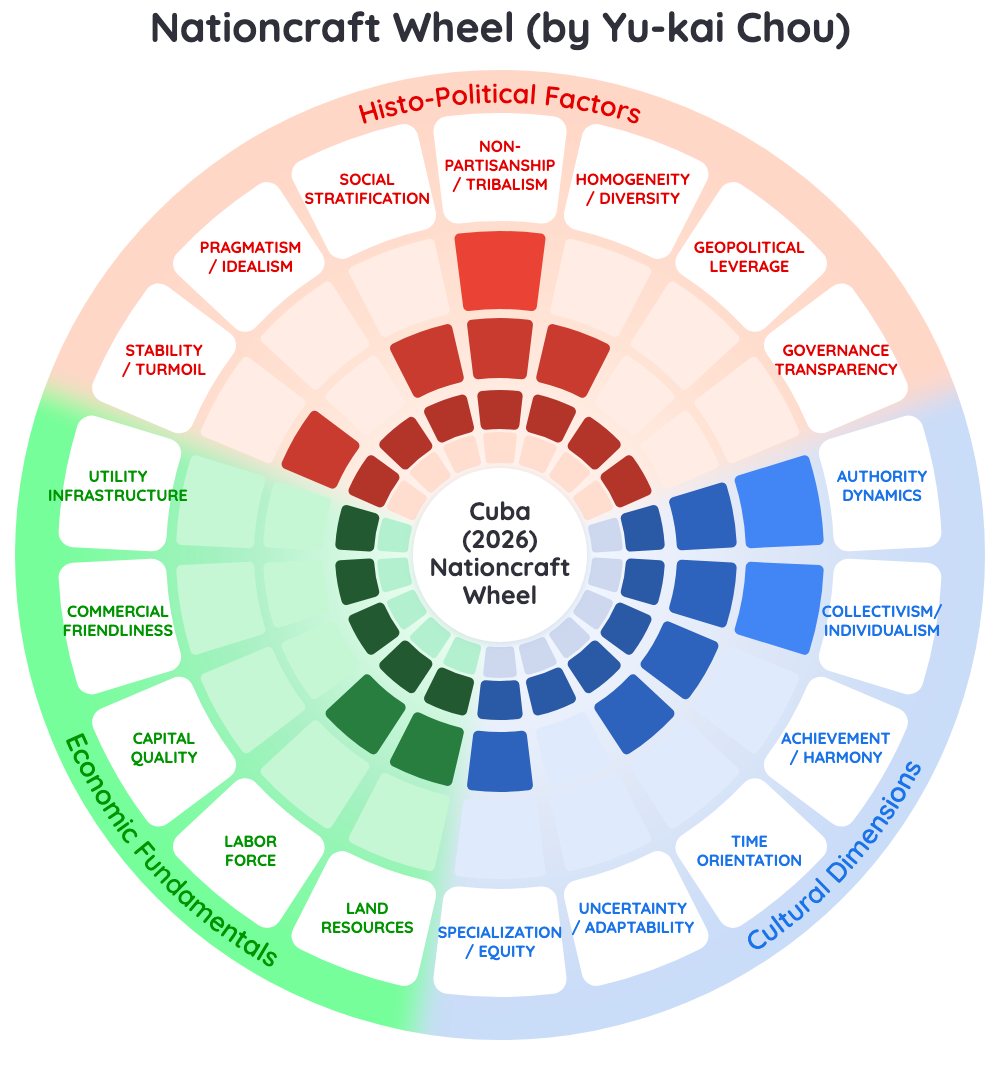
Below is Cuba’s full V-vector as it stands in the Nationcraft corpus for 2026, after this analysis applied two evidence-backed corrections during its sanity check (explained immediately after the table). Read it as a configuration, not as a row of grades to be averaged. In Nationcraft, configuration is strategy: the interaction between two variables matters far more than either score alone.
| Variable | Score (1–10) | One-line reading |
|---|---|---|
| V1: Authority Dynamics | 10 | Maximum. A one-party state with near-total command over economy and society. |
| V2: Collectivism vs Individualism | 9 | A revolutionary collectivist society; the individual is embedded in the collective project. |
| V3: Achievement vs Harmony | 4 | Equity and harmony are prized; an achievement culture is institutionally suppressed. |
| V4: Time Orientation | 5 | Long-horizon revolutionary rhetoric paired with crisis-driven short-horizon practice. |
| V5: Uncertainty Adaptability | 3 | Citizens improvise constantly; the state itself is rigid and slow to adapt. |
| V6: Specialization vs Equity | 4 | Universal-service equity is prioritized over economic specialization. |
| V7: Stability vs Turmoil | 5 | Severe economic crisis, but no armed conflict and no contested government. |
| V8: Pragmatism vs Idealism | 2 | Near the floor. Ideological purity consistently beats results in policy choices. |
| V9: Social Stratification | 5 | Officially egalitarian, with a real dollar-versus-peso dual economy now entrenched. |
| V10: Non-Partisanship vs Tribalism | 7 | No clans or ethnic factions; political loyalty attaches to the Party-state institution. |
| V11: Homogeneity vs Diversity | 6 | A mixed population, one language, no separatist or regional cleavage. |
| V12: Geopolitical Leverage | 2 | Embargo-bound; has lost its Soviet patron and its Venezuelan oil patron. |
| V13: Governance Transparency | 2 | An opaque one-party state with no independent audit, courts, or press. |
| V14: Land Resources | 6 | Agriculture, nickel and cobalt, some offshore potential; not a petrostate. |
| V15: Labor Force Quality | 6 | A high education and health base, eroding fast under working-age emigration. |
| V16: Capital Quality | 3 | Sovereign default, no reserves, no functioning domestic capital market. |
| V17: Commercial Friendliness | 2 | Hostile to private enterprise; the small-business sector is restricted and reversed. |
| V18: Utility Infrastructure | 2 | A national grid in functional collapse; the island ran out of diesel in May 2026. |
Two scores in that table were corrected during this analysis, and intellectual honesty requires saying so plainly. The corpus had carried V10 Non-Partisanship versus Tribalism at 1, a score that denotes Somalia-level clan fragmentation. That is structurally indefensible for Cuba, which has no clans, no tribes, and no ethnic factions; loyalty in Cuba attaches to a single national institution. The corpus’s own Cuba packet records V10 at 7, and comparable one-party states score 6 to 9. V10 was raised from 1 to 7. Separately, V18 Utility Infrastructure had been scored 5, a reading frozen before the 2026 grid collapse. With the system in functional failure, V18 was lowered from 5 to 2. Both changes are logged with their justifications in the corpus change record. Neither softens the diagnosis. The V10 correction, in fact, sharpens it, because it confirms that Cuba’s single-party machine really is unified enough to deliver reform if the doctrine ever allowed it.
Stare at the column for a moment. The two scores that tower over the rest are V1 at 10 and V2 at 9, the cultural variables that, in a functioning developmental state, are the engine of governance. The score that sits almost alone at the bottom, the variable doing the real damage, is V8 at 2. Cuba has the engine. It has chained the ignition.
The Doctrine Trap
Every Nationcraft analysis names the one structural trap that organizes everything else. For Cuba, that trap is the relationship between V1 and V8: between an authority score at the absolute ceiling and a pragmatism score near the absolute floor.
Start with what V1=10 means. Authority Dynamics measures how culturally and structurally easy it is to exercise authority, how readily a decision at the center becomes action across the country. Cuba is at the maximum. There is one party, constitutionally defined as the leading force of the state and society. There is no opposition party with seats, no independent judiciary to overturn a decree, no provincial governor who can refuse. When Havana decides something, the decision propagates. Add V10=7, a single national party with no rival faction, and you have a command instrument of remarkable coherence. This is not nothing. It is, in fact, the rarest and most valuable thing a reformer can be handed.
Now read V8=2. Pragmatism versus Idealism measures whether a country’s operating elite will choose results over ideological purity when the two conflict. Cuba is near the floor, and the reason is foundational rather than incidental. The Cuban regime does not merely hold a socialist ideology the way many governments hold a platform. Its entire claim to legitimacy, the story that justifies sixty-five years of one-party rule, sacrifice, and confrontation with the United States, is that Cuba is the nation that refused to sell itself to capital. The doctrine is not a position the regime took. It is the regime’s epic meaning and calling, the core motivational story that makes the whole structure cohere. Ask the regime to marketize and you are not asking it to change a policy. You are asking it to declare that the entire revolution was a mistake.
Hold those two facts together and the trap appears. Cuba possesses the strongest reform instrument in the Caribbean, V1=10 routed through a unified V10=7 party, and it possesses an operating doctrine, V8=2, whose central function is to forbid the one use of that instrument that would matter. The lever is built. The lever is held. And the hand on the lever belongs to an organization whose identity is defined by not pulling it. That is the Doctrine Trap.
It is worth being precise about why this is a trap and not simply a choice. A choice can be made differently tomorrow. A trap reproduces itself. The Cuban regime is held in place by something close to a textbook case of loss aversion and the sunk-cost effect: sixty-five years of revolutionary identity, of lives spent and enemies made in the name of the doctrine, are sunk into the proposition that the doctrine was right. Abandoning it now would mean conceding that the sacrifice bought a poorer, emptier country than the one the revolution inherited. The deeper the hole, the more unbearable the admission, and so the regime keeps choosing the doctrine precisely because it has already paid so much for it. The trap is baited with the regime’s own past.
There is a second mechanism, and it has a name in behavioral science. The regime sustains a permanent state of cognitive dissonance: it holds a doctrine that promised prosperity through socialism while standing in the wreckage of an economy that doctrine produced. Dissonance is uncomfortable, and the cheapest way to resolve it is not to change the belief but to change the explanation. So the embargo becomes the entire story. Every shortage, every blackout, every departing raft is attributed to the external enemy, and the doctrine is preserved untouched. The embargo is real and it is genuinely punishing. It is also, for the regime, psychologically indispensable, because it is the explanation that lets the doctrine survive contact with the evidence.
The cruelty of the Doctrine Trap is that, from inside it, holding the line feels like governing. A regime that has kept the party intact, kept the doctrine pure, kept the revolution’s enemies at bay, can look, from a certain angle, like a regime that is succeeding. But the country it governs has lost roughly a tenth of its population to emigration in the largest migration wave since the 1960s,3 and is, by the corpus’s own assessment of three decades of “adaptation,” poorer in real terms than it was in 1989. The doctrine is intact. The nation is hollowing out underneath it. The trap is the gap between those two sentences.
Detailed Justifications: Reading Cuba Variable by Variable
A Nationcraft diagnosis is only as good as its variable-by-variable honesty. Below, the 18 scores are read in four clusters that actually drive Cuba’s behavior. The point is never the number alone. It is what each variable does to the others.
The command cluster: V1, V2, V10 and the instrument that works
V1 (Authority Dynamics, 10), V2 (Collectivism, 9) and V10 (Non-Partisanship versus Tribalism, 7) are Cuba’s three structural assets, and they are routinely misread as pathologies. They are pathologies only when paired with the wrong doctrine. A population with V1=10 and V2=9 has exactly the disposition that made rapid, state-led transformation possible in places as different as Meiji Japan and post-war South Korea. The collective will defer; the center can direct. V10=7 means that directing instrument is not fractured by faction. Cuba’s single party is genuinely single. The command cluster is not the problem. It is the part of the machine that works perfectly, which is precisely what makes the idle state of the rest so tragic.
The doctrine cluster: V8, V13, V17 and the engine that is switched off
If the command cluster is the transmission, V8, V13 and V17 are the engine, and the engine has been deliberately switched off. V8 (Pragmatism, 2) is the ignition, examined above. V13 (Governance Transparency, 2) and V17 (Commercial Friendliness, 2) are what V8=2 produces downstream. With no pragmatic willingness to let results override doctrine, there is no reason to build the transparent institutions, V13, that a market would need to trust, and no reason to make the country friendly to private enterprise, V17, since private enterprise is the doctrine’s defined adversary. The small-business sector Cuba did permit, the cuentapropista economy, was expanded under Raúl Castro and then constrained again under his successor, a perfect miniature of the trap: a pragmatic opening, followed by a doctrinal reflex that closed it. V13 and V17 are not independent failures. They are V8’s shadow.
The fracture cluster: V12, V16, V18 and the cost of the standoff
V12 (Geopolitical Leverage, 2), V16 (Capital Quality, 3) and V18 (Utility Infrastructure, 2) are where the doctrine’s bill comes due. Cuba’s V12 is at the floor because its strategy for sixty-five years has been to find a single great-power patron, the Soviet Union, then Venezuela, who would underwrite the doctrine so it never had to be tested against the market. Each patron eventually failed, and each time Cuba was left more exposed. V16=3 reflects an economy in sovereign default with no reserves and no capital market. V18=2 reflects the May 2026 grid collapse. The deepest point in this cluster is that a single Russian tanker of crude can reach Havana and be treated as a rescue.1 A country whose survival turns on the arrival of one ship is not exercising leverage. It is waiting for the next patron, which is the same move the doctrine has demanded for three generations.
The human cluster: V15, V5 and the asset walking out the door
The most painful interaction in Cuba’s vector is between V15 (Labor Force Quality, 6) and the brain drain. Cuba built, genuinely, an educated population: near-universal literacy, a dense supply of doctors, engineers and teachers. That is the V15=6 score, and it is a real achievement of the revolution. But a V8=2 economy cannot offer that workforce a future, so the workforce is leaving, in the largest exodus since the 1960s, and V15 is eroding in real time even as the nominal score holds. V5 (Uncertainty Adaptability, 3) tells the companion story. Cuban citizens are extraordinarily adaptive; the informal economy, the resolver culture, the dollar workarounds are improvisational genius. The score is low because the score measures the state’s adaptability, not the people’s, and the gap between an adaptive population and a rigid state is one more measure of how much human capacity the doctrine is wasting.
Strategic Implications of Cuba’s V-Vector
Three implications follow from the vector, and each one cuts against a piece of conventional Cuba commentary.
First, the binding constraint is V8, and only V8. This is unusual. Most countries in the Nationcraft library are held back by an interaction, a knot of two or three variables. Cuba is held back by one. Every other weak score in the vector, the absent transparency, the hostile commercial environment, the lost leverage, the collapsing infrastructure, is downstream of the V8=2 refusal to let results override doctrine. That is, in a strange way, good news. A single binding constraint is the easiest kind to act on, because there is no ambiguity about where to push. The entire reform question for Cuba reduces to a single question: can V8 move?
Second, the embargo debate is, for diagnostic purposes, a distraction. This needs care, because the embargo is real and its human cost is severe. But the Nationcraft point is structural. If the embargo were lifted tomorrow and V8 stayed at 2, Cuba would not reform; it would simply acquire a new patron and resume the survival posture with more comfortable margins, exactly as it did when Soviet aid was replaced by Venezuelan oil. And if V8 rose to 7 while the embargo stayed in place, Cuba could begin the Vietnamese path immediately, because Vietnam itself began Doi Moi in 1986 while still under a US embargo that was not lifted until the mid-1990s. The embargo changes how painful the journey is. It does not change which journey is possible. V8 does.
Third, the regime’s behavior under pressure is predictable, and it is not reform. When an external force pushes hard on a V1=10 regime whose identity is the doctrine, the response is not capitulation. It is reactance, the documented human tendency to push back hard against any force that threatens a freedom one believes one holds. American pressure for political change does not read, inside the regime, as an incentive to reform. It reads as confirmation that the doctrine’s enemy is at the gate, which makes the doctrine feel more necessary, not less. Cuba’s deputy foreign minister put the reactance on the record in March 2026: “The Cuban political system is not up for negotiation, nor is the president, nor the position of any official in Cuba, subject to negotiation with the United States or with the government of any other country.”2 Maximum external pressure on a doctrine-bound regime tends to harden the doctrine. The lever for V8 is not in Washington. It is in Havana.
Best-Match Historical Packets: Eight Rejected, Three to Study
This is the heart of any Nationcraft analysis: the match between a country’s V-vector and the historical reform packets in the corpus. For Cuba the exercise produces a long list of famous packets that have to be rejected, not because they are bad packets, but because each assumes a variable Cuba does not have, and a short list of less glamorous ones that fit.
Eight reform playbooks Cuba should reject
Each of the eight below is a real, documented Success Packet or a widely recommended approach. None is a bad idea in the abstract. Each fails Cuba’s V-vector for a specific, nameable reason.
| # | Imported playbook | Why it fails Cuba’s V-vector |
|---|---|---|
| 1 | SP-094, Cuba’s own Special Period Survival Packet (Cuba, 1991–2020) | The trap’s default move: survive a shock without reforming, through tourism, remittances and repression. The corpus rates it “cautionary.” It works, and it leaves Cuba poorer in real terms than 1989. Running it again buys time and forecloses development. |
| 2 | SP-003, the Deng Xiaoping Open Reform Packet (China, 1978–2000) | Deng’s engine was de-collectivizing a vast peasant agriculture and unleashing rural demand. Cuba is roughly three-quarters urban with no peasant reservoir to release. The China packet does not scale down to an urban island. |
| 3 | SP-002, the Lee Kuan Yew Industrialization Packet (Singapore, 1965–1990) | Requires governance transparency near V13=8 and pragmatism near V8=9 at reform launch. Cuba is V13=2 and V8=2. The Singapore packet assumes a technocratic, incorruptible state Cuba has not built. |
| 4 | SP-005, the Poland Shock Therapy Packet (Poland, 1990–2004) | Shock therapy followed a clean political rupture: a mass democratic movement and a low-V1 break with the old regime. Cuba has V1=10 and no rupture. Shock therapy with the old regime still in charge has no political vehicle. |
| 5 | SP-033, the Fujimori Shock Therapy Packet (Peru, 1990–2000) | Required a regime willing to hand fifteen years of policy to an insulated technocratic team, a V8 near 8. Cuba’s V8=2 means any technocratic team is overruled by doctrine the moment results conflict with ideology. |
| 6 | SP-001, the Meiji Open Reform Packet (Japan, 1868–1912) | Meiji ran on a multi-generation time horizon, V4=10, that let an elite plan fifty years ahead. Cuba’s V4=5 mixes long rhetoric with crisis-driven short practice. The Meiji patience window is not available. |
| 7 | SP-010, the Post-WWII Reconstruction Packet (Japan, 1945–1960) | The “let a US deal rebuild Cuba” reflex. Reconstruction needed an occupying power and Marshall-scale transfers. There is no occupier and no aid envelope; blockade relief is a transaction, not a reconstruction framework. |
| 8 | SP-037, the Vision 2030 Transformation Packet (Saudi Arabia, 2016–present) | Vision 2030 is funded by sovereign-wealth firepower, a high V16. Cuba is V16=3, in sovereign default with no reserves. There is no fund to deploy and nothing to borrow against. |
The first row deserves a sentence of emphasis, because it is the rejection that matters most. SP-094 is not a foreign packet at all. It is Cuba’s own, the playbook the island ran from 1991 onward: survive the loss of a patron through tourism, remittances, medical-services exports and repression, while changing nothing structural. The corpus classifies it as a cautionary packet, and its recorded verdict is unsparing: regime survival and national development are different goals, and after thirty years of “adaptation” Cuba achieved the first while going backward on the second. The Doctrine Trap’s gravitational pull, in 2026, is toward running SP-094 one more time. That is the option the analysis exists to argue against.
Three reform playbooks Cuba should actually study
Now the harder claim: which packets fit. Three survive variable-matching against Cuba’s 2026 profile, and they share a single feature. Every one of them is a one-party or authoritarian state that opened its economy while keeping political control, and every one of them did it by moving V8 to roughly 7. They are the proof that Cuba’s configuration is reformable. They are also the measure of exactly what Cuba is missing.
| Variable | Cuba 2026 | Vietnam (SP-018) | Laos (SP-067) | Uzbekistan (SP-045) |
|---|---|---|---|---|
| V1 Authority Dynamics | 10 | 9 | 9 | 9 |
| V2 Collectivism | 9 | 8 | 8 | 8 |
| V8 Pragmatism | 2 | 7 | 7 | 7 |
| V10 Non-Partisanship | 7 | 6 | 5 | 6 |
| V13 Governance Transparency | 2 | 4 | 3 | 3 |
| V17 Commercial Friendliness | 2 | 2 | 4 | 4 |
Read that table and the Doctrine Trap stops being a metaphor and becomes arithmetic. On authority, collectivism and party unity, Cuba matches all three packets, and on commercial friendliness it starts even lower than two of them. The packets are not a fit because Cuba is in good shape. They are a fit because Cuba’s starting point is structurally the same as theirs. The one row where Cuba diverges, sharply, is V8. Vietnam, Laos and Uzbekistan all reformed from a 7. Cuba sits at 2. The gap in that single row is the entire distance between Cuba and a way out.
Model one: SP-018, Vietnam’s Doi Moi
Vietnam in 1986 looked, on paper, worse off than Cuba in 2026. Per-capita income was around one hundred dollars. Inflation ran past 700 percent. Collectivized agriculture had failed and parts of the country faced famine. And Vietnam was a one-party communist state, V1=9, with a Soviet patron that was about to disappear. The structural resemblance to Cuba is close to exact, with one difference that decided everything.
The Vietnamese Communist Party chose, deliberately, to let results override doctrine. It de-collectivized agriculture through household contracts, legalized private enterprise, opened the country to foreign investment, and reintegrated with the world economy, normalizing relations with the United States in 1995 and joining the World Trade Organization in 2007. Crucially, the Party kept political control throughout; the official phrase was “market economy with socialist orientation.” The corpus is blunt about the mechanism: the packet worked because, in its own words, “V8=7 pragmatism overcame ideology.” The result was per-capita income rising roughly thirteenfold by 2010 and poverty falling from 70 percent to 14 percent.
The packet’s recorded variable requirements are V1 of at least 8 and V8 of at least 7. Cuba clears the first with room to spare, at 10. It fails the second, at 2. Vietnam is not a fit Cuba should aspire to someday. It is a fit Cuba meets on every precondition but one. The diaspora piece makes the resemblance almost uncomfortable: Vietnam’s reform was fueled partly by overseas Vietnamese supplying capital and connections, and Cuba has, in the Cuban-American community, a diaspora of comparable scale and far greater wealth, already wired to the island through remittances. The capital is waiting. The doctrine is the wall between it and the country.
Model two: SP-067, Laos’s gradual opening
If Vietnam proves the model can work in a war-devastated economy, Laos proves it can work in a small, poor one, which makes it the closer match for an island of roughly ten million people. Laos adopted its New Economic Mechanism in 1986, following Vietnam’s lead: decollectivization, private enterprise, foreign investment, all sequenced gradually and all under continued one-party control. The corpus reads Laos at V8=7, the same pragmatism level as Vietnam. Growth averaged 6 to 7 percent for two decades.
Laos matters for Cuba less as a template to copy than as a warning to heed. The Laotian opening succeeded, but it leaned heavily on a single external relationship, deepening dependence on Chinese investment and Chinese debt until that dependence became its own vulnerability. The corpus lesson is that Laos may have traded one patron for another. That is the precise mistake Cuba is most prone to repeat. The Doctrine Trap has always expressed itself as patron-seeking: the Soviet Union, then Venezuela, and now, with a Russian tanker docking in Havana and treated as salvation, potentially Russia or China again. Laos says that opening the economy is necessary but not sufficient. If Cuba opens while still chasing a patron to underwrite the doctrine, it will have changed its creditor without escaping its trap.
Model three: SP-045, Uzbekistan’s succession pivot
The third packet answers the question the first two leave open: how does a doctrine-bound regime ever move V8 at all? Uzbekistan supplies the cleanest answer in the corpus. Under Islam Karimov, Uzbekistan was Central Asia’s most repressive and most closed economy, frozen for twenty-five years. There was no gradual softening, no reformist wing waiting in the wings. Then Karimov died in 2016, and his successor, Shavkat Mirziyoyev, an insider of the regime, not a dissident, looked at an exhausted model and decided it was finished. Within two years Uzbekistan had unified its exchange rate, made its currency convertible, opened its borders, abolished cotton forced labor, and welcomed foreign investment.
The Uzbek lesson for Cuba is twofold, and both halves matter. The encouraging half is that V8 can move on a succession. It does not require the regime to renounce itself or the old leadership to convert. It requires a new leader, from inside the system, who concludes that the old model is exhausted and has the standing to say so. Cuba’s leadership question is live: reporting in 2026 has named several potential successors to President Diaz-Canel, including figures described as technocratic and reform-curious, and the presidency is structurally replaceable.2 The Uzbek packet says the moment of succession is the moment V8 is most movable.
The cautionary half is just as important. Uzbekistan’s currency unification in 2017 worked because it was sequenced and credible, and it stands as a deliberate contrast to Cuba’s own attempt. Cuba unified its dual-currency system in 2021, the so-called Tarea Ordenamiento, and because it was executed without the pragmatic groundwork, it detonated an inflation crisis instead of curing one. Same reform, opposite outcomes, and the difference was V8. Uzbekistan also shows the ceiling: Mirziyoyev opened the economy while keeping politics tightly closed, and the limits of that bargain surfaced in unrest in 2022. Uzbekistan is not a perfect model. It is the realistic one, the proof that an insider successor can move the single variable that has Cuba trapped.
Governance Strategy Recommendations for Cuba
Recommendations in a Nationcraft analysis are sequencing claims, not wish lists. For Cuba the sequence is dictated by one fact: nothing downstream of V8 can move until V8 itself moves. The table below sets out four phases, each defined by the variable it targets and the move it must not make.
| Phase | Primary variable target | The move | The move to avoid |
|---|---|---|---|
| 1. Move the doctrine | V8 (Pragmatism) 2 toward 5 | An insider leadership willing to say in public that the old model is exhausted, on the Uzbek (SP-045) template. Reframe reform as saving the revolution’s social gains, not abandoning them. | Demanding the regime renounce its identity. That triggers reactance and hardens V8. The doctrine has to be revised from inside, not surrendered to an outsider. |
| 2. Open agriculture and small enterprise | V17 (Commercial Friendliness) 2 toward 5 | Restore and widen the cuentapropista sector permanently; let private food production and small business absorb labor, on the Doi Moi (SP-018) sequencing of agriculture and enterprise first. | Another expand-then-reverse cycle. The 2010s opening failed because the doctrinal reflex closed it. A reform that can be revoked will not attract capital. |
| 3. Build the trust layer | V13 (Governance Transparency) 2 toward 4 | Credible, sequenced monetary reform and basic commercial-legal transparency, learning directly from Uzbekistan’s 2017 currency unification rather than repeating Cuba’s failed 2021 attempt. | A second Tarea Ordenamiento: a doctrinal currency reform with no pragmatic groundwork. It will detonate inflation again. |
| 4. Anchor and capitalize | V12, V16 (Leverage, Capital) | Use the Cuban-American diaspora as the capital catalyst, on Vietnam’s overseas-diaspora model, and seek a rules-based external anchor rather than a patron. | Trading one patron for another. A Russian or Chinese rescue that underwrites the doctrine is the Laos warning and the Cuban habit combined. |
Two points deserve emphasis beyond the table. The first is that phase one is not a precondition for reform. It is the reform. Every Cuba policy debate that skips straight to currency mechanics or investment codes is tuning an engine whose ignition is still off. Until an insider leadership reframes the doctrine, no phase-two or phase-three move will hold, because the doctrinal reflex will reverse it, exactly as it reversed the cuentapropista opening.
The second is a point about framing, and it is where the behavioral-design lineage of Nationcraft becomes concrete. The regime cannot be asked to abandon its epic meaning and calling, because a regime stripped of its founding story will fight to the end to keep it. It can, however, be offered a way to redirect that story. Vietnam did exactly this: it did not announce that socialism had failed; it announced a “market economy with socialist orientation,” a phrase engineered so that reform could be read as the revolution’s next chapter rather than its repudiation. The doctrine was not destroyed. It was given a new verse. For Cuba, the only version of phase one that can succeed is one that lets the regime tell its people that opening the economy is how the revolution’s clinic and classroom survive, not how they are sold off. That is not spin. It is the difference between a reform that triggers the regime’s loss aversion and one that recruits it.
Comparative Context: Cuba Against the Nationcraft Library
Placing Cuba next to other countries in the Nationcraft library sharpens the diagnosis. The table below compares Cuba with its three fitting packets and two siblings from the published library, on the variables that decide whether a state can convert authority into reform.
| Country | V1 Authority | V8 Pragmatism | V10 Non-Partisan | V13 Transparency | Nationcraft pattern |
|---|---|---|---|---|---|
| Cuba (2026) | 10 | 2 | 7 | 2 | The Doctrine Trap |
| Vietnam (1986) | 9 | 7 | 6 | 4 | Gradualist reform succeeded (SP-018) |
| Uzbekistan (2016) | 9 | 7 | 6 | 3 | Succession unlocked reform (SP-045) |
| Venezuela (2026) | 7 | 4 | 2 | 2 | Petrostate collapse, reform window |
| Somalia (2026) | 9 | 1 | 1 | 1 | The Borrowed-Mandate Trap |
Two things jump out of that table. The first is how close Cuba sits to Vietnam and Uzbekistan on everything except V8. Same authority ceiling, same unified party, comparable transparency floor. Cuba is not a different species of country from the two clearest one-party reform successes in the corpus. It is the same species, stopped at a single variable. The second is the contrast with the library’s other recent diagnoses. Venezuela’s reform problem is a fractured polity, V10 at 2, where Cuba’s party is unified at 7; Cuba would consider Venezuela’s factional chaos a luxury problem and Venezuela would envy Cuba’s command coherence. Somalia’s Borrowed-Mandate Trap is the inverse of Cuba’s: Somalia has authority it cannot nationalize, while Cuba has authority it has fully nationalized and refuses to spend.
The most useful sibling comparison is the one the library makes implicitly. Thailand’s coup-cycle trap and the diagnoses gathered in the United States variable analysis both describe countries whose problem is too much contestation: rival power centers grinding the machinery to a halt. Cuba is the opposite failure mode. It has perfected the elimination of contestation, and discovered that a machine with no friction and no direction simply idles. Both extremes fail. The library exists so that a reader can see, across very different countries, that governance is not about maximizing authority or minimizing it. It is about matching the configuration to a packet that fits.
The Nationcraft Framework in Practice
Step back from Cuba and notice what the Nationcraft Framework just did. It took a story the news tells as a morality play, a brave island against a cruel embargo, or a failed ideology meeting its overdue end, and showed it to be something more precise and more actionable: the deterministic output of a single variable held down by a doctrine. That is the entire purpose of the framework. It moves the conversation from blame to structure, because structure is the only thing a reformer can actually redesign.
The method generalizes. For every country, Nationcraft runs the same loop: score the 18 variables, find the interaction or the single variable that traps the system, name the trap, reject the famous packets that do not fit the V-vector, and match the few that do. The discipline is in the rejection. It is always tempting to recommend the glamorous packet, and for Cuba the glamorous packet is “do what China did.” A framework earns trust by being willing to say that the China packet does not fit an urban island, and that the real models are a Vietnamese phrase about socialist orientation, a Laotian warning about patrons, and an Uzbek funeral that turned into an opening.
It generalizes one level further, into the behavioral-design lineage Nationcraft comes from. A nation, in this view, is a motivational system, and the same tools that diagnose a product diagnose a country. The same diagnostic instinct behind the Strategy Dashboard in behavioral design, the habit of asking which drive is actually doing the work before designing anything, is what Nationcraft scales up to the level of the state. Cuba’s regime is running a single motivational play, the Black Hat mechanics of scarcity, external threat and loss avoidance, to hold the population to the doctrine. It works as a survival tool and fails as a development tool, because fear keeps people in place but never makes them build. The Nationcraft prescription is not softer politics. It is a correctly sequenced reform that lets the regime trade a Black Hat survival play for a White Hat one, where citizens stay and build because the system finally offers them a future worth staying for.
The hopeful reading of Cuba is that its trap is shallow. Somalia has to construct an authority conduit that has never existed. Venezuela has to reassemble a fractured polity. Cuba has to do neither. It has the authority, it has the unity, it has the educated population, it even has the diaspora capital waiting at the door. It needs to move one variable, and that variable has been moved, on a normal succession, by a regime insider, in a country structurally just like it, within living memory. The Doctrine Trap is real and it is strong. It is not, on the evidence of Vietnam and Uzbekistan, permanent.
Explore More Nationcraft Analyses
Cuba is one entry in a growing library of country diagnoses built on the same 18-variable method. The full set lives in the Nationcraft Nation Variables Library, which indexes every published analysis and is the best place to see how different V-vectors produce different traps. Each analysis follows the identical loop of score, diagnose, name the trap, and match the packets, so the library doubles as a way to learn the framework itself by watching it run across very different countries.
Related Reading
- South Korea: The Post-Martial Trap. A Nationcraft analysis of a high-capacity state absorbing a stability shock, the developmental endpoint Cuba’s command structure could have reached.
- Taiwan: The Silicon Shield Paradox. How a single dominant variable can both protect and trap a nation, read through the same 18-variable method.
- Ghana: The Bailout Cycle Trap. Another study in patron and creditor dependency, the habit Cuba most needs to break.
- United States Variable Analysis. The same matching logic against a country whose problem is too much contestation rather than too little.
- The Strategy Dashboard for Gamification Design. The behavioral-design tool whose diagnose-before-prescribe logic the Nationcraft Framework scales up from product to nation.
- Core Drive 5: Social Influence & Relatedness. The belonging drive a national identity has to supply, and the one a doctrine alone cannot.
Frequently Asked Questions
What is the Doctrine Trap in Cuba?
The Doctrine Trap is the Nationcraft diagnosis for Cuba. The country scores V1=10 on Authority Dynamics, the maximum, and routes that authority through a unified V10=7 single-party machine. That is the exact apparatus that let Deng’s China and Vietnam’s Communist Party run decisive top-down market reform. But Cuba scores V8=2 on Pragmatism versus Idealism, near the floor, because the regime’s founding doctrine defines its own legitimacy as the refusal to marketize. The authority that should enable reform is welded to a doctrine that forbids it.
Why won’t China’s or Singapore’s model work in Cuba?
The Deng packet (SP-003) ran on de-collectivizing a vast peasant agriculture and releasing rural demand; Cuba is roughly three-quarters urban and has no such reservoir, so the China packet does not scale down to an urban island. The Lee Kuan Yew packet (SP-002) needs governance transparency near V13=8 and pragmatism near V8=9 at reform launch; Cuba scores 2 on both. Both packets are excellent, and both fail Cuba’s V-vector on the variables that decide whether a reform can land.
Which reform models actually fit Cuba?
Three packets survive variable-matching against Cuba’s 2026 profile: Vietnam’s Doi Moi (SP-018), Laos’s gradual opening (SP-067), and Uzbekistan’s Karimov-to-Mirziyoyev succession pivot (SP-045). All three are one-party or authoritarian states that opened their economies while keeping political control, and all three needed or developed pragmatism near V8=7. Cuba meets every precondition except that one, which is why the V8 gap is the entire analysis.
Is Cuba a failed state?
No. By the Nationcraft Framework, Cuba is close to the opposite of a failed state. It holds the strongest concentration of command authority in the Caribbean, a unified single party, an educated population, and a bureaucracy that still reaches the whole island. What it lacks is not capacity but permission: a founding doctrine that treats market reform as betrayal. Cuba is a strong state that will not reform, which is a different and more fixable problem than a weak state that cannot.
What does the Nationcraft Framework measure?
The Nationcraft Framework scores a country on 18 nation variables across cultural, historico-political, and economic categories, then matches that profile to historical reform packets that worked under similar conditions. Its core claim is that policy effectiveness is decided by context-fit, not by policy quality. A reform that transformed one country can fail completely in another whose variable profile is different, which is why the framework rejects eight famous packets for Cuba and recommends three less obvious ones.
Footnotes
- Al Jazeera, “Cuba crisis explained: Who holds power, and could Diaz-Canel be replaced?”, 31 March 2026, on the US oil blockade, the January 2026 cutoff of Venezuelan supply, the tariff executive order, the March island-wide blackouts, and the arrival of a single Russian tanker. aljazeera.com. See also the overview at Wikipedia, “2026 Cuban crisis.” en.wikipedia.org
- WLRN / Associated Press, “As US pressure grows for leadership change in Cuba, a Castro could be the next president,” 25 March 2026, for the Carlos Fernández de Cossío quotation and the named potential successors to President Diaz-Canel. wlrn.org. On the US signal that it might leave the government structure in place if Diaz-Canel is replaced, see Al Jazeera, 31 March 2026. aljazeera.com
- Population loss of roughly a tenth of the country in the largest migration wave since the 1960s, as reported in Al Jazeera, “Cuba crisis explained,” 31 March 2026, citing political scientist Orlando Perez. aljazeera.com