
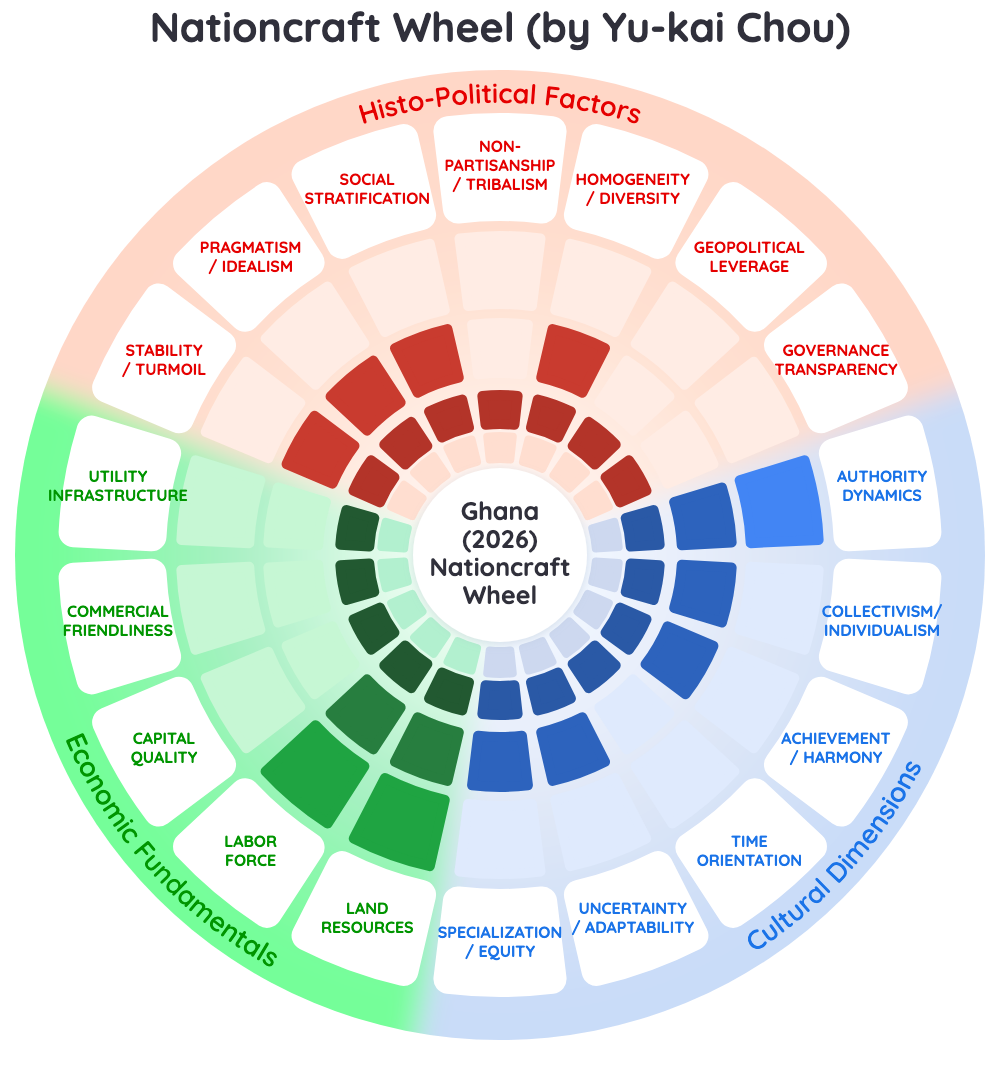

Ghana exited an International Monetary Fund programme in May 2026. It did so ahead of schedule, with the cedi the best-performing currency in Africa, inflation down from nearly twenty-four percent to single digits, reserves rebuilt, and the credit rating climbing out of default. By every headline measure, this was a success. It was also the seventeenth time, give or take, that Ghana has done some version of this since independence in 1957.
That second sentence is the one worth sitting with. A country that has exited roughly seventeen IMF arrangements has also entered roughly seventeen. The exits are real. The entries are just as real. And the gap between “we stabilized” and “we never have to stabilize again” has not closed in sixty-eight years.
This is the central puzzle of Ghanaian political economy, and most coverage misses it because it grades each cycle on its own terms. The 2023 to 2026 programme was run well. The one before it was run badly. The one before that was run well. Scored individually, the record looks like competence interrupted by lapses. Scored as a pattern, it looks like something more specific, and more fixable: a country that has become genuinely excellent at the rescue and has used that excellence to postpone the cure.
I call this configuration the Stabilization Trap, and Ghana’s eighteen-variable Nationcraft profile shows exactly how it works. The trait that should help, a proven ability to run a stabilization programme to completion, is precisely the trait that lets the structural fix wait. A country that is good at being rescued never builds the thing that would stop it needing rescue.
What follows is a full Nationcraft read of Ghana in 2026: the variable profile, the paradox the profile produces, the reformer playbooks Ghana’s structure rejects, the ones it can actually use, and a sequencing logic for converting this exit into the last one.
⚡ Speed Run Notes
- Ghana’s May 2026 IMF exit is real, but it is the seventeenth-or-so cycle since 1957. The pattern, not the cycle, is the story.
- The Nationcraft trap cluster is V4 Time Orientation = 3, V13 Governance Transparency = 3, V16 Capital Quality = 2, V10 Non-Partisanship = 3. Strong inputs (V14 = 7, V15 = 7) cannot outrun it.
- The binding constraint is not resources and not stabilization skill. It is time horizon. Ghana has a V4 problem wearing a debt-crisis costume.
- The Botswana, Norway and Singapore playbooks all fail Ghana’s V-vector: each needs governance transparency Ghana does not have. Reaching for them wastes the reform window.
- The packets that fit attack the horizon directly: Brazil’s Fiscal Responsibility Law (SP-034), Ghana’s own Rawlings record read honestly (SP-038), and Mauritius-style diversification (SP-029).
- The 2025-26 recovery rests heavily on a gold-price windfall. That is a clock, not a cushion.
Table of Contents
- Speed Run Notes
- Understanding Ghana Through the Nationcraft Framework
- What Is the Nationcraft Framework?
- The 18 Ghana Nation Variables
- The Stabilization Trap
- Detailed Justifications: Ghana Variable by Variable
- Best-Match Historical Packets
- Governance Strategy Recommendations
- Comparative Context
- Frequently Asked Questions
- Related Reading
About Yu-kai Chou

Yu-kai Chou is a Human-Systems Architect & Behavioral Designer and the creator of the Nationcraft Framework — an 18-variable diagnostic for matching a country’s structural profile to the reform packets that have historically worked under similar conditions. He has consulted for governments in eight nations, including Ukraine, the United Kingdom, the Kingdom of Bahrain, Singapore, Taiwan, the Netherlands, Kazakhstan, and South Korea, and has worked directly with President Zelenskyy’s team on post-war reconstruction priorities for Ukraine.
Chou’s prior framework — the Octalysis Framework — has been applied by LEGO, Microsoft, Porsche, Coca-Cola, Salesforce, and MrBeast, impacting over 1.5 Billion Users. He has taught the methodology at Harvard, Stanford, Yale, Tesla, Google, BCG, and IDEO.
His work has been cited by Harvard, Stanford, MIT, Forbes, Wall Street Journal, Wired, US Department of Energy, NIST, NSF, NCBI, US Department of Education, ClinicalTrials.gov, and Google Scholar — with 3,700+ more academic publications. Explore his books here.

This Ghana analysis applies the Nationcraft Framework to one of the most-studied recurring-crisis cases in development economics: a stable democracy with a strong resource base that has nonetheless returned to the IMF more often than almost any country in Africa. Chou’s advisory work across eight governments has repeatedly surfaced the same lesson the Ghana profile makes unavoidable. The hardest reforms are not the ones a crisis forces, but the ones that have to hold after the crisis ends and the external pressure lifts.
Understanding Ghana Through the Nationcraft Framework
Ghana is, by most measures the development community cares about, a good-news country. It is rated Free by Freedom House. It has held repeated peaceful transfers of power between its two main parties, the New Patriotic Party and the National Democratic Congress. It has not had a coup since 1981. In December 2024 it voted out an incumbent government cleanly: John Dramani Mahama defeated then-Vice-President Mahamudu Bawumia by nearly fifteen points and was sworn in on 7 January 2025 on a platform he branded “Resetting Ghana.” West Africa, in a decade of coups across the Sahel, has few stories this orderly.
And yet Ghana is also a country whose government has spent much of the past four decades inside an IMF programme or negotiating the next one. It defaulted on most of its external debt in December 2022. It put its own citizens through a Domestic Debt Exchange Programme that swapped roughly 137 billion cedis of domestic bonds for new instruments paying zero percent in the first year. It then ran a three-year, three-billion-dollar Extended Credit Facility, and exited it in May 2026 to applause.
How does an orderly, democratic, resource-rich country keep arriving at the same fiscal cliff? The standard answers (corruption, commodity prices, global shocks, bad luck) each explain a cycle. None explains the cycle. To see the cycle, you have to stop scoring Ghana on outcomes and start scoring it on structure. That is what the Nationcraft Framework is built to do.
What Is the Nationcraft Framework?
The Nationcraft Framework treats a nation the way a behavioral designer treats a complex system: as something with a measurable structure that determines which interventions can work and which cannot. It grew out of the same lineage as the Octalysis work on human motivation, and it borrows the architecture of the Octalysis Strategy Dashboard, in which business metrics become nation goals, player types become cultural and historical factors, and game mechanics become government policies. For readers coming from the behavioral-design side, the bridge piece on how the Octalysis Framework applies to nation-building traces that lineage in full.
The framework rests on a single, uncomfortable claim: policy effectiveness is decided by context-fit, not policy quality. A reform packet that worked brilliantly in one country’s structural profile can be inert, or actively destructive, in another’s. The job of Nationcraft is to measure the profile precisely enough that you can tell the difference before you import the policy, not after.
That profile is the eighteen Nation Variables, each scored on a one-to-nine scale, grouped into three blocks. The Cultural block (V1 through V6) covers Authority Dynamics, Collectivism, Achievement orientation, Time Orientation, Uncertainty Adaptability and Specialization. The Histo-Political block (V7 through V13) covers Stability, Pragmatism, Social Stratification, Non-Partisanship, Homogeneity, Geopolitical Leverage and Governance Transparency. The Economic block (V14 through V18) covers Land Resources, Labor Force Quality, Capital Quality, Commercial Friendliness and Utility Infrastructure.
The scores are never averaged. A country is not the mean of its eighteen variables; it is the specific shape they make together. Nationcraft calls this principle “configuration is strategy”: the leverage is always in how a handful of variables interact, not in any single number. Against that profile the framework runs a corpus of more than a hundred historical Success Packets, each a documented reform episode with its own variable signature, and asks a narrow, testable question. Which packets were run by countries shaped like this one? You can see the same method applied to very different profiles across the library of Nationcraft country analyses.
The 18 Ghana Nation Variables
Here is Ghana’s 2026 profile in full. Read it as a shape, not a scorecard. The story is in which variables sit high, which sit low, and which ones reinforce each other.
| Variable | Score (1-10) | One-line read |
|---|---|---|
| V1 Authority Dynamics | 7 | Chieftaincy and communal deference, inside a competitive democracy |
| V2 Collectivism vs Individualism | 6 | Strong family and ethnic networks; communal obligation |
| V3 Achievement vs Harmony | 4 | Communal balance with a deep entrepreneurial trader streak |
| V4 Time Orientation | 3 | Fiscal policy paced to the four-year election cycle |
| V5 Uncertainty & Adaptability | 5 | Moderate; hardship-tempered improvisation |
| V6 Specialization vs Equity | 4 | Informal-sector heavy; limited high-end specialization |
| V7 Stability vs Turmoil | 5 | Politically very stable; economically volatile |
| V8 Pragmatism vs Idealism | 4 | Reform-capable when a crisis and an external anchor are both present |
| V9 Social Stratification | 6 | Chieftaincy hierarchy plus education-driven mobility |
| V10 Non-Partisanship vs Tribalism | 3 | Intense two-party binary plus ethnic voting blocs |
| V11 Homogeneity vs Diversity | 4 | Multi-ethnic, Akan plurality, no separatism |
| V12 Geopolitical Leverage | 2 | Small open economy; a price-taker |
| V13 Governance Transparency | 3 | Mid-table corruption scores; revenue leaks before it compounds |
| V14 Land Resources | 7 | Africa’s top gold producer; world’s second cocoa producer; oil, bauxite, manganese |
| V15 Labor Force Quality | 7 | Educated and English-speaking; eroded by persistent emigration |
| V16 Capital Quality | 2 | Thin domestic capital; banks impaired by the 2023 debt exchange |
| V17 Commercial Friendliness | 3 | Moderate, friction-heavy business environment |
| V18 Utility Infrastructure | 3 | Chronic power instability, slowly improving |
Two things jump out of this shape. First, Ghana’s production inputs are not the problem. V14 Land Resources at 7 and V15 Labor Force Quality at 7 are genuinely strong scores. Ghana is Africa’s largest gold producer, the world’s second-largest cocoa grower, an oil producer since 2010, and home to an educated, English-speaking workforce. Add V1 Authority Dynamics at 7 and the raw materials of a successful state are present.
Second, the low scores are not scattered. They cluster. V4 Time Orientation at 3, V13 Governance Transparency at 3, V16 Capital Quality at 2, and V10 Non-Partisanship at 3 form a tight, mutually reinforcing group. That cluster is the Stabilization Trap, and it deserves its own section.
The Stabilization Trap
Every Nationcraft analysis looks for the configuration signature, the small combination of variables that explains a country’s recurring behavior better than any single score. Ghana’s signature is unusually clean, and I have not seen it isolated this sharply anywhere else in the corpus, so it is worth naming. The Stabilization Trap is the pattern in which a country becomes so reliably good at the stabilization phase of reform that it never has to complete the structural phase.
Here is the mechanism, variable by variable. A stabilization programme is a three-to-four-year window of fiscal discipline enforced by an external anchor. Ghana is excellent inside that window. With V1 Authority Dynamics at 7, the government can ask for sacrifice and be obeyed. With V8 Pragmatism at 4, the operating elite will accept orthodox medicine when a crisis is loud enough and the IMF is in the room. With V14 and V15 both at 7, there is a real economy to stabilize. Ghana has run this play, in some form, roughly seventeen times, and the 2023 to 2026 programme shows it can still execute: inflation fell from 23.8 percent in December 2024 to single digits within a year, gross reserves climbed back toward fifteen billion dollars, and the cedi became the strongest-performing currency on the continent.
Then the window closes. The IMF leaves. The crisis salience that the framework’s Crisis Window pattern (RE-001) depends on fades, and as it fades, the trap cluster reasserts itself. V4 Time Orientation at 3 means the planning horizon collapses back to the next election. Ghana runs a fiercely contested national vote every four years, and with V10 Non-Partisanship at 3 (a near-zero-sum NPP-versus-NDC binary layered over ethnic voting blocs), each cycle reopens the spending taps as both parties bid for the same swing constituencies. V13 Governance Transparency at 3 means a meaningful share of revenue leaks before it can compound; Ghana lost more than 1.1 billion dollars to cocoa smuggling alone between the 2021/22 and 2024/25 seasons. V16 Capital Quality at 2 means there is no deep domestic capital market to absorb the resulting gap, so the gap becomes external debt. Within a handful of years, the country is at the cliff again, and the cycle restarts.
The cruel part is the feedback loop. Because Ghana is good at stabilization, stabilization always arrives in time. And because it always arrives in time, the structural reform (the legally locked fiscal rule, the depoliticized revenue institution, the diversified export base) never becomes urgent enough to force. The competence is the trap. This is the nation-scale version of a pattern behavioral designers know well: meaningful work loses to urgent work not because it matters less, but because the urgent thing keeps rescuing you from the consequences of skipping the meaningful one.
There is a motivational reading of this that sharpens the diagnosis. An IMF programme is, in Octalysis terms, almost pure Black Hat motivation: external pressure, hard deadlines, an outside enforcer, the looming loss of market access. Black Hat motivation is powerful and fast, which is exactly why Ghana stabilizes so well. But it has a known failure mode. It stops working the moment the pressure is removed, because it never builds the intrinsic, self-sustaining structures that keep behavior going on their own. Ghana keeps reaching for the external anchor because the internal one was never built. The Nationcraft corpus has a name for the chronic over-use of an external commitment device, the External Anchor pattern (RE-003), and Ghana is one of its clearest examples.
One clarification matters for honesty here. Ghana is not the textbook Aid Dependency Trap (ED-001) in the Afghanistan or Haiti sense; its grant aid is modest and it is a lower-middle-income economy, not a budget-support ward. What Ghana exhibits is the commitment-device variant of the same family: it has come to use IMF programmes as the fiscal discipline its own institutions do not supply. The structural variables that drive ED-001, V12 Geopolitical Leverage at 2 and V16 Capital Quality at 2, are both present. The mechanism transfers even though the label does not fit cleanly. That precision matters, because it tells you the fix is not “less aid”; it is a domestic institution.
Detailed Justifications: Ghana Variable by Variable
A configuration signature is only as trustworthy as the scores underneath it. Here is the per-variable reasoning for the variables that carry the Ghana analysis, drawn from the 2026 sanity check against World Bank, IMF, Transparency International and Bank of Ghana data.
V4 Time Orientation = 3: The Binding Constraint
This is the single most important score in the Ghana profile, and it earns the low number. Ghanaian fiscal policy has a well-documented election-cycle rhythm: spending and deficits widen sharply in election years and contract afterward, often under IMF supervision. A score of 3 on V4 does not mean Ghanaians cannot think long-term as individuals; education is deeply valued, and the trader culture plans across seasons. It means the state’s revealed planning horizon is short, bounded by the four-year cycle. Every other variable in the trap cluster is downstream of this one.
V13 Governance Transparency = 3
Ghana’s Transparency International Corruption Perceptions score sits in the low forties out of a hundred, which is mid-table, neither catastrophic nor clean. On the Nationcraft one-to-nine scale that maps to a 3, and the sanity check flags it as a defensible low read rather than a hard floor; a case exists for 4. The lower score is supported by concrete leakage: the cocoa smuggling losses already cited, recurring questions about gold-sector revenue capture, and the procurement opacity that has accompanied past spending booms. V13 is the variable that decides whether resource revenue compounds or evaporates.
V14 Land Resources = 7 and V15 Labor Force Quality = 7
These are Ghana’s genuine strengths, and they are why the country is not a failed state. Ghana overtook South Africa as the continent’s largest gold producer, grows roughly a fifth of the world’s cocoa, and has produced oil commercially since the Jubilee field came online in 2010. Its labor force is literate, English-speaking and served by a respected university system. The one caveat, flagged as a minor downward drift in the sanity check, is the Brain Drain Spiral pattern (ST-002): Ghana is a persistent net exporter of nurses, doctors and skilled graduates, which slowly erodes the V15 strength the country reports on paper.
V16 Capital Quality = 2
Ghana’s domestic capital base is thin, and it was made thinner by its own crisis response. The 2023 Domestic Debt Exchange Programme, which restructured about 137 billion cedis of local bonds, fell heavily on Ghanaian banks, pension funds and insurers; the Bank of Ghana itself posted a loss of roughly 60.8 billion cedis in 2022. A V16 of 2 means that when the fiscal gap reopens, there is no deep domestic market to absorb it. The gap has to be financed externally, which is the mechanical link between the trap cluster and the debt cycle.
V10 Non-Partisanship vs Tribalism = 3
Ghana’s democracy is, paradoxically, both its great achievement and a load-bearing part of the trap. The NPP-NDC contest is genuinely competitive, which is healthy. But it is also close to zero-sum and overlaid on ethnic and regional voting blocs, which is what a low V10 measures. The consequence for reform is specific: any fiscal rule, revenue institution or spending discipline that is identified with one party becomes a target for the other. Depolarizing the fiscal framework is therefore not a nicety. It is a precondition.
V7 Stability = 5 and V8 Pragmatism = 4
These two are scored at the middle of the scale because they genuinely sit there. V7 blends Ghana’s strong political stability (no coup since 1981, repeated peaceful alternations) with its real economic volatility, and 5 is the honest composite. V8 at 4 captures a government that is pragmatic when crisis and external pressure coincide, and less so otherwise; the sanity check notes the Mahama administration’s competent handling of the Extended Credit Facility could argue for a drift toward 5, but sixteen months is too short a record to move a corpus score. Both variables are watch-items, not anchors.
Best-Match Historical Packets
With the profile established, the Nationcraft method runs Ghana’s V-vector against the Success Packet corpus. The exercise splits cleanly into two halves: the famous templates Ghana commentators reach for that the variable profile rejects, and the less-celebrated packets that actually fit.
Reformer playbooks Ghana’s profile rejects
Each of these is a real, documented Success Packet. Each fails Ghana on at least one cardinal variable. Citing them in a Ghana reform conversation is not just unhelpful; it actively burns the reform window.
| Packet | What it needs | Why Ghana’s V-vector rejects it |
|---|---|---|
| Botswana Diamond Management (SP-004) | V13 ≥ 6 and V10 ≥ 4 before resources flow | Ghana is V13 = 3, V10 = 3, and gold, cocoa and oil have flowed for decades. The sequencing window is shut. |
| Norway Oil Fund (SP-106) | V13 = 10, V4 = 9 at fund creation | Ghana is V13 = 3, V4 = 3. A sovereign fund built on these institutions leaks. |
| Lee Kuan Yew Industrialization (SP-002) | V13 = 8, V8 ≥ 8, V5 ≥ 7, city-state scale | Ghana is V13 = 3, V8 = 4, V5 = 5. Three misses plus non-replicable scale. |
| EPRDF Developmental State (SP-030) | V1 = 8, V4 = 7, one-party discipline | Ghana is V4 = 3 and a competitive two-party democracy; V10 = 3 re-litigates any 20-year plan every cycle. |
| Vision 2030 Transformation (SP-037) | V1 = 10 monarchy, V12 = 9, V16 = 6 sovereign-wealth firepower | Ghana is V1 = 7, V12 = 2, V16 = 2. No absolute authority, no leverage, no self-funding capital. |
The Botswana rejection deserves a moment, because it is the comparison Ghanaians and outside commentators reach for most often. Ghana has gold, Botswana had diamonds, why can’t Ghana do what Botswana did? The Nationcraft answer is precise and a little brutal. The Botswana Diamond Management Packet worked because Seretse Khama’s government built transparent institutions (the anti-corruption bureau, the fiscal rules, the Pula Fund) before the diamond revenue arrived. The packet’s own documented requirement is V13 of 6 or higher at the moment resources begin to flow, and it explicitly fails where V13 sits at 4 or below or V10 sits at 3 or below, because capture becomes inevitable. Ghana fails both thresholds. More importantly, Ghana cannot replay the sequence at all: its resources have already been flowing through V13 = 3 institutions for half a century. Botswana ran institutions-then-resources. Ghana is living resources-then-institutions, which is a different and harder game. Botswana is the destination. It is not an available road.
The same logic sinks the Norway comparison. Norway built the Government Pension Fund Global on a V13 of 10, institutions that predated the oil. Ghana already has a petroleum fund, and it is precisely the V13 = 3 environment that makes a fund necessary but not sufficient. The Resource Curse Prevention Playbook (PB-03) states the threshold flatly: below V13 = 5, resource revenues get stolen, and that is the single strongest predictor of the resource curse. Ghana does not clear it.
Reformer playbooks Ghana’s profile can actually use
The packets that fit Ghana share a feature the rejected ones lack: they do not assume governance Ghana does not have, and they target the binding constraint directly. Ghana does not need a lesson in how to stabilize; it has run that play seventeen times. It needs a lesson in how to make discipline outlast the programme. That is a V4 problem, and these are the V4 packets.
| Packet | The transferable instrument | Variable it attacks |
|---|---|---|
| Plano Real & Stabilization (SP-034, Brazil 1994) | A Fiscal Responsibility Law: hard, legally binding budget constraints that ended bailout expectations | V4 Time Orientation |
| Rawlings Structural Adjustment (SP-038, Ghana 1983-2000) | Credible domestic ownership of reform, plus an honest reading of what it failed to finish | V8 Pragmatism, V1 Authority |
| Diversification & Services (SP-029, Mauritius 1970) | Sequenced diversification: build the next export sector before the current windfall fades | V14 dependence, V6 Specialization |
| Fiscal Crisis Consolidation (PB-05) | Zero-based program review, conservative budgeting, and a cross-party fiscal pact | V10 Non-Partisanship, V4 |
Plano Real (SP-034) is the closest match in the corpus. Brazil in 1994 had a thirty-year history of failed stabilization plans (Cruzado, Bresser, Verão, two Collor plans) that looked exactly like Ghana’s seventeen-cycle record. What broke Brazil’s pattern was not the famous URV transition currency alone. It was the Fiscal Responsibility Law of 2000, which put hard, legally binding budget constraints on every level of the state and, in the packet’s own language, “ended bailout expectations.” Brazil’s 1994 benchmark profile, with V13 = 4, V7 = 4, V4 = 4 and V8 = 6, is a slightly more functional version of Ghana’s, which is what makes the packet reachable rather than aspirational. The single most transferable move in the entire corpus, for Ghana, is a statutory fiscal-responsibility rule that survives the election cycle because it is locked in law and watched by an independent fiscal council.
The Rawlings packet (SP-038) is Ghana’s own history, and it should be studied as both a model and a warning. The Economic Recovery Program that Jerry Rawlings launched in 1983 worked: inflation fell from 123 percent to 25 percent, cocoa production roughly doubled after producer prices were raised, and the country became, in the IMF’s own phrase, a poster child. The packet’s documented critical insight is that structural adjustment succeeds when a credible leader owns it rather than appearing as an IMF puppet. But the same packet’s honest ledger of what failed is the first recorded lap of the Stabilization Trap: manufacturing deindustrialized, inequality widened, the northern regions were left behind, and the brain drain continued. Ghana’s own past is the cautionary case. The stabilization held; the structural transformation did not.
The Mauritius packet (SP-029) speaks to the windfall problem. Ghana’s 2025-26 recovery has been powered substantially by gold. The new Ghana Gold Board, created in 2025 to formalize artisanal and small-scale mining, helped lift gold to more than eleven billion dollars of export earnings in the first nine months of 2025, more than cocoa and oil combined, on the back of historically high global prices. Mauritius faced the same temptation with sugar: a guaranteed-price windfall that could have been consumed. Instead it sequenced, letting sugar revenue fund textiles, textiles fund tourism, and tourism fund financial services, diversifying before each preference expired. The Mauritius lesson for Ghana is one sentence. A windfall is the fuel for diversification, not a substitute for it. High gold prices are a clock.
Finally, for the revenue side specifically, the Resource Curse Prevention Playbook (PB-03) carries a branch built exactly for Ghana’s situation. Where V13 sits at 4 or below, PB-03 explicitly advises against a conventional government-managed sovereign fund, the Norway model, and recommends either direct citizen distribution on the Alaska Permanent Fund pattern or an internationally co-managed fund governed by the Santiago Principles. It is the rare piece of corpus advice designed for a country that knows its own institutions are not yet trustworthy. Honesty about V13 = 3 is not defeatism. It is the precondition for choosing an instrument that will actually hold.
Governance Strategy Recommendations
The Nationcraft method does not end at diagnosis. Once the fitting packets are identified, the question becomes sequencing: what order, on what horizon, with which variable as the target. For Ghana, the sequence is unusually legible because the binding constraint is so clearly V4.
| Phase | Move | Packet basis | Target |
|---|---|---|---|
| Phase 1 (0-12 months) | Pass a statutory Fiscal Responsibility Law with an independent fiscal council, agreed across the NPP-NDC divide before the next budget | SP-034, PB-05 | V4, V10 |
| Phase 2 (1-3 years) | Route the gold windfall through a transparency-appropriate vehicle (PB-03 low-V13 branch), ring-fenced for diversification, not consumption | PB-03, SP-029 | V13, V14 dependence |
| Phase 3 (3-7 years) | Build the next export sector while gold prices are high; treat the Policy Coordination Instrument as the last external anchor, not the next | SP-029, SP-038 | V6, V16, V4 |
Three strategic implications follow, and they are the conclusions most 2026 commentary on Ghana is not yet drawing.
First, the exit is real and the cycle is real, and both statements are true at once. The 2025-26 stabilization was genuinely well executed. The disinflation, the reserve rebuild, the strongest currency in Africa, and the rating recovery from default to a B with a positive outlook are not spin. But a stabilization is not an escape. Treating the May 2026 exit as the end of the story is the exact cognitive move that has preceded every previous re-entry. The honest framing is that Ghana has bought itself a reform window, and reform windows are spent, not banked.
Second, the binding constraint is V4, not V14. Ghana does not have a resource problem and it does not have a stabilization-skill problem. It has a time-horizon problem wearing a debt-crisis costume. Every reform conversation that is about gold, or about the IMF relationship, or about which spending to cut, is a conversation about a symptom. The conversation that matters is about a single institution: a fiscal rule with enough legal and political insulation to survive a Ghanaian election. Nothing else on the agenda moves V4.
Third, the gold windfall is a clock, not a cushion. The most uncomfortable fact in the 2026 picture is that the recovery leans heavily on a global gold-price spike that Ghana does not control; its V12 Geopolitical Leverage of 2 says exactly that. When prices revert, the question will be whether a domestic fiscal institution exists to hold the line. Today it does not. The window to build one is open precisely as long as the gold price stays high, which is to say: not indefinitely.
Comparative Context
Ghana’s profile reads more sharply against its neighbors. The Nationcraft corpus lets us line up the trap-cluster and resource variables side by side, and the comparison places Ghana in a revealing middle position.
| Country | V4 | V8 | V10 | V13 | V14 | V16 | Resource outcome |
|---|---|---|---|---|---|---|---|
| Ghana | 3 | 4 | 3 | 3 | 7 | 2 | Recurring-crisis middle |
| Botswana | 5 | 6 | 6 | 7 | 9 | 6 | Resource blessing (ET-002) |
| Norway | 9 | 8 | 10 | 10 | 10 | 10 | Resource blessing (ET-002) |
| Nigeria | 3 | 4 | 1 | 2 | 9 | 3 | Resource curse (ET-001) |
| Zambia | 3 | 3 | 2 | 2 | 8 | 2 | Commodity-dependent, debt-prone |
The table tells a clear story. Ghana is not Nigeria, and that distinction is real and worth defending: with V10 at 3 against Nigeria’s 1 and V13 at 3 against Nigeria’s 2, Ghana has a functioning competitive democracy and a less-captured state. Ghana is also not Zambia, whose copper economy carries the cautionary Chiluba Privatization Packet (SP-072), a country the corpus describes as one where “democratic success masked development failure.” But Ghana is just as plainly not Botswana. The gap between Ghana’s V13 = 3 and Botswana’s V13 = 7 is the whole difference between the Resource Curse pattern (ET-001) and the Resource Blessing pattern (ET-002), and four points of governance transparency is not a gap you close inside one reform window.
That middle position is the actionable insight. Ghana is good enough to keep escaping the worst outcomes and not yet structured enough to stop needing to escape. Among the published country analyses, the Thailand read shows the strongest resemblance: Thailand’s “coup cycle” and Ghana’s bailout cycle are the same species of trap, a country competent at the reset and unable to make the reset the last one. The contrast with the high-capital, high-transparency profile of the United States and the war-reshaped variables of Ukraine shows how differently the same framework reads across profiles.
The Nationcraft Framework in Practice
It is worth stepping back to what this exercise demonstrated about the method itself. A conventional analysis of Ghana in May 2026 would have led with the good news and ended with a caution. The Nationcraft Framework did something different. It ignored the outcome entirely and read the structure, and the structure said the good news and the recurring crisis are produced by the same configuration.
That is the framework’s core discipline. By scoring eighteen variables rather than reacting to one headline, Nationcraft separates what a country did from what a country is, and the second is what predicts the next cycle. The Stabilization Trap is not a moral failing or a run of bad luck. It is V4 = 3 interacting with V13 = 3, V16 = 2 and V10 = 3, and naming it that precisely is what makes it fixable. You cannot legislate against bad luck. You can legislate a fiscal rule.
The same method, run against the recurring crises of other nations, keeps surfacing the same lesson. Imported policy fails not because the policy is bad but because the importing country’s variable profile was never measured. Ghana has spent decades importing the stabilization half of reform and skipping the structural half. The framework’s contribution is to say, with corpus evidence behind it, which structural half its profile can actually carry.
Explore More Nationcraft Analyses
This Ghana analysis sits alongside a growing set of country reads built on the same eighteen-variable method, and several are direct companions to the Ghana case. The Venezuela analysis runs the same packet-matching logic against a full petrostate collapse. The South Korea and Taiwan reads show the method applied to high-capital economies, and the United Kingdom analysis tracks a different kind of slow institutional drift. Each is a worked example of reading a country as a configuration rather than a scoreboard.
Frequently Asked Questions
Did Ghana actually exit the IMF in 2026, or is that political spin?
It is real. Ghana concluded its three-year, three-billion-dollar Extended Credit Facility ahead of schedule in May 2026, moved to a non-financing Policy Coordination Instrument, saw its credit rating climb from restricted default to a B with a positive outlook after five consecutive upgrades, and rebuilt gross reserves to roughly 14.5 billion dollars. The exit is genuine. What this analysis questions is whether an exit is the same thing as an escape, and Ghana’s variable profile says it is not, not yet.
What is the Stabilization Trap?
It is the Nationcraft configuration signature in which a country becomes so reliably good at executing a stabilization programme that it never builds the structural institutions that would stop it needing one. The skill substitutes for the structure. Ghana’s profile shows it cleanly: strong production inputs and proven programme discipline, sitting on a trap cluster of V4 Time Orientation at 3, V13 Governance Transparency at 3, V16 Capital Quality at 2, and V10 Non-Partisanship at 3.
Why can’t Ghana just manage its gold the way Botswana managed its diamonds?
Because the Botswana packet (SP-004) requires governance transparency of 6 or higher and low ethnic competition for resources before resource wealth begins flowing. Ghana sits at V13 = 3 and V10 = 3, and its gold, cocoa and oil have flowed through those institutions for decades. Botswana built institutions first and let resources arrive second. Ghana cannot replay a sequence whose window closed in the twentieth century.
Is Ghana a resource-curse country?
It is an edge case. The Nationcraft Resource Curse pattern (ET-001) triggers at V14 of 8 or higher with V13 at 3 or below and V8 at 4 or below. Ghana scores V14 = 7, V13 = 3 and V8 = 4, so two of the three conditions are met, the third one point short. Ghana is not a full petrostate collapse like Venezuela or Nigeria, but the curse dynamics operate at the margin, which is why honest revenue management still matters.
What single reform would matter most for Ghana?
A legally locked fiscal-responsibility rule, modelled on Brazil’s Fiscal Responsibility Law in the Plano Real packet (SP-034), agreed across the NPP-NDC divide before the next windfall is spent. It is the only move on the table that directly attacks V4 Time Orientation at 3, the binding constraint. A fiscal rule that survives an election cycle is what converts a stabilization into an escape.
What would prove this Ghana analysis wrong?
A durable rise in V4, meaning a statutory fiscal rule with an independent fiscal council that survives at least one full election cycle without being suspended, would falsify the Stabilization Trap diagnosis. A sustained climb in V13 Governance Transparency past 5, or a real diversification of export earnings away from gold before global prices revert, would also shift the binding constraint. The framework is built to be tested against exactly these markers.
Related Reading
- The Nationcraft Framework: the full 18-variable model, the eight nation goals, and the configuration-is-strategy principle.
- Nationcraft Country Analyses: the complete library of applied V-vector reads.
- Venezuela: Eight Reform Playbooks Rejected, Three That Fit: the same packet-matching logic against a petrostate collapse.
- Nationcraft Analysis: South Korea: a high-capital democracy with its own configuration trap.
- How the Octalysis Framework Applies to Nation-Building: the behavioral-design lineage behind Nationcraft.
- Books by Yu-kai Chou: the behavioral-design foundations the framework is built on.
Footnotes
- Ghana’s IMF programme exit, credit-rating recovery and reserve levels: Africanews, “Ghana wraps up $3 billion dollar IMF bailout programme,” 16 May 2026, africanews.com; and “Ghana exits IMF bailout programme,” 15 May 2026.
- The count of Ghana’s IMF programmes since 1957 varies by methodology; mainstream coverage of the 2023 Extended Credit Facility commonly describes it as Ghana’s seventeenth, while other tallies cite eighteen or nineteen. IMF, “IMF Lending Case Study: Ghana,” imf.org.
- 2022 default and the Domestic Debt Exchange Programme: PwC Ghana, “What next after the Domestic Debt Exchange Programme?”, pwc.com.
- Cedi performance, the Ghana Gold Board and 2025 gold export earnings: Ghana Gold Board, “Ghana Cedi Emerges Africa’s Best-Performing Currency in 2025,” goldbod.gov.gh.
- Cocoa production and smuggling losses: USDA Foreign Agricultural Service, Ghana cocoa GAIN reporting, fas.usda.gov.
- Nation Variables, Success Packets, Historical Patterns and Solution Playbooks: the Nationcraft corpus, summarized at the Nationcraft Framework hub.