

Eight Reformer Playbooks Venezuela’s Variables Reject — And the Three That Actually Fit
Every time a Venezuelan transition looks possible, the same op-ed reflex kicks in. Just do what Singapore did. Just do what Pinochet did. Just do what postwar Germany did. The instinct is understandable — when a country is this broken, you reach for the most famous fixes. The problem is that none of those fixes were designed for a country shaped like Venezuela.
This is the central claim of the Nationcraft framework I’ve been building since 2024: policy effectiveness is decided by context-fit, not policy quality. A reform packet that worked brilliantly in one nation’s 18-variable profile can be inert — or actively destructive — in another’s. The 27-year Bolivarian collapse is, in part, the result of importing ideas (Cuban-style social missions, Chinese-style state oil, Russian-style oligarch alliances) into a country whose cultural and structural readiness for each was wrong. The next round of Venezuela reform deserves better.
So instead of asking “what should Venezuela do?” I want to ask the harder question: which historical reform packets does Venezuela’s variable profile actually permit? I ran every well-known modernization playbook in the Nationcraft corpus against Venezuela’s post-Maduro V-vector. Most of them fail the match test before policy-by-policy critique even begins. Three pass. Here’s what survives the math — and why eight of the usual suspects don’t.
⚡ Speed Run Notes
- Eight famous reformer playbooks fail Venezuela’s variable profile on at least two cardinal variables apiece. Cite them at your peril.
- Three packets survive variable matching against Venezuela in 2026: Plano Real (Brazil 1994, SP-034), Saakashvili (Georgia 2003, SP-051), and Estenssoro NEP / Decree 21060 (Bolivia 1985, SP-118) — Bolivia’s 2026 V-vector read shows how the country’s reform DNA looks four decades later.
- The single most important V-score in this analysis is V8 Pragmatism vs Idealism, which moved from ~2 under Maduro to 4 under Delcy Rodríguez and is the unlock for any reformer match at all.
- The biggest 2026-05 sanity-check corrections to Venezuela’s stored V-vector (V5 5→7, V9 8→6, V11 5→7, V12 1→3) expand the set of feasible packets rather than contract it.
- “Normalization without transition” is a real, identifiable variable-matching pattern, and it has historical precedents. Pretending otherwise is wishful thinking.
Table of Contents
- Speed Run Notes
- What Venezuela actually looks like in numbers
- Eight reformer playbooks Venezuela reform should reject
- Three reformer playbooks Venezuela reform should actually study
- What this means practically for Venezuela reform
- Frequently asked questions
- Closing
- Related Reading
Author Credibility: Yu-kai Chou

Yu-kai Chou created the Nationcraft Framework, applying behavioral design to the hardest motivational problem there is — getting an entire population to move through structural reform without losing momentum. As of 2026, the framework has informed advisory work with eight governments: Taiwan, the Netherlands, the United Kingdom, Bahrain, South Korea, Singapore, Ukraine, and Kazakhstan. The same 8 Core Drives that have driven design at Microsoft, Porsche, and MrBeast now anchor nation-scale reform sequencing — diagnosing where motivation is broken, which Core Drives to lean into for each phase of reform, and how to sequence the political asks so the public stays bought in.
Published Nationcraft analyses include diagnostic playbooks for Venezuela’s post-Maduro reform window and Thailand’s reset-vs-cycle election dynamics, alongside cabinet-level advisory work on post-conflict recovery, reform-sequencing, and public-policy gamification. Chou also teaches the Octalysis methodology at Harvard, Stanford, Yale, Google, BCG, and IDEO — institutions where the human-systems lens applies whether the system is a product, a company, or a country.
His work has been cited by Harvard, Stanford, MIT, Forbes, Wall Street Journal, Wired, US Department of Energy, NIST, NSF, NCBI, US Department of Education, ClinicalTrials.gov, and Google Scholar — with 3,700+ more academic publications. Explore his books here.

This Venezuela analysis applies the Nationcraft Framework to one of the world’s most studied petrostate-collapse cases — a country where V14 (Land Resources) sits at 9 while V16 (Capital Quality) collapsed to 1, the configuration signature Chou identifies as the “Resource Curse Trap.” The next round of Venezuela reform deserves better than imported templates designed for Singapore, Vision 2030 Saudi Arabia, or the Marshall Plan — the analysis below traces which historical packets the V-vector structurally permits, and which it rejects before policy-by-policy critique even begins.
What Venezuela actually looks like in numbers
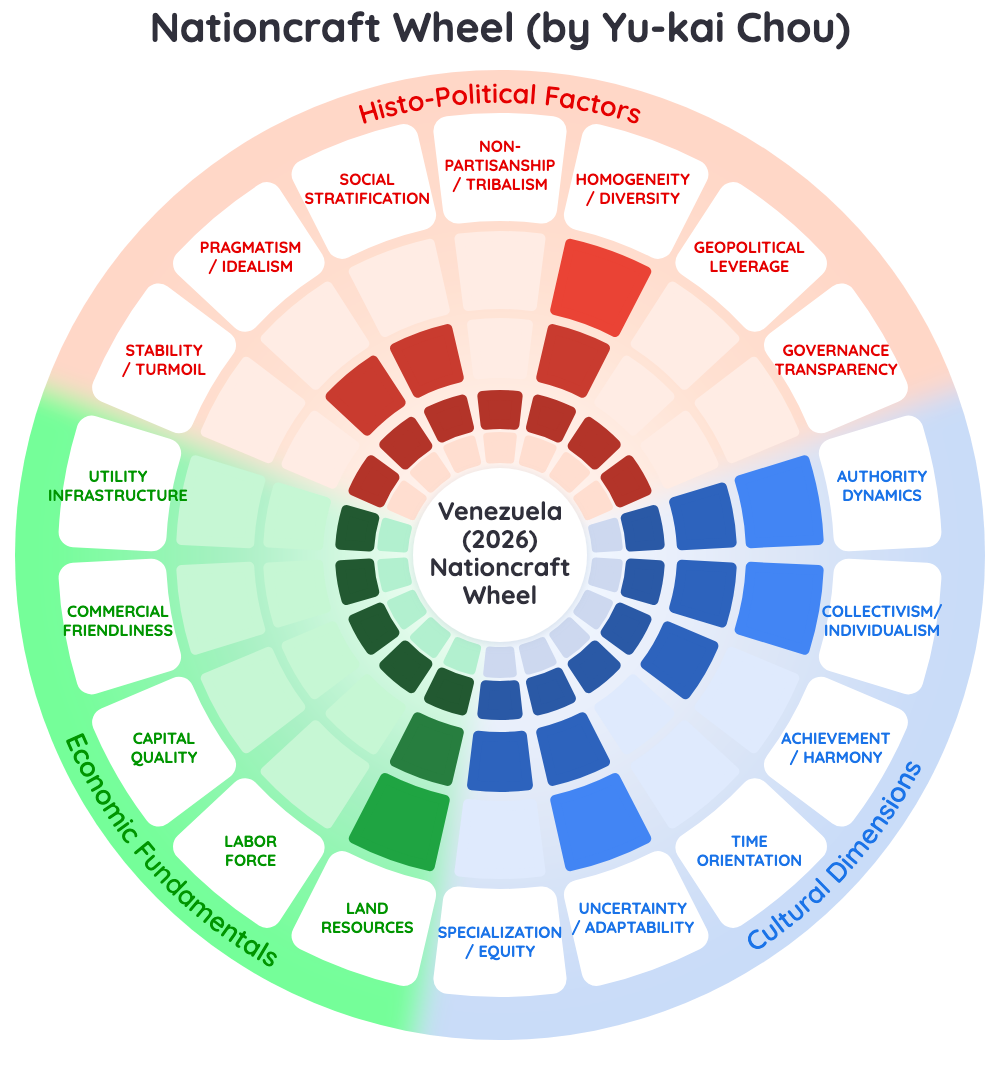
Before testing any packet against Venezuela, we need a clean read of Venezuela itself. The 18-variable Nationcraft profile groups into three blocks (Cultural V1–V6, Histo-Political V7–V13, and Economic Fundamentals V14–V18), and Venezuela’s signature emerges from how its blocks contradict each other.
Culturally, Venezuela is hierarchical but not deferential. V1 Authority Dynamics = 7: Venezuelans accept top-down rule (27 years of Bolivarian conditioning, military and bureaucracy followed Rodríguez seamlessly after the January 3, 2026 extraction of Maduro), but nearly 7.9 million people have voted with their feet (UN R4V Inter-Agency Coordination Platform) and María Corina Machado is the clear plurality preference in any post-Maduro election (38.2% first-choice, 56% favorable in the February 2026 Atlas/Bloomberg Latam Pulse poll). V2 Collectivism = 7 and V11 Homogeneity = 7 (revised up from 5 in May 2026)[1] mean Venezuelans share an unusually unified sense of who “we” are: ~70% mestizo, near-universal Spanish, no major separatist ethnic regions.
Histo-politically, Venezuela is a near-catastrophe. V7 Stability = 2, the most defensible “1 or 2” of any variable in the entire corpus, given a sitting president was extracted by US military four months ago and the Essequibo deployment continues despite ICJ (International Court of Justice) orders. V10 Tribalism = 2: Chavismo versus Opposition is one of the world’s purest zero-sum political binaries. V13 Governance Transparency = 2: PDVSA (Petróleos de Venezuela) opaque, courts captured, $1.95B in gold still held by the UK. V12 Geopolitical Leverage = 3 (revised up from 1): Venezuela’s sovereignty is demonstrably permeable, but it still holds the world’s largest proven oil reserves, an Essequibo card, and migration pressure on every neighbor.
But the variable that matters most for this article is V8 Pragmatism = 4, up from ~2 under Maduro. Chávez and Maduro ran a textbook idealistic-authoritarian regime where ideological purity beat results. Delcy Rodríguez is running the opposite play. She has accepted Chevron, BP, Eni, Repsol, Shell, and Établissements Maurel & Prom back into the country under OFAC General License 50A (issued February 13, 2026; Maurel & Prom added in the February 18 amendment). She has accepted de-facto dollarization. She has accepted sanctions-relief-for-cooperation as the operating logic of the state. The Chavista base is still idealistic; the operating elite has gone transactional. This V8 swing of +2 in a single political transition is what unlocks any of the reformer matches in this article. Without it, even the three that fit wouldn’t fit.
Economically: V14 Land = 9 (world’s largest oil reserves, gold, iron, bauxite, coltan, arable land), but every other economic variable is on the floor. V15 Labor = 3 after the multi-million emigration of working-age, highly-credentialed Venezuelans (high concentrations of college-educated, master’s, and doctorate holders). V16 Capital = 1. V17 Commercial Friendliness = 2. V18 Utility Infrastructure = 2 (Bloomberg, May 8, 2026: “Venezuela’s Faulty Power Grid Risks Derailing Economic Comeback”). This is the resource curse Configuration Signature: V14 high, V15–V18 low, V13 low. It is the most predictable failure pattern in the corpus, and it is the actual binding constraint on any Venezuela reform plan.
That is the profile every packet has to match. Now let’s see what doesn’t.
Eight reformer playbooks Venezuela reform should reject
These are the eight imported templates I see Venezuela commentators reach for most often. Each is a real Nationcraft Success Packet, and each fails Venezuela’s V-profile on at least two cardinal variables.
1. Singapore / Lee Kuan Yew Industrialization (SP-002, 1965)
The reform story: a tiny city-state with no resources, a recently-collapsed federation membership, and a population of immigrants is turned into a global trading hub by an incorruptible technocratic party that rules without serious opposition for sixty years. The match fails three places at once. Singapore had V13 Governance Transparency = 8 at the start of LKY’s reforms (the Corrupt Practices Investigation Bureau predated independence); Venezuela has V13 = 2 and no comparable institution. Singapore had V14 Land Resources = 2 (nothing to steal); Venezuela has V14 = 9 (everything to steal). And the city-state scale that makes Singaporean governance legible is non-replicable in a country of 28 million across nine federal regions. The “what would LKY do” question is malformed for Venezuela. He never would have started from here.
2. Marshall Plan / Post-WWII Reconstruction (SP-010, 1948)
The reform story: a defeated, occupied Germany and Japan are rebuilt under American military administration with $13 billion in transfers, currency reform imposed from outside, and a rewritten constitution. The match fails on the most obvious variable in the corpus: there is no occupying power. The January 3 extraction of Maduro looked superficially Marshall-Plan-shaped to some commentators, but the International Crisis Group’s January 2026 framing of the moment — “Venezuela after Maduro: Transaction or Transition?” — captures the actual posture: the Trump administration is managing the country transactionally rather than brokering a political transition. GL 50A is a sanctions instrument, not a reconstruction framework, and there is no aid envelope close to Marshall scale. Venezuela’s V12 Geopolitical Leverage = 3 is exactly the wrong number for a Marshall analog: Germany and Japan after 1945 had V12 ≈ 0–1 (true occupation), while Marshall-recipient countries depended on a unified Western political project that does not exist in 2026.
3. Rwanda Post-Genocide Reconstruction (SP-006, 1994)
The reform story: Paul Kagame builds a high-V13 developmental state out of the ashes of genocide by enforcing ethnic-reconciliation discipline and importing Singapore-grade governance norms. The match fails on homogeneity and tribalism in opposite directions. Rwanda needed reconciliation across a Hutu-Tutsi cleavage that Venezuela does not have (V11 = 7 means Venezuela’s “we” is already shared); but Venezuela needs reconciliation across a Chavismo-Opposition cleavage (V10 = 2) that Rwanda did not have to manage in the same form. The Kagame model also requires a charismatic post-conflict leader with broad legitimacy to enforce a single national narrative; Rodríguez has neither legitimacy nor Machado’s narrative, and Machado has neither the apparatus nor the mandate to enforce reconciliation. Rwanda’s reform is not portable to a Venezuela that needs political pluralism more than it needs ethnic unity.
4. Deng Xiaoping Opening (SP-003, 1978)
The reform story: a one-party state with deep peasant collectivism gradually opens special economic zones, accepts foreign capital under tight political control, and grows out of poverty while maintaining party supremacy. Tempting for Rodríguez, who clearly admires the political-control-plus-economic-opening logic. The match fails on three variables. Deng’s China had V14 Land = 6 (decent but not dominant), so resource-curse dynamics weren’t the binding constraint. Deng’s China had V15 Labor = 7 — a massive, disciplined, low-cost workforce capable of absorbing FDI. Venezuela has V15 = 3 after the largest professional brain-drain in Western Hemisphere history. And Deng inherited a thirty-year run of Mao-era statebuilding that gave him institutional bandwidth for SEZs Venezuela does not have at V18 = 2. The “Venezuela’s Deng moment” framing fails on labor and infrastructure before it fails on politics.
5. Pinochet / Chicago Boys Reform (SP-014, 1975)
The reform story: a military junta crushes opposition, imposes shock therapy at gunpoint, opens trade unilaterally, privatizes pensions, and gets growth at a brutal political cost. This is the packet Venezuela commentators reach for whenever they want to sound serious. The match fails on V8 Pragmatism = 4: the Chilean experiment required not just a willing junta but a regime that genuinely deferred to a technocratic economic team for fifteen years, with V8 effectively at 8+. Rodríguez’s pragmatism is real but transactional and short-horizon (“90-day mandate, renewable once”) — that’s not the policy patience window the Chicago Boys had. The packet also requires V13 ≥ 5 to make property-rights commitments credible to foreign capital under privatization; Venezuela at V13 = 2 will lose any privatization auction to incumbent-elite capture, exactly as the 2007 oil nationalizations did in reverse.
6. Vision 2030 / MBS Transformation (SP-037, 2016)
The reform story: an absolute monarchy with sovereign wealth fund firepower diversifies away from oil, opens entertainment and tourism, and uses centralized authority to push social liberalization at scale. The match fails on the cleanest single-variable mismatch of the whole exercise: Saudi Arabia at V1 Authority Dynamics = 10 (literal absolute monarchy) versus Venezuela at V1 = 7 with majority-Machado preference in current polling and nearly 7.9M people who exited rather than comply. Venezuela also lacks the V16 Capital = 8 that lets Vision 2030 self-fund mega-projects through PIF; Venezuela’s V16 = 1 means every comparable project would require external borrowing the country cannot service. And V9 Social Stratification = 6 in Venezuela (revised down from 8 in May 2026) means the top-down MBS model would meet exactly the kind of mass resistance Saudi Arabia’s cultural acceptance of hierarchy suppresses.
7. Estonia Digital Revolution (SP-007, 1991)
The reform story: a tiny post-Soviet state with no resources but a high-trust population leapfrogs into e-governance, digital ID, and a fully online state. Genuinely tempting after the May 2026 V5 revision (Venezuela citizens are highly adaptive; crypto rails, dollar wallets, and informal-economy digital improvisation are real). But Estonia’s leap depended on V13 ≥ 5 at the moment of digital state-building (incoming reformers and Nordic mentor relationships made the trust layer credible), and on a population of 1.3 million where the entire state could be re-architected by a single coordinated team. Venezuela’s V13 = 2 means any e-government layer launched under current governance norms gets immediately weaponized for surveillance, not citizen empowerment, repeating the carnet de la patria failure pattern of 2017. Adaptability without trust is not enough.
8. Meiji Open Reform (SP-001, 1868)
The reform story: a feudal society under existential foreign-military pressure rapidly imports Western industrial, military, and constitutional technology through an elite-led restoration. Commentators reach for Meiji whenever a country needs a “national rebirth” narrative. The match fails on every cultural variable that made Meiji possible. Meiji Japan had V1 ≈ 9 (samurai-class deference plus emperor reverence), V4 Time Orientation ≈ 7 (multi-generation planning was baseline), and V11 ≈ 10 (one of the most homogeneous societies in history). Venezuela at V1 = 7, V4 = 3 (oil-revenue-spent-immediately culture), and V11 = 7 lacks the time-horizon and authority-deference combination that let Meiji oligarchs run a fifty-year modernization without electoral reversal. The Meiji analogy is comfort food, not strategy.
Three reformer playbooks Venezuela reform should actually study
Now the harder claim: which packets do fit. These are the three that survive variable matching against Venezuela’s 2026 profile.
Plano Real & Stabilization (SP-034, Brazil 1994)
The reform story. Brazil in 1993 had 2,500% inflation, a thirty-year history of failed stabilization plans (Cruzado, Bresser, Verão, Collor I, Collor II), and a recently-democratized political system that had not yet proven it could deliver. Fernando Henrique Cardoso, an academic finance minister, designed a stabilization plan with a genuinely novel mechanism: the URV (Unit of Real Value), a virtual indexed currency that ran in parallel with the cruzeiro real for several months, letting Brazilians voluntarily re-anchor their pricing decisions to a stable unit before the new physical currency was introduced. When the Real was launched in July 1994, inflationary psychology had already been broken, not by interest-rate brute force but by a coordination device that gave every actor in the economy a credible reason to expect stability from the others. Inflation fell from 2,500% to single digits inside three years. The Fiscal Responsibility Law (2000) institutionalized hard budget constraints on states and municipalities, ending the bailout expectations that had defeated every prior plan. The package (URV, Real, FRL, central-bank inflation targeting in 1999, and a $100B privatization wave) became the platform for two decades of macro stability that Lula later built on. Cardoso’s reform was a Success Packet on the strength of one underrated insight: psychological coordination problems require psychological coordination instruments, not just monetary tightening.
The V-match. Pre-Plano Brazil at the 1994 benchmark scored V7 Stability = 4 (lower than today’s perception; military rule had ended only in 1985), V8 Pragmatism = 6, V9 Social Stratification = 7, V13 Governance Transparency = 4, V14 Land = 8, V17 Commercial Friendliness = 5. Compared with Venezuela in 2026 (V7 = 2, V8 = 4, V9 = 6 revised, V13 = 2, V14 = 9, V17 = 2), Venezuela is a more broken version of the same configuration: Brazil 1994 with the dials turned further toward dysfunction. Critically, Venezuela’s V8 = 4 (rising under Rodríguez) is now within striking distance of the V8 = 6 Brazil needed to make Plano Real politically deliverable. And the V5 = 7 update is decisive: Plano Real worked partly because Brazilians had the cognitive flexibility to start re-pricing in URV voluntarily. Venezuelans have already demonstrated that flexibility, in dollars, without any government coordination at all.
What Venezuela could borrow. Three specific moves. (a) A URV-equivalent unit of account: with de-facto dollarization at 60%+ of transactions, Venezuela could formalize the dollar (or a basket-pegged digital unit) as a legal unit of account before any new physical currency reform, building on citizen-led adaptation rather than fighting it. The cognitive work is already done. (b) A Fiscal Responsibility Law tailored to PDVSA: hard budget constraints between PDVSA and the central government, ending the parastatal-as-piggy-bank pattern that has defined the petrostate. The FRL design is well documented and adaptable. (c) An inflation-targeting framework with a credibility anchor: Cardoso paid a high real interest rate to buy credibility, but Venezuela could substitute external technical assistance (IMF Article IV consultation, BIS (Bank for International Settlements) hosting, or even an unconventional currency-board arrangement) as the credibility instrument. None of these requires consensus politics. All of them are compatible with a Rodríguez-style “normalization without transition.” This is the closest packet match Venezuela has, and the framework that should anchor any serious Venezuela reform conversation in 2026.
Saakashvili Reform Packet (SP-051, Georgia 2003)
The reform story. Georgia in 2003 was a failed state with 70% of the economy informal, an entirely corrupt police force, daily electricity blackouts, breakaway regions, and a stolen election that triggered the Rose Revolution. Mikheil Saakashvili came to power on a reformist mandate and implemented one of the most radical anti-corruption and deregulation campaigns ever attempted. He fired the entire traffic police on a single day, every officer, and hired a new force at ten times the salary; corruption in roadside extraction effectively ceased. He passed a flat 20% tax, simplified customs (new building, new staff, cameras everywhere), launched one-stop-shop business registration that became #1 in the World Bank’s reform ranking, and built “Public Service Halls”: glass buildings where every government interaction was visible and institutionalized. Electricity went from blackouts to 24/7. Foreign direct investment surged. The first five years averaged 9% GDP growth. The packet has well-documented limits: Saakashvili’s later authoritarian drift, the 2008 war with Russia, and incomplete judicial reform are the cautionary half of the lesson. But on the narrow question of “can corruption be defeated by political will when V13 starts at 2?”, Georgia is the empirical proof of concept.
The V-match. Pre-Saakashvili Georgia scored V1 = 6, V7 = 2 (decade of civil war and breakaway regions), V8 = 9 (extreme pragmatism: “fired everyone”), V13 = 6 by intent, lower in fact at moment of reform start, V14 = 3 (resource-light), V17 = 3 (collapsed), V18 = 3 (Soviet infrastructure degraded). Compared with Venezuela 2026 (V1 = 7, V7 = 2, V8 = 4, V13 = 2, V14 = 9, V17 = 2, V18 = 2), the cultural-and-stability fit is unusually strong on V1, V7, V11, V17, and V18. Venezuela looks like Georgia 2003 with more oil. The clear gap is V8: Saakashvili scored 9 because his coalition was willing to fire everyone in a single day, and Rodríguez’s V8 = 4 is real but not in that league. The article’s earlier framing matters here: if V8 keeps drifting upward (the trajectory since January 2026 supports this), the packet match strengthens. The bigger structural difference (V14 = 9 versus V14 = 3) means Venezuela has resource-curse dynamics Georgia did not, and the Saakashvili playbook needs a resource-curse overlay to be applied responsibly.
What Venezuela could borrow. Three specific moves. (a) The mass-firing-with-salary-increase mechanic at SENIAT (tax authority) and customs: the politically cheapest reform Rodríguez could announce in her 90-day window is a Saakashvili-style replacement of customs and tax personnel. Fire the cadre, hire new staff at higher salaries funded by recovered revenue, install cameras and audit trails. The win is visible inside 90 days, and the political cost falls on a cohort the public already resents. (b) One-stop-shop business registration: Georgia’s 15-minute company registration was implemented from a captured-state baseline; the technical model is open-source and Venezuela’s diaspora technocrat pool — a scientific brain drain SciDev.Net has tracked since the early 2000s, with engineering (especially petroleum and hydrocarbons) among the hardest-hit fields — is well placed to staff it remotely. (c) Public Service Halls as a transparency commitment device: physical, glass-walled buildings where all government interactions happen in the open. The architecture itself is the institution. Each of these is implementable inside the V8 = 4 envelope; each is sequenced in the order Saakashvili used; each generates the visible early win that builds political space for the next move.
Estenssoro NEP / Decree 21060 Hyperinflation Kill (SP-118, Bolivia 1985)
The reform story. Bolivia in mid-1985 was running annualized hyperinflation of ~24,000% after a tin-price collapse hollowed COMIBOL fiscally and the prior UDP government’s heterodox attempts failed. Víctor Paz Estenssoro, architect of the 1952 MNR (Movimiento Nacionalista Revolucionario) revolution returning to the presidency on a populist mandate, reversed his own ideological lineage by issuing the New Economic Policy via Decreto Supremo 21060 on August 29, 1985: a single decree that floated the peso, freed prices, opened trade, slashed the state tin payroll, and re-anchored fiscal policy. The package was designed with Gonzalo Sánchez de Lozada (planning minister) and Harvard economist Jeffrey Sachs. Inflation collapsed to the 10–20% range within twelve months and to single digits by the late 1980s, one of the cleanest hyperinflation kills in the historical record. The durability question is contested (1990s privatization under Sánchez de Lozada eventually fed the backlash that elected Morales in 2005; see SP-062), but the 1985–86 stabilization is unambiguous.
The V-match. Pre-NEP Bolivia at the 1985 benchmark scored V7 = 2 (decades of coups plus hyperinflation), V8 = 7 (Paz-Sachs-Sánchez de Lozada reform-elite cohesion was unusually high), V13 = 3, V14 = 6, V16 = 1, V17 = 2. Compared with Venezuela 2026 (V7 = 2, V8 = 4, V13 = 2, V14 = 9, V16 = 1, V17 = 2), the cultural-political substrate matches in ways non-Latin packets cannot: same Spanish-speaking populist-tradition baseline, same V7 collapse, same V16 = 1 currency destruction, same V17 floor. The diagnostic signature SP-118 defines is the Crisis_Salience_Unlock cluster: low V7 (existential urgency) plus high V8 (reform-elite pragmatism) is what makes a single-decree shock politically deliverable. Venezuela has the V7 half but only V8 = 4 against Bolivia’s V8 = 7, which is the gap any Rodríguez-era Decreto-21060-analog has to close. Venezuela has more resource leverage (V14 = 9 vs 6) and more homogeneity (V11 = 7 vs 4), which on net favors Venezuela.
What Venezuela could borrow. Three specific moves. (a) A single-decree shock bundling exchange-rate unification, price-control elimination, and subsidy cuts into one legal instrument, on the SP-118 logic that distributed reform gives distributed opposition organizing time. (b) Inside-the-coalition execution: assigning the shock to Chavismo-aligned technocrats (Rafael Ramírez / Felipe Pérez Martí / Asdrúbal Oliveros end of the spectrum) rather than Opposition-affiliated finance professionals. SP-118’s defining political-economy lesson is that a populist leader from inside the populist tradition can deliver a stabilization plan that would be politically impossible from outside it. In Venezuela, that maps to Rodríguez, not Machado. (c) External anchor: Bolivia used an IMF stand-by; Venezuela has that option plus a more interesting one, an oil-revenue-backed sovereign instrument tying future export receipts to debt restructuring. SP-118’s long-run warning: hyperinflation kills durably, but post-stabilization growth and inclusion are separate problems. The mining-belt grievance that lingered in Bolivia for two decades is the closest analog to what a PDVSA-restructuring Venezuela would produce in Maracaibo.
What this means practically for Venezuela reform
If you accept the Nationcraft variable-matching exercise, three conclusions follow that most Venezuela commentary in 2026 is not yet making.
First, stop importing high-V1 high-V13 templates. Singapore, Vision 2030, post-Mao China, and Rwanda-Kagame all require either authority levels Venezuela does not have or transparency levels Venezuela cannot manufacture inside a 90-day mandate window. Every minute spent debating “the Venezuelan LKY” is a minute not spent on packets that actually match. The 2026 Venezuela reform conversation needs to recenter on Latin American hyperinflation packets and on captured-state anti-corruption packets, because that’s what the variable profile actually supports.
Second, the V8 movement is everything. The single most important political fact about Venezuela in 2026 is that V8 Pragmatism rose from ~2 under Maduro to ~4 under Rodríguez. Every reformer match in the corpus is gated by V8. If V8 keeps drifting upward through normalization, the Saakashvili packet becomes more accessible and the Plano Real packet becomes politically deliverable. If V8 reverses, if Rodríguez consolidates and reverts to Chavista orthodoxy, every packet in this article goes back to zero. The next twelve months of V8 trajectory matter more than any individual policy announcement. Watch the pragmatism, not the rhetoric.
Third, “normalization without transition” is not a slur — it is a variable-matching pattern with historical precedent. Angola under João Lourenço, Cuba under Raúl Castro’s late period, and Mozambique under Filipe Nyusi all ran versions of this play. Venezuela watchers who insist on framing the choice as “real transition or no transition” are missing the third option that Rodríguez is actually executing and that the variable profile actually permits. The honest conversation is not whether normalization is happening (it is) but whether it can be steered toward the Plano-Real-plus-Saakashvili composite rather than toward the Angola plateau. The packet matches say yes. The political will is the open question.
Closing
The Venezuela reform debate is stuck because it keeps importing playbooks from countries whose Nationcraft variable profiles never resembled Venezuela’s. Run the math, and only three packets survive: Plano Real (SP-034), Saakashvili (SP-051), and the Estenssoro NEP (SP-118), and only because of a +2 swing on V8 Pragmatism since January 2026. The tweetable version: Venezuela’s next reform won’t come from Singapore. It will come from São Paulo, Tbilisi, and La Paz, if it comes at all.
For deeper Venezuela follow-up, the next two pieces in this sequence will be (1) a full country-page analysis with the complete V-vector and a named-paradox treatment, and (2) a focused look at Angola 2017 as the under-discussed petro-state V-twin. Both are in development. The framework hub is here, the country library is here, and the Octalysis-to-Nationcraft bridge is here if you want the behavioral-design lineage. Sibling reads: USA Variable Analysis and Ukraine Variable Analysis, both apply the same V-matching logic to very different profiles.
Six-month watch list. Four indicators will tell you whether the variable-matching window opens or closes:
- V8 trajectory under Rodríguez. Does she keep accepting foreign oil counterparties and dollarization, or does she retreat to Chavista orthodoxy under base pressure?
- PDVSA hard-budget signal. Any move toward a Fiscal Responsibility Law analog, even a weak one, is the leading indicator for Plano Real feasibility.
- SENIAT and customs personnel turnover. A Saakashvili-style replacement is the cheapest visible win the regime can claim.
- External-anchor formalization. IMF Article IV, BIS hosting, or a sovereign-instrument announcement marks the start of credibility-buying.
Absence of all four within twelve months would suggest the V8 unlock was tactical, not strategic.
Frequently asked questions
Q: Why won’t Singapore’s model work in Venezuela? The Lee Kuan Yew packet (SP-002) requires V13 Governance Transparency around 8 at the moment of reform launch — Singapore had the Corrupt Practices Investigation Bureau in place before independence. Venezuela’s V13 sits at 2, and no Venezuelan institution functions as a credible anti-corruption gate. The Singapore packet also assumes V14 Land Resources near 2 (nothing to steal); Venezuela’s V14 = 9 creates resource-curse capture dynamics Singapore never faced. The two profiles diverge on the two variables that matter most.
Q: What is V8 Pragmatism, and why does this article keep returning to it? V8 is one of the 18 Nationcraft variables — a score from 1 to 10 measuring how willing a country’s operating elite is to choose results over ideological purity. Venezuela’s V8 was approximately 2 under Maduro (ideological purity beat results consistently) and is now approximately 4 under Delcy Rodríguez (foreign-oil counterparties readmitted, dollarization tolerated, sanctions-relief accepted). Every reformer match in this article is gated by V8; without the +2 swing, none of the three matches would clear the threshold.
Q: Why is “normalization without transition” not just a polite term for authoritarianism? Because the variable-matching evidence shows it is a distinct configuration with historical precedent (Angola under Lourenço, late Raúl Castro Cuba, Mozambique under Nyusi). These regimes are not democratic and are not on a democratic path, but they exhibit measurable variable shifts on V8 and V17 that produce different policy possibilities than full authoritarianism does. Calling it normalization-without-transition is a description of the configuration, not an endorsement of the regime. The framework’s analytical claim is that this configuration permits the Plano-Real-plus-Saakashvili composite while excluding the Singapore template.
Q: Could Venezuela run all three matched packets at once, or are they mutually exclusive? The three packets are sequenceable, not simultaneous. The Estenssoro single-decree shock (SP-118) is a 90-day move and the natural opening play given Venezuela’s V7 = 2 crisis-salience. The Saakashvili customs-and-tax personnel replacement (SP-051) can run in parallel with the shock and produces the visible early win that buys political space for the next phase. The Plano Real institutional layer (SP-034), which combines a Fiscal Responsibility Law analog, an inflation-targeting framework, and dollar-as-unit-of-account formalization, is a 12 to 24-month build that requires the first two to have stuck. Run in reverse order, none of them stick.
Q: What would invalidate this analysis? A V8 reversal under Rodríguez would invalidate all three packet matches. A V12 Geopolitical Leverage jump (for example, a formal US-Venezuela security treaty changing the sovereignty profile) would open the Marshall Plan template and partially close the Plano Real template. A V14 Land Resources discovery that doesn’t change much (Venezuela already at 9), or a V15 Labor Force Quality reversal driven by mass return migration of the diaspora (currently no signal), would shift the binding constraint. The framework is falsifiable — these are the variables to watch.
Related Reading
- Nationcraft framework hub — the 18-variable model in full, with the Configuration Signature concept.
- Nationcraft country analyses — applied V-vector reads for other nations.
- USA Variable Analysis — the same matching logic against a very different profile.
- Ukraine 2026 Variable Analysis — wartime variable dynamics and reform-window analysis.
- Octalysis-to-Nationcraft bridge — how the behavioral-design lineage maps onto public-policy variables.
Footnotes
- The 2026-05 sanity check called V11 “borderline 6 or 7”; 6 is also defensible. I chose 7 because the off-by-2 framing only lands at 7 (5→7), the per-variable read was “my read 7”, and Venezuela’s lack of major separatist ethnic, linguistic, or regional cleavages of governance significance puts it closer to the upper-homogeneous anchor (Japan ~9) than to the corpus midpoint. Either value preserves the analytical conclusion that Venezuela is above the corpus midpoint on homogeneity. And V5 Uncertainty & Adaptability = 7 (revised up from 5) captures what is arguably Venezuela’s strongest cultural asset right now: citizens who have absorbed hyperinflation, dollarization (60%+ of transactions), food collapse, mass emigration, and crypto remittance rails without breaking. That’s not a society waiting for instruction. That’s a society already running the experiment. ↩