
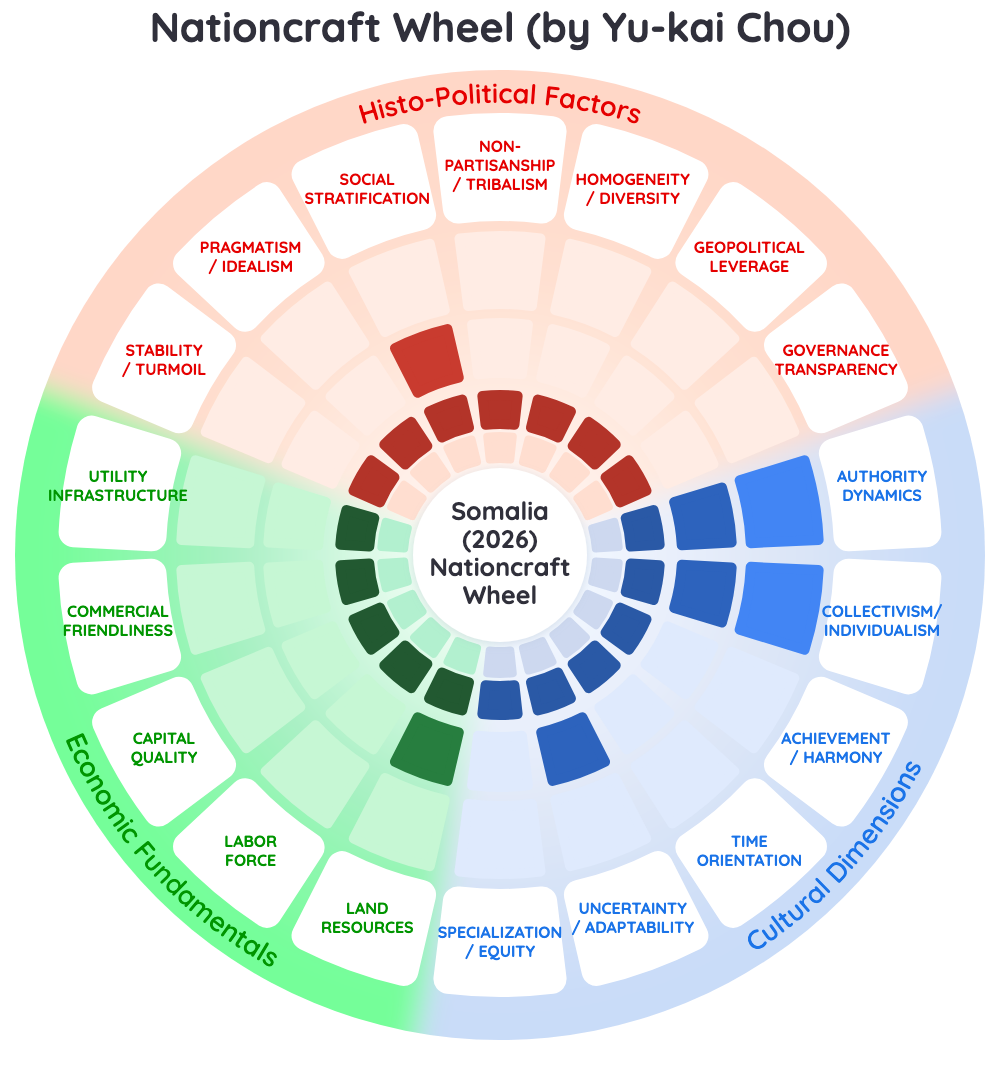

On 15 May 2026, Somalia’s president neither left office nor kept it. He did both, and neither, depending on which building in Mogadishu you asked. That is what a constitutional crisis looks like in a country that has a great deal of authority and nowhere to put it.
Hassan Sheikh Mohamud was elected in May 2022 to a four-year term.1 The puzzle worth sitting with is not that his term lapsed into dispute. The puzzle is that Somalia, a country most analysts file under “failed state,” scores near the very top of the world on the one cultural trait every state-builder begs for: deference to authority. Somalis do not reject hierarchy. They revere it. Clan elders, religious authority, the gerontocratic chain of command: the instinct to obey a recognized leader runs close to maximal.
And it has never once produced a durable national state.
That is the paradox this analysis is built around, and it deserves a name. Call it the Borrowed-Mandate Trap. A nation overflowing with the raw psychological material of authority is structurally unable to nationalize a single unit of it, because the clan intercepts every unit before it reaches the capital. So each government in Mogadishu, unable to generate real national authority, borrows it. It extends its own mandate, it rents soldiers from the African Union, it runs on donor money. The March 2026 constitutional amendments that stretched the presidential term from four years to five2 were not a power grab in the ordinary sense. They were the trap closing.
This is a Nationcraft analysis, which means it does not ask whether Somalia’s leaders are good or bad. It asks what Somalia’s 18-variable profile makes possible, what it forecloses, and which historical reform packets were built for a country shaped like this one. The answer is uncomfortable, specific, and, once you see the structure, strangely hopeful.
⚡ Speed Run Notes
- Somalia scores V1=9 on Authority Dynamics, near-maximum cultural deference to hierarchy, yet V10=1 on clan tribalism. The authority instinct is abundant; it just cannot be nationalized.
- The Borrowed-Mandate Trap: a federal government with no nationalized authority borrows it instead, extending its term, renting African Union troops, living on donors. It never converts into the real thing.
- The May 2026 term-extension crisis is the trap closing: a mandate so visibly borrowed that federal member states stopped recognizing it.
- Nationcraft’s minimum-state rule says no development playbook works when V7, V10 and V13 are all at the floor. Somalia is V7=1, V10=1, V13=1, failing on all three.
- The imported playbooks reformers love (Singapore’s developmental state, Rwanda’s top-down reconciliation, digital-state leapfrogging) all assume a state Somalia does not have. Eight of them get rejected here.
- The models that fit do the opposite of overriding clans: Somaliland’s hybrid clan-democracy, Senegal’s authority-through-tradition packet, and Mozambique’s negotiated two-bloc settlement.
Table of Contents
- Understanding Somalia’s Governance Landscape Through Nationcraft
- What Is the Nationcraft Framework?
- Why This Somalia Variables Analysis Matters
- The 18 Somalia Nation Variables
- The Borrowed-Mandate Trap
- Detailed Justifications: Reading Somalia Variable by Variable
- Strategic Implications of Somalia’s V-Vector
- Best-Match Historical Packets: Eight Rejected, Three to Study
- Governance Strategy Recommendations for Somalia
- Comparative Context: Somalia Against the Nationcraft Library
- Frequently Asked Questions
About Yu-kai Chou

Yu-kai Chou is a Human-Systems Architect & Behavioral Designer and the creator of the Nationcraft Framework, an 18-variable diagnostic for matching a country’s structural profile to the reform packets that have historically worked under similar conditions. He has consulted for governments in eight nations, including Ukraine, the United Kingdom, the Kingdom of Bahrain, Singapore, Taiwan, the Netherlands, Kazakhstan, and South Korea, and has worked directly with President Zelenskyy’s team on post-war reconstruction priorities for Ukraine.
Chou’s prior framework, the Octalysis Framework, has been applied by LEGO, Microsoft, Porsche, Coca-Cola, Salesforce, and MrBeast, impacting over 1.5 Billion Users. He has taught the methodology at Harvard, Stanford, Yale, Tesla, Google, BCG, and IDEO.
His work has been cited by Harvard, Stanford, MIT, Forbes, Wall Street Journal, Wired, US Department of Energy, NIST, NSF, NCBI, US Department of Education, ClinicalTrials.gov, and Google Scholar — with 3,700+ more academic publications. Explore his books here.

This Somalia analysis applies the Nationcraft Framework to the hardest case in the entire country library: a state whose culture supplies an abundance of authority and whose structure cannot convert it. Across eight national advisory engagements, the recurring lesson is that reform fails not when leaders lack will but when a packet is imported into a variable profile it was never built for. Somalia in 2026 is the cleanest illustration of that lesson on the map, and getting the diagnosis right matters more here than almost anywhere else, because the cost of the wrong imported playbook is measured in collapsed states, not missed growth targets.
Understanding Somalia’s Governance Landscape Through Nationcraft
Most commentary on Somalia runs through one of two scripts. The first is the security script: al-Shabaab, the African Union mission, drone strikes, territory lost and regained. The second is the donor script: debt relief, IMF reviews, fiscal consolidation, aid flows. Both are real. Neither explains why a country can do everything the scripts ask and still arrive, every few years, at a constitutional crisis.
The Nationcraft Framework looks underneath both scripts at the structural profile that produces them. It treats a country the way a behavioral designer treats a system: as a set of variables that make some outcomes cheap and others nearly impossible. When you read Somalia this way, the 2026 crisis stops looking like a personality clash between a president and his opponents. It starts looking like the predictable output of a specific variable configuration, one that has produced almost exactly this outcome in 1991, in 2000, in 2012, and now in 2026.
Here is the configuration in one sentence. Somalia has the cultural hardware of a strong state and none of the structural software. The hardware is real: a population that genuinely defers to recognized authority, a dense web of collective obligation, a shared language, a shared faith. The software, meaning the impersonal institutions that would let that deference attach to a national government rather than a clan, has never been installed. And you cannot run a state on hardware alone.
This is why the Nationcraft reading of Somalia is, oddly, more hopeful than the failed-state verdict. “Failed state” is a moral conclusion that offers no next move. A variable diagnosis is a list of specific things that are broken, in a specific order, with specific historical precedents for fixing them. That is a far better place to stand than despair.
What Is the Nationcraft Framework?
The Nationcraft Framework grew out of a simple, slightly disappointing discovery. While extending the Octalysis behavioral-design system to the scale of countries, it became clear that a nation is not a fundamentally new kind of object. It is a very large motivational system, and it can be diagnosed with the same logic used to diagnose a product, a company, or a game. Nation goals replace business metrics. Cultural dimensions and historical factors replace player types. Government policies, which Nationcraft calls “packets” to keep them modular and concrete, replace game mechanics.
The diagnostic core is the set of 18 nation variables. Each is scored from 1 to 9, and they fall into three groups. The cultural variables, V1 through V6, cover Authority Dynamics, Collectivism, Achievement orientation, Time Orientation, Uncertainty Adaptability, and Specialization. The historico-political variables, V7 through V13, cover Stability, Pragmatism, Social Stratification, Non-Partisanship versus Tribalism, Homogeneity, Geopolitical Leverage, and Governance Transparency. The economic variables, V14 through V18, cover Land, Labor, Capital, Commercial Friendliness, and Utility Infrastructure.
The scores are not moral grades. A high V1 does not mean a country is good; it means authority is culturally easy to exercise. The framework’s central and most useful claim is that reform effectiveness is decided by context-fit, not by policy quality. A packet that transformed one nation can do nothing in another whose variable profile is different. The Lee Kuan Yew industrialization packet is brilliant; dropped into the wrong V-vector it accomplishes nothing. The job of a Nationcraft analysis is to read a country’s profile honestly, name the structural trap inside it, and match it only to the packets built for that shape. That discipline is the same one behind every application of behavioral design to nation-building: diagnose first, prescribe second, and never confuse a famous policy with a fitting one.
Somalia is the case that tests whether the Nationcraft method is honest. It would be easy to write a hopeful piece recommending Singapore’s playbook to Mogadishu. It would also be useless. A real Nationcraft diagnosis has to be willing to say that most of the celebrated reform packets simply do not apply here, and then do the harder work of finding the few that do.
Why This Somalia Variables Analysis Matters
Somalia matters to the Nationcraft library for a reason beyond its own crisis. It is the framework’s lower bound, the country that defines what “minimum viable state” means by sitting just below it. Every other analysis in the Nationcraft country library is, in some sense, measured against this floor.
It also matters because Somalia is where the most expensive policy mistakes in modern statebuilding have been made. Two international military interventions, decades of aid, a UN-backed transitional government, a federal constitution drafted with heavy external input: each was a serious attempt, and each underperformed because it imported a model that assumed structures Somalia did not have. The cost of a wrong packet here is not a slow decade. It is a collapsed state, a famine, a piracy industry, an insurgency that outlasts three presidents.
And it matters right now because the 2026 constitutional crisis is a live, observable demonstration of the trap. The term-extension dispute, the collapse of mediated talks on 15 May, the federal government’s confrontation with South West State, the opposition coalition forming a parallel track: all of it is the Borrowed-Mandate Trap operating in real time. A reader who understands the variable structure can watch the news and predict the next move. That is what a working framework should let you do.
One more reason. Somalia is a stress test for a hopeful idea: that a country’s culture can be an asset even when its institutions are a ruin. Somalia’s V1=9 authority instinct is an enormous latent asset. The entire question is whether anyone can build the conduit that lets it reach a national government. If Nationcraft can say something precise and true about that, the framework earns its place.
The 18 Somalia Nation Variables
Below is Somalia’s full V-vector as it stands in the Nationcraft corpus for 2026. Read it as a configuration, not as a row of grades to be averaged. In Nationcraft, configuration is strategy: the interaction between two variables matters far more than either score alone.
| Variable | Score (1–9) | One-line reading |
|---|---|---|
| V1: Authority Dynamics | 9 | Near-maximum cultural deference to recognized authority, but clan-routed rather than nationalized. |
| V2: Collectivism vs Individualism | 8 | Intense kinship and clan solidarity; the individual is embedded in the lineage. |
| V3: Achievement vs Harmony | 3 | Survival-oriented, with little institutional space for an achievement culture. |
| V4: Time Orientation | 2 | Immediate-survival horizon; long planning is impossible under permanent threat. |
| V5: Uncertainty Adaptability | 4 | Resilient informal adaptation through hawala, telecoms and diaspora, without formal scaffolding. |
| V6: Specialization vs Equity | 3 | No institutional framework to deliver either specialization or equity. |
| V7: Stability vs Turmoil | 1 | Active insurgency, regional clashes, and an unresolved constitutional crisis. |
| V8: Pragmatism vs Idealism | 1 | Politics is zero-sum and clan-rigid; compromise reads as defeat. |
| V9: Social Stratification | 6 | A clan hierarchy plus genuinely marginalized minority groups. |
| V10: Non-Partisanship vs Tribalism | 1 | The clan is the political unit; the “4.5” formula institutionalizes it. |
| V11: Homogeneity vs Diversity | 2 | Ethnically homogeneous, yet the clan cleavage operates as functional diversity. |
| V12: Geopolitical Leverage | 1 | Aid-, troop- and donor-dependent, with a strategic location it cannot cash in. |
| V13: Governance Transparency | 1 | Perennially among the lowest-ranked states on global corruption indices. |
| V14: Land Resources | 6 | Longest mainland-Africa coastline, livestock, fisheries, untapped hydrocarbons. |
| V15: Labor Force Quality | 2 | Very low schooling and chronic brain drain. |
| V16: Capital Quality | 1 | No domestic capital market; post-debt-relief re-entry only beginning. |
| V17: Commercial Friendliness | 1 | Formal layer near zero; the informal private sector is famously dynamic. |
| V18: Utility Infrastructure | 1 | Minimal grid, water, and sanitation coverage. |
Stare at that column for a moment. Eleven of the 18 variables sit at 1 or 2. The two that tower over the rest, V1 at 9 and V2 at 8, are precisely the cultural variables that, in a functioning state, would be the engine of governance. Somalia has the engine. It has no chassis, no transmission, no wheels. That gap between V1 and almost everything else is not noise. It is the whole story.
The Borrowed-Mandate Trap
Every Nationcraft analysis names the one structural trap that organizes everything else. For Somalia, that trap is the relationship between V1 and V10, between an authority instinct at 9 and a clan-versus-nation score at 1.
Start with what V1=9 actually means. In Nationcraft, Authority Dynamics measures how culturally easy it is to exercise authority, how readily people defer to a recognized leader. Somalia scores at the top of this scale, and the reason is everywhere in Somali life: the authority of clan elders, the authority of religious figures, the gerontocratic respect that organizes a household, a sub-clan, a settlement. A Somali population does not have to be persuaded to obey legitimate authority. The instinct is already there, fully formed, and it is strong.
Now read V10=1. Non-Partisanship versus Tribalism measures whether political loyalty attaches to impersonal institutions or to identity groups. Somalia is at the absolute floor. The clan is not one factor in Somali politics; it is the unit of Somali politics. The country’s own power-sharing formula, the famous “4.5” model that allocates seats among four major clan families and a half-share for everyone else, does not merely tolerate clan as the basis of representation. It writes clan into the constitution as the basis of representation.
Hold those two facts together and the trap appears. Somalia produces an enormous quantity of deference to authority, and then routes every unit of it through the clan before it can reach the state. The elder commands real obedience. The religious figure commands real obedience. The federal president in Mogadishu commands the obedience of his own clan coalition and very little beyond it. The authority is not missing. It is captured in transit.
This is what makes Somalia different from a simple weak state. A weak state has little authority to begin with. Somalia has abundant authority and a structural inability to nationalize it. The framework’s term for the consequence is the Borrowed-Mandate Trap: a federal government, unable to generate national authority of its own, is forced to borrow authority from outside the national system entirely.
It borrows in three ways, and all three are visible in 2026. It borrows time, by extending its own mandate, as the March 2026 amendments did, converting a four-year term into a five-year term without an election. It borrows force, by renting roughly 11,800 uniformed personnel from the African Union, whose AUSSOM mission is itself the security spine the national army cannot yet be.3 And it borrows money, by running on donor finance and the fiscal space that $4.5 billion of debt relief opened up in 2023.4 Each of these is a loan against a national authority that does not exist. None of them ever converts into the real thing.
The cruelty of the trap is that borrowing feels like governing. A president whose term has been extended, whose capital is secured by foreign troops, whose budget is met by donors, can look, from a certain distance, like a head of state. But the borrowed mandate has a property the genuine article does not: everyone can see that it is borrowed. And a mandate that is visibly borrowed invites exactly the challenge it was meant to prevent.
That is the mechanism behind the 2026 crisis. When the federal government extended its term by amendment, the move did not read, in Somalia’s V10=1 environment, as “stabilization.” It read as one clan coalition seizing the prize and refusing to put it back on the table. The opposition’s response was immediate. The Somali Salvation Forum, an opposition coalition that had formed in October 2025, declared the president illegitimate the moment his original term lapsed on 15 May 2026, and proposed that the speaker of parliament serve as acting president pending fresh elections.5 US- and UK-mediated transition talks collapsed the same day, and an external risk assessment described Mogadishu as entering a “full-blown constitutional crisis.”6
There is a clean behavioral name for what the term extension triggered. It is reactance, the documented human tendency to push hard against any move that removes a freedom one believed one had. In a V10=1 system, where each clan coalition treats access to the presidency as a freedom it is owed in rotation, a unilateral term extension is the maximum possible reactance trigger. The federal government did not buy five years of calm. It bought an opposition.
The South West State confrontation is the same trap in miniature. A contested regional election in late March 2026 returned the incumbent South West State president; within days, federal forces took control of Baidoa, the regional president was out of office, and an acting president was installed by decree. By mid-May the city’s outskirts saw open fighting between federal forces and fighters loyal to the ousted leader.7 The federal center, lacking nationalized authority, could assert itself in a member state only by force. And force, in a V10=1 environment, does not generate compliance. It generates a new armed faction. Borrowed authority, applied locally, fractures locally.
The deepest point is this. The Borrowed-Mandate Trap is not a moral failing of any particular Somali leader. Hassan Sheikh Mohamud is operating a machine whose wiring guarantees this outcome. Any president, of any clan, with any intentions, who tries to govern Somalia from a base of nationalized authority will discover there is no such base, and will be pushed, by the structure itself, toward borrowing. The trap is in the V-vector. That is why naming it matters: you cannot escape a trap you have mistaken for a personality.
Detailed Justifications: Reading Somalia Variable by Variable
A Nationcraft diagnosis is only as good as its variable-by-variable honesty. Below, the 18 scores are read in the four clusters that actually drive Somalia’s behavior. The point is never the number on its own. It is what each variable does to the others.
The authority cluster: V1, V2, and the conduit that was never built
V1 (Authority Dynamics, score 9) and V2 (Collectivism, score 8) are Somalia’s two great assets, and they are routinely misread as liabilities. They are not. A population with V1=9 and V2=8 has exactly the cultural disposition that made rapid statebuilding possible in places as different as post-genocide Rwanda and post-war South Korea. The disposition is there. What is missing is the conduit: the impersonal national institution that would let V1 deference flow to a government rather than pooling in a clan.
It is worth being precise about a subtlety here. Somalia’s V1 score has to be read as a measure of cultural authority instinct, not state authority capacity. During the pure collapse years of the 1990s, the Nationcraft corpus scores collapsed-Somalia’s V1 at 1, because at that moment there was a genuine authority vacuum at the level of the state. The 2026 score of 9 measures something different and more durable: the underlying cultural readiness to defer, which survived the collapse intact. Both readings are correct at their own layer. The entire Somali tragedy lives in the distance between them.
The conversion cluster: V7, V8, V13 and the engine that cannot turn over
If V1 and V2 are the fuel, V7, V8 and V13 are the engine, and all three are seized. V7 (Stability versus Turmoil, score 1) reflects a country with an active insurgency, regional clashes, and a constitutional crisis running at the same time. V8 (Pragmatism versus Idealism, score 1) reflects a politics in which compromise is read as clan defeat, so deals do not hold. V13 (Governance Transparency, score 1) reflects a state that sits, year after year, among the lowest-ranked in the world on corruption indices.
The interaction is the lesson. With V13=1, no public institution is trusted to hold resources fairly, so every actor must secure resources through the clan, which drives V10 further down. With V8=1, no negotiated settlement is trusted to last, so each side prefers a unilateral move now to a shared move later, which keeps V7 at the floor. The conversion cluster does not just fail; it actively recycles the failure back into the culture cluster, ensuring the conduit stays unbuilt.
The clan cluster: V9, V10, V11 and the operative cleavage
V10 (Non-Partisanship versus Tribalism, score 1) is the variable around which the whole vector is organized, and it deserves one careful clarification. Somalia is, by ethnicity, language and religion, one of the most homogeneous countries in Africa. That is why V11 (Homogeneity versus Diversity) is scored low at 2: not because Somalia is ethnically plural, but because the clan cleavage functions like diversity. The operative division is not Somali against non-Somali. It is clan against clan. V9 (Social Stratification, score 6) adds the layer that this clan order is also a hierarchy, with minority clans genuinely marginalized within it.
This is where realistic conflict theory is directly useful. Sherif’s classic finding, that competition over scarce resources is sufficient to manufacture intense group hostility even between groups with no prior grievance, describes Somali clan politics with uncomfortable precision. The clans are not locked in ancient hatred. They are locked in a present-tense competition over a genuinely scarce resource: access to the state and the rents that flow through it. Lower the stakes of that single competition and the hostility has nothing to feed on. Raise them, as a winner-take-all term extension does, and the hostility is guaranteed.
The economic cluster: V14 through V18 and the informal-formal inversion
The economic variables tell a paradox of their own. V14 (Land Resources, score 6) is decent: Somalia has the longest coastline of any mainland African country, substantial livestock and fisheries, and untapped hydrocarbon potential. But V15 (Labor Force Quality, 2), V16 (Capital Quality, 1), V17 (Commercial Friendliness, 1) and V18 (Utility Infrastructure, 1) sit at or near the floor.
V17 carries the most instructive nuance. The score of 1 measures the formal commercial environment of registration, courts and contract enforcement, which is effectively absent. Yet Somalia’s informal private sector is famously vigorous: it built one of the cheapest mobile-telecom markets in Africa and a hawala remittance network of remarkable efficiency, all without a functioning state to regulate them. This is not a contradiction. It is the V1-versus-V10 trap showing up in the economy. Somali commercial energy is real and high; it simply routes around the state, exactly as Somali authority routes around the state. A vibrant informal economy is not evidence that the state is unnecessary. It is evidence of how much value is being left on the table because the state cannot host it.
Strategic Implications of Somalia’s V-Vector
Before matching Somalia to any historical packet, the Nationcraft method runs one hard gate: the minimum-state rule. The framework’s post-conflict rebuilding playbook, catalogued as PB-04, sets explicit prerequisites. It requires V7 of at least 3, because below that you have an active hot war and the only task is a ceasefire. It requires V10 of at least 3, because below that no power-sharing arrangement holds. And it states the rule in the starkest possible terms: if V7, V10 and V13 are all at 2 or below, no development playbook works at all, and the first and only priority is establishing a minimum viable state.
Somalia is V7=1, V10=1, V13=1. It fails the minimum-state rule on all three axes simultaneously. This is the single most important strategic implication in the entire analysis, and it is worth stating without softening. Somalia in 2026 is not yet a candidate for the post-conflict rebuilding playbook. It is a candidate only for the precursor move, the construction of a minimum viable state, which the rebuilding playbook itself assumes has already happened.
This reframes what “reform” even means for Somalia. In a country with a functioning state, reform is about choosing better policies. In Somalia, the prior question is whether there is an entity capable of carrying any policy at all. Spending the 2026 reform window arguing about fiscal policy or investment codes is like tuning an engine that is not bolted to a car.
The second implication follows from the first. Because the binding constraint is the V1-to-V10 conduit, the strategic question is not “how do we override the clans” but “how do we route national authority through them.” Every Somali intervention that treated clan as a problem to be defeated has failed. The corpus failure packet for Somalia’s collapse years, FP-019, records exactly this, noting that both international missions of the 1990s “treated Somalia as a military problem rather than a clan-politics problem.” The clan structure is not going to be defeated. It is the most powerful institution in the country. The only winning move is to make it a load-bearing part of the state rather than a competitor to it.
The third implication is about sequencing, and it is where the Octalysis lineage of Nationcraft becomes concrete. A federal government in Somalia cannot lead with Black Hat motivation, the urgency, pressure and fear-of-loss mechanics that a term extension represents. Black Hat moves generate compliance only where authority is already nationalized enough to enforce them. In Somalia they generate reactance and fracture. The sequencing has to begin with White Hat foundations: visible competence, predictability, a sense that the system is fair enough to belong to. Authority earned that way is slow. It is also the only kind that does not have to be borrowed.
Best-Match Historical Packets: Eight Rejected, Three to Study
This is the heart of any Nationcraft analysis: the match between a country’s V-vector and the historical reform packets in the corpus. For most countries the exercise produces a comfortable list of models to emulate. For Somalia it produces something harder: a long list of famous packets that must be rejected, and a short list of unglamorous ones worth genuine study.
Eight playbooks Somalia reform should reject
Each of the eight below is a real, successful packet or a widely recommended approach. None is a bad idea in the abstract. Each is rejected for the same structural reason: it assumes a state Somalia does not yet have.
| # | Imported playbook | Why it fails Somalia’s V-vector |
|---|---|---|
| 1 | The centralized-constitution fix: strengthen the presidency, extend the federal term, build a strong center | This is the term-extension logic itself. It assumes the center can hold authority it has not nationalized. At V10=1 it reads as clan capture and produces the 2026 crisis directly. |
| 2 | SP-002, the Lee Kuan Yew developmental state (Singapore) | Requires V8 of 8 or higher and deep technocratic insulation. The packet’s own notes warn that its pragmatism “is cultural, not easily imported.” Somalia is V8=1. |
| 3 | SP-006, Rwanda post-genocide reconstruction | Requires V8 of 7-plus and a single decisive military victor able to impose reconciliation from above. Somalia has five federal member states, al-Shabaab and Somaliland, with no victor. |
| 4 | SP-014, Chilean shock therapy | Requires V1=9 authoritarian cover plus a functioning technocratic state to execute the shock. Somalia has the authority culture and none of the state. |
| 5 | Digital-state leapfrogging (the Estonia and Ukraine e-governance model) | A genuine post-conflict accelerator, but it needs a minimum V13 and a state to host the digital layer. You cannot leapfrog a state that is not there. |
| 6 | Marshall Plan-style reconstruction | The Marshall Plan rebuilt institutions and skilled workforces that had been damaged. Somalia’s were never built. There is no prior state to reconstruct. |
| 7 | Aid-financed statebuilding: treat money as the binding constraint | Somalia received $4.5 billion in debt relief and runs an IMF program; the binding constraint was never money. It is the authority conduit. Money poured through a broken conduit deepens V13=1. |
| 8 | International military intervention as state substitute | FP-019 is explicit: the 1990s interventions failed because they treated a clan-politics problem as a military one. AUSSOM secures space; it cannot manufacture the V1-to-V10 conduit. |
The pattern across all eight is one error repeated: each treats Somalia as a state with bad policies rather than as a polity without a working state. The Nationcraft point is not that these packets are wrong. It is that they are answers to a question Somalia has not reached yet.
Model one to study: Somaliland’s hybrid clan-democracy
The most important comparison for Somalia is not in another country. It is inside Somalia’s own borders. Somaliland, the unrecognized republic in the north, which Somalia’s collapse packet FP-019 itself notes emerged as a self-governing region during the anarchy years, started from the identical clan structure. Same V10 base. Same V2 collectivism. Same culture, same faith, same language. And it built something the south has not: a functioning, durable, hybrid political system.
It did so by doing the one thing the eight rejected playbooks never do. Instead of treating clan authority as a rival to be overridden, Somaliland formalized clan authority into the state. Its system pairs an elected lower house with an upper chamber of clan elders, a body that gives the traditional V1 authority structure a permanent, constitutional seat at the national table. The elders are not an obstacle the modern state works around. They are a branch of it.
That is the V1-to-V10 conduit, built. It is imperfect, it is contested, and it is not a finished model. But it is the single existing proof that Somalia’s authority instinct can be nationalized, that V1=9 can reach a government, when the design routes it through clan structures rather than against them. Any serious Somali reform conversation that does not start here is not serious.
Model two to study: SP-040, Senegal’s authority-through-tradition packet
Outside Somalia, the closest fitting packet in the corpus is SP-040, the Senghor-Wade stability packet that made Senegal one of Africa’s most durable democracies. Senegal is not a rich-country success story; its economic growth was modest for decades. What it got right was precisely the variable Somalia is stuck on.
Senegal’s core move was an alliance between the formal state and the country’s non-state authority structures, most famously the Sufi religious brotherhoods, whose leaders, the marabouts, command exactly the kind of deep V1 deference that Somali clan elders command. A Catholic president governing a Muslim-majority country survived and stabilized by working with the marabouts rather than around them. Senegal scores V1=5 in the corpus, with the explicit rationale that religious leaders are influential and politics is negotiated through them. The packet’s lesson for Somalia is direct: a state that channels authority through existing, trusted, traditional legitimacy structures can buy stability that a state demanding direct loyalty cannot. The marabout is Senegal’s elder. The alliance is the conduit.
Model three to study: SP-085, Mozambique’s negotiated two-bloc settlement
The third model addresses a narrower problem: how to actually end the armed contest, not between many clans, but between the two largest blocs. In Somalia’s case those are the federal government and the most powerful federal-member-state coalition, and eventually the harder question of al-Shabaab. SP-085, Mozambique’s post-civil-war recovery packet, is the corpus’s clearest case of a negotiated settlement that held.
Mozambique’s 1992 Rome Peace Agreement ended a devastating civil war between two armed movements through an externally mediated settlement: demobilization of fighters, integration of the insurgent movement into normal politics, a UN peacekeeping presence to hold the ring, and a real electoral calendar. The peace held for two decades. The honest part of citing SP-085 is also citing its limits: Mozambique later suffered a hidden-debt scandal and a northern insurgency, because the settlement was not paired with the institution-building that would have made it durable. The packet is a model of how to stop the war, not how to build the state. For Somalia, that is still exactly the right model for one specific job, and a clear warning to pair it with the conduit work rather than substitute it for the conduit work.
Two failure analogs Somalia must keep in view
Two corpus failure packets mark the cliffs on either side of the path. FP-014, Tajikistan’s post-Soviet civil-war packet, shows the trap of mistaking the absence of war for success: Tajikistan ended its civil war and then spent twenty-five years in authoritarian stagnation, a clan-coalition calm that never became development. That is the risk if Somalia buys a Borrowed-Mandate peace and calls it done.
FP-005, South Sudan’s independence-to-civil-war packet, marks the other cliff. South Sudan had a recognized government, oil money and international goodwill, and collapsed into a clan-coded civil war within two years because it had no institutions underneath the flag. Independence without a state is not freedom. That is the precise risk of the parallel-government path being floated by Somalia’s opposition in 2026. A second center does not fix a borrowed mandate. It doubles it.
Governance Strategy Recommendations for Somalia
Recommendations in a Nationcraft analysis are sequencing claims, not wish lists. The order is the strategy. For Somalia, the order is dictated by one fact: until the V1-to-V10 conduit exists, nothing downstream of it can hold. The table below lays out four phases, each defined by the variable it is trying to move and the move it explicitly must not make.
| Phase | Primary variable target | The move | The move to avoid |
|---|---|---|---|
| 1. Stop the bleeding | V7 (Stability) 1 to 3 | Externally mediated settlement on the federal-versus-member-state contest, on the SP-085 template: demobilization, integration, a credible electoral calendar. | Resolving the contest by force, as the South West State intervention attempted. Force at V10=1 makes new factions. |
| 2. Build the conduit | V10 (Tribalism) 1 to 3 | Formalize clan authority into the state, on the Somaliland template: a constitutional chamber of elders, clan structures as a branch of government rather than a rival. | Another centralized-constitution fix. A stronger presidency without a conduit just raises the stakes of clan capture. |
| 3. Earn the mandate | V13 (Transparency) 1 to 3 | Visible, fast, White Hat competence wins: security people can feel, services that arrive, money that is seen to be handled fairly. | Black Hat shortcuts such as term extensions, emergency powers and urgency framing. They trigger reactance and burn legitimacy. |
| 4. Only now, develop | V14 to V18 (Economic cluster) | Host the informal economy that already works; let V17 commercial energy attach to a state that can finally carry it. | Leading with development packets. An investment code on top of a borrowed mandate funds the next crisis. |
Three points deserve emphasis beyond the table. First, phases one and two are not “pre-reform.” They are the reform. The entire international habit of treating statebuilding as the boring prelude to the real work of development has the order backwards for a country at Somalia’s V-vector.
Second, the psychology of phase three is where the Octalysis lineage of Nationcraft pays off most directly. A government trying to earn rather than borrow a mandate is competing for citizen loyalty against the clan, and the clan currently owns the entire stock of social influence and relatedness, the belonging drive, in Somali life. The federal state cannot out-clan the clan on belonging. What it can do is offer something the clan cannot: impartial competence, the experience of being treated fairly by an institution that does not care which lineage you are. That is a different motivational offer, and it is the only one available to a national government.
Third, reformers must expect system justification to work against them. This is the documented tendency of people to defend an existing order, even a costly one, simply because it is the order they know. The “4.5” clan formula is unjust and dysfunctional, and it will still be defended by many of the people it disadvantages, because a known allocation feels safer than an unknown one. Any conduit-building reform has to be designed knowing that the broken system has psychological defenders, not just beneficiaries.
Comparative Context: Somalia Against the Nationcraft Library
Placing Somalia next to other countries in the Nationcraft library sharpens the diagnosis. The table below compares Somalia with two fragile-state failure analogs and three reference points from the published library, on the four variables that decide whether authority can be nationalized.
| Country | V1 Authority | V7 Stability | V10 Tribalism | V13 Transparency | Nationcraft pattern |
|---|---|---|---|---|---|
| Somalia (2026) | 9 | 1 | 1 | 1 | The Borrowed-Mandate Trap |
| South Sudan | 3 | 1 | 1 | 1 | Independence without a state (FP-005) |
| Tajikistan | 9 | 5 | 3 | 2 | Stability without development (FP-014) |
| Senegal | 5 | 5 | 5 | 4 | Authority through tradition (SP-040) |
| Mozambique | 7 | 2 | 4 | 3 | Negotiated two-bloc peace (SP-085) |
| Rwanda | 8 | 1 | 3 | 5 | Top-down reconciliation (SP-006) |
Two things jump out. Somalia and Tajikistan share the same V1=9 authority instinct, yet Tajikistan converted it, through repression, into a stable if stagnant state, while Somalia has not converted it at all. The difference is V10: Tajikistan’s clan competition was forced down to a 3; Somalia’s sits at 1. Somalia and South Sudan, meanwhile, share the same V7, V10 and V13 floor, yet Somalia’s V1=9 is the asset South Sudan’s V1=3 never had. Somalia is, paradoxically, both worse off and better endowed than its closest failure analog.
The contrast with the rest of the published Nationcraft library is just as instructive. Venezuela‘s analysis turns on a damaged-but-real state with genuine institutional memory to recover; Somalia has no comparable memory to recover to. The United Kingdom‘s “compact fracture” is the strain of a high-capacity state under political pressure, the opposite end of the spectrum from Somalia entirely. Ghana‘s bailout-cycle trap is a story of a functioning state with a recurring fiscal weakness; Somalia would consider Ghana’s problems a destination. And Thailand‘s coup-cycle trap is the closest structural cousin: like Somalia, Thailand has strong economic variables trapped by a V1, V7 and V10 configuration that keeps resetting the political clock. But even Thailand resets around a state that persists between coups. Somalia’s resets are resets of the state itself.
This is the value of a library. A single country analysis is a snapshot. The library is a measuring instrument, and Somalia is the mark at the bottom of the ruler that gives every other reading its scale.
The Nationcraft Framework in Practice
Step back from Somalia and notice what the Nationcraft Framework just did. It took a story that the news tells as a personality conflict, a president who would not leave and an opposition that would not wait, and showed it to be the deterministic output of a variable configuration. That is the entire purpose of the framework: to move the conversation from blame to structure, because structure is the only thing you can actually redesign.
The method generalizes. For every country, Nationcraft runs the same loop: score the 18 variables, find the interaction that traps the system, name the trap, reject the famous packets that do not fit the V-vector, and match the few that do. The discipline is in the rejection. It is always tempting to recommend the glamorous packet, the Singapore miracle or the Rwanda turnaround. A framework earns trust by being willing to say, as it must say for Somalia, that the glamorous packets are the wrong tool and the right tools are an unrecognized polity in the north, a Senegalese alliance with religious brotherhoods, and a Mozambican peace agreement.
It generalizes one level further, into the behavioral-design lineage Nationcraft comes from. A nation, in this view, is a motivational system, and the same questions that diagnose a product diagnose a country: where does authority come from, what behavior is being asked for, which drives are doing the work, and is the design leaning on White Hat foundations or Black Hat shortcuts. Somalia’s federal government has been running a Black Hat play of urgency, pressure and fear of losing the seat, in a system that punishes it. The Nationcraft prescription is not softer politics. It is correctly sequenced politics, with White Hat foundations first, because borrowed authority cannot be made permanent and earned authority cannot be rushed.
The hopeful reading of Somalia is real, and it is not sentimental. A country with V1=9 has the hardest thing to build, a genuine cultural respect for authority, already built. Bridging clan divisions through deliberate, structured contact between groups is a known and researched process; the principle behind intergroup contact is exactly the kind of mechanism a conduit-building reform would institutionalize. Somalia does not need to manufacture a civic culture from nothing. It needs to build one conduit. That is a smaller, sharper, more achievable task than “fix a failed state,” and naming it correctly is the first move.
Explore More Nationcraft Analyses
Somalia is one entry in a growing library of country diagnoses built on the same 18-variable method. The full set lives in the Nationcraft Nation Variables Library, which indexes every published analysis and is the best place to see how different V-vectors produce different traps. Each analysis follows the identical loop of score, diagnose, name the trap, and match the packets, so the library doubles as a way to learn the framework itself by watching it run across very different countries.
Related Reading
- South Korea: The Post-Martial Trap. A Nationcraft analysis of a high-capacity state absorbing a stability shock, the instructive opposite of Somalia’s no-capacity starting point.
- Taiwan: The Silicon Shield Paradox. How a single dominant variable can both protect and trap a nation, read through the same 18-variable method.
- The Strategy Dashboard for Gamification Design. The behavioral-design tool the Nationcraft Framework scales up from product to nation.
- Core Drive 1: Epic Meaning & Calling. The motivational drive a national identity has to supply that a clan identity already does.
- Core Drive 8: Loss & Avoidance. Why clans defend an unfair allocation they would never design from scratch, the psychology behind a stalled reform.
Frequently Asked Questions
Why is Somalia having a constitutional crisis in 2026?
President Hassan Sheikh Mohamud was elected in May 2022 to a four-year term. Constitutional amendments approved in March 2024 and finalized in March 2026 extended federal terms from four to five years, so Mohamud treats his mandate as running to May 2027. The opposition argues that extending a mandate by parliamentary amendment rather than by election is illegitimate. When US- and UK-mediated transition talks collapsed on 15 May 2026, the original term-expiry date, the dispute became a full constitutional crisis.
What is the Borrowed-Mandate Trap in Somalia?
The Borrowed-Mandate Trap is the Nationcraft diagnosis for Somalia. The country scores near the global maximum on cultural deference to authority (V1=9) but at the floor on the variables that convert authority into a state: V10=1 clan tribalism, V13=1 governance transparency, V7=1 stability. Because clans intercept authority before it reaches the capital, every federal government borrows authority instead of generating it. It extends its own term, rents African Union soldiers, and runs on donor money. The borrowed mandate buys time but never converts into the real thing.
Which reform models actually fit Somalia?
Not the high-capacity development packets reformers usually import. Somalia fails the Nationcraft minimum-state rule, with V7, V10 and V13 all at 1, so the Singapore developmental-state model, Rwanda’s top-down reconciliation, and digital-state leapfrogging all assume a state Somalia does not yet have. The three models worth studying are Somaliland’s hybrid clan-democracy, Senegal’s strategy of routing authority through traditional and religious structures, and Mozambique’s externally mediated negotiated settlement to end a two-bloc conflict.
Is Somalia a failed state?
By the Nationcraft Framework, Somalia is better described as a state that cannot nationalize the authority its own culture produces. It has a recognized federal government, a constitution, an army, a central bank that completed debt relief in 2023, and near-maximum cultural respect for hierarchy. What it lacks is the ability to route that respect through impersonal national institutions rather than through clans. That is a specific, fixable diagnosis, not a verdict of permanent failure.
What does the Nationcraft Framework measure?
The Nationcraft Framework scores a country on 18 nation variables across cultural, historico-political, and economic categories, then matches that profile to historical reform packets that worked under similar conditions. Its core claim is that policy effectiveness is decided by context-fit, not by policy quality. A reform that transformed one country can fail completely in another whose variable profile is different, which is why the framework rejects eight famous packets for Somalia and recommends three obscure ones.
Footnotes
- Institute for Security Studies, “More instability for Somalia as another election deadline lapses,” ISS Today, 20 May 2026. issafrica.org
- ConstitutionNet, “From Provisional to Permanent Constitution? Assessing the End of Somalia’s Constitutional Review Process,” 4 March 2026. constitutionnet.org
- United Nations Security Council, Resolution 2809 (2025) re-authorizing the African Union Support and Stabilisation Mission in Somalia (AUSSOM), meetings coverage SC/16262. press.un.org
- World Bank and IMF, “IMF and World Bank Announce US$4.5 billion in Debt Relief for Somalia,” press release, 13 December 2023. worldbank.org
- Institute for Security Studies, “More instability for Somalia as another election deadline lapses,” ISS Today, 20 May 2026, on the opposition Somali Salvation Forum and the post-15-May legitimacy dispute. issafrica.org
- Stratfor Worldview, “Somalia: Mogadishu Enters Full-Blown Constitutional Crisis,” situation report, 18 May 2026. worldview.stratfor.com
- Al Jazeera, “Somali army takes over key city in Southwest as state leader resigns,” 31 March 2026. aljazeera.com