
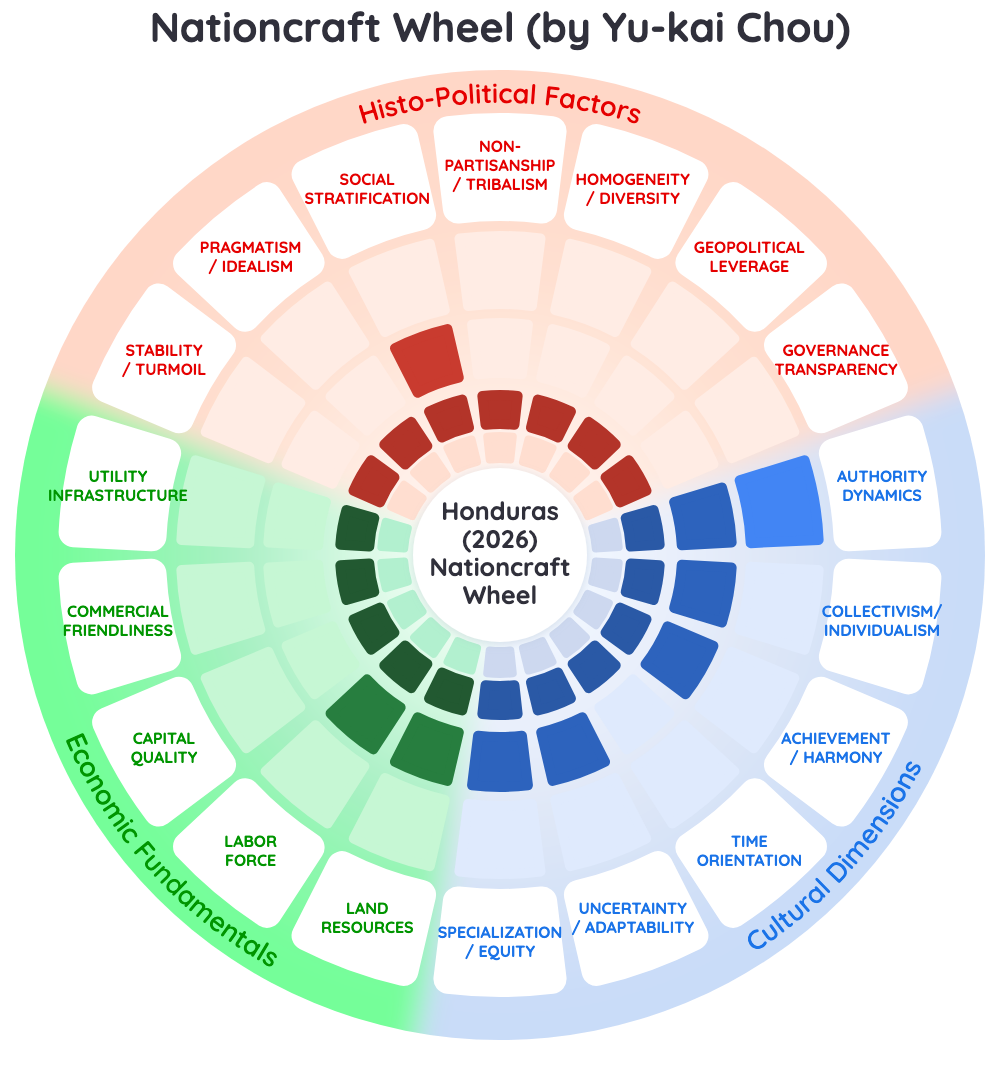

In a single November week, Honduras ran its entire survival playbook in public view. President Nasry Asfura flew to Washington for a State Department meeting with Secretary of State Marco Rubio and a scheduled sit-down with the IMF’s Kristalina Georgieva, his finance team announced that the country wants a new three-year IMF program the moment the current one closes, and the Millennium Challenge Corporation scorecard came back clean enough to chase a large American grant.[2]
Back home, four dawn attacks killed twelve people in Yoro, among them a municipal councillor and her three-year-old daughter. The security council answered by declaring the entire department high-risk territory under an emergency decree, with exceptional control measures aimed at the newly terrorist-designated MS-13, Barrio 18, and Cartel del Diablo.[7]
And quietly, in the central bank’s tables, the number that actually runs the country kept climbing: Hondurans working abroad sent home US$10.1 billion in the first nine months of 2026, on track for a record US$13.2 billion year. A university study puts 2025 remittances at 29.4 percent of GDP, and the fiscal watchdog FOSDEH calculates that 56 of every 100 foreign-currency dollars entering Honduras now arrive as a family remittance.[3][4]
Put those three storylines together and you get the paradox this analysis is about. Every lifeline keeping Honduras solvent is earned, approved, or granted outside Honduras: the wages of citizens who had to leave, the seal of an IMF board in Washington, the patronage of whichever American administration is in power.
I call this the Remittance Trap. The better a Honduran government gets at harvesting external lifelines, the less pressure it faces to build the domestic institutions whose absence made the lifelines necessary, and the country’s 18-variable Nationcraft profile shows precisely how that loop closes, which celebrated reform playbooks would fail against it, and where the narrow exits are.
⚡ Speed Run Notes
- Honduras is finishing its $847M IMF program and immediately asking for the next one, while remittances hit 29.4% of GDP. The lifelines work; the dependence they measure is the trap.
- The V-vector explains why: V13=2 transparency, V16=2 capital, and V17=2 commercial friendliness mean the domestic engine stalls, so every government re-rents stability from outside.
- A record remittance year is a failure indicator wearing a success costume. It prices, in dollars, the livelihoods Honduras could not generate at home for the citizens who left.
- The Bukele playbook next door is the loudest temptation and the clearest misfit: Asfura won by 0.7 points with 49 of 128 seats, and SP-064 requires a mandate Honduras did not give anyone.
- The packets that fit are humbler: Bangladesh’s ladder out of garment assembly, Costa Rica’s compounding social investment, and Mauritius’s rule for windfalls — diversify before the preference expires.
Table of Contents
- Understanding Honduras’s Governance Landscape Through Nationcraft
- What Is the Nationcraft Framework?
- Why This Honduras Variables Analysis Matters
- The 18 Honduras Nation Variables
- The Remittance Trap
- Detailed Justifications: Reading the Honduras V-Vector
- Best-Match Historical Packets
- Six Reformer Playbooks Honduras Should Reject
- Three Reformer Playbooks Honduras Should Actually Study
- Governance Strategy Recommendations
- Strategic Implications
- Comparative Context
- The Nationcraft Framework in Practice
- Frequently Asked Questions
- Explore More Nationcraft Analyses
- Related Reading
- Footnotes
About Yu-kai Chou

Yu-kai Chou is a Human-Systems Architect & Behavioral Designer and the creator of the Nationcraft Framework — an 18-variable diagnostic for matching a country’s structural profile to the reform packets that have historically worked under similar conditions. He has consulted for governments in eight nations, including Ukraine, the United Kingdom, the Kingdom of Bahrain, Singapore, Taiwan, the Netherlands, Kazakhstan, and South Korea, and has worked directly with President Zelenskyy’s team on post-war reconstruction priorities for Ukraine.
Chou’s prior framework — the Octalysis Framework — has been applied by LEGO, Microsoft, Porsche, Coca-Cola, Salesforce, and MrBeast, impacting over 1.5 Billion Users. He has taught the methodology at Harvard, Stanford, Yale, Tesla, Google, BCG, and IDEO.
His work has been cited by Harvard, Stanford, MIT, Forbes, Wall Street Journal, Wired, US Department of Energy, NIST, NSF, NCBI, US Department of Education, ClinicalTrials.gov, and Google Scholar — with 3,700+ more academic publications. Explore his books here.

This Honduras analysis applies the Nationcraft Framework to the hemisphere’s clearest case of externally funded stability, extending the 2026 series on IMF-exit economies and Central American configurations — asking what it would take for a remittance-dependent state to convert its lifelines into institutions its citizens no longer have to leave to find.
Understanding Honduras’s Governance Landscape Through Nationcraft
Honduras has never had a Venezuelan-style collapse, a Guatemalan-length civil war, or a Salvadoran homicide peak. What it has instead is a half-century of low-grade dysfunction punctuated by shocks: Hurricane Mitch in 1998, the 2009 coup against Manuel Zelaya, and a president, Juan Orlando Hernández, who ran a U.S.-partnered drug war while trafficking cocaine, a contradiction that ended with his conviction in a New York courtroom.
The Nationcraft corpus carries this record as SP-097, the Migration & Maquila Economy Packet, and its verdict on the 1990–2020 period is blunt: maquila assembly jobs and remittances allowed survival, and survival substituted for development.
The 2026 chapter is new management running the same operating system. Asfura took office in January after winning the November 2025 election by 26,338 votes, a 0.7-point margin that survived a crashed results website, a partial manual recount, and an opposition that still calls the outcome an electoral coup.[6]
His first-year foreign policy has been a sprint toward Washington: a meeting with Rubio before inauguration, a seat at the launch of the Americas Counter Cartel Coalition in March, terrorist designations for the gangs, and the November trip that produced warm State Department language about a safer, stronger, more prosperous hemisphere.[5]
None of that answers the configuration question underneath. A Nationcraft reading asks what this specific society, with this specific institutional inheritance, can actually execute, and the answer begins with eighteen scored variables.
What Is the Nationcraft Framework?
The Nationcraft Framework is my 18-variable diagnostic for matching a country’s structural profile to the reform programs that have historically worked under similar conditions. It grew out of two decades of behavioral systems design, extended to national scale through the same logic I laid out when bridging Octalysis into nation-building and public policy.
The variables split into three families. Cultural dimensions (V1–V6) describe what the people are like and shift on generational timescales.
Histo-political factors (V7–V13) describe what the situation is like, from stability to transparency. Economic fundamentals (V14–V18) describe the resource base.
Against a country’s V-vector, the framework matches Success Packets: documented historical reform programs, each recorded with its preconditions, sequencing, outcomes, and limits. The core claim of Nationcraft is that policy effectiveness is decided by context-fit rather than policy quality, which is why a packet that transformed one country reliably fails in another.
Why This Honduras Variables Analysis Matters
Honduras is about to become a live experiment in post-program dependence. The IMF staff agreement on the sixth and final review of the 2023 arrangement means the $847 million anchor dissolves after the December board meeting, and the government has already said it wants a successor program negotiated before the first quarter of 2027.[1][2]
That places Honduras in a class I have been tracking across the 2026 corpus: countries at the exit door of an IMF program, each revealing what the program did and did not change. Sri Lanka’s Graduation Cliff maps the cliff-edge version and Ghana’s Imported Discipline Trap maps the re-enrollment version.
Honduras adds a third shape to the series, because its dependence runs deeper than the IMF. Remittances are a quarter of the economy, American patronage sets the security agenda, and the political system that must metabolize all of this just produced a presidency with a 0.7-point mandate and a congress split three ways.
For readers of the series, this is also the first Honduras entry in the Nationcraft country-analyses library, joining its neighbors Guatemala and Mexico on the board. The method stays the one the Venezuela reform playbooks analysis established: read the V-vector first, then let the vector reject the playbooks that flatter it.
The 18 Honduras Nation Variables
These scores come from the Nationcraft corpus record for Honduras, sanity-checked in November 2026 against IMF program documents, central bank remittance data, electoral records, and the regional comparator set. The check found no score requiring revision; two scores carry documented minor-drift notes.
| Variable | Score | 2026 Reading |
|---|---|---|
| V1 Authority Dynamics | 7/9 | Caudillo tradition endures; Hernández-era concentration is remembered as a warning and, by a worrying share of voters, as a model |
| V2 Collectivism vs Individualism | 6/9 | Extended-family networks are the real welfare state, now stretched across borders by migration |
| V3 Achievement vs Harmony | 4/9 | Survival economics dominates; ambition routes abroad rather than into domestic enterprise |
| V4 Time Orientation | 3/9 | 90.6% of remittance income is consumed on immediate needs; 9.4% is invested |
| V5 Uncertainty & Adaptability | 6/9 | A population that absorbs hurricanes, coups, and cartel turf wars keeps functioning; adaptability as scar tissue |
| V6 Specialization vs Equity | 4/9 | Maquila assembly and agro-exports; a thin specialist class, much of it emigrated |
| V7 Stability vs Turmoil | 3/9 | The 2009 coup was never institutionally metabolized; the 2025 election nearly re-ran it in slow motion |
| V8 Pragmatism vs Idealism | 3/9 | Partisan trench warfare blocks pragmatic bargains; even the full recount needed a congressional fight |
| V9 Social Stratification | 6/9 | A small oligarchy spans banking, energy, media, and politics, and its position is broadly treated as a fact of nature |
| V10 Non-Partisanship vs Tribalism | 2/9 | National, Liberal, and LIBRE operate as tribes; 49/41/35 seats with 65 needed to pass anything |
| V11 Homogeneity vs Diversity | 3/9 | A mestizo majority overlays Garifuna, indigenous, and deep regional divides that national politics amplifies |
| V12 Geopolitical Leverage | 2/9 | Migration-source and transit state; attention from Washington is conditionality, and conditionality is the opposite of leverage |
| V13 Governance Transparency | 2/9 | A former president convicted of trafficking; U.S. sanctions on sitting electoral officials in December 2025 |
| V14 Land Resources | 5/9 | Fertile valleys, coffee, palm, some mining; climate-exposed and drought-stressed |
| V15 Labor Force Quality | 6/9 | Abundant, trainable, maquila-proven labor; low average schooling, and the most skilled cohort keeps leaving |
| V16 Capital Quality | 2/9 | Shallow domestic capital markets; the marginal investable dollar is a remittance or an IMF disbursement |
| V17 Commercial Friendliness | 2/9 | Extortion functions as a parallel tax system; contract enforcement is slow and purchasable |
| V18 Utility Infrastructure | 3/9 | The state power company ENEE carries losses and arrears the IMF flags in every review; blackouts price the gap |
Read as a configuration rather than an average, one triangle dominates this profile: V13=2, V16=2, V17=2. Opaque governance, shallow capital, hostile commerce.
That triangle is why the lifelines exist. It is also what the lifelines protect.
The Remittance Trap
Here is the loop, stated as plainly as the data allows. Because V17=2 and V13=2 make building a business or trusting an institution in Honduras expensive, people leave, and the Hondurans working abroad, overwhelmingly in the United States, become the economy’s largest earners.
Because they leave, money arrives: US$10,098.8 million from January to September 2026, up 11.2 percent on the year, following a record US$12.21 billion in 2025 that equaled 29.42 percent of GDP.[3]
Because the money arrives, the macro picture holds. Reserves sit at US$11.56 billion, 6.7 months of imports; the lempira slides gently instead of collapsing; consumption stays funded; the IMF can certify stability and praise the program as a key anchor.[1][4]
And because the macro picture holds, no Honduran government has ever faced the full price of the triangle that started the loop. The pressure that forced Singapore to build institutions or starve, the pressure that forced Ireland to fix its fiscal credibility, arrives in Tegucigalpa pre-absorbed by the wages of the departed.
| Lifeline | 2026 Scale | What It Buys | What It Defers |
|---|---|---|---|
| Remittances | $10.1B through September; $13.2B projected; 56 of every 100 FX dollars | Consumption, reserves, exchange-rate calm | A domestic labor market worth staying for (V17, V15) |
| IMF anchor | $847M program closing; successor sought for Q3 2027 | Fiscal discipline on loan, policy credibility | Institutions that supply discipline without a lender attached (V13) |
| U.S. patronage | Counter-cartel coalition, MCC scorecard, trade access | Security cover, aid, investment interest | Leverage; the patron sets terms, and the terms change with Washington’s politics (V12) |
Notice what the table implies about measurement. A record remittance year reads, in every official communiqué, as good news.
In configuration terms it is a gauge of failure: 29.42 percent of GDP is the annual invoice for the livelihoods Honduras could not generate at home, priced in dollars and paid by the people who left. The lifeline measures the leak.
The 2026 twist is that the trap’s quiet assumption, a permanently open U.S. labor market, is no longer safe. The 2025 record was widely read as senders front-loading transfers against deportation risk, growth has since halved, and the single largest line in Honduras’s external accounts now depends on American immigration politics that Tegucigalpa cannot influence at all.[3]
Detailed Justifications: Reading the Honduras V-Vector
Scores are claims, and claims need evidence. Here is the behavioral record behind the numbers that do the most work in this analysis.
V13 Governance Transparency (2/9): the variable with a conviction attached
Most countries at V13=2 earn the score through indices. Honduras earned it through a verdict: Juan Orlando Hernández, president from 2014 to 2022 and Washington’s drug-war partner for most of that time, was convicted of cocaine trafficking, then pardoned by President Trump and released in December 2025, two days after the election his party’s candidate narrowly won.[6]
The same month, the United States sanctioned a sitting electoral councilor and a tribunal magistrate for impeding the vote count. When both the head of state and the referees of elections have recent corruption-adjacent records, V13=2 is description rather than judgment.
V10 Tribalism (2/9) and V8 Pragmatism (3/9): the arithmetic of a three-tribe congress
The 2025 election split congress 49 National, 41 Liberal, 35 LIBRE, with 65 votes needed to pass anything. Each bloc treats the other two as existential enemies; LIBRE’s refusal to recognize the presidential result and the National-Liberal fight over the recount set the tone.[6]
At V10=2, every reform becomes a loyalty test, and at V8=3 there is no cross-camp language of results to appeal to. This pairing, more than any economic variable, is what disqualifies the heroic-executive packets examined below.
V1 Authority Dynamics (7/9): the strongman market is still open
Hondurans accept concentrated authority when it promises order; Hernández demonstrated the acceptance and Bukele’s approval ratings next door advertise it daily. V1=7 means a Bukele-style bid would find cultural demand.
The constraint is institutional, and it is the 0.7-point, 49-seat shape of the actual mandate. High V1 with a thin mandate is the configuration for attempted strongman moves that fracture rather than consolidate, which is the V7=3 scenario to watch through 2027.
V16 Capital (2/9) and V17 Commercial Friendliness (2/9): why ambition emigrates
The marginal investable dollar in Honduras is a remittance or a multilateral disbursement, because domestic capital formation never recovered from a century of enclave economics. V16=2 is the banana-republic inheritance in balance-sheet form.
V17=2 is its street-level twin: extortion operates as a parallel tax authority in the urban economy, and formal contract enforcement is slow enough to be optional. A worker facing that pair can rationally conclude that the highest-return use of Honduran labor is to export it, which is the Remittance Trap restated as a career decision.
V15 Labor (6/9) and V5 Adaptability (6/9): the asset the trap keeps shipping out
The paradox inside the paradox is that Honduras’s strongest cards are its people. Maquila operators rate Honduran labor as productive and trainable, and the adaptability score is earned by a population that keeps functioning through hurricanes, coups, and cartel wars.
Those same traits price well abroad, so the V15 stock drains continuously toward U.S. labor markets. Remittances are the dividend Honduras collects on human capital it developed and then lost.
V18 Infrastructure (3/9): ENEE as the state in miniature
IMF assessments of the current program, the final review included, keep flagging the state power company ENEE: losses, arrears, weak governance.[2] The utility loses a large share of the electricity it distributes to theft and non-payment, and the fiscal transfers that plug the hole crowd out everything else.
ENEE matters diagnostically because it shows the triangle operating inside a single institution: opaque management (V13), starved investment (V16), and a commercial environment where not paying is normal (V17).
V12 Geopolitical Leverage (2/9) and V14 Land (5/9): dependence without cards
Honduras currently enjoys more Washington attention than at any point since the Cold War: a counter-cartel coalition seat, terrorist designations praised by the Secretary of State, an MCC candidacy.[5] Attention is flowing because Honduras is useful, and usefulness on a patron’s terms is V12=2, whatever the photo opportunities suggest.
The land endowment, V14=5, is real but climate-stressed; the El Niño drought the IMF cites as a managed shock is the preview of the variable’s downside. Nothing in the resource base changes the dependence math.
Best-Match Historical Packets
The Nationcraft corpus holds over 100 Success Packets and failure packets: documented reform programs with preconditions, sequencing, and twenty-year outcomes. Matching the Honduras V-vector against them produces three packets worth studying and six celebrated playbooks the configuration rejects, starting with the one every Honduran politician is currently tempted by.
| Packet | Country / Era | Verdict for Honduras | Deciding Variables |
|---|---|---|---|
| SP-064 Bukele Security & Digital | El Salvador, 2019– | Reject | Requires V1=8 authority plus a legislative supermajority; Honduras has V1=7 with 49/128 seats and a 0.7-point mandate |
| SP-002 Lee Kuan Yew Industrialization | Singapore, 1965–1990 | Reject | Requires V8≥8 pragmatism and V5≥7; Honduras sits at V8=3, and V13=2 cannot host a CPIB |
| SP-051 Saakashvili Reform | Georgia, 2004–2012 | Reject | Fire-everyone reform needs a revolutionary mandate; Honduras’s was 26,338 votes, and the packet’s own second half is a relapse |
| SP-016 Celtic Tiger | Ireland, 1987–2007 | Reject | Requires V15≥7, V8≥7, V11≥7 and an EU-class anchor; Honduras fails all four preconditions |
| SP-065 Sisi Stabilization | Egypt, 2013–2023 | Reject | IMF-anchored, security-first holding pattern; stabilizes without transforming, and Honduras is drifting into it by default |
| SP-096 Post-Civil War Development | Guatemala, 1996–2020 | Reject (as mirror) | The twin trap: remittances allow survival without development; elite capture outlasted CICIG |
| SP-025 Garment & Microfinance Revolution | Bangladesh, 1980–2015 | Study | Built for V15 labor surplus and V13=3 weak states; NGO delivery channels substitute for distrusted ministries |
| SP-031 Demilitarization & Eco-Tourism | Costa Rica, 1948–1990 | Study | The neighbor that proves the region can exit; the lesson is the compounding social investment, with its V10/V13 preconditions respected |
| SP-029 Diversification & Services | Mauritius, 1970–2000 | Study | The windfall rule: exploit every preference window and diversify before it expires; CAFTA and nearshoring are Honduras’s version |
Six Reformer Playbooks Honduras Should Reject
Rejection is where Nationcraft earns its keep. Each of these playbooks is being urged on Honduras by someone, and each fails against specific variables rather than against taste.
SP-064: the Bukele temptation, and why the arithmetic says no
El Salvador’s homicide collapse is real, popular, and one border away, and Honduran politics has been auditioning Bukele imitations for years; the mano dura reflex that followed the Yoro massacre, with its blanket high-risk designations, shows the groove is already worn.[7]
The packet record says the imitation cannot cash. SP-064 ran on V1=8 authority acceptance, a captured legislature, dollarization, and a traditional-party collapse that handed Bukele a generational mandate; its documented costs include due process abandoned and democratic institutions dismantled.
Honduras’s version of those preconditions reads: V1=7 but a congress split 49/41/35, an opposition that considers the presidency stolen, and courts that all three tribes distrust. A state-of-exception bid from that base does not produce El Salvador’s control; it produces the contested-legitimacy spiral that V7=3 already prices, with the coercive apparatus as one more prize for the tribes to fight over.
There is also a subtler reason the import fails, and it is the one this series keeps finding: SP-064 made El Salvador’s state harder to take away from its winner. Every packet that durably improved a V13-floor country did the opposite.
SP-002 and SP-051: the strong-hand imports, Singapore and Georgia
The Singapore LKY packet stress test established the series rule that SP-002 is cited everywhere and portable almost nowhere. Its variable requirements, V8≥8 pragmatism and V5≥7, describe a society that asks whether a policy works; Honduras at V8=3 asks which tribe it belongs to.
An incorruptible enforcement bureau like the CPIB presumes a leadership cadre willing to jail its own financiers, which V13=2 and V9=6 jointly rule out. The packet’s industrialization half also leaned on forced domestic savings, and a V16=2 economy whose savings arrive as remittances has nothing equivalent to conscript.
SP-051 is the honest-broker version of the same rejection. Georgia’s fire-the-entire-police-force reform, which I took apart in the Saakashvili Reform Packet deep-dive, required a revolutionary mandate, Western money, and a leader prepared to concentrate power to break capture.
Honduras’s mandate is 26,338 votes. And the packet’s own second act, relapse into the capture it broke, is exactly the failure V1=7 plus V10=2 would accelerate in Tegucigalpa’s version.
SP-016: the Celtic Tiger dream the diaspora keeps selling
Ireland is the seductive comparison because it starts from the same wound: a country whose principal export was its own people. The Ireland Windfall Trap analysis covers where that story went next, and diaspora-minded Hondurans reasonably ask why San Pedro Sula cannot run the Dublin play.
The precondition list answers the question. SP-016 required V15≥7 education feeding multinational payrolls, V8≥7 social partnership capable of wage bargains, V11≥7 consensus capacity, and the EU as market, anchor, and funder; Honduras fails each test, and CAFTA is a tariff schedule rather than a Brussels.
What survives the rejection is one transferable mechanism: Ireland turned its diaspora from a remittance pipe into a return channel once home conditions crossed a threshold. That mechanism reappears in the recommendations, aimed at the variables that set the threshold.
SP-065 and SP-096: the default futures, Egypt’s holding pattern and Guatemala’s mirror
The most likely Honduran futures are packets nobody would choose from a podium. SP-065 is the IMF-anchored, security-first holding pattern I examined in the Egypt garrison economy analysis: stabilization certificates accumulate, the security budget grows, and the underlying economy never generates jobs at the rate demography demands.
Swap conscription demographics for emigration demographics and the Honduran drift is recognizably the same shape: anchor, crackdown, repeat. The final-review praise and the Yoro decree landed in the same month, which is the pattern announcing itself.
SP-096 is the mirror case, and it is one border away. Guatemala’s Escape Valve Trap documents the Honduran loop running in a neighboring configuration: peace without justice, growth without development, remittances as the valve that keeps pressure off the elite bargain, and an international anti-corruption mission, CICIG, that worked until the elites it threatened expelled it.
The CICIG arc matters for Honduras because the demand for a Honduran equivalent resurfaces in every reform cycle. The packet lesson is narrow and useful: externally-backed prosecution works at V13≤3, and it survives only if its mandate is written to outlast the first government it indicts.
Three Reformer Playbooks Honduras Should Actually Study
A playbook fits when its preconditions overlap the actual V-vector, not the aspirational one. Three packets pass that test for Honduras, each matched to a different face of the triangle.
SP-025: Bangladesh, or how a maquila economy grows a ladder
Bangladesh in 1980 scored V15=3, V13=3, V16=2: a labor-surplus economy with a distrusted state and no capital, carrying a basket-case label it had done little to contradict. By 2015 garment exports had gone from roughly zero to $25 billion, poverty had fallen from 70 percent to 24 percent, and GDP per capita had multiplied five and a half times.
The mechanism maps onto Honduras limb for limb. Labor-intensive exports used the abundant factor; microfinance moved capital to people formal banks ignored; and, critically for a V13-floor country, NGO networks like Grameen and BRAC delivered health, education, and credit through channels the state could not corrupt because the state did not run them.
Honduras already has the maquila base, CAFTA access, and the nearshoring window; what it has never built is the ladder above assembly or the parallel delivery capacity. The packet’s warning label matters too: Bangladesh stalled at the garment rung, and its MFA-quota tailwind no longer exists, so the Honduran version must climb faster than the original. I traced the model’s present-day strains in the Bangladesh Seven-Percent State analysis.
SP-031: Costa Rica, the neighbor that proves the exit exists
Costa Rica shares Honduras’s isthmus, size class, and export geography, and became Latin America’s most stable democracy anyway. SP-031’s engine was a 1948 decision to abolish the military and compound the savings into education and health for seventy years, which built the V15=7 workforce that later attracted Intel and the eco-tourism economy.
The honest reading respects the preconditions: Costa Rica started with V10=8 consensus politics and functioning courts, which Honduras does not have, so the packet cannot be copied whole. What transfers is the compounding logic.
Every lempira moved from patronage and security theater into schooling and primary care is a deposit in the only account that historically appreciates at this configuration. Costa Rica is what the deposit curve looks like after seven decades; the packet’s point for Honduras is that the curve has to start somewhere, and it starts with budget lines rather than speeches.
SP-029: Mauritius, the rulebook for windfalls that expire
Mauritius at independence was a monocrop island so hopeless that a Nobel laureate predicted disaster. The packet’s method, which I set against its small-state siblings in the small-state survival playbook comparison, was to treat every external preference as a timed windfall: harvest the EU sugar quota, pour the proceeds into export-processing zones before the quota died, ride textile preferences into tourism, then finance, each rung built while the previous one still paid.
Honduras’s windfalls are legible: CAFTA access, the nearshoring moment, MCC eligibility, and the remittance flow itself. The Mauritian discipline is to treat each as expiring, because each is.
Remittances in particular are a preference window on the U.S. labor market that American politics can narrow at will, and 2026’s deportation-shadowed surge is the expiry notice. A Mauritian Honduras would be converting today’s record inflows into tradable-sector capacity at maximum speed; the actual Honduras consumes 90.6 percent of them.[3]
Governance Strategy Recommendations
What follows is addressed to the general reader judging Honduras’s next decade, and to any reformer, inside the country or watching from the diaspora, who wants the trap loosened rather than redecorated. Every item is derived from the packet evidence, and every item passes one test: it opens the system for the population rather than upgrading the apparatus of whoever currently holds it.
| Requirement | What It Looks Like | Packet Evidence | Variables Addressed |
|---|---|---|---|
| Make the referees independent before the next vote | Electoral authorities and courts appointed by cross-bloc supermajority, with tenure that outlasts the appointing congress; the 2025 count must be the last one the referees themselves taint | SP-096’s CICIG arc: externally-checked referees worked until their mandate could be revoked by the people they threatened | V13 up, V7 up |
| Prosecute upward through a mission built to outlast its first target | An internationally-backed anti-corruption mechanism whose mandate, funding, and personnel survive a change of government, indicting across all three tribes | SP-051’s proof that V13-floor states can prosecute capture; SP-096’s proof of what happens when the mission’s survival depends on the indicted | V13, V9 |
| Convert remittances from consumption to capacity, voluntarily | Matched-savings and diaspora-investment instruments that pay senders to co-fund housing, small enterprise, and schooling rather than taxing or capturing the flow | SP-025’s microfinance channel; SP-016’s diaspora-return threshold mechanism | V16 up, V4 up |
| Build the ladder above the maquila floor | Training pipelines and supplier-upgrading tied to CAFTA and nearshoring investment, so assembly jobs feed a tradable sector instead of capping it | SP-025’s garment ladder; SP-029’s rule of diversifying inside the preference window | V15, V6, V17 |
| Publish ENEE, then fix what publication exposes | Full transparency on the power company’s losses, arrears, and contracts, with citizen-visible service metrics, before any tariff or subsidy bargain | Every IMF review flags ENEE; SP-031 shows utilities as the credibility frontier where states either earn or forfeit trust | V18, V13 |
| Move the security fight into courtrooms that can convict the powerful | Witness protection, vetted prosecutors, and police accountability that make extortion cases winnable; measured by convictions of financiers and officials, never by detention counts | SP-064’s documented costs are the control group; SP-031 is the regional proof that courts can substitute for crackdowns | V17, V13, V7 |
The through-line: every recommendation converts an external lifeline into an internal capability, with accountability attached. That conversion is the only exit from the Remittance Trap the packet record documents, because it is the only move that makes the lifelines optional.
A note on what is deliberately absent. Nothing in this table would help a Honduran government tax, surveil, or police its population more efficiently, and nothing here needs the word reform to disguise it; each row names who gains and through what mechanism they can hold the state to it.
Strategic Implications
For Honduras, the next thirteen months are a forced experiment. The IMF anchor dissolves after the December board vote, the successor program will take until late 2027 to arrive on the government’s own timetable, and the interval is the first unanchored stretch since 2023.[2]
Watch three gauges through that window. Whether the 2027 budget holds discipline without a lender watching tells you if the program changed anything or merely rented compliance.
Whether the Yoro-style decrees evolve into prosecutions or into a rolling state of exception tells you which neighbor’s packet is being run. And whether remittance growth keeps decelerating, from 26 percent in 2025 to 11 percent now, tells you how fast the deportation era is closing the window the Mauritian strategy needs.[3]
For the wider region, Honduras is the test of whether U.S. security patronage can coexist with institution-building in a V13-floor state, or whether the patronage simply re-arms the apparatus while the triangle stays frozen. Guatemala next door and Mexico’s borrowed calm one border further are running versions of the same test.
For investors and the diaspora, the signal is simpler. The first administration that makes measurable progress on the referee problem, V13, will find a decade of deferred investment, domestic and diaspora-held, waiting behind the dam.
Comparative Context
Honduras’s trap reads sharpest against its three closest comparators, each one variable away from a different fate.
| Country | External Lifeline | Security Model | Key Variable Contrast with Honduras |
|---|---|---|---|
| Honduras 2026 | Remittances 29.4% of GDP; IMF; U.S. patronage | Mano dura reflex, now coalition-badged | Baseline: V13=2, V10=2, V1=7 |
| El Salvador | Remittances comparable; Bitcoin experiment; U.S. remittance corridor | SP-064 state of exception | V1=8 with supermajority; the mandate Honduras lacks |
| Guatemala | Remittances; CAFTA | Mano dura cycles | Same loop, V11=3 with deeper indigenous exclusion; the mirror case |
| Costa Rica | FDI and tourism instead of emigrants | No military since 1948 | V10=8, V13=6; the exit, seventy years in |
The table’s quiet lesson is that geography is not the variable doing the work. Four isthmus neighbors, four configurations, four different decades ahead; Haiti’s Ballot-First Trap shows the floor below the floor when the referee problem goes fully unsolved.
The Nationcraft Framework in Practice
This reading demonstrates the move Nationcraft exists to make: refuse the question everyone asks, which is what policy Honduras should adopt, until the configuration question is answered, which is what this society can execute at V13=2, V10=2, V8=3.
Asked in that order, the glamorous playbooks eliminate themselves and three humbler packets remain, each engineered for exactly the variables Honduras actually has. The same method produced the Venezuela, Guatemala, and small-state readings this analysis leaned on, and it is the discipline behind every entry in the series.
Nationcraft treats a nation the way a systems designer treats any motivation system: diagnose the real state, respect the constraints, sequence the interventions, and measure outcomes for the people inside it. Honduras is a hard case precisely because its most important metric, the remittance line, has spent thirty years reporting the system’s failure as the system’s success.
Frequently Asked Questions
What is the Remittance Trap in Honduras?
It is the self-reinforcing loop where weak institutions (V13=2, V17=2) push Hondurans to emigrate, their remittances then stabilize the economy at 29.4 percent of GDP, and that stability removes the pressure on governments to fix the institutions that caused the emigration. The lifeline funds the leak it measures.
How dependent is Honduras on remittances in 2026?
Through September 2026, remittances reached US$10.1 billion, up 11.2 percent year over year, after a record US$12.21 billion in 2025. FOSDEH calculates that 56 of every 100 foreign-currency dollars entering Honduras are remittances, and roughly 90.6 percent of the money is spent on immediate consumption.
What happens when the IMF program ends in December 2026?
The sixth and final review has a staff-level agreement, with about US$120 million expected after the board meets in late December. The government wants a successor three-year program effective around late 2027, which leaves an unanchored interval that will test whether fiscal discipline was built or borrowed.
Should Honduras copy El Salvador’s Bukele model?
The packet evidence says the preconditions are missing: SP-064 ran on V1=8 authority acceptance and a legislative supermajority, while Honduras has a 0.7-point presidential margin and a 49/41/35 congress. The documented costs, dismantled courts and due process, would also deepen the exact V13 floor that drives Honduran emigration.
Which historical packet fits Honduras best?
SP-025, Bangladesh’s Garment and Microfinance Revolution, matches the configuration most closely: it was built for a labor-surplus economy with a distrusted state, and it used NGO channels and labor-intensive exports to grow around institutional weakness while poverty fell from 70 to 24 percent.
What would escaping the trap look like by 2030?
Three measurable shifts: remittance growth redirected so the invested share rises meaningfully above today’s 9.4 percent; a V13 referee fix evidenced by electoral authorities and courts surviving a hostile government; and maquila employment feeding a supplier ladder rather than capping out at assembly. Any one of them would mark the loop weakening.
Explore More Nationcraft Analyses
The full library of country readings lives at the Nationcraft country analyses library, including the Guatemala and Mexico neighbors cited throughout, the IMF-exit siblings Sri Lanka and Ghana, and the packet deep-dives on Singapore, Georgia, and the small-state trio this analysis tested Honduras against.
Related Reading
- The Nationcraft Framework: 18 Variables, 8 Goals, 100+ Success Packets
- Nationcraft Country Analyses Library
- Nationcraft Analysis: Zambia Model Debtor Trap 2026
- Nationcraft Analysis: Pakistan Borrower’s Gavel 2026
- Nationcraft Analysis: Colombia Escape Clause Trap 2026
- Nationcraft Analysis: Hungary Mirror Mandate 2026
Footnotes
- The Manila Times (AFP), “IMF clears way for $120 million for Honduras in final bailout tranche”, 2 November 2026 — staff agreement on the final review of the $847 million 2023 program; December board; growth 3.7% in H1 2026 slowing to a 3.4% forecast; inflation 6.3% in September; reserves about $11.5 billion in October.
- The Rio Times, “Honduras Leader Heads to US for New IMF Deal”, November 2026 — Asfura’s 12 November Washington trip and scheduled Georgieva meeting; staff-level agreement on the sixth and final review after the 20 October–2 November mission; successor-program timetable (negotiations before Q1 2027, new three-year agreement targeted for Q3 2027); MCC FY2027 scorecard; IMF flags on ENEE losses, arrears, and governance.
- The Rio Times, “Honduras Remittances Top US$10 Billion as Growth Slows”, October 2026 — BCH data via La Tribuna/El Heraldo: US$10.13 billion by 1 October 2026 (+11.3%); 2025 total US$12.21 billion; BCH 2026 projection US$13.16 billion; UNAH study putting 2025 remittances at 29.42% of GDP, with 90.6% consumed and 9.4% invested; January–September 2025 growth of 26.21%.
- The Rio Times, “Honduran Think Tank Sees Remittances at 56%”, 16 November 2026 — FOSDEH: 56 of every 100 foreign-currency dollars are remittances versus about 37 from exports; BCH January–September figure of US$10,098.8 million (+11.2%); reserves US$11,560.2 million on 13 October, 6.7 months of imports.
- Latin Times, “Rubio and Honduras’ Asfura discuss security alliance as counter-cartel coalition nears operational plan”, 14 November 2026 — the 13 November State Department meeting; Shield of the Americas and the 19-member Americas Counter Cartel Coalition; Honduras’s terrorist designations of MS-13, Barrio 18, and the Cartel del Diablo; the January 2026 Rubio meeting and March 2026 Doral summit.
- Wikipedia, 2025 Honduran general election — certified results: Asfura 1,481,414 (40.26%) over Nasralla 1,455,076 (39.55%), margin 26,338; turnout 58.17%; CNE declaration 24 December 2025; congressional recount decision 10 January 2026; seats National 49, Liberal 41, LIBRE 35; Trump endorsement, the Hernández pardon and 2 December 2025 release, and the 19 December U.S. sanctions on CNE officials.
- The Rio Times, “Honduras Vows Full Force After 12 Killings”, November 2026 — four attacks in Yorito municipality on 18 November killed twelve, nine in Vallecillo and three in Pacayal, including councillor Yolanda Olvera and her daughter; the National Defence and Security Council declared all Yoro municipalities high-risk under Decree 208-2026, authorizing exceptional control, surveillance, and territorial-recovery measures; Security Minister Gerzon Velásquez named MS-13, Barrio 18, and the Cartel del Diablo as terrorist-designated groups, with the Cartel del Diablo preliminarily suspected of the attacks.
- IMF, “IMF Executive Board Completes Fourth and Fifth Reviews under the EFF and ECF Arrangements for Honduras”, 29 June 2026 — the 36-month arrangements approved in September 2023 (SDR 624.5 million, about US$847 million); roughly US$242 million released at the combined reviews; cumulative disbursements near US$725 million.