
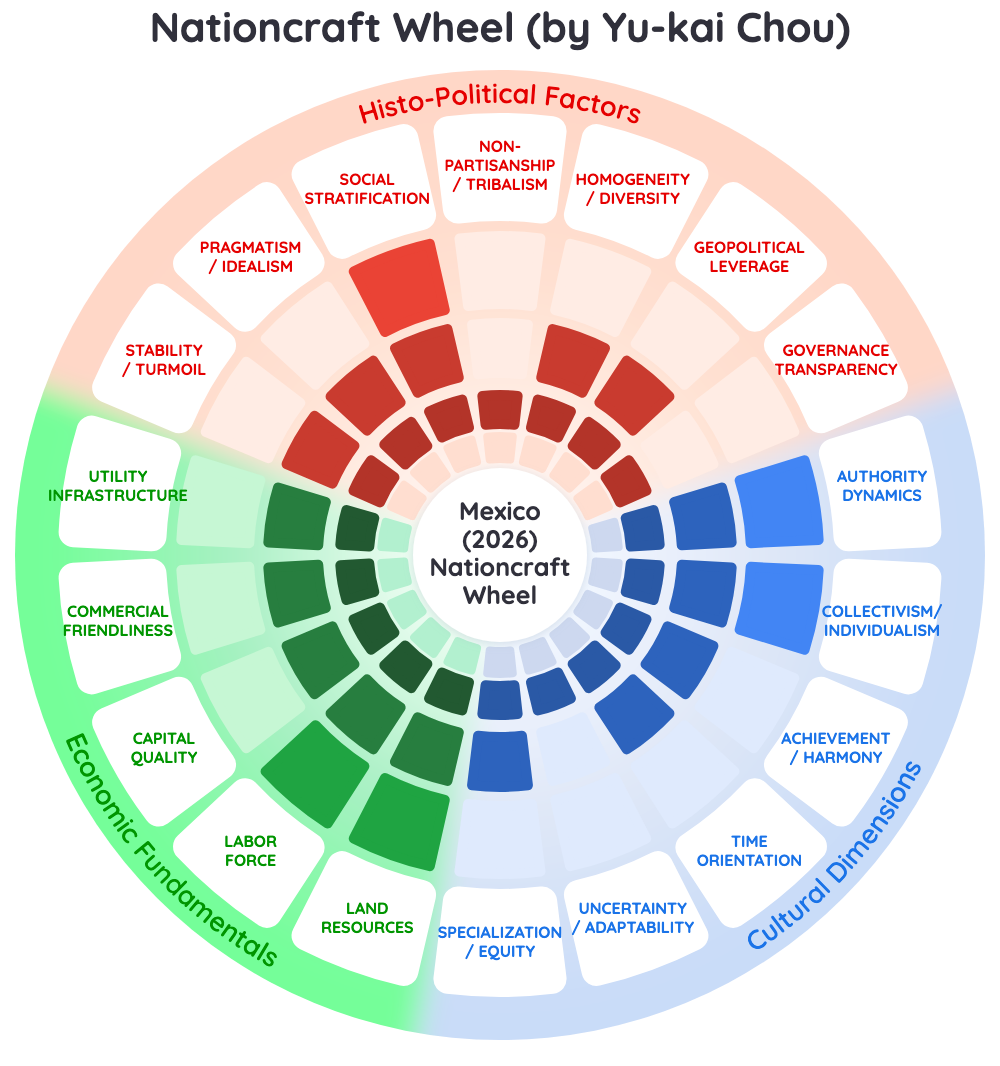

Mexico is winning its war on murder by the numbers: 23,374 homicide victims in 2025, thirty percent fewer than the year before, and daily murders by May 2026 running 46 percent below where the administration found them.
Here is the uncomfortable question nobody in the celebration wants to ask: who is producing the quiet?
During the World Cup this summer, security analysts watched homicides drop in cartel-heavy host cities and suspected the cartels had quietly agreed to a truce among themselves while the world was watching. Read that again. The most persuasive explanation for the safest weeks in recent Mexican history is a decision made in cartel country, not in the National Palace.
That is the shape of what I call the Borrowed-Calm Trap. The homicide curve is real, and the state’s fingerprints are on some of it. But much of the calm is leased from forces the government does not command: criminal wars that end in monopoly, truces the other side can cancel, kingpin removals that trade long-term fragmentation for short-term wins, and US prisons absorbing the capos Mexico cannot convict at home.
This analysis runs Mexico through all 18 Nationcraft variables, shows why the quiet is rented rather than owned, and pulls the historical reform packets that fit Mexico’s configuration, along with five famous security playbooks that quietly do not.
⚡ Speed Run Notes
- Mexico’s homicide numbers are falling fast: 23,374 victims in 2025, down 30.2%, with daily murders down 46% from September 2024 to May 2026. The Borrowed-Calm Trap: real numbers the state does not own.
- Three lenders of calm: cartel consolidation after won wars, a World Cup truce the cartels chose to observe, and US prisons absorbing extradited capos. Every lease can be called by someone other than Mexico.
- V13=3 transparency and V10=3 tribalism sit untouched underneath: most homicides never produce a sentence, and the judiciary was just elected on 13% turnout. The scoreboard improves while capacity does not.
- Bukele, Saakashvili, Fujimori, Suharto, and LKY all fail Mexico’s preconditions. Colombia’s SP-035, Ukraine’s SP-117, and Mexico’s own SP-046 are the packets worth studying.
- The USMCA review is the anchor: lock institution-building into trade terms the way NAFTA locked in macro reform, or keep renting calm until a Sinaloa-style succession war calls the loan nationwide.
Table of Contents
- Understanding Mexico’s Governance Landscape Through Nationcraft
- What Is the Nationcraft Framework?
- Why This Mexico Variables Analysis Matters Now
- The 18 Mexico Nation Variables
- The Borrowed-Calm Trap
- Detailed Justifications: Reading Each Variable Through the Quiet
- Strategic Implications: The Lease Ledger
- Best-Match Historical Packets
- Governance Strategy Recommendations
- Comparative Context: Security Politics Across the Region
- Frequently Asked Questions
About Yu-kai Chou

Yu-kai Chou is a Human-Systems Architect & Behavioral Designer and the creator of the Nationcraft Framework — an 18-variable diagnostic for matching a country’s structural profile to the reform packets that have historically worked under similar conditions. He has consulted for governments in eight nations, including Ukraine, the United Kingdom, the Kingdom of Bahrain, Singapore, Taiwan, the Netherlands, Kazakhstan, and South Korea, and has worked directly with President Zelenskyy’s team on post-war reconstruction priorities for Ukraine.
Chou’s prior framework — the Octalysis Framework — has been applied by LEGO, Microsoft, Porsche, Coca-Cola, Salesforce, and MrBeast, impacting over 1.5 Billion Users. He has taught the methodology at Harvard, Stanford, Yale, Tesla, Google, BCG, and IDEO.
His work has been cited by Harvard, Stanford, MIT, Forbes, Wall Street Journal, Wired, US Department of Energy, NIST, NSF, NCBI, US Department of Education, ClinicalTrials.gov, and Google Scholar — with 3,700+ more academic publications. Explore his books here.

This Mexico analysis applies the same variable-matching method Chou has used in cabinet-level advisory work across eight governments to the hardest security-governance question in the Western Hemisphere: whether a state can convert a statistical peace it did not fully produce into an enforcement capacity it has never had. Mexico’s combination of world-class endowments and chronically leased sovereignty is exactly the configuration the Nationcraft Framework was built to diagnose.
Understanding Mexico’s Governance Landscape Through Nationcraft
Mexico in August 2026 presents the strangest scoreboard in the hemisphere.
President Claudia Sheinbaum’s government just posted the least violent year Mexico has recorded in a decade, and 2026 keeps improving on it: May was the calmest May in twelve years. Her security cabinet can recite numbers most predecessors would have traded a sexenio for: more than 56,000 high-impact arrests, close to 30,000 weapons seized, around 420 tons of drugs taken off the board since October 2024.
And yet the same twelve months contain a different ledger. Culiacán spent the year as the epicenter of a cartel succession war that made Sinaloa one of only six states where homicides rose in 2025 while the national curve fell. The killing of CJNG founder Nemesio “El Mencho” Oseguera in February cost 25 National Guard members their lives in the operation itself and set off retaliatory blockades and arson across multiple states. Washington designated the cartels terrorist organizations, openly debated drone strikes on Mexican soil, and wrote measurable compliance benchmarks for Mexico into its 2026 National Drug Control Strategy.
A falling murder rate, a rising body count in the places that matter most, and a superpower reserving the right to enforce on your territory. Any framework that can only see one of those three facts at a time will misread Mexico.
The Nationcraft Framework reads them together. Its core claim: policy effectiveness is decided by context-fit, not policy quality. Mexico’s 18-variable configuration explains why the same country can post genuine security statistics and still lack a security state, and why the most-cited reform models on earth would fail here.
What Is the Nationcraft Framework?
The Nationcraft Framework is an 18-variable diagnostic system for nation-scale strategy. It scores a country across three clusters: Cultural (V1-V6: Authority Dynamics, Collectivism, Achievement Orientation, Time Orientation, Uncertainty Adaptability, Specialization), Histo-Political (V7-V13: Stability, Pragmatism, Stratification, Partisanship, Homogeneity, Geopolitical Leverage, Transparency), and Economic (V14-V18: Land and Resources, Labor Quality, Capital Quality, Commercial Friendliness, Utility Infrastructure).
The scores are not a report card. Configuration is strategy: the same policy that transformed one country will destroy another if the underlying variables differ.
Against this profile, Nationcraft matches Success Packets: documented historical reform programs, from Meiji Japan to Deng’s China to Botswana’s diamond management, each with its own precondition fingerprint. A packet whose preconditions match your V-vector is a candidate. A packet whose preconditions clash with it is a trap wearing a success story’s clothes.
Mexico is about to be offered a lot of packets wearing other countries’ clothes. That is what makes this analysis urgent.
Why This Mexico Variables Analysis Matters Now
Three clocks are running at once.
First, the post-World Cup clock. The tournament’s opening days gave Mexico single-day homicide lows unseen in a decade: 30 murders on opening day, 27 five days later, with host cities Mexico City and Guadalajara at one each and Monterrey at zero. Analysts credit a cartel-side truce for part of it. Truces expire. Whatever mix of state pressure and criminal restraint produced the quiet of June and July, the restraint half was never Mexico’s to keep.
Second, the Washington clock. The USMCA joint review process is live: bilateral talks formally launched in March 2026, the review window opened in July, and a Section 301 action on July 23 assigned Mexico a 10 percent tariff while sparing USMCA-compliant goods. Every security metric Mexico posts is now also a trade negotiation input, because the US wrote drug-cooperation benchmarks into the same relationship that carries 80-plus percent of Mexico’s exports.
Third, the succession clock. El Mayo Zambada’s 2024 arrest split the Sinaloa Cartel into warring factions. El Mencho’s death in February 2026 put the CJNG, the most disciplined criminal firm in the country, into its own succession test. Decapitation has historically fragmented Mexican cartels into more violent successor cells. Two of the three largest criminal enterprises in the hemisphere are mid-transition simultaneously, which has never happened before.
When all three clocks strike, Mexico’s institutions will be asked to produce order the old-fashioned way: by investigating, convicting, and holding. The variables below say how ready they are.
The 18 Mexico Nation Variables
Scores are from the Nationcraft corpus, sanity-checked August 22, 2026 against current homicide data, corruption indices, and the diplomatic record. 1 is the lowest expression of the variable, 10 the highest.
| Variable | Score | 2026 Reading |
|---|---|---|
| V1 Authority Dynamics | 8 | Restored presidencialismo; Morena holds the presidency, both chambers, and most governorships; deep cultural deference to hierarchy |
| V2 Collectivism | 8 | Family and compadrazgo networks as the operating system of loyalty; the same networks recruit for cartels and shield neighbors from them |
| V3 Achievement vs Harmony | 6 | Competitive maquila and startup culture in the north; harmony and family-first values temper it elsewhere |
| V4 Time Orientation | 4 | The sexenio resets strategy every six years; few institutions plan past the next presidential transition |
| V5 Uncertainty Adaptability | 3 | High uncertainty avoidance; improvisation under crisis but rigidity in institutions; reform-by-decree preferred over experiment |
| V6 Specialization vs Equity | 6 | World-class auto and aerospace clusters beside subsistence regions; the north-south divide is a specialization map |
| V7 Stability vs Turmoil | 4 | Electoral continuity without civil peace: 23,374 homicide victims in 2025, an active Sinaloa faction war, municipal officials assassinated routinely |
| V8 Pragmatism vs Idealism | 4 | Fourth Transformation ideology shapes energy and austerity policy; Sheinbaum is more technocratic at the margin, especially on security |
| V9 Social Stratification | 7 | Entrenched class and regional stratification; around 55 percent of workers in informality; elite capture of opportunity |
| V10 Non-Partisanship vs Tribalism | 3 | Hyper-polarized Morena-vs-opposition politics; institutions staffed by loyalty; judicial elections extended the pattern to the bench |
| V11 Homogeneity vs Diversity | 5 | Mestizo majority with 68 recognized indigenous language groups and strong regional identities |
| V12 Geopolitical Leverage | 4 | Nearshoring darling and largest US trade partner, yet tariffs, terrorist designations, and drone-strike talk show which side holds the cards |
| V13 Governance Transparency | 3 | Corruption perception near the bottom quartile globally; the overwhelming majority of homicides never produce a sentence |
| V14 Land & Resources | 8 | Oil, the world’s largest silver output, lithium, two-ocean geography, and a land border with the world’s largest consumer market |
| V15 Labor Force Quality | 8 | Large, young, manufacturing-proven workforce; roughly 110,000 engineering graduates a year; the reason nearshoring chose Mexico |
| V16 Capital Quality | 4 | Shallow domestic credit; Pemex debt overhang near $100B; public investment crowded out by transfers |
| V17 Commercial Friendliness | 5 | USMCA access and maquila regimes against permit discretion, regulatory reversals, and extortion operating as a shadow tax |
| V18 Utility Infrastructure | 5 | Strained grid, water stress in the capital, uneven rail; world-class industrial corridors in the north |
The Borrowed-Calm Trap
Every named Nationcraft paradox is a small set of variables interacting badly. Mexico’s is four: V1=8, V2=8, V13=3, V10=3.
Start with the strange pair. Mexico scores 8 on Authority Dynamics and 8 on Collectivism — the profile of countries that execute national projects well, like Vietnam or Singapore. High deference to hierarchy, high loyalty to the group. On paper, a state with this culture should be able to enforce.
The trap is that V1 and V2 describe how Mexicans relate to authority, not which authority. Deference flows to whoever credibly governs the territory in front of you. In Polanco that is the state. In pockets of Sinaloa, Michoacán, and Guerrero, it is a cartel that adjudicates disputes, funds fiestas, and punishes theft faster than any prosecutor. The cultural variables that should be the state’s greatest asset are jurisdiction-agnostic: they make Mexicans excellent citizens of whichever sovereign shows up.
Now add the institutional floor. V13=3 means the enforcement pipeline barely converts: the overwhelming majority of homicides in Mexico never end in a sentence. V10=3 means the institutions that should fix this are staffed by political loyalty — a pattern the 2025 judicial elections deepened when roughly 2,600 judgeships, including the full Supreme Court, were filled by popular vote on 13 percent turnout, with candidates including a convicted drug smuggler and a former lawyer for El Chapo.
Put the four together and the 2025-2026 homicide decline reads differently. A state with V13=3 cannot be producing most of the quiet through convictions, because it does not convict. So where does the quiet come from? From four lenders.
Lender one: consolidation. Wars between criminal firms end the way price wars do, in monopoly or truce, and a cartel that has won its territory stops shooting. The national curve falls as markets stabilize. Sinaloa is the exception that proves it: the one place where the criminal market is genuinely contested kept rising through 2025 while 26 states declined.
Lender two: performance truces. The World Cup calm (cartels visibly standing down while Mexico hosted the world) demonstrated something no security strategy wants demonstrated: the violence dial has an owner, and it is not the state. Analysts note the government also paused high-profile captures for the tournament’s duration. Both sides, it turns out, know exactly where the dial is.
Lender three: decapitation dividends. The operation that killed El Mencho was a genuine capability win for Mexican forces working with US intelligence. But the 25 National Guard members lost taking him, the retaliation wave that followed, and the succession fight now brewing inside CJNG are the interest payments. Kingpin removals buy headlines now and fragmentation violence later. Mexico has run this experiment since 2006, and the result has replicated every time.
Lender four: outsourced incapacitation. The 29 cartel figures transferred to US custody in February 2025 and 26 more that August were removed from the battlefield by American prosecutors, not Mexican courts. Every transfer is an admission that the domestic justice system cannot hold its own most dangerous citizens, converted into a diplomatic payment.
That is the Borrowed-Calm Trap: a security scoreboard improving for reasons the state does not control, anesthetizing exactly the urgency that V5=3 adaptability and V4=4 time orientation need to attempt institutional reform. The better the numbers look, the weaker the mandate to build the capacity that would make them real. And every lender can call the loan.
Detailed Justifications: Reading Each Variable Through the Quiet
Scores without behavioral evidence are astrology. Here is what each cluster looks like on the ground in 2026.
Cultural cluster (V1-V6): a high-execution culture waiting for a credible principal
V1 Authority Dynamics (8) shows up in how completely Mexican politics reorganized around a single credible authority once one appeared. Morena’s dominance is not just electoral math; it is a cultural preference for a strong center reasserting itself after decades of fragmented technocracy. The same deference explains cartel governance: half the country’s political culture is available to whoever demonstrates command.
V2 Collectivism (8) is Mexico’s deepest resource and its recruitment vulnerability. The compadrazgo network that funds a cousin’s business also moves a nephew into a cartel’s logistics arm, and the community that shields its own from police does so out of loyalty, not fear alone. Any security strategy that treats these networks as the enemy loses; they are the terrain.
V3 Achievement Orientation (6) and V6 Specialization (6) concentrate in the industrial north, where Monterrey’s engineering culture competes globally. V4 Time Orientation (4) is the sexenio trap: every six years, strategies, acronyms, and uniforms reset (the Federal Police became the Guardia Nacional inside one administration), so no enforcement institution has ever compounded for twenty years. V5 Uncertainty Adaptability (3) means reform arrives as constitutional decree rather than tested pilot, which is exactly how a judiciary got rebuilt by ballot in a single election cycle.
Histo-political cluster (V7-V13): where the trap lives
V7 Stability (4) captures the split-screen: a popular presidency and orderly transfers of power above, an active succession war in Culiacán below. Mexico does not have a state-collapse problem like Haiti’s ballot-first trap; it has a sovereignty-sharing problem, which is harder to see and easier to live with.
V8 Pragmatism (4) is improving at the margin. The Sheinbaum-Harfuch pivot from AMLO’s “hugs not bullets” to intelligence-led operations is the most pragmatic security posture in a generation, but energy nationalism and austerity dogma still route around evidence when ideology demands.
V9 Stratification (7) feeds the pipeline: with over half the workforce informal and social mobility gated by region and class, a cartel salary is the most credible achievement ladder many young men will ever be offered. V10 Tribalism (3) means every institution that should check this (prosecutors, courts, election authorities) is contested as a partisan asset. The judicial elections did not invent that; they constitutionalized it.
V12 Geopolitical Leverage (4) is the variable most people misread. Mexico is the United States’ largest trading partner, the nearshoring destination of the decade, and host of the World Cup it just co-ran. None of that translated into leverage when Washington designated cartels as terrorist organizations, floated drone strikes despite six sovereignty mentions in a single joint statement, and set a 10 percent tariff while writing compliance benchmarks into its drug strategy. Interdependence is not leverage when the other side can price your access.
V13 Transparency (3) is the floor everything else stands on. A justice system that lets the overwhelming majority of murders go unsentenced is not a weak deterrent; it is a non-deterrent. Every calm statistic in 2026 has to be read against this fact: the state’s conviction machinery did not produce the peace, because it cannot.
Economic cluster (V14-V18): world-class endowments, leased conditions
V14 Land and Resources (8) and V15 Labor Quality (8) are the pair that makes Mexico’s underperformance so expensive. The world’s top silver producer, significant lithium, two coasts, and 110,000 engineers a year sitting on the border of the largest consumer market on earth: this is an endowment profile most nations would trade anything for.
V16 Capital Quality (4) shows why endowments idle: Pemex’s debt swallows fiscal space, domestic credit stays shallow, and public investment loses to transfer programs every budget cycle. V17 Commercial Friendliness (5) is split by geography: USMCA-grade rules for exporters, extortion-as-shadow-tax for domestic small business, which pays protection money as a routine cost of operating. V18 Infrastructure (5) mirrors it: world-class northern corridors, a strained grid, and a capital city rationing water.
The economic cluster’s message: Mexico does not need to become rich. It needs to make the conditions under which its riches operate state-guaranteed instead of cartel-tolerated.
Strategic Implications: The Lease Ledger
If the calm is borrowed, strategy starts with knowing the creditors. Four sources of quiet, four dials, four events that call the loan.
| Source of calm | Who holds the dial | What calls the loan | Nationcraft variable exposed |
|---|---|---|---|
| Criminal-market consolidation (won wars stop shooting) | Dominant cartel in each plaza | Any succession crisis or new entrant; Sinaloa 2024-26 is the live demo, rising while 26 states declined | V7 Stability |
| Performance truces (World Cup quiet) | Cartel leadership collectively | End of the spotlight; any incentive shift; the truce that can be granted can be revoked | V1 Authority (who commands?) |
| Decapitation dividends (El Mencho, top-target arrests) | Mexican forces + US intelligence | Successor fragmentation; every kingpin removal since 2006 has eventually priced in more violence | V13 Transparency (no conviction pipeline behind the raid) |
| Outsourced incapacitation (55 capos transferred to US custody in 2025) | US Department of Justice | Diplomatic rupture; tariff escalation; Washington choosing unilateral action over cooperation | V12 Geopolitical Leverage |
Read the ledger’s last column top to bottom: every lender exposes a variable Mexico scores 4 or below on. The quiet is collateralized against the country’s weakest scores.
The strategic implication is uncomfortable but clarifying. Mexico’s task is not to extend the calm; it is to refinance it: swap borrowed quiet for owned enforcement capacity while the borrowing window is open. Statistical peace is a resource. Spent on victory laps, it evaporates. Spent on institution-building, it compounds. That refinancing logic is what the historical packets below either support or sabotage.
Best-Match Historical Packets
The Nationcraft corpus holds 140 documented Success Packets and failure packets. Run Mexico’s V-vector against their precondition fingerprints and the results split cleanly: five celebrated security playbooks fail Mexico’s preconditions, and three packets fit. Popularity and fit are almost perfectly uncorrelated — the same pattern the Venezuela reform playbooks analysis found.
Rejected: SP-064, the Bukele Security & Digital Packet (El Salvador)
The most demanded import in Latin American politics, and the worst fit on this list. Bukele’s mass-incarceration sweep worked against extortion gangs whose core asset was neighborhood presence: visible, lightly armed, geographically fixed. Round up the presence, break the firm.
Mexican cartels are a different species: vertically integrated transnational enterprises with military-grade weapons, billions in diversified revenue, and community patronage deep enough to buy loyalty rather than merely extort it. The precondition mismatch runs through scale (El Salvador is smaller than many Mexican states; V1=8 concentration of power in a unitary microstate does not exist in Mexico’s federation of 32 states and roughly 1,800 municipal police forces), through firepower, and through history: Mexico already ran the frontal-war experiment after 2006, and violence exploded; the corpus records that outcome inside Mexico’s own SP-046 packet. A Mexican state of exception would not be a sweep; it would be a war declaration with the conviction pipeline still at V13=3.
Rejected: SP-051, the Saakashvili Reform Packet (Georgia)
Georgia 2003 proves radical anti-corruption is possible: fire the entire traffic police, rebuild from zero, show visible results fast. The corpus is blunt about the preconditions: a revolutionary mandate, a small country of four million, generous Western support, and one leader’s personal drive. Mexico has none of the four. Its police number in the hundreds of thousands across three levels of government; there is no revolutionary moment, only a governing incumbency defending a winning scoreboard; and V10=3 tribalism means a fire-everyone purge would be re-staffed through the same patronage networks that staffed it the first time. The packet’s judicial-reform failure is the sharper warning: even Georgia never fixed its courts, and courts are exactly where Mexico’s pipeline breaks.
Rejected: SP-033, the Fujimori Shock Therapy Packet (Peru)
Peru 1990 gets cited whenever a country faces insurgent territorial control: hyperinflation ended, Shining Path defeated, order restored. But the preconditions were an ideological insurgency that had alienated its own base and a crisis so total that Peruvians accepted an autogolpe. Cartels are not insurgencies; they are market firms embedded in the communities V2=8 binds together, selling employment rather than ideology. And the packet’s poison is documented in its own lessons: the Montesinos intelligence apparatus that won the war became the most corrupt institution in Peruvian history. Building an unaccountable security-intelligence complex on a V13=3 foundation does not defeat the cartels; it franchises them. Peru is still paying: its post-Fujimori political system cycles through presidents the way the carousel trap describes.
Rejected: SP-023, the New Order Stabilization Packet (Indonesia)
Suharto’s Indonesia is the quiet template behind every “let the military run the territory and the technocrats run the economy” proposal. Its early mechanics genuinely rhyme with Mexico’s current drift: soldiers in civil roles, technocrats insulated, order prioritized. The corpus verdict is that the packet’s stabilization depended on a unified military institutionally superior to every local power, legitimated by an anti-communist emergency that cannot be replicated. Mexico’s military is already running airports, trains, and customs; deepening its economic footprint builds a praetorian economy rather than a state. The packet’s own trajectory shows the endgame: cronyism metastasized until the 1997 crisis exposed everything. Indonesia’s strongman trap analysis traces what that inheritance still costs.
Rejected: SP-002, the Lee Kuan Yew Industrialization Packet (Singapore)
Every anti-corruption conversation eventually reaches Singapore: pay officials well, prosecute without exception, watch V13 climb. The packet’s precondition list is why it stops there: a city-state of five million, V8=9 pragmatism against Mexico’s V8=4, and a corruption-prosecution agency answerable to a leadership that wanted prosecutions. Mexico’s judicial elections just moved the bench closer to electoral politics, the opposite of the insulation the CPIB model requires. The Singapore LKY stress test shows the packet straining even at home; transplanted onto a federation with elected judges, it has no organ to graft onto.
Rejected: SP-096, the CICIG lesson (Guatemala)
The one rejected packet that failed for political rather than structural reasons. Guatemala’s internationally backed anti-impunity commission proved imported prosecutors can convict untouchables — until it touched the elite that hosted it and was expelled. For Mexico the sovereignty politics are prohibitive twice over: no Morena government will invite an international prosecution body while Washington debates drone strikes, and V10=3 guarantees any such body becomes a partisan football faster than it did in Guatemala City. The mechanism is right; the vehicle is unimportable.
Fit: SP-035, the Apertura & Modernization Packet (Colombia)
Colombia 1990 is the closest thing the corpus has to Mexico’s assignment: modernize the economy and the constitution while a drug war burns. At the peak of Escobar’s terror (25,000 murders a year), Colombia wrote the 1991 Constitution, liberalized trade, and kept its central bank credible. The packet’s critical insight is that economic modernization can proceed during conflict if technocrats hold institutional islands of competence.
The fit runs through Mexico’s strengths: V14=8 and V15=8 give the islands something to administer, and Sheinbaum’s technocratic instincts are the right staffing profile. The honest caveats: Colombia needed 25 years and massive US security investment delivered as partnership: Plan Colombia dollars, not Section 301 tariffs. Mexico gets the pressure without the partnership, and Colombia’s polarization pendulum shows the political bill arriving even in the success case. Study the islands logic, not the timeline.
Fit: SP-117, the Post-Euromaidan Reform Packet (Ukraine)
Ukraine 2014-2022 answered the question Mexico is actually facing: how do you raise V13 while under fire, with captured courts and an oligarchic political class? Not frontally. Ukraine built bypass institutions that routed citizen-state interactions around the corrupt layer instead of reforming it head-on: NABU for investigation, ProZorro for procurement transparency, Diia for digital services. The corpus scores the result: V13 roughly 2 to roughly 5 inside eight years, during a war.
The Mexican translation is direct. A federal procurement platform with ProZorro’s radical transparency attacks the contracting corruption that feeds V13=3. García Harfuch’s new 250-agent civilian investigative force is embryonic NABU logic: build a small clean unit beside the broken system rather than purging the system first. And the external-anchor mechanic (EU and IMF conditionality holding reforms in place across political cycles) has an exact Mexican equivalent sitting in plain sight: the USMCA review. This packet is the playbook for that, as the Ukraine variables analysis details variable by variable.
Fit: SP-046, the NAFTA Integration Packet (Mexico’s own, half-finished)
The strongest evidence that external anchoring works on Mexico is Mexico. Salinas used NAFTA to lock in macroeconomic reform against domestic reversal, and it held: manufacturing FDI transformed the north, macro stability survived every sexenio since 1995, and democratization arrived peacefully. The packet’s recorded failure is just as instructive: growth underwhelmed, the south was left behind, and, in the corpus’s own words, drug violence exploded after 2006, because trade anchoring cannot substitute for domestic institutional development.
SP-046 is not a foreign model to import; it is Mexico’s own packet with the second half unexecuted. The first run anchored markets and skipped institutions. The 2026 USMCA review is the first structural opportunity since 1994 to run the anchor play again with institutions inside the lock.
| Packet | Country / era | Core mechanism | Mexico verdict | Deciding variables |
|---|---|---|---|---|
| SP-064 Bukele Security & Digital | El Salvador 2019- | Mass incarceration under state of exception | Reject | Scale, federalism, cartel firepower; V13=3 pipeline |
| SP-051 Saakashvili Reform | Georgia 2003-2012 | Fire-everyone purge + deregulation | Reject | No revolutionary mandate; V10=3 re-staffing risk |
| SP-033 Fujimori Shock Therapy | Peru 1990-2000 | Autogolpe + counterinsurgency | Reject | Cartels ≠ insurgency; Montesinos capture at V13=3 |
| SP-023 New Order Stabilization | Indonesia 1966-1996 | Military-territorial control + technocrats | Reject | Praetorian-economy drift; non-replicable legitimacy |
| SP-002 LKY Industrialization | Singapore 1965-1990 | Clean-sweep anti-corruption + meritocracy | Reject | City-state scale; V8=9 vs Mexico’s V8=4; elected judges |
| SP-096 Post-Civil War Development | Guatemala 1996- | CICIG international anti-impunity | Reject | Sovereignty politics; V10=3 partisan capture |
| SP-035 Apertura & Modernization | Colombia 1990-2016 | Institutional islands during conflict | Fit | V14/V15 strength; technocrat insulation viable |
| SP-117 Post-Euromaidan Reform | Ukraine 2014-2022 | Bypass institutions + external anchor | Fit | Raises V13 without frontal war; USMCA as anchor |
| SP-046 NAFTA Integration | Mexico 1988-2000 | Trade anchor locks domestic reform | Fit (self) | Proven on Mexico; institutions half unexecuted |
Governance Strategy Recommendations
Nationcraft recommendations are sequenced, not listed. Order matters because each phase either builds or burns the political capital the next phase needs. Mexico’s sequencing logic follows from the lease ledger: refinance the borrowed calm into owned capacity before a lender calls.
| Phase | Move | Packet source | Variables targeted |
|---|---|---|---|
| 1 (now – mid-2027) | Anchor institutions into the USMCA review: bind judicial integrity screening, procurement transparency, and investigative-police buildout into the trade framework’s review terms, converting US pressure into conditionality that outlives the sexenio | SP-046 + SP-117 | V13, V12, V4 |
| 1 (parallel) | Scale the bypass institutions: grow the 250-agent civilian investigative force on NABU logic (small, clean, beside the broken system) and stand up a ProZorro-grade open procurement platform for all federal contracting | SP-117 | V13, V17 |
| 2 (2027-2028) | Build institutional islands: insulate five to ten enforcement and prosecutorial units with independent budgets, vetted staffing, and publication-by-default metrics, administered on Colombia’s islands-of-competence model rather than system-wide purges | SP-035 | V13, V10 |
| 2 (parallel) | Repair the judicial-election damage at the margin: integrity screening with teeth for the 2027 judicial ballot round, public case-outcome dashboards per elected judge, and federal protection details that make ruling against a cartel survivable | SP-117 + SP-035 | V13, V10, V7 |
| 3 (2028+) | Convert calm into presence: as consolidation holds, replace cartel governance services (dispute resolution, credit, security) with state equivalents in the specific plazas where the truce is quietest — competing for V1/V2 deference territory by territory instead of decapitating firm by firm | SP-035 sequencing | V1, V2, V9 |
What is deliberately absent: a national state of exception, a fire-everyone purge, a new super-agency, and any move that spends Phase 1’s window proving toughness instead of building conviction capacity. Mexico has spent two decades demonstrating that theatrical enforcement and institutional enforcement are different products. The recommendation is to finally buy the second one.
Comparative Context: Security Politics Across the Region
Mexico’s Borrowed-Calm Trap sits inside a hemisphere running four other security-politics experiments, each already analyzed in this library.
| Country | Named pattern | Relation to Mexico’s trap |
|---|---|---|
| Chile | Mano Dura Mirage | Security panic without Mexico’s violence levels; shows how fast crime politics consumes a reform mandate |
| Ecuador | Emergency Ratchet Trap | The state-of-exception path Mexico is being urged toward: each emergency normalizes the next, capacity never built |
| Philippines | Dynasty Trap | Duterte’s drug war proved body counts substitute for institutions only until the accounting arrives |
| Haiti | Ballot-First Trap | The endpoint when sovereignty-sharing with armed groups completes; the cautionary asymptote, not the forecast |
The regional pattern is consistent with the corpus: states that spent their calm windows on institutional construction (Colombia’s islands, however slowly) exited the cycle; states that spent them on enforcement theater (Ecuador’s emergency ratchet, the Philippines’ dynasty-run drug war) re-entered it harder. Chile’s mano dura mirage shows the politics arriving even before the violence does, and Honduras (whose corpus packet SP-097 ends with a president convicted as a trafficker) shows what full state capture looks like when the borrowing never stops.
One more neighbor belongs in the frame: the United States variables analysis. The US is simultaneously Mexico’s demand market, arms supplier, extradition warehouse, and tariff-setter: four roles that make it the largest single actor inside Mexico’s security equation while sitting entirely outside Mexico’s political control. No Nationcraft profile in the corpus has its V12 shaped this completely by one counterpart.
The Nationcraft Framework in Practice
The Nationcraft method here is the same one applied across every analysis in this library: score the 18 variables from behavioral evidence, find the small variable cluster that generates the country’s signature pattern, name it, then filter historical packets by precondition fit rather than popularity.
Mexico also shows why Nationcraft is ultimately motivational design at nation scale, the same discipline as the Octalysis Framework, pointed at states. Cartels out-recruit the state on Core Drive 5 (Social Influence & Relatedness) through the same family networks V2=8 describes, out-pay it on Core Drive 2 (Development & Accomplishment) with visible advancement ladders, and out-punish it on Core Drive 8 (Loss & Avoidance) through extortion enforced faster than any court. A state that wants its citizens’ deference back has to compete on those drives, offering credible belonging, credible ladders, and credible protection on top of force. That translation from behavioral design to statecraft is developed in Nationcraft: How the Octalysis Framework Applies to Nation-Building and Public Policy.
And the judiciary question (what happens to enforcement when judges answer to electorates that cartels can reach) has a corpus rhyme on the other side of the Pacific: Thailand’s judicial veto trap, where courts became political instruments through appointment instead of election. Different mechanism, same lesson: a bench that serves power cannot anchor a state’s V13.
Explore More Nationcraft Analyses
The Nationcraft Nation Variables Library holds every published country analysis, from resource-curse economies to post-conflict rebuilds, each running the same 18-variable diagnostic this Mexico analysis used. For configuration neighbors, start with Colombia’s polarization pendulum, Ecuador’s emergency ratchet, and Brazil’s renewal deficit; for the anchor-play mechanics, the Ukraine and Singapore analyses show external and internal anchoring at their extremes.
Frequently Asked Questions
What is the Borrowed-Calm Trap in Mexico’s Nationcraft analysis?
It is the interaction of falling homicide numbers with an unbuilt enforcement state. Homicides fell 30.2 percent in 2025 to 23,374 victims, with daily murders down 46 percent from September 2024 to May 2026, but the decline is financed by lenders the state does not control: cartel consolidation, a World Cup truce, decapitation dividends, and US prisons holding extradited capos. With V13 Governance Transparency at 3 and V10 Non-Partisanship at 3, the conviction pipeline and institutional independence that would make the calm state-owned remain unbuilt; any lender can call the loan.
Why doesn’t the Bukele model work for Mexico?
SP-064 worked against neighborhood extortion gangs in a unitary microstate. Mexico’s cartels are vertically integrated transnational firms with military-grade weapons and community patronage, spread across a federation with roughly 1,800 municipal police forces. Mexico already ran the frontal-war experiment after 2006 and violence multiplied. The preconditions that made El Salvador’s sweep possible are absent at Mexico’s scale.
Which historical reform packets actually fit Mexico in 2026?
Three: SP-035, Colombia’s Apertura and its institutional islands of competence during active conflict; SP-117, Ukraine’s post-Euromaidan bypass institutions (ProZorro, Diia) that raised transparency during a war; and SP-046, Mexico’s own NAFTA packet, external anchoring proven on Mexico with the institutional half never executed. The 2026 USMCA review is the structural opening to finish SP-046.
Did Mexico’s homicide numbers really fall in 2025 and 2026?
Yes. The decline is real. Mexico recorded 23,374 homicides in 2025, down 30.2 percent and the lowest per-capita rate since 2015, and daily murders fell 46 percent between September 2024 and May 2026, alongside 56,000-plus high-impact arrests and about 420 tons of drugs seized since October 2024. The Nationcraft question is attribution: Sinaloa was one of only six states where homicides rose in 2025 while its factions fought, showing how much of the national decline rides on criminal-market consolidation rather than state conviction capacity.
What should Mexico do with the 2026 USMCA review?
Use it as Salinas used NAFTA: an external anchor that locks domestic reform against reversal. Bind judicial integrity screening, open procurement, and investigative-police buildout into the review’s terms so that US pressure becomes conditionality that outlives the sexenio instead of a sovereignty humiliation that feeds nationalist backlash.
Related Reading
- The Nationcraft Framework: 18 Variables, 8 Goals, 100+ Proven Reform Packets
- Nationcraft Nation Variables Library
- Nationcraft Analysis: Colombia Pendulum 2026
- Nationcraft Analysis: Brazil Renewal Deficit 2026
- Nationcraft Analysis: Turkey Strongman Discount 2026
- Nationcraft Analysis: China Supply Reflex 2026
Footnotes
- 2025 homicide total (23,374), the 30.2 percent annual decline, and the lowest per-capita rate since 2015: Mexico News Daily, “Mexico’s homicide rate dropped 30% in 2025, preliminary data shows”: mexiconewsdaily.com/news/mexico-homicide-rate-2026/
- 46 percent decline in daily intentional homicides September 2024 (86.9/day) to May 2026 (47.3/day), May 2026 as the calmest May in twelve years, and García Harfuch’s enforcement totals (56,000+ detentions, ~30,000 firearms, ~420 tons of drugs): Mexico Solidarity Media / La Jornada: mexicosolidarity.com/homicides-fell-46/
- Death of Nemesio “El Mencho” Oseguera (February 22, 2026), the 25 National Guard members killed in the operation, and the retaliatory unrest: Wikipedia, “2026 Jalisco operation”: en.wikipedia.org/wiki/2026_Jalisco_operation; and “2026 Mexico cartel unrest”: en.wikipedia.org/wiki/2026_Mexico_cartel_unrest
- World Cup truce assessment (analyst David Saucedo) and the paused-operations caveat: NewsNation via Yahoo News: yahoo.com; opening-days homicide lows (30 on opening day, 27 five days later; host-city counts): Latin Times: latintimes.com
- Sinaloa faction war (Los Chapitos vs La Mayiza) and Culiacán violence: NPR, “Cartel violence in Sinaloa, Mexico, leaves 20 dead”: npr.org (July 2025)
- USMCA 2026 joint review process and stakes: CSIS, “USMCA Review 2026”: csis.org/analysis/usmca-review-2026
- July 23, 2026 Section 301 tariff action and the USMCA-compliant exclusion: Holland & Knight: hklaw.com
- US National Drug Control Strategy 2026 benchmarks and FTO designations targeting Mexico: Mexico Business News: mexicobusiness.news
- US deliberations on drone strikes against cartels: NBC News: nbcnews.com; sovereignty emphasis after the Rubio visit: CSIS: csis.org
- 2025 judicial elections (roughly 2,600 positions, 13 percent turnout, candidate-integrity concerns): Wikipedia, “2025 Mexican judicial elections”: en.wikipedia.org/wiki/2025_Mexican_judicial_elections
- García Harfuch’s 250-agent civilian investigative force and the security-reform window: International Crisis Group: crisisgroup.org
- Strategy pivot from “abrazos no balazos” to intelligence-led operations: Stimson Center, “Bullets Not Hugs? Mexico’s New Old Security Strategy”: stimson.org