
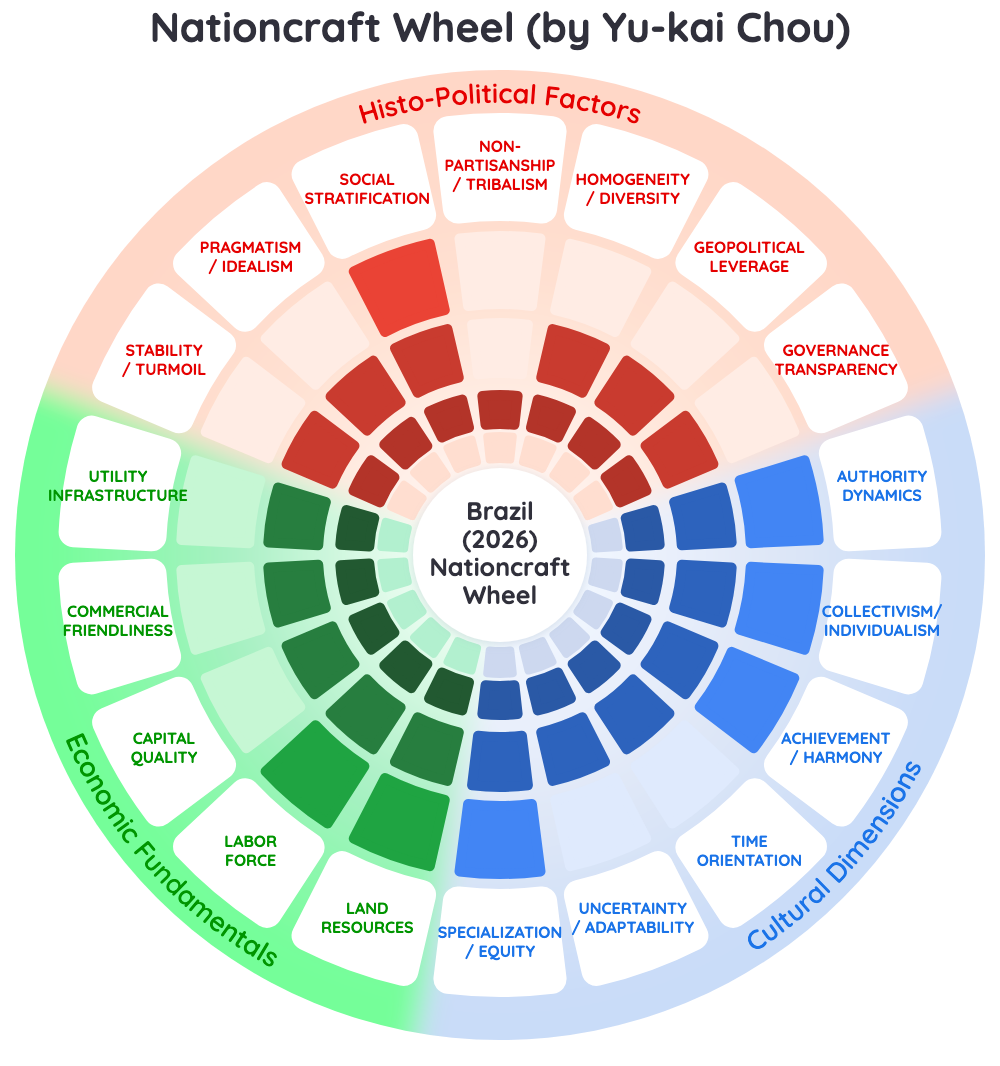

In September 2025, Brazil did something almost no democracy under stress manages to do. Its Supreme Federal Tribunal convicted a former president, Jair Bolsonaro, of plotting a coup to overturn the election he had lost, and sentenced him to twenty-seven years and three months in prison.1 The plot the court described was not metaphorical. Prosecutors laid out a plan to reject the 2022 result by force, up to and including the assassination of the winner. The institutions held. The judges did not flinch. A country that many observers had written off as sliding toward strongman rule produced, instead, the clearest act of democratic accountability in the hemisphere.
Ten months later, Brazil is campaigning for the 4 October 2026 general election, and the shape of the contest tells the other half of the story. On one side stands President Luiz Inacio Lula da Silva, eighty years old, seeking an unprecedented fourth term. On the other stands Senator Flavio Bolsonaro, carrying his imprisoned father’s movement into the race because the father is barred from running.4 A July 2026 poll put Lula ahead of the younger Bolsonaro by eight points in a runoff, 45 to 37.5 The names have shifted by a generation. The fight has not moved an inch.
This is the shape the Nationcraft Framework calls the Renewal-Deficit Trap. A democracy proves it is strong enough to punish an assault on itself, and discovers that punishing the assault does nothing to dissolve the polarization that produced it. The court can jail the man. It cannot renew the party system, cannot lower the temperature, cannot stop the same war from reloading behind new faces every four years. Brazil’s institutions passed the hardest test a democracy can face. The reward for passing is to run the same election again.
⚡ Speed Run Notes
- Brazil’s Nationcraft signature pairs strong, assertive institutions (V1 = 7; a Supreme Court that jailed a coup-plotter) with extreme tribalism (V10 = 3), deep inequality (V9 = 8), and mid-low transparency (V13 = 4). The strength is real; so is the split.
- The corpus pattern for democratic collapse (PT-002 Authoritarian Backslide) lists one immunity factor: a strong independent judiciary established before the backslide. Brazil has it and just used it. That is why the coup failed and the country did not tip.
- Accountability is not renewal. The 27-year sentence removed a man, not the movement. The 2026 race is an 80-year-old incumbent versus the strongman’s son, which is the trap: the polarization regenerates faster than the system renews.
- Brazil’s V14 = 9 land and resources and V12 = 6 heft make it too big and too checked for the strongman packets it keeps being offered (Bukele, Chavez, Fujimori). Those need a commanding center Brazil’s institutions structurally deny.
- The packets that fit lower tribalism from within: Brazil’s own Plano Real (SP-034), Spain’s pacted transition (SP-017), Uruguay’s consensus democracy (SP-047). The real deficit is not economic. It is the missing habit of putting a few rules above the fight.
Table of Contents
- Understanding Brazil’s Governance Landscape Through Nationcraft
- What Is the Nationcraft Framework?
- Why This Brazil Variables Analysis Matters
- What Brazil Actually Looks Like in Numbers
- The 18 Brazil Nation Variables
- Detailed Justifications: Reading the Variables That Matter
- The Renewal-Deficit Trap
- Three Patterns: Backslide Soil, Middle-Income Trap, and Resource Blessing
- Reformer Playbooks Brazil Should Reject
- Reformer Playbooks Brazil Should Actually Study
- Governance Strategy Recommendations
- Comparative Context
- What This Means Practically for Brazil
- The Nationcraft Framework in Practice
- Explore More Nationcraft Analyses
- Related Reading
- Frequently Asked Questions
- Footnotes
About Yu-kai Chou

Yu-kai Chou is a Human-Systems Architect & Behavioral Designer and the creator of the Nationcraft Framework — an 18-variable diagnostic for matching a country’s structural profile to the reform packets that have historically worked under similar conditions. He has consulted for governments in eight nations, including Ukraine, the United Kingdom, the Kingdom of Bahrain, Singapore, Taiwan, the Netherlands, Kazakhstan, and South Korea, and has worked directly with President Zelenskyy’s team on post-war reconstruction priorities for Ukraine.
Chou’s prior framework — the Octalysis Framework — has been applied by LEGO, Microsoft, Porsche, Coca-Cola, Salesforce, and MrBeast, impacting over 1.5 Billion Users. He has taught the methodology at Harvard, Stanford, Yale, Tesla, Google, BCG, and IDEO.
His work has been cited by Harvard, Stanford, MIT, Forbes, Wall Street Journal, Wired, US Department of Energy, NIST, NSF, NCBI, US Department of Education, ClinicalTrials.gov, and Google Scholar — with 3,700+ more academic publications. Explore his books here.

I have spent years watching reform efforts succeed and fail across very different countries, and Brazil is the case that most complicates the usual story about democratic decline. The reflex is to grade a democracy by whether it can stop a strongman, and by that test Brazil passed with a clarity almost nobody expected. But the framework forces a harder question. What happens after the strongman is stopped, when the country that stopped him is still split down the middle, still governed by the two men who have defined the fight for twenty years, still unable to produce a third choice? Brazil is not a story about whether institutions work. It is a story about what institutions cannot do on their own, and that is the more useful thing to understand.
Understanding Brazil’s Governance Landscape Through Nationcraft
Brazil is usually described in one of two registers, and the two rarely meet. The first is triumphant: a democracy that resisted an authoritarian assault, jailed the man behind it, and kept its constitutional order intact through the worst stress test since the end of military rule in 1985. The second is despairing: a society so polarized that half of it regards that same jailing as persecution, an economy stuck at middle income for four decades, a state where corruption scandals recur with the regularity of the seasons. Both registers are accurate. The Nationcraft read begins by insisting that they are not in tension. They are two descriptions of a single variable profile.
The framework treats a country as a configuration of eighteen structural variables, and its first discipline is to refuse to average them. Brazil’s profile is not the story of a country that is doing well or badly on balance. It is the story of a specific split: a set of institutional-strength variables that are genuinely high, sitting directly on top of a set of social-cohesion variables that are genuinely low. The judiciary is assertive (part of a V1 = 7 authority reading). The society is riven (V10 = 3 tribalism). Those two facts do not cancel out into a moderate country. They describe a country that can be simultaneously excellent at defending its democracy and terrible at healing it.
What makes 2026 the year to run the analysis is that both halves of that profile hit a landmark within a single year. The strong-institution half produced a landmark conviction in September 2025. The low-cohesion half produced, almost immediately, a 2026 campaign that reproduces the exact polarization the conviction was supposed to resolve. The framework’s task is to explain how a country can be this good at the one thing and this stuck on the other, and to say what, if anything, converts a one-time act of institutional courage into a durable lowering of the temperature.
What Is the Nationcraft Framework?
The Nationcraft Framework is an 18-variable diagnostic for nation-states. Each variable, labeled V1 through V18, captures one structural dimension of how a country actually behaves: how power concentrates and is checked (V1 Authority Dynamics), how much a culture prizes the group over the individual (V2 Collectivism), how it handles time and risk (V4 Time Orientation, V5 Uncertainty and Adaptability), how partisan or cohesive its politics are (V10 Non-Partisanship versus Tribalism), how stratified its society is (V9 Social Stratification), how transparent its governance is (V13 Governance Transparency), how much leverage it holds over the outside world (V12 Geopolitical Leverage), and on through land, labor, capital, commerce, and infrastructure.
The point of the framework is not to rank countries. It is to match them. A reform packet that transformed one nation routinely fails in another, and the framework’s claim is that these failures are predictable: a packet works when the target country’s variables resemble the variables of the place where the packet first succeeded. A strongman security drive needs a strongman profile. A pacted democratic transition needs the raw material for pacts. Import a template built for a different configuration and it does not merely underperform. It backfires, because it assumes capacities the country does not have or licenses moves the country’s structure will punish.
So every Nationcraft analysis ends with two questions. Which historical packets fit this country’s variables, and which famous packets will break against them? For Brazil, the second list is unusually seductive, because a polarized middle-income democracy is exactly the kind of country whose commentators reach for a savior, and every savior model on offer collides with the same two variables: the assertive institutions (V1 = 7) that will not be captured, and the tribalism (V10 = 3) that no strongman can command his way out of. The framework grew out of the same behavioral-design work behind Octalysis and public policy: what determines whether a reform holds is motivation and structure, not the elegance of the plan on paper.
Why This Brazil Variables Analysis Matters
Brazil matters as the test case for a question every stressed democracy is quietly asking: is defeating an authoritarian attempt enough? The global story of the 2020s has been democratic backsliding, and Brazil is the rare counter-example where the backslide was attempted and stopped. That makes it the place to study what stopping it actually buys. The optimistic reading is that Brazil proved institutions can win. The Nationcraft reading is more cautious, because winning the defensive battle left every underlying variable that produced the attack exactly where it was.
The framework sharpens the stakes by refusing to let the win stand in for a cure. Plenty of countries have strong courts, or deep polarization, or high inequality. What decides the trajectory is the interaction of the variables, not any single one. Brazil’s assertive institutions (V1 = 7) are strong enough to punish an assault but not to depolarize a society, because depolarization is not a judicial function. Its tribalism (V10 = 3) is deep enough to keep regenerating leaders on both poles but not, so far, deep enough to overwhelm the courts. Its inequality (V9 = 8) and its mid-low transparency (V13 = 4) supply the permanent grievance that keeps both poles fed. The analysis exists to answer what happens when a country keeps winning the defensive fight and never gets to the offensive one, which is the slow, unglamorous work of making the next fight smaller.
What Brazil Actually Looks Like in Numbers
Before the variables, the ledger, because Brazil’s ledger cuts against the crisis narrative. This is not a collapsing economy. Real GDP grew 2.3% in 2025, the fifth consecutive year of growth, led by an 11.7% surge in agriculture as corn and soybean harvests hit records.2 Inflation ended 2025 at 4.26%, inside the target band and the lowest reading since 2018, and unemployment fell to roughly 5.2%, a record low.3 The macro picture is, if anything, enviable. The one obvious strain is the price of that stability: the central bank’s Selic rate sat at 15% through 2025, the highest since 2006, choking investment to hold inflation down.2
The strain that matters for this analysis is political and social, and it does not show up in the growth figures. Brazil remains one of the most unequal societies on earth, with a Gini coefficient near 0.52 and stratification that runs along racial and regional lines as much as income. Its governance record is a cycle of exposure and recurrence: the Lava Jato investigations of the 2010s reached into the highest offices, and corruption remains the permanent background grievance of its politics. And its political system is split so cleanly between two poles that a coup attempt, a conviction, and a fresh election have all failed to move the basic alignment.
The table below translates that split into the Nationcraft variables it stresses. Each row is a headline fact mapped to the structural score it moves, and those scores are what the rest of the analysis runs on.
| 2026 indicator | Reading | Nationcraft variable stressed |
|---|---|---|
| Coup conviction | Ex-President Bolsonaro sentenced to 27y3m for a 2022 coup plot; upheld on appeal | V1 Authority Dynamics = 7 |
| Political alignment | 2026 race = Lula (PT) vs Flavio Bolsonaro (PL), the same poles by proxy | V10 Non-Partisanship vs Tribalism = 3 |
| Inequality | Gini ~0.52; racial and regional stratification | V9 Social Stratification = 8 |
| Corruption | Recurring high-office scandals; Lava Jato legacy | V13 Governance Transparency = 4 |
| GDP & resources | +2.3% in 2025; agribusiness, minerals, pre-salt oil, the Amazon | V14 Land Resources = 9 |
| Monetary policy | Selic 15%, highest since 2006; deep but costly capital market | V16 Capital Quality = 5 |
| Global posture | BRICS heavyweight, regional power, farm-and-energy weight | V12 Geopolitical Leverage = 6 |
The 18 Brazil Nation Variables
Here is the full Nationcraft profile for Brazil in 2026. Scores run on the framework’s standard nine-point scale, where low numbers mark a structural weakness on that dimension and high numbers mark a strength or an intensity. Read the vector as a shape, not a report card: the story is in the clustering, and Brazil’s clusters a strong, resource-rich, institutionally assertive body around a deeply divided and unequal political soul.
| Variable | Score | One-line reading |
|---|---|---|
| V1 Authority Dynamics | 7 | Strong presidency and an assertive Supreme Court; power concentrates but is genuinely checked |
| V2 Collectivism vs Individualism | 7 | Family, community, and church networks anchor identity above the individual |
| V3 Achievement vs Harmony | 7 | Competitive, status-conscious, entrepreneurial energy |
| V4 Time Orientation | 5 | Short electoral horizon crowds out long-term planning |
| V5 Uncertainty & Adaptability | 4 | Society absorbs shocks; institutions adapt slowly and reactively |
| V6 Specialization vs Equity | 7 | Market specialization alongside a large transfer state (Bolsa Familia lineage) |
| V7 Stability vs Turmoil | 6 | Survived a coup attempt without state failure; turbulent but durable |
| V8 Pragmatism vs Idealism | 6 | Pragmatic coalition-building, increasingly strained by ideological rigidity |
| V9 Social Stratification | 8 | Among the world’s most unequal; racial, regional, and class tiers |
| V10 Non-Partisanship vs Tribalism | 3 | The anchor weakness: an entrenched two-pole war that survives every shock |
| V11 Homogeneity vs Diversity | 6 | Racially and regionally diverse, unified by one language and a syncretic culture |
| V12 Geopolitical Leverage | 6 | BRICS heavyweight and regional power; agricultural and energy weight |
| V13 Governance Transparency | 4 | Strong investigative capacity over a political economy that keeps regenerating graft |
| V14 Land Resources | 9 | Vast: the Amazon, agribusiness superpower, minerals, offshore pre-salt oil |
| V15 Labor Force Quality | 7 | Large and improving, dragged by skills gaps and high informality |
| V16 Capital Quality | 5 | Deep financial system throttled by punishing real interest rates |
| V17 Commercial Friendliness | 6 | Enormous market weighed down by the tax-and-red-tape “Custo Brasil” |
| V18 Utility Infrastructure | 6 | Broad, renewable-heavy grid with real logistics and transport gaps |
Detailed Justifications: Reading the Variables That Matter
Eighteen variables define the profile, but five of them do the analytical work in Brazil’s case. They are the ones that explain how a country can defend its democracy so effectively and repair it so poorly.
V10 Non-Partisanship vs Tribalism (3): the variable that runs the whole story
Brazil’s politics have collapsed into two poles, and the collapse is unusually total. Lulismo and Bolsonarismo are not merely parties; they are identities, each with its own media, its own moral universe, its own account of who the enemy is. The corpus scores this as V10 = 3, and it is the direct cause of the Renewal-Deficit Trap. A tribalism this deep does two things at once. It supplies the energy that produced a coup attempt, because when the other side winning feels like an existential threat, extraordinary measures start to look justified. And it guarantees that removing one leader changes nothing, because the identity does not depend on the man. Jail Bolsonaro and Bolsonarismo simply reappears as his son. A V10 = 3 is not noise around the edges of Brazilian politics. It is the organizing fact, and every other variable is read through it.
V1 Authority Dynamics (7): the strength that held the line
Authority in Brazil concentrates in a powerful presidency and, critically, in an assertive Supreme Federal Tribunal that has grown into one of the most consequential high courts in the democratic world. The V1 = 7 captures a system where power is strong but genuinely contested: the presidency commands, the court checks, and neither can simply override the other. This is the variable that produced the 2025 conviction. The corpus is explicit that the single immunity factor against an authoritarian backslide is a strong independent judiciary established before the backslide begins, and Brazil’s was. The nuance the framework insists on is that a high V1 with strong checks is a double-edged reading. The same assertive court that jailed a coup-plotter is accused by the other pole of judicial overreach, and that accusation is itself fuel for the tribalism. Strong institutions defended the democracy and, in defending it, became another front in the war.
V9 Social Stratification (8): the permanent grievance
Brazil is among the most unequal societies on earth, and the inequality is not only about income. It runs along colour and region, concentrating opportunity in a mostly white, mostly southern elite while the north, the northeast, and the favelas of every city carry the deficit. A V9 = 8 is the reservoir the tribalism draws on. Lulismo was built on redistribution to the bottom; Bolsonarismo on the anxieties and resentments of the middle and the agrarian frontier. Neither pole invented the division; the stratification was there first, and it guarantees that any politics will have a class-and-race fault line ready to be mobilized. Until the V9 reading moves, the raw material for a two-pole war is permanently in stock, which is why the framework treats inequality here as a governance variable and not merely a social one.
V13 Governance Transparency (4): strong exposure, weak cure
Transparency is the variable where Brazil’s story is most easily misread. The country has world-class investigative institutions: an independent prosecutorial service and a federal police capable of jailing the powerful, as the Lava Jato operation demonstrated when it reached presidents and billionaires alike. Yet the V13 sits at 4, mid-low, because exposure is not the same as prevention. The graft keeps regenerating, the scandals keep recurring, and even the 2026 campaign has been shadowed by a financing scandal touching the opposition’s own candidate. The 4 reflects a state that is fierce at catching corruption and weak at stopping it from happening again, which is a very different profile from a country that simply lacks the tools. Brazil has the tools. What it lacks is the institutional follow-through that would turn periodic exposure into durable clean governance.
V14 Land Resources (9): the blessing that raises the stakes
Brazil’s endowment is close to the top of the scale. It is an agribusiness superpower, a mineral giant, the steward of the Amazon, and, since the pre-salt discoveries, a major offshore oil producer. A V14 = 9 is a genuine strength, and in the Nationcraft corpus it maps to the Resource Blessing pattern rather than the Resource Curse, because Brazil has diversified institutions that can, in principle, manage the windfall. But the framework flags the danger that sits inside the blessing. Resource abundance is exactly what makes the left-populist packet tempting, because oil and commodity revenue can fund a movement’s dominance and paper over the destruction of institutions for years, as it did in Venezuela. Brazil’s V14 = 9 is a cushion and a temptation at once: it gives the country room to reform, and it gives any would-be capturer the means to avoid reforming. Which of those it becomes depends entirely on the variables it interacts with, above all the V1 checks and the V13 transparency.
Set those five readings together and the shape resolves. Brazil has the institutional strength (V1 = 7), the resource base (V14 = 9), and the global weight (V12 = 6) that should let a country govern itself well. What it carries underneath is a society split into two warring identities (V10 = 3) over a deep bed of inequality (V9 = 8), policed by institutions that expose corruption without curing it (V13 = 4). Its great strength, the capacity to defend the constitutional order, is real and was just proven. Its great weakness, the inability to lower the temperature, is the thing that strength cannot touch.
The Renewal-Deficit Trap
Here is the paradox stated plainly. Brazil’s institutional resilience is strong enough to defeat an authoritarian assault and powerless to dissolve the polarization that produced it. The trait that should reassure everyone, a democracy that punishes those who attack it, has trapped the country in the very conflict the punishment was meant to end. Holding the line against the strongman freezes the two-pole war in place instead of resolving it, because the act of accountability removes a person while leaving the identity, the grievance, and the alignment completely intact.
The mechanism is a loop with three steps. Step one is the assault. A tribalism this deep (V10 = 3), sitting on inequality this high (V9 = 8), eventually produces a leader for whom losing an election feels like a catastrophe worth overturning, and in 2022 it did. Step two is the defense. Brazil’s assertive institutions (V1 = 7), with the independent judiciary the corpus names as the decisive immunity factor, refuse the assault and punish it, jailing the former president for twenty-seven years. This is where a healthier profile would begin to heal, because the strongman is discredited and removed. Step three is the regeneration, and it is the part that turns a victory into a trap. Because the underlying variables are unchanged, the movement does not die with the man’s political career. It transfers. Bolsonarismo becomes Flavio Bolsonaro, the grievance finds a new face, and the pole reassembles for the next election exactly where it was.
What makes the loop tighten rather than merely repeat is that the defense itself feeds the tribalism. The same court whose independence saved the democracy is cast by the opposing pole as a partisan actor persecuting their champion, and that narrative is not a fringe belief; it animates a movement large enough to run competitively in 2026. So the institutional strength that stopped the coup becomes, in the story half the country tells, proof that the system is rigged, which deepens the polarization, which raises the odds of the next assault. That is the Renewal-Deficit Trap: not a failure of institutions, but a success at defense so complete, and so contested, that it renews the conflict it was supposed to close. Brazil keeps winning the battle in a way that guarantees the war continues.
Three Patterns: Backslide Soil, Middle-Income Trap, and Resource Blessing
The Nationcraft corpus keeps a library of historical patterns, each keyed to a variable signature. Brazil sits on three of them at once, and the interaction is what makes the trap distinctive. Read any one alone and you get a partial story; read the overlap and the loop comes into focus.
| Pattern | Signature (corpus) | Brazil’s scores | Match? |
|---|---|---|---|
| PT-002 Authoritarian Backslide | V10 ≤ 3, V13 declining, V1 ≥ 6 | V10 = 3, V13 = 4, V1 = 7 | Soil present, but the immunity factor (independent judiciary) is present and was used |
| ET-007 Middle Income Trap | Wages rise above low-cost competitiveness before innovation matures | Four decades stuck at middle income; V16 = 5, V17 = 6 | Yes: the classic case |
| ET-002 Resource Blessing | V14 high with institutions able to manage the windfall | V14 = 9, V1 = 7 checks | Yes, for now, with a live risk of tipping to Resource Curse |
The PT-002 match is the engine, and it is the most important thing the framework says about Brazil. The Authoritarian Backslide pattern describes an elected leader dismantling the checks on power, and its variable signature reads almost like Brazil’s: deep tribalism (V10 ≤ 3) that enables an us-versus-them narrative, a strong-authority context (V1 ≥ 6) where the population will accept a forceful leader, and declining transparency. Brazil is sitting in exactly that soil. What kept it from the outcome is the one immunity factor the corpus lists: a strong independent judiciary established before the backslide. Brazil had built that judiciary long before 2022, and in 2025 it used it. The lesson the pattern teaches is sobering and precise. The immunity factor blocks the collapse; it does not remove the conditions. Brazil is a country whose PT-002 soil is fully intact and whose PT-002 outcome was prevented by a single structural feature, which means the pressure has not dissipated. It has simply been contained, and containment is a state that has to be maintained election after election.
The ET-007 match is the economic backdrop that keeps the grievance alive. Brazil is the textbook Middle Income Trap: a country that escaped poverty, reached middle income, and then stalled for a generation, its wages too high for low-cost manufacturing and its innovation and productivity too weak to climb higher. High interest rates (V16 = 5, with the Selic at 15%) and the tax-and-bureaucracy drag on commerce (V17 = 6, the “Custo Brasil”) are part of why. The relevance to the trap is direct. A country that was visibly getting richer could afford to let its politics be a spectator sport; a country stuck in place turns its politics into a fight over a pie that is not growing fast enough for everyone, and that fight maps straight onto the V9 = 8 stratification. The middle-income stall is the economic fuel line into the polarization.
The ET-002 match is the wildcard. Brazil’s enormous endowment (V14 = 9) currently reads as a Resource Blessing rather than a Resource Curse, because its institutions are diversified and strong enough to manage the wealth rather than be captured by it. But the framework is clear that the line between blessing and curse is drawn by the other variables, and Brazil’s are under strain. Should the V1 checks weaken or the V13 transparency erode, the same commodity and oil revenue that funds a functioning state could instead fund a movement’s permanent dominance, which is the mechanism that turned Venezuela from the richest economy in the region into the poorest. The blessing is real today. It is also the single largest asset any future capturer would inherit, which is why the framework treats V14 = 9 as a reason for vigilance rather than comfort.
Reformer Playbooks Brazil Should Reject
When a country looks stuck in a two-pole war, its commentators reach for saviors. For Brazil, the famous ones are almost all misfits, and the misfit is nearly always the same: they assume a single commanding center that Brazil’s V1 = 7 checks and V10 = 3 fragmentation both deny, or they use resource wealth to bypass the institutions that are Brazil’s actual strength. Naming them matters, because each is being sold to some part of the Brazilian electorate right now.
The Bukele packet (SP-064, El Salvador)
Nayib Bukele is the tempting analogy for the Brazilian right, and for anyone exhausted by crime and gridlock. He concentrated power, packed the courts, suspended due process, and delivered a dramatic and genuinely popular drop in homicides. The corpus records the result honestly: the security gains were real, and so was the destruction of democratic institutions. The packet is a profound misfit for Brazil for two structural reasons. First, El Salvador is small and manageable for a single security push; Brazil is a continental federation of 27 states where no president commands the machinery Bukele had. Second, and decisively, Bukele’s model requires dismantling the courts, and Brazil’s courts (V1 = 7) just demonstrated, by jailing a president, that they will not be dismantled. Running the Bukele packet in Brazil does not produce Bukele’s outcome. It produces the collision Bolsonaro already lost, and the security-strongman path leads where a country like Turkey shows it leads once the courts are hollowed.
The Bolivarian packet (SP-095, Venezuela)
This is the mirror-image temptation, aimed at the Brazilian left, and it is the most dangerous because Brazil’s V14 = 9 resource base makes it briefly feasible. Hugo Chavez used oil wealth to fund a movement, mobilize the poor, and then systematically destroy every independent institution, from the state oil company to the central bank to the judiciary, because commodity revenue made the institutions seem unnecessary. The corpus files Venezuela not as a model but as the ultimate cautionary tale: the world’s largest oil reserves produced the hemisphere’s worst collapse. Brazil should study the resource-nationalist path visible in Bolivia and the full catastrophe in Venezuela as the picture of what its own blessing becomes if a movement decides to capture rather than reform. The 2026 stakes make this concrete: a governing project that treated the courts as an obstacle rather than a guardrail would be reaching for the first step of the Bolivarian sequence, and Brazil’s V14 = 9 is exactly the fuel that lets that sequence run long enough to do permanent damage.
The Fujimori packet (SP-033, Peru)
Alberto Fujimori’s Peru is the packet that looks most like a solution to Brazilian polarization and is in fact its purest anti-model. Facing gridlock and insurgency, Fujimori simply closed Congress, rewrote the rules, and governed by autogolpe, delivering macro stabilization and a defeated insurgency at the cost of democratic destruction and vast corruption. The macro framework survived; the institutions did not. Brazil’s whole 2025 achievement was to reject exactly this move: the coup plot the Supreme Court punished was, in essence, a proposed autogolpe. To run the Fujimori packet now would be to voluntarily choose the outcome Brazil’s institutions just paid to avoid. The regional cousins of this pattern, from the recurring instability of Peru to the emergency-powers ratchet in Ecuador, show how quickly “temporary” strongman fixes become permanent.
The Chicago Boys packet (SP-014, Chile)
Chile’s market transformation is the packet reached for by Brazilian economic liberals who want a clean break from statism. The corpus is unsentimental about why it worked: it required V1 = 9 authoritarian cover, Pinochet’s dictatorship suppressing the labor and political opposition that would otherwise have blocked the shock. The corpus states the variable requirement plainly: the shock-therapy variant needs either authoritarian cover (V1 ≥ 8) or a broad crisis mandate with unusual unity. Brazil has neither. Its V1 = 7 is checked, not authoritarian, and its V10 = 3 fragmentation makes the unity option impossible. Attempting Chicago-Boys shock therapy in a checked, polarized democracy produces the pain without the insulation, and the reforms get reversed at the next election. The legitimacy costs that still shadow Chile decades later are the warning attached to the growth.
The Convertibility packet (SP-050, Argentina)
Argentina’s convertibility regime is the packet of monetary rigidity, and it is a misfit for Brazil for a technical reason worth stating. Convertibility killed hyperinflation by locking the peso to the dollar, but the rigidity prevented adjustment to shocks and, without fiscal discipline, ended in the largest sovereign default in history and the destruction of the middle class in 2001. Brazil already solved its inflation problem a different and better way, through the flexible design of the Plano Real, and it retains a floating currency and an independent central bank that a convertibility regime would throw away. The recurring temptation to fix the exchange rate as a shortcut to stability is a straitjacket dressed as a cure, and the fate of Argentina is the standing evidence.
Reformer Playbooks Brazil Should Actually Study
The fitting packets share a feature the misfits lack. Each one shows how to lower tribalism and build durable institutions from within a plural society, without either a strongman or a resource-funded movement doing the work by force. They are less dramatic than the savior models and far more useful to a country whose real deficit is not economic strength but political renewal.
| Packet | Country / era | Why it fits Brazil’s variables |
|---|---|---|
| SP-034 | Brazil, 1994–2002 | Brazil’s own Plano Real: proof that credibility earned through institutional design, not decree, can beat an entrenched problem across the partisan divide. The model written in its own history |
| SP-017 | Spain, 1975–1982 | The depolarization template: a pacted transition that managed deep tribalism through elite bargains and regional autonomy. Requires the V8 pragmatism and minimal V10 unity Brazil must still build |
| SP-047 | Uruguay, 1985–2020 | The regional proof that a Latin American democracy can alternate power without rupture, trading some growth for consensus and institutional quality |
| SP-048 | South Africa, 1994–2008 | A negotiated transition that preserved institutions across a bitter divide, with an honest lesson about the limits of compromise on inequality |
Brazil’s own Plano Real (SP-034): the proof it already wrote
The first packet Brazil should study is its own. In 1994, after decades of failed stabilization plans and inflation running at 2,500%, Fernando Henrique Cardoso’s team broke the inflationary psychology not by brute monetary force but by a creative institutional mechanism, the URV, that let prices re-anchor before the new currency arrived. The corpus’s critical insight is the one Brazil most needs to remember now: defeating an entrenched problem requires breaking psychological inertia through credible institutional design, and credibility must be earned through design rather than declared. The Plano Real worked because it was depoliticized enough that it survived the transition from Cardoso to Lula, becoming a shared national asset rather than one pole’s project, and the Fiscal Responsibility Law that followed outlasted the government that passed it. That is the template for the Renewal-Deficit Trap. Brazil has already proven, once, that it can build a durable institution both poles come to defend. The trap is that it has never repeated the trick on the political rules themselves.
Spain’s post-Franco transition (SP-017): managing tribalism by pact
Spain is the packet built for Brazil’s actual disease. Emerging from a dictatorship into a society split by the memory of civil war, Spain managed its tribalism through a pacted transition: elite bargains like the Moncloa Pacts that put economic and constitutional fundamentals above the partisan fight, and a system of regional autonomy that defused separatist pressure. The corpus is precise about what the packet requires, and it is precisely where Brazil falls short: consolidation on this model needs V8 ≥ 7 pragmatic elite pacts and V10 ≥ 4 sufficient unity for compromise. Brazil sits at V8 = 6 and V10 = 3, which means it is close on pragmatism and short on the minimal unity a pact requires. That gap is not a reason to dismiss the packet; it is the exact specification of the work. Spain’s lesson is that depolarization is a deliberate act of elite self-restraint, not a natural cooling, and that the mechanism is agreeing, in advance, that some things sit above the contest. The honest caveat the corpus attaches, that Spain’s “pact of forgetting” left real grievances unresolved and Catalonia later reopened, is itself instructive: pacts manage tribalism, they do not abolish it, and Brazil should design for maintenance rather than a one-time cure.
Uruguay’s consensus democracy (SP-047): the sibling that proved it possible
Uruguay is the encouraging packet, because it is a Latin American democracy that broke the exact pattern Brazil is stuck in. In a region famous for caudillos and coups, Uruguay built a politics of consensus and institutional quality where power alternates between left and right without either side treating a loss as the end of the world. The corpus attributes this to a deliberate trade: Uruguay accepted more modest growth in exchange for stability, equality, and social cohesion, and the democratic consensus held across the spectrum. The lesson for Brazil is not that it can become Uruguay, which is small and homogeneous where Brazil is vast and stratified. The lesson is that the two-pole death match is not a Latin American inevitability. A neighbor with a shared regional inheritance chose alternation over rupture, which means the choice exists. What Uruguay had that Brazil lacks is a settled agreement that the stakes of losing an election are survivable, and manufacturing that agreement is the whole content of escaping the trap.
South Africa’s negotiated transition (SP-048): institutions across a bitter divide
South Africa earns a place on the study list as a qualified fit. Its negotiated end to apartheid preserved the constitutional order and financial stability through a transition that could easily have become a bloodbath, and the corpus credits the peaceful handover and the durability of the constitutional settlement. Brazil can learn from how a society more divided than its own built institutions that both sides agreed to be bound by. But the corpus attaches a warning Brazil must take seriously given its V9 = 8: South Africa’s compromises prioritized stability over redistribution, and inequality barely moved, producing a stable but deeply unequal democracy that remains under strain. The lesson is double-edged. Negotiated institution-building can hold a divided country together, and it can also entrench the inequality that keeps the division alive if the pact quietly protects the existing distribution. For Brazil, whose stratification is the reservoir feeding its tribalism, a depolarization pact that ignored inequality would buy calm at the cost of leaving the fuel in place.
Governance Strategy Recommendations
The Nationcraft prescription is not “beat the other side” or “restrain the courts.” It is more specific, and it works with Brazil’s variables instead of against them. The goal is to convert a one-time act of accountability into a durable lowering of the tribalism, using the credibility of the institutions that just held the line to fund the depolarization they cannot perform on their own.
| Move | Nationcraft rationale | Variable it works on |
|---|---|---|
| Negotiate a few above-the-fight rules both poles accept | Spain-style pact; converts a contested judicial win into shared guardrails | V10 = 3, V8 = 6 |
| Invest in institutional quality and orderly succession | Uruguay-style; makes losing an election survivable, which drains the coup impulse | V7 = 6, V10 = 3 |
| Depoliticize one major reform so both sides own it | Plano-Real-style credibility by design, not decree | V13 = 4, V1 = 7 |
| Attack inequality as a governance problem, not charity | Drains the V9 reservoir that keeps the two-pole war supplied | V9 = 8, V6 = 7 |
The through-line is de-escalation by design. Brazil cannot run the strongman playbook, because its checked, plural structure (V1 = 7, V10 = 3) will punish the attempt, as it just did. It does not need a resource-funded movement, because the resource base (V14 = 9) is more valuable as a cushion for reform than as fuel for capture. What it can do is the hardest and least dramatic thing: use the standing of the institutions that defended the democracy to broker the few rules that both poles will agree to live inside, so that the next election is a contest rather than a survival threat. None of this requires either side to disarm unilaterally. It requires the political class to do, deliberately, the depolarizing work that a court ruling cannot do for it. The conviction bought Brazil time. It cannot spend it.
Comparative Context
Brazil’s trap is a distinctive variation on patterns that repeat across the hemisphere and beyond. The polarization family is the closest. The pendulum of left and right that defines Colombia shows how a divided society swings without ever settling, and the recurring instability of Peru shows where fragmentation leads when no institution is strong enough to hold the floor. Brazil’s version is milder in one crucial respect and more dangerous in another: its institutions are strong enough to prevent collapse, which is its mercy, but that same strength becomes another front in the war, which is its trap.
The backslide-and-strongman family sharpens the risk. The hollowing of the courts documented in Turkey and the majoritarian capture traced in Hungary are the futures Brazil’s 2025 conviction was meant to foreclose, and they are the futures a future capturer of either pole would still be reaching for. And the reform-versus-Russia strain analyzed in Ukraine is a reminder that institutional resilience under pressure is the rarest and most valuable thing a stressed state can have. Brazil has more of it than almost any country in its risk class, which is precisely why the question of what it does next matters so much.
What This Means Practically for Brazil
In the near term, the visible test is the 4 October 2026 election and, more importantly, what the winner does with victory. The contest itself, an 80-year-old incumbent against the imprisoned strongman’s son, is the trap made flesh: two poles, two dynastic figures, one unbroken alignment.4 A July poll gave Lula a clear lead, widened by a financing scandal engulfing the opposition, but the framework’s read is that the identity of the winner matters less than whether the winner treats the mandate as license to crush the other pole or as an opening to lower the stakes.5 A victory spent entrenching one side deepens the V10 = 3 tribalism. A victory spent brokering a few shared rules begins, slowly, to drain it.
The medium-term risk is not collapse; Brazil’s V7 = 6 and its proven institutions make a successful authoritarian takeover unlikely as long as the judiciary holds. The risk is exactly the opposite: a permanent, exhausting stalemate in which each election is fought as an existential emergency, each result is contested as illegitimate by the losing pole, and the country’s real problems, the middle-income stall, the inequality, the infrastructure and productivity gaps, go unaddressed because all the political energy is consumed by the war itself. A Brazil that spends the late 2020s re-fighting 2022 does not become Venezuela. It becomes something quieter and still costly: a strong, capable, resource-rich democracy that cannot use its strength because it cannot stop fighting over who holds it.
The practical advice for anyone close to Brazil is to stop measuring the health of the democracy solely by whether it can stop a coup, and start measuring it by whether it can produce a third option. The conviction was a real achievement, and it was a defensive one. Defense keeps a democracy alive; it does not make it well. From here, the work that matters is the offensive kind that no court can order: the elite restraint, the shared guardrails, the depoliticized reforms, and the assault on inequality that would let the next generation of Brazilian politics be about something other than Lula and Bolsonaro. Get that right and the 2025 conviction becomes the foundation of a calmer era. Get it wrong and Brazil proves that a democracy can win every battle for its survival and still lose the peace.
The Nationcraft Framework in Practice
Brazil is a clean demonstration of why the Nationcraft Framework exists. Read only the institutional story and you get a triumph with an inexplicable footnote about why the country is still at war with itself. Read only the polarization story and you get a dysfunction narrative with no explanation for why the democracy did not fall. Read the eighteen variables together and the two become one account: a strong, resource-rich, institutionally assertive body (V1 = 7, V14 = 9, V12 = 6) wrapped around a divided and unequal political soul (V10 = 3, V9 = 8, V13 = 4), where the strength defends the body and cannot heal the soul.
The framework’s discipline is that it refuses to import admiration. Bukele’s El Salvador, Chavez’s Venezuela, and Fujimori’s Peru are each held up somewhere in Brazil as the answer to its mess, and each is wrong for the same structural reason: they assume a commanding center that Brazil’s checked, plural structure denies, and in the Venezuelan case, a willingness to burn the institutions that are actually the country’s greatest asset. The packets that fit, Brazil’s own Plano Real, Spain’s pacted transition, Uruguay’s consensus, and South Africa’s negotiated settlement with its honest limits, all solve the real constraint, which is not a shortage of strength but a shortage of the habit of putting a few things above the fight. Surfacing that kind of match is what the framework is built to do, and it is why a full library of these country analyses is more useful than any single case.
Explore More Nationcraft Analyses
Every country in the Nationcraft Country Analyses library is a different configuration of the same eighteen variables, and the traps rhyme across regions. The Latin American cluster is especially close to Brazil’s story: the polarization pendulum of Colombia, the instability carousel of Peru, and the resource-nationalist temptation of Bolivia. Reading them alongside this one shows how the same handful of tribalism, inequality, and resource signatures produce very different-looking outcomes with the same underlying grammar.
Related Reading
- The Nationcraft Framework: the 18-variable diagnostic behind this analysis.
- Nationcraft Country Analyses: the full library of country diagnoses.
- Colombia: The Polarization Pendulum, a neighboring democracy stuck swinging between poles.
- Venezuela: Reform Playbooks, where resource wealth funded the destruction of every institution.
- Chile: The Mano Dura Mirage, the legitimacy cost of shock reform without consent.
- Hungary: The Two-Thirds Trap, where majoritarian capture hollowed a democracy from inside.
Frequently Asked Questions
What is Brazil’s Nationcraft profile in one sentence?
Brazil pairs strong, assertive institutions (V1 = 7 authority, a Supreme Court that convicted a coup-plotting former president) and enormous structural endowments (V14 = 9 land and resources, V12 = 6 geopolitical weight) with extreme political tribalism (V10 = 3), deep inequality (V9 = 8), and mid-low governance transparency (V13 = 4), so in 2026 it can hold the line against an authoritarian attempt while the polarized duopoly that produced that attempt simply regenerates in the next election.
What does the Renewal-Deficit Trap mean?
The Renewal-Deficit Trap is the pattern where a democracy’s institutions are resilient enough to defeat an authoritarian assault but its political system cannot renew the leadership or dissolve the polarization that produced the assault. Brazil’s Supreme Federal Tribunal jailed a coup-plotting former president, which is exactly the immunity factor the corpus says blocks an authoritarian backslide. Yet the same tribalism (V10 = 3) regenerates: the 2026 contest pits an 80-year-old incumbent seeking a fourth term against the imprisoned strongman’s son. Accountability holds; renewal does not.
If Brazil’s courts jailed Bolsonaro, isn’t its democracy safe?
The accountability was real and rare. In September 2025 the Supreme Federal Tribunal sentenced former President Jair Bolsonaro to 27 years and three months for plotting a coup to overturn the 2022 election, and upheld it on appeal. That is the single immunity factor the Nationcraft corpus lists against Authoritarian Backslide (pattern PT-002): a strong independent judiciary established before the backslide. But holding the line is not the same as healing the split. Brazil’s V10 = 3 tribalism, V9 = 8 inequality, and V13 = 4 transparency are unchanged, and the movement Bolsonaro built simply transferred to his son. The court can jail a man; it cannot renew a party system.
Why can’t Brazil just copy Bukele or become a left-populist state like Venezuela?
Both are misfits for opposite reasons. Nayib Bukele’s security packet (SP-064) ran in a small, dollarized country where one leader could dismantle checks quickly; Brazil is a vast federation with an assertive Supreme Court (V1 = 7) that just proved it will not be dismantled, so the Bukele path invites the exact collision Bolsonaro lost. Hugo Chavez’s Bolivarian packet (SP-095) used oil wealth to destroy every institution; Brazil’s V14 = 9 resource base makes that temptation real and its outcome catastrophic, which is why the corpus files Venezuela as a cautionary tale rather than a model.
Which historical packets fit Brazil and which do not?
Packets that lower tribalism and build durable institutions from within fit: Brazil’s own Plano Real (SP-034), Spain’s post-Franco pacted transition (SP-017), Uruguay’s consensus social democracy (SP-047), and South Africa’s negotiated transition (SP-048) with its honest limits. Packets that assume a single commanding center or use resource wealth to bypass institutions do not fit: El Salvador’s Bukele packet (SP-064), Venezuela’s Bolivarian packet (SP-095) as the anti-model, Peru’s Fujimori autogolpe (SP-033), Chile’s Chicago Boys under dictatorship (SP-014), and Argentina’s rigid convertibility (SP-050).
What would break the Renewal-Deficit Trap?
Spending the credibility of the institutions that just held the line on depolarization rather than on winning the next round of the same fight: Spain-style elite pacts that put a few rules above the partisan contest, Uruguay-style investment in institutional quality and orderly succession so neither bloc treats a loss as existential, and a Plano-Real-style depoliticized reform both sides can own. The goal is to convert a one-time act of accountability into a lower-tribalism equilibrium, so the polarization does not simply reload behind new faces every four years.
Footnotes
- NPR, “Brazil’s ex-President Bolsonaro sentenced to 27 years for coup plot,” 11 September 2025 (Supreme Federal Tribunal convicted Bolsonaro and associates on five charges including armed criminal conspiracy and attempting to abolish the democratic rule of law by violent means; sentence 27 years and 3 months; appeal later rejected). Link
- Agencia Brasil (EBC), “Brazilian economy grows 2.3% in 2025,” 3 February 2026 (real GDP +2.3% in 2025, fifth consecutive year of growth; agriculture +11.7%; Selic held at 15% since June 2025, highest since 2006; 2025 ended with the lowest unemployment rate on record). Link
- Agencia Brasil (EBC), “Brazil’s inflation ends 2025 at 4.26%, within target” (IPCA 4.26% for 2025, within the tolerance band, lowest since 2018; unemployment ~5.2%). Link
- Rio Times, “Brazil Election 2026 Guide: October 4 Vote, Polls, Stakes” (general election 4 October 2026 for president, 513 deputies, 54 senators, 27 governors; Lula (PT), age 80, seeking a fourth non-consecutive term with running mate Geraldo Alckmin; Jair Bolsonaro barred, endorsing son Senator Flavio Bolsonaro (PL)). Link
- Bloomberg, “Lula Expands Lead Over Bolsonaro Ahead of Brazil Presidential Election,” 15 July 2026 (Genial/Quaest survey: Lula 45% vs Flavio Bolsonaro 37% in a runoff scenario; opposition weighed down by a campaign-financing scandal). Link
- Trial for the 2022–2023 Brazilian coup plot — background on the plot, the charges, and the Supreme Federal Tribunal proceedings led by Justice Alexandre de Moraes. Link