

On July 30, 2026, the politburo met to answer China’s slowest quarterly growth since 2022: 5.0 percent in the first quarter fading to 4.3 percent in the second, below the bottom of the target band.1
The answer it gave was accelerated fiscal expenditure, equipment upgrades, consumer goods trade-ins, and faster deployment of already-planned projects, with no large new stimulus.2 Read that list again and notice what every item has in common: each one routes money through producers.
This is the tell of what I call the Supply Reflex Trap. China runs the strongest supply machine in economic history, a state that can order factories, rail lines, and entire industries into existence, and household consumption still sits at 39.57 percent of GDP against a world average of 63.62 percent.3 When demand weakens, the machine reaches for the instruments that obey orders, and demand is the one thing that has never obeyed one.
The stakes run far beyond Beijing. China’s playbook is the most exported reform template of the last fifty years, cited by planners from Hanoi to Addis Ababa, and the 15th Five-Year Plan (2026-2030) is now in its opening year with a record $1.2 trillion trade surplus feeding tariff walls abroad.4
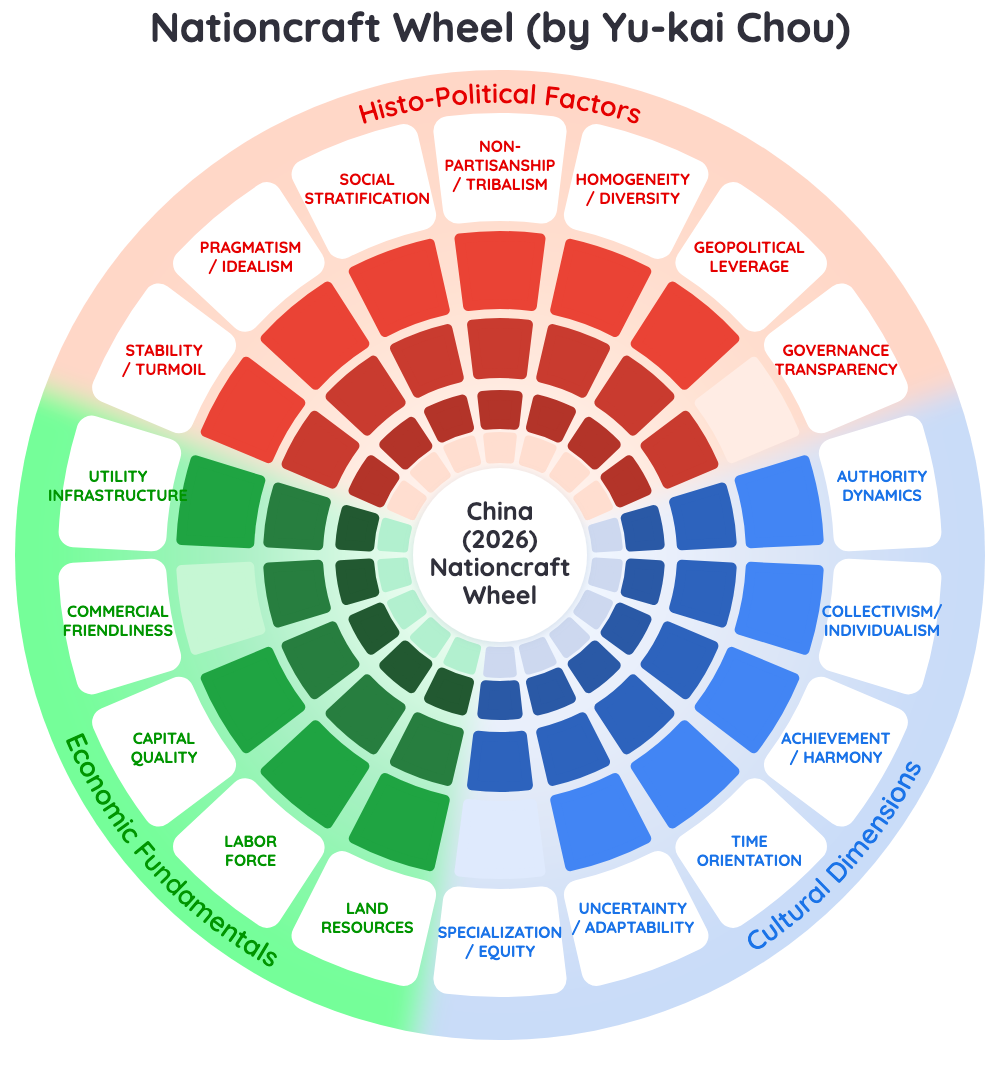
This analysis reads China through the Nationcraft 18-variable lens: what the V-vector actually shows, why the paradox is structural, which six reform playbooks fail against China’s configuration, and which three illuminate it.
⚡ Speed Run Notes
- China holds the strongest command quad in the 147-country Nationcraft corpus (V1=10, V2=10, V4=9, V12=10). It can order supply into existence at any scale. Demand is the one output it cannot decree.
- Household consumption is 39.57% of GDP vs a 63.62% world average. That gap is configuration: hukou-tiered access (V6=5), stratification (V9=8), and a trust deficit (V13=4) make households save defensively.
- The July 30 politburo answered weak demand with supply instruments: faster fiscal deployment, equipment upgrades, trade-in subsidies. The reflex that built China is now the thing blocking its rebalance.
- Six celebrated packets fail China’s 2026 preconditions, including its own SP-003 Deng packet. Surplus labor, empty capital stock, and open export markets are gone; re-running the packet produces deflation.
- The packets that fit attack the demand side: SP-101 New Deal social insurance, SP-109 Sweden’s transparent property workout, SP-113 Denmark’s flexicurity floor. All three demand strength where China scores weakest.
Table of Contents
- Understanding China’s Governance Machine Through Nationcraft
- What Is the Nationcraft Framework?
- Why This China Variables Analysis Matters
- The 18 China Nation Variables
- The Supply Reflex Trap
- Detailed Justifications: Variable by Variable
- Best-Match Historical Packets
- Six Reformer Playbooks China Should Reject
- Three Reformer Playbooks China Should Study
- Governance Strategy Recommendations
- Comparative Context: China Among Its Peers
Author Credibility: Yu-kai Chou

Yu-kai Chou created the Nationcraft Framework, applying behavioral design to the hardest motivational problem there is — getting an entire population to move through structural reform without losing momentum. As of 2026, the framework has informed advisory work with eight governments: Taiwan, the Netherlands, the United Kingdom, Bahrain, South Korea, Singapore, Ukraine, and Kazakhstan. The same 8 Core Drives that have driven design at Microsoft, Porsche, and MrBeast now anchor nation-scale reform sequencing — diagnosing where motivation is broken, which Core Drives to lean into for each phase of reform, and how to sequence the political asks so the public stays bought in.
Published Nationcraft analyses include diagnostic playbooks for Venezuela’s post-Maduro reform window and Thailand’s reset-vs-cycle election dynamics, alongside cabinet-level advisory work on post-conflict recovery, reform-sequencing, and public-policy gamification. Chou also teaches the Octalysis methodology at Harvard, Stanford, Yale, Google, BCG, and IDEO — institutions where the human-systems lens applies whether the system is a product, a company, or a country.
His work has been cited by Harvard, Stanford, MIT, Forbes, Wall Street Journal, Wired, US Department of Energy, NIST, NSF, NCBI, US Department of Education, ClinicalTrials.gov, and Google Scholar — with 3,700+ more academic publications. Explore his books here.

On this topic specifically: I have advised eight governments on reform sequencing, and every one of those engagements eventually circles back to China, either as the model a ministry wants to copy or as the gravity it is trying to escape. Singapore and Taiwan built variants of the same export machine; Kazakhstan and Ukraine felt its demand as a commodity buyer; South Korea competes against its overcapacity. Watching planners on four continents cite the Chinese playbook while Beijing itself struggles to exit it is what convinced me this analysis needed writing.
Understanding China’s Governance Machine Through Nationcraft
China is the most analyzed economy on earth and one of the least understood as a system. Analysts argue about the GDP print or the property numbers while the more useful question sits underneath: what kind of machine produces these outputs, and what can that machine actually do?
The Nationcraft answer starts from configuration. A nation behaves like a designed system: its culture, institutions, and endowments form an 18-variable profile, and policy succeeds or fails based on fit with that profile rather than on how good the policy sounds in a white paper.
The same logic drives the Octalysis Framework at product scale. Motivation is engineered through specific drives, and a mechanic that works brilliantly in one motivational context fails flat in another.
China’s configuration is extreme in a way no other large state matches. It concentrates command capacity at the theoretical maximum while carrying mid-tier economic plumbing and a deep trust deficit, and that combination explains 2026 better than any quarterly data release.
What Is the Nationcraft Framework?
The Nationcraft Framework scores every country on 18 Nation Variables across three clusters: Cultural (V1-V6), Histo-Political (V7-V13), and Economic (V14-V18). The corpus behind it holds 147 country scorecards, 140 historical Success and Failure Packets, and 35 recurring historical patterns.
A Success Packet is a documented reform sequence with its preconditions attached: what the reforming state’s V-profile looked like at the start, what was sequenced first, and what the packet needed to work. Matching packets to profiles is how Nationcraft turns history into an engineering discipline instead of a highlight reel.
The founding case study of this method is the Venezuela reform playbooks analysis, which rejected eight celebrated packets on precondition grounds before finding three that fit. China gets the same treatment below, and the twist is that the most famous packet China must reject is its own.
Why This China Variables Analysis Matters
Three clocks make this the right moment to score China. First, the 15th Five-Year Plan (2026-2030) is in its opening year, and the July 30 politburo readout explicitly framed second-half policy as securing a good start to the period, with the 5th Plenary Session of the 20th Central Committee set for October.5
Second, the growth model is visibly straining in the data: after 2024’s full-year 5.0 percent,10 H1 2026 growth of 4.7 percent masked a Q2 fade to 4.3 percent, property investment fell 18 percent in six months, and retail sales grew just 0.7 percent across the half.6
Third, the spillover is now global policy. A record $1.2 trillion goods surplus in 2025, built on $3.8 trillion of exports, is exactly what a supply machine produces when domestic demand cannot absorb its output, and the tariff walls rising in response (the US effective rate on Chinese goods stood near 23.4 percent in July 2026) are the world pricing that imbalance.7
For reformers elsewhere, the stakes compound: China’s model is the most-copied template in the developing world. Reading where it binds tells a planner in Jakarta or Nairobi which parts were the engine and which parts were the era.
The 18 China Nation Variables
The scores below come from the Nationcraft 147-country corpus, cross-checked this week against Freedom House, Transparency International, World Bank, and the August 2026 data flow. Scale is 1-10. The corpus rule applies: configuration IS strategy, and scores are never averaged into a single index.
| Variable | Score | 2026 evidence |
|---|---|---|
| V1 Authority Dynamics | 10/10 | Party-state with centralized personal authority; no institutional veto on the General Secretary |
| V2 Collectivism vs Individualism | 10/10 | Leninist mass-line machinery on Confucian collectivism; national campaigns still mobilize |
| V3 Achievement vs Harmony | 8/10 | Gaokao culture and 996 norms so intense the state regulates their excesses |
| V4 Time Orientation | 9/10 | Fifteen consecutive five-year plans since 1953; 2035 and 2049 goals codified |
| V5 Uncertainty & Adaptability | 9/10 | Post-Mao pivots, zero-COVID exit, tariff-shock rerouting; property response slower |
| V6 Specialization vs Equity | 5/10 | Hukou two-track access to schools and healthcare; coastal-inland divergence |
| V7 Stability vs Turmoil | 7/10 | Regime-secure; mortgage boycotts and local protests contained |
| V8 Pragmatism vs Idealism | 7/10 | Deng-era pragmatism discounted by ideology re-weighting; doctrine narrows growth paths |
| V9 Social Stratification | 8/10 | Gini near 46-47; property wealth concentration; hukou service gaps |
| V10 Non-Partisanship vs Tribalism | 10/10 | Single-party monopoly; October 2026 plenum centered on Party discipline |
| V11 Homogeneity vs Diversity | 8/10 | Han roughly 91 percent; periphery managed coercively |
| V12 Geopolitical Leverage | 10/10 | UNSC seat, manufacturing near-monopolies, rare-earth chokehold, record surplus |
| V13 Governance Transparency | 4/10 | CPI near 43/100; youth-unemployment series suspended then re-based; opaque local books |
| V14 Land Resources | 8/10 | Continental scale and rare earths; per-capita water and arable stress |
| V15 Labor Force Quality | 8/10 | PISA-top schooling, huge STEM pipeline; workforce shrinking, population declining |
| V16 Capital Quality | 7/10 | Deep pools behind capital controls; property and LGFV stress lock allocation quality |
| V17 Commercial Friendliness | 6/10 | World-class logistics against regulatory unpredictability; 2025 private-economy law as corrective |
| V18 Utility Infrastructure | 7/10 | World-leading HSR, grid, and 5G; scored on household-service conversion and rural gaps |
Two clusters jump out of this table. The command quad of V1=10, V2=10, V4=9, and V12=10 is the strongest in the entire 147-country Nationcraft corpus, matched only partially by Singapore and Vietnam.
Against it sits what I call the household quad: V6=5 equity, V9=8 stratification, V13=4 transparency, V17=6 commercial trust. Demand lives in the second cluster, and the second cluster is where every weak score sits.
The Supply Reflex Trap
Name the paradox precisely: the state that commands supply best is the state least able to command demand, and its own strength keeps it from noticing.
Supply responds to orders. A province told to build high-speed rail builds it; an industry told to scale batteries scales it; the equipment-upgrade and trade-in programs of 2024-2026 are orders routed through manufacturers.
Demand responds to security. A household consumes when it trusts its income stream, its safety net, its property value, and the books of the institutions holding its savings.
Look at the trust ledger from a Chinese household’s seat. The largest store of family wealth is property, where investment fell 18 percent in H1 2026 and developers spent five years defaulting; the statistical system suspended the youth-unemployment series when it embarrassed (the re-based figure stood at 14.9 percent in June); and local governments carry off-books debt that Beijing itself is restructuring through a 12 trillion yuan program.8,9
With V13=4 transparency, none of those ledgers can be independently checked. So households do the rational thing under opacity: they save near a third of income, and consumption stays at 39.57 percent of GDP while the world averages 63.62.11
| What the command quad can order | What it cannot order |
|---|---|
| Factories, rail, grids, entire industries (V1=10, V2=10 mobilization) | Household confidence in income and safety nets (V6=5, V9=8) |
| Decade-scale plans and centenary goals (V4=9) | Trust in the books: local debt, developer balance sheets, statistics (V13=4) |
| Export dominance and supply-chain chokeholds (V12=10) | Foreign willingness to absorb the surplus (tariffs at 23.4 percent effective) |
| Trade-in subsidies routed through manufacturers | Organic consumption growth once the subsidy ends (retail +0.7 percent H1) |
| Discipline campaigns and cadre mobilization (V10=10) | Private-sector risk appetite under regulatory unpredictability (V17=6) |
The trap closes because every instrument that responds to orders is a supply instrument. When growth misses, the system reaches for what works, and what works for the machine deepens the imbalance the machine is trying to cure.
Even the trade-in program, the closest thing to demand policy in the current toolkit, shows the reflex’s fingerprints. The subsidy is administered through manufacturers and retailers, pulls forward replacement purchases of the goods the industrial system needs to move, and expires the moment funding does; June retail’s 1.0 percent rebound after May’s decline tracks subsidy tranches almost mechanically.6
Meanwhile the surplus the machine produces has to go somewhere. What domestic households cannot absorb ships abroad, the $1.2 trillion surplus rises, tariffs rise with it, and factory-gate prices fall at home as producers fight for the remaining demand.
That loop has a name in the pattern library: ET-007, the Middle Income Trap, arriving through overcapacity instead of stagnation. China is rich enough to have exhausted catch-up growth and configured, at V6=5 and V13=4, to suppress the household demand that carries economies past it.
July 30 demonstrated the reflex in real time. A demand-side diagnosis (weak consumption, property distrust, deflationary pressure) received a mostly supply-side prescription: accelerate fiscal deployment, upgrade equipment, subsidize trade-ins.2
Detailed Justifications: Reading the Profile Variable by Variable
Cultural Variables (V1-V6): The Mobilization Layer
V1 Authority Dynamics at 10 is the corpus maximum, and it is scored on deference produced, whether from belief or fear. Orders issued at the center execute at the village.
V2 Collectivism at 10 gives that authority its transmission fluid: family-first Confucian norms fused to Leninist mass-line organization mean national campaigns still move hundreds of millions. V3 Achievement at 8 supplies the fuel, a work and exam culture so intense the state has had to regulate tutoring and overtime rather than encourage them.
V4 Time Orientation at 9 is the quiet superpower: fifteen consecutive five-year plans since 1953, with 2035 and 2049 goals treated as engineering deadlines. Almost no other state can hold a thirty-year horizon through leadership turnover, a theme explored in Japan’s long-horizon trap from the other direction.
V5 Adaptability at 9 reflects the historical record of hard pivots, from Mao to market to zero-COVID exit. The property crisis is the first stress test where the pivot has visibly lagged, which is why my sanity check flags V5 with a one-notch caution rather than a clean pass.
V6 Specialization vs Equity at 5 is the first crack in the motivation engine. Hukou status still routes two children born the same year into different schools, hospitals, and pensions, and a household treated as second-tier saves like one.
The V3-V6 interaction deserves its own sentence, because it explains the involution debate better than any commentary. When achievement pressure at V3=8 meets a tiered opportunity structure at V6=5, effort escalates while perceived payoff stagnates, and the rational response for young workers is the defensive crouch Chinese social media calls lying flat.
A state can suppress the vocabulary, and censors periodically do. Suppressing the underlying V-configuration is a different project entirely.
Histo-Political Variables (V7-V13): The Control Layer
V7 Stability at 7 and V10 Non-Partisanship at 10 describe a regime with no organized rival and no partisan fragmentation channel. The October 2026 plenum agenda, centered on Party discipline, shows the system tightening its own bolts rather than fighting external opposition.5
V8 Pragmatism at 7 carries the most consequential downgrade from the Deng era. The packet that built modern China ran on V8 near 10, truth from facts; the 2026 version filters facts through doctrine first, and “new productive forces” defines which growth counts as acceptable.
V9 Stratification at 8 and V11 Homogeneity at 8 frame the social bargain: a largely Han nation with steep internal tiers. V12 Geopolitical Leverage at 10 is self-evident after a $1.2 trillion surplus year and rare-earth chokeholds that turn export licenses into foreign policy.
V13 Transparency at 4 is the load-bearing weakness of the entire profile. A state that suspends embarrassing statistics is telling its own households what it thinks of their right to the ledger, and households answer with precautionary savings.
Watch how V13 interacts with V1. Maximal authority means decisions can be made instantly, and opacity means the information reaching the decision-maker has already been filtered by every layer with something to hide; the property crisis ran for years partly because local reporting incentives buried its scale.
This is the variable pair where the 2026 system most differs from the Deng-era system that shares its scores on paper. Deng institutionalized internal feedback (field experiments, zone comparisons, retreat-and-retry) that functioned as a substitute for public transparency, and the current configuration has been dismantling those substitutes.
Economic Variables (V14-V18): The Constraint Layer
V14 Land at 8 and V15 Labor at 8 are strong stocks with unfavorable flows: continental resources against per-capita water stress, a PISA-topping workforce that is now shrinking as the population declines.
V16 Capital Quality at 7 measures depth against allocation. The pools are vast and fenced by capital controls, but five years of developer defaults and an 18 percent H1 drop in property investment show where the allocation machinery sends money when orders substitute for prices.
V17 Commercial Friendliness at 6 captures the whiplash economy: world-class logistics and permitting speed for favored sectors, alongside regulatory strikes like 2021’s platform crackdown that erased business models overnight. The 2025 Private Economy Promotion Law is the state’s own admission of the trust gap.
The private sector this variable governs supplies the majority of urban employment, which makes V17 a demand variable wearing a supply costume. An entrepreneur uncertain whether next year’s rules permit this year’s business hires cautiously, and cautious hiring is transmitted straight into household income expectations.
Manufacturing investment falling 1.2 percent in H1 2026 alongside an 18 percent property drop says the caution has generalized.6 When even the sectors Beijing champions invest timidly, the issue has moved past sector policy into the predictability of the operating environment itself.
V18 Utility Infrastructure at 7 will surprise readers expecting a 10, and the physical network deserves one: the high-speed rail map alone is a civilizational artifact. The score prices the household side, where rural service quality and the conversion of infrastructure into consumer surplus lag the concrete.
Best-Match Historical Packets
Nationcraft matches reform packets on preconditions. Below is China’s 2026 scorecard against nine canonical packets, six of which fail on precondition grounds and three of which fit the actual binding constraint.
| Packet | Origin | Precondition test against China 2026 | Verdict |
|---|---|---|---|
| SP-003 Deng Open Reform | China 1978-2000 | Needs surplus rural labor, empty capital stock, open export markets; all three gone | Reject |
| SP-008 Park Industrialization | South Korea 1961-1979 | Needs open US market and catch-up gap; tariffs at 23.4 percent, frontier reached | Reject |
| SP-002 LKY Industrialization | Singapore 1965-1990 | Solves capital scarcity via forced savings; China’s bind is over-saving | Reject |
| SP-011 1991 Liberalization | India 1991-2010 | Runs on a crisis window (RE-001); $1.2T surplus means no forcing crisis | Reject |
| FP-016 Yeltsin Shock Therapy | Russia 1991-1999 | Big-bang liberalization without institutions; V13=4 invites asset-stripping | Reject |
| FP-018 Juche Isolation | North Korea 1953-1994 | Autarky as sovereignty; V12=10 leverage is built on openness | Reject |
| SP-101 New Deal | United States 1933-1939 | Social insurance as demand infrastructure under deflation; strong executive fits V1 | Study |
| SP-109 Swedish Bank Resolution | Sweden 1990-1996 | Transparent loss recognition after a property bust; targets the V13 deficit | Study |
| SP-113 Flexicurity | Denmark 1994-2005 | Security floor converts precaution into consumption; targets V6 | Study |
Six Reformer Playbooks China Should Reject
SP-003: The Deng Xiaoping Open Reform Packet (China, 1978-2000)
The hardest packet for any state to reject is the one with its own name on it. The Deng packet is the most successful economic program ever run, and every precondition it needed has been consumed by its own success.
In 1978 China held hundreds of millions of underemployed rural workers, a capital stock near zero, and a world market wide open to cheap manufactures. The packet converted those conditions into growth through gradualist marketization (pattern ET-005), zone-based experimentation, and export-led accumulation.
In 2026 the surplus labor is urbanized, the capital stock is so saturated that investment in property fell 18 percent in a half-year, and the export channel faces a 23.4 percent effective US tariff. Running the packet’s instruments under these conditions produces overcapacity, deflationary pressure, and inventory dumped abroad at compressed margins.
The Nationcraft reading is blunt: SP-003 did not stop working because China changed its mind. It stopped because packets consume their own preconditions, and the greatest packet consumed its own the fastest.
SP-008: The Park Chung-hee Industrialization Packet (South Korea, 1961-1979)
Park’s Korea is the cleanest expression of the Tiger pattern (ET-003): state-directed credit, monthly export scoreboards, and chaebol scale aimed at an open American market. China already ran its own version at ten times the size.
The precondition that no longer exists is the absorber. Export-led industrialization requires someone to absorb the exports, and the 2026 trade environment prices Chinese goods with stacked tariffs precisely because the absorption capacity of foreign demand has a political limit that was reached.
There is also a frontier problem. Catch-up industrialization has a defined target to copy; China now sits at the frontier in EVs, batteries, and solar, where the next yuan of state-directed capacity has no proven blueprint to chase and lands as global oversupply.
The deeper Korea lesson for Beijing sits later in the timeline anyway, in the 1998 restructuring that forced transparent losses onto the chaebol system. I traced the political version of that reckoning in South Korea’s post-martial trap.
SP-002: The Lee Kuan Yew Industrialization Packet (Singapore, 1965-1990)
The LKY packet solved capital scarcity: the Central Provident Fund forced savings out of households to fund housing and industry without foreign debt. It fit a city-state with V8=9 pragmatism and an existential crisis mandate.
China’s 2026 problem is the mirror image. Households already save near a third of income; the state’s challenge is releasing that precaution into consumption, and a forced-savings instrument points exactly backward.
Singapore’s real 2026 relevance is as a stress test of state-led models under demographic and geopolitical pressure, which is why Singapore’s LKY packet stress test reads as a companion piece to this one. Even the packet’s home country is renegotiating its terms.
SP-011: The 1991 Liberalization Packet (India)
India’s 1991 opening is the canonical crisis-window packet (RE-001): a balance-of-payments emergency gave technocrats three months of political cover to dismantle the License Raj.
China has no forcing crisis and will not get one on the external account. A $1.2 trillion surplus and controlled capital flows mean the classic liberalization trigger, reserves running out, is structurally unavailable.
That is a curse dressed as a blessing. Without a crisis window, every liberalizing move must be executed against the standing interests that profit from the current configuration, which is why announced reforms drift. The domestic politics of that drift have their own analysis in India’s mandate trap.
FP-016: The Yeltsin Shock Therapy Packet (Russia, 1991-1999)
The one packet every Chinese economist can recite as a cautionary tale earns its place in the canon as a Failure Packet. Big-bang price liberalization and voucher privatization, executed before institutions existed to referee them, transferred state assets to insiders and produced a decade of contraction.
The precondition lesson (institutions first, liberalization second) reads directly onto China’s V13=4. Rapid marketization of land, capital accounts, or SOE equity under an opaque ledger would hand the windfall to exactly the connected class currently being purged.
The instructive contrast is Poland, where SP-005 shock therapy worked against a different V-profile with functioning accountability channels, a divergence I unpacked in Poland’s liberum veto trap. Same instrument, different configuration, opposite outcome: that asymmetry is the entire Nationcraft thesis.
FP-018: The Juche Total Isolation Packet (North Korea, 1953-1994)
No one in Beijing proposes Juche. The packet earns its slot because its logic, self-reliance as sovereignty, echoes inside “dual circulation” and the technology-independence drive, and the packet shows where that logic terminates.
Kim Il-sung’s system scored maximum control and near-zero adaptive capacity; when Soviet subsidies vanished in 1991, there was no market signal left to respond. The variable interaction to fear is high V1 control smothering the feedback that V5 adaptability needs.
China’s V12=10 leverage exists because the world depends on Chinese supply, and dependence requires engagement. Every step toward autarky trades away the exact variable that makes Beijing powerful, a doctrine-over-adaptation failure whose Caribbean expression I documented in Cuba’s doctrine trap.
Three Reformer Playbooks China Should Study
SP-101: Roosevelt’s New Deal (United States, 1933-1939)
Strip the ideology and the New Deal is a state building demand infrastructure during a deflationary spiral: deposit insurance to stop bank runs, Social Security to convert old-age fear into spending confidence, and public employment to put a floor under incomes.
The packet’s variable profile maps onto China unexpectedly well. It ran on maximal executive authority and public receptiveness compensating for hostile courts and business, and China’s V1=10 with V2=10 gives Beijing more executive room than Roosevelt ever held.
The adaptation is not copying agencies; it is recognizing that social insurance IS demand policy. Every yuan of credible pension, healthcare, and unemployment coverage is a yuan a household no longer needs to hoard, and unlike a trade-in subsidy the effect compounds instead of expiring.
The New Deal also carries a warning label China should read: institutional experimentation needs judicial and provincial buy-in to stick, a coordination problem I scored from the American side in the United States nation-variable analysis.
SP-109: Sweden’s Banking Crisis Resolution (Sweden, 1990-1996)
Sweden in 1991 is the closest structural rhyme to China’s property problem in the entire corpus: a deregulation-fueled property bubble burst onto bank balance sheets and threatened the national credit system.
The packet’s core move was radical transparency. Shareholders were wiped, depositors protected, bad assets moved into openly-audited bad banks, and the political parties signed a joint guarantee that made the numbers believable; recovery followed within five years, and the template became the global standard cited through 2008.
The precondition gap is exactly China’s weak spot: Sweden ran the workout on V13=9 transparency and cross-party trust, China would have to run it on V13=4. That is the adaptation challenge rather than a reason to skip the packet, because the alternative (extend-and-pretend on developer and LGFV books) is the one strategy guaranteed to keep household trust suppressed.
A Chinese-charactered version exists in embryo: the 12 trillion yuan local-debt swap acknowledges the hole. The Swedish lesson is that acknowledgment only rebuilds demand when the loss allocation is published and final, so households and banks can stop pricing hidden risk.9
SP-113: Denmark’s Flexicurity Packet (Denmark, 1994-2005)
Denmark’s flexicurity triangle (easy hiring and firing, generous unemployment support, mandatory re-activation) cut unemployment from 12 to under 5 percent while keeping labor mobile. The packet’s discovery is that flexibility and security are complements: workers accept churn when the floor is real.
Translate the triangle to China and it names the hukou problem. China has world-class labor flexibility and a security floor that stops at the city registration line; hundreds of millions of migrant workers live where their benefits are not.
Portability is the reform: pensions, schooling, and healthcare that follow the worker rather than the registration. Every notch of V6 equity gained converts precautionary savings into demand, which is the entire rebalancing problem restated as one administrative fix.
Flexicurity also fits China’s governing style better than Anglo liberalization ever will. It is a designed system with explicit rules and measurable coverage targets, the kind of engineering the five-year-plan apparatus (V4=9) is built to execute.
Governance Strategy Recommendations
Sequencing is where Nationcraft earns its keep: the order of moves decides whether each move is politically survivable. The sequence below runs demand-side reform in the order the V-vector can bear it.
| Phase | Move | Variables engaged | Packet source |
|---|---|---|---|
| 1 (2026-27) | National benefit portability: pensions, healthcare, schooling follow the worker | V6 equity, V9 stratification | SP-113 |
| 2 (2026-28) | Property and LGFV workout with published, final loss allocation | V16 capital, V13 transparency | SP-109 |
| 3 (2027-29) | Centrally-funded social insurance floor, financed by SOE dividends | V2 collectivism, V4 horizon | SP-101 |
| 4 (2027-30) | Household income share written into plan scorecards cadres are graded on | V4 horizon, V10 discipline | Corpus synthesis |
| 5 (continuous) | Regulatory predictability: sunset clauses and notice periods for private-sector rules | V17 commerce | 2025 law follow-through |
The sequence redirects the command quad at demand-side targets, because a system this centralized will only run reforms that can be expressed as orders to itself.
The behavioral layer beneath the table is Octalysis. Household hoarding is Core Drive 8 (CD8): Loss & Avoidance doing its job under opacity, and no subsidy out-motivates fear; the sequence works by replacing avoidance triggers with Core Drive 4 (CD4): Ownership & Possession, the felt security of benefits a family actually owns wherever it lives. That mapping comes straight from Octalysis applied to nation-building and public policy.
For foreign firms and investors, the same table is a forecast: expect supply-side stimulus to keep arriving on schedule, expect consumption to respond only where a phase-1 or phase-2 style move actually lands, and price policy risk by watching V17 predictability rather than headline GDP.
What This Means Practically for China Reform
For Beijing’s own planners, the practical test of the next four years is a single ratio: household income share of GDP, and whether it climbs inside the 15th Five-Year Plan scorecards the way investment targets always have. Everything else in the politburo vocabulary, from high-quality development to new drivers, either moves that ratio or restates the reflex.
For provincial cadres, the operational shift is from counting what gets built to counting what gets covered. A province that enrolls migrant families into portable benefits is doing more for national demand than a province that pours another expressway, and the grading system will decide which one gets promoted.
For multinationals and investors, the Supply Reflex Trap is a screening tool. Supply-side stimulus will keep arriving on schedule, so China-facing industrial plays retain their policy tailwind; consumption plays should be priced against phase-1 and phase-2 delivery from the sequencing table, because consumption follows household security rather than announcements.
For reformers in third countries studying the Chinese model, the export lesson is about eras. The packet’s engine was real, and the era that let a state ride supply-led growth for forty years without building household demand institutions has closed; any country importing the model in 2026 imports the trap along with the machine.
Comparative Context: China Among Its Peers
Configuration reads best in contrast. Vietnam runs a near-identical command quad at one-tenth the scale, and its Resolution 19 growth decree collides with the same wall of uncommandable variables, a collision I scored last week in Vietnam’s double-digit decree.
Japan is the cautionary future: a supply powerhouse that let a property bust calcify into three decades of demand deficit because loss recognition arrived a decade late. Taiwan shows a third path, where export dependence became geopolitical shield rather than vulnerability, examined in Taiwan’s Silicon Shield paradox.
Two more contrasts sharpen the edges. Turkey demonstrates what happens when V1 authority overrides economic feedback entirely, priced by markets as Turkey’s strongman discount; Egypt shows a state-investment economy without China’s execution capacity, a diagnosis this series filed under the garrison economy.
And Ukraine sits at the far pole of the stability axis: a state whose V7 and V16 were shattered by invasion yet whose civic trust variables moved opposite to China’s, documented in the Ukraine wartime variable analysis in this same series. Configuration, again, is destiny only until it is redesigned.
The Nationcraft Framework in Practice
Every analysis in this series runs the same discipline: score the 18 variables from evidence, name the paradox the configuration produces, then test historical packets against preconditions instead of prestige. The method is the product; China is this week’s input.
The full set of country diagnostics lives in the Nationcraft country analyses library, from Venezuela’s eight-rejected-three-fit origin case to the command-economy family this analysis extends.
If the method itself interests you more than any single country, start with the Nationcraft Framework hub and the Octalysis bridge piece linked above, then read three country analyses back to back. The pattern recognition compounds fast.
Closing
China spent forty years proving a state can command supply into existence, and the next decade will test whether it can do something harder: make 1.4 billion households feel safe enough to spend.
The Supply Reflex Trap diagnoses an instrument mismatch. Instruments can be changed; the three study packets above are existence proofs that demand infrastructure can be engineered.
The reflex, and only the reflex, is the obstacle.
Frequently Asked Questions
What is the Supply Reflex Trap in China?
It is the structural bind where China’s command quad (V1=10 authority, V2=10 collectivism, V4=9 time orientation, V12=10 leverage) can order supply into existence at any scale, while demand depends on variables no order reaches: household equity at V6=5, transparency at V13=4, commercial trust at V17=6. Weak demand therefore keeps receiving supply-side answers, because supply instruments are the ones that respond to orders.
How does the Nationcraft Framework score China in 2026?
The profile pairs the corpus-maximum command quad with mid-tier economic plumbing: V16=7 capital under property stress, V17=6 commerce, V18=7 infrastructure conversion, and V13=4 transparency as the load-bearing deficit. Consumption at 39.57 percent of GDP against the 63.62 percent world average is that configuration’s output.
Why can’t China simply re-run the Deng playbook?
SP-003’s preconditions are consumed: the surplus rural labor is absorbed, the capital stock is saturated (property investment fell 18 percent in H1 2026), and the open export market is tariffed near 23.4 percent effective. Re-running investment-and-export instruments under those conditions produces deflationary overcapacity, which is the condition China is already in.
What did the July 30, 2026 politburo meeting actually decide?
Incremental, targeted support rather than large stimulus: faster fiscal deployment, flexible monetary policy, equipment upgrades and consumer trade-ins, property stabilization, and continued local-debt resolution, plus an October plenum focused on Party discipline. In Nationcraft terms, a demand-side diagnosis met a mostly supply-side prescription.
Which historical packets fit China’s 2026 problem?
Three demand-side packets: SP-101 (New Deal social insurance as demand infrastructure), SP-109 (Sweden’s transparent property-bust workout), and SP-113 (Denmark’s flexicurity floor). Each targets a variable China scores lowest, which is exactly why they fit and why they are hard.
Does the Supply Reflex Trap mean China’s growth model has failed?
No. It means the model’s instruments no longer match the binding constraint. The same command quad that built the supply machine can build demand infrastructure (portable benefits, credible workouts, social insurance) if the reflex to reach for producer-side tools is consciously overridden.
Explore More Nationcraft Analyses
The library holds every country diagnostic in this series, each with its 18-variable scorecard and named paradox. Recent additions to the command-economy family include Vietnam, Cuba, and Egypt, all linked above; the full index grows several times a week.
Related Reading
- The Nationcraft Framework: 18 Nation Variables, 8 Goals, and the Packet Method
- Nationcraft Country Analyses Library
- Nationcraft Analysis: Vietnam Double-Digit Decree 2026
- Nationcraft Analysis: Japan Long-Horizon Trap 2026
- Nationcraft Analysis: Singapore LKY Packet Stress Test 2026
- Nationcraft Analysis: South Korea Post-Martial Trap 2026
Footnotes
- National Bureau of Statistics via State Council: China’s GDP expands 4.7 percent in H1 2026 (Q1 5.0 percent, Q2 4.3 percent). english.www.gov.cn, July 15, 2026.
- Caixin Global: China’s politburo pledges incremental policy support, targeted stimulus, and counter-cyclical adjustment. Caixin, July 30, 2026; full readout: Xinhua, July 30, 2026.
- World Bank data series, household consumption as percent of GDP: China 39.57 percent (2023) vs 63.62 percent world average. TheGlobalEconomy.com.
- CNN Business: China ends 2025 with a record $1.2 trillion trade surplus on $3.8 trillion of exports, up 5.5 percent. CNN, January 13, 2026.
- Pekingnology: Reading the July politburo meeting, including the October 5th Plenary Session centered on Party discipline. Pekingnology, July 30, 2026.
- CNBC: China posts slowest quarterly growth since 2022; property investment down 18 percent H1, fixed-asset investment down 5.7 percent, retail sales up 0.7 percent H1 (June +1.0 percent after May’s first decline in over three years). CNBC, July 15, 2026.
- Penn Wharton Budget Model: effective US tariff rates by partner, China at 23.4 percent. PWBM, updated July 13, 2026.
- Caixin Global: China’s youth jobless rate (16-24, ex-students) fell to 14.9 percent in June 2026, still above June 2025’s 14.5 percent. Caixin, July 21, 2026. On the statistical suspension and re-basing of this series in 2023, see the same report’s series history.
- Atlantic Council on the 12 trillion yuan local-debt restructuring program: Beijing extends and pretends; Caixin on shrinking hidden LGFV debts and the new challenge: Caixin, May 29, 2026.
- National Bureau of Statistics: 2024 GDP growth 5.0 percent. NBS, February 28, 2025.
- Rhodium Group on the structural causes of weak household consumption: No Quick Fixes: China’s Long-Term Consumption Growth.