

On October 1, 2026, New Zealand’s Parliament dissolved on schedule, without drama, exactly as the constitutional calendar said it would. That sentence could not be written about most of the 90 countries in the Nationcraft corpus, and it is the most deceptive sentence in this analysis.
Because five weeks from now, on November 7, one of the best-governed countries on Earth will do what it does every 36 months: put its entire policy architecture back on the table. The latest 1News-Verian poll has National and Labour locked at 28 percent each, the Greens at a record 16 percent, and the seat math favoring a change of government.
Whoever wins inherits a country that tops transparency rankings, clears every ease-of-doing-business benchmark, and still cannot solve the three problems it has been diagnosing for twenty years: flat productivity, unaffordable housing, and a steady outflow of its own citizens across the Tasman.
The Nationcraft Framework reads this configuration as a specific, nameable failure mode. New Zealand does not have a governance quality problem. It has a governance horizon problem, and the two are so different that the standard reform advice makes things worse.
This analysis names that failure mode the Three-Year Horizon Trap, shows which of the 18 Nation Variables produce it, and tests ten historical reform playbooks against New Zealand’s actual configuration. Seven fail. Three fit. The difference is never policy quality. It is context fit.
⚡ Speed Run Notes
- New Zealand scores V7=9 stability and V13=8 transparency, elite numbers, yet V4=3 time orientation means every reform is relitigated inside a 3-year electoral cycle. The machine is clean; the horizon is short.
- The Three-Year Horizon Trap: world-class institutions re-decide their destination every 36 months, so twenty-year problems (productivity, housing, emigration) never get twenty-year answers.
- New Zealand already ran the boldest liberalization in OECD history (SP-108, Rogernomics 1984-93). The unfinished business isn’t more speed. It’s durability.
- Seven famous playbooks fail NZ’s V-vector, including Singapore’s LKY packet, Thatcherism, and the Celtic Tiger. The misfit is structural: wrong V1, wrong V12, or a horizon NZ doesn’t have.
- The three that fit — Australia’s Accord, Canada’s Program Review, the Dutch Wassenaar pact — all solved the same problem: making reform survive the election after next.
Table of Contents
- Understanding New Zealand’s Governance Landscape Through Nationcraft
- What Is the Nationcraft Framework?
- Why This New Zealand Variables Analysis Matters
- What New Zealand Actually Looks Like in Numbers
- The Three-Year Horizon Trap
- Detailed Justifications: The 18 New Zealand Nation Variables
- Best-Match Historical Packets
- Governance Strategy Recommendations
- Strategic Implications
- What This Means Practically for New Zealand Reform
- Frequently Asked Questions
About Yu-kai Chou

Yu-kai Chou is a Human-Systems Architect & Behavioral Designer and the creator of the Nationcraft Framework — an 18-variable diagnostic for matching a country’s structural profile to the reform packets that have historically worked under similar conditions. He has consulted for governments in eight nations, including Ukraine, the United Kingdom, the Kingdom of Bahrain, Singapore, Taiwan, the Netherlands, Kazakhstan, and South Korea, and has worked directly with President Zelenskyy’s team on post-war reconstruction priorities for Ukraine.
Chou’s prior framework — the Octalysis Framework — has been applied by LEGO, Microsoft, Porsche, Coca-Cola, Salesforce, and MrBeast, impacting over 1.5 Billion Users. He has taught the methodology at Harvard, Stanford, Yale, Tesla, Google, BCG, and IDEO.
His work has been cited by Harvard, Stanford, MIT, Forbes, Wall Street Journal, Wired, US Department of Energy, NIST, NSF, NCBI, US Department of Education, ClinicalTrials.gov, and Google Scholar — with 3,700+ more academic publications. Explore his books here.

This New Zealand analysis applies the Nationcraft Framework to the rare case of a nation whose institutions need no repair: Chou’s advisory work across eight governments, including Westminster-system cabinets in the United Kingdom and coalition systems in the Netherlands, has repeatedly surfaced the same lesson this profile makes explicit, that reform durability is a design problem separate from reform quality, and New Zealand is the cleanest natural experiment in the world for separating the two.
Understanding New Zealand’s Governance Landscape Through Nationcraft
Start with what makes New Zealand strange inside the Nationcraft corpus. Most countries analyzed in this series are trapped by broken institutions: a captured judiciary, a politicized military, a patronage bureaucracy.
New Zealand has none of these. It sits in the top tier of Transparency International’s Corruption Perceptions Index year after year. Its elections are administered without controversy. Power transfers peacefully, routinely, and fast.
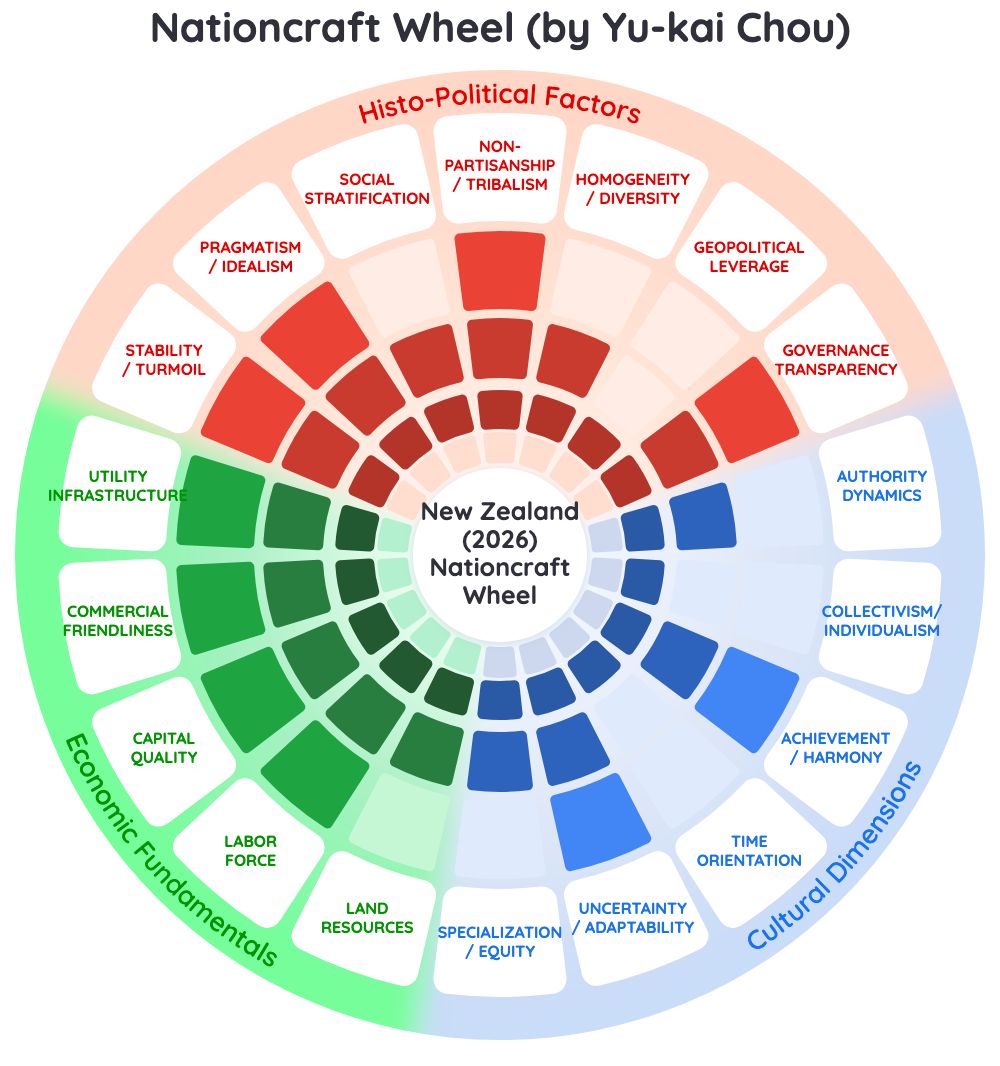
Under the Nationcraft lens, that shows up as a V-vector other nations would trade half their GDP for: V7=9 (Stability vs Turmoil), V13=8 (Governance Transparency), V17=8 (Commercial Friendliness), V16=8 (Capital Quality), V8=8 (Pragmatism).
And yet the outcomes do not match the inputs. GDP grew just 0.2 percent in the June 2026 quarter and 1.7 percent for the year.[4] Unemployment sat at 5.3 percent in the March quarter.[5] Productivity growth has trailed the OECD frontier for decades. Young New Zealanders keep leaving for Australia, a one-way talent subsidy to a richer neighbor.
When a country with elite governance scores produces mediocre economic outcomes, Nationcraft doesn’t look at the institutions. It looks at the variables the institutions run on. In New Zealand’s case, two low scores do almost all the explanatory work: V4=3 (Time Orientation) and V12=3 (Geopolitical Leverage).
What Is the Nationcraft Framework?
The Nationcraft Framework is an 18-variable diagnostic for matching a country’s structural profile to the reform strategies that have historically worked under similar conditions. The variables split into three clusters: Cultural (V1-V6), Histo-Political (V7-V13), and Economic (V14-V18).
The core thesis: policy effectiveness is decided by context fit, not policy quality. A reform that transformed one nation can wreck another, because the receiving configuration differs on the variables the reform silently assumes.
Nationcraft encodes those assumptions explicitly. Each historical Success Packet in the corpus carries the V-vector of the country that ran it, at the moment it ran it. Diagnosis means scoring today’s nation on the same 18 variables and checking the overlap, the same configuration-first logic explored in the Octalysis-to-Nationcraft bridge that first connected behavioral design to public policy.
Configuration is strategy. The scores are never averaged into a single index, because the interactions between variables, not the levels, decide what works.
Why This New Zealand Variables Analysis Matters
Three reasons this profile earns a place in the Nationcraft library now.
First, timing. Parliament dissolved on October 1 and New Zealand votes on November 7, 2026.[1] The polls describe a dead heat with record minor-party strength,[3] which means coalition negotiation will decide the program. Every finding below is about to be stress-tested live.
Second, New Zealand is the corpus’s cleanest control case. If you believe national underperformance is always an institutions problem, New Zealand is your falsification test. The institutions are excellent. The underperformance persists. Something else is binding.
Third, the country’s own reform history is in the corpus as a Success Packet. SP-108, the Rogernomics Radical Liberalization Packet (1984-93), is the most radical peacetime economic restructuring any OECD democracy has run. New Zealand is the rare nation that gets to be both patient and precedent in the same analysis.
What New Zealand Actually Looks Like in Numbers
The 18 New Zealand Nation Variables below come from the Nationcraft corpus, sanity-checked October 2026 against Stats NZ releases, Elections NZ records, and current polling. Scores run 1-9.
| Variable | Score | 2026 Reading |
|---|---|---|
| V1 Authority Dynamics | 4 | Egalitarian MMP democracy; coalition cabinets since 1996; no strongman lane exists |
| V2 Collectivism vs Individualism | 2 | Strongly individualist settler society with a welfare-state residue |
| V3 Achievement vs Harmony | 7 | Competitive farming and business culture; “number-8 wire” improvisation pride |
| V4 Time Orientation | 3 | Three-year parliamentary term; policy horizon resets every cycle |
| V5 Uncertainty Adaptability | 7 | Small isolated economy accustomed to reinvention; 1984 is the proof point |
| V6 Specialization vs Equity | 6 | Deep agritech specialization against an egalitarian wage tradition |
| V7 Stability vs Turmoil | 9 | No coups, no constitutional crises; dissolution on schedule, October 1, 2026 |
| V8 Pragmatism vs Idealism | 8 | Accepted the OECD’s harshest reform program when the logic was clear |
| V9 Social Stratification | 4 | Egalitarian norms; persistent Māori-Pākehā gaps are the main fault line |
| V10 Non-Partisanship vs Tribalism | 8 | Consensual MMP politics; 2026 fragmentation strains it without breaking it |
| V11 Homogeneity vs Diversity | 6 | Bicultural foundation plus high-migration diversity |
| V12 Geopolitical Leverage | 3 | Small, remote, trade-taking; prices set elsewhere |
| V13 Governance Transparency | 8 | Perennial top tier of global transparency rankings[7] |
| V14 Land Resources | 6 | Pastoral land and hydro; no hydrocarbon rents at scale |
| V15 Labor Force Quality | 7 | Educated anglophone workforce; the problem is keeping it onshore |
| V16 Capital Quality | 8 | Sound (Australian-owned) banks; shallow domestic capital markets |
| V17 Commercial Friendliness | 8 | Top-tier ease of starting and running a business |
| V18 Utility Infrastructure | 8 | Reliable by global standards; the live debate is the renewal deficit |
Now place the macro picture beside the V-vector, because the mismatch is the whole story.
| Indicator | Latest reading | Source period |
|---|---|---|
| GDP growth (quarterly) | +0.2% | June 2026 quarter, Stats NZ[4] |
| GDP growth (annual) | +1.7% | Year to June 2026, Stats NZ[4] |
| CPI inflation (annual) | 3.1% | March 2026 quarter, Stats NZ[5] |
| Unemployment | 5.3% | March 2026 quarter, Stats NZ[5] |
| Current account deficit | 3.6% of GDP | Year to March 2026, Stats NZ[5] |
| Election polling | National 28%, Labour 28%, Greens 16% | 1News-Verian, Sep 23-27, 2026[2] |
A country with V13=8 transparency and V17=8 commercial friendliness should not be growing at 1.7 percent with a structural current account deficit. Unless something upstream of the institutions is capping the return on them.
The Three-Year Horizon Trap
Here is the named paradox, in Nationcraft terms.
New Zealand combines near-perfect reform machinery with a structurally short reform horizon. V7=9 and V13=8 mean any government can execute: the bureaucracy is clean, the courts are trusted, the legislature is unicameral and fast. V1=4 and V10=8 mean execution happens by consent, not decree.
But V4=3 means the consent expires every three years, on one of the shortest electoral terms in the developed world, in a unicameral system with no upper house to slow a successor’s repeal. What one government builds in year one, the next can unwind in year one.
So New Zealand’s twenty-year problems never receive twenty-year answers. Housing policy flips with each coalition. Infrastructure pipelines are announced, cancelled, re-announced. Retirement pre-funding gets paused when cycles tighten. Water reform is legislated, repealed, redesigned. Each reversal is individually rational and procedurally immaculate. V13=8 guarantees the repeal is as transparent as the reform.
That is the Three-Year Horizon Trap: the cleaner the machine, the cheaper the U-turn. Countries with messy institutions get policy stability by accident, because change is too hard. New Zealand’s frictionless system makes reversal nearly free, so only policies with cross-party consensus survive, and the hard reforms, the V15 retention problem, the V18 renewal deficit, the productivity gap, are precisely the ones without it.
The 2026 election is the trap in real time. A dead-heat poll with the Greens at a record 16 percent[2] means the next policy program will be assembled in coalition talks among parties with incompatible twenty-year visions, and guaranteed only until November 2029.
Detailed Justifications: The 18 New Zealand Nation Variables
Cultural cluster (V1-V6): individualists who can mobilize
V1=4 (Authority Dynamics) reflects a political culture allergic to concentrated power. New Zealand abolished its upper house in 1951 but then adopted MMP in 1996 precisely to prevent single-party dominance. No reformer gets a Deng-style or LKY-style authority runway here, and any playbook assuming one is disqualified on contact.
V2=2 (Collectivism) is among the lowest in the corpus. This is a society of individual householders, not of encompassing unions or clan networks. It matters because several of the most successful small-state packets, Denmark’s flexicurity above all, run on collective institutions New Zealand dismantled decades ago.
V3=7 (Achievement) and V5=7 (Adaptability) are the country’s quiet strengths. The same culture that produced the world’s most efficient unsubsidized farmers after 1984 still exists. V8=8 (Pragmatism) is the standout: the SP-108 record shows New Zealanders will absorb painful change when the logic is argued honestly.
V4=3 (Time Orientation) is the trap variable, and it is institutional as much as cultural. The three-year term compresses every government into a one-year learning phase, a one-year delivery phase, and a one-year campaign. Two referendums (1967, 1990) proposed extending the term; voters refused both times. The short horizon is chosen, repeatedly.
V6=6 (Specialization vs Equity) captures a dairy-and-agritech export machine sitting inside an egalitarian wage culture that distrusts winner-take-most outcomes.
Histo-political cluster (V7-V13): the cleanest machine in the corpus
V7=9 (Stability) needs little argument. The October 1 dissolution proceeded on statutory schedule;[1] the only suspense in New Zealand politics is arithmetic, never legitimacy.
V13=8 (Transparency) reflects a perennial top-tier position on global corruption rankings[7] plus an Official Information Act regime that makes policy reversals as public as policies.
V10=8 (Non-Partisanship) survives the 2026 fragmentation so far: the contest is sharp but the losers concede, and coalition practice under MMP has normalized compromise. The strain is real, though. A 28-28-16 poll[2] with seat projections of 59 for the governing bloc against 65 for the opposition bloc[2] pushes more of the policy program into post-election bargaining than at any election since 1996.
V9=4 (Stratification) records the main social fault line: aggregate egalitarianism with persistent Māori disadvantage, a gap SP-108’s own ledger records widening during the 1984-93 restructuring (Gini 0.27 to 0.34).
V12=3 (Geopolitical Leverage) is the other binding constraint. New Zealand is a price-taker in everything: commodity markets, shipping routes, capital costs, and the strategic competition between its largest trading partner and its traditional security partners. V12=3 means no playbook that relies on geopolitical rents, gateway position, or great-power patronage transfers here.
V11=6 (Homogeneity) reflects a bicultural constitutional foundation layered with one of the OECD’s highest foreign-born population shares.
Economic cluster (V14-V18): strong scores, shallow depths
V14=6 (Land Resources): world-class pastoral land and renewable hydro, but no hydrocarbon rents, so no sovereign-wealth shortcut. V15=7 (Labor Quality) is high and leaking: the educated anglophone workforce is the most internationally mobile in the OECD, and Australia pays more for it.
V16=8 (Capital Quality) deserves its caveat: the banking system is sound but Australian-owned, and domestic capital markets are shallow, so New Zealand savings fund Australian balance sheets while New Zealand firms starve for growth capital. V17=8 (Commercial Friendliness) remains a genuine asset. V18=8 (Utility Infrastructure) is accurate against a global baseline while understating the renewal deficit that dominates domestic debate.
Count the interactions and the paradox tightens: 11 of 18 variables score 6 or higher. The configuration fails at exactly two points, V4=3 and V12=3, and those two points are sufficient to cap everything else.
Best-Match Historical Packets
The Nationcraft corpus holds 139 Success Packets: documented reform programs with their preconditions, sequencing, outcomes, and the V-vector of the country that ran them. Testing New Zealand’s 2026 configuration against the obvious candidates produces a clear split.
| Packet | Country, years | Verdict for New Zealand | Deciding variables |
|---|---|---|---|
| SP-002 LKY Industrialization | Singapore, 1965-90 | Reject | V1 7 vs 4; no existential mandate |
| SP-003 Deng Open Reform | China, 1978-2000 | Reject | V1 10 vs 4; scale absent |
| SP-102 Thatcher Revolution | UK, 1979-90 | Reject | Already ran harder version (SP-108) |
| SP-016 Celtic Tiger | Ireland, 1987-2007 | Reject | V12 3; EU market access absent; tax lane closed |
| SP-021 Laissez-Faire Development | Hong Kong, 1950-97 | Reject | Gateway geography absent; V12 3 |
| SP-113 Flexicurity | Denmark, 1994-2005 | Reject | V2 7 vs 2; collective machinery dismantled |
| SP-106 Oil Fund Sovereign Wealth | Norway, 1990-2010 | Reject | V4 9 vs 3; no resource rent to sterilize |
| SP-107 Hawke-Keating Open Economy | Australia, 1983-96 | Study | V1 5, V8 8, Accord survived 5 elections |
| SP-111 Chrétien-Martin Deficit Elimination | Canada, 1993-98 | Study | V13 9, V7 9; credibility compounding |
| SP-112 Wassenaar Consensus Labor | Netherlands, 1982-95 | Study | V10 8; pact outlived governments |
Seven reformer playbooks New Zealand reform should reject
1. SP-002: The Lee Kuan Yew Industrialization Packet (Singapore, 1965-1990)
The most requested playbook in the corpus, and the worst fit for this configuration. The LKY packet ran on V1=7 authority, V7=3 existential turmoil, and a mandate forged by expulsion from Malaysia. Its own ledger warns that the approach “may cause backlash in V1≤5 nations,” and New Zealand sits at V1=4 with V7=9.
No existential crisis means no authority runway: the Economic Development Board model of a single empowered agency overriding local veto points is exactly the institutional shape New Zealand’s egalitarian politics exists to prevent. Where Singapore compounded one plan for 25 years, as examined in Singapore’s LKY packet stress test, New Zealand would relitigate the plan eight times in the same span. The packet assumes the one variable New Zealand structurally lacks: a long, protected horizon.
2. SP-003: The Deng Xiaoping Open Reform Packet (China, 1978-2000)
Deng’s gradualism gets cited to New Zealand reformers as the patient alternative to 1984-style shock. The citation misreads the precondition. The packet’s zone-based experimentation worked because V1=10 authority let the center protect experiments from political reversal for decades. Shenzhen was never one election from repeal.
New Zealand’s V1=4 offers no such protection. A special economic zone, a charter-city experiment, a regulatory sandbox: each would face judicial review, media scrutiny (V13=8 cuts both ways), and a repeal vote within 36 months. Gradualism without authority is just slowness, and slowness inside a three-year horizon means nothing finishes. The variables, not the ambition, disqualify it.
3. SP-102: The Thatcher Neoliberal Revolution Packet (UK, 1979-1990)
New Zealand cannot run the Thatcher packet for the simplest reason in the corpus: it already ran a more extreme version, faster, without the Falklands, and the receipts are in SP-108. Rogernomics floated the currency, eliminated agricultural subsidies entirely (unique in the OECD), cut tariffs from 28 percent to under 5, and made the Reserve Bank independent, all inside nine years.
The residue defines today’s politics. Inequality jumped (Gini 0.27 to 0.34), Māori communities carried disproportionate cost, and the political system responded by adopting MMP in 1996, deliberately installing the coalition brakes that make any second blitzkrieg impossible. Prescribing more liberalization speed to the country that invented liberalization speed mistakes the diagnosis: New Zealand’s binding constraint is no longer what it can change, but what it can keep.
4. SP-016: The Celtic Tiger Packet (Ireland, 1987-2007)
Ireland is the seductive comparison: small, anglophone, emigration-scarred, then suddenly rich. But the packet’s engine was a 12.5 percent corporate tax rate attached to barrier-free access to the EU single market, with €9.5 billion of structural funds paying for the runway. Every element fails against New Zealand’s V12=3.
There is no 450-million-consumer market three hours away; there is the Tasman Sea and then the Pacific. The OECD global minimum tax has closed the headline-rate arbitrage Ireland rode for two decades. And Ireland’s V11=9 homogeneity underwrote a social-partnership consensus (the Tallaght Strategy) that New Zealand’s more fragmented 2026 party system cannot replicate on demand. What transfers from Ireland is one sentence, not a playbook: education plus openness compounds only when the market you open onto is large. New Zealand’s isn’t.
5. SP-021: The Laissez-Faire Development Packet (Hong Kong, 1950-1997)
ACT-aligned reformers periodically invoke Cowperthwaite’s Hong Kong: low flat taxes, positive non-interventionism, free trade. The packet’s own preconditions refute the transfer. Hong Kong ran on gateway-to-China geography (the definition of V12 leverage New Zealand lacks), refugee-driven V3=9 achievement hunger and V5=9 adaptability, and a colonial administration that never faced an election.
Strip those out and laissez-faire in a remote commodity economy produces not an entrepôt boom but what New Zealand already has: sound money, light regulation, and 1.7 percent growth. New Zealand is the OECD’s longest-running test of the proposition that commercial friendliness alone (V17=8) generates prosperity. The test result is the productivity gap.
6. SP-113: The Flexicurity Labor Market Packet (Denmark, 1994-2005)
Denmark looks like the obvious donor: small, trade-exposed, high-trust, V7=8 and V13=10, the nearest V-vector neighbor New Zealand has among the fits and rejects alike. The disqualifier is a single variable: Denmark’s V2=7 collectivism against New Zealand’s V2=2.
Flexicurity is a triangle: easy firing, generous unemployment insurance at up to 90 percent replacement, and mandatory activation spending near 1.5 percent of GDP, negotiated and administered through encompassing unions. New Zealand’s Employment Contracts Act (1991) dismantled precisely that collective machinery; the packet’s own transferability note warns it cannot run where strong unions and high tax consent are absent. New Zealand kept the flexibility leg and never built the other two. Importing the model now would require first rebuilding V2-type institutions, a generation-scale project no three-year government can bank.
7. SP-106: The Oil Fund Sovereign Wealth Packet (Norway, 1990-2010)
Norway is rejected with an asterisk, because New Zealand already copied the mechanism. The NZ Super Fund is a direct institutional cousin of the Government Pension Fund Global. What New Zealand could not copy was the packet’s two preconditions: a petroleum rent to fill the fund, and V4=9 time orientation to leave it alone.
The New Zealand version demonstrates the Three-Year Horizon Trap with archival precision: contributions were suspended in 2009 under fiscal pressure and not resumed until late 2017, two full electoral cycles of pre-funding lost to the cycle.[8] Norway’s fund survived every government since 1990 because V4=9 made raiding it unthinkable. The instrument transfers; the horizon that powers it does not. A fund is only as long-term as the polity holding it.
Three playbooks New Zealand should actually study
1. SP-107: The Hawke-Keating Open Economy Reforms Packet (Australia, 1983-1996)
Australia ran New Zealand’s reform program over the same years with one structural difference: the Accord, a standing wages-and-incomes bargain with the union movement that traded restraint for the social wage. The result was liberalization that survived five elections and thirteen years under one governing partnership, where New Zealand’s version burned through its political capital in six.
The V-fit is close: V1=5 against New Zealand’s 4, V8=8 matching New Zealand’s own, the same commodity exposure, the same Westminster inheritance. The packet’s first lesson is sequencing (float and deregulate finance before micro reform), which both countries executed. Its second lesson is the one New Zealand skipped: build the distributional bargain into the reform, so the losers’ coalition never forms. For a 2026 reformer, the Accord is the proof that a V1=4 democracy can hold a program across cycles if the social partners are inside it. Australia’s own configuration has since drifted into problems of a different shape, but the 1983-96 packet remains the region’s durability benchmark.
2. SP-111: The Chrétien-Martin Deficit Elimination Packet (Canada, 1993-1998)
Canada 1993 is the closest historical match to New Zealand’s institutional profile in the entire corpus: V13=9, V7=9, a Westminster federation shamed by a Wall Street Journal editorial into fiscal action. The Program Review eliminated a 5.6-percent-of-GDP deficit in five years without recession, and the mechanism is the transferable part.
Every program faced six published tests. Martin’s budgets systematically under-promised and over-delivered, converting V13 transparency into compounding market credibility. The narrative framed cuts as saving the social programs, not shrinking them, which is how a V10=8 consensus polity absorbs austerity without tribal rupture. New Zealand’s 2026 fiscal position is nowhere near Canada’s 1993 crisis, which is exactly why the packet matters now: the method works best applied early, and its credibility dividend is the one asset a three-year government can bank fast enough to defend. The packet’s costs are on the ledger too: downstream service strain and underfunded transfers, borne provincially, a warning for how cuts land on councils.
3. SP-112: The Wassenaar Consensus Labor Packet (Netherlands, 1982-1995)
The deepest fit is the least famous. The Netherlands in 1982 was a small, open, trade-exposed democracy with V1=4 consensus politics, drowning in Dutch disease and 12 percent unemployment. The Wassenaar Agreement, a tripartite pact trading wage restraint for working-time reform, held from 1982 into the mid-1990s, across governments of both colors, because every veto player had signed it.
That is the precise institutional technology the Three-Year Horizon Trap calls for: an agreement whose authors include the next government, so the election does not reopen it. The V-fit holds on V1 (4 vs 4), V10 (8 vs 8), V13 (9 vs 8); the gap is V2 (7 vs 2), which means New Zealand’s version cannot be union-brokered and would need different signatories: iwi, councils, business, and both major parties directly. The Dutch configuration has since found new traps of its own, but Wassenaar remains the corpus’s cleanest demonstration that small consensus democracies can manufacture long horizons by contract when their constitutions refuse to supply them.
Governance Strategy Recommendations
What follows is addressed to anyone designing reform for New Zealand, in any party, no party, or the voting booth: the Nationcraft reading of what this configuration requires. The beneficiary throughout is the New Zealand public, whose housing, wages, and children’s addresses are the variables at stake.
The ruling principle: stop optimizing reform quality and start engineering reform durability. V7=9, V13=8, and V17=8 mean execution is solved. V4=3 means persistence is not. Every recommendation below is a persistence mechanism.
| Move | Mechanism | Packet precedent | Variables engaged |
|---|---|---|---|
| Cross-party infrastructure compact | 30-year pipeline signed by both major parties before the election decides who runs it | SP-112 Wassenaar | V4, V10, V18 |
| Published program tests | Every spending program reviewed against public criteria; results released whole | SP-111 Program Review | V13, V8 |
| Distributional bargain inside reform | Compensation for identifiable losers legislated in the same bill as the reform | SP-107 Accord | V9, V10 |
| Horizon-protected funds | Statutory contribution floors for pre-funding vehicles, breakable only by supermajority | SP-106’s missing clause | V4, V16 |
| Housing supply as standing policy | Land-use and consenting settings agreed cross-party, exempted from cycle renegotiation | SP-112 logic | V4, V14, V15 |
The common thread: every mechanism converts New Zealand’s real strengths, V13 transparency and V10 low tribalism, into substitutes for the long horizon the constitution refuses to provide. Reform that benefits the public only if it survives three elections must be built, from day one, to survive three elections.
None of this requires constitutional change, though the four-year-term debate will surface again. The 1967 and 1990 referendums suggest New Zealanders prefer short leashes on power. The configuration-respecting answer is not to force the leash longer but to write agreements the leash cannot reach.
Strategic Implications
For the reader tracking Nationcraft patterns across the library, New Zealand extends a finding that keeps recurring in high-functioning democracies: institutional quality and outcome quality decouple when the time variable fails. Sweden’s trust overdraft shows social capital being spent faster than it regenerates; Germany’s consensus machine shows V10 consensus hardening into V5 paralysis. New Zealand is the purest case: nothing is broken, and that is precisely why nothing compounds.
The emigration channel gives the trap its teeth. V15=7 labor quality plus an open border with a richer neighbor means every year of deferred housing and productivity reform is paid in departures, the same corrosive arithmetic that drives Albania’s departure dividend at a different income level. A country cannot retain a V15=7 workforce on V4=3 policy credibility forever.
Externally, V12=3 is unfixable and therefore clarifying. New Zealand will not change the price of milk solids, shipping, or capital. Its entire strategic budget should concentrate on the two variables it actually controls: the horizon (V4) and the retention of its people (V15). Small states that accept their leverage ceiling and optimize inside it, the pattern documented in the small-state borrowed buffer comparison, consistently outperform small states that spend their budgets pretending to be large.
What This Means Practically for New Zealand Reform
Sequencing, for whichever coalition emerges in November, and for the voters scoring it.
Year one is the only year that exists. The Nationcraft reading of V4=3 says any reform not legislated within 12 months of a New Zealand election dies in the campaign that follows. SP-111’s lesson applies directly: move early, publish the tests, and bank credibility while the mandate is fresh.
Durable beats optimal. A second-best housing policy both major parties sign survives; a first-best policy one party owns gets repealed. The Wassenaar lesson is that the signature of the opposition is worth more than an extra decile of policy elegance, because it deletes the repeal risk that V4=3 otherwise prices into every private investment decision: the developer who won’t consent land, the firm that won’t train staff, the graduate who won’t bet a career on a pipeline that may not exist in 2030.
Protect the pre-funding instruments this cycle. The Super Fund suspension of 2009-17 is the canonical local proof that fiscal instruments without statutory floors become cycle casualties. Supermajority locks on contribution schedules are cheap to legislate and expensive to break, which is the correct asymmetry for a V4=3 polity.
And for the public watching the coalition talks: the Nationcraft diagnostic suggests the single most informative question to ask of any promised reform is not “is it good?” but “who, outside the proposing party, has signed it?” In this configuration, that answer predicts survival better than any quality metric.
Comparative Context
Within the Nationcraft library, New Zealand’s nearest neighbors illuminate by contrast. The UK’s honeymoon ledger runs the same Westminster machinery on five-year terms and still struggles to compound, which shows the horizon problem is necessary but not sufficient. Argentina’s anchor trap is the inverted image: chronic institutional weakness forcing reliance on external anchors New Zealand has never needed.
The closest kin is the small-state cohort: Bahrain, Botswana, Mauritius, all V12-constrained economies that convert discipline into buffers. New Zealand belongs in that comparison with one distinction. It is the only member whose binding constraint is self-imposed, renewed by referendum, and perfectly transparent to everyone operating under it.
The Nationcraft Framework in Practice
This analysis demonstrates the Nationcraft method at its most counterintuitive: a country where every institutional variable passes and the diagnosis still finds a binding trap. Averaging New Zealand’s 18 scores would produce one of the highest composites in the corpus, and the composite would be a lie. Configuration is strategy: V4=3 and V12=3 cap the return on eleven variables scoring 6 or better.
That is why the Nationcraft Framework refuses index logic, and why every analysis in the Nationcraft country analyses library leads with variable interactions rather than rankings. The same diagnostic that finds authority vacuums in fragile states finds horizon failure in excellent ones. The method is constant; only the trap changes.
Closing
On November 7, New Zealand will run the world’s most transparent election to choose a government that its own constitution guarantees cannot see past 2029. The institutions will perform flawlessly. The question the Three-Year Horizon Trap poses is whether this election, unlike the last several, produces agreements designed to outlive it.
The configuration says that is the only reform that matters. Everything else is already working.
Frequently Asked Questions
What is the Three-Year Horizon Trap in New Zealand?
It is the Nationcraft diagnosis that New Zealand’s elite governance machinery (V7=9 stability, V13=8 transparency) is capped by a structurally short policy horizon (V4=3): a three-year electoral term in a unicameral system makes policy reversal nearly costless, so long-term problems like productivity, housing, and emigration never receive durable answers.
Why doesn’t the Singapore model work for New Zealand?
The LKY packet (SP-002) ran on V1=7 authority and an existential crisis mandate. New Zealand’s V1=4 egalitarian MMP democracy and V7=9 stability provide neither. The packet’s own documentation warns it backfires in V1≤5 nations, and its 25-year protected planning horizon is precisely what V4=3 denies.
Which historical reform programs actually fit New Zealand’s profile?
Three: Australia’s Hawke-Keating Accord reforms (SP-107), which embedded the distributional bargain inside liberalization; Canada’s Chrétien-Martin Program Review (SP-111), which converted transparency into fiscal credibility; and the Dutch Wassenaar pact (SP-112), which manufactured a long horizon by cross-party contract. All three solved reform durability, not reform design.
Didn’t New Zealand already do radical reform in the 1980s?
Yes. SP-108 (Rogernomics, 1984-93) is the most radical peacetime liberalization in OECD history: subsidies eliminated, tariffs slashed, central bank made independent. It fixed the openness problem and left the durability problem, and the 1996 switch to MMP deliberately made any repeat impossible. Today’s constraint is keeping reforms, not making them.
What should voters watch for in the November 2026 election?
Cross-party signatures. In a V4=3 configuration, the survival of any reform depends on whether parties outside the proposing coalition have signed it. A dead-heat result (National 28, Labour 28, Greens 16 in late-September polling) makes coalition agreements the real policy documents, and durability clauses in them matter more than any manifesto promise.
Explore More Nationcraft Analyses
The library of full country analyses spans every region and configuration type, from consensus democracies to garrison states. Recent companions to this analysis include Sweden, Germany, and the United Kingdom among high-trust democracies, and the small-state comparison of Bahrain, Botswana, and Mauritius.
Related Reading
- The Nationcraft Framework — the 18 variables, 8 national goals, and the packet-matching method
- Nationcraft Country Analyses Library — every published country profile
- The Small-State Survival Playbook: Bahrain, Botswana, Mauritius
- Nationcraft Analysis: Sweden Trust Overdraft 2026
- Nationcraft Analysis: UK Honeymoon Ledger 2026
- Nationcraft Analysis: Germany Consensus Machine Trap 2026
Footnotes
- Elections New Zealand, “Key dates for the 2026 General Election”: dissolution of Parliament October 1, 2026; writ day October 4; election day November 7, 2026. elections.nz
- 1News, “Poll: Greens surge to best result ever as National, Labour slide further,” September 28, 2026 (1News-Verian poll, September 23-27, 2026, n=1,004, max sampling error ±3.4pp). 1news.co.nz
- The Conversation, “NZ election poll watch: minor parties gain as Labour and National slide,” September 2026, including bloc seat projections. theconversation.com
- Stats NZ, Gross domestic product indicator page: GDP +0.2% in the June 2026 quarter; +1.7% annual; released September 24, 2026. stats.govt.nz
- Stats NZ, “Economic snapshot: March 2026 quarter,” released June 25, 2026: CPI 3.1% annual; unemployment 5.3%; current account deficit 3.6% of GDP (year to March 2026). stats.govt.nz
- New Zealand Government, “Resource management reform” factsheet (March 2025) and report-back release (November 2025) on the replacement of the Resource Management Act with a Planning Act and Natural Environment Act. beehive.govt.nz
- Transparency International, Corruption Perceptions Index: New Zealand’s standing in the top tier of ranked countries. transparency.org
- NZ Super Fund, “Purpose and mandate,” documenting the Fund’s pre-funding role and the history of Crown contributions, suspended in 2009 and resumed in December 2017. nzsuperfund.nz