
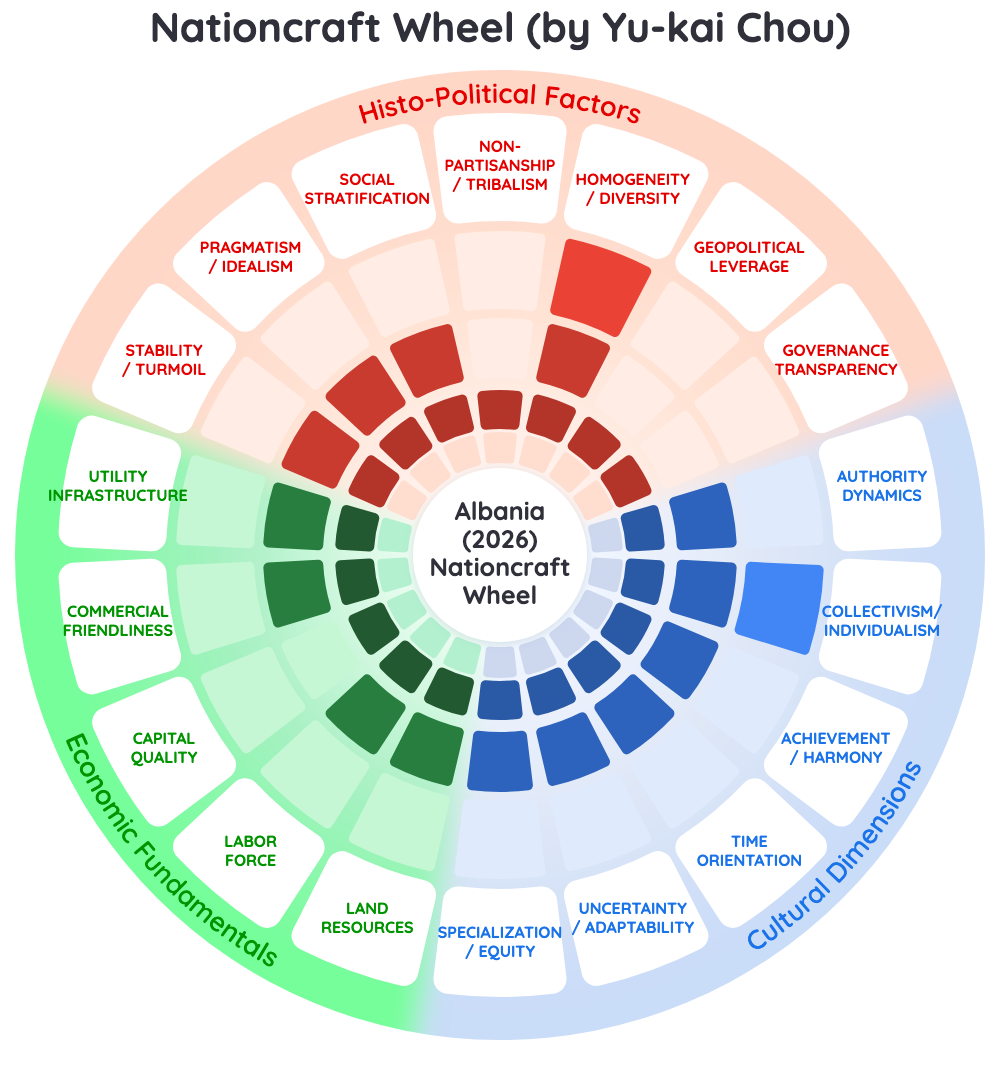

On May 26, 2026, Brussels certified that Albania had met its interim benchmarks on rule of law and moved into the concluding phase of EU accession negotiations. Five days later, Tirana filled with what Deutsche Welle would soon call the largest civic protest movement Albania has seen since the fall of communism.
Most commentary treats one of those two facts as the anomaly. Read through the Nationcraft Framework, both are exactly on schedule.
Albania has been running two scoreboards for thirty years. One is graded in Brussels: negotiating clusters, interim benchmarks, growth rates, tourism receipts. The other is graded at the departure gate of Tirana’s airport, where the country lost a net 28,531 people to migration in 2025 alone.
I call the mechanism that kept those scoreboards from colliding the Departure Dividend. Every citizen who gives up on Albania pays the state on the way out: remittances flow in, dissent flows out, wage pressure eases, and the macro numbers the EU reads keep improving.
The Flamingo Revolution, at more than one hundred consecutive days of protest as of this week, is what happens when that valve jams. This analysis maps Albania’s 18-variable Nationcraft profile, shows why the dividend is now exhausted, and names which historical reform packets actually fit a country that graduates in Brussels while emptying at home.
⚡ Speed Run Notes
- Albania entered the concluding phase of EU accession on May 26, 2026. Its largest protest movement since communism began within the same week. Both are real, because two different scoreboards are being graded.
- The Departure Dividend: each exit pays the state. Money flows home, critics settle abroad, and the indicators Brussels grades keep climbing, so V13=3 transparency never faces the constituency that would fix it.
- Albania is a full-signature Brain Drain Spiral (ST-002): V15=6 talent, V16=3 capital, V17=4 commercial friction. The corpus locks the Diaspora Catalyst (RE-005) until V17 reaches 5.
- Eight celebrated playbooks fail this V-vector: Lee Kuan Yew, Saakashvili, Bukele, Estonia’s digital leap, Polish shock therapy, the Baltic sprint, Portugal’s structural-funds era, and Greece’s accession-as-arrival.
- Three packets fit: Slovakia’s post-Meciar turnaround (SP-090), Romania’s prosecution-inside-accession model (SP-080), and Ireland’s conversion of an emigration nation into a return economy (SP-016).
- The Flamingo Revolution is exit switching to voice. The diaspora that served as the state’s pressure valve came home as its opposition, in motorcades through Muriqan and rallies across 30-plus cities abroad.
Table of Contents
- Understanding Albania’s Governance Landscape Through Nationcraft
- What Is the Nationcraft Framework?
- Why This Albania Variables Analysis Matters Right Now
- What Albania Actually Looks Like in Numbers
- The Departure Dividend
- Detailed Justifications: Albania Variable by Variable
- The Flamingo Revolution as a Variable Event
- Eight Reformer Playbooks Albania Should Reject
- Three Reformer Playbooks Albania Should Actually Study
- Strategic Implications
- Governance Strategy Recommendations
About Yu-kai Chou

Yu-kai Chou is a Human-Systems Architect & Behavioral Designer and the creator of the Nationcraft Framework — an 18-variable diagnostic for matching a country’s structural profile to the reform packets that have historically worked under similar conditions. He has consulted for governments in eight nations, including Ukraine, the United Kingdom, the Kingdom of Bahrain, Singapore, Taiwan, the Netherlands, Kazakhstan, and South Korea, and has worked directly with President Zelenskyy’s team on post-war reconstruction priorities for Ukraine.
Chou’s prior framework — the Octalysis Framework — has been applied by LEGO, Microsoft, Porsche, Coca-Cola, Salesforce, and MrBeast, impacting over 1.5 Billion Users. He has taught the methodology at Harvard, Stanford, Yale, Tesla, Google, BCG, and IDEO.
His work has been cited by Harvard, Stanford, MIT, Forbes, Wall Street Journal, Wired, US Department of Energy, NIST, NSF, NCBI, US Department of Education, ClinicalTrials.gov, and Google Scholar — with 3,700+ more academic publications. Explore his books here.

This Albania analysis reads the Flamingo Revolution the way the Nationcraft Framework reads every reform moment: as a motivation-architecture event before a political one. Chou’s advisory work across eight governments has repeatedly run into the same pattern now visible in Tirana, where a state optimizes the metrics an external anchor grades while the variables its own citizens live inside stay frozen, and where emigration quietly removes the constituency every reform needs.
Understanding Albania’s Governance Landscape Through Nationcraft
Albania is the European Union’s fastest-moving accession file. It opened all 33 negotiating chapters in thirteen months, met its rule-of-law interim benchmarks in May 2026, and provisionally closed its first three chapters on July 14.[2][3]
It is also a country of 2.33 million people, shrinking by more than one percent a year, with an average age of 45.[8]
Standard analysis holds those facts apart: the accession story in one article, the emigration story in another, the protest story in a third. Nationcraft reads them as one system, because in an 18-variable profile the same configuration produces all three.
Enlargement Commissioner Marta Kos announced in May that Albania had “officially transitioned into the concluding phase” of its negotiations.[4] The protesters on Dëshmorët e Kombit Boulevard are contesting the same state Brussels is grading, and both evaluations are accurate.
Resolving it takes the whole vector, so that is where this analysis goes first.
What Is the Nationcraft Framework?
The Nationcraft Framework is my diagnostic system for matching a country’s structural profile to the reform strategies that have historically worked under similar conditions. It grew out of two decades spent building the Octalysis Framework, which maps the eight Core Drives behind human motivation.
Nationcraft scores a nation on 18 variables: six cultural (V1–V6), seven histo-political (V7–V13), and five economic (V14–V18). Each runs from 1 to 9 or, in command states, to 10.
The central claim is that policy effectiveness is decided by context-fit rather than policy quality. A reform packet that transformed one country will break against another country’s V-vector, which is why the framework catalogs over 100 historical Success Packets with the variable preconditions under which each one worked.
Configuration is strategy. The scores are never averaged, because a single blocked variable can gate an entire reform sequence, and Albania is about to demonstrate exactly that.
Why This Albania Variables Analysis Matters Right Now
On September 8, parliament returned from summer recess and met a police cordon holding back protesters chanting “Arrest Rama!” while lawmakers were escorted in.[1] The movement had marked its hundredth day the evening before.
The Flamingo Revolution began on May 23 at the Narta Lagoon, where residents protested the fencing of a protected beach for a luxury resort backed by Jared Kushner, with Sazan Island in the same package.[5] After private security assaulted protesters on May 30, it spread to Tirana and never stopped.
By June 20 it was putting more than 250,000 people on the boulevard, the largest single demonstration in the movement, with diaspora motorcades entering through Muriqan and solidarity rallies in over thirty cities abroad.[5]
Its five-point platform demands Rama’s resignation, a 12-month non-partisan technical government, constitutional changes by referendum, electoral and party-financing reform, a lifetime two-term limit for prime ministers, and repeal of the strategic-investment framework and the protected-areas amendments.[5]
A movement this size, this sustained, aimed simultaneously at the government and the opposition, is a variable event. The chant heard nightly in Tirana pairs both establishment leaders: “Rama në burg, Berisha në burg.”[5]
What it can and cannot change only becomes visible against the full 18-variable read, which follows.
What Albania Actually Looks Like in Numbers
Here is Albania’s 2026 Nationcraft V-vector, drawn from the framework’s 147-country corpus and sanity-checked this week against Freedom House, Reporters Without Borders, OSCE/ODIHR, EU Council records, and INSTAT demographic data.[12][13][14]
| Variable | Score | 2026 Reading |
|---|---|---|
| V1 Authority Dynamics | 6/9 | Dominant-PM tradition; fourth consecutive Socialist mandate; concentrated decision-making without a command apparatus |
| V2 Collectivism | 7/9 | Family and fis networks; diaspora solidarity proven at 30+ rally cities |
| V3 Achievement Orientation | 5/9 | Entrepreneurial hustle abroad; survival-mode economics at home |
| V4 Time Orientation | 5/9 | EU-2030 aspiration coexists with remittance-cycle short-termism |
| V5 Uncertainty Adaptability | 6/9 | Absorbed 1991, the 1997 pyramid collapse, and 1999 Kosovo spillover; adapts by exit |
| V6 Specialization | 4/9 | Informal-sector breadth over institutional depth |
| V7 Stability vs Turmoil | 6/9 | No state collapse since 1997, now stress-tested by 100+ protest days |
| V8 Pragmatism | 5/9 | Delivers what Brussels measures; selective at home |
| V9 Social Stratification | 6/9 | Connected-insider concentration atop a flattened post-communist base |
| V10 Non-Partisanship | 3/9 | PS–PD duopoly since 1991; a party-linked database tracked ~910,000 Tirana voters |
| V11 Homogeneity | 7/9 | ~98% Albanian; religious diversity under one national identity |
| V12 Geopolitical Leverage | 2/9 | NATO member and accession candidate, yet a rule-taker; conditionality flows inward |
| V13 Governance Transparency | 3/9 | SPAK convicts ministers while resort permits go unpublished; RSF ranks Albania 83/180 |
| V14 Land Resources | 5/9 | A 470–km coastline carrying tourism at 20% of GDP; hydropower; chromium |
| V15 Labor Force Quality | 6/9 | Educated, European-fluent workforce, increasingly located outside Albania |
| V16 Capital Quality | 3/9 | Remittance-fed, construction-heavy, shallow formal capital formation |
| V17 Commercial Friendliness | 4/9 | Better roads and airports; opaque permits; courts favor the connected |
| V18 Utility Infrastructure | 4/9 | Transformed since 1991, still hydropower-dependent with tourism-load strain |
Read the table as three clusters rather than eighteen scores. The identity assets sit high: V2=7 collectivism, V11=7 homogeneity, V15=6 labor quality.
The governance core sits low: V10=3 partisanship, V13=3 transparency, V16=3 capital, V17=4 commercial friction. And the leverage variable, V12=2, means the reform agenda is written by an external anchor rather than by Albania itself.
The Nationcraft corpus recognizes this exact configuration. Albania is a full-signature match for pattern ST-002, the Brain Drain Spiral, whose trigger is precisely V15≥6 talent produced inside V16≤4 capital and V17≤4 commercial conditions.
The Departure Dividend
Every country in the Brain Drain Spiral loses people. Albania industrialized the loss.
The state’s own Success Packet in the Nationcraft corpus, SP-070, records the pattern across 1991–2020: mass emigration began with the transition, the diaspora sustained the economy, and the packet’s closing verdict reads that dependence on emigration is not development, because Albania’s success is partly its people succeeding elsewhere.
Here is the mechanism, stated as a ledger.
| What exit produces | Who collects | Which variable it anesthetizes |
|---|---|---|
| Remittances that prop household income and the trade deficit | The macro numbers Brussels reads | V16 capital never has to formalize |
| Exported unemployment and eased wage pressure | Government approval of the growth story | V17 friction never gets priced politically |
| The departure of exactly the citizens most likely to demand accountability | The V10=3 patronage duopoly | V13 transparency loses its constituency |
| A diaspora success story to advertise | National narrative, Core Drive 1 (CD1): Epic Meaning & Calling | V15 depletion reads as pride instead of loss |
This is the Departure Dividend: the state collects a payment every time a citizen gives up on it. Exit de-pressurizes reform, and the pressure that remains is graded by an external examiner who measures chapters, benchmarks, and growth.
The demographic invoice is now visible. Albania’s population fell to 2.33 million in January 2026, down 1.16 percent in a single year, with net migration at minus 28,531 and an average age of 45.[8]
Meanwhile the Brussels scoreboard has never looked better: GDP grew 3.71 percent year-on-year in the first quarter of 2026, tourism revenue reached roughly 20 percent of GDP, and foreign arrivals passed 11.7 million in 2024.[9][10]
In the Octalysis vocabulary underneath Nationcraft, exit is a Core Drive 8 (CD8): Loss & Avoidance strategy. Leaving is how an Albanian avoids losing a life to a system experienced as rigged, and my Core Drive 8 (CD8): Loss & Avoidance analysis explains why avoidance behaviors compound quietly until they define the whole system.
The Venezuela analysis in this series showed an exodus born of collapse. Albania’s version is stranger: an exodus born of growth, timed to an accession the EU itself calls exemplary.
A similar inversion appears in Cuba’s Doctrine Trap, where emigration functions as the regime’s release valve. The difference is that Havana rations exit, while Tirana’s exit runs through an open European labor market that absorbs every departure without friction.
Detailed Justifications: Albania Variable by Variable
The cultural layer (V1–V6): cohesion built for elsewhere
V1 Authority Dynamics sits at 6. Albanians accept strong leadership, and the system has produced one dominant figure per era, Berisha then Rama, with the Socialist Party now in its fourth consecutive mandate since 2013.[6]
That is enough authority to concentrate decisions and starve consultation, and too little to run the command-state sequencing that packets like Deng’s or Lee Kuan Yew’s presuppose. Albania occupies the uncomfortable middle of the V1 scale, where dominance is real but legitimacy is contested nightly on the boulevard.
V2 Collectivism at 7 is the highest usable score on Albania’s card, and the evidence for it is operational: the fis and family networks that survived Hoxha now span a continent, and the protest movement runs on them. the same kinship channels that move remittances moved motorcades of emigrants home through Muriqan in June.[5]
In Octalysis terms this is Core Drive 5 (CD5): Social Influence & Relatedness operating at national scale. The state never built it and cannot switch it off.
V3 Achievement at 5 and V4 Time Orientation at 5 record a population whose ambition is intact but whose planning horizon has been shortened by three system collapses in living memory. V5 Uncertainty Adaptability at 6 is high for Europe, earned the hard way, and V6 Specialization at 4 reflects an economy where versatile informality beats institutional careers.
The histo-political layer (V7–V13): where the dividend is spent
V7 Stability at 6 has held since the 1997 pyramid-scheme collapse nearly dissolved the state. One hundred consecutive protest days now apply down-pressure, though the movement’s own discipline, nightly marches with almost no arson or looting, has kept V7 from breaking.[5]
V8 Pragmatism at 5 points in two directions at once. Toward Brussels, Rama’s government executes whatever the benchmark requires, which is how all 33 chapters opened in thirteen months.[2] Toward home, pragmatism yields to loyalty management.
V10 Non-Partisanship at 3 blocks more reform paths than any other score on the card. Albanian politics has been a two-clan war since 1991, and the Patronageists scandal, in which a party-linked database tracked the political preferences of roughly 910,000 Tirana-area voters, showed how completely employment and services route through party membership.[5]
The protests understand this better than most foreign coverage does. Their signature chant condemns both dynasties at once, and the movement has refused capture by the Democratic Party opposition from its first week.[11]
V12 Geopolitical Leverage at 2 defines the reform game. Albania is a NATO member and the EU’s star candidate, yet leverage flows inward: Brussels sets conditions, Washington’s first family arrives as an investor, and Tirana’s only counter-move is compliance or delay.
V13 Governance Transparency at 3 holds the profile’s strangest contradiction. Albania built SPAK, an institutionally independent anti-corruption prosecution that has charged a sitting deputy prime minister, the mayor of Tirana, and a former environment minister who is now serving a sentence.[6]
The same state granted a €1.4 billion protected-coast land deal that parliamentarians learned about from newspapers, amended the Protected Areas Law to exempt five-star “structures of excellence,” and let development permits for Zvërnec sit unpublished.[5] Enforcement is rising while discretion stays dark, and V13 stays at 3 because transparency is measured at the point of decision, well before the point of prosecution.
The economic layer (V14–V18): a coastline monetized faster than a state is built
V14 Land at 5 is appreciating in real time. Tourism revenue has roughly doubled as a share of GDP since 2021, reaching about 20 percent, on 11.7 million foreign arrivals in 2024.[10]
That same coastline is the protest trigger, because monetizing it runs through exactly the opaque instruments V13=3 permits: strategic-investment status, discretionary exemptions, disputed land titles. The corpus filed decades of coastal litigation under psychological ownership long before the bulldozers arrived, and my psychological ownership guide explains why fencing land people regard as ancestral produces resistance no compensation schedule can buy out.
V15 Labor Quality at 6 measures quality, and the quality is real: European-fluent, hard-working, entrepreneurial. The score cannot capture location, and location is the crisis, with net migration at minus 28,531 in 2025 and the average age at 45.[8]
V16 Capital at 3 records what the dividend leaves behind. An economy fed by remittances and tourism cash concentrates in construction and consumption, formalizes slowly, and leaves domestic credit shallow.
V17 Commercial Friendliness at 4 and V18 Utilities at 4 complete the trap arithmetic: good enough to visit, hard enough to build in. The corpus threshold matters here, because pattern RE-005, the Diaspora Catalyst, requires V17≥5 before emigrant capital and expertise return at scale. Albania sits one point below the gate.
The Flamingo Revolution as a Variable Event
Political scientists have a name for the choice Albanians have faced since 1991: exit or voice. For thirty years the system priced exit cheaper, and the Departure Dividend was the state’s cut of every departure.
What began at the Narta Lagoon on May 23 is the repricing. The trigger was specific, a fenced beach inside the Vjosa–Narta Protected Landscape, preparatory works on a resort project whose land changed hands for €1.4 billion, and a private-security assault on protesters that police watched without intervening.[5]
The escalation was structural. Within three weeks the movement had a five-point constitutional platform, a 250,000-person rally, and diaspora rallies across Europe, North America, and Australia.[5]
Read as variables, three things changed at once.
First, V2’s collectivism reversed polarity. The kinship networks that carried remittances inward began carrying accountability demands inward, with emigrants driving home to march. Exit infrastructure became voice infrastructure.
Second, the movement declined to feed V10’s duopoly. By rejecting Berisha’s opposition as loudly as Rama’s government, it kept itself outside the patronage machine that has absorbed every previous protest wave, which is why it has lasted 100 days instead of ten.[1]
Third, the state’s answer revealed the V13 ceiling. Rama dismissed the crowds as numbering a few thousand, floated foreign “hybrid war” explanations, and pressed ahead, while announcing legislation to stop courts from suspending ministers under criminal investigation.[5]
A government that answers its largest civic movement since communism by narrowing judicial reach is running the early steps of pattern PT-002, Authoritarian Backslide, whose signature is exactly Albania’s V10≤3 polarization plus V1≥6 strong-leader acceptance. Hungary’s Two-Thirds Trap documents where that road ends when an EU member walks it with no accession leverage left to lose.
Albania is not there. The difference is the anchor: Hungary’s conditionality ended at accession, while Albania’s is at maximum strength right now, which is precisely why the next two years decide which pattern wins.
Eight Reformer Playbooks Albania Should Reject
Every reform debate in Tirana, Brussels, and the diaspora press reaches for a celebrated model. Against Albania’s actual V-vector, eight of the most-cited packets fail on preconditions.
1. The Lee Kuan Yew Packet (SP-002, Singapore 1965–1990)
The perennial favorite of development conferences requires what Singapore had at intervention start: V3=9 achievement drive, V8=9 pragmatism, and above all an enforcement culture that built V13 toward 8 while wages rose.
Albania fields V3=5, V8=5, V13=3. The LKY packet also presupposes a city-state’s administrative reach and a one-party dominance that faces no boulevard. Import it into a V10=3 two-clan system and its clean-government machinery becomes one clan’s weapon, which is the outcome Albanians already assume of every institution.
2. The Saakashvili Packet (SP-051, Georgia 2004–2012)
Fire the entire police force, rebuild from zero, and dare the courts to object. Georgia’s blitz worked from a revolutionary mandate, V8=9 pragmatism, and a public that had watched the old state fail at everything including electricity.
Albania’s state has not failed at everything; it has succeeded selectively, which removes the mandate for demolition. And the packet’s ending is the warning: the concentration that enabled Saakashvili’s purge later corroded Georgia’s own democracy. A V10=3 country handing one camp a purge instrument should expect it aimed across the aisle within one electoral cycle.
3. The Bukele Packet (SP-064, El Salvador 2019–present)
Suspend rights, mass-incarcerate, and post approval ratings. Bukele’s packet runs on V1=8 authority acceptance and a security emergency so extreme that citizens traded checks for safety.
Albania has V1=6, no gang war, and an EU accession that dies the week constitutional guarantees are suspended. More fundamentally, the Flamingo movement’s entire demand stack is anti-concentration: term limits, technical government, referendum control. A concentration packet would answer a protest about concentrated power by concentrating more of it, and the movement’s own five demands say exactly that.
4. The Estonia Digital Packet (SP-007, Estonia 1991–2020)
Albania has visibly attempted this packet already. E-Albania digitized services, and in September 2025 Rama appointed Diella, an AI system, as the world’s first cabinet-level “minister” with a mandate to clean public procurement.[7]
Estonia’s leap worked because V13=7 transparency and V8=9 pragmatism existed before the digitization, so the code automated an honesty already decided. Albania is running the sequence backward: the AKSHI procurement scandal put the state’s own digital agency under investigation, and a year after Diella’s appointment BIRN found her actual role unclear, with the Public Procurement Agency still “at the preparatory stage.”[7]
Digitizing a discretionary state automates the queue and leaves the discretion. V13 is a precondition of the Estonia packet, never its output.
5. The Polish Shock Therapy Packet (SP-005, Poland 1990–2004)
Balcerowicz’s rapid liberalization worked on a V15=6 educated workforce inside a society with functioning governance checks and a once-in-history window in which every institution was being rebuilt at once.
Albania already took its shock in 1991, and its version detoured through pyramid schemes into the 1997 collapse. The corpus playbook PB-10 is explicit that shock speed requires V13≥6 governance to stop oligarchic capture of the sell-off. At V13=3, accelerating the sell-off would hand today’s discretionary state a faster pen.
6. The Baltic Tiger Packet (SP-089, Lithuania 1990–2015)
Flat taxes, EU sprint, FDI-led convergence. The Baltic packet is the closest regional rhyme, and its own outcome disqualifies it: Lithuania converged economically while shedding population so fast that the packet’s recorded lesson is a country “richer and safer than ever, but smaller.”
Albania’s crisis is already the smallness. A packet whose known side effect is accelerated emigration would pay the Departure Dividend faster, and the 2004 accession wave that carried the Baltics no longer exists for latecomers.
7. The Portugal Convergence Packet (SP-078, Portugal 1974–2000)
Portugal stabilized a chaotic transition inside an EU that pre-dated the Copenhagen criteria, absorbed structural funds at a scale enlargement no longer offers, and converged across two generous decades.
The EU that admitted Portugal in 1986 graded intentions. The EU grading Albania audits interim benchmarks cluster by cluster.[2] The packet’s own caveat applies too: convergence in GDP never guaranteed convergence in institutions, which Portugal’s 2011 crisis exposed.
8. The Greece Accession Packet (SP-079, Greece 1974–2015)
Greece entered the Community in 1981 with clientelism intact, treated membership as the finish line, and spent three decades letting EU funds substitute for reform until the 2010 collapse forced internal devaluation at catastrophic social cost.
Greece’s packet variables at entry rhyme uncomfortably with Tirana’s file: V13=4 transparency, V4=4 short horizon, patronage politics. Greece’s Discipline Window Trap in this series shows the bill arriving forty years later. Albania’s 2030 target works as an instrument for forcing V13 disclosure and V10 reform, and Greece shows what four decades of treating the membership date as the achievement produced.
Three Reformer Playbooks Albania Should Actually Study
Fit in Nationcraft means variable preconditions Albania actually holds, aimed at the variables actually blocking it: V13 transparency, V17 friction, V10 partisanship, and the V15-to-V16 conversion the Departure Dividend prevents.
| Packet | Starting vector match | What it moved | Albania relevance |
|---|---|---|---|
| SP-090 Slovakia, Velvet Divorce & EU Integration (1993–2009) | V10=6, V13=5, V15=6, mid-scale V1=5 | Broke Mečiar-era captured dominance via coalition + EU conditionality; V13 5→7; auto-industry FDI converted V15 into V16=7 | The closest historical case of an EU anchor plus a united opposition ending one-man dominance without collapse |
| SP-080 Romania, Post-Ceaușescu Transition (1989–2007) | V1=6, V13=4, V15=6, captured transition | Prosecution capacity (DNA) built inside accession conditionality; captured state reformed late but real | The template for SPAK: enforcement institutions grown under EU monitoring that outlive the government that tolerated them |
| SP-016 Ireland, Celtic Tiger (1987–2007) | V15=7 educated emigrants, V16=3, V11=8, chronic exodus | Social-partnership pacts + EU funds + targeted FDI turned an emigration nation into a return destination inside one generation | The only packet in the corpus that reversed a Departure Dividend at national scale |
Slovakia: how a captured state votes its way out (SP-090)
Slovakia in 1997 was the EU’s problem child, excluded from NATO’s first wave because Mečiar ran it as a private estate. One coalition election in 1998, disciplined by the accession calendar, flipped the trajectory, and by 2009 the “Tatra Tiger” was in the eurozone.
The packet’s Albanian lesson is precise: the anchor did the disciplining, and a temporarily united, otherwise incompatible opposition did the winning. Albania’s protest movement is the first force since 1991 positioned outside both clans, and Slovakia shows what such a force converts into when an accession window gives defection from the duopoly a payoff.
Romania: prosecution as the accession deliverable (SP-080)
Romania’s transition was captured for a decade, and its recovery ran through an anti-corruption directorate whose caseload eventually reached ministers and party financiers, sustained because EU monitoring made dismantling it expensive.
SPAK is Albania’s DNA, and it is already the most trusted institution in the country’s polling precisely because it prosecutes both clans. The Romanian packet also carries the countermove Albania should expect: when prosecutions reached the political core, Bucharest attempted decriminalization by emergency decree in 2017, and the streets stopped it. Rama’s proposal to shield ministers from court suspension is the same play in a different font, and Romania’s Austerity Backlash Trap shows the long-run cost of winning that fight against your own judiciary.
Ireland: the only recorded dividend reversal (SP-016)
Ireland spent the 1980s as Albania spends the 2020s, exporting graduates and importing remittances. The Celtic Tiger packet reversed the flow with three moves: social-partnership wage pacts that made the domestic game credible, EU structural funds spent on capability, and FDI targeted at sectors where returning emigrants’ skills earned a premium.
The corpus is honest about non-replicable conditions, the US tech pipeline above all. What is replicable is the sequencing: Ireland made staying rational before it asked anyone to return, which in Nationcraft terms means V17 moved first. Albania’s playbook PB-01, Brain Drain Reversal, encodes the same gate: below V13=4, talent programs get captured, so the transparency floor precedes every diaspora scheme.
Strategic Implications
The Departure Dividend has a repayment schedule, and it has started.
First implication: the accession anchor is Albania’s only lever strong enough to move V13, and it expires on success. Pattern RE-003, External Anchor, works while membership is credible and conditional, which is now through roughly 2030. Every reform Albania defers past accession joins Hungary’s category of things the EU can no longer compel.
Second: the state is reading the protests as a threat when their content is institutional demand. A movement that rejects both clans is the first organic V10 repair mechanism Albania has produced, and its five demands, term limits, electoral reform, technical government, are institutional rather than tribal.[5] States usually spend decades of civic education building an accountability constituency of this size, and Albania received one in fourteen weeks of marches.
Third: the coastline forces the sequencing question now. Tourism at 20 percent of GDP[10] monetizes exactly the asset whose allocation runs through unpublished permits, and every €5 billion strategic package signed under V13=3 rules converts a national endowment into a future Zvërnec.[5]
Fourth: demography sets the clock. At minus 28,531 net migration against a 2.33 million base,[8] Albania loses more than one percent of itself annually, and the departure skews young. The V15 that reform needs is boarding flights while the reform is being scheduled.
Sequenced correctly, the same flows reverse: pattern RE-005 is explicit that a diaspora converts from remittance source to development catalyst once V17 crosses 5, and Albania’s diaspora just demonstrated, in thirty cities, that its attention is available.[5]
Governance Strategy Recommendations
The Nationcraft prescription follows the variable gates rather than the news cycle.
| Sequence | Move | Variable target | Core Drive logic |
|---|---|---|---|
| 1 | Publish everything: every strategic-investment contract, permit, and coastal land transaction, retroactive to 2024 | V13 3→4 | Core Drive 4 (CD4): Ownership & Possession, returning the coast to public accounting; trust begins at disclosure |
| 2 | Shield SPAK structurally: withdraw the ministerial-suspension bill, constitutionalize the vetting architecture inside Cluster 1 commitments | V13 enforcement floor | Core Drive 8 (CD8): Loss & Avoidance made symmetric, so elite impunity carries real downside |
| 3 | Answer the platform’s institutional demands: electoral-code and party-financing reform, term-limit referendum | V10 3→4 | Core Drive 2 (CD2): Development & Accomplishment for citizens inside the system, giving voice a win-state exit never offered |
| 4 | One-stop, published-by-default business permitting, benchmarked to the accession acquis | V17 4→5, unlocking RE-005 | Core Drive 3 (CD3): Empowerment of Creativity & Feedback for builders who currently need a patron |
| 5 | Diaspora return instruments only after gates 1–4: matched investment funds, credential fast-tracks, dual-role civil-service posts | V15→V16 conversion | Core Drive 1 (CD1): Epic Meaning & Calling, offering the exiled generation a country worth the return ticket |
| 6 | Ring-fence Vjosa–Narta and the protected coast from the strategic-investment framework entirely | V14 preserved; V7 de-escalated | Removing the standing CD8 grievance that regenerates the boulevard every evening |
The table deliberately contains no measure for accelerating headline growth. The Brussels scoreboard is already green.[9] Nationcraft’s read is that Albania’s binding constraints are all on the citizen scoreboard, and the dividend ends only when staying beats leaving on lived variables.
Comparative Context: Albania Among the Accession States
Albania’s configuration becomes clearer against its neighbors in this series.
| Country | Named pattern | Shared variable | Divergence |
|---|---|---|---|
| Albania 2026 | The Departure Dividend | — | Exit substitutes for accountability while the anchor grades the exterior |
| Bulgaria | Borrowed Anchor Trap | External anchor as legitimacy source | Bulgaria borrowed the euro’s credibility post-accession; Albania still holds pre-accession leverage it can spend |
| Serbia | Managed Exit | Mass protests against a dominant ruler | Belgrade balances between anchors; Tirana has exactly one, which concentrates the conditionality |
| Kosovo | Coalition Stalemate Trap | V2=7 Albanian identity networks | Kosovo’s blockage is parliamentary arithmetic; Albania’s is a duopoly too stable to lose |
| Rwanda | Star Pupil Trap | External grades masking domestic gaps | Kigali’s examiner is the donor community; Tirana’s is an EU whose rulebook, unlike donors’, eventually audits V13 directly |
| Netherlands | Second Dutch Disease | Excellence masking decay | The Dutch execution stack hides representational rot; Albania’s accession excellence hides extraction |
The pattern family is visible across Serbia’s Managed Exit, Kosovo’s Coalition Stalemate Trap, and Bulgaria’s Borrowed Anchor Trap: Balkan states whose reform motivation is administered from outside while the domestic motivation system runs on patronage.
Rwanda’s Star Pupil Trap sits closest to Albania’s pattern: a state that aces its examiner’s test. The difference favors Albania: the EU’s Cluster 1 is a rule-of-law audit, so Albania’s examiner, uniquely, grades the exact variable the country hides. And where the Netherlands’ Second Dutch Disease shows competence anesthetizing politics in a mature democracy, Albania shows the pre-accession version, caught earlier, while the anchor still has teeth.
The prior Ukraine Nation Variable Analysis makes the final contrast: Ukraine’s diaspora mobilized to defend a state under existential attack, fusing V2 collectivism with Core Drive 1 meaning. Albania’s diaspora mobilized against its own state’s conduct, an inward-pointing accountability pressure the corpus records far less often than wartime rallying.
The Nationcraft Framework in Practice
Albania is the seventy-third diagnosis in this series, and it needed no special treatment: the same variable arithmetic that separated fits from misfits elsewhere separated them here.
Albania’s case shows the framework’s core discipline. Growth at 3.7 percent, tourism records, and closed chapters all read as success until the variable layer reveals who is absorbing the gains and who is buying a ticket out.[9]
It also shows why Nationcraft treats motivation as infrastructure. A state that lets Core Drive 8 avoidance become its citizens’ dominant strategy will discover, as Tirana has, that the remaining motivation arrives all at once, on the boulevard, with a five-point platform.
The full methodology, all 18 variables, the goal stack, and the packet library live at the Nationcraft Framework hub linked throughout this analysis, with every published country diagnosis indexed in the library below.
Closing
Albania will probably keep closing chapters, and the boulevard will probably keep filling, because both are outputs of the same configuration.
The question the next two years decide is which scoreboard the state chooses to win. The Departure Dividend is still paying, but its currency, people, is running out at 28,531 net per year, and the generation that would normally have left is standing outside parliament instead.
A country that converts that presence into V13 disclosure, V10 de-tribalization, and a V17 worth returning to gets the packet Slovakia and Ireland wrote. A country that waits for the protests to exhaust themselves repeats Greece’s sequence with better beaches and a later start date.
Frequently Asked Questions
What is the Departure Dividend in Albania’s Nationcraft profile?
It is the payment the Albanian state collects each time a citizen emigrates: money sent home supports consumption, the loudest critics end up abroad, and the labor market exports its slack. The dividend lets a V13=3 transparency system survive without reforming, because the citizens most likely to demand accountability exit instead of contesting it.
What triggered the Flamingo Revolution protests in 2026?
Fencing of a protected beach at the Narta Lagoon for a luxury resort development backed by Jared Kushner, followed by a private-security assault on protesters on May 30, 2026. Daily protests began in Tirana on May 31 and broadened into a national movement against corruption, state capture, and both dominant parties, passing 100 consecutive days in September.
Why do imported models like Singapore’s or Georgia’s fail in Albania?
Preconditions. The Lee Kuan Yew packet requires achievement and enforcement variables (V3, V8, V13) far above Albania’s 5/5/3, while Saakashvili’s purge model requires a revolutionary mandate and tolerates a power concentration that Albania’s V10=3 two-clan system would immediately weaponize. Nationcraft matches packets to variable configurations, and both fail Albania’s.
Does EU accession fix Albania’s governance problems?
Accession is leverage, and leverage expires at membership. Greece’s SP-079 packet shows accession without institutional repair producing dependency and eventual crisis, while Slovakia’s SP-090 and Romania’s SP-080 show conditionality moving V13 when domestic forces use the window. The anchor enables the fix; it never is the fix.
Which historical reform packets actually fit Albania’s V-vector?
Three. Slovakia’s post-Mečiar turnaround (SP-090) for ending captured dominance through an EU-disciplined coalition, Romania’s post-Ceaușescu prosecution model (SP-080) for building enforcement inside accession, and Ireland’s Celtic Tiger (SP-016) as the corpus’s only successful national reversal of an emigration economy.
How does emigration affect Albania’s reform capacity?
Directly and doubly. It removes the V15 talent reform requires, with net migration at minus 28,531 in 2025 against 2.33 million people, and it removes the accountability constituency V13 requires, which is the Departure Dividend’s political half. The corpus gates diaspora return (RE-005) behind V17≥5 commercial conditions, so reversal starts at home rather than abroad.
Explore More Nationcraft Analyses
The full library now covers more than seventy country diagnoses. Adjacent reads include Poland’s Liberum Veto Trap, Turkey’s Strongman Discount, and France’s Fragmentation Trap.
Related Reading
- The Nationcraft Framework
- Nationcraft Country Analyses Library
- Nationcraft Analysis: UK Honeymoon Ledger 2026
- Nationcraft Analysis: Sweden Trust Overdraft 2026
- Nationcraft Analysis: Bosnia Dayton Deadlock 2026
- Nationcraft Analysis: Germany Consensus Trap 2026
Footnotes
- Al Jazeera, Protesters, police clash in Albania over Trump-linked project, September 8, 2026.
- Council of the EU, Albania meets interim benchmarks for fundamentals cluster, May 26, 2026.
- Council of the EU, Albania and EU provisionally close first three negotiating chapters, July 14, 2026.
- European Western Balkans, Kos: Albania has officially transitioned into the concluding phase of EU accession negotiations, May 27, 2026.
- Wikipedia, Flamingo Revolution, accessed September 10, 2026 (aggregating Reuters, AP, BIRN/Reporter.al, BalkanWeb and OSCE/ODIHR reporting).
- Balkan Insight, Albania in 2025: Socialists Win Big, Graft Probes Continue, December 18, 2025.
- Balkan Insight, BIRN Reality Check: What Has Albania’s AI ‘Minister’ Achieved So Far?, August 14, 2026.
- Euronews Albania, Albania Lost 28,500 Residents in 2025 as Average Age Reaches 45, 2026 (INSTAT data).
- FocusEconomics, Albania Economy: GDP, Inflation, CPI & Interest Rates, accessed September 10, 2026.
- German Economic Team, Tourism sector drives growth and shapes Albania’s economy, 2025.
- New Eastern Europe, Making sense of the Flamingo Revolution in Albania, July 7, 2026.
- Reporters Without Borders, Albania country profile, 2026 World Press Freedom Index.
- Freedom House, Albania: Freedom in the World.
- OSCE/ODIHR, Elections in Albania (2025 parliamentary election observation reports).