

Sweden built the most trusted state machinery on earth, and for ten days in September it gets to find out what that machinery still costs. The country that invented the modern ombudsman, that passed the world’s first freedom-of-information law in 1766, that top-scores nearly every governance index ever devised, goes to the polls on September 13 carrying the memory of January 2025, when its bomb squads logged more than thirty detonations in a single month, in a country where children as young as eleven have answered social-media ads for contract killings.
And yet the numbers are improving. Shootings in the first half of 2026 fell to their lowest level since 2017, and the governing bloc is campaigning on that curve.
I call what Sweden is actually facing the Trust Overdraft Trap: a state so trusted it never built the muscles of enforcement. Sweden’s institutions run on deposits made by an older, tighter society. The gang economy, the welfare-fraud economy, and the bloc politics of 2026 are all spending from that account faster than anything currently refills it.
An overdraft is comfortable right up until the margin call. September 13 is a margin call.
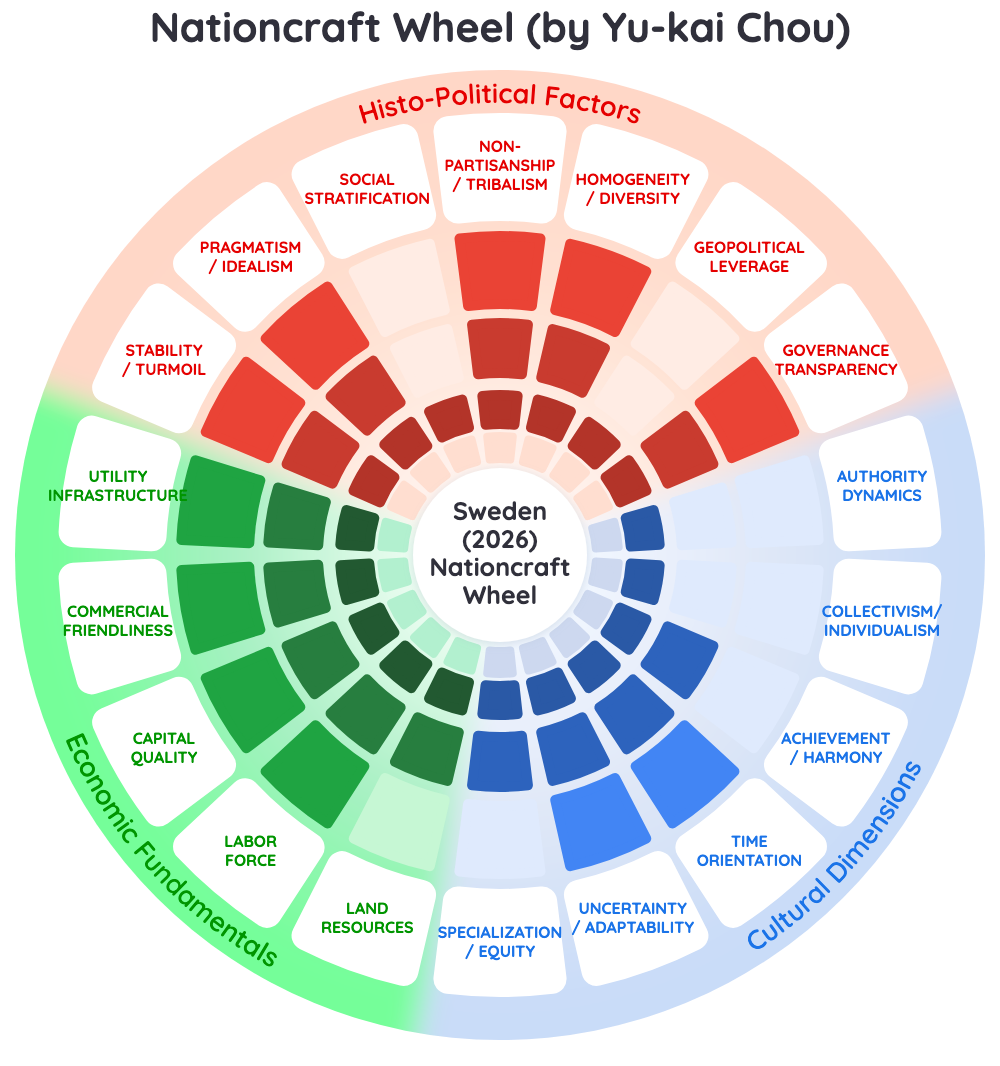
The Nationcraft corpus scores 147 nations on 18 variables, and Sweden’s vector is one of the most lopsided in the entire dataset: six variables at 9 or 10, two variables at 2 or 3, and the gap between them is where the whole story lives. Read the vector honestly and you can see why the imported playbooks Swedes argue about, El Salvador’s and Singapore’s above all, cannot work here, and why the one that fits is sitting in Sweden’s own filing cabinet with a 1996 date stamp on it.
⚡ Speed Run Notes
- Sweden’s V-vector is the most trust-heavy in the Nationcraft corpus: V13=10 transparency, V10=10 non-partisanship, V7=9 stability. Yet V1=3 authority and V2=2 collectivism. Consent without coercion.
- The Trust Overdraft Trap: institutions this trusted absorb failure instead of correcting it. The gang economy grew inside the absorption zone for a decade before the system re-priced it as a crisis.
- Shootings fell from 390 in 2022 to 262 in 2024, and H1 2026 was the calmest since 2017. The criminal economy answered by shifting into fraud, bombings, and recruiting children as young as 11.
- September 13 prices the overdraft: Kristersson campaigns to bring the Sweden Democrats into cabinet for the first time, Andersson’s four-party bloc leads at 51.3%, and the Liberals may vanish below the 4% threshold.
- Five imported playbooks fail Sweden’s vector: Bukele’s state of exception, the LKY discipline state, Saakashvili’s fire-them-all reform, Austria’s extra consensus machinery, and Uruguay’s stay-the-course reassurance.
- The fits are closer to home: Sweden’s own 1990s crisis packet (SP-109), Denmark’s flexicurity triangle (SP-113), and the Netherlands’ Wassenaar bargain (SP-112). All three run on variables Sweden still has.
Table of Contents
- Understanding Sweden’s Governance Landscape Through Nationcraft
- What Is the Nationcraft Framework?
- Why This Sweden Variables Analysis Matters Now
- What Sweden Actually Looks Like in Numbers
- The Trust Overdraft Trap
- Detailed Justifications: Reading Each Variable
- Five Reformer Playbooks Sweden Should Reject
- Three Playbooks Sweden Should Actually Study
- Strategic Implications
- Governance Strategy Recommendations
- Comparative Context
About Yu-kai Chou

Yu-kai Chou is a Human-Systems Architect & Behavioral Designer and the creator of the Nationcraft Framework — an 18-variable diagnostic for matching a country’s structural profile to the reform packets that have historically worked under similar conditions. He has consulted for governments in eight nations, including Ukraine, the United Kingdom, the Kingdom of Bahrain, Singapore, Taiwan, the Netherlands, Kazakhstan, and South Korea, and has worked directly with President Zelenskyy’s team on post-war reconstruction priorities for Ukraine.
Chou’s prior framework — the Octalysis Framework — has been applied by LEGO, Microsoft, Porsche, Coca-Cola, Salesforce, and MrBeast, impacting over 1.5 Billion Users. He has taught the methodology at Harvard, Stanford, Yale, Tesla, Google, BCG, and IDEO.
His work has been cited by Harvard, Stanford, MIT, Forbes, Wall Street Journal, Wired, US Department of Energy, NIST, NSF, NCBI, US Department of Education, ClinicalTrials.gov, and Google Scholar — with 3,700+ more academic publications. Explore his books here.

This Sweden analysis was written through the same Nationcraft lens Chou has applied in advisory work with governments including the Netherlands, the United Kingdom, and Ukraine — three systems watching Stockholm’s September vote for their own reasons. Sweden itself is read here purely through the corpus: 147 scored nations, the Success Packet library, and the variable interactions that decide which policy imports take and which reject like a mismatched organ.
Understanding Sweden’s Governance Landscape Through Nationcraft
Most political coverage of Sweden in 2026 runs on one of two stories. Story one: the far right has captured a tolerant country. Story two: a naive country is finally waking up.
Both stories are about mood. Neither explains the mechanics, and mechanics are what the Nationcraft Framework is for.
The mechanical question is this: how does a state with the world’s best governance scores produce Western Europe’s worst gun-homicide problem, and why did its correction arrive a decade late and at consensus speed?
The answer sits in the variable structure. Sweden runs an extreme configuration: near-perfect scores on transparency, institutional neutrality, stability, capital, and commerce, stacked on top of one of the weakest authority scores in the developed world and the most individualist culture the World Values Survey has ever measured.
That configuration is a machine for producing consent. It was never a machine for producing force, and for most of a century it never needed to be.
Nationcraft reads countries as configurations rather than report cards, which is why this analysis will spend as much time on Sweden’s 10s as on its 2s: the 10s do the trapping.
What Is the Nationcraft Framework?
The Nationcraft Framework profiles a nation across 18 variables: six cultural (V1–V6), seven historical-political (V7–V13), and five economic (V14–V18). Each is scored 1–10.
Scores are never averaged. A nation is its configuration, and the Nationcraft corpus exists to match configurations against 139 historical Success Packets, each a documented reform program with known preconditions, sequencing, and outcomes.
The working rule: policy quality decides less than context fit. A reform that succeeded brilliantly under one variable profile fails on schedule under another, which is why every Nationcraft analysis spends more time on preconditions than prescriptions.
Behavioral design is where the framework grew from: the Octalysis Framework‘s variable-interaction method, run at population scale, with the full transfer documented in how the Octalysis Framework applies to nation-building and public policy. That lineage matters in Sweden’s case, because the trap is at bottom a motivation problem: a state that can no longer produce the behaviors it needs from either its institutions or its teenagers.
Sweden makes an unusually clean subject because its configuration is extreme in both directions at once. Nations with mixed scores blur; Sweden’s vector is a natural experiment in what maximum trust buys, and what it cannot buy.
Why This Sweden Variables Analysis Matters Now
Three clocks converge on September 13, 2026.
The electoral clock. Sweden elects all 349 Riksdag seats under a hard 4% national threshold.[1] Late-August polling gives Magdalena Andersson’s four-party opposition 51.3% against 46.6% for the governing side, a gap that has narrowed from 8.9 points in June to 4.7.[2]
Ulf Kristersson has spent the campaign dismantling the last taboo in Swedish politics: after four years of governing with the Sweden Democrats as an external support party under the Tidö Agreement, he now proposes to bring them into cabinet outright.[3] The SD polls at 18.3%, down from its 20.5% result in 2022.[2]
And underneath the bloc arithmetic sits a threshold bomb: the Liberals have polled near 2.5%, and if they fall out of the Riksdag the governing bloc loses roughly 15 to 17 seats at a stroke.[4]
The security clock. The decade-long gang emergency has entered a strange new phase. Shootings fell by a third between 2022 and 2024, from 390 to 262, and the first half of 2026 logged 39 shootings with 8 deaths, the calmest half-year since 2017.[5]
The improvement is real, and so is what it conceals. January 2025 alone produced more than 30 bombings.[6] Police counted 23 bystanders killed and 30 wounded over three years of gang shootings.[7] Networks now recruit children as young as 11 through social media, with murder contracts reported around 150,000 kronor.[8]
A criminal economy that adapts this fast has stopped being a policing problem and become a systems problem. Falling shooting counts coexist with a business model migrating into welfare fraud, extortion, and exported violence.[5]
The model clock. Sweden reversed its migration paradigm: asylum immigration now sits at its lowest level since 1985, voluntary-return grants rose in January 2026 to 350,000 kronor per adult, and a commission has proposed revoking asylum-based permanent residency from 2027.[9] Defense spending jumps 18% in 2026 to reach 2.8% of GDP for NATO’s newest member.[10]
Meanwhile the economy is finally exiting a long stagnation, with growth forecast at 1.9% for 2026 while unemployment, at 8.9% in 2025, remains among the highest in the EU.[11]
Three clocks, one question: can a consent machine learn enforcement without breaking the consent? That is a variable question, so we go to the variables.
What Sweden Actually Looks Like in Numbers
The 2026 Nationcraft scores for Sweden, canon-checked this week against election coverage, police data, OECD and EU forecasts, and the migration record:
| Variable | Score | One-line read |
|---|---|---|
| V1 Authority Dynamics | 3/10 | Consensus parliamentarism; weak-PM tradition; no emergency-powers habit |
| V2 Collectivism vs Individualism | 2/10 | The most individualist culture in the World Values Survey’s map; solidarity outsourced to the state |
| V3 Achievement vs Harmony | 5/10 | Lagom and Jante moderation wrapped around a fiercely competitive export economy |
| V4 Time Orientation | 8/10 | Fiscal framework, pension framework, defense plans running to the 2030s |
| V5 Uncertainty Adaptability | 7/10 | Two centuries of non-alignment reversed in months; migration paradigm reversed in two years |
| V6 Specialization vs Equity | 6/10 | Deep export niches riding on universal systems |
| V7 Stability vs Turmoil | 9/10 | Institutional stability intact through a street-level security emergency |
| V8 Pragmatism vs Idealism | 8/10 | Ruthless pragmatism, once consensus forms; the 2015 idealist era is closed |
| V9 Social Stratification | 3/10 | Low income inequality; wealth concentration and spatial segregation strain the score |
| V10 Non-Partisanship vs Tribalism | 10/10 | Institutions above party; cross-bloc machinery still ships defense and pension deals |
| V11 Homogeneity vs Diversity | 8/10 | Strong normative majority culture; roughly a fifth of residents born abroad stress-test it |
| V12 Geopolitical Leverage | 3/10 | Small state; NATO seat, Baltic position, and defense exports push upward without breaking the ceiling |
| V13 Governance Transparency | 10/10 | World’s oldest FOI law (1766); a welfare state that runs on presumed honesty |
| V14 Land Resources | 5/10 | Iron ore, timber, hydro; the Kiruna rare-earth find is upward optionality |
| V15 Labor Force Quality | 8/10 | Engineering tradition and high tertiary attainment; mid-pack PISA is the counterweight |
| V16 Capital Quality | 9/10 | Deep pension capital, Nasdaq Stockholm, Europe-leading unicorn density |
| V17 Commercial Friendliness | 9/10 | Top-tier ease of doing business and regulatory predictability |
| V18 Utility Infrastructure | 9/10 | World-class broadband and grid; southern price zones are the known weak point |
Look at the shape before the details. Six variables at 9 or 10. Two variables at 2 or 3 that any security planner would want higher.
The Nationcraft corpus holds no other Western nation with a spread this wide between its trust stack and its authority stack.
Configurations this lopsided do one thing reliably: they excel at everything their strong variables cover and remain blind to anything that must route through the weak ones.
The Trust Overdraft Trap
Every institution in Sweden is built on the same operating assumption: the counterparty is honest. Taxes are filed on trust and audited lightly.
Welfare pays out on declaration. Public registers publish what other states classify.
The police, per capita, are among Europe’s least numerous because deterrence was cultural, never physical.
That assumption is a balance. Decades of honest counterparties built it up, and the system learned to spend from it: every institutional failure gets absorbed by residual trust rather than corrected by force.
School doesn’t integrate a neighborhood? Trust absorbs it.
A benefits scheme gets systematically farmed? Trust absorbs it.
A criminal network starts clearing internal disputes with hand grenades? For years, trust absorbed that too, because acting proportionally to the threat would have required tools a V1=3 state does not own and a V2=2 society does not grant.
This is the Trust Overdraft Trap in mechanism form: the higher a system’s accumulated trust, the longer it can defer correction, and the deferral itself is what compounds the eventual bill.
Notice which variables power the trap. V13=10 means the system genuinely is clean, so scandal never triggers reform the way it does in corrupt states; there is no thief to catch, only a design to admit was wrong.
V10=10 adds the second delay: no institution will act outside consensus, so correction waits for every party to arrive at the same diagnosis.
And V7=9 silences the alarm, because nothing registers as an emergency at the institutional layer even while the street layer detonates thirty bombs a month.
The strengths themselves generate the latency. That is what separates a trap from a weakness, and it is the same structural signature as Germany’s consensus machine: an excellence that meters the response to precisely the threats that refuse to wait.
The adversary, meanwhile, runs the inverse vector. Sweden’s criminal networks are flat, entrepreneurial, digitally fluent, and utterly unburdened by consensus requirements. They re-price quarterly. When policing pressure raised the cost of shootings, the networks pivoted into fraud and bombings and moved recruitment below the age of criminal responsibility, faster than any parliamentary inquiry can convene.[5]
In behavioral terms, the state and the networks compete for the same scarce resource: the loyalty of a fifteen-year-old in an outer suburb.
The networks bid with belonging and fast money; in Octalysis terms they run Core Drive 5: Social Influence & Relatedness fused with instant payout, while the state’s offer engages no drive a fifteen-year-old can feel.
The state bids with a nine-year integration timeline and a caseworker. That auction was lost on motivational design before it was ever lost on policing.
One more mechanism completes the trap. Because Swedish politics ran a cordon sanitaire around the party that owned the security issue, the issue itself went unpriced in government for a decade; the voters who cared most exited to the excluded party, which grew until exclusion failed. The UK is running a version of this dynamic in its Reform surge; Sweden simply started earlier and has now reached the endgame, with Kristersson proposing to seat the once-quarantined party in cabinet.[3]
Trust, deferral, adaptation, exclusion: four compounding lines on the same overdraft. Now read the variables one by one, because the repair has to be built from exactly these parts.
Detailed Justifications: Reading Each Variable
The cultural stack (V1–V6): consent without command
V1 Authority Dynamics = 3. Sweden’s executive is structurally soft. Governments are minority coalitions more often than majorities, the PM commands through negotiation, and the constitutional tradition has no peacetime emergency-powers reflex. The Tidö arrangement itself is a contract with an outside party rather than a command structure.[1]
For fifty years this was a feature: nothing arbitrary could happen. The security crisis exposed its price, which is that nothing fast can happen either.
V2 Collectivism vs Individualism = 2. On the World Values Survey map, Sweden occupies the extreme secular-rational, self-expression corner, essentially alone. The Swedish social model is best described as statist individualism: individuals delegate solidarity to the state precisely so they owe nothing informal to each other.
The delegation works while the state delivers. When the state falters, a V2=2 society has no clan, parish, or neighborhood layer to fall back on, which is exactly the vacuum a gang fills. This is the variable that makes Sweden’s gang problem a design problem.
V3 Achievement vs Harmony = 5. Jante moderation coexists with a brutally competitive export and startup economy.
The culture punishes visible ambition while quietly producing Spotify, Ericsson, and a unicorn density near the top of Europe. A middle score, honestly earned.
V4 Time Orientation = 8. The fiscal framework born in the 1990s crisis, the pension system rebuilt by cross-bloc committee, defense procurement running to the mid-2030s.[10] Sweden plans in decades. The trap uses this too: long horizons rationalize slow responses.
V5 Uncertainty Adaptability = 7. The counter-evidence to any claim that Sweden cannot change: two hundred years of military non-alignment ended in months once consensus formed, and NATO accession completed in March 2024. The migration paradigm flipped inside a single parliamentary term.[9] Sweden adapts late, then completely.
V6 Specialization vs Equity = 6. A handful of world-class niches (telecom, defense aerospace, pharma, music, gaming) financed by and financing universal systems. The equity commitment survived even the 1990s consolidation, which is why the score sits above the midpoint.
The historical-political stack (V7–V13): the trust machine itself
V7 Stability vs Turmoil = 9. Governments serve full terms, transfers of power are boring, and no institutional actor contests the rules. Hold that against the street data: 23 bystanders killed in three years, a January of daily bombings.[6][7]
The 9 is real and institutional; the turmoil is real and territorial. Both readings survive contact with the evidence, and Swedish politics has spent a decade deciding which one to govern from.
V8 Pragmatism vs Idealism = 8. The country that declared itself a humanitarian superpower in 2015 now pays 350,000 kronor for voluntary return and drafts conduct requirements for residency.[9] Judge the reversal however you like morally; as a variable reading it is decisive evidence that Swedish idealism is a fair-weather setting layered over deep pragmatism.
V9 Social Stratification = 3. Income compression remains world-class.
Two pressures strain the score without yet breaking it: wealth concentration that now rivals far less egalitarian states, and spatial segregation that concentrates disadvantage into the police’s own list of exposed areas. Sweden is egalitarian in wages and increasingly stratified in geography.
V10 Non-Partisanship vs Tribalism = 10. The civil service is neutral, the courts are unquestioned, and even now the blocs deliver joint products: the NATO decision, defense frameworks, pension deals. Bloc rhetoric has sharpened, and the SD-normalization fight is genuinely tribal in tone.[3] The machinery underneath still runs on cross-party committees, which is why the score holds at the top of the scale.
V11 Homogeneity vs Diversity = 8. The most stress-tested score in the vector. Normatively, majority-Swedish culture remains remarkably uniform: same language, same institutional habits, same quiet conformity.
Demographically, about one resident in five was born abroad, and the institutions calibrated for the old homogeneity (light policing, trust-based welfare, school choice) are precisely where the parallel society grew.
This analysis keeps the 8 and treats the strain as the finding.
V12 Geopolitical Leverage = 3. Ten million people cannot bend great-power outcomes.
Membership in NATO, a commanding Baltic position, Gripen and submarine exports, and Europe’s most significant rare-earth find at Kiruna all push upward; none of them breaks the small-state ceiling. The honest score stays low, which matters for packet selection later.
V13 Governance Transparency = 10. The offentlighetsprincipen has made state records public since 1766. Corruption indices place Sweden at the top of the world tables year after year.
V13=10 has a blind side: the machine watches the state, while the fraud economy farms the welfare system from the citizen side, where everything was built to presume honesty.
V13=10 audits power. It never audited claimants.
The economic stack (V14–V18): a rich state with an idle balance sheet
V14 Land Resources = 5. Iron ore that built the industrial base, timber, abundant hydro, and the Per Geijer deposit outside Kiruna, one of Europe’s largest known rare-earth reserves.
Optionality, still years from production. A mid score with an upward tail.
V15 Labor Force Quality = 8. An engineering culture a century deep, near-universal English, high tertiary attainment. The counterweight: mid-pack PISA results and an integration failure that leaves a measurable share of the workforce outside the high-productivity economy entirely, visible in an unemployment rate of 8.9% that ranks among the EU’s worst.[11]
V16 Capital Quality = 9. Deep pension funds, a stock exchange that mints listings other European capitals envy, and a venture scene that made Stockholm a unicorn factory. Northvolt’s collapse proved even deep capital cannot rescue a mis-executed industrial bet; it did nothing to shallow the pools themselves.
V17 Commercial Friendliness = 9. Predictable regulation, fast company formation, digital-first administration. The same frictionless registration architecture, it turns out, also incorporates shell companies for the fraud economy at Swedish efficiency.
V18 Utility Infrastructure = 9. World-class broadband, a grid that exports power in most hours, and the known southern price-zone bottleneck as the asterisk. The physical layer of the Swedish model is in no way the problem.
Eighteen readings, one pattern: every weakness in the vector is either a direct inversion of a strength (V1, V2 against V10, V13) or a blind spot the strengths created (V11, V9, the claimant side of V13). Which means imported reforms that treat the weaknesses in isolation will collide with the strengths that generate them. Now watch five famous playbooks do exactly that.
Five Reformer Playbooks Sweden Should Reject
Every one of these gets prescribed for Sweden somewhere, from parliamentary motions to newspaper columns to think-tank panels. Each one fails on variables, and the corpus can show precisely where.
The packet-fit summary first; the autopsies follow.
| Packet | What it requires | What Sweden has | Verdict |
|---|---|---|---|
| SP-064 Bukele Security & Digital (El Salvador) | V1=8 concentrated power; suspended due process; territorial gangs | V1=3, V13=10, networked gangs | Reject |
| SP-002 Lee Kuan Yew Industrialization (Singapore, 1965–1990) | Existential crisis mandate; V1=7 hierarchy; city-state scale | V1=3, V2=2, V7=9 comfort | Reject |
| SP-051 Saakashvili Reform (Georgia) | Collapsed V13; corrupt institutions worth razing; revolutionary mandate | V13=10, clean institutions | Reject |
| SP-115 Social Partnership Corporatism (Austria, 1955–1985) | A polarized society needing consensus machinery installed | V10=10, consensus already saturated | Reject |
| SP-047 Social Democracy & Stability (Uruguay) | External threats, internal cohesion, small homogeneous population | Internal parallel economy; V11 under strain | Reject |
| SP-109 Banking Crisis & Fiscal Consolidation (Sweden, 1990–1996) | V10+V13 consensus trust; crisis framed as system solvency | V10=10, V13=10, crisis available for framing | Fit |
| SP-113 Flexicurity Labor Market (Denmark, 1994–2005) | Trust stack (V2/V10/V13); ~1.5% GDP for activation | Trust stack present; V16=9 can fund it | Fit |
| SP-112 Wassenaar Consensus Labor (Netherlands, 1982–1995) | Corporatist actors; crisis felt as existential to the model | Both present in 2026 | Fit |
1. The Bukele packet (SP-064): the import Sweden argues about most
El Salvador’s state of exception jailed more than 70,000 people, suspended due process, and cut homicides by roughly 70%. As raw crime reduction, the Bukele Security & Digital Packet (SP-064) is the most dramatic result in the modern corpus.
Its preconditions are equally dramatic. The packet’s own record shows V1=8: courts packed, supermajority in hand, all institutional veto points cleared. It worked against territorial, mass-membership gangs whose members could be identified by tattoo and neighborhood.
Sweden fails every precondition at once. V1=3 means no Swedish executive can suspend anything; the ombudsmen, the courts, and the coalition partners all hold live vetoes, and V13=10 means each violation would be publicly documented within the week.
Swedish networks are also the wrong shape for the tool. They are loose contractor markets recruiting children by the job, with leadership often directing operations from abroad. Mass preventive detention has no stable membership roster to sweep.
The packet file itself lists democratic institutions among the costs and flags the model as unreplicable outside its conditions. Chile’s voters have been running the same seduction cycle with mano dura promises, and Chile’s mano dura mirage shows how the promise outruns the delivery even in a far more presidential system than Sweden’s.
2. The Lee Kuan Yew packet (SP-002): the Singapore of the North fantasy
The fantasy recurs across Swedish commentary: a disciplined, clean, high-capacity state that simply decides order into existence. Singapore’s Lee Kuan Yew Industrialization Packet (SP-002) is the reference implementation.
Read its preconditions. Expulsion from Malaysia in 1965, an existential crisis with 10% unemployment and a live communist insurgency, V1=7 hierarchical authority, and a governing party that faced no meaningful institutional resistance for a generation. The packet file’s own list of what cannot be copied begins with city-state scale and one-party dominance.
Sweden’s V7=9 stability denies it the crisis mandate; its V1=3 denies it the command structure; its V2=2 individualism denies it the social license for paternalism. Swedes will accept dramatic policy, as NATO accession proved, but only through the consensus channel, never through a strongman one.
The corpus already ran this exact stress test from the other side: Singapore’s LKY packet stress test examines what happens when the packet’s own home conditions shift. A packet under stress in its birthplace is a poor candidate for export to its variable opposite.
3. The Saakashvili packet (SP-051): firing everyone works only when everyone deserves firing
Georgia after the Rose Revolution fired its entire traffic police force in a day, rehired new officers at ten times the salary, and crushed corruption so fast the World Bank made it a poster child. The Saakashvili Reform Packet (SP-051) is the corpus’s proof that radical institutional replacement is possible.
Its precondition is a state already dead: 70% informal economy, police who were themselves the extortion racket, revolutionary legitimacy to raze and rebuild.
Sweden’s institutions are the opposite case, clean at V13=10 and trusted in every survey. Firing them would destroy the one asset the corpus says is hardest to rebuild. The packet solves institutional corruption; Sweden’s problem is institutional latency, and razing a slow-but-clean bureaucracy to cure slowness is amputation for a limp.
What Sweden can borrow from Georgia is narrow and real: the demonstration that a state can, when it chooses, rebuild a single function completely rather than reform it incrementally. Applied surgically, say to a border-customs function or a benefits-audit function, that logic survives. Applied systemically, it burns the trust stack for nothing.
4. The Austrian packet (SP-115): prescribing consensus to a consensus overdose
Austria’s Social Partnership Corporatism Packet (SP-115) built decades of social peace by institutionalizing negotiation between chambers of labor, commerce, and state. For societies emerging from civil conflict, it is a genuinely great design; its recorded lesson credits V10=8 non-partisanship and long horizons for the result.
Sweden already runs the maximal version of this. V10=10. Remissvar consultation rounds, tripartite habits, cross-bloc committees for anything durable.
Importing more consensus machinery therefore treats the disease with a second dose of the patient. The Austrian file even documents the failure mode on its own terms: Proporz proportionality hardened into patronage and sclerosis by the 1980s. Sweden’s utredning culture, where a state inquiry precedes any significant act by two to four years, is the same sclerosis wearing a cleaner suit.
The packet’s real gift to Sweden is the warning label. Consensus systems age into latency machines unless someone builds a fast lane, which is exactly what the third fit packet below is for.
5. The Uruguay packet (SP-047): the reassurance that everything is fine
Uruguay’s Social Democracy & Stability Packet (SP-047) is the corpus’s best evidence that small consensus democracies can simply stay the course: restore norms, invest socially, trust the institutions, and outlast turbulence. Its V1=3 profile even matches Sweden’s.
That resemblance is exactly what disqualifies it. Uruguay’s packet worked against threats that were external or cyclical, in a society whose cohesion was never contested from inside; its own file lists a small, homogeneous population among the conditions that do not travel.
Sweden’s threat is internal, adaptive, and compounding, running a parallel economy inside the welfare system itself. Stay-the-course is precisely how the overdraft accumulated: every year of institutional patience was a year the networks used to entrench. For Sweden in 2026, the most dangerous playbook on this list is the one that counsels being proud of the machine as-is.
Three Playbooks Sweden Should Actually Study
1. Sweden’s own 1990s packet (SP-109): the machine has a crisis mode, and it works
The strongest evidence about what Sweden can do under pressure is filed under Sweden. The 1990s Banking Crisis & Fiscal Consolidation Packet (SP-109) records the sequence: a property bubble burst, three major banks went technically insolvent, GDP contracted 5% over 1990–93, unemployment tripled from 1.5% to 8%, and a 500% marginal interest rate failed to save the krona.
Then the consent machine did something the 2026 caricature says it cannot do. It moved.
A blanket bank guarantee within weeks. Good-bank/bad-bank separation through Securum.
A fiscal consolidation worth 8% of GDP across four years, run by rival parties in structured cooperation. A pension system rebuilt by cross-bloc committee into a design other nations still copy.
The packet’s recorded variable lesson is the key: V10 and V13, the same scores Sweden still maxes, are what made cross-party crisis consensus credible enough to execute. Sweden’s machine has a second gear; it engages when the problem is framed as system solvency rather than as a partisan issue.
One honest caveat travels with the packet. Its file records crisis-era collectivism far above today’s V2=2, meaning the shared-sacrifice fuel is thinner now.
The framing therefore has to carry what solidarity once carried: the gang economy has to be named, accurately, as a solvency threat to the welfare state itself, the one asset every Swedish voter co-owns.
Frame it as crime policy and the machine idles. Frame it as the 1992 bank run happening to the trust system, and the machine already knows what to do. The reframe works because losses mobilize harder than gains: Core Drive 8: Loss & Avoidance is the strongest short-horizon motivator in the behavioral record, and losing the welfare state is the one loss every Swedish voter co-owns.
2. Denmark’s flexicurity packet (SP-113): kill the recruitment pipeline with activation economics
Denmark in 1993 carried 12% unemployment and a passive welfare system quietly warehousing people. The Flexicurity Labor Market Packet (SP-113) rebuilt it as a triangle: easy hiring and firing, generous unemployment support, and mandatory activation, with training or placement required in exchange for benefits, funded at roughly 1.5% of GDP.
The packet’s variable lesson maps onto Sweden almost one-to-one: it credits the trust stack, transparency, low tribalism, and solidarity, for making generous-but-conditional support politically sustainable. Sweden holds every one of those scores.
Why it matters for a security crisis: the gang labor market recruits from exactly the population a passive system warehouses. A sixteen-year-old with no plausible route into the legal economy prices gang work rationally. Mandatory activation, aimed hard at the exposed-area cohort and funded from V16=9 capital depth, attacks the recruitment side of the network economy, the one input the networks cannot import.
Denmark also demonstrates the honest cost: flexicurity is expensive, and it only works where tax compliance and administrative competence are already high. On both counts Sweden sits in the global top tier, which is exactly what V13=10 and V17=9 measure: the precondition sheet is already signed.
3. The Netherlands’ Wassenaar packet (SP-112): how a consensus system renegotiates itself
The Dutch crisis of 1982 was existential to the model rather than to the state: Dutch disease, 12% unemployment, welfare dependency at 27% of the working-age population. The response, recorded in the Wassenaar Consensus Labor Packet (SP-112), was a tripartite bargain in which each side surrendered something sacred: unions accepted wage restraint, employers accepted shorter hours and part-time rights, and government backed the trade.
What Sweden needs from this file is the mechanism, independent of the labor content. Wassenaar shows a V10-saturated system building a fast lane through its own consensus machinery by concentrating the negotiation into one named bargain with named counterparties, rather than diffusing it through years of inquiry.
The Swedish translation is a security Wassenaar: one cross-bloc compact, negotiated once, in which the right surrenders the fantasy of enforcement-only solutions and the left surrenders the taboo on coercive tools, in exchange for a locked, funded, decade-long program spanning policing, benefits-audit, school placement, and activation. The politics of the moment make the trade nameable: both blocs enter September 13 needing proof the model can act.[2]
Austria’s warning label applies here too. The bargain must have a sunset and a scoreboard, or it calcifies into the next layer of machinery. Wassenaar worked because it was a deal, with terms, rather than an institution that outlived its purpose.
Strategic Implications
Run the vector against the September 13 outcomes and the implications stop being abstract.
| Scenario | Mechanics | Trust-overdraft effect |
|---|---|---|
| Andersson bloc wins outright | Four parties from ex-communist Left to market-liberal Centre must co-govern; polling gave the bloc 51.3% in late August | Overdraft continues unless the bloc runs a solvency-framed SP-109 program; a soft security course re-opens the space the SD grew in |
| Kristersson side wins with SD in cabinet | First far-right cabinet entry in Swedish history; V10 machinery tested by ministries run from outside the old consensus | Enforcement gets its mandate; the trust stack takes the strain, and every institutional friction becomes a legitimacy fight |
| Liberals fall below 4% | Right bloc loses roughly 15–17 seats of coalition math at a stroke | Whoever governs does so narrowly; a thin mandate is the worst fuel for a decade-long program |
| Hung result, weeks of formation talks | 2022 took days; 2026 could take months if thresholds surprise | Latency, the trap’s own currency, gets printed at the exact moment the system needs speed |
Notice what all four rows share: none of them, by itself, repays the overdraft. The election chooses which coalition holds the pen. The vector says the repayment program looks the same regardless of who writes it, because the variables do not change on election night.
Three strategic facts follow from the vector.
First, Sweden’s enforcement ceiling is structural, so the strategy must be economic. A V1=3 state will never out-coerce its criminal networks, and attempts to try will spend legitimacy the model cannot spare.
It can out-spend, out-audit, and out-employ them. The levers that fit the vector are the benefits ledger, the labor market, and the recruitment pipeline, which is precisely where the fit packets aim.
Second, the fraud economy is the soft target. Sweden’s V13=10 transparency machine was pointed at the state; pointing serious audit capacity at the claimant side of welfare, at scale, requires no new coercive powers at all, only the decision that presumed honesty is now verified honesty. That single reorientation de-funds networks more reliably than any raid.
Third, the demographic clock inside V15 is the quiet one. Every year the exposed-area cohort ages without labor-market absorption, the network economy compounds and the eventual activation bill grows. Unemployment at 8.9% with V16=9 capital depth is a solvable mismatch today; it stops being one if the overdraft runs another decade.[11]
Governance Strategy Recommendations
Sequenced the way the corpus sequences, with the packet each step borrows from:
| Phase | Move | Packet source | Variables engaged |
|---|---|---|---|
| 1. Frame (months 0–6) | Declare the network economy a solvency threat to the welfare state; commission a single cross-bloc crisis body with a fixed reporting clock, replacing the open-ended inquiry habit | SP-109 | V10, V13, V4 |
| 2. Bargain (months 3–12) | Negotiate the security Wassenaar: one named compact trading coercive-tool taboos against enforcement-only fantasies, with sunset clauses and a public scoreboard | SP-112 | V10, V8 |
| 3. De-fund (years 1–3) | Reorient the transparency machine onto the claimant ledger: verified-honesty welfare administration, beneficial-owner registers, shell-company audit at commercial speed | SP-109 bad-bank logic | V13, V17 |
| 4. Absorb (years 1–8) | Flexicurity-grade mandatory activation aimed at the exposed-area cohort, funded at Danish intensity from capital depth | SP-113 | V15, V16, V2 |
| 5. Lock (years 3–10) | Convert the compact into framework law with the same structural stickiness as the 1990s fiscal framework, so the program survives coalition churn | SP-109 fiscal-framework logic | V4, V7 |
The sequence matters more than the parts. De-funding before absorbing leaves a recruitment vacuum the networks refill; absorbing without de-funding subsidizes the networks’ own labor pool. The 1990s packet ran guarantee, separation, and consolidation in strict order for the same reason.
The program also needs a public scoreboard. The 1990s consolidation held because progress was visible and co-owned across blocs, and a decade-long program with no visible progress gets abandoned by year three, a pattern the corpus documents as reliably in nations as Venezuela’s reform playbooks analysis showed in the negative.
Comparative Context
Sweden’s trap belongs to a family the corpus has been mapping all year.
| System | Signature | Shared mechanism with Sweden |
|---|---|---|
| Germany 2026 | Consensus Machine Trap | Excellence at consensus meters the response speed; V10 strength generates latency |
| Ukraine 2026 | Spartan Paradox | The inverse case: war forged V2 collectivism Sweden lacks, while collapsing the stability Sweden keeps |
| Singapore 2026 | LKY packet under stress | The discipline import Swedes fantasize about, stress-testing in its own birthplace |
| UK 2026 | Compact fracture | Cordon-sanitaire politics pricing an issue out of government until the excluded party owns it |
| France 2026 | Fragmentation trap | Bloc arithmetic degrading into ungovernability; Sweden’s threshold bomb is a milder strain |
Two of these deserve the longer read alongside this piece. Ukraine’s wartime variable profile shows what a society looks like when existential pressure rebuilds the collectivism score Sweden has spent fifty years dismantling; nobody should wish the mechanism on anyone, and the contrast clarifies exactly what V2=2 costs in mobilization capacity.
And France’s fragmentation trap is the cautionary road for Swedish party arithmetic: once bloc systems fragment past a threshold, formation crises stop being events and become the operating condition. Sweden is one failed 4% party away from its first taste of that.
The broader European set, Hungary’s two-thirds trap and Poland’s liberum veto trap among them, rounds out the pattern: every European democracy in the corpus is currently paying down some deferred structural bill, and the bills differ by vector, never by virtue.
The Nationcraft Framework in Practice
Strip this analysis to its method and you get the Nationcraft loop: score the 18 variables honestly, find the interaction that generates the observed pathology, name it, then filter the world’s reform inventory by precondition fit.
Sweden’s case shows why the filter is the whole game. By outcomes, Bukele’s packet is the best anti-gang result on record and Singapore’s is the best governance result on record; both are vector poison for Sweden. By preconditions, the winning references turn out to be a thirty-year-old Swedish crisis file and two neighbors’ labor-market bargains that never once mention crime.
Configuration-first analysis is what keeps a reform inventory honest.
The same discipline runs through every entry in the Nationcraft country analyses library. And the reason a Bukele import would misfire here has a behavioral name, White Hat and Black Hat design: fear-based motivation buys fast compliance and brittle legitimacy, consent-based motivation buys the reverse, and Sweden is the purest consent-run state in the corpus trying to answer a fear-run adversary.
Explore More Nationcraft Analyses
The library at yukaichou.com/nationcraft-country-analyses holds every published country profile, each with its full 18-variable wheel and packet matching.
Nearest neighbors to this analysis: Germany’s consensus machine trap for the latency mechanism in a larger consensus system, and Singapore’s LKY stress test for the discipline model Swedes keep pricing from across the world.
Closing
Sweden is holding an election about whether the model failed. The vector says something more precise: the model succeeded so completely that it stopped checking its own assumptions, and the account that funded a century of quiet excellence has been running an overdraft for a decade.
The repayment tools exist, most of them in Sweden’s own archive. What September 13 decides is only who has to pick them up.
The machine still works. It is waiting, as it always has, for consensus that the emergency is real.
Frequently Asked Questions
What is the Trust Overdraft Trap in Sweden?
It is the Nationcraft reading of Sweden’s 2026 condition: institutions with maximum accumulated trust (V13=10 transparency, V10=10 non-partisanship) absorb failures instead of correcting them, because correction would require authority (V1=3) and collective mobilization (V2=2) the system deliberately never built. The gang and fraud economies grew inside that absorption zone, spending down trust faster than the system refills it.
Why can’t Sweden just copy El Salvador’s Bukele model?
The Bukele packet (SP-064) required V1=8 concentrated executive power, suspended due process, and territorial mass-membership gangs. Sweden scores V1=3, its courts and ombudsmen hold live vetoes, its V13=10 transparency would document every abuse within days, and its networked, contractor-style gangs offer no stable membership to mass-detain. The preconditions fail on every axis at once.
Is Sweden’s gang crisis actually getting worse in 2026?
Shootings are falling: from 390 in 2022 to 262 in 2024, with the first half of 2026 the calmest since 2017. The underlying economy is adapting rather than shrinking, moving into welfare fraud, bombings, and recruitment of children below the age of criminal responsibility. Falling violence metrics and a compounding criminal economy are both true simultaneously, which is exactly what makes the moment strategically dangerous.
What would a Nationcraft-fit reform program for Sweden look like?
Three packets fit the vector: Sweden’s own 1990s crisis packet (SP-109) supplies the frame, a cross-bloc solvency program with structural lock-in; Denmark’s flexicurity packet (SP-113) supplies the recruitment-pipeline attack through mandatory activation; and the Netherlands’ Wassenaar packet (SP-112) supplies the mechanism, one named cross-bloc bargain with sunset clauses instead of years of open-ended inquiry.
What does the September 13, 2026 election decide?
All 349 Riksdag seats, under a 4% threshold that could eliminate the Liberals and reshape bloc math entirely. Late-August polling put Andersson’s four-party opposition at 51.3% against 46.6% for the governing side, with Kristersson campaigning to bring the Sweden Democrats into cabinet for the first time. In vector terms, the election picks who administers the trust overdraft; it does not by itself repay it.
Related Reading
- The Nationcraft Framework: 18 Variables, 8 Goals, 100+ Proven Reform Packets
- Nationcraft Nation Variables Library
- Nationcraft Analysis: Germany Consensus Trap 2026
- Nationcraft Analysis: Singapore LKY Stress Test 2026
- UK Reform Surge 2026: Eight Reformer Playbooks the Compact Fracture Requires
- Nationcraft Analysis: Venezuela Reform Playbooks 2026
Footnotes
- 2026 Swedish general election · Wikipedia: date, 349 seats, 4% threshold, Tidö background.
- Opinion polling for the 2026 Swedish general election · Wikipedia poll aggregate (incl. the Statistics Sweden series): August 2026 reading of 51.3% for the four-party opposition vs 46.6% for the governing side, the gap narrowing from 8.9 points in June; SD at 18.3% against its 20.5% result in 2022.
- 2026 Swedish general election · Wikipedia (Kristersson’s stated aim of forming a government including the Sweden Democrats); cabinet-post negotiations per GlobalSecurity.org: Sweden — 2026 Riksdag Election.
- Sweden — 2026 Riksdag Election · GlobalSecurity.org: Liberals near 2.5%, threshold mechanics, seat arithmetic.
- Sweden has fewer shootings than at any time since 2017 · NordiskPost, July 3, 2026 (H1 2026: 39 shootings, 8 fatal); companion analysis Sweden gang shootings are falling, but the gang problem is changing, March 22, 2026; 2022–2024 decline per Gun violence in Sweden.
- Sweden suffers surge in bomb attacks as gang violence rises · AFP via Yahoo News (30+ bombings, January 2025).
- Gangland wars killing dozens of bystanders, report Swedish police · Al Jazeera, May 4, 2026 (Swedish police report: 23 bystanders killed, 30 wounded over three years).
- Rise of the ‘crimfluencers’ in Sweden: kids as young as 11 answer social media ads for murder jobs · AFP via Malay Mail, November 29, 2024 (150,000-kronor contracts).
- Migration and asylum · Government Offices of Sweden (asylum at lowest level since 1985); How have migration regulations changed? · Swedish Migration Agency, April 29, 2026 (SEK 350,000 repatriation grant from January 2026); When Permanent Turns Temporary · Verfassungsblog (permanent-residency revocation proposal, target 2027).
- Russian threat pushes Sweden to additional $2.9 billion defense spending pledge for 2026 · Breaking Defense, September 2025 (defense reaching 2.8% of GDP in 2026, 3.1% by 2028); announcement at Government.se, September 2025.
- Economic forecast for Sweden · European Commission (unemployment 8.9% in 2025, easing toward 7.6% by 2027); growth at 1.9% for 2026 per OECD Economic Outlook, Volume 2026 Issue 1: Sweden.