
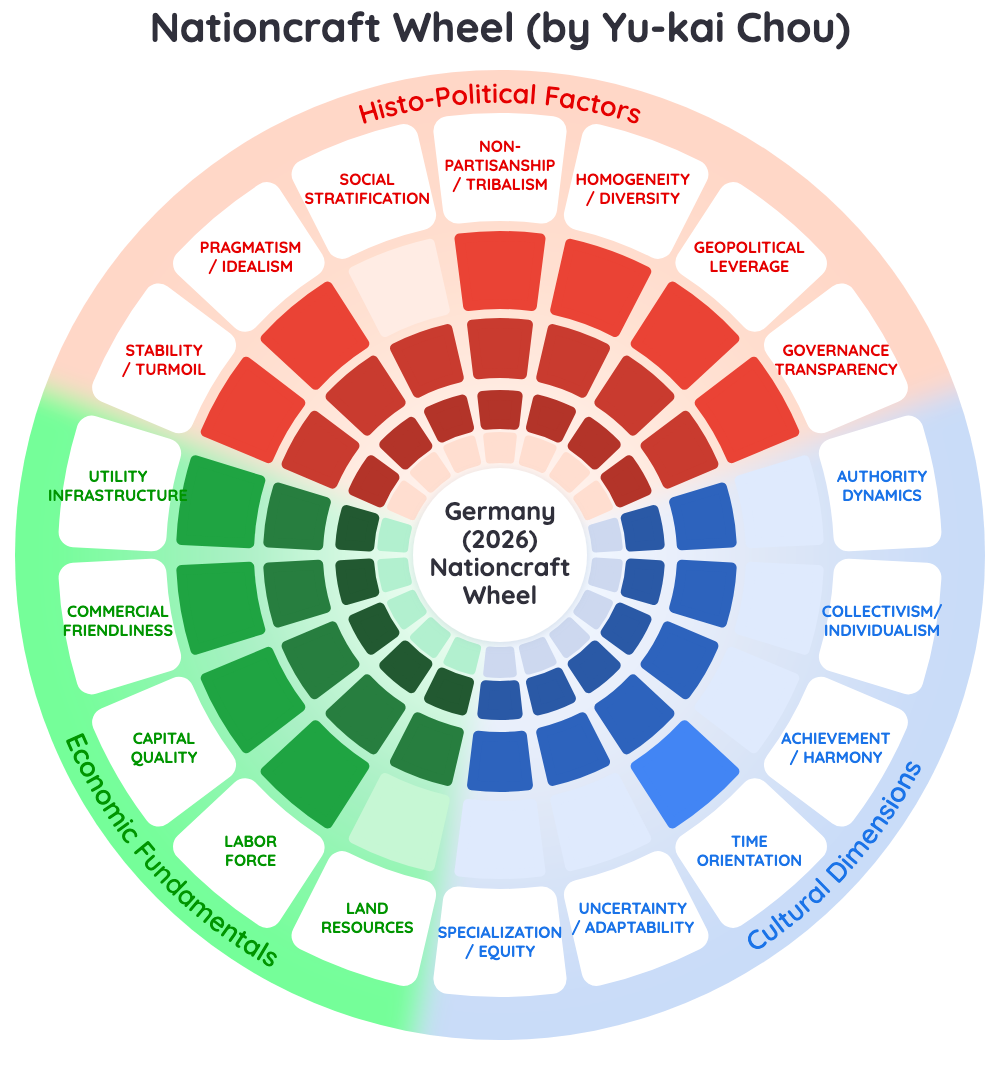

On September 6, voters in Saxony-Anhalt are polling 42 percent for a party every other party has sworn never to govern with. Two weeks later, Mecklenburg-Vorpommern votes, and the same party leads there at 36 percent.
Germany is not a failing state. It runs a 9/10 labor force, a 9/10 capital base, a 9/10 utility backbone, and one of the highest governance-transparency scores in the Nationcraft corpus.
That is what makes the September numbers so strange. The countries that usually produce 40-percent anti-system parties have collapsed currencies, captured courts, or armed men in the streets.
Germany has none of these. What it has is a machine.
I call this configuration the Consensus Machine Trap: a governance operating system deliberately engineered after 1945 to make rapid unilateral change impossible, bolted to an economy that now requires rapid change to survive. The machine still works exactly as designed.
The design is the problem.
The stakes are concrete. A three-year stagnation, an aging Mittelstand, a €500 billion repair bill, and a reform program racing two state elections it is currently losing.
This analysis reads Germany through all 18 Nation Variables, names the trap in the numbers, and tests eleven historical reform packets against the German profile: which ones the Federal Republic should reject no matter how loudly they are advertised, and which three it should actually study before the window narrows further.
⚡ Speed Run Notes
- Germany runs elite economic fundamentals (V15, V16, V17, V18 all at 9) on a consensus operating system built to prevent rapid change. Stagnation is the output, and the AfD surge is the interest payment.
- The corpus’s own founding packet, SP-015 Wirtschaftswunder, cannot be rerun: its preconditions (V7=1, V16=1, V18=2 in 1948) are the exact inverse of Germany’s 2026 profile.
- Merz’s 34-measure July package is real reform at consensus speed: €10 billion in tax relief, pension overhaul, day-one sick notes. Saxony-Anhalt votes September 6 with the AfD at 42 percent.
- Reject the fast-authority packets: Shock Therapy (FP-016), Rogernomics (SP-108), Bukele (SP-064), De Gaulle (SP-103). Each requires an authority concentration Germany’s Basic Law was written to forbid.
- Study the consensus-native packets instead: Wassenaar (SP-112), Flexicurity (SP-113), Hawke-Keating (SP-107). All three turned consensus machinery from a brake into the reform vehicle itself.
- The Nationcraft read: Germany does not need a stronger chancellor. It needs a grand bargain formatted for the machine it already has, shipped before the machine’s legitimacy runs out.
Table of Contents
- Understanding Germany’s Governance Landscape Through Nationcraft
- What Is the Nationcraft Framework?
- Why This Germany Variables Analysis Matters Right Now
- The 18 Germany Nation Variables
- The Consensus Machine Trap
- Detailed Justifications: The Variables Behind the Trap
- Best-Match Historical Packets: Six to Reject, Three to Study
- Strategic Implications
- Governance Strategy Recommendations
- Comparative Context: Germany Among Its Peers
- The Nationcraft Framework in Practice
- Explore More Nationcraft Analyses
- Frequently Asked Questions
About Yu-kai Chou

Yu-kai Chou is a Human-Systems Architect & Behavioral Designer and the creator of the Nationcraft Framework — an 18-variable diagnostic for matching a country’s structural profile to the reform packets that have historically worked under similar conditions. He has consulted for governments in eight nations, including Ukraine, the United Kingdom, the Kingdom of Bahrain, Singapore, Taiwan, the Netherlands, Kazakhstan, and South Korea, and has worked directly with President Zelenskyy’s team on post-war reconstruction priorities for Ukraine.
Chou’s prior framework — the Octalysis Framework — has been applied by LEGO, Microsoft, Porsche, Coca-Cola, Salesforce, and MrBeast, impacting over 1.5 Billion Users. He has taught the methodology at Harvard, Stanford, Yale, Tesla, Google, BCG, and IDEO.
His work has been cited by Harvard, Stanford, MIT, Forbes, Wall Street Journal, Wired, US Department of Energy, NIST, NSF, NCBI, US Department of Education, ClinicalTrials.gov, and Google Scholar — with 3,700+ more academic publications. Explore his books here.

This Germany analysis draws on Chou’s advisory work with governments including the Netherlands and the United Kingdom — two consensus systems that share institutional DNA with Berlin’s — and applies the Nationcraft Framework to the hardest version of the consensus question: what happens when the world’s most successful stability machine has to reform itself under electoral fire.
Understanding Germany’s Governance Landscape Through Nationcraft
Every Nationcraft analysis starts from one premise: policy effectiveness is decided by context-fit, and context can be measured. Germany in 2026 is the sharpest test of that premise in the entire corpus.
Here is the surface picture. The economy shrank 0.5 percent in 2024, grew 0.2 percent in 2025, and is forecast by the European Commission to manage 0.6 percent in 2026.[1]
Registered unemployment has climbed from a 6.0 percent annual average in 2024 to 6.4 percent in July 2026.[2]
Three years of effective standstill in Europe’s largest economy. Meanwhile inflation sits at a manageable 2.8 percent, the sovereign borrows at AAA rates, and the export machine still runs some of the finest engineering on earth.
A conventional country-risk report reads that mix and shrugs: sluggish but stable, hold rating. The Nationcraft read is different, because the framework does not average a nation’s scores.
Configuration is strategy. A country with a 9/10 engine and a 5/10 steering column is a specific kind of system with a specific failure mode, and averaging those numbers into a bland 7 hides exactly the thing that matters.
Germany’s configuration pairs the strongest economic block in the European corpus with a political operating system built for deliberate slowness. Sixteen federal states with real veto power.
Coalition governments as a structural guarantee, near-permanent since 1949. Codetermination boards inside every large firm.
A constitutional debt brake. A constitutional court that strikes down budgets.
None of this is dysfunction. All of it is design, and in 2026 the design is being stress-tested by a force it was never sized for: a stagnation long enough to make voters doubt the machine itself.
What Is the Nationcraft Framework?
The Nationcraft Framework treats a nation the way a systems architect treats any complex product: as a configuration of measurable variables that determines which interventions can succeed.
It scores every country on 18 Nation Variables in three clusters. Cultural Dimensions (V1–V6) describe what the people are like: how they relate to authority, groups, achievement, time, uncertainty, and specialization.
Histo-Political Factors (V7–V13) describe what the situation is like: stability, pragmatism, stratification, tribalism, homogeneity, geopolitical leverage, and transparency. Economic Fundamentals (V14–V18) describe the resource base: land, labor, capital, commercial friendliness, and infrastructure.
Against those profiles, Nationcraft maintains a library of over a hundred historical Success Packets: documented reform programs, from the Meiji Restoration to Denmark’s flexicurity, each tagged with the variable preconditions under which it worked. The framework grew out of the same behavioral-design discipline as the Octalysis Framework, because a nation, like a game economy, runs on motivation under constraints.
The method’s core discipline is negative: before asking what a country should do, establish which famous playbooks its V-vector rules out. Most reform failures in the corpus are context-fit failures.
The policy was fine. The country was wrong.
Why This Germany Variables Analysis Matters Right Now
Timing is the reason this Nationcraft analysis exists now rather than next year. Three clocks are running, and they converge in September.
Clock one is electoral. Saxony-Anhalt votes on September 6, and the final August polling has the AfD at 42 percent against 22 for the CDU.[3]
Mecklenburg-Vorpommern follows on September 20, with the AfD leading at 36 percent.[4] An anti-system party winning a German state outright would be a first in the Federal Republic’s history.
Clock two is legislative. On July 2 the Merz coalition shipped its 34-measure “Programme for Revival and Employment”: roughly €10 billion a year in income-tax relief, a pension overhaul that adds a funded element and points toward a later retirement age, day-one sick-note requirements, and a bureaucracy cut that includes automatic approval of applications left unanswered for four months.[5]
It is the largest structural package since Agenda 2010, and it is racing the electoral clock.
Clock three is demographic and fiscal. The March 2025 constitutional package exempted defense spending above one percent of GDP from the debt brake and created a €500 billion, twelve-year infrastructure fund.[6]
That money now has to convert into rebuilt rail, bridges, and grids faster than the workforce ages out from under the pension system paying for it.
When three clocks converge like this, the Nationcraft question stops being academic. Which reform packets can this specific V-vector actually execute, at this specific speed, without handing the system’s enemies the win?
That question has a wrong answer currently gaining 42 percent of the vote, which is what makes the right answer urgent.
The 18 Germany Nation Variables
Here is Germany’s full Nationcraft scorecard as of August 2026, drawn from the canonical Nation Variables corpus and sanity-checked this week against current Destatis, Federal Employment Agency, and Transparency International data.
| Variable | Score | 2026 Reading |
|---|---|---|
| V1 Authority Dynamics | 5/10 | Rule-following culture atop a constitution engineered against strong leaders |
| V2 Collectivism vs Individualism | 4/10 | Individualist lean wrapped in corporatist institutions |
| V3 Achievement vs Harmony | 6/10 | Engineering achievement culture, tempered by consensus norms |
| V4 Time Orientation | 9/10 | Among the most long-horizon societies ever measured |
| V5 Uncertainty & Adaptability | 5/10 | High uncertainty avoidance; adapts through process, never improvisation |
| V6 Specialization vs Equity | 6/10 | Mittelstand specialization balanced by heavy redistribution |
| V7 Stability vs Turmoil | 9/10 | Elite institutional stability, now carrying visible stress fractures |
| V8 Pragmatism vs Idealism | 8/10 | Ordoliberal pragmatism; coalitions grind ideology into compromise |
| V9 Social Stratification | 5/10 | Contained income inequality, high wealth inequality, tracked schooling |
| V10 Non-Partisanship vs Tribalism | 8/10 | Consensus-first party culture, fraying along the east-west seam |
| V11 Homogeneity vs Diversity | 8/10 | Legacy score; roughly a quarter of residents now have a migration background |
| V12 Geopolitical Leverage | 7/10 | EU anchor economy, dependent on US security and export markets |
| V13 Governance Transparency | 9/10 | CPI 75/100, rank 15 worldwide |
| V14 Land Resources | 5/10 | Modest endowment; no resource rents to hide behind |
| V15 Labor Force Quality | 9/10 | Dual vocational system and engineering depth; aging is the countdown |
| V16 Capital Quality | 9/10 | AAA sovereign, deep capital markets, cheap borrowing capacity |
| V17 Commercial Friendliness | 9/10 | Strong commercial rule of law; bureaucratic latency is the asterisk |
| V18 Utility Infrastructure | 9/10 | World-elite grid reliability; decayed rail and digital administration |
Read the table as two blocks. The bottom five economic variables are almost a clean sweep: V15=9, V16=9, V17=9, V18=9, with only V14=5 reflecting the absence of natural-resource rents.
The top of the table tells a different story. V1=5 means no actor in the system can impose anything.
V4=9 and V7=9 mean the system optimizes for continuity across decades. V10=8 means politics runs on negotiated consensus.
Individually, every one of those scores is an asset. Together, under stagnation, they form a trap with a name.
The Consensus Machine Trap
The Consensus Machine Trap is what happens when a governance system engineered to prevent catastrophic change succeeds so completely that it also prevents necessary change, and the resulting stagnation feeds the very anti-system forces the machinery was built to lock out.
Five variables produce it. V1=5 (Authority Dynamics) distributes power so widely that every major reform needs sixteen states, two coalition partners, the Constitutional Court, and the social partners to say yes.
V10=8 (Non-Partisanship vs Tribalism) makes negotiated agreement the only legitimate mode of politics. V4=9 (Time Orientation) biases every negotiation toward the long-safe option over the fast-necessary one.
V5=5 (Uncertainty & Adaptability) means the electorate punishes improvisation. And V7=9 (Stability vs Turmoil) removes the crisis trigger that forces other nations to move.
This is the German paradox in one sentence: the Federal Republic cannot generate the emergency that reform normally requires, because it engineered emergencies out of the system.
Behavioral science has a name for the individual-level version of this pattern. Status quo bias holds agents to defaults even when the defaults are visibly losing, and Germany’s institutions are status quo bias rendered in constitutional law.
Every veto point is a default-preserver. Every consensus requirement raises the activation energy of change.
The trap has a second jaw. Voters experiencing a stagnating system do not read institutional caution as wisdom; they read it as refusal.
Loss aversion makes a decade of slow relative decline feel like theft, and the party that promises to smash the machine collects the anger. The AfD’s 42 percent in Saxony-Anhalt is not primarily an ideological score.
In Nationcraft terms it is a system-legitimacy invoice, presented to a machine that has been slow-walking its own renewal since roughly 2010.
Compare the extreme case in the corpus: Bosnia’s Dayton Deadlock, where consensus requirements were set so high that the state can barely pass a budget. Germany sits far from that cliff, but on the same road.
The difference is that Germany’s V15/V16/V18 engine keeps generating the surplus that lets everyone pretend the steering still works.
Detailed Justifications: The Variables Behind the Trap
The cultural block (V1–V6): a people optimized for process
Germany’s V1=5 on Authority Dynamics is the most deliberate score in the corpus. Postwar constitutional designers distributed authority across states, courts, coalition partners, and a weak-by-design chancellery precisely because concentrated authority had produced catastrophe.
The score has barely moved in 75 years, and no serious German politician campaigns to raise it.
V2=4 (Collectivism vs Individualism) and V3=6 (Achievement vs Harmony) describe an individualist, achievement-oriented people who nonetheless built corporatist institutions: works councils, sectoral wage bargaining, mandatory chambers. The culture competes hard inside negotiated cages.
V4=9 (Time Orientation) is Germany’s superpower and its sedative. The same long-termism that builds hundred-year Mittelstand firms and funds twelve-year infrastructure programs also tells every finance minister that the pension cliff is a problem for the next government.
V5=5 (Uncertainty & Adaptability) compounds it: the electorate rewards predictability, so leaders sell even urgent reforms as continuity, which caps their speed. V6=6 rounds out the block with a workforce that specializes deeply but expects the state to compress outcomes.
The political block (V7–V13): stability as inheritance and anesthetic
V7=9 (Stability vs Turmoil) is earned: through reunification, the euro crisis, a pandemic, an energy war, and the November 2024 coalition collapse, the Federal Republic never missed a constitutional beat. Even the chancellor investiture of May 2025, the first in FRG history to fail on the opening ballot, resolved within hours through ordinary procedure.
Yet V7=9 is exactly why the Consensus Machine Trap closes. In the Nationcraft corpus, most successful reform packets fired inside a V7 window of 2 to 6: enough turmoil to create a mandate, enough order to execute.
Germany sits outside that window on the calm side. Nothing burns, so nothing forces the bargain.
V8=8 (Pragmatism vs Idealism) is the trap’s best exit ramp. German politics, whatever its speed, converts ideology into workable compromise with unusual reliability.
V10=8 (Non-Partisanship vs Tribalism) still holds at the federal level, where grand coalitions remain formable, but the east-west seam is visibly fraying: the firewall against the AfD is itself becoming the central axis of partisan identity.
V9=5, V11=8, and V13=9 complete the block. Stratification is moderate and mostly wealth-based.
The homogeneity score is a legacy reading under live revision, with roughly 25.6 percent of residents holding a migration background, and integration outcomes now a first-order political variable. Transparency, at CPI 75 and rank 15, remains the machine’s cleanest gauge: whatever Germany decides, it decides in the open.[7]
The economic block (V14–V18): a 9/10 engine idling
Four nines and a five. V14=5 records the absence of resource rents, which in Nationcraft terms is quietly protective: no petro-cushion, so the state must eventually earn its budget through competitiveness.
V15=9 (Labor Force Quality) rests on the dual vocational system that half the OECD has tried to copy. The asterisk is demographic: the median German worker is among the oldest in the developed world, and the skills pipeline is thinning at exactly the moment reindustrialization, defense, and the energy transition all bid for the same engineers.
V16=9 (Capital Quality) is the least-used asset in Europe. A AAA sovereign with deep domestic savings spent fifteen years declining to borrow at negative real rates while its rail network decayed.
V17=9 (Commercial Friendliness) holds for contract law and property rights, with bureaucratic latency as the counterweight: the July package’s four-month automatic-approval rule is the state admitting its own queue times had become a growth constraint.[5]
V18=9 (Utility Infrastructure) is the most double-edged nine in the table. Grid reliability remains world-elite, with outage minutes per customer among the lowest ever recorded.
Meanwhile roughly three in five long-distance trains ran on time in 2024, and a bridge in Dresden fell into the Elbe.[8] The €500 billion fund exists because the machine finally noticed the gap between its two infrastructures: the one it maintained and the one it deferred.
Best-Match Historical Packets: Six to Reject, Three to Study
This is the heart of any Nationcraft analysis. The corpus holds over a hundred Success Packets, each tagged with the variable preconditions under which it actually worked.
Run Germany’s V-vector against the library and the field sorts itself fast.
| Packet | Country / Years | Verdict for Germany | Deciding Variables |
|---|---|---|---|
| FP-016 Yeltsin Shock Therapy | Russia 1991–99 | Reject | Built for institutional vacuum (V7=2, V13=2); Germany’s V13=9 institutions are the asset, never the obstacle |
| SP-108 Rogernomics | New Zealand 1984–93 | Reject | Blitz speed requires Westminster concentration; V1=5 federalism forbids it |
| SP-064 Bukele Security & Digital | El Salvador 2019– | Reject | Requires V1=8 strongman concentration and tolerates V13=3; constitutional anti-matter for Germany |
| SP-103 De Gaulle Trente Glorieuses | France 1958–69 | Reject | Executive planning needs V1=8; the Basic Law was written against exactly this |
| SP-011 1991 Liberalization | India 1991–2010 | Reject | Crisis-mandate packet; V7=9 Germany has no forcing crisis to spend |
| SP-001 Meiji Open Reform | Japan 1868–1912 | Reject | Total institutional replacement under V1=10 deference; nothing transfers |
| SP-015 Wirtschaftswunder | West Germany 1948–63 | Cannot rerun | Germany’s own packet; every precondition (V7=1, V16=1, V18=2) has inverted |
| SP-112 Wassenaar Consensus Labor | Netherlands 1982–95 | Study | V10=8, V13=9, V8=8 near-mirror; consensus machinery as the reform vehicle |
| SP-113 Flexicurity Labor Market | Denmark 1994–2005 | Study | High-trust, transparency-funded flexibility; affordable only at V16=9 |
| SP-107 Hawke-Keating Open Economy | Australia 1983–96 | Study | V7=9, V13=9, V8=8 match; thirteen years of negotiated liberalization |
Reject: FP-016, the Shock Therapy reflex
Whenever a rich country stagnates, someone rediscovers shock therapy. The Yeltsin packet (FP-016) is the corpus’s standing rebuttal: rapid liberalization executed into an institutional vacuum, with V13=2 transparency and V17=2 commercial rule of law, produced oligarch capture and a decade of collapse rather than a market economy.
The packet’s own lesson file says it plainly: institutions must precede liberalization. Germany’s problem is the mirror image of Russia’s 1991 problem.
Its institutions are so strong they meter reform out by the teaspoon. Prescribing shock to a consensus machine misreads which side of the institutions-first lesson Germany sits on.
Reject: SP-108, the Rogernomics blitz
New Zealand’s 1984–93 liberalization is the honest version of the fast-reform fantasy, and its architecture is instructive. Roger Douglas argued reforms must move faster than opposition can organize, and a Westminster system with V1=5 but total cabinet supremacy let him do it: currency float, tariff elimination, state-enterprise corporatization inside a decade.
Germany cannot copy the mechanics. Sixteen Länder, a Bundesrat, coalition partners, and codetermination boards mean opposition is always already organized; that is what V1=5 plus corporatism means in practice.
And the packet’s price tag matters: New Zealand’s Gini jumped from 0.27 to 0.34, and the political resentment reshaped its party system for a generation. A blitz Germany cannot even execute would still hand its resentment dividend to the AfD.
Reject: SP-064, the Bukele temptation
The Bukele packet (SP-064) is on this list because a version of it is on the September ballot. Concentrate authority, suspend procedural niceties, deliver one visible result fast, convert gratitude into permanent power.
It required V1=8 concentration and drove El Salvador’s V13 transparency down to 3 while courts and congress were captured.
Germany’s V13=9 and V1=5 are engineered rejections of that trade. The Nationcraft point worth stating coldly: voters flirting with anti-system parties are implicitly shopping for SP-064, and the only durable counter is a consensus system that visibly delivers.
Chile’s voters ran the same flirtation through the Mano Dura Mirage, and Hungary shows the end state: the Two-Thirds Trap, where one election’s frustration became a constitutional lock.
Reject: SP-103, the De Gaulle planning state
France 1958–69 delivered spectacular growth through indicative planning, nationalized credit allocation, and grandes-écoles technocracy. The packet’s precondition list disqualifies Germany at the first line: V1=8 executive authority, born from the Fourth Republic’s collapse and a general with an emergency mandate.
Germany’s federalism distributes planning authority the way the Fifth Republic concentrated it. Import dirigisme into a V1=5 system and you get plans without executioners: strategy papers, Länder negotiations, and a court date.
The packet also carried a delayed invoice, and May 1968 was its payment. Concentration buys speed and stores resentment.
Reject: SP-011, the crisis-mandate packet
India’s 1991 liberalization is one of the corpus’s cleanest demonstrations that crisis is a resource. Reserves down to two weeks of imports, gold flown to London as collateral, an IMF program dictating the calendar: the emergency manufactured the mandate that forty years of Indian politics had refused to produce.
Germany’s V7=9 means that resource does not exist. There will be no balance-of-payments morning that forces the Bundestag’s hand; a AAA sovereign with deep capital markets can fund its own stagnation indefinitely.
Waiting for the clarifying crisis is therefore a strategy of waiting forever, while the slow-motion legitimacy crisis compounds in the east. Countries like Greece reformed inside a forced Discipline Window; Germany has to build its window by choice.
Reject: SP-001, the Meiji totality
Meiji Japan replaced its entire institutional stack in a generation: domains abolished, classes dissolved, industry imported. The packet ran on V1=10 imperial deference and V11=9 homogeneity, under existential threat from Western fleets in the harbor.
Nothing in that precondition set maps to a federal republic of empowered veto players at V1=5. SP-001 stays in the library as calibration: it marks the far end of the authority spectrum, so that reformers can see how far from it Germany deliberately sits.
The packet Germany cannot rerun: SP-015, its own
The most painful entry in the table is Germany’s own founding packet. The Wirtschaftswunder (SP-015) is one of the most studied programs in the entire Nationcraft corpus: Erhard’s currency reform cutting the money supply by 93 percent in a week, price decontrol announced without Allied permission, the social market economy synthesis, Marshall Plan capital, European integration.
Its precondition profile reads like a photographic negative of 2026. Stability V7=1 against today’s 9.
Capital V16=1 against 9. Infrastructure V18=2 against 9.
Geopolitical leverage V12=1 under occupation against 7 now.
The packet’s lessons file contains the line every German reformer should sit with: among the things that cannot be copied, destruction actually cleared old constraints. In 1948 there were no incumbent processes to defend, no veto players with sunk costs, no consensus machine because there was nothing yet to conserve.
The Federal Republic then spent 75 years building the finest constraint-preservation system in Europe, partly so 1948 could never be needed again.
That is the Consensus Machine Trap stated as inheritance. Germany’s founding miracle is non-replayable by design, and the machinery that guarantees this is the same machinery now metering out reform at 0.2 percent growth per year.
The country does keep one live descendant of SP-015 in the family: the ordoliberal instinct that rules, once agreed, get enforced. The task is aiming that instinct at renewal instead of preservation.
Study: SP-112, the Wassenaar bargain
The Netherlands in 1982 is the closest V-vector cousin to Germany in the entire packet library: V10=8, V13=9, V8=8, V4=7, a consensus polder-model system in visible economic failure. Unemployment at 12 percent, welfare dependency at 27 percent of the working-age population, manufacturing hollowed out by the guilder.
What Wassenaar proved is the single most important sentence for Berlin in this analysis: consensus machinery can be the reform vehicle rather than the obstacle. Unions accepted wage restraint; employers conceded shorter hours and the normalization of part-time work with equal rights; government delivered fiscal repair.
One negotiated pact, held for a decade, and the sick man of Europe of 1982 became the Dutch model of the 1990s.
The transfer conditions check out variable by variable. Germany has the same tripartite hardware (chambers, sectoral bargaining, works councils at V2=4 with corporatist wrapping), the same transparency to make commitments credible at V13=9, and a deeper capital cushion at V16=9 to fund the transition.
What it has lacked is the pact itself: a single named bargain in which each social partner trades its sacred cow for the others’ sacrifices, at national scale, with a decade horizon. The July package is a down payment negotiated inside the coalition; Wassenaar says the durable version is negotiated with the social partners directly.
Study: SP-113, the Flexicurity triangle
Denmark 1994–2005 solved a version of Germany’s labor-market dilemma without breaking its welfare identity. The flexicurity triangle: easy hiring and firing, generous unemployment insurance up to 90 percent replacement for low earners, and mandatory activation with training and job-search obligations.
The packet’s lesson file is precise about why this is a rich-country packet: it costs roughly 1.5 percent of GDP in active labor-market programs alone, and it only works where V13 transparency and social trust keep benefit systems honest. Denmark ran it at V13=10, V15=9, V10=8.
Germany qualifies on every gating variable and is one of the few large economies whose V16=9 can actually fund Danish intensity at scale.
The German application is targeted rather than wholesale: apply the triangle to the structural transition already underway, where engineers and skilled trades must move from combustion-era industries into defense, grid, and rail buildouts. Pay for movement generously, protect the person rather than the job, and make retraining an obligation instead of an offer.
That is a packet the SPD’s base can sign, which under V10=8 consensus rules is a feature of the design.
Study: SP-107, the Accord method
Australia 1983–96 is the scale proof. A commodity-shocked, protection-encrusted economy at 10 percent unemployment and 11 percent inflation liberalized almost everything: floated the currency, cut tariffs from the 15–20 percent range, deregulated finance, decentralized wages.
It did so through the Prices and Incomes Accord, a standing bargain with the union movement that traded wage restraint for the social wage, and it held for thirteen years across five elections.
The variable match to Germany is strong where it counts: V7=9 stability, V13=9 institutions, V8=8 pragmatism, and a federation. Hawke’s method was sequencing macro reform first, so price signals and the currency told the truth, then walking micro reform through the Accord piece by piece, keeping labor inside the tent for the whole ride.
For Berlin the translation is direct. Energy costs, permitting speed, and the investment framework come first, because they reprice everything else.
Labor-market and pension detail follow, negotiated with the social partners under the Wassenaar logic. And the SPD plays the role of Hawke’s union wing: the coalition partner whose presence inside the bargain is what makes the bargain hold.
One corpus warning applies, from Austria’s Social Partnership packet (SP-115): consensus machinery left running without fresh mandates ossifies into patronage, which is the Proporz lesson. The Accord avoided it by re-earning its mandate at every election.
Consensus is a renewable, never a permanent, license.
Strategic Implications
Pull the packet verdicts and the V-vector together and Germany’s strategic position resolves into five implications.
First, speed through the machine beats speed against it. Every rejected packet failed the same test: it assumed authority Germany deliberately does not concentrate. The three study packets pass because each one made V10=8 consensus machinery carry the reform.
Berlin’s binding constraint is bargain design, and treating it as a leadership-willpower problem misdiagnoses the system.
Second, the crisis will not come, so the deadline must be manufactured. V7=9 and V16=9 mean Germany can fund stagnation for decades, which is precisely the trap. The July package’s four-month automatic-approval rule is the embryonic form of the answer: consensus with a shot clock.
Every negotiation in the coming bargain needs a statutory default that fires if the parties stall, because under V4=9 long-termism, undeadlined talks converge on the horizon.
Third, the east is the legitimacy front, and delivery there is priced at a premium. The AfD’s 42 percent in Saxony-Anhalt is regionally concentrated system-exit sentiment.[3] In Nationcraft motivation terms, the machine’s eastern users stopped believing outputs would ever reach them, and abstract federal packages do not repair that.
Visible, dated, east-first delivery from the €500 billion fund (rail links, grid buildouts, industrial sites with names and ribbon-cuttings) is the counter-offer. Sequencing infrastructure through network-aware targeting, the logic of the Nodal Economy Stimulus Model, buys more legitimacy per euro than spreading the fund evenly across sixteen states.
Fourth, the 9/10 economic block is the war chest, and it is currently underdrawn. V16=9 capital at AAA rates, V15=9 labor still inside the demographic window, V18=9 grid reliability as the substrate for reindustrialization. The corpus shows almost no case of a country holding this hand this late into a stagnation.
Denmark spent 1.5 percent of GDP a year on activation alone; Germany’s cushion makes that affordable at scale, and the pension overhaul’s funded element opens the door to the household-capital deepening the system has deferred since the 1950s.
Fifth, the window is measured in electoral cycles, and two close in September. Whatever survives contact with Saxony-Anhalt and Mecklenburg-Vorpommern sets the coalition’s real reform budget through 2029. A machine that produces one more visible bargain before legitimacy prices reset keeps its operating license.
One that produces another committee season pays the Hungary rate.
Governance Strategy Recommendations
Translating the three study packets into a Germany-native program yields six recommendations, each tagged to the variables that make it executable.
| # | Recommendation | Source Packet | Enabling Variables |
|---|---|---|---|
| 1 | Convene a named tripartite pact (a Wassenaar for Germany): unions trade wage moderation and a retirement-age glidepath for training rights and part-time protections; employers commit dated investment; the state delivers the tax and energy floor | SP-112 | V10=8, V8=8, V13=9 |
| 2 | Fund flexicurity at Danish intensity for the combustion-to-defense/grid transition: protect workers, free the jobs, mandate activation | SP-113 | V16=9, V15=9, V13=9 |
| 3 | Sequence macro before micro: energy costs, permitting, and investment framework first; labor and pension detail through the pact second | SP-107 | V8=8, V4=9 |
| 4 | Generalize the shot clock: statutory default outcomes for every stalled approval, negotiation, and planning process, extending the four-month auto-approval rule | July package, SP-107 sequencing logic | V13=9, V5=5 |
| 5 | Run the €500bn fund east-first and node-first, with named, dated, visible projects as legitimacy repayments | SP-112 delivery logic | V16=9, V18=9, V12=7 |
| 6 | Re-earn the mandate every cycle: publish pact scorecards before each state election rather than after federal ones, avoiding the Austrian Proporz drift | SP-115 (negative lesson), SP-107 | V13=9, V10=8 |
Notice what is absent. No chancellor-empowerment act, no emergency framework, no imported strongman mechanics.
Under this V-vector those are fantasy purchases, and the September electorate flirting with them is being offered a packet (SP-064) whose corpus results include captured courts and a transparency collapse.
The recommendations also answer the motivation question underneath the politics. In Octalysis terms, a population deep in stagnation loses Core Drive 2: Development & Accomplishment, the sense that effort moves the needle, and drifts toward Core Drive 8: Loss & Avoidance, voting to punish rather than to build.
Named bargains with dated, visible wins are how a system returns accomplishment to its citizens’ loops. That mechanism is the same whether the system is an app or a federal republic, which is the deeper point of reading statecraft through a motivation lens.
Comparative Context: Germany Among Its Peers
Germany’s trap becomes clearest against the four neighboring diagnoses already in the Nationcraft library.
| Country | Named Pattern | Shared Variables | The Instructive Difference |
|---|---|---|---|
| Japan | Long-Horizon Trap | V4=9, V7 high, aging V15 | Thirty years further into consensus deferral; shows the terminal fare on the road Germany is driving |
| France | Fragmentation Trap | V15/V16 elite, stagnation politics | Lost its consensus machinery; Germany’s V10=8 is an asset France no longer holds |
| Poland | Liberum Veto Trap | Veto-dense institutions | Veto points weaponized by partisan blockade; Germany’s version is consensual, which is why it is curable |
| United Kingdom | Compact Fracture | Stagnation-driven insurgent surge | Majoritarian speed without consensus brakes; the opposite failure, and no better outcomes |
Japan’s Long-Horizon Trap is the closest cousin: the same V4=9 patience metabolizing into deferral, three decades further along. It stands as Germany’s memento mori.
Deflationary consensus does not collapse; it politely compounds.
France’s Fragmentation Trap inverts the diagnosis. Paris kept the strong executive Germany refuses and lost the consensus substrate Germany retains, and its reform attempts now detonate in the street.
The pairing is the strongest evidence in Europe that Germany’s problem is soluble: Berlin still owns the machinery a bargain needs.
Poland’s Liberum Veto Trap shows veto density under partisan warfare, vetoes as weapons rather than as consensus instruments. Germany’s V10=8 keeps its veto points cooperative for now; the fraying east-west seam is what Polish-style escalation would look like in year one.
And the United Kingdom’s Compact Fracture disposes of the fantasy that Germany’s cure is majoritarian speed. Westminster can pass in a week what Berlin negotiates for a year, and its stagnation-bred insurgency is polling at German levels anyway.
Speed without bargains buys churn, and bargains are the one thing Germany’s hardware does best.
The Nationcraft Framework in Practice
This Germany study runs the same Nationcraft method as every analysis in the series: score the 18 variables against current evidence, find the interaction that forms a named pattern, then test the packet library against the profile instead of against fashion.
The method’s value shows in what it refuses. A dozen op-ed prescriptions for Germany died on contact with the V-vector in this analysis, exactly as the Venezuela reform playbooks study rejected eight before finding three that fit.
Different country, different trap, same discipline: context-fit first, policy second.
It also travels. The same variable logic that stress-tested Singapore’s LKY packet against 2026 conditions, and that frames the reconstruction sequencing behind reSTATE’s work on Ukraine, is what sorted Germany’s eleven candidate packets here.
A framework earns the name only when it produces different answers for different configurations, and Germany’s answer (consensus-native bargains on a manufactured deadline) belongs to Germany alone.
Explore More Nationcraft Analyses
The full library of Nationcraft country analyses now covers more than sixty nations, each with its 18-variable scorecard and named pattern.
Adjacent to this study: Vietnam’s Double-Digit Decree examines a state commanding growth targets Germany’s machine could never decree, and Bulgaria’s Borrowed Anchor Trap shows a system outsourcing the discipline Germany generates internally. For the security dimension pressing on Berlin’s budget, Turkey’s Strongman Discount prices the alternative governance model at the EU’s edge.
Related Reading
- The Nationcraft Framework — the 18 variables, 8 goals, and packet library behind this analysis
- Nationcraft Country Analyses Library — every published scorecard in one place
- South Korea: The Post-Martial Trap — a high-capability democracy stress-testing its own stability machinery
- USA Nation Variable Analysis — the American Paradox read through the same 18 variables
- Ukraine Nation Variable Analysis — the Spartan Paradox and wartime variable dynamics
Frequently Asked Questions
What is the Consensus Machine Trap?
It is the Nationcraft pattern in which a governance system engineered to prevent rapid change (Germany’s V1=5 distributed authority, V10=8 consensus politics, V4=9 long-termism, V7=9 stability) succeeds so completely that it also blocks necessary renewal. The resulting stagnation then feeds anti-system parties, threatening the machine’s own legitimacy from a direction its designers never armored.
Why can’t Germany just repeat the Wirtschaftswunder?
Because every precondition of its founding packet (SP-015) has inverted. In 1948 Germany ran V7=1 turmoil, V16=1 destroyed capital, and V18=2 rubble infrastructure, and that destruction cleared the constraints reform normally fights.
The 2026 profile is V7=9, V16=9, V18=9: a system with everything to conserve and a machine built to conserve it. The miracle is non-replayable by design.
Is the AfD surge mainly an economic phenomenon?
The Nationcraft read treats it as a system-legitimacy invoice rather than a simple recession response. Three years of stagnation (GDP −0.5 percent in 2024, +0.2 percent in 2025) interacted with V4=9 institutional patience to convince parts of the electorate, concentrated in the east, that the machine will never deliver for them.
The 42 percent Saxony-Anhalt polling is priced in legitimacy, which is why visible, dated, east-first delivery is the recommended counter rather than rhetoric.
Which historical reform packets actually fit Germany’s profile?
Three: the Netherlands’ Wassenaar consensus labor bargain (SP-112), Denmark’s flexicurity triangle (SP-113), and Australia’s Hawke-Keating Accord sequence (SP-107). All three ran on variable profiles Germany matches (high V10 consensus, high V13 transparency, high V8 pragmatism) and all three made consensus machinery carry the reform.
The rejected list includes Shock Therapy (FP-016), Rogernomics (SP-108), the Bukele packet (SP-064), De Gaulle planning (SP-103), India’s crisis-mandate liberalization (SP-011), and Meiji total replacement (SP-001).
What are Germany’s strongest Nation Variables in 2026?
The economic block: V15=9 labor force quality, V16=9 capital quality, V17=9 commercial friendliness, and V18=9 utility infrastructure, alongside V13=9 governance transparency and V4=9 time orientation. That combination is close to unmatched in the corpus, which is exactly why the binding constraint sits in the political operating system rather than in the fundamentals.
Footnotes
- Destatis (Federal Statistical Office), national accounts: GDP −0.5% (2024), +0.2% (2025); European Commission Spring 2026 forecast +0.6% (2026). destatis.de — National Accounts
- Federal Employment Agency / Destatis labour market data: registered unemployment 6.0% (2024 avg), 6.3% (2025 avg), 6.4% (July 2026). destatis.de — Labour Market
- Infratest dimap state poll, Saxony-Anhalt, 25 August 2026: AfD 42%, CDU 22%, Linke 11%, SPD 8%, BSW 4%; election scheduled 6 September 2026. Wikipedia — 2026 Saxony-Anhalt state election
- INSA state poll, Mecklenburg-Vorpommern, 13 August 2026: AfD 36%, SPD 29%, Linke 11%, CDU 10%; election scheduled 20 September 2026. Wikipedia — 2026 Mecklenburg-Vorpommern state election
- Coalition committee, “Programme for Revival and Employment,” 2 July 2026: 34 measures, ~€10bn/year income-tax relief phased to 2028, pension overhaul with funded element, day-one sick-note rules, four-month automatic approvals, 8% ministry staffing reduction via digitization. Al Jazeera, 2 July 2026; PwC Legal analysis, July 2026
- March 2025 Basic Law amendment: defense spending above 1% of GDP exempted from the debt brake; €500bn special infrastructure fund over 12 years. Wikipedia — Debt brake (Germany)
- Transparency International, Corruption Perceptions Index 2024: Germany 75/100, rank 15. transparency.org — Germany
- Deutsche Bahn long-distance punctuality 62.5% (2024); Carola Bridge partial collapse, Dresden, September 2024. Wikipedia — Deutsche Bahn; Wikipedia — Carola Bridge