

In August 2025, Bosnia and Herzegovina did something it had never done in thirty years of independence. Its central election commission stripped the president of one of its two constituent entities, Republika Srpska, of his mandate, enforcing a court verdict that had convicted Milorad Dodik of defying the country’s international overseer and banned him from office for six years.1 For a moment it looked like the Bosnian state had finally asserted itself over the man who had spent a decade threatening to break it apart. Then the other half of the story arrived. In November 2025, a snap election in Republika Srpska replaced Dodik with his own hand-picked ally, who promptly pledged to carry the secessionist project forward with even greater force, while the entity’s parliament declared that it no longer recognized the overseer’s authority at all.2
Nothing had moved. A leader was removed and the movement he built simply reassembled behind a new face, still holding the same veto over the same state, still able to stop the country from functioning without ever having to govern it. Ten months later, Bosnia is heading into a general election scheduled for 4 October 2026, and the shape of that contest is the shape of the last thirty years: three peoples, two entities, one settlement that ended a war and froze everything else in place.5
This is the pattern the Nationcraft Framework calls the Dayton Deadlock. The 1995 Dayton Agreement stopped one of the worst wars in modern European history by guaranteeing that no ethnic group could ever again be outvoted into submission. It handed each people a veto. Three decades on, that veto is the reason the country cannot reform its constitution, pass the laws the European Union demands, or assemble a government capable of a long-term decision. The trait that bought the peace is the trait that now blocks the peace from becoming a functioning state. Bosnia is not failing. It is frozen, and the freezing is by design.
⚡ Speed Run Notes
- Bosnia’s Nationcraft signature is entrenched fragmentation: V10 = 2 tribalism, V11 = 2 diversity without integration, V7 = 4 turmoil, V16 = 2 weak capital, and a central authority (V1 = 5) any entity or people can veto.
- The corpus reads Dayton as a textbook prevention of the Ethnic Fragmentation Cascade (SC-001): power-sharing plus an external guarantee stopped the war. The cost was Governance Paralysis (ST-003), a stable deadlock.
- Peace and function are different achievements. The 2025 removal of Milorad Dodik left the veto untouched, and Republika Srpska’s rejection of the High Representative is the sharpest stress on Dayton since the war.
- Every centralizing packet on offer, from Rwanda to Singapore to Bukele, needs a single commanding center Bosnia’s whole constitution was written to prevent. They do not misfire here; they cannot even be attempted.
- What fits is the External Anchor (RE-003): Croatia’s EU discipline (SP-068), North Macedonia’s Prespa breakthrough (SP-091), Spain’s pacted autonomy (SP-017). The proof is at home in the euro-pegged currency board.
Table of Contents
- Understanding Bosnia’s Governance Landscape Through Nationcraft
- What Is the Nationcraft Framework?
- Why This Bosnia Variables Analysis Matters
- What Bosnia Actually Looks Like in Numbers
- The 18 Bosnia Nation Variables
- Detailed Justifications: Reading the Variables That Matter
- The Dayton Deadlock
- Three Patterns: Fragmentation, Paralysis, and the Anchor
- Reformer Playbooks Bosnia Should Reject
- Reformer Playbooks Bosnia Should Actually Study
- Governance Strategy Recommendations
- Comparative Context
- What This Means Practically for Bosnia
- The Nationcraft Framework in Practice
- Explore More Nationcraft Analyses
- Related Reading
- Frequently Asked Questions
- Footnotes
About Yu-kai Chou

Yu-kai Chou is a Human-Systems Architect & Behavioral Designer and the creator of the Nationcraft Framework — an 18-variable diagnostic for matching a country’s structural profile to the reform packets that have historically worked under similar conditions. He has consulted for governments in eight nations, including Ukraine, the United Kingdom, the Kingdom of Bahrain, Singapore, Taiwan, the Netherlands, Kazakhstan, and South Korea, and has worked directly with President Zelenskyy’s team on post-war reconstruction priorities for Ukraine.
Chou’s prior framework — the Octalysis Framework — has been applied by LEGO, Microsoft, Porsche, Coca-Cola, Salesforce, and MrBeast, impacting over 1.5 Billion Users. He has taught the methodology at Harvard, Stanford, Yale, Tesla, Google, BCG, and IDEO.
His work has been cited by Harvard, Stanford, MIT, Forbes, Wall Street Journal, Wired, US Department of Energy, NIST, NSF, NCBI, US Department of Education, ClinicalTrials.gov, and Google Scholar — with 3,700+ more academic publications. Explore his books here.

I have spent years advising governments on why reforms hold in one country and shatter in another, and Bosnia is the case that most sharply separates two things people usually confuse: ending a war and building a state. The reflex is to grade Bosnia by whether the peace has held, and by that test Dayton is one of the great successes of modern diplomacy. But the framework forces the harder question. What do you do with a peace that works so well at preventing war that it also prevents governing? Bosnia is not a story about whether power-sharing can stop killing. It is a story about what power-sharing costs once the killing has stopped, and that is the more useful thing for any divided country to understand before it copies the model.
Understanding Bosnia’s Governance Landscape Through Nationcraft
Bosnia and Herzegovina is usually described in one of two registers, and the two rarely meet. The first is a triumph of peace: a country that survived the worst atrocity in Europe since the Second World War, ended it through a negotiated settlement, and has not returned to war in three decades. The second is a portrait of dysfunction: the most complicated government structure on earth, a state that cannot pass a budget without a crisis, an economy shedding its young people faster than almost any country in the world. Both registers are accurate. The Nationcraft read begins by insisting that they are not describing two different countries. They are two descriptions of a single variable profile, and the peace and the paralysis come from the same source.
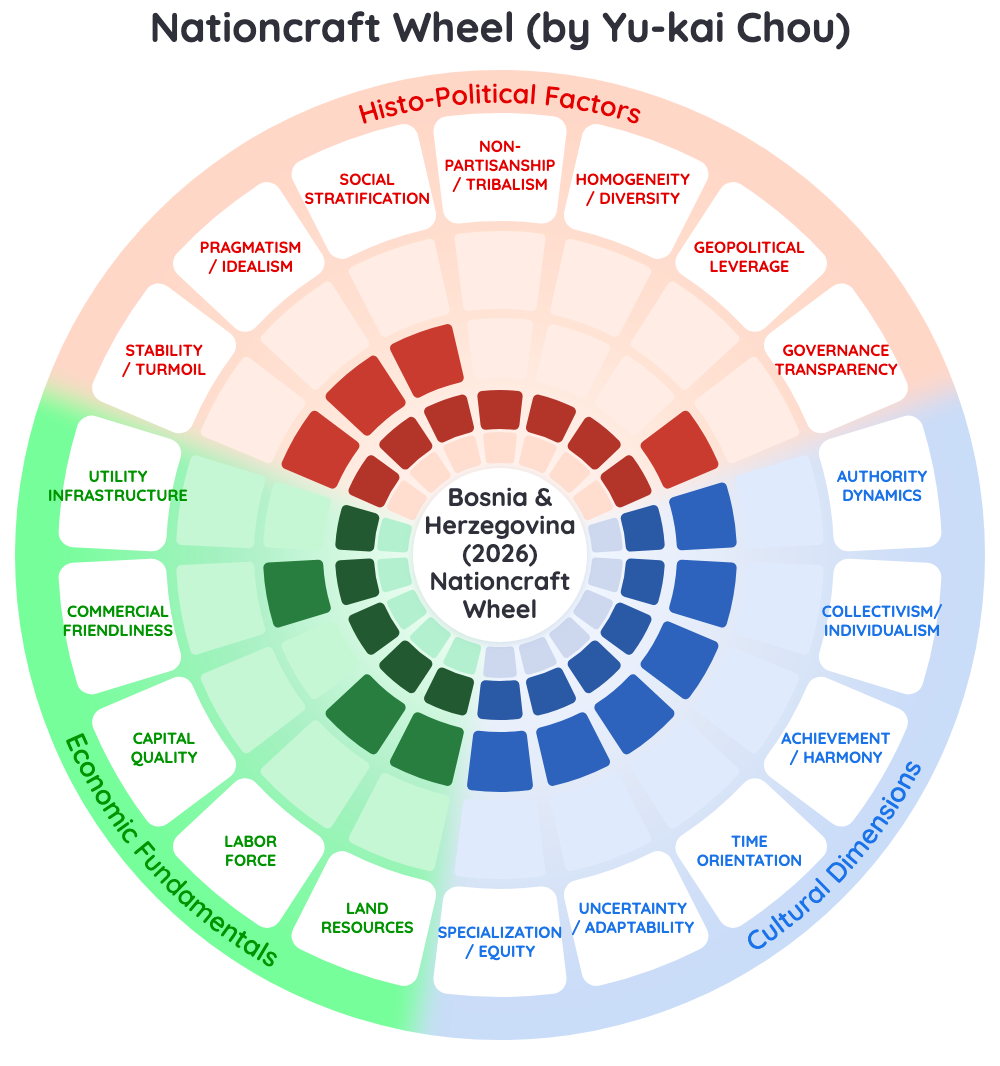
The framework treats a country as a configuration of eighteen structural variables, and its first discipline is to refuse to average them. Bosnia’s profile is not the story of a country doing moderately well on balance. It is the story of a very specific architecture. The variables that measure social cohesion sit at the floor of the scale: an ethnic-bloc politics scored at V10 = 2 and a diversity without integration scored at V11 = 2. Sitting on top of them is a nominal central authority scored at V1 = 5 that, in practice, any of the two entities or three constituent peoples can stop. Those numbers do not blend into a mediocre state. They describe a country engineered so that no group can dominate another, which is exactly what a country emerging from ethnic cleansing needs and exactly what makes it ungovernable afterward.
What makes 2026 the year to run the analysis is that both halves of the profile hit a landmark within a single cycle. The state-authority half produced a genuine assertion of central power in 2025, when the courts and the election commission removed Republika Srpska’s president for defying the international overseer. The fragmentation half answered almost immediately, when the same entity replaced him with an ally and formally rejected the overseer’s legitimacy, and it will answer again at the ballot box on 4 October 2026. The framework’s task is to explain how a country can be this good at keeping the peace and this stuck at everything else, and to say what, if anything, converts a frozen settlement into a state that can move.
What Is the Nationcraft Framework?
The Nationcraft Framework is an 18-variable diagnostic for nation-states. Each variable, labeled V1 through V18, captures one structural dimension of how a country actually behaves: how power concentrates and is checked (V1 Authority Dynamics), how much a culture prizes the group over the individual (V2 Collectivism), how partisan or cohesive its politics are (V10 Non-Partisanship versus Tribalism), how integrated its diversity is (V11 Homogeneity versus Diversity), how stable it is under stress (V7 Stability versus Turmoil), how much leverage it holds over the outside world (V12 Geopolitical Leverage), and on through time orientation, transparency, land, labor, capital, commerce, and infrastructure.
The point of the framework is not to rank countries. It is to match them. A reform packet that transformed one nation routinely fails in another, and the framework’s claim is that these failures are predictable: a packet works when the target country’s variables resemble the variables of the place where the packet first succeeded. A centralizing modernization drive needs a center. A pacted transition needs the raw material for pacts. An external-anchor reform needs a credible anchor and a country willing to be pulled by it. Import a template built for a different configuration and it does not merely underperform. It fails structurally, because it assumes capacities the country’s architecture does not permit.
So every Nationcraft analysis ends with two questions. Which historical packets fit this country’s variables, and which famous packets will break against them? Bosnia is an unusually clean case, because its architecture forbids an entire family of reforms outright. Any packet that runs through a single commanding executive collides immediately with a constitution whose entire purpose is to prevent a single commanding executive from existing. The framework grew out of the same behavioral-design work behind Octalysis and public policy: what determines whether a reform holds is motivation and structure, not the elegance of the plan on paper. In Bosnia the structure is the whole story.
Why This Bosnia Variables Analysis Matters
Bosnia matters as the reference case for a question every divided society eventually faces: what does a power-sharing peace cost once the war is over? Consociational settlements that hand each group a veto have been proposed or imposed everywhere from Northern Ireland to Iraq to Lebanon, and Bosnia is the purest and longest-running experiment in the form. Studying it is how you learn what the model buys and what it takes away. The optimistic reading is that Dayton proved a veto peace can hold for thirty years. The Nationcraft reading is more careful, because holding for thirty years is exactly the problem: the settlement is stable, and its stability is what prevents it from evolving into a normal state.
The framework sharpens the stakes by refusing to let the peace stand in for a cure. Plenty of countries have ethnic divisions, or weak central authority, or high emigration. What decides the trajectory is the interaction of the variables, not any one of them. Bosnia’s tribalism (V10 = 2) is deep enough to make every issue an ethnic issue, but the external guarantee installed at Dayton keeps it from tipping into the violence it produced in the 1990s. Its central authority (V1 = 5) exists on paper but is vetoable in practice, so it can neither reform the state nor abandon the field. Its capital base (V16 = 2) is too weak to give its skilled young people (V15 = 6) a reason to stay, so the country empties out year by year. The analysis exists to answer what happens when a country succeeds completely at the defensive task of not fighting and fails completely at the constructive task of governing, which is the exact condition Bosnia has occupied since the guns fell silent.
What Bosnia Actually Looks Like in Numbers
Before the variables, the ledger, because Bosnia’s ledger cuts against the disaster narrative. This is not a collapsing economy. Real GDP grew about 2.1% in 2025, down from the year before but still positive, with inflation running near 4% and unemployment easing to roughly 11%.34 GDP per capita sits near $10,800, firmly middle-income, and public debt is a moderate 28% of GDP. The single most impressive fact in the whole macro picture is the currency: the convertible mark has been locked to the euro through a rigid currency board since 1998, and it has delivered price stability across thirty years of political chaos because it was deliberately placed beyond the reach of politics. That one detail is the key to the entire analysis, and the rest of this piece returns to it.
The strain that matters does not show up in the growth figures. It shows up in the demographics and the deadlock. Bosnia is losing its people: the population has fallen from roughly 4.4 million before the war to around 3.2 million, and the outflow is heaviest among exactly the young, educated workers the economy most needs, a haemorrhage the IMF and World Bank both flag as the central medium-term threat to the tax base and the labor force.3 Politically, the country runs on a permanent low-grade crisis: a state government that can take a year to form, entity leaders who periodically threaten to withdraw from national institutions, and an international High Representative who still, thirty years on, imposes laws the domestic system cannot pass for itself.7
The table below translates that split into the Nationcraft variables it stresses. Each row is a headline fact mapped to the structural score it moves, and those scores are what the rest of the analysis runs on.
| 2026 indicator | Reading | Nationcraft variable stressed |
|---|---|---|
| Entity veto politics | RS president removed in 2025, replaced by an ally who pledges more secession; RS rejects OHR | V10 Non-Partisanship vs Tribalism = 2 |
| Three constituent peoples | Bosniak, Serb, Croat blocs with no majority; identity governs every institution | V11 Homogeneity vs Diversity = 2 |
| State authority | Two entities, tripartite presidency, OHR Bonn Powers above all; nominal but vetoable | V1 Authority Dynamics = 5 |
| Emigration | Population down from ~4.4M to ~3.2M; heaviest among the young and skilled | V16 Capital Quality = 2 |
| Currency board | Convertible mark pegged to the euro since 1998; the one un-vetoable institution | V8 Pragmatism vs Idealism = 6 |
| EU path | Candidate since December 2022; negotiations conditional and stalled on rule-of-law reform | V12 Geopolitical Leverage = 3 |
| Recurrent crisis | State government slow to form; secession threats; still under international oversight | V7 Stability vs Turmoil = 4 |
The 18 Bosnia Nation Variables
Here is the full Nationcraft profile for Bosnia and Herzegovina in 2026. Scores run on the framework’s standard nine-point scale, where low numbers mark a structural weakness on that dimension and high numbers mark a strength or an intensity. Read the vector as a shape, not a report card. Bosnia’s shape is a competent, skilled, currency-stable body wrapped around a politically frozen core, with the two social-cohesion variables sitting at the very bottom of the scale and dragging everything else.
| Variable | Score | One-line reading |
|---|---|---|
| V1 Authority Dynamics | 5 | Nominal central authority that any entity or people can veto; real power sits with the entities and the OHR |
| V2 Collectivism vs Individualism | 6 | Strong solidarity inside each ethnic group; weak civic bond across them |
| V3 Achievement vs Harmony | 5 | Post-war survival orientation; ethnic division caps cooperative achievement |
| V4 Time Orientation | 5 | Backward-looking politics of grievance crowds out the distant EU horizon |
| V5 Uncertainty & Adaptability | 5 | Society absorbs shocks; institutions frozen by veto adapt slowly |
| V6 Specialization vs Equity | 5 | Large public sector, clientelist distribution running along ethnic lines |
| V7 Stability vs Turmoil | 4 | Peace held thirty years, but recurrent secession crises keep it turbulent |
| V8 Pragmatism vs Idealism | 6 | Elites bargain pragmatically over spoils; nationalism is the ideological overlay |
| V9 Social Stratification | 5 | Moderate; ethnic patronage and clientelism matter more than class tiers |
| V10 Non-Partisanship vs Tribalism | 2 | The anchor weakness: politics is ethnic bloc, and the vetoes are constitutional |
| V11 Homogeneity vs Diversity | 2 | Three constituent peoples, no majority, diversity without integration |
| V12 Geopolitical Leverage | 3 | Small, dependent, still externally supervised; little leverage of its own |
| V13 Governance Transparency | 5 | Mid at best; corruption entrenched by patronage across both entities |
| V14 Land Resources | 4 | Modest: hydropower, some minerals, arable land; no windfall to fight over |
| V15 Labor Force Quality | 6 | Literate and skilled, and leaving; the asset the country is exporting |
| V16 Capital Quality | 2 | Shallow capital, FDI-poor, drained by emigration; the hard economic constraint |
| V17 Commercial Friendliness | 4 | Regulation fragmented across entities; costly to operate as one market |
| V18 Utility Infrastructure | 3 | Aging and duplicated across entities; grid and logistics gaps |
Detailed Justifications: Reading the Variables That Matter
Eighteen variables define the profile, but five of them do the analytical work in Bosnia’s case. They are the ones that explain how a country can keep its peace so reliably and govern itself so poorly.
V10 Non-Partisanship vs Tribalism (2): the variable that runs the whole story
Bosnian politics is not partisan in the ordinary sense; it is ethnic, and the ethnicity is written into the constitution. Seats, ministries, the presidency itself are apportioned among Bosniaks, Serbs, and Croats, and each bloc holds a formal veto over decisions it deems to threaten its “vital national interest.” The corpus scores this as V10 = 2, near the floor, and it is the direct cause of the Dayton Deadlock. A tribalism this deep and this institutionalized does two things at once. It supplies the permanent friction that makes every budget, every census, every judicial appointment a national crisis, because each is scored as a win or loss for an ethnic group rather than for the country. And it guarantees that removing any single leader changes nothing, because the veto belongs to the ethnic bloc rather than to any individual. Strip Milorad Dodik of office and Republika Srpska simply elects another Serb nationalist who inherits the identical veto. A V10 = 2 is not background noise in Bosnian politics. It is the operating system, and every other variable runs on top of it.
V11 Homogeneity vs Diversity (2): diversity without a roof over it
Bosnia is genuinely, deeply plural: three constituent peoples, two alphabets, three national narratives, and no group that comes close to a majority. That plurality is a fact to be respected, not a flaw. The V11 = 2 does not mark the diversity itself as the problem. It marks the absence of any integrating layer above it, any shared civic identity that a Bosnian of any background could stand inside without ceasing to be Bosniak, Serb, or Croat. Other diverse countries built that roof: the framework’s own counter-examples note that Tanzania scores a functional V10 = 5 despite a fragmented V11 = 2 because Nyerere constructed a national identity that transcended tribe. Bosnia never got the chance, because the settlement that ended its war locked each identity into a separate constitutional compartment before any shared one could form. The result is a country that is diverse in the way a building with three tenants and no shared lobby is diverse: everyone has a home, and no one has a house.
V1 Authority Dynamics (5): the power that is real on paper and vetoable in practice
This is the variable most easily misread, and the corpus itself carries a tension worth naming. The Nation Variables dataset scores Bosnia’s authority at V1 = 5, a middling reading, while the country’s own historical packet scores it lower, at 3. Both are pointing at the same reality from different angles. There is a state on paper, with a presidency, a council of ministers, a central bank, and a constitutional court, which is why the nominal score is not lower. But almost none of that authority is exercisable without the consent of both entities and all three peoples, and above the entire structure sits an international High Representative who can still impose or annul laws by decree. So the effective, usable central authority is far weaker than a 5 suggests. The practical reading is that Bosnia has the form of a state and the reflexes of a standoff. When the 2025 courts removed an entity president, that was the paper authority asserting itself. When the entity rejected the ruling and elected his ally anyway, that was the vetoable reality reasserting itself right back. The variable that should let a country govern is present in name and neutralized in function.
V16 Capital Quality (2): the constraint that empties the country
Underneath the political story runs an economic one that the politics keeps making worse. Bosnia’s capital base is thin. Its financial markets are shallow, foreign direct investment is chronically low for the region, and the fragmentation of regulation across two entities means a company that wants to operate nationally faces two of everything. A V16 = 2 is the hard floor of the profile, and it interacts with the country’s one clear asset, a skilled and literate workforce scored at V15 = 6, to produce the most damaging feedback loop Bosnia faces. The country educates capable young people and then offers them a stagnant, patronage-clogged economy with few good jobs, so they leave, mostly for Germany and Austria and Croatia. Their departure thins the capital base further, which worsens the opportunities, which drives the next cohort out. The framework files this exact loop as the Brain Drain Spiral, and Bosnia is one of its clearest active cases. The veto freezes the politics; the emigration hollows the demographics; and the two reinforce each other, because a shrinking, aging country has even less capacity to break a political deadlock than a growing one.
V7 Stability vs Turmoil (4): stable enough not to collapse, unstable enough never to settle
Bosnia’s stability score sits at 4, and the number captures a precise and unusual condition. The country has not returned to war in thirty years, which is a genuine and hard-won achievement that should never be minimized. But it has also never reached the calm of a settled state. It lives in a permanent middle register of crisis: secession threats that flare and subside, national institutions that entity leaders periodically boycott, a state government that can take the better part of a year to assemble after an election. The V7 = 4 marks a country held above collapse by external guarantees and below normal function by its own internal veto. That is not a transitional phase on the way somewhere. It is the equilibrium, and recognizing it as an equilibrium rather than a passing turbulence is the single most important adjustment the framework asks a reader to make about Bosnia.
Set those five readings together and the shape resolves. Bosnia has the skilled labor (V15 = 6), the monetary discipline (a euro-pegged currency board), and the survived-a-war resilience that should let a country build itself into something. What it carries underneath is a politics frozen into ethnic compartments (V10 = 2, V11 = 2), a central authority that is real in form and vetoed in practice (V1 = 5), and a capital base too weak to hold its own people (V16 = 2). Its great achievement, keeping the peace, is real and permanent. Its great failure, becoming a functioning state, is the thing that achievement cannot deliver on its own, because the very mechanism that keeps the peace is the mechanism that blocks the function.
The Dayton Deadlock
Here is the paradox stated plainly. The Dayton settlement’s power-sharing veto is effective enough to guarantee that no ethnic group is ever again outvoted into another war, and that same veto is the reason no government can be assembled to reform, modernize, or advance the country. The trait that should reassure everyone, a peace so secure that each people is constitutionally protected from the others, has trapped Bosnia in a permanent stalemate. Keeping the war away froze the country in place instead of letting it heal, because the instrument of the peace is a mutual veto, and a mutual veto is by definition an instrument for stopping things.
The mechanism is a loop with three steps. Step one is the design. To end a war of ethnic cleansing, Dayton had to convince three terrified peoples that they could lay down their arms without being dominated by the others, and the only credible guarantee was to give each of them the power to block anything that threatened it. That was the correct decision in 1995; it stopped the killing. Step two is the freeze. That same blocking power, carried into peacetime, means every reform that would strengthen the central state reads to at least one group as a threat to its autonomy, and so gets vetoed. Constitutional reform, a single national judiciary, the property and election-law changes the EU requires: each one dies in the veto, not because it lacks merit but because merit is not how a veto decides. Step three is the regeneration, and it is the part that turns a settlement into a trap. Because the veto belongs to the ethnic bloc and not to any individual, no election and no prosecution can dissolve it. Remove Dodik and Republika Srpska elects Karan; the face changes and the veto is inherited intact, ready to freeze the next reform exactly as it froze the last.
What makes the loop tighten rather than merely repeat is that the external guarantee meant to hold the peace has become another object of the fight. The Office of the High Representative was installed to backstop Dayton, with power to impose laws when the domestic system deadlocks. For years that was the release valve. But an overseer who imposes what one group refuses becomes, in that group’s account, an occupier, and Republika Srpska’s leadership has now made rejecting the High Representative’s authority the centerpiece of its politics, passing laws to bar his decisions and declaring his office illegitimate.27 So the mechanism designed to break the deadlock has itself been pulled into the deadlock. That is the Dayton Deadlock in full: not a failure of the peace, but a success at peace so complete, and so permanent, that it has become the country’s ceiling. Bosnia keeps winning the argument it settled in 1995, and the prize for winning is to keep having it.
Three Patterns: Fragmentation, Paralysis, and the Anchor
The Nationcraft corpus keeps a library of historical patterns, each keyed to a variable signature. Bosnia sits on three of them in sequence, and reading them in order is the clearest way to see how the country got here and where the exit is. One pattern was successfully prevented, one is the trap that prevention landed the country in, and one is the only documented way out.
| Pattern | Signature (corpus) | Bosnia’s scores | Match? |
|---|---|---|---|
| SC-001 Ethnic Fragmentation Cascade | V10 ≤ 2, V11 ≤ 3, V7 ≤ 4 | V10 = 2, V11 = 2, V7 = 4 | Full-signature match; the 1990s war. Prevented since by consociationalism plus an external guarantee, exactly as the corpus prescribes |
| ST-003 Governance Paralysis | V10 ≤ 3, unstable but not collapsing (V7 4–6) | V10 = 2, V7 = 4, veto-driven rather than ideological | Yes: the current equilibrium; a stable deadlock that does not self-correct |
| RE-003 External Anchor | V12 ≤ 5, plus a credible path to membership | V12 = 3, EU candidate since 2022 | The exit, if and only if the anchor is credible and the entities accept it |
The SC-001 match is the country’s origin and its warning. The Ethnic Fragmentation Cascade describes how economic stress or a political transition activates dormant ethnic divisions until competition turns violent, and its signature reads exactly like Bosnia’s: deep cleavages (V10 = 2), diversity without integration (V11 = 2), and instability (V7 = 4). Yugoslavia from 1990 to 1999 is the corpus’s headline example of the pattern completing. The crucial point is what stopped it. The framework lists the prevention mechanisms for a cascade, and two of them are “power-sharing institutions, consociationalism” and “external security guarantees.” Dayton is those two mechanisms applied in full. So Bosnia is not a country that failed to prevent an ethnic cascade. It is a country that succeeded at preventing it, using precisely the tools the corpus recommends, and is now living with the bill.
The ST-003 match is that bill. Governance Paralysis is the pattern where a political system produces governments unable to enact policy, a perpetual deadlock without collapse, and its signature is deep tribalism (V10 ≤ 3) in a country unstable but not failing. The corpus’s own examples are instructive company for Bosnia: Bulgaria with seven elections in four years, Israel with five, Belgium with its 541 days without a government. Bosnia’s version is more severe and more structural, because its paralysis is not the accidental product of fragmented coalitions but the designed product of constitutional vetoes. The corpus is blunt about the prognosis, and Bosnia should read it carefully: paralysis is a stable equilibrium that does not self-correct, and the very external frameworks that prevent collapse, in Bosnia’s case the OHR and the currency board, also enable the paralysis by removing the threat of the collapse that might otherwise force cooperation. The country is held up and held down by the same hands.
The RE-003 match is the exit, and it is the reason this analysis is not simply a counsel of despair. The External Anchor pattern describes how an international institution can supply the reform roadmap, the accountability, and the reward that a divided domestic politics cannot generate on its own, and its signature fits a country like Bosnia that has low leverage of its own (V12 = 3) and needs external validation. EU accession is the archetypal anchor, and the corpus’s success examples, from Poland to Spain to the Baltics, are all countries that reformed because the anchor pulled them. But the framework attaches two warnings that describe Bosnia’s situation with uncomfortable precision. The anchor works best before accession, because leverage collapses once a country is safely inside, which is the lesson of Hungary backsliding after it joined. And the anchor fails when it is not credible or when domestic politics reject it, which is exactly the risk when Republika Srpska treats Brussels and the High Representative as adversaries. The exit exists. Whether Bosnia can walk through it depends on keeping the anchor real and getting the entities to be pulled by it rather than dig in against it.
Reformer Playbooks Bosnia Should Reject
When a country looks permanently stuck, its would-be reformers reach for a decisive leader who will cut through the mess. For Bosnia that instinct is not merely wrong; it is constitutionally impossible, and understanding why is the heart of the diagnosis. Almost every famous reform packet runs through a single commanding center, and Bosnia’s entire architecture exists to guarantee that no such center can form. These are not packets that would underperform in Bosnia. They are packets that cannot even be started.
The Rwanda packet (SP-006, post-genocide reconstruction)
Rwanda is the analogy people reach for first, because it is the other country that rebuilt after a genocide, and its recovery has been genuinely impressive. It is also the clearest possible misfit for Bosnia. The corpus is explicit that Rwanda’s model required V1 = 8 authority to impose reconciliation from above: Paul Kagame’s government suppressed the political salience of ethnicity by decree, banned ethnic parties, and drove development through a centralized, semi-authoritarian state. That is the exact opposite of Bosnia’s design. Rwanda abolished the ethnic veto; Dayton enshrined it. To run the Rwanda packet in Bosnia, one group would have to impose a single national identity on the other two, which is precisely the domination the war was fought over and the settlement was written to forbid. The packet does not fail in Bosnia for lack of effort. It is unavailable, because it requires a concentration of authority (V1 = 8) that Bosnia’s V1 = 5, split and vetoed, structurally denies.
The Lee Kuan Yew packet (SP-002, Singapore)
Singapore is the perennial temptation for any small, poorly governed country, and it is even more of a misfit here than Rwanda. Lee Kuan Yew’s transformation ran on a V1 = 7 authority that most democracies never accept, and on a deliberate, decades-long project of nation-building that fused Chinese, Malay, and Indian citizens into a single Singaporean identity above their ethnic ones. Bosnia has neither the concentrated authority nor the permission to build a shared identity, because building one is coded, in each community, as erasing the others. Singapore’s meritocratic civil service and long-horizon planning are exactly what Bosnia’s patronage-clogged, veto-frozen state lacks, and the reason it lacks them is the reason it cannot copy the model: the packet assumes a country willing to be governed as one people, and Bosnia is constitutionally three.
The Bukele packet (SP-064, El Salvador)
Nayib Bukele’s security state is the newest strongman template on offer, and it appeals to anyone exhausted by Bosnian gridlock who fantasizes about a leader who simply overrides it. It is a fantasy. Bukele’s model runs on concentrating power, packing the courts, and suspending the checks that would slow him, all of which require a single national executive with command over the whole state. Bosnia has three presidents, two entity governments, and an international High Representative above them all. There is no chair to seize. Even if a nationalist leader in one entity tried to run the Bukele play, it would apply only within that entity and would immediately trigger the vetoes and the external guarantee designed to stop exactly that move, the same collision Republika Srpska’s leadership keeps walking into. The security-strongman path leads where a hollowed judiciary always leads, and Bosnia’s structure turns the attempt into a constitutional crisis rather than a consolidation.
The Chicago Boys packet (SP-014, Chile)
Chile’s market transformation is the packet reached for by economic liberals who want to blast through Bosnia’s clientelist stagnation with a clean dose of shock therapy. The corpus is unsentimental about why it worked in Chile: it required V1 = 9 authoritarian cover, Pinochet’s dictatorship suppressing the labor and political opposition that would otherwise have blocked the shock. Shock therapy of that kind needs either an authoritarian to impose it or an extraordinary unity to consent to it, and Bosnia has neither. Its authority is checked and vetoed, and its V10 = 2 fragmentation makes the unity option unthinkable, because no economic program can be presented that is not immediately scored by three ethnic accountants for who wins and who loses. The same rigid liberalization also assumes a single national market, and Bosnia has two entity regulatory systems stapled together. The packet’s precondition is a coherent center Bosnia was built not to have.
The through-line across all four is a single sentence: they assume a commanding center, and Bosnia’s constitution is a machine for preventing one. That is why the reject list here is not a matter of taste. It is a matter of structural possibility, and it clears the ground for the packets that actually fit, which all share the opposite premise.
Reformer Playbooks Bosnia Should Actually Study
The fitting packets share a feature the misfits lack. Not one of them requires a strongman or a single national identity. Each one shows how a divided or externally constrained country reformed by borrowing authority it did not have at home, binding itself to an outside anchor whose conditions did the disciplining that domestic politics could not. They are less dramatic than the savior models and far more useful to a country whose real deficit is not a shortage of leaders but a surplus of vetoes.
| Packet | Country / era | Why it fits Bosnia’s variables |
|---|---|---|
| SP-068 | Croatia, 1995–2013 | The nearest neighbor and the cleanest proof: EU accession conditionality drove reforms, including painful war-crimes cooperation, that domestic politics alone could never have delivered. Same war, same starting point, an anchor that pulled |
| SP-091 | North Macedonia, 1991–2020 | The structural twin: a multi-ethnic Balkan state that ran its own consociational settlement (the Ohrid Framework) and then broke a frozen identity deadlock (the Prespa name change) to unlock NATO. Proof a veto state can move |
| SP-017 | Spain, 1975–1986 | The depolarization template: a pacted transition that managed plural identities through elite bargains and asymmetric regional autonomy rather than by suppressing them, with the EU as the anchor |
| SP-090 | Slovakia, 1993–2009 | The recovery story: a country that a nationalist-authoritarian turn had left behind, pulled back onto the reform path and into the EU by the credible prospect of membership |
Croatia’s EU accession (SP-068): the neighbor that proves the anchor works
The first packet Bosnia should study is the one that started from almost the same place. Croatia emerged from the same 1990s Yugoslav wars with a devastated economy, deep ethnic wounds, and a nationalist strongman in Franjo Tudjman. After Tudjman’s death, it pivoted toward the European Union, and the corpus’s critical insight is the one Bosnia most needs to absorb: EU conditionality drove difficult reforms that domestic politics alone could not achieve. The hardest of those was cooperation with the war-crimes tribunal, including the arrest of a national-hero general, a move no Croatian government would have made for domestic reasons and every Croatian government made because the alternative was forfeiting the accession the country wanted. Croatia joined the EU in 2013, the only post-Yugoslav state besides Slovenia to do so. The lesson for Bosnia is exact. An external anchor can force a divided country to do things its internal politics forbid, provided the anchor is credible and the reward is real. Croatia is not a distant model; it is next door, it started from the same rubble, and it walked through the exact door the framework says is Bosnia’s only exit.
North Macedonia’s Ohrid and Prespa (SP-091): the twin that unfroze itself
If Croatia proves the anchor works, North Macedonia proves it can work for a country built like Bosnia. North Macedonia is a multi-ethnic Balkan state that, after a 2001 Albanian insurgency, adopted the Ohrid Framework Agreement, its own version of consociational power-sharing with minority vetoes and guaranteed representation. For years it sat frozen, its EU and NATO path blocked by an identity dispute with Greece over its very name. Then, in 2018, it did the thing that looked impossible: it accepted the Prespa Agreement, changed its name to North Macedonia, and unlocked NATO membership. The corpus records the cost honestly, a genuine sacrifice of national identity, and the payoff, the end of a 27-year deadlock. The relevance to Bosnia is direct and encouraging. A power-sharing Balkan state with entrenched vetoes broke its own frozen deadlock by trading a piece of contested identity for the external anchor’s reward. Bosnia’s veto is deeper and its dispute is internal rather than with a neighbor, so the transfer is not automatic. But North Macedonia demolishes the fatalist claim that a consociational state simply cannot move. One did.
Spain’s pacted transition (SP-017): managing plural identity without erasing it
Spain is the packet built for Bosnia’s actual disease, which is plural identity under a weak center. Emerging from the Franco dictatorship into a society scarred by civil-war memory and strained by Basque and Catalan nationalism, Spain did not suppress its regional identities the way Rwanda later suppressed ethnicity. It accommodated them, through the Moncloa Pacts that put economic and constitutional fundamentals above the partisan fight and through a “State of Autonomies” that granted asymmetric self-government to the regions while keeping the country whole. The EU served as the anchor that locked the transition in. The corpus is precise about what the packet requires, and it is precisely where Bosnia is closest and still short: it needs pragmatic elite pacts (a V8 around 7) and a minimum of cross-group unity (a V10 around 4) to make the bargains hold. Bosnia sits at V8 = 6 and V10 = 2, close on pragmatism and far short on unity. That gap is not a reason to dismiss the packet; it is the exact specification of the work. Spain’s lesson is that a divided country can build a shared roof without demolishing anyone’s room, and that the mechanism is autonomy plus a few things agreed to sit above the ethnic contest, anchored to an outside reward. The corpus’s honest caveat, that Spain’s Catalan question later reopened, is itself the right expectation to set: accommodation manages plural identity, it does not end it, and Bosnia should design for maintenance rather than a one-time cure.
Slovakia’s recovery (SP-090): a country the nationalists lost, and the anchor won back
Slovakia earns a place on the study list because it is the encouraging proof that a bad turn is not permanent. In the 1990s, Vladimir Meciar’s semi-authoritarian nationalism left Slovakia isolated and excluded from NATO’s first wave while its Central European neighbors advanced. Then a democratic turn in 1998 put the country back on the reform path, and the credible prospect of EU and NATO membership pulled it the rest of the way, into the EU in 2004 and the eurozone in 2009. The lesson for Bosnia is not the flat tax or the auto industry that followed; it is the sequence. A country that nationalism had frozen out was thawed by the anchor once its politics gave the anchor an opening. Bosnia’s nationalism is more structural than Meciar’s was, embedded in the constitution rather than in one leader, so the thaw is harder. But Slovakia establishes that the direction of travel can reverse, and that the thing that reverses it is a credible external reward meeting a domestic opening. Bosnia’s task is to manufacture the opening; the anchor is already in place.
Governance Strategy Recommendations
The Nationcraft prescription for Bosnia is not “empower the center” or “abolish the vetoes,” because neither is available inside the Dayton structure and attempting either would reignite the fight the structure exists to prevent. It is more specific and works with the variables instead of against them. The goal is to move reform out of the veto’s reach by binding it to the external anchor and de-ethnicizing it, copying the one thing that already works in the country: the currency board.
| Move | Nationcraft rationale | Variable it works on |
|---|---|---|
| Bind EU reforms to the anchor so no entity can trade them for leverage | RE-003 External Anchor; Croatia’s proof that conditionality forces what politics forbids | V12 = 3, V10 = 2 |
| De-ethnicize one major institution the way the currency was de-ethnicized | The currency board is the domestic proof that removing a function from the veto makes it work | V8 = 6, V16 = 2 |
| Accommodate identity through autonomy, do not suppress it | Spain’s pacted model fits a plural country; Rwanda’s suppression does not | V11 = 2, V10 = 2 |
| Attack the brain drain by building domestic opportunity, not by restriction | ST-002 Brain Drain Spiral reverses only when V17 improves and talent has a reason to stay | V16 = 2, V15 = 6 |
The through-line is reform by extraction: pull the things that must get done out of the arena where the veto can kill them, and attach them to the one force the veto cannot fully block, which is the external reward the whole country still says it wants. Bosnia cannot run the strongman playbook, because its checked, compartmentalized structure (V1 = 5, V10 = 2) will veto the attempt, as it just did to its own overseer. It does not need to abolish the entities, which is impossible and dangerous. What it can do is the patient, unglamorous work of moving reform after reform out of the ethnic column and into the technical one, binding each to accession conditions, and building each de-ethnicized institution the way it built the currency board. None of this requires any group to surrender its veto. It requires the political class to agree, issue by issue, that some things sit above the ethnic ledger, and to let an outside anchor hold them there. The peace bought Bosnia thirty years. It has not yet been spent on a state.
Comparative Context
Bosnia’s trap is the sharpest case in a family of power-sharing states that repeats across regions, and reading the siblings together is how the pattern comes into focus. The closest relative is Lebanon, whose confessional system distributes office among religious communities and has produced the same paralysis, the same clientelism, and a far worse economic collapse, because Lebanon lacks the external guarantee and the currency discipline that have kept Bosnia stable. Iraq is the cautionary version, where a consociational settlement imposed after invasion, without a credible anchor or a durable guarantee, degraded into sectarian government and the opening that produced ISIS. Bosnia sits between them: more stable than either because Dayton’s external guarantee holds, and yet frozen by the same veto logic that froze them both.
The Balkan neighbors sharpen the exit. Kosovo shows how coalition stalemate afflicts even a smaller post-conflict state, and Serbia, the patron of Republika Srpska’s secessionism, is the external actor whose posture shapes how far the Bosnian veto can be pushed. Further afield, the frozen sovereignty of Syria and the reform-under-external-pressure story of Ukraine both illustrate, from opposite directions, that the presence or absence of a credible external anchor is the variable that most decides whether a stressed state drifts toward function or collapse. Bosnia has the anchor. What it has not yet done is let itself be pulled.
What This Means Practically for Bosnia
In the near term, the visible test is the general election scheduled for 4 October 2026, and, more importantly, what the winners in each entity do with the veto afterward.5 The contest itself, fought bloc by bloc with the same nationalist vetoes intact, is the Dayton Deadlock made procedural: three peoples voting to protect three positions, with the state government that emerges likely to take months to form and years to accomplish anything. The framework’s read is that the identity of the winners matters less than whether Republika Srpska’s leadership continues to treat the external anchor and the international overseer as enemies to be defied or begins, however grudgingly, to treat them as the terms of a reward it still wants.
The medium-term risk is not a return to war, though that risk is real enough that it cannot be dismissed. Bosnia’s V7 = 4 and the external guarantee make a renewed Ethnic Fragmentation Cascade unlikely as long as the guarantee holds, which is exactly why the assault on the High Representative’s legitimacy is the most dangerous development of the cycle: it targets the guarantee itself. The likelier and quieter danger is that the country simply hollows out. A Bosnia that spends the late 2020s re-litigating 1995 does not necessarily explode. It empties, as the Brain Drain Spiral runs another decade, as the young and skilled keep leaving for Germany, as the tax base shrinks and the average age climbs and the capacity to break the deadlock erodes further with every departure. That is the trajectory the framework flags as most probable and least discussed: not collapse, but a slow demographic bleed that makes the deadlock permanent by removing the people who might have ended it.
The practical advice for anyone close to Bosnia is to stop measuring the country’s health by whether the peace holds, because the peace will almost certainly hold, and start measuring it by whether a single reform can be moved out of the veto and made to stick. The currency board is the proof that it can be done. Thirty years ago Bosnia took the most politically explosive function in any economy, the currency, and placed it beyond the reach of every ethnic veto, and it has worked flawlessly ever since precisely because no bloc can touch it. The whole content of escaping the Dayton Deadlock is repeating that move on the reforms that accession requires: extract them from the ethnic arena, bind them to the anchor, and let the outside reward hold them in place. Get that right and the peace becomes the foundation of a state. Get it wrong and Bosnia proves that a country can win its war forever and still never become a home worth staying in.
The Nationcraft Framework in Practice
Bosnia is a clean demonstration of why the Nationcraft Framework exists. Read only the peace story and you get a diplomatic triumph with a baffling footnote about why the country cannot govern itself thirty years on. Read only the dysfunction story and you get a failed-state narrative with no explanation for why it has not failed. Read the eighteen variables together and the two become one account: a skilled, currency-stable, war-tested body (V15 = 6, V8 = 6) wrapped around a politically frozen core (V10 = 2, V11 = 2, V1 = 5 vetoed), where the mechanism that keeps the peace is the mechanism that blocks the function, and neither can be had without the other under the current design.
The framework’s discipline is that it refuses to import admiration. Rwanda’s recovery, Singapore’s meritocracy, and Bukele’s security state are each held up somewhere as the answer to Bosnian dysfunction, and each is wrong for the identical structural reason: they assume a commanding center that Bosnia’s constitution was written to make impossible. The packets that fit, Croatia’s accession discipline, North Macedonia’s unfreezing, Spain’s pacted autonomy, and Slovakia’s recovery, all solve the real constraint, which is not a shortage of authority but a surplus of veto, by borrowing discipline from an external anchor rather than manufacturing it at home. Surfacing that kind of match is what the framework is built to do, and it is why a full Nationcraft Country Analyses library of these diagnoses is more useful than any single case: the traps rhyme, and seeing Bosnia beside Lebanon, Iraq, and Croatia teaches more than any of them alone.
Explore More Nationcraft Analyses
Every country in the Nationcraft Country Analyses library is a different configuration of the same eighteen variables, and the power-sharing family is especially close to Bosnia’s story. The confessional paralysis of Lebanon, the imposed consociationalism of Iraq, and the coalition stalemate of Kosovo each show how the same tribalism and veto signatures produce different-looking outcomes with the same underlying grammar. Reading them alongside this one shows why the presence of an external anchor and a currency discipline is the difference between Bosnia’s stable freeze and Lebanon’s collapse.
Related Reading
- The Nationcraft Framework: the 18-variable diagnostic behind this analysis.
- Nationcraft Country Analyses: the full library of country diagnoses.
- Lebanon: The Power-Sharing Trap, the confessional cousin without Bosnia’s external guarantee.
- Kosovo: The Coalition Stalemate Trap, a smaller post-conflict Balkan state stuck the same way.
- Serbia: The Managed Exit, the patron whose posture shapes Republika Srpska’s veto.
- Iraq: The Rentier Sovereignty Trap, consociationalism imposed without a credible anchor.
Frequently Asked Questions
What is Bosnia’s Nationcraft profile in one sentence?
Bosnia and Herzegovina pairs an entrenched ethnic-bloc politics (V10 = 2 tribalism, V11 = 2 diversity without integration) and turmoil-prone stability (V7 = 4) with weak capital (V16 = 2) and low geopolitical leverage (V12 = 3), governed by a nominal central authority (V1 = 5) that any of its two entities or three peoples can veto, so in 2026 the country holds the peace it won at Dayton in 1995 while remaining structurally unable to reform, govern, or advance toward the EU.
What is the Dayton Deadlock?
The Dayton Deadlock is the pattern where the power-sharing settlement that stopped a civil war institutionalizes the ethnic veto that then freezes the state. The 1995 Dayton Agreement ended Bosnia’s war by guaranteeing that no group could be outvoted, splitting the country into two entities with a tripartite presidency and international oversight. Thirty years later that same veto means no government can be assembled to reform anything. The trait that bought peace, mutual veto power, is the trait that now blocks the peace from maturing into a functioning country.
Why can’t Bosnia just copy Rwanda, Singapore, or a strongman security model?
Every centralizing packet assumes a single commanding center that Dayton deliberately abolished. Rwanda’s post-genocide reconstruction (SP-006) required V1 = 8 authority to impose reconciliation from above; Bosnia’s authority is split across two entities and vetoable at every step. Singapore’s Lee Kuan Yew packet (SP-002) needed V1 = 7 meritocratic command and a nation-building drive that would erase ethnic identity; Bosnia’s constitution is built on protecting those identities. Nayib Bukele’s security packet (SP-064) needs one leader who can suspend the courts; Bosnia has three presidents and an international High Representative above them. None of these fit a state whose founding purpose was to prevent any single center from forming.
Which historical packets fit Bosnia and which do not?
Packets that use an external anchor to drive reform a divided domestic politics cannot drive itself fit best: Croatia’s EU-accession discipline (SP-068), North Macedonia’s Ohrid power-sharing and Prespa breakthrough (SP-091), Spain’s pacted transition with regional autonomy (SP-017), and Slovakia’s recovery from a nationalist reversal (SP-090). Packets that assume a single commanding center or resource wealth do not fit: Rwanda’s centralized reconstruction (SP-006), Singapore’s Lee Kuan Yew model (SP-002), El Salvador’s Bukele security packet (SP-064), and the authoritarian-cover shock therapy behind Chile’s Chicago Boys (SP-014).
What actually works in Bosnia today?
The one thing that works is the part of the state the ethnic veto cannot reach. The convertible mark, Bosnia’s currency, has been pegged to the euro through a rigid currency board since 1998, and it has delivered price stability across three decades of political dysfunction precisely because it was removed from politics. That is the template for escaping the Dayton Deadlock: take the reforms EU accession requires, bind them to the external anchor so no entity can trade them away for leverage, and de-ethnicize them the way the currency was de-ethnicized. The country already built one un-vetoable institution. The question is whether it can build a second.
Is Bosnia at risk of another war in 2026?
The corpus reads the risk as real but contained. The Ethnic Fragmentation Cascade pattern (SC-001) that produced the 1990s war needs deep cleavages (V10 = 2, V11 = 2) and instability (V7 = 4), and Bosnia has all three. What blocks the cascade is the same thing that blocks reform: the external security guarantee and power-sharing institutions Dayton installed. Republika Srpska’s leadership rejecting the authority of the international High Representative in 2025 and 2026 is the most serious stress on that guarantee since the war, which is why the October 2026 general election matters. The likelier trajectory is not renewed war but a deepening paralysis that hollows the state out through emigration and drift.
Footnotes
- Balkan Insight, “Bosnian Serb Leader’s Presidential Mandate Revoked Following Verdict,” 6 August 2025 (the Central Election Commission stripped Milorad Dodik of the Republika Srpska presidency after a court convicted him of defying the High Representative and banned him from office for six years). Link
- Euronews, “Electoral authorities strip Bosnian Serb leader Milorad Dodik of presidency after court ban,” 6 August 2025 (mandate terminated after appeal rejected; the appeals court replaced the one-year prison term with a fine but upheld the six-year political ban; SNSD ally Sinisa Karan later won the November 2025 snap RS presidential election). Link
- International Monetary Fund, “Bosnia and Herzegovina: Staff Concluding Statement of the 2025 Article IV Consultation Mission,” 1 July 2025 (growth, inflation, and the assessment of emigration and an aging workforce shrinking the labor force and tax base as central medium-term risks). Link
- World Bank, Macro Poverty Outlook: Bosnia and Herzegovina (GDP growth slowed to about 2.1% in 2025 from 3.2%, with the currency board arrangement pegging the convertible mark to the euro underpinning price stability). Link
- Wikipedia, “2026 Bosnian general election” (general elections scheduled for 4 October 2026, held against a backdrop of the Republika Srpska institutional standoff, with new biometric voter identification and ballot-scanning technology). Link
- European Council / Council of the EU, “Bosnia and Herzegovina” policy page (EU candidate status granted December 2022; the decision to open accession negotiations remains conditional on further rule-of-law, anti-corruption, and related reforms). Link
- Office of the High Representative, “68th Report of the High Representative for Implementation of the Peace Agreement on Bosnia and Herzegovina to the UN Secretary-General” (documents Republika Srpska legislation challenging state institutions and the OHR, and the suspension of those measures). Link