
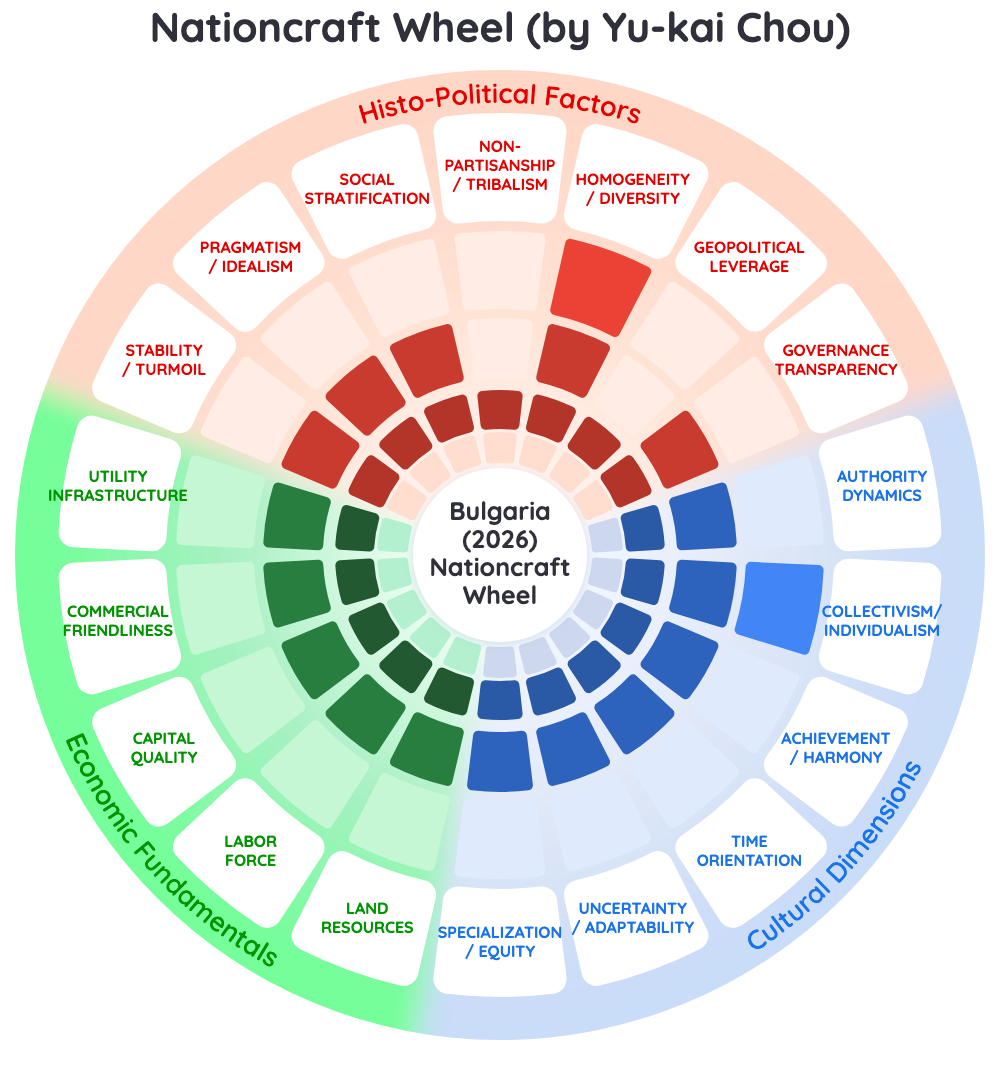

On the first morning of 2026, the cash machines in Sofia began dispensing euros, and Bulgaria became the twenty-first member of the eurozone. It was the culmination of nearly thirty years of imported discipline: a currency board in 1997 that killed hyperinflation by pegging the lev to the Deutsche Mark and then the euro, NATO membership in 2004, EU membership in 2007, and now the single currency itself. On the macroeconomic scorecard, Bulgaria had done everything right. Its public debt was among the lowest in the European Union, its inflation was tamed, its currency was locked to Europe’s at a rate it had held for a generation.
Three and a half months later, Bulgarians voted in their eighth parliamentary election in five years. The government of Rosen Zhelyazkov had collapsed in December amid mass protests, no majority could be assembled, and the country went back to the polls yet again. A state that had just met the most demanding external benchmark in Europe could not, at the same moment, perform the most basic act of self-government: form a cabinet that lasts.
This is the shape the Nationcraft Framework calls the Borrowed-Anchor Trap. A country keeps reaching outside itself for the discipline it cannot generate at home, and every time the anchor holds, its own political class is spared the work of learning to produce that discipline. The euro is the newest and most complete anchor Bulgaria has ever attached to. It is also the reason the country can go on being ungovernable without ever quite falling over.
⚡ Speed Run Notes
- Bulgaria’s Nationcraft signature pairs macro discipline (V16 = 4, near-lowest EU debt; currency board since 1997) with political collapse (V10 = 2 partisanship, V7 = 4 stability), so its weakness is not the economy but the state.
- The euro (1 January 2026) is the latest in a chain of imported anchors, currency board, NATO, EU, that supplied stability Bulgaria’s own politics never learned to make. Anchors held; institutions never got built.
- Eight elections in five years is not noise. The corpus flags Bulgaria as the type case for Governance Paralysis, where EU membership itself enables the deadlock by removing the threat of collapse.
- Bulgaria is the second-most-corrupt EU member (CPI 2024) and has the fastest-shrinking population in the world. The euro anchors the currency; it does nothing for rule of law or demography.
- The packets that fit build clean institutions from a fresh mandate (Georgia, Estonia, Latvia, and Bulgaria’s own history read as a warning), not the strongman models (Singapore, Bukele, Orban) the profile keeps being offered.
Table of Contents
- Understanding Bulgaria’s Governance Landscape Through Nationcraft
- What Is the Nationcraft Framework?
- Why This Bulgaria Variables Analysis Matters
- What Bulgaria Actually Looks Like in Numbers
- The 18 Bulgaria Nation Variables
- Detailed Justifications: Reading the Variables That Matter
- The Borrowed-Anchor Trap
- Three Patterns: External Anchor, Paralysis, and Brain Drain
- Reformer Playbooks Bulgaria Should Reject
- Reformer Playbooks Bulgaria Should Actually Study
- Governance Strategy Recommendations
- Comparative Context
- What This Means Practically for Bulgaria
- The Nationcraft Framework in Practice
- Explore More Nationcraft Analyses
- Related Reading
- Frequently Asked Questions
- Footnotes
About Yu-kai Chou

Yu-kai Chou is a Human-Systems Architect & Behavioral Designer and the creator of the Nationcraft Framework — an 18-variable diagnostic for matching a country’s structural profile to the reform packets that have historically worked under similar conditions. He has consulted for governments in eight nations, including Ukraine, the United Kingdom, the Kingdom of Bahrain, Singapore, Taiwan, the Netherlands, Kazakhstan, and South Korea, and has worked directly with President Zelenskyy’s team on post-war reconstruction priorities for Ukraine.
Chou’s prior framework — the Octalysis Framework — has been applied by LEGO, Microsoft, Porsche, Coca-Cola, Salesforce, and MrBeast, impacting over 1.5 Billion Users. He has taught the methodology at Harvard, Stanford, Yale, Tesla, Google, BCG, and IDEO.
His work has been cited by Harvard, Stanford, MIT, Forbes, Wall Street Journal, Wired, US Department of Energy, NIST, NSF, NCBI, US Department of Education, ClinicalTrials.gov, and Google Scholar — with 3,700+ more academic publications. Explore his books here.

I have spent years watching reform efforts succeed and fail across very different countries, and Bulgaria is the clearest case I know of a specific and under-diagnosed failure mode: the state that outsources its discipline so successfully that it never develops any of its own. Nothing here is broken in the dramatic sense. There is no coup, no default, no collapse. There is a country that has learned to borrow stability so well that it has stopped trying to build it, and a new majority that will decide in the next two years whether the euro becomes a foundation or just the last and largest crutch.
Understanding Bulgaria’s Governance Landscape Through Nationcraft
Bulgaria is usually filed under two contradictory headlines, and both are true. One says European success story: newest member of the eurozone, lowest debt on the continent, a macroeconomic record most of Southern Europe would envy. The other says perpetual dysfunction: eight elections in five years, the bloc’s worst corruption ranking, a population draining away faster than anywhere on earth. The instinct is to treat these as a paradox, or to assume one of them must be exaggerated. Neither is. They are two readings of the same variable profile.
The Nationcraft read starts by refusing to average them. A country is a configuration of eighteen structural variables, and the story is almost never in the total; it is in which variables cluster together and which pull apart. Bulgaria’s configuration is unusually split. Its economic-discipline variables are strong for the region, held there by three decades of external anchoring. Its political-cohesion variables are among the weakest in Europe. The gap between the two is not a contradiction to be explained away. It is the diagnosis.
What makes 2026 the year to run the analysis is that both halves reached a landmark within a single quarter. The euro locked in on the first of January, the most complete external anchor the country has ever accepted. The eighth election landed in April, the clearest possible signal that the domestic political system still cannot hold itself together. The framework’s task is to explain why a state can be so good at meeting outside benchmarks and so bad at governing itself, and to say what, if anything, converts the one into the other.
What Is the Nationcraft Framework?
The Nationcraft Framework is an 18-variable diagnostic for nation-states. Each variable, labeled V1 through V18, captures one structural dimension of how a country actually behaves: how power concentrates (V1 Authority Dynamics), how much a culture prizes the group over the individual (V2 Collectivism), how it handles time and risk (V4 Time Orientation, V5 Uncertainty and Adaptability), how partisan or cohesive its politics are (V10 Non-Partisanship versus Tribalism), how transparent its governance is (V13 Governance Transparency), how strong its financial plumbing is (V16 Capital Quality), how much leverage it holds over the outside world (V12 Geopolitical Leverage), and so on through land, labor, commerce, and infrastructure.
The point of the framework is not to rank countries. It is to match them. A reform packet that transformed one nation routinely fails in another, and the framework’s claim is that these failures are predictable: a packet works when the target country’s variables resemble the variables of the place where the packet first succeeded. Lee Kuan Yew’s playbook needs a Lee Kuan Yew profile. Shock therapy needs a shock-therapy profile. Import a template built for a different configuration and it does not merely underperform. It backfires, because it assumes capacities the country does not have.
So every Nationcraft analysis ends with two questions. Which historical packets fit this country’s variables, and which famous packets will break against them? For Bulgaria, the answer to the second question includes most of the models its own commentators reach for, from the Singapore fantasy to the Orban temptation. The framework grew out of the same behavioral-design work behind Octalysis and public policy: what determines whether a reform holds is motivation and structure, not the elegance of the plan on paper.
Why This Bulgaria Variables Analysis Matters
Bulgaria matters as a controlled experiment. It is the cleanest case in Europe of external anchoring done thoroughly and institution-building skipped entirely, which makes it the place to test what an anchor can and cannot do. Almost every post-communist state used the EU as a reform engine, but most paired it with at least some domestic transformation. Bulgaria leaned on the anchor harder and reformed itself less, and it still made it into every club it applied to. The result is a natural experiment in whether membership can substitute for statehood.
The Nationcraft lens sharpens the stakes. Plenty of countries have low debt, or high corruption, or unstable coalitions. What decides the outcome is the interaction of the variables, not any one of them. A state with strong political cohesion can carry weak institutions for a while, and a state with strong institutions can carry weak cohesion. Bulgaria has neither the cohesion (V10 = 2) nor the institutional depth (V13 = 5, and generous at that), and it has compensated by borrowing the one thing an anchor can supply, which is macroeconomic credibility (V16 = 4). The question this analysis exists to answer is what happens when there are no more anchors left to borrow, because the euro is the last big one, and Bulgaria has now used it.
What Bulgaria Actually Looks Like in Numbers
Before the variables, the ledger, because Bulgaria’s ledger is the thing that surprises people. This is not a fragile economy. The Bulgarian lev has been pegged to the euro at 1.95583 through a strict currency board since 1997, the arrangement that ended hyperinflation and has held without a wobble ever since; euro adoption on 1 January 2026 simply retired a currency that had behaved like the euro for a generation.1 Public debt sat near 30% of GDP in 2025, among the lowest in the European Union, and growth ran around 3% with inflation near three and a half percent.37
The strain is on the other ledger, the political and institutional one, and it is severe. Bulgaria scored 43 on the 2024 Corruption Perceptions Index, ranking 76th of 180 countries and standing as the second-most-corrupt member of the entire European Union, ahead only of Hungary.2 Its parliament has been unable to sustain a government: the eighth election in five years took place in April 2026 after the Zhelyazkov cabinet collapsed under mass protest the previous December.4 And its population is disappearing, down to roughly 6.4 million and shrinking faster than any country in the world, with deaths nearly double births.6
The table below translates that split ledger into the Nationcraft variables it stresses. Each row is a headline number mapped to the structural score it moves, and those scores are what the rest of the analysis runs on.
| 2026 indicator | Reading | Nationcraft variable stressed |
|---|---|---|
| Euro adoption | 21st eurozone member; lev fixed at 1.95583 since 1997 currency board | V12 Geopolitical Leverage = 2 |
| Public debt / GDP | ~30% in 2025, among the EU’s lowest | V16 Capital Quality = 4 |
| Corruption (CPI 2024) | Score 43; second-most-corrupt EU member after Hungary | V13 Governance Transparency = 5 |
| Elections | 8th parliamentary vote in 5 years (April 2026) | V10 Non-Partisanship vs Tribalism = 2 |
| Government durability | Cabinets last months; December 2025 collapse triggered the vote | V7 Stability vs Turmoil = 4 |
| Population | ~6.4M, fastest decline in the world; deaths ~2x births | V15 Labor Force Quality = 6 |
| Party field | GERB, reformists, minority and socialist blocs, pro-Russia Revival | V8 Pragmatism vs Idealism = 4 |
The 18 Bulgaria Nation Variables
Here is the full Nationcraft profile for Bulgaria in 2026. Scores run on the framework’s standard nine-point scale, where low numbers mark a structural weakness on that dimension and high numbers mark a strength or an intensity. Read the vector as a shape, not a report card: the story is in the clustering, and Bulgaria’s clusters a homogeneous, financially disciplined shell around a hollow political core.
| Variable | Score | One-line reading |
|---|---|---|
| V1 Authority Dynamics | 6 | Parliamentary, with recurring strongman pull; April 2026 majority reconcentrates a center |
| V2 Collectivism vs Individualism | 7 | Orthodox solidarity, family and village networks over the individual |
| V3 Achievement vs Harmony | 4 | Harmony-leaning; accommodation and patronage over open contest |
| V4 Time Orientation | 4 | Short horizon; politics organized around the next collapse, not the next decade |
| V5 Uncertainty & Adaptability | 5 | Society absorbs shocks; institutions respond slowly and reactively |
| V6 Specialization vs Equity | 5 | Mixed; subsidy and patronage distribution alongside EU-market specialization |
| V7 Stability vs Turmoil | 4 | Chronic churn without collapse; eight elections, no state failure |
| V8 Pragmatism vs Idealism | 4 | Identity rigidity on Russia and the euro blocks pragmatic deals |
| V9 Social Stratification | 6 | Oligarchic tiers; deep Roma exclusion; coastal and capital concentration |
| V10 Non-Partisanship vs Tribalism | 2 | The anchor weakness: deepest political fragmentation in the EU |
| V11 Homogeneity vs Diversity | 7 | ~85% ethnic Bulgarian, Orthodox majority; Turkish and Roma minorities |
| V12 Geopolitical Leverage | 2 | Small rule-taker; historic Russian energy dependence; a price-taker on its own future |
| V13 Governance Transparency | 5 | Mid and flattering; the EU’s worst corruption record after Hungary |
| V14 Land Resources | 4 | Agriculture and energy transit; no windfall to paper over the politics |
| V15 Labor Force Quality | 6 | Educated and capable, hollowing out through emigration and aging |
| V16 Capital Quality | 4 | Low debt and currency-board discipline over a shallow, oligarch-scarred banking system |
| V17 Commercial Friendliness | 4 | Open EU single market dragged by corruption and weak courts |
| V18 Utility Infrastructure | 5 | Adequate EU-member infrastructure with real regional gaps |
Detailed Justifications: Reading the Variables That Matter
Eighteen variables define the profile, but five of them do the analytical work in Bulgaria’s case. They are the ones that explain how a country can be macroeconomically exemplary and politically ungovernable at the same time.
V10 Non-Partisanship vs Tribalism (2): the variable that runs the whole story
Bulgaria’s politics do not divide along one clean fault line; they shatter. A parliamentary field split among a dominant center-right bloc, several reformist formations, a fractured Turkish-minority party, socialists, and a pro-Russia nationalist party leaves no combination that can both add up to a majority and agree on anything once it does. The corpus scores this as V10 = 2, the deepest partisanship in the EU, and it is the direct cause of the eight-elections pattern. When no coalition can hold, the country does the only thing its constitution allows: it votes again. A V10 = 2 does not produce dramatic conflict here; it produces a slow, grinding inability to decide, which is a quieter and more durable kind of failure.
V12 Geopolitical Leverage (2): why Bulgaria imports its rules
Leverage is a country’s ability to shape the terms it lives under rather than accept them. Bulgaria’s is minimal. It is a small economy at the edge of the EU, historically dependent on Russian energy, without an indispensable export or a great-power patron committed to its agenda. A V12 = 2 state is a rule-taker, and Bulgaria has made rule-taking a strategy: it borrows its monetary policy from the European Central Bank, its security posture from NATO, its legal framework from the EU acquis. This is not weakness disguised as prudence; it is a genuine adaptation to having almost no leverage. But it has a cost the framework insists on naming, which is that a state which always imports its rules never has to build the domestic machinery for making them.
V13 Governance Transparency (5): the score that flatters
Transparency is where the profile is most generous to Bulgaria, and it is worth being honest that a 5 is a charitable read. On the 2024 Corruption Perceptions Index, Bulgaria was the second-most-corrupt member of the European Union, and the persistence of that ranking across administrations is the core of what the anchors never fixed. The 5 reflects the machinery of a modern EU state, courts, audits, a free-ish press, sitting over a political economy where those institutions are routinely captured. This is the variable the euro is powerless to move. A single currency disciplines a central bank; it does nothing about a prosecutor’s office, and Bulgaria’s central problem lives in the prosecutor’s office, not the central bank.
V7 Stability vs Turmoil (4): churn without collapse
Stability in Bulgaria has an unusual signature. The country is chronically unstable at the level of governments, which fall every few months, and remarkably stable at the level of the state, which never breaks. That combination is exactly what a V7 = 4 captures: turbulent but not fragile. The reason the churn never becomes a crisis is the anchor itself. EU and eurozone membership guarantee that the currency holds, the borders stay open, and the money keeps flowing regardless of who is or is not in the cabinet. The state cannot fall because it is bolted to something larger. That is the mechanism, and it is also the trap, because a system that cannot collapse also faces no forcing event that would make its factions finally cooperate.
V16 Capital Quality (4): borrowed discipline, real for now
Capital Quality measures the strength and credibility of a country’s financial plumbing, and Bulgaria’s is a genuine, if borrowed, strength. Debt is low, the currency board has held for nearly thirty years, and the euro now removes exchange-rate risk entirely. The 4 rather than something higher reflects what sits underneath: a shallow domestic financial system with a memory of oligarchic bank failure, and a discipline that was imported rather than grown. The currency board did not emerge from a domestic consensus on sound money; it was adopted in 1997 precisely because the domestic system had proven it could not manage money on its own. The score is a strength, and it is the clearest example in the whole vector of the Borrowed-Anchor pattern: the discipline is real, and it is not Bulgaria’s own.
Set those five readings together and the shape resolves. Bulgaria has the homogeneity (V11 = 7), the solidarity (V2 = 7), and the imported financial discipline (V16 = 4) that should make a country governable. What it lacks is the political cohesion (V10 = 2) to convert any of that into a working government, and the leverage (V12 = 2) to fix the problem from the outside. Its one apparent strength, macro stability, is on loan, and the loan is the thing keeping the underlying weakness from ever forcing a resolution.
The Borrowed-Anchor Trap
Here is the paradox stated plainly. Bulgaria’s success at importing stability is what keeps it from ever building its own. The trait that should help, a proven ability to attach itself to credible external institutions, has trapped the outcome it was meant to secure, which is a state that can govern itself. Every anchor that holds removes the pressure that would otherwise force the domestic system to grow up.
The mechanism is a loop. Step one is the anchor. Faced with a crisis its politics cannot solve, Bulgaria reaches outward and attaches to something disciplined: the currency board in 1997 to kill hyperinflation, NATO in 2004 for security, the EU in 2007 for a legal and economic framework, the euro in 2026 to seal the monetary question for good. Each attachment works, and works impressively, on its own narrow terms. Step two is the substitution. Because the discipline now comes from outside, the domestic political class never has to develop the capacities the anchor is standing in for: durable coalitions, an independent judiciary, a professional and un-captured bureaucracy. The anchor does the hard part, so the hard part never gets learned.
Step three is the backlash, and it is the part that makes the trap tighten rather than merely persist. Imported discipline is, by definition, discipline the population did not choose through its own politics, which makes it a permanent target for anyone selling sovereignty. Bulgaria’s pro-Russia nationalist party built its rise on precisely this, staging waves of protest against euro adoption as a surrender of national control. The more the country leans on external anchors, the larger the constituency that resents them, and the harder it becomes to build the domestic consensus that might one day make an anchor unnecessary. That is the Borrowed-Anchor Trap: not a failure to find discipline, but a success at borrowing it so complete that the country never produces any of its own, and grows a politics organized around resenting the loan.
Three Patterns: External Anchor, Paralysis, and Brain Drain
The Nationcraft corpus keeps a library of historical patterns, each keyed to a variable signature. Bulgaria sits cleanly on three of them at once, and the combination is what makes the trap so stable. Read any one alone and you get a partial story; read the overlap and the loop comes into focus.
| Pattern | Signature (corpus) | Bulgaria’s scores | Match? |
|---|---|---|---|
| RE-003 External Anchor | V12 ≤ 5, credible membership path | V12 = 2, euro achieved | Yes: the defining pattern, now at its endpoint |
| ST-003 Governance Paralysis | V10 ≤ 3, V8 ≤ 3, V7 = 4–6 | V10 = 2, V8 = 4, V7 = 4 | Yes: the corpus type case for this pattern |
| ST-002 Brain Drain Spiral | V15 ≥ 6, V16 ≤ 4, V17 ≤ 4 | V15 = 6, V16 = 4, V17 = 4 | Yes: fastest population decline in the world |
The RE-003 match is the engine. The External Anchor pattern describes a low-leverage state that reforms in exchange for membership in a credible institution, and its corpus lesson is the sharp one for Bulgaria: the pre-accession phase is the period of maximum leverage, and post-accession enforcement mechanisms are weak. Bulgaria reformed hardest when it was chasing the EU and euro, because the reward was still ahead and conditional. Now the reward is banked. The euro was the last big carrot, and once it was eaten, the external pressure that drove three decades of convergence largely dissolved. The anchor is attached, and the discipline it once motivated is no longer being demanded.
The ST-003 match is the one the corpus makes explicit, because it names Bulgaria directly. Governance Paralysis is the pattern where a political system produces governments unable to act, in perpetual deadlock without collapse, and the framework lists Bulgaria’s 2021 to 2025 run of seven elections in four years as a defining example. Its most important corpus note is the one that ties the whole analysis together: EU membership enables the paralysis by preventing collapse. Ordinarily, a government that cannot function eventually triggers a crisis severe enough to force a resolution. Bulgaria never reaches that point, because the anchor guarantees the floor. Paralysis becomes a stable equilibrium rather than a phase, which is why the eighth election felt less like a turning point than like the pattern repeating.
The ST-002 match is the slow bleed underneath. The Brain Drain Spiral describes an educated population (V15 = 6) leaving a low-opportunity, weak-institution economy (V16 = 4, V17 = 4), which reduces domestic capacity, which worsens conditions, which drives more emigration. Bulgaria is the extreme case: the fastest population decline on earth, a country that has lost more than two million people since 1989. The framework’s warning here is that you cannot restrict your way out of it, because the exit is a symptom, not the disease. The disease is the same weak-institution profile that the anchors never fixed, and every capable Bulgarian who leaves is a small verdict on whether the borrowed discipline was ever going to be enough.
Reformer Playbooks Bulgaria Should Reject
When a country looks stuck, its commentators reach for famous models. For Bulgaria, most of the famous ones are misfits, and the misfit is almost always the same: they assume a single commanding center that Bulgaria’s V10 = 2 fragmentation structurally denies, or a forward anchor that Bulgaria has already spent. Naming them matters, because chasing the wrong packet wastes the rare and expensive thing a fresh majority represents.
The Lee Kuan Yew packet (SP-002, Singapore)
Singapore’s transformation ran on extreme pragmatism, with the corpus scoring Lee Kuan Yew’s Singapore at V8 = 9, inside a one-party technocracy that could adjust policy without ideological friction. Bulgaria scores V8 = 4 and runs the most fragmented multiparty politics in the EU. The packet’s core engine, rapid evidence-driven correction under a single unchallenged authority, is exactly what Bulgaria’s structure prevents. Every few years someone proposes that Bulgaria simply needs a Bulgarian Lee Kuan Yew; the framework’s answer is that a Lee Kuan Yew packet requires a Lee Kuan Yew profile, and Bulgaria’s is close to the opposite.
The Bukele packet (SP-064, El Salvador)
Nayib Bukele is the tempting analogy for any leader facing institutional rot, because he concentrated power, packed the courts, and delivered a visible result. The corpus scores Bukele’s El Salvador at V1 = 8 precisely because he gathered all authority into one office with a compliant supermajority and suspended the checks that slowed him down. Bulgaria could imitate the style, but it sits inside the European Union, where dismantling judicial independence does not free a leader from oversight; it triggers rule-of-law conditionality and puts EU funds at risk. The Bukele model trades institutions for speed. Bulgaria’s whole problem is that its institutions are already too weak, and a country like Turkey shows where the security-strongman path leads once the courts are hollowed and the leverage that came from credible institutions is gone.
Poland’s shock therapy (SP-005, Poland)
Poland’s shock therapy worked because the old system was fully discredited, the crisis window was wide open, and, above all, an EU accession anchor lay ahead supplying both discipline and reward. Bulgaria has no accession prize left. It is already in the EU and the euro; the carrot that motivates a shock program has been eaten. Running Balcerowicz-style austerity now would reproduce the pain of adjustment with none of the forward reward that made Poles tolerate it, which is close to the dynamic a country like Romania keeps circling as its own reform fatigue sets in. The shock-therapy pattern needs a destination the public can see. Bulgaria has already arrived, which is exactly why the discipline stopped.
Greece’s accession-and-crisis packet (SP-079, Greece)
Greece belongs on the reject list as a cautionary case rather than a tempting one. The corpus records Greece as the state that entered the EU and then the euro without ever fixing its clientelism, competitiveness gaps, or fiscal indiscipline, so that eurozone membership removed the devaluation escape valve and converted a structural weakness into a solvency catastrophe. Bulgaria should study Greece as the picture of what its own trap looks like if it runs long enough. Bulgaria’s saving grace today is its low debt, which Greece did not have. But the underlying logic is identical, an unreformed political economy locked inside a hard currency, and low debt is a buffer, not an immunity. The euro that protects Bulgaria now is the same instrument that trapped Greece then.
The Orban convergence packet (SP-059, Hungary)
This is the most dangerous misfit, because it is the one the April 2026 majority makes newly available. Orban’s Hungary took EU membership and structural funds and used the stability they provided to consolidate power at home, and the corpus is blunt about the result: democratic backsliding after 2010, fiscal discipline never achieved, the machinery of the state captured by one movement. For a Bulgarian leader who has just won a governing majority after years of deadlock, the temptation to follow Hungary and turn a rare mandate into permanent control is real. The framework flags it as a trap wearing the mask of a solution. It would take Bulgaria’s genuine problem, weak institutions, and make it constitutional, converting a fragmented democracy into a captured one while the euro keeps the lights on. The corpus pattern for this is PT-002, Authoritarian Backslide, and Bulgaria’s V10 = 2, V1 = 6, V13 = 5 profile is precisely the soil it grows in.
Reformer Playbooks Bulgaria Should Actually Study
The fitting packets share a feature the misfits lack. Each one shows how to build clean, durable institutions from a fresh mandate, in a small state with limited leverage, without either a strongman or an external savior doing the work. They are less glamorous than the Singapore fantasy and far more useful to a country whose real deficit is institutional, not economic.
| Packet | Country / era | Why it fits Bulgaria’s variables |
|---|---|---|
| SP-081 | Bulgaria, 1997–2007 | Bulgaria’s own path: the currency board and EU accession that delivered stability but, in the corpus’s words, left institutions unreformed and rule of law deficient. The warning written in its own history |
| SP-051 | Georgia, 2004–2012 (Saakashvili) | Radical, visible anti-corruption from a fresh mandate; the fast public wins Bulgaria’s new majority could deliver, minus the later authoritarian drift |
| SP-007 | Estonia, 1991–2020 | A small post-Soviet EU and euro state that built clean digital governance, reducing corruption by architecture rather than by exhortation |
| SP-088 | Latvia, 1991–2020 | The closest structural sibling: currency board to euro, fragmented but functional coalitions, Russian minority, emigration, adjustment that worked |
Bulgaria’s own post-communist path (SP-081): the warning it already wrote
The first packet Bulgaria should study is its own. The corpus records the post-communist EU path as a real achievement, the currency board that ended inflation permanently, the accession that was won despite the country being the poorest applicant, the macro stability that carried it through the 2008 crisis. And then it records the other half with unusual bluntness: institutions never reformed, organized crime embedded, rule of law deficient, still the poorest member. The critical insight the corpus draws is that anchors bought stability but never bought institutions, which is the Borrowed-Anchor Trap named a decade before this article. Studying its own packet tells Bulgaria exactly what the euro will and will not do. It will hold the currency, as the currency board did. It will not, on its own, build a single honest court or a single durable coalition. Those were left undone the last three times an anchor was attached, and the euro will leave them undone a fourth time unless someone does the domestic half deliberately.
Georgia’s Saakashvili cleanup (SP-051): fast, visible anti-corruption wins
Georgia after the Rose Revolution took a fresh mandate and spent it on a radical, visible anti-corruption drive, firing an entire corrupt traffic police force overnight and cutting business registration to fifteen minutes, delivering wins the public could feel within months. That is the complement Bulgaria’s new majority needs. The corpus scores post-revolutionary Georgia at V1 = 6, the same authority reading Bulgaria carries now, and the lesson is that a concentrated mandate is a wasting asset best spent on cleanups the public can see rather than on consolidating the mandate itself. The caveat is written into the packet too: Saakashvili’s later authoritarian turn is the warning attached to the win, and it is the exact line Bulgaria has to walk between the Georgia packet and the Orban trap. Use the mandate for visible reform, then let it go. That distinction is the whole game.
Estonia’s digital revolution (SP-007): transparency by architecture
Estonia is the packet for the problem Bulgaria has never solved. Another small post-Soviet state that adopted the euro, Estonia differentiated itself by building digital governance from the ground up, an interoperable data layer, a mandatory digital identity, and near-total online public services, so that most transactions between citizen and state leave no room for a discretionary official to demand a bribe. The corpus attributes this to high adaptability and strong technical literacy, and Bulgaria’s V15 = 6 labor force has the raw material. The deeper lesson is structural: Estonia reduced corruption not by preaching against it but by removing the human discretion that corruption feeds on. For a state whose V13 is charitable at 5, transparency by architecture is the most realistic route to actually earning that score, because it does not depend on the honesty of individuals the country cannot guarantee.
Latvia’s Baltic-Tiger integration (SP-088): the sibling that made it work
Latvia is the closest structural match Bulgaria has, and the most encouraging. It ran a currency board, adopted the euro, governs through fragmented multiparty coalitions the corpus scores at V1 = 4, carries a large Russian minority, and has bled population to emigration, the same cluster of features that defines Bulgaria. And it still managed a brutal internal devaluation after 2008 and came out the other side inside the eurozone. The lesson is not that Latvia is a paradise; the corpus flags its population decline as a genuine failure Bulgaria shares. The lesson is that a small, fragmented, low-leverage state can anchor externally and still act decisively when it has to, which is the exact capacity Bulgaria keeps insisting it lacks. Latvia proves the profile is not a life sentence. What Latvia had that Bulgaria has struggled to find is periodic elite agreement that some things are above the fight, and that is a choice, not a structural gift.
Governance Strategy Recommendations
The Nationcraft prescription is not “use the majority” or “restrain the majority.” It is more specific, and it works with Bulgaria’s variables instead of against them. The goal is to convert the euro’s borrowed stability into one piece of domestic discipline that is genuinely Bulgaria’s own, before the external pressure that drove reform fades entirely.
| Move | Nationcraft rationale | Variable it works on |
|---|---|---|
| Spend the mandate on a visible anti-corruption win | Georgia-style, converts a fragile majority into public legitimacy while it lasts | V13 = 5, V1 = 6 |
| Build digital governance that removes discretion | Estonia-style, attacks corruption by architecture, not by exhortation | V13 = 5, V15 = 6 |
| Treat judicial independence as untouchable | The one line that separates the Georgia packet from the Orban trap | V10 = 2, V1 = 6 |
| Make one reform that outlasts the coalition that passed it | Latvia-style elite agreement that some things sit above the fight | V7 = 4, V8 = 4 |
The through-line is ownership. Bulgaria cannot run the strongman playbook, because concentration inside the EU invites conditionality rather than escaping it, and it does not need another external anchor, because it has just attached the last big one available. What it can do is the hardest and least glamorous thing: use the window a governing majority opens to build a single institution that does not depend on an outside guarantor, an honest anti-corruption body, a digital public administration, a judiciary that survives the government that reformed it. None of it requires abandoning the euro or the EU. It requires the political class to do, once, deliberately, the domestic work that thirty years of borrowed discipline let it postpone. The euro bought the time. It cannot spend it.
Comparative Context
Bulgaria’s trap is a distinctive variation on patterns that repeat across post-communist Europe and beyond. The paralysis family is the closest. The coalition deadlock of Kosovo and the reformist-coalition strain of Malaysia show how fragmentation blocks reform even where the will exists, and the power-sharing gridlock of Lebanon shows where paralysis eventually leads when there is no anchor to hold the floor. Bulgaria’s version is milder precisely because the euro guarantees the floor Lebanon lacks, which is both its mercy and its trap.
The anchor-and-sovereignty family sharpens the political half. The managed EU trajectory of Serbia and the reform-versus-Russia pull documented in Ukraine are the regional backdrop against which Bulgaria’s pro-Russia backlash plays out, a reminder that in Europe’s east the choice of anchor is never purely economic. And the discipline-versus-sovereignty argument that animates Tunisia and the resource-nationalist warning of Venezuela are the far ends of what happens when a country either refuses the anchor or captures the state around it. Bulgaria sits in the middle: it took every anchor and captured nothing, and its problem is the peculiar hollowness that leaves behind.
What This Means Practically for Bulgaria
In the near term, the visible test is what the April 2026 majority does with its first year. The vote finally produced a governing bloc capable of lasting more than a season, built around former president Rumen Radev’s new party, and that is a real break from the pattern.5 The risk is that a majority won after five years of deadlock is spent the way majorities usually are, on entrenching itself. The framework’s read is that this is the fork. A mandate used for a visible anti-corruption cleanup and a digital-governance push converts the euro’s stability into domestic legitimacy. A mandate used to capture the courts and the media follows Hungary into a backslide the EU can complain about but, post-accession, can no longer prevent.
The medium-term risk is not collapse; Bulgaria’s V7 = 4 and its eurozone membership make dramatic failure almost impossible. The risk is exactly the opposite, a comfortable, permanent mediocrity. A Bulgaria that spends the late 2020s cycling through governments while the euro holds the currency and the young keep leaving does not become a failed state. It becomes a hollow one, a full member of every European club that cannot govern itself and slowly empties of the people who might. That is a quieter loss than a crisis, and because the anchor prevents the crisis that would force a fix, it is a more permanent one.
The practical advice for anyone close to Bulgaria is to stop measuring success by the next accession and start measuring it by the first institution built without one. The euro was an achievement, and it was also the last of its kind available. There is no bigger anchor to chase now, no further club whose entry requirements will do the reforming for the country. From here, the discipline has to come from inside or not at all. Get that right and the euro becomes a foundation. Get it wrong and Bulgaria proves that a country can pass every external exam in Europe and still fail the only one that was ever really its own.
The Nationcraft Framework in Practice
Bulgaria is a clean demonstration of why the Nationcraft Framework exists. Read only the economics and you get a success story with an inexplicable footnote about elections. Read only the politics and you get a dysfunction story with no explanation for why the currency never breaks. Read the eighteen variables together and the two become one account: a homogeneous, low-leverage, financially disciplined shell (V11 = 7, V12 = 2, V16 = 4) built around a shattered and un-cohesive political core (V10 = 2, V7 = 4, V8 = 4), held together by an anchor that is not the country’s own.
The framework’s discipline is that it refuses to import admiration. Singapore, Bukele’s El Salvador, and Orban’s Hungary are each held up somewhere as the answer to Bulgaria’s mess, and each is wrong for the same structural reason: they assume a commanding center Bulgaria does not have and, in the Orban case, should not want. The packets that fit, Georgia’s visible cleanup, Estonia’s institutions by design, Latvia’s decisive adjustment, and Bulgaria’s own history read as a warning, all solve the real constraint, which is not a shortage of money but a shortage of home-grown discipline. Surfacing that kind of match is what the framework is built to do, and it is why a full library of these country analyses is more useful than any single case.
Explore More Nationcraft Analyses
Every country in the Nationcraft Country Analyses library is a different configuration of the same eighteen variables, and the traps rhyme across regions. The post-communist and EU-integration cluster is especially close to Bulgaria’s story: the Balkan accession path of Serbia, the backsliding warning of Hungary, and the reform-fatigue bind of Romania. Reading them alongside this one shows how the same handful of anchor-dependent, low-leverage signatures produce very different-looking outcomes with the same underlying grammar.
Related Reading
- The Nationcraft Framework: the 18-variable diagnostic behind this analysis.
- Nationcraft Country Analyses: the full library of country diagnoses.
- Hungary: The Two-Thirds Trap, the backsliding path Bulgaria’s new majority could fall into.
- Greece: The Discipline Window Trap, what an unreformed economy inside a hard currency eventually costs.
- Romania: The Austerity Backlash Trap, the post-communist EU sibling wrestling with reform fatigue.
- Turkey: The Strongman Discount, where hollowing the courts for speed actually leads.
Frequently Asked Questions
What is Bulgaria’s Nationcraft profile in one sentence?
Bulgaria pairs a homogeneous, solidaristic society (V11 = 7, V2 = 7) and unusually disciplined public finances (V16 = 4, among the lowest debt in the EU) with a shattered political layer (V10 = 2 partisanship, V7 = 4 stability, V8 = 4 pragmatism) and almost no external leverage (V12 = 2), so in 2026 it can meet the euro’s convergence bar it could never govern its way to internally, while its own politics stays deadlocked.
What does the Borrowed-Anchor Trap mean?
The Borrowed-Anchor Trap is the pattern where a state keeps importing external anchors, a currency board, NATO, the EU, and now the euro, to supply the macroeconomic discipline and stability its fragmented politics cannot generate. Each anchor works on its narrow terms, but because the discipline is imported, the domestic political class never has to learn to produce it, so the underlying weakness in coalition-building and rule of law never gets fixed, and a nationalist backlash grows against the very anchors keeping the ship steady.
If Bulgaria just joined the euro and has low debt, what is the problem?
The macro numbers are genuinely good. Public debt sat near 30% of GDP in 2025, among the EU’s lowest, and the currency board pegged the lev to the euro at 1.95583 since 1997, so euro adoption on 1 January 2026 was mostly a formality. The problem is everything the euro does not touch: Bulgaria is the second-most-corrupt EU member on the 2024 Corruption Perceptions Index, it held its eighth parliamentary election in five years in April 2026, and it has the fastest-shrinking population in the world. The euro anchors the currency; it does not anchor the state.
Why can’t Bulgaria just copy Singapore or become like Orban’s Hungary?
Lee Kuan Yew’s Singapore packet (SP-002) ran on extreme pragmatism (V8 = 9) inside a one-party technocracy; Bulgaria scores V8 = 4 with the deepest partisanship in the EU (V10 = 2), so the single commanding center the packet needs does not exist. Orban’s Hungary convergence packet (SP-059) is the more dangerous temptation now that the April 2026 vote produced a governing majority, but the corpus records that path as democratic backsliding with fiscal discipline never achieved, and inside the EU it invites rule-of-law conditionality rather than escaping it.
Which historical packets fit Bulgaria and which do not?
Packets that build clean institutions from a fresh mandate fit: Bulgaria’s own post-communist EU path (SP-081) read as a warning, Georgia’s Saakashvili anti-corruption cleanup (SP-051), Estonia’s digital-governance transformation (SP-007), and Latvia’s Baltic-Tiger euro integration (SP-088). Packets that assume a single commanding center or a forward accession prize do not fit: Singapore’s Lee Kuan Yew packet (SP-002), El Salvador’s Bukele packet (SP-064), Poland’s shock therapy (SP-005), Greece’s accession-and-crisis packet (SP-079) as a cautionary case, and Hungary’s Orban convergence packet (SP-059) as the anti-model.
What would break the Borrowed-Anchor Trap?
Spending the rare governing majority produced in April 2026 on visible institutional wins rather than on power consolidation: a Georgia-style anti-corruption cleanup the public can see within months, Estonia-style digital governance that removes discretion from corruptible hands, and a transparent judicial reform that survives the majority that passed it. The point is to build one piece of domestic discipline that is not borrowed, so the next crisis does not require another imported anchor.
Footnotes
- European Central Bank, “Bulgaria to join euro area on 1 January 2026,” press release, 8 July 2025 (Council approval; conversion rate fixed at 1.95583 lev per euro; 21st euro-area member). Link
- Transparency International, Corruption Perceptions Index 2024 — Bulgaria (score 43, rank 76/180; second-lowest score among EU members after Hungary at 41, with Romania at 46). Link
- Novinite / Sofia News Agency, “Bulgaria’s Debt Reaches €34.6 Billion As Country Remains Among EU’s Lowest Indebted” (general government debt ~29.9% of GDP in 2025, among the lowest in the EU). Link
- Xinhua, “Bulgaria holds 8th parliamentary election in 5 years,” 19 April 2026 (eighth vote in five years; ~6.6M eligible voters, 240 seats; triggered after PM Rosen Zhelyazkov’s coalition resigned in December 2025 amid mass protests and parliament failed to form a government). Link
- EU Today, “Euro adoption completed, but Bulgaria’s political crisis deepens,” 2026, and Friedrich Naumann Foundation, “Bulgaria’s Election Results” (reported April 2026 outcome: the vote broke the multi-year deadlock, with former president Rumen Radev’s new party emerging as the largest bloc and forming a government; some coverage notes continuing uncertainty). Outcome specifics are reported from these sources, not independently primary-verified. Link
- Novinite / Sofia News Agency, “Bulgaria Lost 14,000 People in 2025,” and OSW Centre for Eastern Studies, “A dwindling nation: Bulgaria on the brink of a demographic collapse,” 2024 (population ~6.42M end-2025, down 2M+ since 1989; UN-described fastest population decline in the world; deaths ~99,479 vs ~50,241 births in 2025; projected -22.5% by 2050). Link
- European Commission, “Economic forecast for Bulgaria” (real GDP growth ~3% in 2025 easing toward ~2.3% in 2026; HICP inflation ~3.5% in 2025 rising toward ~4.2% in 2026). Link