

Andy Burnham is the only politician in Britain with a positive approval rating. Net +14, while every rival sits underwater and Nigel Farage scores minus 26.[5]
Seven weeks into the job, the new Prime Minister has a real polling bounce, a packed announcement calendar, and a Chancellor’s spreadsheet waiting for him in October. The bounce is measured in approval points. The spreadsheet is measured in gilts, OBR scorings, and a Bank of England forecast that says inflation hits 3.2% the very month his flagship VAT cut lands.[3]
Here is the problem the United Kingdom’s September configuration poses, and it deserves a name: the Honeymoon Ledger. A honeymoon is a depreciating asset held by one person. A ledger is a compounding constraint held by the state. In the UK’s 18-variable Nationcraft profile, the honeymoon appears nowhere. The ledger appears everywhere.
The May Nationcraft reading of the United Kingdom diagnosed a fractured political compact: pristine institutions underneath, five-party tribal warfare on top. Since then the fracture consumed a sitting Prime Minister. Keir Starmer announced his resignation on 22 June, four days after Burnham won the Makerfield by-election, and by 20 July Britain had a leader who arrived through a route no predecessor ever used: a metro mayoralty, a vacated safe seat, and a 94% nomination sweep of his own MPs.[1]
What did all of that drama change in the country’s actual reform capacity? The uncomfortable answer, variable by variable, is: almost nothing. That answer, and what a leader with a shrinking honeymoon should do about an unmoved ledger, is what this analysis works through.
⚡ Speed Run Notes
- The Burnham bounce is real (+14 net approval, Labour 28 vs Reform 24) and it is a leader-level asset. All 18 UK Nation Variables (the system-level structure) read the same as they did in May.
- The Honeymoon Ledger: popularity depreciates on a personal account while fiscal constraints compound on the national one. The October budget is where the two accounts reconcile.
- V10=4 tribalism is untouched: the five-party fracture survived a change of Prime Minister. A bounce that lifts one party to 28% has healed nothing structural.
- V16=9 capital depth is the enforcement arm. The gilt market that ended the Truss experiment in 2022 will score October’s arithmetic in real time.
- Eight celebrated reform packets fail the UK’s preconditions, including Thatcher’s own. The three that fit (Canada 1993, Australia 1983, Sweden 1991) converted the honeymoon into institutional machinery early.
Table of Contents
- Understanding the United Kingdom’s September Reset Through Nationcraft
- What Is the Nationcraft Framework?
- Why This UK Analysis Matters Now
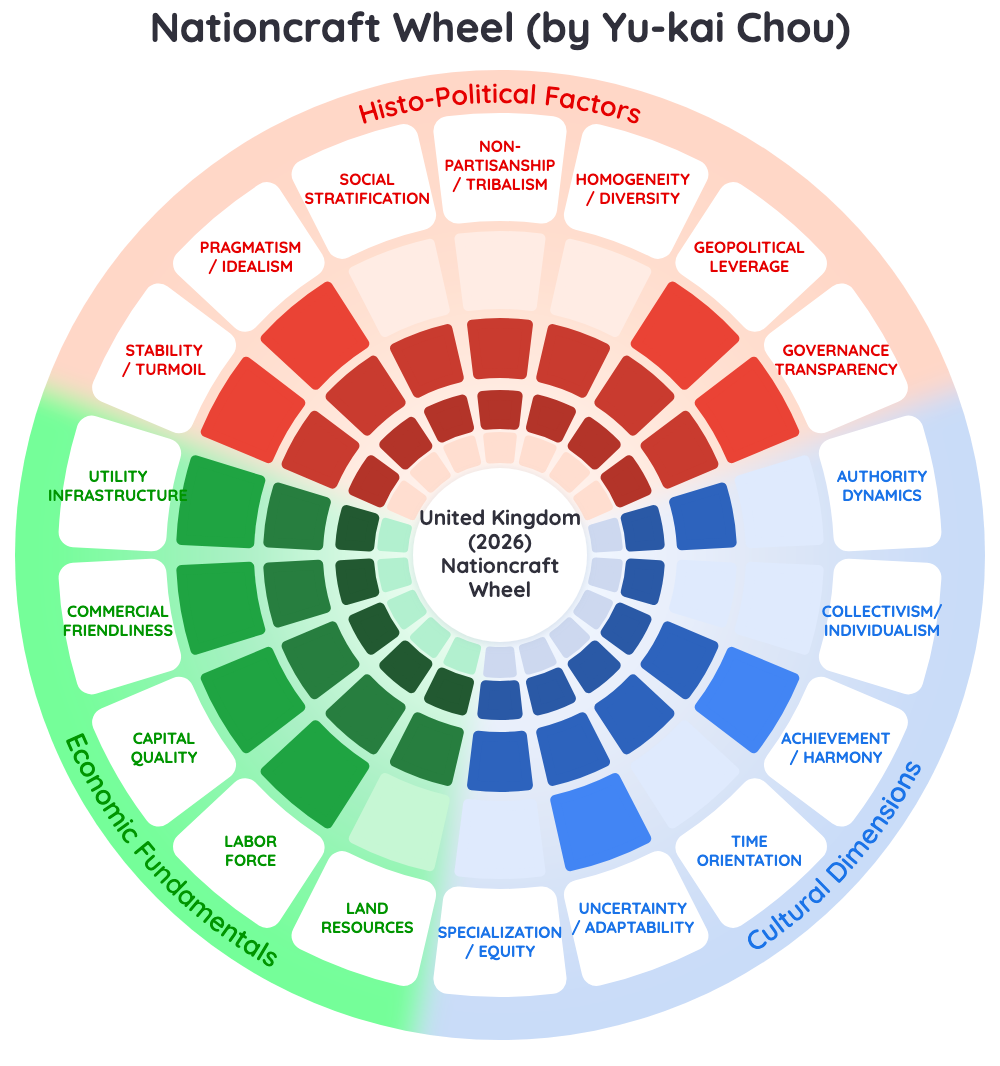
- The 18 UK Nation Variables in September 2026
- The Honeymoon Ledger
- Detailed Justifications: The Variables Doing the Work
- Strategic Implications for the October Budget
- Best-Match Historical Packets: Eight Rejected, Three Worth Studying
- Governance Strategy Recommendations
- Comparative Context: Britain Among Its Neighbors
- The Nationcraft Framework in Practice
About Yu-kai Chou

Yu-kai Chou is a Human-Systems Architect & Behavioral Designer and the creator of the Nationcraft Framework — an 18-variable diagnostic for matching a country’s structural profile to the reform packets that have historically worked under similar conditions. He has consulted for governments in eight nations, including Ukraine, the United Kingdom, the Kingdom of Bahrain, Singapore, Taiwan, the Netherlands, Kazakhstan, and South Korea, and has worked directly with President Zelenskyy’s team on post-war reconstruction priorities for Ukraine.
Chou’s prior framework — the Octalysis Framework — has been applied by LEGO, Microsoft, Porsche, Coca-Cola, Salesforce, and MrBeast, impacting over 1.5 Billion Users. He has taught the methodology at Harvard, Stanford, Yale, Tesla, Google, BCG, and IDEO.
His work has been cited by Harvard, Stanford, MIT, Forbes, Wall Street Journal, Wired, US Department of Energy, NIST, NSF, NCBI, US Department of Education, ClinicalTrials.gov, and Google Scholar — with 3,700+ more academic publications. Explore his books here.

This United Kingdom analysis is the second Nationcraft reading of the country in 2026, building on the May diagnosis of its fractured political compact. The September question is narrower and harder than May’s: whether a popular new Prime Minister changes what an unchanged 18-variable configuration will permit him to do — and what the October budget will reveal about the difference.
Understanding the United Kingdom’s September Reset Through Nationcraft
Between May and September 2026, Britain replaced its Prime Minister without a general election, a street protest, or a market panic. Starmer announced his resignation on 22 June; Andy Burnham, having entered Parliament through the Makerfield by-election on 18 June, became Labour leader on 17 July with 379 MP nominations (94%, the highest share in a modern Labour contest) and Prime Minister on 20 July.[1]
The Nationcraft lens reads that sequence differently than the commentary did. Most coverage treated it as rupture. In variable terms it was the opposite: a demonstration of the exact configuration the May Compact Fracture analysis mapped: V7=9 institutional stability absorbing a leadership crisis so smoothly that the country changed governments in twenty-eight days through party paperwork.
The new Prime Minister then did something new leaders reliably do. He moved fast on small, visible, popular things: a 5% VAT cut on household electricity from 1 October, a £2 bus fare cap for 2027, a 20% business-rates cut for pubs and music venues, £340 million against rough sleeping.[1][2][6]
Each is real. None of them touches a nation variable. That gap — between what a honeymoon can buy and what a configuration will permit — is the whole September story.
What Is the Nationcraft Framework?
The Nationcraft Framework is a diagnostic system that scores a nation on eighteen variables (six cultural, seven histo-political, five economic) and then reads the interactions between them instead of averaging them into a grade. Configuration is strategy: the same policy that rescued one country has wrecked another, and the difference lives in the variables, and in how they combine.
The lineage runs through the Octalysis Framework and the Nationcraft-Octalysis bridge for nation-building and public policy: where Octalysis asks which of the 8 Core Drives moves a user, Nationcraft asks which variable interactions will let a reform survive contact with a real population.
Against that corpus sit 140 documented reform packets: historical bundles of preconditions, sequencing, and outcomes, from Meiji Japan to Estonia’s digital state. The match against preconditions comes before any borrowing, and the sections below run it for the United Kingdom.
Why This UK Analysis Matters Now
Three clocks are running at once, and they disagree.
The first clock is the honeymoon. John Curtice called the Burnham bounce “real but it’s not massive”: Labour at 28% against Reform UK’s 24% in Opinium’s early-September poll, with Burnham at +14 net approval while Farage sits at −26.[5][7] Approval like that decays on contact with governing. Every week it is spent or it evaporates.
The second clock is the ledger. The Bank of England’s July forecast has inflation rising to 3.2% in October and holding above 3% until the third quarter of 2027, pushed by the energy consequences of the US–Iran conflict that began on 28 February.[2][3] Cumulative prices are up 30.7% since January 2021; food is up 39.3%.[2] Unemployment sits at 4.9% with private-sector wage growth at its weakest since 2020, and the IMF’s July Article IV read underlying growth as modest.[4][10] And Burnham has bound himself to his predecessor’s fiscal rules.[1]
The third clock is the budget. Ten weeks from taking office, the new government faces an OBR-scored October statement that must reconcile clock one with clock two in public. The Netherlands faced a version of this squeeze in its own way; the Second Dutch Disease analysis traced what happens when a rich country’s fiscal reflexes meet a structural bill. Britain, though, is running the test with a five-party system and a bond market that has already disciplined one Prime Minister this decade.
Diagnosis precedes prescription, so here is the September vector.
The 18 UK Nation Variables in September 2026
Scores are held from the corpus record after a September 9 sanity pass: zero major drifts, three minor watch-flags (V7, V8, V10, the same three flagged in May). The vector is deliberately identical to the one the May analysis published against; what has changed is the situation sitting on top of it.
| Variable | Score | September 2026 reading |
|---|---|---|
| V1 Authority Dynamics | 4/10 | Distributed authority; a sitting PM removed through party procedure in under a month, no constitutional strain. |
| V2 Collectivism vs Individualism | 2/10 | Anglo-individualist baseline; Burnham’s Co-operative affiliation is a party label; the individualist baseline holds. |
| V3 Achievement vs Harmony | 8/10 | City of London, research clusters, services exports: the achievement engine runs regardless of who governs. |
| V4 Time Orientation | 6/10 | Electoral-cycle dominance; the promised “10-year plan for Britain” is an announcement, so far unpriced by any institution. |
| V5 Uncertainty Adaptability | 7/10 | Absorbed a mid-term change of PM and an oil shock in the same half-year without rupture. |
| V6 Specialization vs Equity | 6/10 | Welfare floor intact under specialization-led upside; unchanged. |
| V7 Stability vs Turmoil | 9/10 | Top-of-corpus. The leadership crisis was processed entirely inside institutions; the fracture stays inside the ballot. |
| V8 Pragmatism vs Idealism | 8/10* | Burnham’s cost-of-living pragmatism cuts against a decade of ideological drift; the party system around him has not followed. Watch-flag held from May. |
| V9 Social Stratification | 6/10 | Legible class structure; a comprehensive-school Prime Minister changes the optics, the pipeline persists. |
| V10 Non-Partisanship vs Tribalism | 4/10* | The five-party fracture is intact under the bounce: 28/24 at the top, the rest split. Drifting toward 3; watch-flag held from May. |
| V11 Homogeneity vs Diversity | 4/10 | Stable diversity profile; no structural movement. |
| V12 Geopolitical Leverage | 7/10 | Day-one calls with Trump, Zelenskyy, and von der Leyen; a UK–EU summit agreed; new West Bank settlement measures announced this week. P5 seat intact. |
| V13 Governance Transparency | 8/10 | The OBR will score October’s arithmetic in public; transparency here is a constraint on the government, which is the point. |
| V14 Land & Resources | 5/10 | Energy-import dependency actively biting: motor fuels added 0.6 points to June CPI, and the Ofgem cap is set to rise in October despite the VAT cut. |
| V15 Labor Force Quality | 8/10 | The talent base is unchanged; the soft labour market (4.9% unemployment, 707,000 vacancies) reads cyclical, with the talent base intact underneath. |
| V16 Capital Quality | 9/10 | Deep gilt and equity markets, and the memory of 2022, when those markets ended a premiership in seven weeks. |
| V17 Commercial Friendliness | 9/10 | Top-decile ease of doing business in Europe; unchanged. |
| V18 Utility Infrastructure | 9/10 | OECD top-quartile grid, broadband, transport; chronic underinvestment complaints, functioning systems. |
* V8 and V10 carry minor-drift watch flags; the corpus scores are retained pending a dedicated methodology pass, consistent with the May analysis.
The Honeymoon Ledger
Name the paradox precisely. The United Kingdom in September 2026 holds a rare political asset, the only net-positive leader in the country, attached to a reform configuration that assigns that asset no structural value at all.
The Nationcraft Framework has no variable for a likable Prime Minister. That omission is deliberate. Popularity is a resource; the eighteen variables describe structure, and resources get spent against structure. Every decision that produces a loser draws the honeymoon account down, and British budgets produce losers by design.
The ledger, meanwhile, compounds. Debt interest accrues, the energy shock feeds the price cap, the OBR scores everything, and V16=9 capital depth means the gilt market marks the government’s homework in real time. The asymmetry is the one Loss & Avoidance psychology documents: voters weigh the £45 they save on electricity far less than whatever October takes away, because losses land roughly twice as hard as equivalent gains.
Here is the September accounting, side by side.
| Dimension | What the Burnham transition changed | What it left untouched |
|---|---|---|
| Leadership | Only net-positive politician in Britain (+14); 94% MP nomination share | V1=4 distributed authority; no new formal power beyond Starmer’s |
| Party system | Labour up to 28%, Reform down to 24% | V10=4 five-party fracture; no compact restored, no realignment reversed |
| Fiscal position | Tone: “cost of living government,” visible micro-relief | V16=9 gilt discipline; inherited fiscal rules re-affirmed, October arithmetic unmoved |
| Inflation path | £45 average VAT relief on electricity from 1 October | V14=5 import dependency; BoE path to 3.2% in October, cap rising despite the cut |
| Institutions | Number 10 North opened in Manchester | V7=9, V13=8: the machine that will score, audit, and publish his budget unchanged |
| Time horizon | A “10-year plan for Britain” promised | V4=6 electoral-cycle dominance; next general election due by 2029 |
Read the second column top to bottom: that is the ledger the October statement must answer. The Honeymoon Ledger names the trap it creates. A leader-level asset gets mistaken for a system-level one, the asset is spent on applause-safe micro-policy while it is largest, and by the time the structural asks arrive the account is empty.
The bounce itself removes the one thing high-stability polities usually require before accepting painful reform: the felt sense of emergency. A Prime Minister at +14 in a country at V7=9 has, in motivational terms, anesthetized his own crisis window; the urgency that Scarcity & Impatience would otherwise supply is missing by construction.
Detailed Justifications: The Variables Doing the Work
Eighteen scores, four doing the heavy lifting this quarter, with the rest supporting. The clusters below justify the readings that matter for October.
V10 = 4: The fracture the bounce did not heal
In May, six parties polled between 10% and 27% and the analysis called it a compact fracture: the two-party duopoly that structured British politics since 1945 dissolving into tribal blocs. September’s numbers dress the same wound differently. Labour 28, Reform 24, and the remainder scattered means the governing party’s celebrated recovery still leaves nearly three-quarters of the electorate elsewhere.[5]
Burnham won Makerfield decisively in June, with Reform underperforming its May local-elections showing: evidence that a trusted individual can beat the fracture locally.[9] Evidence, equally, that the win attached to the person. V10 measures whether the system can act across tribal lines, and on that measure nothing moved: the Institute for Government notes the 2026 results raise the salience of full electoral-system reform precisely because four- and five-way marginals are becoming the national norm.[8]
V16 = 9 and V13 = 8: The enforcement arms
Britain’s capital depth is usually listed as a pure asset. For a new government it is also a supervisor. The 2022 mini-budget episode established the precedent every Chancellor now governs under: the gilt market can end a premiership in weeks when arithmetic and announcement diverge.
V13=8 transparency compounds the discipline. The OBR will publish its scoring of October’s statement, the NAO will audit what follows, and the press operates freely. In low-V13 polities a government can massage a bad budget’s reception; in Britain a bad budget’s reception is written by the OBR within hours.
V14 = 5: The imported ledger
The US–Iran conflict that began on 28 February 2026 did to Britain what every energy shock does to an import-dependent island: it moved the fiscal goalposts from abroad. Motor fuels alone contributed 0.6 percentage points to June’s 2.6% inflation rate, and the Bank of England now projects 3.2% for October, the same month the VAT cut lands.[2][3]
Cornwall Insight’s cap forecast makes the trap concrete: household energy bills are likely to rise in October despite the VAT removal.[2] A £45 policy meets a larger counter-move from wholesale markets, and the voter experiences the net. This is what V14=5 means operationally: a variable the government does not control writing entries in the ledger the government answers for.
V7 = 9 and V5 = 7: The floor that is also a ceiling
The same institutional stability that let Britain swap Prime Ministers through paperwork denies the new one a crisis mandate. Most of the corpus’s celebrated reform packets fire inside a V7≤4 window, when collapse makes bold action feel cheaper than inertia. Britain’s configuration runs the other way: V7=9 means voters experience no emergency, so consent for structural surgery must be manufactured through narrative and sequencing — the harder, slower path South Korea’s post-martial trap analysis mapped from the opposite direction, where a crisis window existed and closed.
V4 = 6 and the meaning deficit
Burnham’s early package is competent micro-relief with no story arc. A VAT cut, a bus cap, and a rates discount answer “what have you done for me,” and leave “where is this going” empty. Epic Meaning & Calling, the drive a national project would engage, is absent from the package: nothing yet asks the public to be part of something larger than a discount.
The promised 10-year plan is the open slot where meaning could go. V4=6 says the default gravity pulls toward the electoral cycle instead. Watch whether the plan ships with binding instruments (statutory targets, independent delivery bodies) or as a speech; that difference decides whether V4 gets bent upward on this government’s watch.
Strategic Implications for the October Budget
The configuration converts October from an accounting event into the honeymoon’s expiry test. Three implications follow directly from the vector.
First: the budget is the only credibility instrument available. With V10=4 blocking any cross-party grand bargain in the near term and V7=9 removing crisis legitimacy, the government’s sole chance to convert personal approval into institutional authority is a fiscal statement the gilt market and the OBR both accept without drama. Boring, in this configuration, is a triumph.
Second: micro-relief has a compounding cost. Each visible giveaway funded by one-off maneuvers (a scrapped digital ID scheme here, climate donations converted to loans there[1]) trains the electorate to expect relief while teaching the bond market to expect improvisation. The first audience claps now; the second audience marks it later. V16=9 guarantees the second audience is always in the room.
Third: the meaning slot is still open. A population at 88% cost-of-living concern[2] cannot be micro-discounted into optimism. It can be enrolled into a project. The 10-year plan, if it arrives with real instruments, is the only announced vehicle that could convert V15=8 human capital and V17=9 commercial capacity into a growth story the ledger itself would eventually credit; meaning is the one lever that scales to 88% cost-of-living salience.
Best-Match Historical Packets: Eight Rejected, Three Worth Studying
The corpus holds 140 reform packets. Run the UK’s September vector against their preconditions and most of the famous ones fail, including the only packet in the corpus that is itself British. The method here follows the Venezuela audit that rejected eight playbooks before finding three that fit: elimination first, matching second.
| Packet | Country / years | Verdict for UK 2026 | Decisive precondition mismatch or match |
|---|---|---|---|
| SP-102 Thatcher Neoliberal Revolution | UK 1979–1990 | Reject | Needed a crisis mandate (Winter of Discontent) plus majoritarian dominance; Burnham has an inherited mid-term mandate atop a V10=4 five-party split |
| SP-108 Rogernomics Radical Liberalization | New Zealand 1984–1993 | Reject | Blitz-by-surprise burned the governing party’s own coalition and triggered an electoral-system revolt (MMP) |
| SP-005 Poland Shock Therapy | Poland 1990–2004 | Reject | Requires a collapsed ancien régime and 250% inflation desperation; V7=9 Britain has neither |
| SP-101 Roosevelt New Deal | USA 1933–1939 | Reject | Depression-depth crisis (unemployment near 25%) plus legislative supermajorities; no analog exists |
| SP-014 Chicago Boys Reform | Chile 1975–1990 | Reject | Ran under authoritarian cover (V1=9); the UK’s V1=4 institutions would refuse, correctly |
| SP-002 Lee Kuan Yew Industrialization | Singapore 1965–1990 | Reject | V1=7/V2=7 hierarchical-collectivist preconditions against the UK’s 4/2; single-party dominance unavailable |
| SP-003 Deng Xiaoping Open Reform | China 1978–2000 | Reject | Party-state gradualism at V1=10; category error for a distributed-authority democracy |
| SP-064 Bukele Security & Digital | El Salvador 2019– | Reject | Supermajority, packed courts, emergency powers: instruments a V13=8 system exists to deny |
| SP-111 Chrétien–Martin Deficit Elimination | Canada 1993–1998 | Study | New PM after a party-system collapse and a surging Reform Party; honeymoon spent on Program Review; first surplus in 28 years |
| SP-107 Hawke–Keating Open Economy Reforms | Australia 1983–1996 | Study | Personable Labor PM converted popularity into the Accord: an institutional instrument that outlived the honeymoon |
| SP-109 Swedish Fiscal Consolidation | Sweden 1990–1996 | Study | Cross-party crisis agreement in a high-trust democracy; consolidation survived a change of government |
Why the crisis-window packets fail: Poland, Roosevelt, and the missing emergency
SP-005 and SP-101 share one load-bearing precondition: a population so battered that structural surgery polls better than the status quo. Poland in 1990 faced 250% inflation and empty shelves; Roosevelt inherited banks that had simply stopped. Fear did the consent-manufacturing for both governments.
Britain’s 2.6% inflation and 4.9% unemployment describe discomfort, and discomfort is a different fuel from collapse.[2][4] A V7=9 polity cannot import a V7≤4 playbook, because the playbook’s first page assumes an emergency the population refuses to feel.
Why the concentrated-authority packets fail: LKY, Deng, Pinochet’s economists, Bukele
SP-002, SP-003, SP-014, and SP-064 all presume an authority configuration (V1 between 7 and 10) that lets the center impose sequencing and absorb short-term pain without electoral interruption. Admirers of these packets in high-income democracies consistently skip the precondition and cite the outcome.
The UK runs V1=4 with an election due by 2029. Any packet whose sequencing assumes a decade of uninterrupted control is fiction here; the corpus treats such matches as automatic rejections regardless of how attractive the outcome trajectory looks.
The instructive rejection: Thatcher’s own packet no longer fits Thatcher’s own country
SP-102 is the UK’s sole native packet, and the September vector rejects it. The 1979 configuration paired a genuine crisis mandate with a party system that converted 43.9% of the vote into unassailable Commons control, and a Prime Minister prepared to spend years of unpopularity against V16 capital flight and V10 confrontation.
Every one of those preconditions is absent. The 2026 fracture means no party converts vote share into dominance; the honeymoon logic runs opposite to Thatcher’s deliberate unpopularity budget; and the crisis is chronic (cumulative 30.7% prices) rather than acute. A Burnham government reaching for Thatcherite confrontation would find the mandate machinery missing — the analysis of Hungary’s two-thirds trap shows what that machinery looks like when it exists; Britain’s V10=4 runs the other way.
The cautionary rejection: Rogernomics and the price of betraying a honeymoon
SP-108 is the corpus’s cleanest warning for exactly this moment. New Zealand’s 1984 Labour government arrived popular, faced a currency crisis, and let its Finance Minister run a radical liberalization the party had never campaigned on. The economy restructured; the political system took revenge.
Labour split, the electorate lost trust in both major parties, and by 1993 voters had imposed proportional representation on the political class itself. A five-party Britain contemplating budget surprises should read that trajectory as prophecy: blitz a fractured electorate and the fracture institutionalizes.
SP-111 Canada 1993: the closest rhyme in the corpus
The match is almost uncomfortable. Canada 1993: the governing Progressive Conservatives collapse from majority to two seats, a party literally named Reform surges out of regional grievance, a new Prime Minister inherits a fiscal position so poor a Wall Street Journal editorial called the country “an honorary member of the Third World,” and debt-to-GDP stands at 67% with a 5.6% deficit.
Chrétien and Finance Minister Martin spent their honeymoon on one instrument: Program Review, a six-test screen applied to every federal program, cutting spending across departments with the new government’s full early-mandate authority. By 1998 Canada posted its first surplus in twenty-eight years and the credit rating recovered. The sequencing lesson for October is precise: the cuts came first, inside the honeymoon, with the popular Prime Minister fronting them; the giveaways came later, funded by restored credibility.
SP-107 Australia 1983: how a personable leader converts warmth into machinery
Bob Hawke is the closest personality analog the corpus offers: a beloved, plain-speaking Labor figure whose approval ratings were themselves a national asset. What makes the packet studyable is what he did with the asset: within weeks he traded it for the Accord, a formal wages-and-prices agreement with the union movement that institutionalized restraint no popularity contest could have sustained.
The float of the dollar and phased tariff reform followed, sequenced across ten years, and inflation halved from 11% to 5% by 1988. The mapping to Burnham is direct. A Greater Manchester mayor with deep union relationships and a +14 rating holds exactly the social capital an Accord-class instrument requires: cross-party on social care, tripartite on wages and productivity, or contractual on the 10-year plan. The window for that trade is now, while the account is full.
SP-109 Sweden 1991: consolidation that survives its own government
Sweden’s banking-crisis response worked because its hardest measures were co-signed. The blanket bank guarantee and the fiscal consolidation that followed were negotiated across party lines, which meant the 1994 change of government changed nothing about the program. Consolidation at an 11%-of-GDP deficit trough held all the way to a balanced position by decade’s end.
Britain’s V10=4 makes a full Swedish co-signature improbable this year. The studyable core is narrower: pick the one or two reforms whose payoff horizon exceeds the parliament (social care, pension architecture) and price cross-party co-ownership into them from the start, as Burnham’s early social-care overtures already gesture.[1] What is co-signed cannot be weaponized, which in a five-party system is the property that lets a program outlive its authors.
Governance Strategy Recommendations
Nationcraft recommendations follow the vector rather than the mood. Given V10=4, V16=9, V14=5, and a depreciating honeymoon, the sequencing logic reads:
| Phase | Window | Move | Variable logic |
|---|---|---|---|
| 1. Credibility lock | October 2026 budget | A dull, fully-scored, rule-consistent statement; zero improvised funding devices | V16=9 + V13=8: the gilt market and OBR are the only audiences that can end the honeymoon overnight |
| 2. Instrument trade | Q4 2026 – Q1 2027 | Convert approval into one Accord-class institution: tripartite productivity compact or statutory social-care body with opposition seats | SP-107/SP-109 logic: machinery outlives popularity; V10=4 punishes anything weaponizable |
| 3. Meaning launch | With the 10-year plan | Ship the plan with binding targets and an independent delivery body, framed as national project rather than party program | V4=6 needs bending; Core Drive 1 (CD1): Epic Meaning & Calling is the only motivational lever that scales to 88% cost-of-living salience |
| 4. Ledger repair | 2027–2028 | Program-Review-class spending screen, fronted personally by the PM while approval remains positive | SP-111 sequencing: cuts inside the honeymoon, giveaways after credibility returns |
| 5. Fracture management | Continuous | Treat electoral-reform pressure as a variable to manage instead of a taboo; co-own any review | V10 drifting toward 3; Rogernomics shows what voters do to systems that surprise them |
Reverse phases 1 and 4 (giveaways first, screen later) and the configuration predicts the standard failure: a honeymoon spent on applause, a ledger unmoved, and a 2028 government begging markets for patience it no longer commands.
Comparative Context: Britain Among Its Neighbors
Europe in 2026 is running a natural experiment in how high-institution democracies process voter revolt, and the UK sits in the middle of the sample. The comparison sharpens what is and is not unique about the British configuration.
| Polity | Configuration signature | Shared with UK | Divergence |
|---|---|---|---|
| United Kingdom | V7=9 floor under V10=4 fracture; honeymoon leader; gilt-market discipline | baseline | baseline |
| France | Fragmented assembly, serial governments, budget paralysis | Party-system fracture, fiscal squeeze | No honeymoon anywhere in sight; executive presidency changes the release valve |
| Germany | Consensus machinery straining as AfD hit 43.8% in Saxony-Anhalt on 6 September | Insurgent right reshaping all coalition math | Federal structure disperses the shock; UK concentrates it at Westminster |
| Sweden | High-trust system drawing down its trust reserves | V13-class transparency, strong institutions | Sweden’s fracture is managed inside bloc politics; Britain’s is open-field |
| United States | Two-party system internalizing the fracture as polarization | Achievement culture, deep capital markets | Duopoly forces the conflict inside parties; Britain’s spilled into new ones |
The pattern across Greece’s discipline window and Japan’s long-horizon trap repeats here with British parameters: institutional strength postpones reckonings, and postponement compounds them. The American paradox analysis shows the duopoly version of the same disease, with Britain running the multiparty strain.
The Nationcraft Framework in Practice
This is the second time the Nationcraft method has read the same country inside one year, which makes the pair a demonstration of what the framework actually measures. Between May and September, Britain’s news cycle produced a resignation, a by-election, a coronation, a poll reversal, and a new governing style. The eighteen variables moved zero points.
Nationcraft separates weather from climate: leaders, bounces, and announcements are weather; V-variables are climate, and reform packets succeed or fail against climate. A framework that scored the UK on September’s mood would be a horoscope with better typography.
The same discipline runs through the whole corpus: the Singapore LKY packet stress test asked whether a legendary packet still fits its own country of origin; this analysis asked whether Britain’s most famous packet fits Britain, and both times the vector rather than the legend gave the answer.
Explore More Nationcraft Analyses
The full set of country diagnostics lives in the Nation Variables library, spanning more than sixty published country analyses across every region and configuration class.
Closest companions to this piece: the May UK reading, the Canada 1993 rhyme once its analysis publishes, and the European neighbors compared above.
Closing
The Honeymoon Ledger resolves one way or the other within months, and the resolution is legible in advance. If October’s budget is dull, scored, and credible — and the honeymoon gets traded for machinery rather than applause — Britain’s configuration rewards the trade with something rare: reform capacity inside a stable democracy, no crisis required.
If instead the account gets spent on breathing space, the ledger will still be there in 2027, larger, with the bounce gone and Reform UK holding the grievance franchise. The scores that sat still through the most dramatic political summer in years will referee that outcome too.
Frequently Asked Questions
What is the Honeymoon Ledger?
It is the named paradox of the UK’s September 2026 configuration: a popular new Prime Minister (a depreciating, leader-level asset) governing against fiscal and structural constraints that compound (the ledger), where none of the country’s 18 Nation Variables changed with the leadership. October’s budget forces the reconciliation.
Did the UK’s Nation Variables change when Burnham replaced Starmer?
No. The September sanity pass held all eighteen scores from the May analysis, with the same three minor watch-flags (V7, V8, V10). A change of Prime Minister through party procedure is behavior the existing scores predict, and a poll bounce is a resource rather than a structural shift.
Why does the October 2026 budget matter so much in this analysis?
Because the configuration makes it the honeymoon’s expiry test. V16=9 capital depth and V13=8 transparency mean the gilt market and the OBR score the statement in public, V14=5 import dependency has the Bank of England projecting 3.2% inflation for that exact month, and the government has re-committed to inherited fiscal rules. October is the first event the bounce cannot outperform.
Which historical reform packets fit the UK’s 2026 configuration?
Three: Canada’s Chrétien–Martin deficit elimination (SP-111), Australia’s Hawke–Keating open-economy reforms (SP-107), and Sweden’s 1990s fiscal consolidation (SP-109). All three converted an early-mandate honeymoon into an institutional instrument. Eight celebrated packets fail the preconditions, including Thatcher’s own SP-102.
How does this relate to the May 2026 “Compact Fracture” analysis?
It is the sequel, on an unchanged vector. May diagnosed the structure: pristine institutional floor, fractured five-party compact. September tests what a new, popular leader can do inside that structure, and the answer the corpus gives is that popularity converts to reform only when traded early for machinery.
Does a popular leader really change nothing in a Nationcraft reading?
A popular leader changes the resources available while the structure they get spent against stays put. The framework deliberately carries no variable for leader appeal, because packets that depended on one (Hawke’s Australia) worked through the institutions the leader built, and packets that coasted on appeal alone left no trace the corpus can measure.
Related Reading
- The Nationcraft Framework: the 18 variables, 8 goals, and packet-matching method in full.
- Nation Variables: Country Analyses Library: every published diagnostic in one place.
- Nationcraft Analysis: France Fragmentation Trap 2026: the neighboring strain of compact fracture.
- Nationcraft Analysis: Germany Consensus Trap 2026: consensus machinery under insurgent-right pressure.
- Nationcraft Analysis: Sweden Trust Overdraft 2026: what drawing down institutional trust looks like.
- Nation Variable Analysis: Ukraine (2026): the wartime configuration at the other end of the V7 scale.
Footnotes
- Premiership of Andy Burnham. Wikipedia. Timeline (Makerfield 18 June; leader 17 July with 379/94% nominations; PM 20 July), cabinet changes, fiscal-rules commitment, VAT/bus/rates/rough-sleeping measures and their funding devices, Number 10 North, day-one calls.
- Economic update: The new Prime Minister, inflation and the cost of living. House of Commons Library (Daniel Harari), 31 July 2026. Cumulative CPI +30.7% and food +39.3% since Jan 2021; CPI 2.6% June; US–Iran conflict from 28 February 2026; motor fuels +0.6pp; £45 VAT estimate; Cornwall Insight cap forecast; 88% cost-of-living salience.
- Monetary Policy Report, July 2026. Bank of England, 30 July 2026. Inflation projected at 3.2% in October–November 2026, above 3% until Q3 2027; abating domestic pressures.
- Employment in the UK: August 2026. Office for National Statistics. Unemployment 4.9% (Apr–Jun 2026); vacancies 707,000; private-sector regular pay +2.8%.
- Voting intention: 2nd September 2026. Opinium. Labour 28%, Reform 24%; Burnham +14 net approval; Farage −26.
- What will Andy Burnham’s VAT cut on electricity bills mean for you? — The Guardian, 21 July 2026.
- Sir John Curtice: The “Burnham bounce” is real but it’s not massive — BBC News, 1 August 2026.
- The significance of the 2026 elections for UK government. Institute for Government. Multi-way marginals and electoral-reform salience.
- 2026 Labour Party leadership crisis. Wikipedia. May local elections, resignations, Makerfield, leadership timetable.
- IMF Executive Board Concludes 2026 Article IV Consultation with the United Kingdom. IMF, 16 July 2026. Modest underlying growth.