
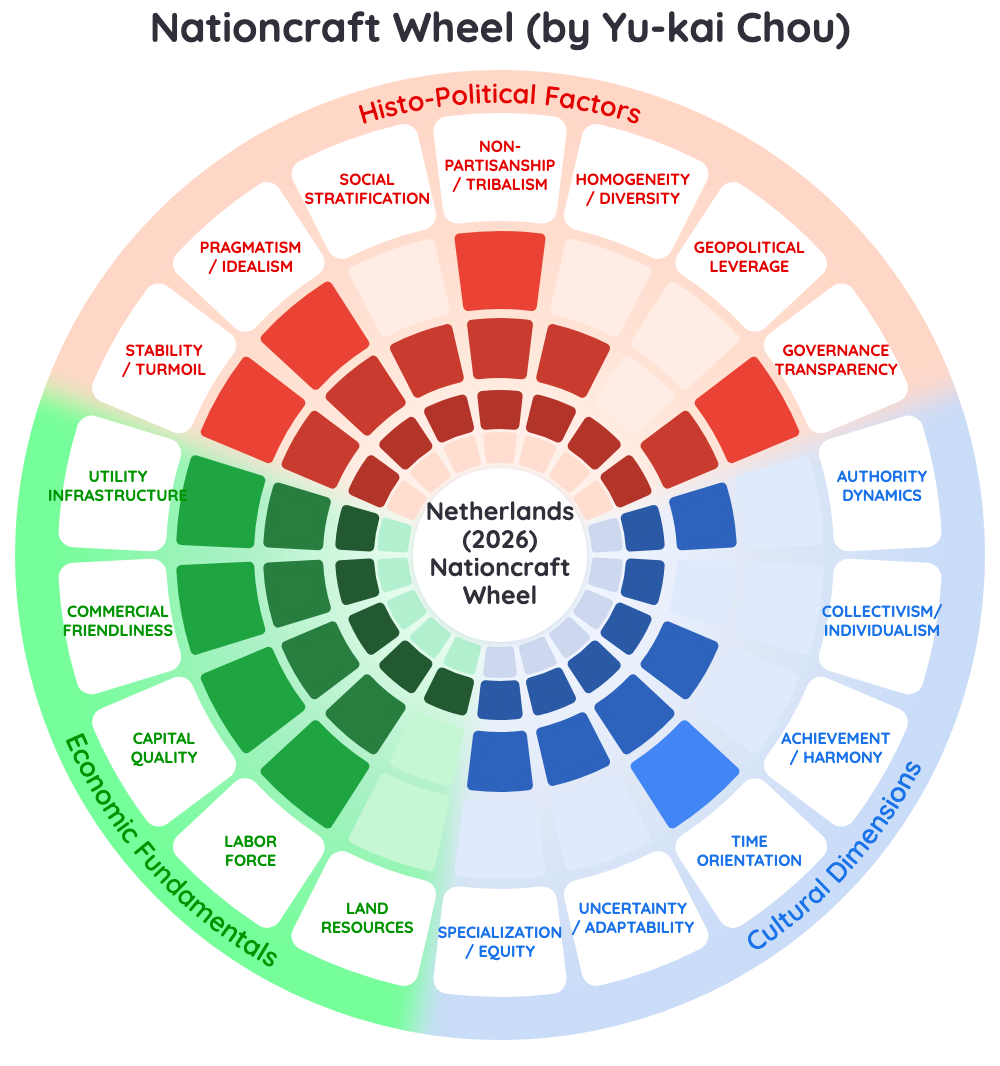

In the space of eighteen months, the Netherlands lost a government, spent 117 days assembling a replacement, and installed its first minority cabinet in decades. During that same window it also quietly moved roughly 9.5 million workers onto an entirely new pension system, on schedule, without a headline. One of those facts is a political crisis. The other is one of the largest peacetime administrative migrations in Europe. The country pulled them off at the same time, and almost nobody outside the sector noticed.
That is the tell. A state that can re-plumb its entire retirement architecture between a collapse and a coalition is a state whose machinery has decoupled from its politics.
The Netherlands built one of the most consensual reform models in modern Europe. In 1982 its unions and employers traded wage restraint for shorter hours under government pressure to act, and the “polder model” became the continent’s benchmark for how a rich democracy fixes itself without a fight. Four decades later the table is still there. The people who used to sit around it are not.
The country that invented consensual reform has quietly lost the ability to run its own playbook, and its competence is the reason no one has had to admit it. I call this the Second Dutch Disease.
⚡ Speed Run Notes
- The first Dutch Disease was Groningen gas hiding industrial decay behind a strong guilder. The second is administrative competence hiding political decay behind a state that still delivers.
- The Nationcraft profile is a split nation: an execution stack near 9 on transparency, labor, capital, commerce, and infrastructure, bolted to a representation layer at 4 on authority and 2 on collectivism.
- The 1982 Wassenaar packet ran on collectivism at 7 and low tribalism at 8. Today’s collectivism reads 2 against a 15-party parliament. The country cannot re-run its own miracle because the preconditions moved.
- The state delivers so reliably that citizens never feel the cost of a politics that has stopped producing majorities. Reform needs felt loss to start, and competence keeps erasing the loss.
- Nationcraft says the model to study is not Singapore or shock therapy. It is Ireland’s Tallaght Strategy and Denmark’s flexicurity: consensus democracies that engineered a mandate rather than waiting to inherit one.
- The fix is not another grand bargain. It is a smaller, sequenced set of pre-committed cross-bloc deals that manufacture the urgency the economy refuses to supply.
Table of Contents
- Understanding the Netherlands’ Governance Landscape Through Nationcraft
- What Is the Nationcraft Framework?
- Why This Netherlands Variables Analysis Matters
- The 18 Netherlands Nation Variables
- The Second Dutch Disease
- Detailed Justifications, Variable by Variable
- Strategic Implications
- Best-Match Historical Packets
- Governance Strategy Recommendations
- Comparative Context
- The Nationcraft Framework in Practice
- Explore More Nationcraft Analyses
- Frequently Asked Questions
About Yu-kai Chou

Yu-kai Chou is a Human-Systems Architect & Behavioral Designer and the creator of the Nationcraft Framework — an 18-variable diagnostic for matching a country’s structural profile to the reform packets that have historically worked under similar conditions. He has consulted for governments in eight nations, including Ukraine, the United Kingdom, the Kingdom of Bahrain, Singapore, Taiwan, the Netherlands, Kazakhstan, and South Korea, and has worked directly with President Zelenskyy’s team on post-war reconstruction priorities for Ukraine.
Chou’s prior framework — the Octalysis Framework — has been applied by LEGO, Microsoft, Porsche, Coca-Cola, Salesforce, and MrBeast, impacting over 1.5 Billion Users. He has taught the methodology at Harvard, Stanford, Yale, Tesla, Google, BCG, and IDEO.
His work has been cited by Harvard, Stanford, MIT, Forbes, Wall Street Journal, Wired, US Department of Energy, NIST, NSF, NCBI, US Department of Education, ClinicalTrials.gov, and Google Scholar — with 3,700+ more academic publications. Explore his books here.

This Netherlands analysis draws on the Nationcraft Framework’s use in Dutch advisory conversations and on a simple observation from watching the polder model up close: the machinery of Dutch governance is still world-class, and that is precisely what makes its political drift so hard to see and so easy to postpone. The country that taught Europe how to reform by consensus is the most interesting place in the world to ask what happens when the consensus quietly leaves and the competence stays.
Understanding the Netherlands’ Governance Landscape Through Nationcraft
Most analysis of the Netherlands in 2026 reaches for the same two stories. One is the political circus: Geert Wilders pulling the Party for Freedom out of the Schoof coalition in June 2025 over asylum policy, the snap election, the far-right surge that fizzled, and the long crawl to a Rob Jetten minority cabinet.1 The other is the good-news economy: growth around one percent, unemployment under four, a labor market so tight employers are begging for staff.2
Both stories are true. Neither explains the thing that actually matters, which is how a country can be in permanent political crisis and functional administrative excellence at the same time, for years, with no resolution in either direction.
Nationcraft exists to answer exactly that kind of question. It refuses to average a country into a single grade. It reads the Netherlands as an eighteen-dimensional profile and looks for the interaction between the dimensions, because that is where national behavior actually lives.
When you run the Netherlands through the Nationcraft lattice, the two stories stop being separate. They are the same fracture seen from two sides. The economy keeps working because the execution variables are near the ceiling. The politics keeps failing because the representation variables have quietly fallen through the floor. And the reason the fracture never forces a reckoning is that the strong half keeps covering for the weak half.
What Is the Nationcraft Framework?
The Nationcraft Framework is a diagnostic system that scores a nation on eighteen variables and then matches that profile to the historical reform packets that have actually worked under similar conditions. It grew out of two decades of behavioral-design work: the same instinct that built the Octalysis Framework for products, turned on the hardest motivation problem there is, which is moving an entire population through structural change without losing them along the way.
The core claim of Nationcraft is uncomfortable for policy people. It says that policy quality is not what decides outcomes. Context-fit is. A reform package that transformed one country will break another, not because the package was bad, but because the receiving nation’s variables could not carry it. The bridge from the behavioral-design world into governance is laid out in the Octalysis-to-Nationcraft nation-building analysis, which shows how the eight motivational Core Drives scale from a single user up to a whole society.
The eighteen variables split into three families. The cultural variables (V1 through V6) capture how a society is wired: its relationship to authority, to the group, to achievement, to time, to uncertainty, and to fairness. The histo-political variables (V7 through V13) capture the state of the machine: stability, pragmatism, stratification, tribalism, homogeneity, geopolitical leverage, and transparency. The economic variables (V14 through V18) capture the endowment: land, labor, capital, commercial friendliness, and infrastructure.
The scores never get averaged. A nation is its configuration. Nationcraft treats the specific combination of high and low scores as a signature, and it is the signature, not the sum, that tells you which reforms will hold and which will slide off. The Netherlands is a textbook case for why the anti-averaging rule matters, because its average would read “excellent” and its configuration reads “dangerous.”
Why This Netherlands Variables Analysis Matters
The Netherlands is not a fragile state, and nothing here is a collapse forecast. That is exactly why the case is instructive. The failure modes that Nationcraft is best at surfacing are the ones a country can afford to ignore, because it is rich and competent enough to keep paying for the symptom instead of the cause.
There is a second reason this analysis matters beyond Dutch borders. The Netherlands sits inside the Nationcraft corpus twice: once as a living 2026 profile, and once as the source of a canonical reform packet, the Wassenaar Consensus Labor Packet of 1982. Almost no country in the corpus gives you a clean before-and-after on itself across forty years. The Netherlands does. Its own success packet is a time capsule of the variables it used to have, and comparing the capsule to the present profile is the sharpest tool available for seeing what has actually changed.
Third, the Netherlands is a stress test for a claim consensus democracies tell themselves everywhere, from Berlin to Brussels to Stockholm: that broad agreement is a strength. The Nationcraft reading suggests that agreement is only a strength when a society is cohesive enough to reach it. When cohesion thins but the demand for consensus stays, the same machinery that once produced the polder model starts producing paralysis, and it looks identical from the outside right up until it doesn’t. The Sweden analysis and the Germany consensus-machine analysis are the two nearest cousins, and reading the three together shows a pattern across Northern Europe rather than a Dutch quirk.
The 18 Netherlands Nation Variables
Here is the full Netherlands profile as scored in the Nationcraft corpus. Each variable runs on a nine-point scale, and the interpretation of the number depends entirely on which variable it is attached to. A high V1 means concentrated authority; a high V13 means clean government. The point is never the individual score. It is the shape they make together.
| Variable | Score | What it reads in the Netherlands |
|---|---|---|
| V1 Authority Dynamics | 4 / 9 | Dispersed. Coalition government by design, now a minority cabinet with no reliable majority. |
| V2 Collectivism vs Individualism | 2 / 9 | Strongly individualist. The 1982 benchmark scored this at 7 — the single biggest shift in the profile. |
| V3 Achievement vs Harmony | 6 / 9 | Commercial drive tempered by a preference for social harmony. |
| V4 Time Orientation | 8 / 9 | Deep long-horizon capacity: water boards, pension planning, multi-decade infrastructure. |
| V5 Uncertainty Adaptability | 6 / 9 | A trading nation historically comfortable adapting to changing conditions. |
| V6 Specialization vs Equity | 6 / 9 | A specialized trade economy still committed to broad equity. |
| V7 Stability vs Turmoil | 9 / 9 | Institutionally rock-solid — even as three governments ended early since 2023. |
| V8 Pragmatism vs Idealism | 8 / 9 | Merchants over missionaries. Deals get made even when the politics is ugly. |
| V9 Social Stratification | 4 / 9 | Flat hierarchy, strong middle class, relatively low inequality. |
| V10 Non-Partisanship vs Tribalism | 9 / 9 | Low tribalism and a genuine negotiation culture — under measurable strain from fragmentation. |
| V11 Homogeneity vs Diversity | 6 / 9 | A diverse society where integration and migration are live political fault lines. |
| V12 Geopolitical Leverage | 3 / 9 | A mid-size rule-taker; the ASML chokepoint is real but largely steered from Washington. |
| V13 Governance Transparency | 9 / 9 | Among the cleanest governments in the world; every party platform is independently costed. |
| V14 Land Resources | 3 / 9 | Small, dense, below sea level. Groningen gas is now switched off for good. |
| V15 Labor Force Quality | 8 / 9 | Educated, multilingual, highly productive, and currently very scarce. |
| V16 Capital Quality | 9 / 9 | Around 1.5 trillion euros of pension capital and a deep, sophisticated financial sector. |
| V17 Commercial Friendliness | 9 / 9 | A top-tier place to do business, historically and today. |
| V18 Utility Infrastructure | 9 / 9 | Rotterdam, Schiphol, world-class digital and physical networks — with grid congestion the first crack. |
Read the table by family and the fracture jumps out. The economic block (V14 through V18) reads 3, 8, 9, 9, 9. The execution and integrity block (V7, V8, V13) reads 9, 8, 9. Then look at the two variables that decide whether a country can convert all of that into collective action: V1 authority at 4, and V2 collectivism at 2. The Netherlands has a superb engine and a steering column that is coming loose.
The Second Dutch Disease
The original Dutch Disease is one of the few pieces of Dutch economic history that made it into the global vocabulary, and Nationcraft carries it as pattern ET-008. In the 1960s the Netherlands discovered an enormous natural-gas field at Groningen. The gas revenue flooded in, the guilder appreciated, Dutch manufacturing priced itself out of world markets, and the country hollowed out its industrial base while the topline numbers looked fantastic. The wealth was the anesthetic. It masked the rot until the rot was structural.
The Second Dutch Disease runs the identical logic one layer up. The masking agent this time is not gas revenue. It is administrative competence.
Set the two side by side and the parallel is exact. In both cases an unusually strong asset generates enough surplus to hide a decay elsewhere in the system, and because the surplus keeps flowing, the pressure to fix the decay never builds.
| Feature | First Dutch Disease (1960s–80s) | Second Dutch Disease (2020s) |
|---|---|---|
| The strong asset | Groningen natural-gas revenue | Administrative and institutional competence (V13/V15/V16/V17/V18) |
| What it masks | Erosion of the manufacturing base | Erosion of the political representation layer (V1, V2, V10) |
| The mechanism | Strong guilder prices out industry | Reliable delivery removes the felt cost of gridlock |
| Why nobody acts | Topline growth looks healthy | Trains run, pensions convert, services hold |
| The eventual bill | Deindustrialization | A permanent inability to form governing majorities |
The evidence for the second disease is the pension migration this analysis opened with. Under the Future Pensions Act, roughly 9.5 million Dutch workers were moved onto a new defined-contribution-style system on the first of January 2026, with thirty funds converted by the end of the first quarter.3 That is a generational reform of the country’s 1.5-trillion-euro retirement system, executed on time, straddling a government collapse and a 117-day formation. No other rich democracy could have done that in that window. The Netherlands did it without breaking stride.
That competence is admirable, and it is also the disease. Because the state absorbs shocks so well, the political class faces no deadline. A country where a caretaker government can host a NATO summit and re-plumb its pension system is a country where voters never get the sharp, undeniable signal that the way they are governed has stopped working. The machine keeps the lights on, so the wiring never gets replaced.
In behavioral terms the mechanism is precise, and it is one the Octalysis world names directly. Reform is powered by Core Drive 8 (Loss Avoidance): people and polities move when they can feel something slipping away. The Second Dutch Disease is a machine that keeps neutralizing that instinct. Every time the political layer fails to produce a governing majority, the administrative layer quietly delivers anyway, and the loss that should have triggered repair never registers. Competence is functioning as an anesthetic on the one motive that would otherwise force change.
Detailed Justifications, Variable by Variable
The paradox lives in the interaction of a handful of variables, so it is worth walking the load-bearing ones in detail. This is where the Nationcraft habit of reading interactions rather than scores earns its keep.
V1 Authority Dynamics (4) and the minority-cabinet problem
The Netherlands has always dispersed authority. Coalition government is the default, and V1 at 4 encodes a system built to require broad agreement before anything moves. That was survivable for decades because the agreements were reachable. What changed in February 2026 is that the Jetten cabinet took office as a minority: D66, VVD, and CDA hold 66 of 150 seats, ten short of a majority, the first minority government in decades.1 A V1 of 4 built for a two-or-three-party bargain now has to operate with no reliable majority at all. The authority was always dispersed; now it is dispersed below the threshold of function.
V2 Collectivism (2) — the variable that moved
This is the number that tells the whole story, and it is visible inside the corpus itself. The Wassenaar Consensus Labor Packet, the Netherlands’ own 1982 success packet, was scored at V2 equals 7. A collectivist bargaining culture, organized around powerful union and employer peak bodies, is what made the Wassenaar bargain possible. The 2026 profile reads V2 equals 2. Pillarization has dissolved, union density has fallen, and the peak bodies that could once deliver their members no longer command the same authority. The polder model was a machine for turning collectivism into agreements. The collectivism it ran on has drained out from under it, and this single 7-to-2 shift is the mechanical core of the Second Dutch Disease.
V7 Stability (9) versus the political churn
V7 stays at 9 and it should. Dutch institutions are rock-solid: power transfers are orderly, there is no political violence, the rule of law is unquestioned. But 9 is now doing heavy lifting to cover a political layer in constant motion. Three governments have ended early since 2023, culminating in a first-in-decades minority cabinet that a record seven in ten voters told pollsters they were dissatisfied with, days before its first budget day.4 The institutional stability is real, which is exactly why it functions as part of the anesthetic. The buffer is deep enough that the churn never becomes a crisis, so the churn never gets fixed.
V10 Non-Partisanship (9) under fragmentation strain
V10 measures how far a society sits from tribal, zero-sum politics, and the Netherlands sits far from it: the negotiation culture is real, and the Sept 2026 budget weekend produced a deal.5 But the strain is measurable. The October 2025 election seated fifteen parties, saw the New Social Contract fall from twenty seats to zero in a single cycle, and left the coalition openly split over which opposition bloc to court for its budget: D66 and CDA wanting a deal with the progressive PRO, the VVD refusing the left path.6 The elite negotiation habit still works, which keeps V10 at 9. The raw material it works on is more fractured every cycle.
V14 Land (3) and the end of Groningen
V14 sits at 3 and belongs there. The Netherlands is small, dense, and below sea level, and the one endowment that ever lifted its resource score, Groningen gas, is now switched off for good after decades of extraction-induced earthquakes. The first Dutch Disease was born from that gas field. Its permanent closure is a quiet reminder that the original masking asset is gone, which is part of why the country had to find a new one.
The execution stack: V13 (9), V15 (8), V16 (9), V17 (9), V18 (9)
The five variables that make the Netherlands a delivery machine all cluster near the ceiling. V13 transparency is world-class, with every party manifesto independently costed by the CPB before an election. V15 labor is educated, multilingual, and productive. V16 capital is enormous, anchored by that 1.5-trillion-euro pension system. V17 commercial friendliness is top-tier. V18 infrastructure runs on Rotterdam and Schiphol. This is the engine that absorbs every shock the political layer generates. The one hairline crack worth watching is inside V18: grid congestion now queues new industrial connections and delays housing for years, the first place where even the execution stack is starting to say no.7
Strategic Implications
The strategic reading follows directly from the profile. The Netherlands does not have an economic problem that better economics will fix, and it does not have an institutional-integrity problem that better institutions will fix. It has a representation problem wearing the disguise of stability, and the disguise is funded by the very competence everyone points to as proof that nothing is wrong.
The first implication is that the usual reform triggers will not fire here. Most countries reform when something breaks loudly enough to create a mandate. The Netherlands has organized itself so that nothing breaks loudly. Its V7 stability and its execution stack are shock absorbers so effective that the political system can fail continuously without ever generating the crisis that would license a fix.
The second implication is that grand consensus is now the wrong instrument, which is counterintuitive for the country that invented it. Grand consensus requires the collectivism the Netherlands used to have at V2 equals 7. Trying to run a Wassenaar-scale bargain on a V2 of 2 and a fifteen-party parliament does not produce a grand bargain. It produces a “budget for ten parties” that satisfies none of them and passes by exhaustion. The instrument assumes cohesion the society no longer has.
The third implication is the one with the widest reach. If Dutch competence is masking Dutch political decay, then competence is not a reason to relax. It is the thing that has to be spent deliberately, before it runs out, to buy the political repair the crisis would otherwise have forced. A country this good at delivery has a rare and closing window: it can choose to reform on its own schedule precisely because nothing is forcing it to, but only for as long as the machine holds.
Best-Match Historical Packets
This is where Nationcraft moves from diagnosis to prescription. The framework matches the Netherlands profile against the corpus of historical reform packets and sorts them into the ones whose preconditions the Netherlands cannot meet and the ones it can. The rule is strict: a packet only fits if the receiving nation’s variables can actually carry it. The Venezuela analysis established the method of naming the packets a country should reject before naming the ones it should study, and the Netherlands needs the same discipline, because the packets it would instinctively reach for are the ones that no longer fit.
Packets the Netherlands should reject
The seductive mistake for a paralyzed government is to reach for a model of decisive action. Every one of those models assumes an authority structure the Netherlands does not have and should not want.
| Packet | Origin | Why it misfits the Netherlands |
|---|---|---|
| SP-002 Lee Kuan Yew Industrialization | Singapore, 1965–1990 | Requires concentrated authority (V1 8–9). The Dutch V1 of 4 is a hard structural fact, not a choice. |
| SP-003 Deng Xiaoping Open Reform | China, 1978–2000 | Party-state gradualism needs a command structure the Netherlands has never had. |
| SP-108 Rogernomics | New Zealand, 1984–1993 | A blitz of liberalization run through a single-party Westminster majority. Dutch coalition veto points make the speed impossible, and the open economy it bought already exists here. |
| SP-005 Poland Shock Therapy | Poland, 1990–2004 | Crisis-legitimated big bang. The Dutch V7 of 9 means no crisis mandate exists to legitimate it. |
| SP-051 Saakashvili Reform | Georgia, 2004–2012 | Purge-style state rebuilding needs a low starting transparency and a concentrated mandate. A V13 of 9 leaves nothing to purge. |
| SP-112 Wassenaar (as a re-run) | Netherlands, 1982–1995 | The country’s own miracle. Its preconditions — V2 equals 7, unified peak bodies, high unemployment pain — have all inverted. |
The most important row in that table is the last one. The single most tempting move for a Dutch government in trouble is to summon the spirit of Wassenaar and call everyone back to the table. The Singapore packet analysis shows what a concentrated-authority success story actually requires, and the distance between that and the Dutch profile is the point: the Netherlands cannot borrow decisiveness it is not built for. But it also cannot re-borrow its own past. Wassenaar worked in 1982 because the Netherlands was a more collectivist society with union and employer bodies that could bind their members and high unemployment that made the pain undeniable. Every one of those conditions is gone. Running the 1982 packet on the 2026 profile is the reform equivalent of a middle-aged athlete trying to repeat a routine their younger body could do. The routine is not wrong. The body changed.
Packets the Netherlands should actually study
The packets that fit share a specific quality: they are cases where a consensus democracy manufactured a mandate rather than waiting to inherit one from a crisis. That is the exact problem the Netherlands has to solve.
| Packet | Origin | Why it fits |
|---|---|---|
| SP-016 Celtic Tiger / Tallaght Strategy | Ireland, 1987–2001 | The opposition Fine Gael pledged not to bring down a minority Fianna Fáil government pursuing painful correction. A pre-committed cross-party truce is exactly what a 66-seat cabinet needs. |
| SP-113 Flexicurity | Denmark, 1994–2005 | The closest V-profile cousin. Labor reform sustained across governments of both blocs — reforming the safety net’s incentives without destroying it. |
| SP-109 1990s Banking & Fiscal Consolidation | Sweden, 1990–1996 | A PR consensus democracy where governing and opposition parties co-signed the rescue. Proof that consensus systems can move fast when elites pre-commit. |
| SP-115 Social Partnership Corporatism | Austria, 1955–1985 | Consensus machinery was deliberately built after civil conflict — evidence that negotiation capacity can be constructed, not just inherited. |
Ireland’s Tallaght Strategy is the sharpest single lesson. In 1987 Ireland was governed by a minority, facing a fiscal correction that would be brutal and would take longer than one parliamentary term to pay off. The opposition leader, Alan Dukes, made a decision that has almost no modern equivalent: he pledged that Fine Gael would not use its numbers to bring the government down while it did the necessary but unpopular work. That single pre-commitment converted a minority into a working reform vehicle. It is the move a Dutch minority cabinet with a genuine agenda most needs to learn, and it does not require any collectivism the Netherlands has lost. It requires a handful of party leaders to agree, in advance, on what they will not do.
Governance Strategy Recommendations
The recommendations follow the diagnosis. The goal is never to make the Netherlands decisive in the way Singapore is decisive, which its variables forbid. The goal is to manufacture the mandate that its economy refuses to supply, using instruments a low-collectivism, high-transparency, dispersed-authority nation can actually operate.
| Phase | Move | Which variables it works with |
|---|---|---|
| 1. Pre-commit | Negotiate a Tallaght-style cross-bloc truce: opposition parties pledge not to topple the cabinet on a named, narrow reform agenda. | Uses V10 (9) negotiation culture and V13 (9) transparency; routes around V1 (4) and V2 (2). |
| 2. Sequence small | Replace the grand bargain with a short series of single-issue deals, each independently passable, each with its own opposition partner. | Fits V8 (8) pragmatism and a 15-party V10 reality; abandons the Wassenaar assumption of one big table. |
| 3. Manufacture the loss | Name the closing window explicitly — grid, housing, pension follow-through — so the public feels the cost the economy is currently hiding. | Deliberately re-activates the felt loss the execution stack keeps neutralizing. |
| 4. Protect the engine | Ring-fence the execution stack: unblock the grid and permitting so V18 does not crack while the politics is repaired. | Preserves V15/V16/V17/V18 so the competence buys time rather than running out. |
The sequencing logic matters as much as the moves. Phase 1 comes first because nothing else is passable without it: a minority cabinet that has not bought a truce will spend its entire term buying votes one budget at a time, which is precisely the “budget for ten parties” trap of September 2026. Phase 3 is the one that runs against Dutch instinct, because it means a government deliberately telling the public that things are worse than they feel, in a country whose competence has spent years telling them the opposite. That is uncomfortable, and it is the only honest way to re-supply the motivation the Second Dutch Disease keeps draining. National-scale motivation is itself a design problem, the same one that Core Drive 1 (Epic Meaning & Calling) addresses at the level of a single person: people move for a story about what is at stake, and the Dutch state has been too competent to tell one.
Comparative Context
The Netherlands is not alone in this, and placing it against its siblings sharpens the diagnosis. The Nationcraft corpus is full of consensus democracies wrestling with the same fragmentation, each failing in a way that reflects its own profile.
France, in the fragmentation-trap analysis, shows what the same parliamentary splintering looks like in a country with a much stronger executive: France gets recurring showdowns because its V1 is high enough to fight. The Netherlands gets quiet paralysis because its V1 is low enough to simply stall. Poland’s liberum-veto analysis names the deeper historical rhyme: a political culture where any faction can block, and everyone mistakes the blocking for balance. The Dutch minority cabinet is a soft liberum veto, dressed in consensus manners.
Greece, in the discipline-window analysis, is the counter-case worth staring at, because Greece reformed under exactly the kind of external, undeniable pressure the Netherlands lacks. The Dutch have no troika, no bond-market cliff, no visible external deadline. Their pressure is all internal and all deferred, which is why they will have to build their own deadline if they want one. And the Japan long-horizon analysis is the cautionary end-state: a supremely competent society whose very stability lets a structural problem run for decades because nothing ever forces the reckoning. Japan is the Second Dutch Disease with a thirty-year head start.
The Netherlands also belongs in the company of the other advisory-relevant democracies in the corpus. The United Kingdom compact-fracture analysis and the United States variable analysis both trace versions of the same wound: a representation layer decaying while the rest of the state holds. The Kazakhstan steppes-pivot analysis shows the opposite configuration, a state trying to build consensus capacity it never had, which is a useful mirror for a nation that had it and is losing it.
The Nationcraft Framework in Practice
The Netherlands is one of the clearest demonstrations of why Nationcraft refuses to average. Take the eighteen scores, average them, and the Netherlands lands somewhere near the top of the world table, which is both true and useless. The averaging hides the fracture. The configuration reveals it. That is the whole methodological argument of the framework, and it is rarely this vivid.
It also demonstrates why Nationcraft insists that reform is a motivation problem before it is a policy problem. The Dutch do not lack good policy ideas; the CPB will cost you a dozen excellent ones before breakfast. They lack the felt urgency to choose among them and carry one through, and they lack it precisely because they are too good at cushioning the consequences of not choosing. That gap is about motivation rather than analysis, which is where the behavioral-design work at the root of Octalysis meets the governance work of Nationcraft. The economic-recovery logic in the Nodal Stimulus Model makes the same point from the fiscal side: where you apply pressure in a network matters more than how much you apply, and a Dutch reform has to be applied where the motivation is, not where the money is.
Nationcraft treats every country as a system with a signature, and the Dutch signature is now legible: a delivery machine subsidizing a representation failure until the subsidy runs out. Naming it is the first step to spending the competence deliberately instead of watching it quietly cover for the drift. The full method, the eighteen variables, and the growing library of country analyses live in the Nationcraft country-analysis library, and the Netherlands now sits inside it as both a live profile and a forty-year natural experiment on itself.
Explore More Nationcraft Analyses
Every country in the Nationcraft corpus is a different configuration of the same eighteen variables, and reading them against each other is how the patterns become visible. The full and growing set lives in the Nationcraft country-analysis library. For the nearest neighbors to the Dutch case, the Germany consensus-machine analysis and the Sweden trust-overdraft analysis show the same Northern-European consensus model straining in two different ways, and the Ukraine variable analysis is the structural gold standard for how deep a single-country Nationcraft read can go.
Frequently Asked Questions
What is the Second Dutch Disease?
It is a Nationcraft diagnosis for the Netherlands in 2026. The original Dutch Disease was natural-gas revenue masking the decline of Dutch manufacturing behind a strong currency. The Second Dutch Disease is administrative competence masking the decline of the Dutch political representation layer behind a state that still delivers reliably. In both cases a strong asset generates enough surplus to hide a decay elsewhere, so the pressure to fix the decay never builds.
Is the Netherlands actually in crisis?
No, and that is the point. The Netherlands is stable, rich, and exceptionally well run: its stability variable scores a 9 in the Nationcraft profile. The concern is not collapse. It is that the country is competent enough to keep paying for a symptom, permanent political fragmentation and minority government, instead of addressing the cause, indefinitely, because nothing forces a reckoning.
Why can’t the Netherlands just repeat the 1982 Wassenaar agreement?
Because the preconditions have inverted. The Nationcraft corpus scores the 1982 Netherlands at collectivism (V2) equals 7, with unified union and employer peak bodies and high unemployment that made the pain undeniable. The 2026 profile reads V2 equals 2, with fragmented parties and unemployment under 4 percent. Wassenaar was a machine for converting collectivism into consensus, and the collectivism it ran on has drained away.
Which reform models does Nationcraft recommend for the Netherlands?
The packets that fit are consensus democracies that manufactured a mandate rather than waiting for a crisis to hand them one: Ireland’s Tallaght Strategy of 1987, where the opposition pledged not to topple a minority government doing hard work; Denmark’s flexicurity reforms, sustained across governments of both blocs; and Sweden’s 1990s cross-party fiscal consolidation. The models to avoid are concentrated-authority stories like Singapore or shock therapy, which the Dutch dispersed-authority profile cannot carry.
What is the single most important variable in the Dutch profile?
V2, collectivism versus individualism, which reads 2 in 2026 against 7 in the country’s own 1982 success packet. That 7-to-2 shift is the mechanical core of the Second Dutch Disease: it is why the consensus machinery still stands but no longer produces consensus, and why grand bargains have given way to budgets that satisfy no one and pass by exhaustion.
How does the Nationcraft Framework analyze a country?
It scores the nation on eighteen variables across cultural, histo-political, and economic families, then reads the interactions between them rather than averaging them into a single grade. It matches the resulting signature against a corpus of historical reform packets to identify which have succeeded under similar conditions and which have failed. The full method is documented in the Nationcraft Framework overview.
Related Reading
- The Nationcraft Framework: the eighteen variables, eight goals, and the packet-matching method explained in full.
- The Nationcraft Country-Analysis Library: the complete and growing set of country diagnoses.
- Nationcraft Analysis: Germany’s Consensus Machine: the nearest cousin, a consensus democracy straining under its own machinery.
- Nationcraft Analysis: France’s Fragmentation Trap: the same parliamentary splintering with a stronger executive.
- Nationcraft Analysis: Sweden’s Trust Overdraft: a Nordic consensus model spending down its social capital.
- Nation Variable Analysis: Ukraine: the structural gold standard for a deep single-country read.
Footnotes
- Jetten cabinet formation and composition (minority D66-VVD-CDA, 66 of 150 seats, formed after 117 days, sworn in 23 February 2026): Wikipedia, Jetten cabinet; ING Think, Dutch parties reach minority coalition agreement.
- 2026 Dutch macro outlook (GDP growth around one percent, unemployment near four): ABN AMRO, Global Outlook 2026: the Netherlands.
- Future Pensions Act (Wtp) transition, with a large share of funds and roughly 9.5 million workers moving on 1 January 2026 and a transition deadline of 1 January 2028: L&E Global, Netherlands: transition to a new pension system.
- Record-low satisfaction with the Jetten cabinet in the run-up to budget day: DutchNews.nl, September 2026 coverage.
- Cabinet reaches an 11th-hour draft 2027 budget without opposition support: DutchNews.nl, September 2026.
- October 2025 election result (D66 and PVV 26 seats each, NSC 20 to 0) and the 117-day minority formation: Wikipedia, 2025 Dutch general election; Wikipedia, 2025–2026 Dutch cabinet formation.
- Dutch housing shortage and the nitrogen and grid permitting deadlock: Government.nl, the government’s plans in plain language; Government.nl, big choices facing the Netherlands.