
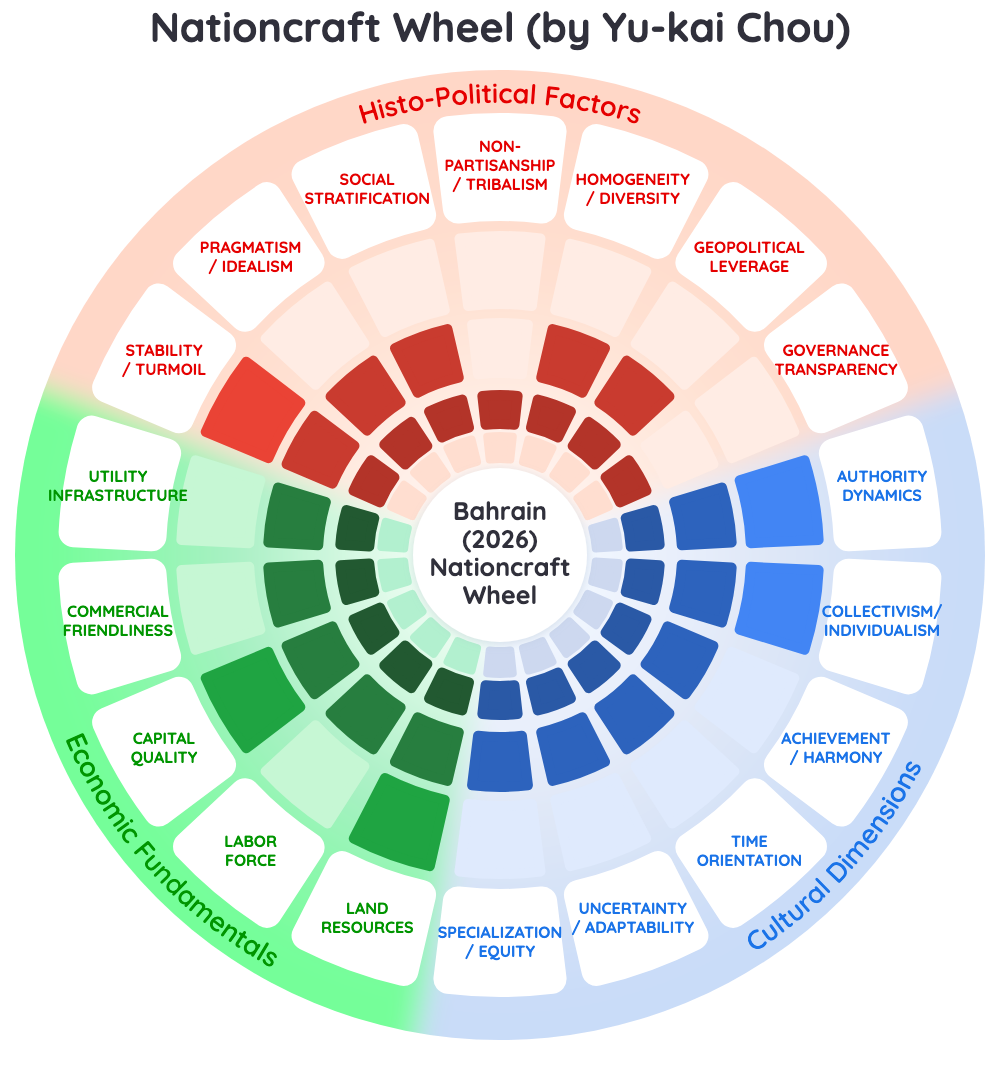

Three small states will close their 2026 books with a deficit they cannot cover from their own revenue, and each of them is filling the gap with something a different party controls.
Bahrain is running a deficit above ten percent of GDP for the fourth consecutive year against public debt of 131 percent, carried by Gulf partners and by a market that prices Bahraini paper partly on those partners. Botswana has contracted for two years straight as diamond revenue collapsed, and is drawing down reserves it spent fifty years accumulating. Mauritius has the most respectable growth of the three and a fiscal plan whose arithmetic depends on treaty payments from the United Kingdom that the International Monetary Fund and the rating agencies decline to count.
None of those three is a scandal. Each is a rational answer to the same structural fact, which is that a country of one to three million people cannot generate the fiscal depth of a large one, and has to buy the buffer somewhere.
I call this the Borrowed Buffer. Small states do not escape the deficit arithmetic that governs large ones. They substitute for it: an ally’s balance sheet, a past windfall, a future receipt. The substitution works, sometimes for decades. The Nationcraft question is not whether a country borrows a buffer, because on these variables all of them must. It is which of the three substitutions the country still controls when the lender changes their mind.
This analysis reads Bahrain, Botswana and Mauritius through all 18 Nation Variables, shows why the variable that predicts their fiscal position is not resources but transparency, and tests nine historical reform packets against the three profiles. Six fail. Three fit, and not to the same country.
⚡ Speed Run Notes
- Three small states, three borrowed buffers: Bahrain leans on GCC partners, Botswana on reserves it banked over fifty years, Mauritius on UK treaty payments the IMF does not score.
- All three score V12 at 4, 3 and 1. Smallness is the constant. What varies is V13 transparency: Bahrain 3, Botswana 7, Mauritius 7.
- The revenue take tracks V13, not V14 resources. Bahrain collects 18.0% of GDP, Botswana 26.6%, Mauritius 25.8%, on World Bank figures for 2025.
- Bahrain diversified its economy without diversifying its revenue: non-oil is 90.1% of GDP at constant prices, and debt is still 131% and rising.
- Botswana carries the lowest debt of the three and the fastest-rising: 22.5% of GDP in 2023 to a projected 47.7% by 2028. Level is not the risk. Slope is.
- ED-004 rentier stability runs on V14≥9 and V1≥8. Only Botswana meets the resource half, and it is the one country here that taxed anyway.
Table of Contents
- Understanding Small-State Fiscal Machinery Through Nationcraft
- What Is the Nationcraft Framework?
- Why These Three Variables Analyses Matter Right Now
- The 18 Nation Variables, Three Small States
- The Borrowed Buffer
- Detailed Justifications: Variable by Variable
- What the Fiscal Numbers Actually Say
- Strategic Implications
- Six Playbooks Small States Should Reject
- Three Playbooks That Actually Fit
- Governance Strategy Recommendations
- Comparative Context
- The Nationcraft Framework in Practice
About Yu-kai Chou

Yu-kai Chou is a Human-Systems Architect & Behavioral Designer and the creator of the Nationcraft Framework — an 18-variable diagnostic for matching a country’s structural profile to the reform packets that have historically worked under similar conditions. He has consulted for governments in eight nations, including Ukraine, the United Kingdom, the Kingdom of Bahrain, Singapore, Taiwan, the Netherlands, Kazakhstan, and South Korea, and has worked directly with President Zelenskyy’s team on post-war reconstruction priorities for Ukraine.
Chou’s prior framework — the Octalysis Framework — has been applied by LEGO, Microsoft, Porsche, Coca-Cola, Salesforce, and MrBeast, impacting over 1.5 Billion Users. He has taught the methodology at Harvard, Stanford, Yale, Tesla, Google, BCG, and IDEO.
His work has been cited by Harvard, Stanford, MIT, Forbes, Wall Street Journal, Wired, US Department of Energy, NIST, NSF, NCBI, US Department of Education, ClinicalTrials.gov, and Google Scholar — with 3,700+ more academic publications. Explore his books here.

Of the three countries in this analysis, Chou has advised one: the Kingdom of Bahrain sits on the eight-government list above, and Botswana and Mauritius do not. That asymmetry is worth stating at the top rather than leaving a reader to infer it, because it changes what this piece can claim. The Bahrain section draws on the structure of a state he has worked with; the Botswana and Mauritius sections are readings of published national accounts, IMF assessments and World Bank series, and nothing more. The Nationcraft Framework was built for exactly this problem: comparing countries whose scale rules out the strategies that large states take for granted, and doing it from the variables rather than from the anecdote.
Understanding Small-State Fiscal Machinery Through Nationcraft
The usual way to write about small states is to treat smallness as a character trait. Nimble, focused, able to turn on a coin. There is something in it, but it describes the upside of a constraint while leaving the constraint itself unexamined, and the constraint is arithmetic rather than temperament.
A state of one to three million people has a tax base of one to three million people. It cannot run the deficit-absorbing machinery a large economy runs almost without noticing: a deep domestic bond market, a central bank whose currency somebody else wants to hold, a private sector large enough that a downturn in one sector is offset by another. When revenue falls short, a large state borrows from its own citizens in its own currency. A small state generally cannot, so it borrows the capacity from outside.
Nationcraft scores that constraint as V12, geopolitical leverage, and the three countries here sit at 4, 3 and 1. Those are among the lowest scores in the 147-country corpus, and they are not a judgement about competence. Bahrain, Botswana and Mauritius are all, by the standards of their neighbourhoods, unusually well-run. The score measures how much the rest of the world has to care what they think, and for a country of this size the answer is structurally close to nothing.
What makes the comparison worth running is that the three responded to the identical constraint in three different currencies. Bahrain bought protection from larger neighbours who share its security interest. Botswana banked the rent from a finite resource and lived off the proceeds. Mauritius, which had almost no resource to bank, sold services instead and is now monetising a sovereignty settlement. Three substitutions, one structural problem, and 2026 is the first year in a long time that all three are being tested at once.
What Is the Nationcraft Framework?
The Nationcraft Framework is an 18-variable diagnostic for nation-states. Each variable is scored 1 to 10 and describes a structural property rather than a policy preference: how authority is distributed (V1), how long the decision horizon runs (V4), how transparent governance is (V13), what the land holds (V14), how good the capital stock is (V16). The variables cluster into histo-political factors, cultural dimensions and economic fundamentals.
Configuration is strategy, and scores are never averaged. The diagnostic value is entirely in the interactions, which is why a comparison like this one is the framework working at its most useful: three countries with a shared constraint and divergent responses let you see which variable is actually doing the work.
The framework then matches each profile against a library of historical reform packets, every one carrying the variable preconditions under which it actually worked. Across the Nationcraft Nation Variables Library the pattern that recurs is not that failed reforms were badly executed. It is that they were competently executed against a profile they were never designed for.
Small states are where that error is most expensive, because the menu of imported models aimed at them is short, loud and mostly drawn from two cases: Singapore and Dubai. Both are real, and neither is a template, for reasons that sit in specific variables rather than in anything as vague as national character, which is what the rejected-playbooks section below sets out row by row.
Why These Three Variables Analyses Matter Right Now
Each of the three has had its buffer questioned inside the last eighteen months, and the questions arrived from different directions.
Bahrain. The World Bank’s April 2026 Macro Poverty Outlook records a fiscal deficit of 10.8 percent of GDP for 2025 and projects 10.2 percent for 2026, against public debt of 131.1 percent of GDP rising to a projected 145.2 percent by 2027.1 Revenue is 18.0 percent of GDP, the lowest of the three by a wide margin. Meanwhile the domestic economy has done what Gulf diversification programmes are supposed to do: non-oil activities reached 90.1 percent of GDP at constant prices in the first quarter of 2026, and the largest single non-oil sector is financial services at 17.6 percent of real GDP.23 Bahrain has been adding revenue instruments, including a VAT doubled to 10 percent in 2022 and a 15 percent domestic minimum top-up tax on large multinationals in force from January 2025.4
Botswana. Real GDP contracted 2.8 percent in 2024 and a further 0.9 percent in 2025 on the same World Bank series, with recovery to 2.7 percent projected for 2026.5 The national accounts tell it through the fiscal line: the Bank of Botswana records a 2025/26 deficit of P16.8 billion, 6.2 percent of GDP, and a 2026/27 budget deficit of P26.4 billion, 8.9 percent.6 S&P lowered the sovereign to BBB-/A-3 with a negative outlook, tying the action explicitly to fiscal pressures from weak global diamond demand.7 The IMF’s most recent Article IV put international reserves at about 3.5 billion dollars, roughly five months of imports, at end-July 2025.8
Mauritius. Growth of 3.2 percent in 2025 slowing to a projected 2.5 percent in 2026, a fiscal deficit of 7.6 percent of GDP in 2025, and public debt of 88.9 percent rising to a projected 90.6 percent.9 The IMF’s 2026 Article IV work describes a fiscal position that needs stronger consolidation, with debt elevated near 88 percent and the primary deficit running above the budget target.10 The complication that makes Mauritius the interesting case is that its consolidation path leans on receipts from the Chagos Archipelago settlement with the United Kingdom, and the IMF and the rating agencies assess the fiscal stance without counting them.11
Read together, the three are not converging on a common crisis. They are demonstrating three distinct ways that a borrowed buffer can come under question: the lender’s patience, the windfall’s exhaustion, and the scorekeeper’s refusal to count the receipt.
The 18 Nation Variables, Three Small States
These are the canonical Nation Variables scores for all three countries as held in the Nationcraft corpus. Read across the rows rather than down the columns. The rows where all three agree describe what smallness does to a country. The rows where they diverge describe what each one chose.
| Variable | Bahrain | Botswana | Mauritius | What the spread means |
|---|---|---|---|---|
| V1 Authority Dynamics | 10 | 7 | 6 | Monarchy, dominant-party democracy, competitive democracy |
| V2 Collectivism vs Individualism | 9 | 6 | 5 | Entitlement by membership vs by contribution |
| V3 Achievement vs Harmony | 5 | 5 | 6 | No meaningful divergence |
| V4 Time Orientation | 5 | 5 | 5 | Identical, and the least useful score on the table |
| V5 Uncertainty Adaptability | 5 | 6 | 6 | Marginal |
| V6 Specialization vs Equity | 6 | 5 | 5 | Marginal |
| V7 Stability vs Turmoil | 7 | 8 | 8 | All three are stable; two have electoral turnover as the release valve |
| V8 Pragmatism vs Idealism | 5 | 6 | 6 | Marginal |
| V9 Social Stratification | 5 | 8 | 5 | Botswana’s inequality is the outlier, and it is a diamond-economy signature |
| V10 Non-Partisanship vs Tribalism | 2 | 6 | 6 | Bahrain’s bloc politics against two functioning party systems |
| V11 Homogeneity vs Diversity | 5 | 4 | 4 | All plural, none homogeneous |
| V12 Geopolitical Leverage | 4 | 3 | 1 | The constant. This is what smallness is. |
| V13 Governance Transparency | 3 | 7 | 7 | The divergence that predicts the fiscal outcome |
| V14 Land Resources | 7 | 9 | 3 | Hydrocarbons, diamonds, and almost nothing |
| V15 Labor Force Quality | 5 | 6 | 6 | Marginal |
| V16 Capital Quality | 7 | 6 | 5 | Bahrain’s financial sector is real and is its best asset |
| V17 Commercial Friendliness | 6 | 6 | 5 | Marginal |
| V18 Utility Infrastructure | 6 | 7 | 6 | All adequate |
Most of that table is noise, and saying so is the point of running it. Eleven of the eighteen rows show a spread of one point or less, which means eleven variables tell you nothing about why these three countries are in different fiscal positions. Four rows carry the signal: V12 low for all three, V13 at 3 against 7 and 7, V14 at 7, 9 and 3, and V10 at 2 against 6 and 6.
Bahrain’s wheel is the image at the head of this article: V1=10 and V16=7 sitting on V13=3, which is strong authority and strong capital with thin disclosure. The other two are below.


The Borrowed Buffer
Here is the mechanism, stated as plainly as it will go.
Every state runs a gap between what it collects and what it spends, in some years. A large state closes that gap against itself: its own savers buy its own bonds in its own currency, and the central bank behind that currency is a buyer of last resort that the market believes in. The gap is financed domestically, the terms are set domestically, and the decision about how long to run it is a domestic decision.
At V12=1 to 4 none of that is available. The domestic savings pool is too shallow, the currency is not wanted abroad, and the central bank’s promise carries only as far as its reserves. So the buffer has to be imported, and there are exactly three places to import it from.
From an ally. Bahrain’s is the purest case in the corpus. Gulf partners have a direct security interest in Bahraini stability, and that interest is legible to bond markets, which is why a sovereign at 131 percent of GDP and a four-year run of double-digit deficits still finances itself. The buffer is real and it is somebody else’s.
From your own past. Botswana banked diamond rent for five decades under an explicit fiscal rule and built the Pula Fund on the proceeds, which is the reason it appears in the corpus as SP-004 rather than as a resource-curse case. When the rent halved, it began spending the buffer, which is exactly what a buffer is for. The constraint is that this one is finite, denominated in a commodity whose demand is being eaten by synthetic substitutes, and visibly draining: reserve cover fell to roughly five months of imports by mid-2025.8
From your own future. Mauritius has no ally underwriting it and no windfall to bank, so its buffer is a receipt that has not arrived: the Chagos settlement payments. The IMF and the rating agencies exclude those from their assessment of the fiscal stance.11 That is not scepticism about the treaty. It is the standard treatment of a revenue stream that is contracted rather than collected, and it means Mauritius is running two sets of books through no fault of its own: one where the consolidation works, and one, the one outsiders use, where the deficit sits near 5 percent of GDP.
The trap in the Borrowed Buffer is not that any of these is imprudent. It is that the terms of all three are set by somebody who is not accountable to the borrowing country’s population, and that the country’s own room for manoeuvre shrinks as the dependence lengthens. An ally can reprice its support. A windfall can exhaust. A scorekeeper can decline to count. In each case the decisive vote belongs to an outside party, and that is the same structural weakness V12 measures, arriving through the fiscal door rather than the diplomatic one.
Detailed Justifications: Variable by Variable
Bahrain: V1=10, V10=2, V13=3, V16=7
Bahrain’s V1 of 10 reflects a system where binding decisions issue from the monarchy, with an elected Council of Representatives whose powers are bounded and a second chamber appointed. V10 at 2 records politics organised around sectarian and family blocs rather than programmatic parties, which in Nationcraft terms means bargaining runs through the blocs and accountability attaches to none of them.
V16 at 7 is the highest capital-quality score of the three and it is earned. Financial and insurance services are the largest non-oil sector in the economy at 17.6 percent of real GDP, and the sector is genuinely regionally competitive rather than a domestic-only arrangement.3 On the Nationcraft reading, Bahrain’s small-state strategy has substantially worked on the terms it was set: the country was asked to build a post-hydrocarbon economy and it has one, with non-oil activity at 90.1 percent of GDP.2
V13 at 3 is what the fiscal numbers are about. Revenue at 18.0 percent of GDP is not a story about an economy too small to tax. It is an economy 90 percent of which is non-oil and a fiscal base that has not followed it there, with the corrective instruments arriving late and narrow: VAT at 10 percent since 2022, and a 15 percent minimum tax that applies to multinational groups above a threshold rather than to the domestic base.4 A state that raises 18 percent of GDP has made a choice about how much it asks of whom, and V13 is where the framework records the consequence, because a low ask travels with a low obligation to explain.
Botswana: V13=7, V14=9, V9=8, V10=6
Botswana is the corpus’s reference case for converting V14 into institutions rather than into capture, and SP-004 is that packet. The scores show why it worked: V13 at 7 and V10 at 6 gave the revenue rule a constituency, and V1 at 7 left an executive strong enough to enforce it without being unaccountable to a chamber that could ask questions.
V9 at 8 is the uncomfortable number and it belongs in any honest reading. High social stratification in a country this successful at macro management is the diamond economy’s fingerprint: a capital-intensive sector with few direct employees generates enormous state revenue and very little broad-based income, so the state ends up the main distributive mechanism. That is a durable arrangement while the rent flows. The World Bank’s series has the upper middle-income poverty rate at 62.0 percent in 2025, on a 2021 PPP basis, which is the distributional side of a two-year contraction.5
The current stress does not contradict SP-004. It is the packet reaching the boundary its own preconditions imply. A savings rule protects you from a cyclical downturn in the rent. It does not protect you from a structural one, and lab-grown stones are a structural change in what the rent is worth. Botswana’s debt of 22.5 percent of GDP in 2023 rising to a projected 47.7 percent by 2028 is a country using the buffer correctly and watching it deplete.5
Mauritius: V12=1, V14=3, V13=7, V16=5
Mauritius holds the lowest V12 in this analysis and close to the lowest V14, and by the crude reading should be the weakest of the three. It is not, and the reason is the whole argument for looking at configuration rather than endowment. With no resource to bank and no ally to lean on, Mauritius had to build revenue out of activity it created: sugar, then textiles, then tourism, then financial and business services. Every one of those was a deliberate move up a value chain, and V13 at 7 is what let each transition be financed.
The strain in 2026 is genuine and it is not a repudiation of that model. Debt near 89 percent of GDP with a deficit of 7.6 percent is a hard position for any small economy, and the IMF has said plainly that consolidation needs to be stronger and more credible.10 What the V-vector adds is that Mauritius is the only one of the three whose buffer problem is a timing problem rather than a control problem. The Chagos receipts are contracted. The difficulty is that a plan which depends on them is, to every outside assessor, a plan with a hole in it until the money lands.
What the Fiscal Numbers Actually Say
All figures in this table come from a single source, the World Bank’s Macro Poverty Outlook of April 2026, so the three countries are measured on one methodology and one vintage. That matters more than it sounds: most cross-country comparisons of small states quietly mix national budget presentations, which are not comparable.
| World Bank MPO, April 2026 | Bahrain | Botswana | Mauritius |
|---|---|---|---|
| Real GDP growth, 2025 estimate | 3.2% | −0.9% | 3.2% |
| Real GDP growth, 2026 forecast | 1.3% | 2.7% | 2.5% |
| Fiscal balance, 2025 estimate | −10.8% | −6.5% | −7.6% |
| Fiscal balance, 2026 forecast | −10.2% | −7.1% | −7.1% |
| Revenues, % of GDP, 2025 | 18.0% | 26.6% | 25.8% |
| Debt, % of GDP, 2023 | 123.0% | 22.5% | 80.4% |
| Debt, % of GDP, 2025 estimate | 131.1% | 39.5% | 88.9% |
| Debt, % of GDP, 2028 forecast | 141.0% | 47.7% | 90.2% |
| Primary balance, 2025 estimate | −7.2% | −5.3% | −4.3% |
| Current account, 2025 estimate | +3.5% | +1.5% | −6.7% |
Three readings fall out of it, and the third is the one worth keeping.
First, the deficits are not very different; the debt stocks are. A spread of 6.5 to 10.8 percent of GDP is a spread, not a chasm, and yet Bahrain carries 131 percent of GDP in debt against Botswana’s 39.5. Stocks are the accumulation of decades of flows, and they record history rather than this year’s decisions.
Second, the slope contradicts the level. Botswana has the lowest debt on the table and the fastest increase: 22.5 to a projected 47.7 percent in five years is more than a doubling, while Mauritius moves from 80.4 to 90.2 and Bahrain from 123.0 to 141.0 across the same window. On level, Botswana is the safest of the three. On rate of change, it is not.
Third, and this is the finding: the revenue take tracks V13 and not V14. Bahrain has V14=7 and collects 18.0 percent of GDP. Botswana has V14=9 and collects 26.6. Mauritius has V14=3, almost nothing in the ground, and collects 25.8. If resources drove the fiscal base, Botswana and Bahrain would sit together and Mauritius would be the outlier. Instead the two countries at V13=7 collect within a point of each other, and the country at V13=3 collects eight points less. Transparency and the revenue base move together, and the causal story runs in both directions: a state that has to ask its own citizens for money has to show them what it does with it, and a state that shows its books finds it easier to ask.
Strategic Implications
Smallness is a constraint on leverage, not on competence. All three of these countries manage themselves better than most states several times their size. The corpus has plenty of large countries with worse numbers and none of the excuse. What V12 takes away is not the ability to govern well; it is the ability to be wrong for a long time without consequence, which is a luxury large states have and small ones do not.
ED-004 explains Bahrain’s revenue line and does not explain the other two. The corpus pattern for rentier stability requires V14≥9 and V1≥8, with the state distributing rather than taxing, and it names the mechanism as “no taxation, no representation”. Bahrain sits one point below the resource threshold and squarely at the authority one, which is the profile of a state that adopted the rentier fiscal bargain without ever having the rent to fund it indefinitely. That is why the tax instruments are arriving now and arriving narrow. Botswana, with a genuine V14 of 9, is the case that shows the bargain is a choice rather than a consequence: it had the rent and taxed anyway.
ET-002 resource blessing is Botswana’s pattern, and its immunity conditions are being tested rather than falsified. ET-002 requires V14≥8, V13≥7 and V8≥7, channelling resource wealth through transparent institutions into savings and diversification. Botswana meets the first two and sits one point below on V8=6. The pattern’s listed immunity factors include a sovereign fund with independent management and institutions built before the discovery, both of which Botswana has. What the pattern does not promise is immunity from the commodity itself losing value, and that is the live question. Compare DR Congo’s cobalt exposure, which is the same V14-high configuration without the V13 that makes the savings rule stick.
The Mauritius case argues against the standard advice given to small states. The advice is to find an anchor: a patron, a resource, a hub specialisation. Mauritius found none of the first two and its hub specialisation has been rebuilt three times. On the variables it should be the most fragile country here, and on growth and revenue take it is holding up at least as well as the other two. The framework’s reading is that what substitutes for V12 is not an anchor but V13, because credibility is the one asset a small state can manufacture domestically.
Every one of these buffers has a counterparty, and the counterparty’s calendar is not the country’s. Gulf support reflects a security interest that exists as long as it exists. Diamond demand is being reshaped by a technology that did not exist commercially twenty years ago. A treaty payment arrives when a treaty says it does. None of these is a judgement about the borrowing country’s conduct, which is precisely why relying on them is a structural vulnerability rather than a policy error. Something similar shows up in Zambia’s experience as a model debtor, where doing the right thing and having the terms set elsewhere turned out to be compatible.
Six Playbooks Small States Should Reject
Each of these is a real packet in the Nationcraft corpus and each worked somewhere. They fail against these three profiles for reasons specific enough to be checked, and the reasons transfer to other small states.
| Packet | Where it worked | What it needs that these three lack |
|---|---|---|
| SP-012 Dubai Transformation | UAE (Dubai), 1971–2010 | A federal partner absorbing downside risk, and V5 appetite for regulatory experiment |
| SP-002 Lee Kuan Yew Industrialization | Singapore, 1965–1990 | V1 and V13 both high at once; none of the three has that pair |
| SP-037 Vision 2030 Transformation | Saudi Arabia, 2016– | V12=9 leverage and demographic scale to absorb mega-project risk |
| SP-014 Chicago Boys Reform | Chile, 1975–1990 | A domestic private sector deep enough to privatise into |
| SP-053 Oil Fund & Authoritarianism | Azerbaijan, 1994–2020 | Nothing; it is available, and it is the outcome to avoid |
| SP-062 Morales Resource Nationalism | Bolivia, 2006–2019 | A foreign-held resource stake left to nationalise |
SP-012, Dubai Transformation
The most-copied small-state story on earth and the least transferable, because its central financial fact is usually left out: Dubai is a member of a federation whose largest member holds the hydrocarbon reserves, and that relationship absorbed the downside when the property cycle turned. The packet also runs on a social bargain that none of these three has, a small citizen minority governing an overwhelming expatriate majority with no political claim. Bahrain has the closest demographic structure and V10=2 bloc politics that has resisted precisely that arrangement for two decades.
SP-002, Lee Kuan Yew Industrialization
Every small state is told to study Singapore, and the study is worth doing as long as the conclusion is honest. The LKY packet needs high V1 authority and high V13 transparency simultaneously, a combination that is rare because the first usually erodes the second. Bahrain has the authority without the disclosure; Botswana and Mauritius have the disclosure without the concentration. Importing the packet into any of them delivers half of it, and the half you get is determined by which score you already had.
SP-037, Vision 2030 Transformation
Discussed at length in the Saudi single-artery analysis, and the relevant point here is scale. Vision-style programmes are financed by a sovereign balance sheet large enough that a failed mega-project is an accounting event rather than a fiscal crisis. At V12 of 1 to 4 and the debt levels in the table above, none of these three has that cushion. A small state running this packet gets the projects and imports the execution, converting a revenue problem into a spending problem.
SP-014, Chicago Boys Reform
Shock liberalisation, uniform tariffs and mass privatisation under an authority that could override objections. The precondition that rules it out here is the one people forget: Chile began with V16=2, meaning there was suppressed capital formation to release. Bahrain at V16=7 and Mauritius at 5 have already-functioning financial sectors, and privatising into a small domestic market with concentrated ownership transfers assets to incumbents. That failure mode is well documented across the corpus and it does not depend on anyone’s bad intentions.
SP-053, Oil Fund and Authoritarianism
Included because it is the one packet on this list that a small state in fiscal stress can actually execute. Azerbaijan built a competent sovereign fund alongside V13=3 and V1=9, and the fund became the financing arm for whatever the executive decided, with no domestic body positioned to ask whether the sequencing served the population that owned the asset. It is listed as rejected rather than as a warning because the corpus records it as a completed run with a known outcome, and because Bahrain’s V1 and V13 pair sits closest to it of the three.
SP-062, Morales Resource Nationalism
Renegotiating extraction contracts to raise the state’s share, then routing the proceeds into transfers, produced real poverty reduction in Bolivia until the gas ran short. Botswana already holds a half share of Debswana and Mauritius has nothing to nationalise, so the lever does not exist. The packet’s recorded failure, treating a windfall as permanent, is the more useful part and it applies to Botswana now.
Three Playbooks That Actually Fit
These three fit, and pointedly not all to the same country. That is the useful output of a comparative run: the corpus does not hand a small state one template, it hands each profile a different one.
SP-004, Botswana Diamond Management Packet, 1966–1999 — for Bahrain
The packet Botswana itself ran, recommended here to the country that did not. Its components are a revenue protocol classifying spending by whether it builds something, a sovereign fund with a rule, an anti-corruption body with enforcement powers, and a published public-accounts practice that let the rules bind the government that wrote them. Botswana started from V16=1 and V18=2 and constructed V13=7 rather than inheriting it.
The reason this is the Bahrain recommendation rather than a Botswana one is the revenue line. Bahrain has built the economy; what it has not built is the fiscal relationship between that economy and the state, and SP-004 is the corpus’s clearest worked example of constructing exactly that. The transferable element is not the fund. It is the published classification, because a rule that can be checked by a citizen is the thing that survives a change of minister.
SP-029, Mauritius Diversification & Services Packet — for Botswana
Mauritius moved from sugar to textiles to tourism to services across four decades, and each transition was executed while the previous sector was still profitable rather than after it collapsed. That timing is the whole packet, and it is what Botswana’s situation now requires: diamonds are not gone, they are repricing, which is the window in which a transition is affordable.
The variable fit is close. Both countries run V13=7, V10=6, V7=8 and V15=6, meaning both have the institutional capacity and the political turnover to sustain a multi-decade sequence. The difference is V14, 9 against 3, and it cuts in Botswana’s favour: it can fund the transition from the resource, which is the option Mauritius never had. The recorded caution in the Mauritius packet is the one to carry over, which is that each new sector was more skill-intensive than the last, so the education and training build has to lead the sector build rather than follow it.
SP-116, Qatar Hamad LNG & Soft-Power Diversification, 1995–2013 — partially, for Bahrain
Listed partially and with the limits named, because the resource half does not transfer: Qatar’s transformation was funded by the North Field, and Bahrain has no second windfall in reserve. What does transfer is the non-resource half, and it is the half usually dismissed as vanity. Education City, a global airline, an international broadcaster and sports diplomacy were a deliberate purchase of something a small state cannot otherwise obtain, which is the attention of counterparties much larger than itself.
On the Nationcraft reading that is a V12 play, and it is the only kind of V12 play available at this scale. Bahrain already has the strongest V16 of the three and a financial sector with genuine regional standing, which is the asset the packet would build on. The limit worth being explicit about: soft power raises the price of ignoring you, and it does not raise revenue. It belongs alongside a fiscal reform, not instead of one.
Governance Strategy Recommendations
These are written for a general reader trying to judge what would count as reform in a small state, and they are ordered by how much of the result the country itself controls. That ordering is the argument. Every borrowed buffer in this analysis has its terms set by an outside party, so the reforms worth ranking first are the ones that shift a decision back inside the country and put it where citizens can see it.
| Step | What physically changes | Who gains, and who can then object | Where it applies |
|---|---|---|---|
| Publish the buffer’s size and terms on a fixed schedule | Support packages, fund balances and treaty receipts become dated public facts rather than year-end discoveries | Citizens, who own the asset and currently learn its size from rating agencies | All three |
| Score the budget twice, with and without the borrowed item | The gap between the plan and the plan outsiders believe becomes visible domestically | Voters and parliament, who can then argue about the real number | Mauritius primarily |
| Broaden the revenue base beyond a narrow taxpayer set | The state is funded by the people it governs rather than by a patron or a windfall | Citizens, who acquire the standing that paying confers | Bahrain primarily |
| Give the audit body a public addressee and a statutory publication date | Findings land in front of the electorate on a known date instead of at official discretion | The audit institution, and anyone who wants to read it | All three |
| Classify spending by whether it builds a future revenue stream, and publish the classification | Consumption and investment stop being interchangeable in the presentation | Anyone who wants to check whether the buffer funded assets or salaries | Botswana primarily; the SP-004 mechanism |
| Sequence the education and skills build ahead of the sector it is meant to staff | A transition stops depending on imported execution | The domestic workforce, which gains the jobs rather than servicing them | Botswana and Bahrain |
The third row deserves its own paragraph, because “broaden the revenue base” is the kind of phrase that can mean two opposite things and only one of them is reform.
It is not a recommendation that a state should extract more from people who are already stretched. It is the observation the corpus records under ED-004 and states as “no taxation, no representation”, read forwards instead of backwards. A government funded by a patron answers to the patron. A government funded by a windfall answers to the commodity price. A government funded by its own citizens has to go and ask them, repeatedly, in public, and that asking is the mechanism by which populations acquire leverage over the states that govern them. The 18 percent of GDP in the table is not primarily a fiscal fact about Bahrain. It is a fact about who currently has to be persuaded.
Which is also why the disclosure rows sit above the revenue row rather than below it. Widening a tax base in a system where the accounts are not published transfers money to an apparatus without transferring any standing to the people who paid it, and that is the version of this recommendation that should be refused. The sequence matters: publish first, then ask.
Comparative Context
Set the three against the corpus’s other small and resource-dependent cases and the V13 pattern holds outside this sample.
| Country | V12 | V13 | V14 | What the configuration produced |
|---|---|---|---|---|
| Mauritius (2026) | 1 | 7 | 3 | Four sector transitions, no resource, revenue at 25.8% of GDP |
| Botswana (2026) | 3 | 7 | 9 | Rent converted to institutions, buffer now draining on a structural shock |
| Bahrain (2026) | 4 | 3 | 7 | Economy diversified to 90% non-oil, fiscal base still at 18% of GDP |
| Kuwait (2026) | 2 | 3 | 10 | World-class fund, unpublished, opened to state borrowing in 2026 |
| Singapore (benchmark) | 6 | 8 | 1 | No resource at all; V13 and V16 built deliberately |
Read the V13 column against the V14 column and the ranking inverts. The two countries with the most in the ground, Kuwait at V14=10 and Botswana at 9, sit at opposite ends of the transparency scale, and their fiscal architectures have diverged accordingly: one built a fund whose size is not published and has now opened it to state borrowing, the other built a fund with a published rule and is spending it down in the open, on schedule, for the reason the rule anticipated.
The instructive pairing is Mauritius and Kuwait, because they are the extremes on V14 and they end up at comparable debt-to-GDP with completely different room to manoeuvre. Almost nothing in the ground plus V13=7 has produced an economy that can still borrow in its own name. A great deal in the ground plus V13=3 has produced an economy borrowing against its own savings. The same contrast runs through Iraq’s rentier configuration and Algeria’s, in both cases without the institutional base that gives Botswana its options.
The Nationcraft Framework in Practice
This comparison is a good demonstration of why the framework insists on running the whole 18 rather than the three or four variables a given argument needs. Eleven of the eighteen rows in the table above turned out to be noise for this question, and there was no way to know which eleven before scoring them. Had the analysis started from the variables that “obviously” matter for small states, it would have started from V14 and V12, and V14 is precisely the variable that turns out not to predict the fiscal outcome here.
It also shows the method’s contrarian edge, which is not contrarianism for its own sake. The standard advice to a small state is to find an external anchor. The standard advice to a resource-rich state is to build a fund. Both are defensible, and this sample contains one country that did each, and both are now in a harder position than the country that did neither. The variable that separates them is the least glamorous one in the framework: whether the books are published.
The origins of Nationcraft in Octalysis behavioural design are directly relevant to why that is, rather than being a coincidence. Disclosure is a motivational mechanism before it is an accounting one. It changes who has to be persuaded, and therefore what a government spends its effort on. Set these three next to the United States Nation Variable analysis, where V13=7 sits with V10=2 and the result is a country that discloses everything and decides very little, and the trade-off becomes visible in both directions. Nationcraft does not rank configurations against each other, and the output of a run like this one is a statement about what a given configuration is capable of executing rather than a score for how good it is.
Explore More Nationcraft Analyses
Each analysis in this series applies the same 18 variables to a different configuration, and the value compounds when they are read against each other. The full set lives in the Nationcraft Nation Variables Library. Closest to this one: the Rwanda star-pupil analysis, on a small state whose external reputation is itself the borrowed buffer, and the Greece discipline-window analysis, on what happens when the scorekeeper and the electorate want different things.
Frequently Asked Questions
Is borrowing a buffer a mistake?
No, and the analysis would be worthless if it said so. At V12 of 1 to 4 a small state cannot finance a shock domestically, so importing the buffer is the rational move and all three countries here made a defensible version of it. The trap is not the borrowing. It is that the terms are set by a party the borrowing country’s population cannot hold to account, and that the dependence tends to lengthen rather than shorten. The question to ask of any buffer is not whether it is prudent but how much notice you get when it changes.
Why does transparency predict the revenue base?
Because the two are the same bargain seen from opposite sides. A state that funds itself from a patron or a windfall does not have to ask its own citizens for money, and a state that does not have to ask does not have to explain. Run it forwards and the mechanism is just as strong: a government that publishes what it does with revenue finds it politically easier to raise more. The numbers in this sample are consistent with it. The two countries at V13=7 collect 26.6 and 25.8 percent of GDP; the country at V13=3 collects 18.0.
Has Bahrain’s diversification failed?
The opposite, on its own terms. Non-oil activity reached 90.1 percent of GDP at constant prices in the first quarter of 2026, and financial services is now the largest single sector of the economy. That is what a successful diversification looks like. The finding in this analysis is narrower and it is about a different variable: the fiscal base did not follow the economic base, so a country with a 90 percent non-oil economy still collects 18.0 percent of GDP in revenue and carries 131 percent of GDP in debt. Diversifying what the country produces and diversifying what the state can tax are two separate projects, and only one of them is done.
Is Botswana’s sovereign fund a failure?
No. A buffer that is drawn down during a downturn is a buffer performing exactly as designed, and Botswana’s fifty-year savings discipline is the reason the country entered this shock with debt at 22.5 percent of GDP rather than the 80 or 130 percent that others carry. The genuine question is different: a savings rule is insurance against a cyclical fall in the rent, and synthetic stones are a structural change in what the rent is worth. Insurance against the wrong risk still pays out; it just does not renew.
What does this say about small states generally?
That the endowment matters less than the arrangement built on it, which is the framework’s central claim and is unusually cleanly demonstrated by this trio. The country with the most in the ground is contracting, the country with the least is growing, and the one variable that lines up with the fiscal outcome across all three is whether the state publishes its own accounts. That is a finding a small state can act on, because unlike resources, leverage or an ally’s goodwill, disclosure is entirely within its own gift.
Related Reading
- The Nationcraft Framework: 18 Variables, 8 Goals, 100+ Proven Reform Packets
- Nationcraft Nation Variables Library
- Nationcraft Analysis: Kazakhstan Steppes Pivot 2026
- Nationcraft Analysis: Nigeria Reform Dividend 2026
- Nationcraft Analysis: Sri Lanka Compliance Paradox 2026
Footnotes
- Bahrain fiscal balance, revenue and debt series: World Bank, Macro Poverty Outlook, April 2026, Bahrain country page, thedocs.worldbank.org.
- Non-oil GDP share of 90.1% at constant prices and non-oil growth of 2.2% in Q1 2026: Bahrain Economic Quarterly as reported by WAM, 27 August 2026, wam.ae.
- Real growth of 3.5% in 2025, financial and insurance activities at 17.6% of real GDP and manufacturing at 15.1%: Bahrain Information & eGovernment Authority, 14 April 2026, iga.gov.bh.
- VAT at 10% since 2022 and the 15% domestic minimum top-up tax on multinational groups: AGBI tax analysis, 6 March 2025, agbi.com.
- Botswana GDP, fiscal balance, revenue, debt and poverty series: World Bank, Macro Poverty Outlook, April 2026, Botswana country page, thedocs.worldbank.org.
- FY2025/26 deficit of P16.8 billion (6.2% of GDP) and FY2026/27 of P26.4 billion (8.9%): Bank of Botswana, Monetary Policy Report, August 2026, bankofbotswana.bw; 2025 contraction and 2026 rebound forecast, Monetary Policy Statement 2026, bankofbotswana.bw.
- S&P Global Ratings lowering Botswana to BBB-/A-3 with a negative outlook on fiscal pressures tied to weak global diamond demand: press release hosted by the Bank of Botswana, bankofbotswana.bw; see also the World Bank Botswana country note, documents1.worldbank.org.
- International reserves of about 3.5 billion dollars, roughly five months of import cover, at end-July 2025: IMF, Botswana 2025 Article IV Consultation, elibrary.imf.org. Context on the IMF’s reform recommendations: Mining Weekly, 29 September 2025.
- Mauritius GDP, fiscal balance, revenue and debt series: World Bank, Macro Poverty Outlook, April 2026, Mauritius country page, thedocs.worldbank.org.
- IMF assessment of the Mauritian fiscal position, debt near 88% of GDP and the call for stronger consolidation: IMF, Mauritius 2026 Article IV Consultation, elibrary.imf.org.
- Treatment of Chagos-related receipts by the IMF and rating agencies, and the deficit excluding them: “IMF presses Mauritius to cut public debt and give teeth to its reform plan,” capmad.com.
- Botswana’s Pula Fund structure and its relationship to the Government Investment Account and foreign exchange reserves: reference overview; primary institutional description in the Bank of Botswana reports at footnote 6.