

Sometime around this weekend, the 60-day safe-passage clause at the heart of the June 17 US-Iran memorandum runs out.
It is the only piece of paper that reopened the Strait of Hormuz after February’s war closed it, and it was already bleeding out before it expired: Iranian forces struck commercial vessels inside the window, Washington reimposed its naval blockade in early August, and Tehran is now negotiating with Oman over who administers the strait going forward.[1]
Every column about this moment is about Iran. I think the more revealing subject is the country that never fired a shot at the strait and nearly lost everything to it.
Saudi Arabia entered 2026 exporting roughly 8 million barrels per day of crude and refined products, most of it through Hormuz. By mid-March, its eastern terminals sat effectively silent, and the entire exportable flow of the world’s largest oil exporter was squeezing through one steel tube to the Red Sea.[2]
Here is the part that should bother Riyadh more than the closure itself: the kingdom got paid for the crisis. War prices near $100 a barrel meant Aramco booked $67.2 billion in first-half adjusted profit, and by July the budget deficit was narrowing on the oil spike.[3]
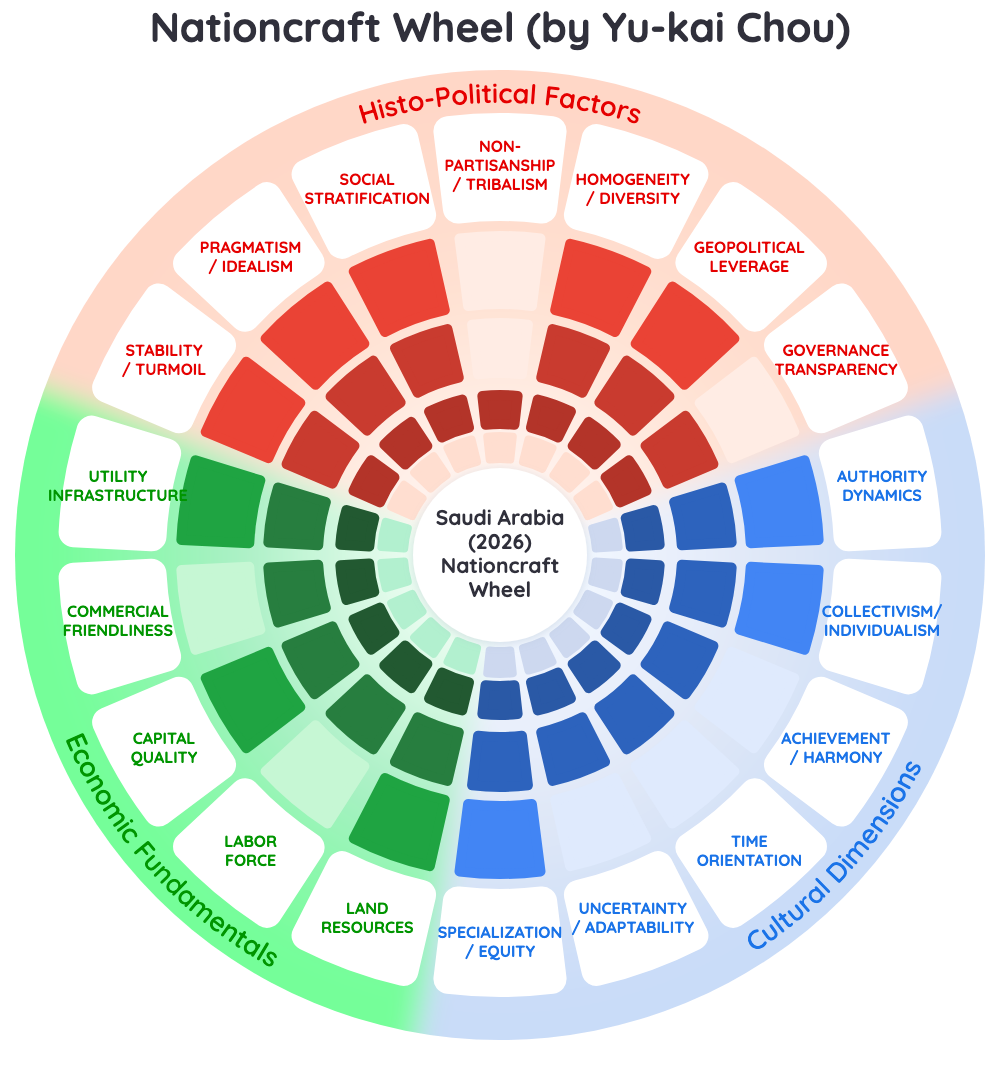
I call this the Single Artery Trap. Saudi Arabia holds the strongest command configuration in the Gulf: absolute authority (V1=10), deep collectivism (V2=10), a tenth-decile resource base (V14=10), and near-bottomless capital (V16=9). That configuration can build a $500 billion city by decree. It cannot decree a second geography. And in 2026, the market paid the kingdom a premium for its own chokepoint, teaching exactly the wrong lesson at exactly the decisive moment.
This analysis runs Saudi Arabia through all 18 Nationcraft variables, shows how the war stress-tested each one, and pulls the historical reform packets that fit its configuration, along with the famous ones that quietly do not.
⚡ Speed Run Notes
- Saudi Arabia’s V-vector pairs a command cluster (V1=10, V2=10, V14=10, V16=9) with one exit: the 2026 war proved most export volume depends on a strait its rival prices.
- The East-West Pipeline saved the kingdom and capped it. 7M bpd nameplate against ~8M bpd pre-war liftings meant survival at a discount, with Yanbu carrying 86.7% of March crude.
- The war made Riyadh richer, and that is the trap. $100 oil paid $67.2B in H1 Aramco profit, narrowing the deficit and anesthetizing the urgency that V5=5 adaptability needs.
- Norway and Botswana are precondition-failed templates here: both require transparency (V13≥7) before the resource. Saudi V13=5 arrived 80 years after the oil.
- The packets that fit share Saudi’s configuration: UAE’s Zayed (SP-105) engineered a second exit, Qatar’s Hamad (SP-116) monetized a security anchor, Kazakhstan (SP-044) hedged a rival-controlled artery.
- Vision 2030 diversifies sectors. The 2026 lesson says diversify exits first: geography is the one variable the fund cannot buy retroactively.
Table of Contents
- Understanding Saudi Arabia’s Governance Landscape Through Nationcraft
- What Is the Nationcraft Framework?
- Why This Saudi Arabia Variables Analysis Matters Now
- The 18 Saudi Arabia Nation Variables
- The Single Artery Trap
- Detailed Justifications: Reading Each Variable Under Fire
- Strategic Implications of the 2026 Stress Test
- Best-Match Historical Packets
- Governance Strategy Recommendations
- Comparative Context: The Gulf After the Closure
- The Nationcraft Framework in Practice
About Yu-kai Chou

Yu-kai Chou is a Human-Systems Architect & Behavioral Designer and the creator of the Nationcraft Framework — an 18-variable diagnostic for matching a country’s structural profile to the reform packets that have historically worked under similar conditions. He has consulted for governments in eight nations, including Ukraine, the United Kingdom, the Kingdom of Bahrain, Singapore, Taiwan, the Netherlands, Kazakhstan, and South Korea, and has worked directly with President Zelenskyy’s team on post-war reconstruction priorities for Ukraine.
Chou’s prior framework — the Octalysis Framework — has been applied by LEGO, Microsoft, Porsche, Coca-Cola, Salesforce, and MrBeast, impacting over 1.5 Billion Users. He has taught the methodology at Harvard, Stanford, Yale, Tesla, Google, BCG, and IDEO.
His work has been cited by Harvard, Stanford, MIT, Forbes, Wall Street Journal, Wired, US Department of Energy, NIST, NSF, NCBI, US Department of Education, ClinicalTrials.gov, and Google Scholar — with 3,700+ more academic publications. Explore his books here.

This Saudi Arabia analysis draws on Chou’s advisory work across the Gulf, including engagements with the Kingdom of Bahrain, a fellow Gulf monarchy whose economy lives and dies by the same strait. Watching small Gulf states hedge a chokepoint they cannot control sharpens the central question of this piece: what happens when the largest player in the region discovers, mid-war, that its own exit was never fully sovereign either?
Understanding Saudi Arabia’s Governance Landscape Through Nationcraft
Most 2026 commentary on Saudi Arabia argues about intent. Is Vision 2030 real reform or rebranding? Is Mohammed bin Salman a modernizer or a consolidator?
The Nationcraft Framework asks a colder question: given this country’s measurable configuration, which policies can physically work here, and which are guaranteed to fail no matter how sincerely they are attempted?
Saudi Arabia is an absolute monarchy under the Basic Law of 1992, with no elected legislature and a 150-member appointed Shura Council in an advisory role.[4] On August 13, three royal decrees reconstituted the Cabinet under the Crown Prince’s chairmanship, a routine act that doubles as a live reading of V1 Authority Dynamics: one office holds the pen.[5]
That concentration is usually analyzed as a political question. Nationcraft treats it as an engineering parameter.
V1=10 means Saudi Arabia can execute decisions at a speed no democracy matches. The same score means every national error executes at that speed too, with no institutional brake between a bad assumption and a national commitment.
The 2026 war made this legible in a way no peacetime audit could. Between February 28 and June 17, the kingdom ran an involuntary experiment on all 18 of its variables at once.
What Is the Nationcraft Framework?
The Nationcraft Framework scores a nation on 18 variables across three clusters: Cultural (V1-V6), Histo-Political (V7-V13), and Economic (V14-V18).
The scores are never averaged. Configuration is strategy: a V1=10 next to a V13=5 behaves completely differently from a V1=4 next to a V13=10, even if the averages look similar.
The framework then matches that configuration against a corpus of 140 historical Success Packets and failure packets, each benchmarked to its starting conditions. Deng’s China, Lee Kuan Yew’s Singapore, Zayed’s UAE, and Norway’s oil fund all worked, but each worked from a specific variable profile, and each fails when transplanted onto the wrong one.
This is the same discipline I apply in behavioral design, where the Octalysis Framework applies to nation-building as the motivational layer: nations, like users, act from their actual configuration rather than from the designer’s intentions.
For Saudi Arabia, the corpus even contains the country’s own live experiment: SP-037, the Vision 2030 Transformation Packet (2016-Present), benchmarked at launch. Comparing the 2016 benchmark to the 2026 profile is one of the most revealing tables in this analysis.
Why This Saudi Arabia Variables Analysis Matters Now
Three clocks converged in August 2026.
First, the strait clock. The June 17 memorandum’s 60-day safe-passage clause expires this week, the US naval blockade is back, and Iran is negotiating a strait administration arrangement with Oman that would formalize Tehran’s pricing power over Gulf shipping.[1]
Second, the fiscal clock. Saudi Arabia posted a SAR 125.7 billion first-quarter deficit, its largest quarterly shortfall in nearly eight years, then watched war prices flip the trajectory by July, before August reporting showed war spending outrunning the windfall again.[6]
Third, the strategy clock. In April, the Public Investment Fund approved its 2026-2030 strategy: roughly 80% of the portfolio pointed at the domestic economy, with NEOM named as one of six priority ecosystems.[7]
Each clock is usually covered as a separate story. The V-vector shows they are one story: a command state deciding, under fire, whether to spend its windfall on more of the same geography or on a second one.
Reformers in Riyadh reading their own moment through imported templates will find most of those templates quietly poisoned. That is what the packet-matching section below is for.
The 18 Saudi Arabia Nation Variables
Scores are from the Nationcraft corpus, sanity-checked August 16, 2026 against IMF Article IV data, wartime trade flows, and the post-war diplomatic record. 1 is the lowest expression of the variable, 10 the highest.
| Variable | Score | 2026 Reading |
|---|---|---|
| V1 Authority Dynamics | 10 | Absolute monarchy; Cabinet reconstituted under MBS by decree on August 13; one pen signs everything |
| V2 Collectivism | 10 | Family, tribe, and faith as the operating system of loyalty; individual identity subordinate to network |
| V3 Achievement vs Harmony | 5 | Status-driven elite competition balanced by face-preservation and consensus rituals |
| V4 Time Orientation | 6 | 2030-horizon planning documents; pro-cyclical spending behavior when prices spike |
| V5 Uncertainty Adaptability | 5 | Prefers scripted futures; the March pivot to Yanbu showed real crisis competence, one episode deep |
| V6 Specialization vs Equity | 7 | Specialist petro-economy; segmented citizen and expatriate labor markets |
| V7 Stability vs Turmoil | 8 | Deep internal stability; March missile strikes were an external shock, ended by the June 17 MOU |
| V8 Pragmatism vs Idealism | 7 | Hedged the US and Iran simultaneously; kept OPEC+ discipline through the war |
| V9 Social Stratification | 7 | Royal-tribal-citizen-expatriate gradient, formalized and stable |
| V10 Non-Partisanship vs Tribalism | 3 | Position and contract still flow along family and clan lines |
| V11 Homogeneity vs Diversity | 7 | Sunni Arab majority; Shia minority concentrated in the Eastern Province, atop the oil |
| V12 Geopolitical Leverage | 7 | Swing-producer power, repriced by the war: leverage that exits through a rival’s strait is rented, not owned |
| V13 Governance Transparency | 5 | Up from 3 at Vision 2030’s launch; budget disclosure real, process opacity intact |
| V14 Land Resources | 10 | Roughly a sixth of proven global oil reserves; the cheapest large-scale barrels on earth |
| V15 Labor Force Quality | 6 | Rising female participation; 7.0% Saudi-national unemployment; expatriate backbone remains |
| V16 Capital Quality | 9 | PIF at ~$925B AUM; Aramco’s dividend machine; deep reserves |
| V17 Commercial Friendliness | 6 | Genuine improvement; FDI still below Vision 2030 targets |
| V18 Utility Infrastructure | 7 | World-class energy infrastructure; war damage repaired within a month |
Read the clusters, never the average. The command quad (V1=10, V2=10, V14=10, V16=9) is among the strongest in the entire Nationcraft corpus.
The friction cluster (V5=5, V10=3, V13=5, V15=6) is what that command quad has to push against. And one entry, V12=7, hides the whole 2026 story inside a single digit.
The Single Artery Trap
Every named paradox in this series is a specific variable interaction. The Single Artery Trap is what happens when V14=10 and V16=9 generate national income that must physically exit through territory priced by a rival, while V1=10 keeps believing that command can substitute for geography.
Trace the war through the numbers.
| Phase | Dates | Saudi export flow | What it proved |
|---|---|---|---|
| Pre-war baseline | January 2026 | ~7.96M bpd total liftings, Gulf + Red Sea terminals | Normal: most volume exits via Hormuz |
| Closure | Feb 28 onward | Eastern terminals effectively ceased; crude exports fell to ~3.33M bpd in March | The strait is a valve Riyadh does not hold |
| Bypass surge | March | Yanbu loadings peak at ~4.07M bpd of crude, 86.7% of all liftings; East-West Pipeline maxed at ~5M bpd crude plus 900K bpd products | The artery works, and it is the ceiling |
| Strike on the artery | March-April | Iranian assault cuts pipeline throughput by ~700K bpd; full 7M bpd capacity restored by April 12 | The bypass is itself a target |
| MOU window | June 17 – August | 34M barrels shipped through Hormuz in the first two weeks, versus 15M across the entire March 9 – June 17 stretch | Reopening is rented from Tehran’s calculus |
Sources for every figure sit in the footnotes.[2] The shape of the data is the argument.
A country with total internal command lost roughly half its export volume in two weeks because of a decision made in another capital. Its lone bypass, the East-West Pipeline, was built in the 1980s under pressure of the Iran-Iraq tanker war, which means the kingdom has known about this exposure for four decades and sized the insurance policy below the risk.
Then came the twist that gives the trap its teeth. Prices did the saving.
Brent near $100 meant that half the volume earned comparable or better revenue. Aramco’s second-quarter adjusted income rose by roughly a third year over year; the July fiscal data showed the deficit narrowing on the spike.[3]
In Octalysis terms, the closure should have registered as the ultimate activation of Core Drive 8: Loss & Avoidance, the motivational alarm that forces systems to redesign. The price windfall converted it instead into a reward signal.
Loss aversion only disciplines you if the loss lands. Saudi Arabia experienced the near-death of its export model as one of its most profitable quarters, and that is precisely how a V5=5 system learns to relax again.
The trap, stated fully: command plus resources plus capital minus a sovereign exit equals a state that can win every battle except the one over its own revenue’s geography, and the market keeps paying it not to notice.
Detailed Justifications: Reading Each Variable Under Fire
A war is the most honest auditor a V-vector ever gets. Here is how each cluster held up.
The command quad: V1, V2, V14, V16
V1 Authority Dynamics (10) performed exactly as scored. The export reroute to Yanbu began within roughly ten days of the closure, with no legislative friction, no coalition management, no leaks.
Contrast that with how a fragmented democracy processes a shock, and the execution advantage of V1=10 becomes measurable in barrels per day.
V2 Collectivism (10) is the quiet enabler. Wartime economic pain produced no visible internal fracture; the loyalty network absorbed the stress the way it was designed to.
V14 Land Resources (10) and V16 Capital Quality (9) explain why the kingdom could finance a war economy, a $21.9 billion quarterly base dividend, and an unchanged giga-project slate simultaneously.[3] Almost no other state on the planet absorbs a 50% export-volume shock without a financing crisis.
The friction cluster: V5, V10, V13, V15
V5 Uncertainty Adaptability (5) is the score the war most complicates. The Yanbu pivot was fast, and the pipeline repair inside a month was competent under fire.
But adaptability as a variable measures the system’s default posture, and the default remains scripted: five-year plans, giga-projects, announced futures. One good improvisation under existential pressure does not move a structural 5, and the sanity check logged it as a minor upward pressure, no more.
V10 Non-Partisanship vs Tribalism (3) still prices every institution. Contract and position flow along family lines, which is exactly why transparency-first packets like Botswana’s cannot be retrofitted here.
V13 Governance Transparency (5) has genuinely improved from the 3 recorded at Vision 2030’s launch in SP-037. Budget documents, IMF Article IV engagement, and Aramco’s listed-company disclosure are real. The distance between 5 and the 7+ that resource-blessing patterns require is the distance this analysis keeps running into.
V15 Labor Force Quality (6) carries the quiet good news: female workforce participation holding above target, national unemployment at 7.0% and falling.[8] It also carries the structural dependency on expatriate labor that no Saudization quota has yet broken.
The exposed hinge: V7, V12, V18
V7 Stability vs Turmoil (8) survived a direct test. Iranian drones and missiles struck oil infrastructure, ports, and the pipeline itself in March, and internal order never wobbled.[9]
V12 Geopolitical Leverage (7) is where the trap lives. SP-037 benchmarked this variable at 9 in 2016, when swing-producer status read as near-total leverage.
The corpus now scores 7, and the war showed why even that may flatter: leverage that must physically exit through the Strait of Hormuz is leverage co-signed by Iran. When Iran’s coercion spiral reached the strait, Saudi Arabia discovered that its most famous power, the ability to move oil markets, had a counterparty.
V18 Utility Infrastructure (7) proved resilient in repair speed. It also revealed the concentration problem: Abqaiq, Ras Tanura, and the East-West Pipeline form a target set small enough to memorize.
The steady middle: V3, V4, V6, V8, V9, V11, V17
Seven variables neither rescued nor betrayed the kingdom in 2026, and their steadiness is itself diagnostic.
V3 Achievement vs Harmony (5) shapes how the elite competes: intensely, but inside face-preserving rituals that keep rivalry from becoming faction. The war produced no visible elite defection, which a V3=8 status tournament under stress often does.
V4 Time Orientation (6) is the variable the windfall will test hardest. The 2026 budget was written with a SAR 165.4 billion planned deficit and a 3.3% of GDP frame; the first quarter alone nearly consumed it, and the July price spike then flattered the full-year picture.[6]
A V4=8 state banks that reversal. A V4=6 state spends it, and the August reporting that war costs were outrunning the windfall suggests which instinct is currently winning.
V6 Specialization vs Equity (7) and V9 Social Stratification (7) work as a pair: a specialist petro-economy layered on a formalized status gradient. Together they explain why wartime austerity never reached citizens, because the compact’s distribution channels are precisely engineered around who must never feel the shock.
V8 Pragmatism vs Idealism (7) had a quietly excellent war. Riyadh condemned no one it would later need, kept OPEC+ discipline intact, took Iranian fire without escalating into belligerent status, and re-entered the strait commercially within days of the MOU.
That 7 is the kingdom’s most underrated asset, and the reason the Kazakhstan-style multi-vector recommendation below is realistic here while it would be fantasy in an ideological V8=3 state.
V11 Homogeneity vs Diversity (7) held, with the asterisk the corpus always attaches: the Shia minority is concentrated in the Eastern Province, directly atop the oil infrastructure Iranian missiles were targeting. Nothing broke in 2026. The map of what could is unchanged.
V17 Commercial Friendliness (6) took collateral damage the headline numbers hide: war-risk insurance premiums, chartering complications, and every foreign boardroom re-running its Gulf concentration analysis. FDI was already below Vision 2030 targets before the war; the artery question is now part of every due-diligence memo that decides whether it recovers.
What the 2016 benchmark reveals
Because SP-037 froze Saudi Arabia’s scores at the Vision 2030 launch, the decade’s delta is measurable: V13 transparency 3→5, V16 capital 6→9, V7 stability 5→8, V12 leverage 9→7.
Three variables up, and the one that went down is the one no ministry owns. That asymmetry is the entire case for treating export geography as Vision 2030 infrastructure.
Strategic Implications of the 2026 Stress Test
Four implications fall straight out of the variable readings.
First, the bypass ceiling is the binding constraint on sovereignty. The East-West Pipeline’s 7M bpd nameplate against ~8M bpd of pre-war liftings means that in any repeat closure, the kingdom operates at a permanent volume discount, holding a discount inventory of exactly one route.
Second, the windfall is a closing window, and the Nationcraft corpus is blunt about this pattern. RE-001, the Crisis Window pattern, gives reformers 6-24 months after a shock before normalcy re-freezes the politics, and it lists the specific failure mode of wealth closing the window early, as oil money did repeatedly in Venezuela’s collapse.
Saudi Arabia’s version is sharper: its crisis arrived pre-monetized. The same quarter that exposed the trap paid a record dividend, which means the window RE-001 describes is closing faster here than in any textbook case.
Third, the rentier compact now has a geographic co-signer. The corpus pattern ED-004, Rentier State Stability, explains the kingdom’s social quiet: distribution without taxation, employment without politics, the same architecture visible in Iraq’s rentier sovereignty trap and Algeria’s empty mandate.
ED-004 lists its vulnerability factors: price collapse, depletion, youth bulge. February 2026 added one the pattern had never needed to name, because no major rentier state had ever had its distribution engine switched off by a foreign hand: artery risk. The compact is only as stable as the strait.
Fourth, scarcity pricing cuts both ways. In behavioral design, Core Drive 6: Scarcity & Impatience describes how restricting supply amplifies perceived value; the war ran that mechanic on the world’s oil market, and Riyadh collected the premium.
But the same mechanic hands Iran a lever it can price at will: Tehran now demonstrably converts strait access into revenue and diplomatic position, including tolls collected inside the closure. Scarcity design always favors whoever controls the valve, and the valve is not in Riyadh.
Best-Match Historical Packets
The Nationcraft method now runs Saudi Arabia’s 2026 vector against the packet corpus. Precondition fit decides everything; prestige decides nothing.
| Packet | Country, years | Key preconditions | Saudi fit | Verdict |
|---|---|---|---|---|
| SP-106 Oil Fund Sovereign Wealth | Norway, 1990-2010 | V13=10, V10=9, V1=4 consensus state | V13=5, V10=3, V1=10 | Reject |
| SP-004 Diamond Management | Botswana, 1966-1999 | V13≥6 before resource exploitation | V13≈2 at 1938 oil discovery; 5 today | Reject |
| SP-008 Park Industrialization | South Korea, 1961-1979 | Cheap disciplined labor, V11=9, export wages | High-wage segmented labor, V15=6 | Reject |
| SP-003 Deng SEZ Gradualism | China, 1978-2000 | Adjacent demand + diaspora capital feeding zones | NEOM borders desert and sea, no Hong Kong | Reject |
| SP-014 Chicago Boys Shock | Chile, 1975-1990 | Tolerance for austerity shock | ED-004 compact makes austerity regime-threatening | Reject |
| SP-105 Zayed Oil-to-Modern State | UAE, 1971-2004 | V1=9, V2=8, V14=9, V10=3 | Near-identical configuration | Study |
| SP-116 Hamad LNG & Soft Power | Qatar, 1995-2013 | V1=9, V16=10, security anchor | Configuration match, bigger scale | Study |
| SP-044 Nazarbayev Resource Management | Kazakhstan, 1991-2019 | V1=9, V14=9, rival-controlled export artery | The structural twin | Study |
Why the famous templates fail here
SP-106, Norway’s Oil Fund Sovereign Wealth Packet (1990-2010), is the advice Saudi Arabia hears most and can use least. Norway’s fund works because V13=10 institutions predated the oil and because the fund invests abroad precisely to keep petro-money out of the home economy.
The PIF’s April strategy formalizes the opposite: roughly 80% domestic allocation, six home-market ecosystems.[7] That is a development bank wearing a sovereign fund’s name, and under ET-001 Resource Curse logic it imports appreciation and crowding-out risk into the exact economy it is trying to diversify. Same instrument label, opposite machine, and pretending otherwise is how reform decks go wrong.
SP-004, Botswana’s Diamond Management Packet (1966-1999), fails on sequencing. Its own packet notes are explicit that the model does not replicate where transparency arrives after the resource; Botswana built the institutions first, then found the diamonds. Saudi oil predates its transparency reforms by 80 years, and ET-002 Resource Blessing requires an ordering that history has already foreclosed.
SP-008, Park Chung-hee’s Industrialization Packet (South Korea, 1961-1979), fails on labor arithmetic. Park’s model ran on cheap, homogeneous, mobilizable labor exporting up the value chain. Saudi Arabia’s V15=6 workforce is high-wage, segmented between citizens and expatriates, and structurally unable to win on unit labor cost, which is why the manufacturing half of Vision 2030 keeps disappointing its own targets.
SP-003, Deng’s Open Reform Packet (China, 1978-2000), fails at the map. Shenzhen worked because it sat next to Hong Kong’s demand, capital, and know-how; the SEZ was a membrane between a command economy and a functioning market. NEOM is a membrane between the desert and the Red Sea. Even China’s supply reflex, the habit of commanding supply and assuming demand, has a Saudi echo: build the zone, decree the ecosystem, wait for the demand that geography never delivers.
SP-014, Chile’s Chicago Boys Reform Packet (1975-1990), fails on the compact. Shock liberalization presumes a state that can impose austerity and survive the anger. ED-004 says the Saudi bargain runs the other way: quiet is purchased with distribution, so the shock instrument dissolves the thing it is meant to save.
What Saudi reform should actually study
SP-105, the UAE’s Zayed Oil-to-Modern State Packet (1971-2004), is the closest configuration match in the corpus: V1=9, V2=8, V14=9, V10=3 at benchmark, a near-mirror of Riyadh’s quad.
The Emirates then did the one thing this analysis keeps circling: they engineered a second geography. The Habshan-Fujairah pipeline, opened in 2012, moves Abu Dhabi crude directly to the Indian Ocean, and the 2026 closure split the Gulf into states with a non-Hormuz exit and states without one.[10] Fujairah loadings continued while eastern Saudi terminals slept. The lesson is precise: at this configuration, geography is a capital project, and the UAE simply booked it earlier.
SP-116, Qatar’s Hamad LNG & Soft-Power Diversification Packet (1995-2013), teaches the other survivable posture: when your exports are 100% strait-locked, as Qatari LNG is, you convert capital into indispensability. Al Udeid as the US security anchor, LNG contracts that make half the world a stakeholder in your survival, media and sports assets that raise the diplomatic price of your destruction.
Doha’s 2026 experience was harsher than Riyadh’s precisely because it has no bypass, and its survival ran through the anchor, proving the packet’s logic under fire. Saudi Arabia already rents pieces of this posture; SP-116 shows what owning it looks like.
SP-044, Kazakhstan’s Nazarbayev Resource Management Packet (1991-2019), is the structural twin nobody in Riyadh cites. Kazakh crude exits overwhelmingly through the Caspian Pipeline Consortium across Russian territory, artery and rival in one, exactly the Saudi-Hormuz geometry.
Astana’s answer was multi-vector diplomacy: extract maximum value from every rival simultaneously, never let one counterparty price your exit alone, and keep alternative routes perpetually in negotiation. Kazakhstan’s multi-vector balancing act is imperfect and permanently uncomfortable, and it is the honest template for a kingdom that will share a strait with Iran forever.
Governance Strategy Recommendations
Nationcraft recommendations are sequenced against the variables that gate them, never offered as a menu.
| Sequence | Move | Gating variables | Packet evidence |
|---|---|---|---|
| 1. Now, inside the window | Declare export geography a Vision 2030 pillar: expand westward pipeline capacity beyond 7M bpd nameplate, harden Yanbu, add storage at both ends | V1=10 and V16=9 make this executable by decree; RE-001 says the political window is months, not years | SP-105 Habshan-Fujairah precedent |
| 2. Same budget cycle | Ring-fence the war windfall under a published spending rule instead of absorbing it into baseline expenditure | V4=6 and V13=5 make discretionary absorption the default; a rule is the countermeasure ET-008 prescribes | SP-106 mechanics (the rule, not the model), SP-044 stabilization fund |
| 3. 12-24 months | Refit PIF’s 80% domestic push with Dutch-disease guardrails: tradable-sector tests, external co-investment requirements, published ecosystem P&L | V16=9 gives the fund power; V13=5 is the capture risk ET-001 warns about | SP-012 Dubai’s export-facing services, ET-008 countermeasures |
| 4. Continuous | Run Kazakh-grade multi-vector diplomacy on the strait: engage any Oman-administered regime, keep the US anchor, price no single guarantor as permanent | V8=7 pragmatism supports it; V12=7 rises only through route plurality | SP-044 multi-vector record, SP-116 anchor monetization |
| 5. The decade | Convert V15 gains into tradables employment with sector-specific wage math, dropping Park-style manufacturing fantasies | V15=6 and V6=7 support services, logistics, energy-adjacent tech; unit labor cost forecloses commodity manufacturing | SP-008 as the counter-example, SP-116 services path |
Notice what is absent: no democratization clause, no transparency moonshot. Nationcraft sequencing works with the configuration that exists.
V13 improvement matters enormously here, and it enters through the spending rule and the published P&L, the two instruments that raise transparency as a side effect of protecting the money.
Comparative Context: The Gulf After the Closure
The 2026 war re-ranked the Gulf by a variable no ministry had a name for last year: exit sovereignty, the share of your export flow that survives a closed Hormuz.
| State | Non-Hormuz exit | 2026 war experience | Nationcraft reading |
|---|---|---|---|
| Saudi Arabia | East-West Pipeline to Yanbu, 7M bpd nameplate | Exports halved; bypass maxed; struck once, repaired in a month | Partial exit sovereignty; the artery is the ceiling |
| UAE | Habshan-Fujairah line to the Indian Ocean | Fujairah kept loading through the closure | SP-105’s late chapters bought a second geography |
| Qatar | None for LNG | Fully strait-locked; survival ran through the US anchor | SP-116’s indispensability posture, tested to the bone |
| Kuwait, Iraq (Gulf terminals) | Minimal / limited | Flows collapsed with the strait | Full artery exposure, no bypass booked |
| Iran | Controls the valve itself | Sold passage inside its own closure | The counterparty position: scarcity’s owner |
Two comparisons outside the Gulf sharpen the picture.
Taiwan’s silicon shield is the same paradox wearing different clothing: a national asset so valuable the world cannot ignore it, which is simultaneously the single point everything depends on. Saudi Arabia’s oil is its silicon, and Hormuz is its strait in both senses.
And Egypt’s garrison economy shows the adjacent failure mode: a state whose commanding institution owns the economy it is supposed to reform. The PIF’s 80% domestic pivot is a more sophisticated cousin of the same move, and the guardrails in the recommendations table exist because the corpus has watched this movie before.
The most instructive contrast remains the smallest one. Singapore’s LKY packet built a nation on a chokepoint it did not control either, and answered with V13=8 institutions, V8=9 pragmatism, and a century of making itself the strait’s indispensable servicer rather than its hostage. Configuration decides which of those answers is available; Singapore’s was never Riyadh’s to copy, which is exactly why the UAE, Qatar, and Kazakhstan packets carry the study weight here.
The Nationcraft Framework in Practice
Strip the analysis to its Nationcraft skeleton and the Saudi case teaches three transferable rules.
First, configuration beats intention. Vision 2030’s sincerity is irrelevant to whether Norway’s fund model can run on V13=5 tribal-allocation institutions; it cannot, and the PIF’s domestic pivot quietly concedes the point.
Second, geography is a variable, and the corpus prices it inside V12 Geopolitical Leverage. States at this configuration that engineered second geographies, as SP-105’s UAE did, hold their V12; states that rented one route hold leverage on another state’s sufferance. The 2016-to-2026 slide from V12=9 to V12=7 is that rent coming due.
Third, windfalls are motivational anesthesia. In Octalysis language, the price spike converted a Core Drive 8 loss signal into a Core Drive 2 achievement banner, and systems redesign themselves under loss, never under applause. The most dangerous quarter in Saudi Arabia’s modern history may be the one where it made $33 billion.
The kingdom’s command quad can still buy the exit. V1=10 means the decree could be signed this week; V16=9 means the capital exists; RE-001 means the political permission expires with the war’s memory.
The Single Artery Trap has one honest escape, and it is a construction project.
There is a version of 2030 in which the anniversary reviews of Vision 2030 lead with a second pipeline breaking ground on the Arabian Sea, a published spending rule holding the war windfall, and a strait regime Riyadh helped design rather than merely survived.
There is another version in which the windfall got absorbed, the artery stayed singular, and the next closure meets the same 7M bpd ceiling with a decade’s more demand riding on it.
Both versions are available to the same V-vector. That is the point of running the diagnostic: V1=10 states choose faster than anyone, and what the 18 variables cannot decide is which future the pen picks.
Explore More Nationcraft Analyses
The full Nationcraft Nation Variables Library holds every published country analysis, each running the same 18-variable diagnostic this piece applied to Saudi Arabia.
For the nearest structural neighbors to this case, start with the rentier and artery families linked throughout: Iran, Iraq, Algeria, Kazakhstan, and the Gulf packets above.
Frequently Asked Questions
What is the Single Artery Trap in Saudi Arabia’s Nationcraft analysis?
It is the interaction of the command cluster (V1=10 Authority Dynamics, V2=10 Collectivism, V14=10 Land Resources, V16=9 Capital Quality) with a geographic dependency no decree can move: most exports must exit through a strait Iran can close.
The 2026 war forced the entire exportable flow onto the East-West Pipeline, whose 7M bpd nameplate sits below pre-war liftings, and the price spike then paid the kingdom for the crisis, weakening the incentive to fix it.
Did the 2026 Hormuz closure hurt or help Saudi Arabia’s economy?
Volumes fell by roughly half in March while war prices near $100 pushed Aramco to $67.2 billion in first-half adjusted income, and July’s fiscal data showed the deficit narrowing on the spike.
The short-run ledger reads as help. The structural ledger records a rival demonstrating it can halve Saudi export volume at will, which is the more expensive fact.
Why can’t Saudi Arabia copy Norway’s sovereign wealth fund model?
SP-106 requires transparency and consensus preconditions (V13=10, V10=9, V1=4) that Saudi Arabia’s configuration (V13=5, V10=3, V1=10) does not supply, and Norway invests abroad to keep petro-money out of the home economy.
The PIF’s 2026-2030 strategy allocates roughly 80% domestically, the inverse mechanism. The name matches; the machine is opposite.
Which reform packets actually fit Saudi Arabia’s V-vector?
The UAE’s Zayed packet (SP-105), Qatar’s Hamad packet (SP-116), and Kazakhstan’s Nazarbayev packet (SP-044). All three share the authority-plus-resources configuration, and each solved a piece of the Saudi problem: a second exit, an indispensability anchor, and multi-vector management of a rival-priced artery.
What should Vision 2030 change after the 2026 war?
Sequence four moves while the RE-001 crisis window is open: make export geography a named Vision 2030 pillar with expanded westward capacity, ring-fence the windfall under a published spending rule, refit the PIF’s domestic push with Dutch-disease guardrails per ET-008, and run Kazakh-style multi-vector diplomacy on the strait without dropping the US anchor.
Related Reading
- The Nationcraft Framework: 18 Variables, 8 Goals, 100+ Proven Reform Packets
- Nationcraft Nation Variables Library
- Nation Variable Analysis: United States of America (2026)
- Nation Variable Analysis: Thailand (2026)
- Nationcraft Analysis: Nigeria Reform Dividend 2026
- Nationcraft Analysis: Turkey Strongman Discount 2026
Footnotes
- CNN, “An agreement on the Strait of Hormuz is taking shape – but not one Trump wants,” August 5, 2026. edition.cnn.com; Al Jazeera, “Iran, Oman, US ‘close’ to Hormuz deal,” August 5, 2026. aljazeera.com; the June 17 MOU text: CNN, June 17, 2026. cnn.com
- Wood Mackenzie via Hydrocarbon Engineering, “Saudi Arabia’s Red Sea crude bypass peaks in March and declines 41% by June,” July 27, 2026 (pre-war ~7.96M bpd; Yanbu March peak 4.07M bpd, 86.7% of liftings). hydrocarbonengineering.com; Argus Media, “Saudi east-west pipeline maxed out on Hormuz closure,” March 29, 2026 (~5M bpd crude via Yanbu + 900K bpd products). argusmedia.com; CNBC, “Saudi Arabia has ramped up oil shipments through the Strait of Hormuz since U.S.-Iran deal,” July 2, 2026 (34M barrels in two weeks vs 15M March 9-June 17). cnbc.com
- Saudi Gazette, “Aramco reports SR125.2 billion profit in Q2 2026,” August 4, 2026 (Q2 adjusted net income $33.4B; H1 $67.2B; Q2 base dividend $21.9B). saudigazette.com.sa; AGBI, “Saudi budget deficit narrows as oil revenue jumps,” July 2026. agbi.com
- Bertelsmann Transformation Index, “Saudi Arabia Country Report 2026.” bti-project.org
- Saudi Gazette, “King orders Cabinet reshuffle under Crown Prince, retains current ministers,” August 13, 2026. saudigazette.com.sa
- EnterpriseAM KSA, “Budget deficit widens to eight-year high in 1Q,” May 7, 2026 (SAR 125.7bn Q1 deficit vs SAR 165.4bn full-year plan). enterpriseam.com; EnterpriseAM KSA, “War spending outruns oil windfall,” August 4, 2026. enterpriseam.com
- PIF board approval of the 2026-2030 strategy, announced April 15, 2026 and reported by Reuters (~$925B AUM; ~80% domestic allocation; six ecosystems including NEOM). Fund overview: Wikipedia, “Public Investment Fund.” en.wikipedia.org
- IMF, Saudi Arabia 2026 Article IV Consultation, Country Report No. 26/210, July 2026 (growth, inflation, unemployment, deficit paths). elibrary.imf.org
- Wikipedia, “2026 Iranian strikes on Arab countries.” en.wikipedia.org; Military.com, “Iran Hits Back at Multiple Gulf Refineries After Israeli Strike on Its Offshore Gas Field,” March 19, 2026. military.com; Wikipedia, “2026 Strait of Hormuz crisis” (timeline of the February 28 closure, pipeline strike and April 12 restoration, tolls, and the MOU window). en.wikipedia.org
- Federal Reserve Bank of Dallas, “What the closure of the Strait of Hormuz means for the global economy,” March 20, 2026. dallasfed.org; Gulf International Forum, “The Strait of Hormuz Closure and the Reshaping of Energy Geopolitics.” gulfif.org