

Egypt’s government spent 2024 and 2025 doing something genuinely hard and genuinely well: it killed a currency crisis, floated the pound, tamed inflation from the low thirties toward the low teens, and rebuilt reserves. Then, in July 2026, President Abdel Fattah el-Sisi stood at the inauguration of a new State Strategic Command and ordered the next phase. He called for a national economic program to succeed the IMF one, and an accelerated exit of the state from economic activity so the private sector can lead.6
Read that directive twice, because it contains its own contradiction. The actor being asked to leave the economy is the same actor that owns roughly half of it. The IMF itself, reviewing Egypt in mid-2025, flagged the military’s expanding commercial footprint and excessive state-backed lending as the thing slowing everything down.5 When the referee is also the biggest player on the field, “the state will step back” is not a reform. It is a negotiation the incumbent gets to run against itself.
Call it the Garrison Economy Trap. It is the specific way a disciplined, unified, high-authority state can stabilize a crisis brilliantly and then find that the very discipline that saved it has become the wall against the next phase. Egypt is not short on authority, order, or the ability to make a decision stick. It is short on the two things a private economy actually runs on, transparency and a level commercial field, and those are exactly the things a garrison economy is structured not to provide.
This analysis runs Egypt through the eighteen-variable Nationcraft Framework, names the trap in the numbers, and then does what the framework is for: it separates the reform playbooks that will fail against Egypt’s specific profile from the two or three that could actually work. The point is not to grade Egypt. The point is to stop it from importing the wrong template at the exact moment the window is open.
⚡ Speed Run Notes
- Egypt stabilized brilliantly: inflation fell from 33% (2024) to about 12% (Jan 2026) and reserves rose to ~$59bn. But the next phase asks a military-owned state to exit an economy it controls at roughly half of GDP.
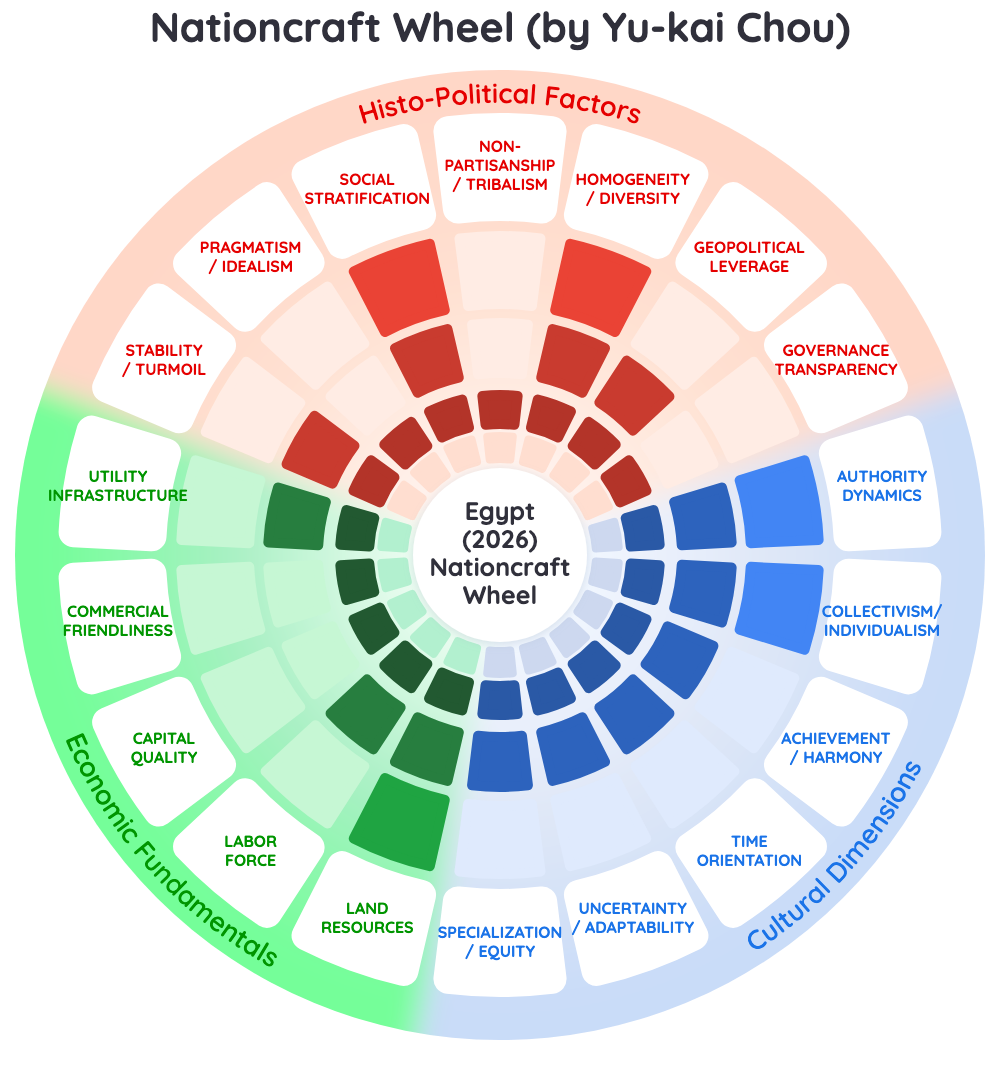
- Nationcraft reads the bind in the numbers. Authority (V1=9) and Collectivism (V2=8) are strong, but Transparency (V13=3) and Commercial Friendliness (V17=3) are the floor. Discipline is high; the market plumbing isn’t.
- The Garrison Economy Trap: when the state that must divest is the incumbent that owns the assets, “exit the economy” routes value to the connected. That is the Syria pattern, not the Singapore one.
- Reject the tempting imports: Saudi Vision 2030 (no oil surplus to fund it), Poland and Russia shock therapy (no transparency to survive it), Singapore’s clean-hands model (Egypt isn’t clean-handed yet).
- Study instead: Uzbekistan’s credible currency-and-labor opening, Indonesia’s autonomous-technocrat macro, and Oman’s sequenced modernization. All opened honestly enough to be believed.
- The one lever that unlocks the rest: a publicly audited, time-bound military exit from commerce. Raise V13 first, or every other reform loops back to the garrison.
Table of Contents
- Understanding Egypt’s Governance Landscape Through Nationcraft
- What Is the Nationcraft Framework?
- Why This Egypt Variables Analysis Matters
- The 18 Egypt Nation Variables
- The Garrison Economy Trap
- Detailed Justifications: Reading the Variables
- Reformer Playbooks Egypt Should Reject
- Reformer Playbooks Egypt Should Actually Study
- Strategic Implications and Sequencing
- The Nationcraft Framework in Practice
- Explore More Nationcraft Analyses
- Frequently Asked Questions
- Related Reading
- Footnotes
About Yu-kai Chou

Yu-kai Chou is a Human-Systems Architect & Behavioral Designer and the creator of the Nationcraft Framework, an 18-variable diagnostic for matching a country’s structural profile to the reform packets that have historically worked under similar conditions. He has consulted for governments in eight nations, including Ukraine, the United Kingdom, the Kingdom of Bahrain, Singapore, Taiwan, the Netherlands, Kazakhstan, and South Korea, and has worked directly with President Zelenskyy’s team on post-war reconstruction priorities for Ukraine.
Chou’s prior framework, the Octalysis Framework, has been applied by LEGO, Microsoft, Porsche, Coca-Cola, Salesforce, and MrBeast, impacting over 1.5 Billion Users. He has taught the methodology at Harvard, Stanford, Yale, Tesla, Google, BCG, and IDEO.
His work has been cited by Harvard, Stanford, MIT, Forbes, Wall Street Journal, Wired, US Department of Energy, NIST, NSF, NCBI, US Department of Education, ClinicalTrials.gov, and Google Scholar — with 3,700+ more academic publications. Explore his books here.

This Egypt analysis draws on the same nation-scale advisory work behind Nationcraft, including engagements across the Gulf and North Africa where the central reform question is almost always the same: how does a strong state make room for a private economy without losing control of the transition? Egypt is the hardest version of that question, because the state and the largest business are the same institution. The framework’s job here is to keep Cairo from copying a model that assumes conditions Egypt does not have.
Understanding Egypt’s Governance Landscape Through Nationcraft
Most commentary on Egypt swings between two poles. One says the reforms are working: look at the growth rebound and the falling inflation. The other says nothing has really changed, since the same men run the same system. Both are partly right, and neither is useful, because both grade Egypt on a single axis of “reforming or not.” Nationcraft does something different. It treats a country as a configuration of eighteen variables, and it insists that the configuration, not any single score, is what determines which reforms stick.
Egypt’s rebound is real. Real GDP grew 4.4% in FY2024/25 and accelerated to 5.3% in the first half of FY2026, with the IMF forecasting roughly 4.5% for the year.2 Inflation fell from 33.3% in 2024 to about 11.9% by January 2026, and gross reserves climbed from $54.9bn in December 2024 to roughly $59.2bn a year later.2 Those are the fingerprints of a competent macro-stabilization, of the kind Nationcraft catalogs as the Sisi Stabilization Packet (SP-065). The stabilization phase plays directly to Egypt’s strengths: a state that can command (V1=9), a population organized around collective and hierarchical norms (V2=8), and enough geopolitical weight (V12=6) to keep the bailouts flowing.
The trouble is that the phase Egypt is now entering plays directly to its weaknesses. Moving from “stabilize the macro” to “let the private sector lead” requires a market, and a market runs on trust that the rules are the same for everyone. Egypt’s configuration says that trust is exactly what is missing: Governance Transparency sits at V13=3, Capital Quality at V16=3, and Commercial Friendliness at V17=3. A country can stabilize with low transparency. It cannot build a private economy with it. That mismatch is the whole story, and the rest of this piece is about reading it precisely enough to act on it.
What Is the Nationcraft Framework?
The Nationcraft country analyses all rest on one idea: nations, like products and people, are motivational systems, and you cannot reform a system you have not diagnosed. Nationcraft applies the behavioral-design logic I developed over two decades in the Octalysis Framework, the study of what actually moves human behavior, to the largest motivational problem there is: getting a whole population through structural reform without losing momentum.
The framework scores a country on eighteen variables, grouped into three clusters. The first six (V1–V6) are cultural dimensions, describing what the people are like, and these change on a generational timescale. Variables V7–V13 are histo-political factors, describing what the situation is like, changeable over five to twenty years. The last five (V14–V18) are economic fundamentals, the resource base, changeable over decades. The core discipline is that scores are never averaged. A country is its configuration, and two nations with the same average can need opposite reforms.
Once a country is scored, the framework matches its profile against a library of historical Success Packets and Failure Packets, documented cases where a reform template either worked or blew up, and asks a blunt question: under a configuration like this one, has this playbook historically built something, or captured something? That is why the same tool can say “study Uzbekistan” and “reject Saudi Arabia” for the same country. The packets are not ranked by prestige. They are ranked by fit. The Nationcraft Framework hub lays out the full variable definitions; what follows applies them to Egypt in 2026.
Why This Egypt Variables Analysis Matters
Egypt is 115 million people, the demographic and cultural anchor of the Arab world, the operator of the Suez Canal, and the mediator every outside power calls when Gaza is on fire. What Egypt does with the next reform window matters far beyond Egypt. And the window is genuinely open: the macro is stable, the IMF program has done its stabilizing work, and Sisi has publicly declared the private-sector phase.
Open windows are also when the wrong template does the most damage, because a confident government moving fast can implement a bad plan just as decisively as a good one. Egypt has money on the table and models on the shelf. The Gulf sovereign-wealth model, the East Asian developmental-state model, and the post-communist shock-therapy model each carry a hidden list of preconditions. Import one whose preconditions you lack, and the reform doesn’t just underperform. It hands the economy to whoever is best positioned to grab the assets, which in Egypt is a known address.
This is the same failure mode the Venezuela reform analysis mapped: eight playbooks that look reasonable in the abstract and fail against the specific profile, versus three that fit. Egypt deserves the same treatment, and it needs it now, while the choice is still live.
The 18 Egypt Nation Variables
Here is Egypt’s full 2026 Nationcraft profile. Read it as a shape, not a scorecard. The three low economic-institution scores near the bottom (V16, V17, and the transparency score V13 above them) are the load-bearing weaknesses. The high authority-and-cohesion scores at the top are the strengths that stabilized the country and now double as the obstacle.
| # | Variable | Score | Reading for Egypt |
|---|---|---|---|
| V1 | Authority Dynamics | 9/10 | Military-led presidential autocracy; decisions stick, dissent does not survive |
| V2 | Collectivism vs Individualism | 8/10 | Family, faith, and community over the individual; strong in-group loyalty |
| V3 | Achievement vs Harmony | 5/10 | Stability valued over hyper-competition; mixed drive |
| V4 | Time Orientation | 4/10 | Prestige megaprojects over deferred, compounding payoff |
| V5 | Uncertainty & Adaptability | 6/10 | Adapts under acute pressure (the 2024 float) but institutionally rigid |
| V6 | Specialization vs Equity | 5/10 | Middling human-capital specialization |
| V7 | Stability vs Turmoil | 5/10 | Regime stable, but the Suez shock and regional spillover strain the base |
| V8 | Pragmatism vs Idealism | 3/10 | Pragmatic on the macro fix, prestige-driven on capital spending |
| V9 | Social Stratification | 7/10 | Entrenched military and elite class; wide inequality |
| V10 | Non-Partisanship vs Tribalism | 3/10 | Patronage networks; in-group capture of opportunity |
| V11 | Homogeneity vs Diversity | 8/10 | Arab-Muslim majority with a Coptic minority near 10% |
| V12 | Geopolitical Leverage | 6/10 | Suez, Gaza mediation, US and Gulf strategic partner |
| V13 | Governance Transparency | 3/10 | Low; the military economy is deliberately opaque |
| V14 | Land Resources | 7/10 | Nile, Suez geography, Zohr gas; limited arable land |
| V15 | Labor Force Quality | 5/10 | Large young workforce; skills gaps and brain drain |
| V16 | Capital Quality | 3/10 | Thin capital markets; state and military crowd out private capital |
| V17 | Commercial Friendliness | 3/10 | Hard business environment; military competition distorts markets |
| V18 | Utility Infrastructure | 4/10 | Electricity surplus after 2015, but gas-import pressure returned in 2025 |
The Garrison Economy Trap
Now the paradox in one sentence: the trait that should make Egyptian reform easy is the trait that makes it structurally impossible in its current form. High Authority Dynamics (V1=9) plus high Collectivism (V2=8) is the classic profile of a state that can force through hard reform against opposition. It is the top-line signature of the East Asian developmental states. On paper, Egypt should be able to command a transition the way South Korea or Indonesia once did.
But look at where that authority is lodged. In Egypt, the state and the largest commercial enterprise are the same institution. The IMF estimates state-owned enterprises hold assets worth roughly half of GDP, spanning banking, energy, manufacturing, transport, and telecoms, and a large, opaque bloc of that is military-affiliated.5 So when Sisi orders the state to “exit economic activity,” the order travels down a chain of command to the officers who run the companies being sold, appraised by agencies inside the same state, and often bought by funds connected to the same networks. The high V1 that should drive the reform is the reason the reform cannot be trusted.
This is where the low scores turn a difficulty into a trap. With Governance Transparency at V13=3 and Non-Partisanship at V10=3, there is no independent referee to certify that a sale was fair or an appraisal honest. With Capital Quality at V16=3 and Commercial Friendliness at V17=3, there is no deep private capital pool standing ready to buy the assets at arm’s length, so the natural buyers are the connected few who already have access. The result is not a market. It is a reshuffling of ownership inside the garrison, wearing the language of privatization.
The framework has a name for the endpoint of liberalization without transparency, and it is not a success story. It is the Syria pattern, which the next section takes up directly. The Garrison Economy Trap is the road that leads there when a strong state opens its economy before it opens its books.
Detailed Justifications: Reading the Variables
A configuration is only as good as the behavior behind each score. Here is why the load-bearing variables read the way they do.
Authority and cohesion: V1=9, V2=8, V11=8
Egypt’s authority score is near the ceiling for good reason. Since 2014 the presidency has concentrated power in the security apparatus, and Freedom House rates the country firmly “Not Free.” That V1=9 is what let Egypt float the pound in 2024 and absorb the inflation shock without the government falling, a move that would topple a lower-authority state. Collectivism (V2=8) and Homogeneity (V11=8) reinforce it: a population organized around family, faith, and a shared national identity tolerates hardship framed as collective sacrifice. These three scores are the engine of the stabilization. They are also, together, why there is no organized domestic force that can hold the reform honest from outside the state.
The pragmatism gap: V8=3, V4=4
Egypt’s Pragmatism score is low, and the tell is the spending. A purely pragmatic government facing thin capital would husband every dollar toward productive private investment. Egypt instead poured tens of billions into the New Administrative Capital and other prestige megaprojects while the private sector was starved of credit and foreign exchange. That is a V4=4 time-orientation, visible monuments now over compounding capacity later, married to a V8=3 preference for the grand gesture over the boring, high-return reform. The macro fix was pragmatic; the capital-allocation pattern around it was not.
The transparency floor: V13=3, V10=3, V9=7
This is the cluster that makes reform dangerous. Transparency International scores Egypt around 30 out of 100. The military economy publishes little, competes with tax and conscription advantages private firms cannot match, and answers to no independent audit. V10=3 (patronage over impartial rules) and V9=7 (a steep, entrenched hierarchy) mean opportunity flows through connection, not merit. In a stabilization, low transparency is survivable. In a privatization, it becomes the mechanism of capture, and every asset sold under these conditions is an asset sold to whoever is closest to the decision.
The economic base: V14=7, V16=3, V17=3, V18=4
Egypt’s Land Resources score of 7 reflects geography more than agriculture: the Nile, the Suez Canal, and the Zohr gas field, offset by scarce arable land for 115 million people. But the resource base does not translate into private economic strength, because Capital Quality (V16=3) and Commercial Friendliness (V17=3) are near the floor. Capital markets are thin, the state and military crowd out private borrowers, and the business environment is hard even for well-connected firms. Utility Infrastructure (V18=4) improved with the post-2015 electricity build-out, but 2025 brought a return of gas-import pressure and rolling supply strain. The base can support growth. It cannot yet support a private-sector-led economy, and that gap is the reform agenda.
| Variable cluster | Egypt signature | What it enables | What it blocks |
|---|---|---|---|
| Authority & cohesion (V1, V2, V11) | 9 / 8 / 8 (very high) | Decisive macro stabilization; shock absorption | Independent checks; credible arms-length reform |
| Governance quality (V8, V10, V13) | 3 / 3 / 3 (very low) | Fast top-down execution | Trust, fair appraisal, capture-proof privatization |
| Economic institutions (V16, V17) | 3 / 3 (very low) | State-led investment | Deep private capital; level competitive field |
| Leverage & base (V12, V14) | 6 / 7 (moderate-high) | Bailouts, mediation, geographic rents | Nothing; but rents can substitute for reform |
Reformer Playbooks Egypt Should Reject
Each of the following is a real, documented reform template that some adviser will urge on Cairo. Each fails against Egypt’s specific configuration, and the framework says why.
1. Saudi Vision 2030 (SP-037): the mirage Egypt most wants to copy
Vision 2030 is the seductive one, because it is Gulf, it is ambitious, and it is state-led: everything Egypt’s leadership finds congenial. But the packet’s preconditions are brutal on closer read. Saudi Arabia’s profile at launch carried Land Resources at V14=10 and a sovereign wealth fund large enough to buy the transition, funding the megaprojects, seeding the new industries, and cushioning citizens through the change. Egypt’s V14 is 7, and it is geography, not liquid oil rent. There is no Egyptian PIF; there is a reliance on Gulf bailouts and a $35bn UAE land deal that plugged a hole rather than funding a future.7 Copy Vision 2030 without the sovereign surplus and you get the part Egypt has already lived: debt-financed monuments that crowd out the private sector they were meant to catalyze. Reject.
2. Poland Shock Therapy (SP-005): capture insurance not included
Poland’s big-bang liberalization is the textbook post-crisis reform. Its documented precondition is explicit in the packet: it requires Governance Transparency at V13 of at least 5 to prevent capture during rapid privatization, plus an external anchor (the EU accession path) to lock in the rules. Egypt has V13=3 and no equivalent anchor. Shock therapy into a low-transparency system does not create owners; it creates oligarchs. Reject.
3. Russia’s Yeltsin Shock Therapy (FP-016): the cautionary twin
If Poland shows the version that needs transparency, Russia shows what happens without it. Yeltsin-era Russia liberalized fast with Governance Transparency at V13=2 and Capital Quality at V16=3, numbers that rhyme uncomfortably with Egypt’s. The assets went to whoever was closest to power, an oligarch class was born in a few years, and the reform’s legitimacy never recovered. Egypt is one poorly-designed privatization law away from the same outcome. This is not a template to copy; it is a warning to post on the wall. Reject.
4. The Singapore Model (SP-002): clean hands required
Every reforming autocracy wants to be Singapore: authoritative, orderly, prosperous. But the Lee Kuan Yew packet’s engine was a set of scores Egypt does not have. It ran on Governance Transparency at V13=8 and Pragmatism at V8=9, a genuinely clean and hyper-competent bureaucracy that made the strong state trustworthy to investors. Egypt sits at V13=3 and V8=3. The Singapore model without clean institutions is just authoritarianism with better slogans. Reject until the transparency gap is closed.
5. Chile’s Chicago Boys (SP-014): the insulated technocracy Egypt won’t allow
Chile’s market reforms ran on an insulated team of technocrats given real autonomy under an authoritarian umbrella, cushioned by copper (V14=8). Egypt has the authoritarian umbrella but not the insulation: the military will not hand economic policy to a team empowered to sell military assets and open military-dominated sectors to competition. The precondition that made Chile work, a technocracy shielded from the incumbents, is precisely what the garrison economy exists to prevent. Reject.
6. Estonia’s Digital Leap (SP-007): wrong resource base
Estonia rebuilt itself around a digital state, but the packet requires Uncertainty-Adaptability at V5 of at least 7 and Labor Force Quality at V15 of at least 7, on a clean post-Soviet slate. Egypt is V5=6 and V15=5, on anything but a clean slate. A digital-first leap is a fine complement to reform; as a substitute for fixing the transparency and capital gaps, it is a distraction. Reject as a headline strategy.
7. The crony-liberalization path: the Syria pattern (FP-020)
This one is not a template anyone proposes out loud; it is the default outcome if Egypt liberalizes without fixing V13 first. Pre-war Syria under Bashar al-Assad opened private banks and free-trade zones while keeping Governance Transparency at V13=1 and impartiality at V10=2. The result was crony capitalism, liberalization as a tool for regime-connected enrichment, and it hollowed the state from the inside before the war ever started. Egypt’s V13=3 and V10=3 place it on the same knife-edge. This is the trap the whole analysis is warning against, and rejecting it is the entire point. Reject, decisively.
| Playbook | Packet | Missing precondition in Egypt | Verdict |
|---|---|---|---|
| Saudi Vision 2030 | SP-037 | V14=10 oil rent + sovereign wealth fund (Egypt V14=7, no fund) | Reject |
| Poland Shock Therapy | SP-005 | V13≥5 + external EU anchor (Egypt V13=3, none) | Reject |
| Russia Shock Therapy | FP-016 | Any transparency at all (V13=2 there led to capture) | Reject (warning) |
| Singapore LKY | SP-002 | V13=8 clean bureaucracy + V8=9 (Egypt 3/3) | Reject for now |
| Chile Chicago Boys | SP-014 | Insulated technocracy the military won’t permit | Reject |
| Estonia Digital | SP-007 | V5≥7, V15≥7, clean slate (Egypt 6/5) | Reject as headline |
| Syria crony-liberalization | FP-020 | N/A; this is the failure mode to avoid | Reject decisively |
Reformer Playbooks Egypt Should Actually Study
Rejection is the easy half. The harder and more useful half is naming the templates that fit Egypt’s real configuration of high authority, low transparency, and a state-dominated economy, and that opened honestly enough to be believed. There are three, and each comes with a warning label Egypt must read.
1. Uzbekistan’s Mirziyoyev opening (SP-045): the closest structural fit
No case in the corpus matches Egypt’s top-line profile more closely. Uzbekistan under Karimov scored Authority at V1=9 and Collectivism at V2=8, nearly identical to Egypt, and ran one of the world’s most closed, state-frozen economies for a generation. Then Mirziyoyev, an insider succeeding from within the system, did the thing that looked impossible. He unified the currency and made the sum convertible in 2017, abolished cotton-harvest forced labor under independent ILO verification, opened borders with neighbors, and let regional trade boom. Growth averaged around 5.5% and remittances doubled.
The lesson for Egypt is precise and hopeful: even a deeply authoritarian, state-dominated system can pivot to real economic opening when the leadership genuinely accepts that the old model is exhausted. But note why it was believed. Mirziyoyev’s opening was credible because the first moves were concrete and externally verifiable, a unified exchange rate anyone could check and a forced-labor ban the ILO could audit. Egypt’s equivalent is not a directive that the state will “exit the economy.” It is a published, independently audited register of every military-owned company, with a binding timetable for divestment that outside monitors can score. Uzbekistan shows the pivot is possible. It also shows the pivot only counts when it is legible from the outside.
2. Indonesia’s New Order stabilization (SP-023): the technocrat bargain
Suharto’s Indonesia is the developmental-state case that most resembles a military-anchored regime running an economy. Its engine was a specific bargain: the generals kept security and politics, but a team of technocrats, the “Berkeley Mafia,” were given genuine autonomy over macroeconomic policy. They ended hyperinflation, welcomed foreign investment, and invested oil revenue in agriculture and education, and the economy grew its income per head roughly sixteenfold across three decades. Indonesia proves a garrison state can grow fast if it walls off economic management from the security apparatus.
The warning label is just as important, and it is Egypt’s exact risk: over time, Suharto-family cronyism metastasized, and the 1997 crisis exposed how much of the “miracle” had been hollowed by capture. The technocrat bargain works only if the technocrats stay genuinely autonomous and the ruling family’s hands stay out. For Egypt, the model gives a clear instruction: give a real economic team real power over the whole economy, including the military’s part of it. Carve the military’s commercial interests out as untouchable and you have not copied Indonesia’s success, you have pre-ordered its failure.
3. Oman’s Qaboos modernization (SP-036): sequenced authority, honestly deployed
Oman is the Gulf case that is actually within Egypt’s reach, precisely because it is not Saudi Arabia. Sultan Qaboos took a country with almost no schools or roads and, over one generation, built human capital first through education, health, and infrastructure, sequencing the state’s investments deliberately rather than chasing prestige. Authority was near-absolute (V1=10), and it was spent on capacity rather than monuments. The result was a move from poorest Arab state to upper-middle-income.
The warning is the one Egypt is already hitting: even well-sequenced authority stalls when it never makes real room for the private sector. Oman’s diversification lagged, private job creation fell short, and youth unemployment rose, because top-down modernization built the state’s capacity without ever building an independent private economy. For Egypt, Oman says sequence honestly and invest in people, but do not mistake a capable state for a substitute for a private one. The garrison can build the road. It cannot be the only thing driving on it.
| Model | Packet | Why it fits Egypt | The warning label |
|---|---|---|---|
| Uzbekistan (Mirziyoyev) | SP-045 | V1=9, V2=8 twin; opened a frozen state economy credibly | Only counts if the first moves are externally verifiable |
| Indonesia (New Order) | SP-023 | Garrison state grew via autonomous technocrats | Cronyism kills it if the military’s assets are off-limits |
| Oman (Qaboos) | SP-036 | High authority sequenced into human capital | A capable state is not a substitute for a private one |
Strategic Implications and Sequencing
Put the fits and rejects together and a clear sequence falls out. Egypt’s problem is not a shortage of authority or of ambition. It is that its authority is entangled with its economy, and its transparency is too low for the untangling to be trusted. So the sequence has to start with the one move that changes that, before any of the exciting stuff.
First, raise V13 with a single credible act. Publish a complete, independently audited register of military-affiliated commercial holdings, with a binding, monitored timetable for divestment. This is the Uzbekistan lesson applied literally: one concrete, externally verifiable move that tells private capital the rules have actually changed. Without it, every later reform routes value back to the garrison, and everyone with money to invest knows it.
Second, build the arms-length referee before you sell. Low V10 and V16 mean Egypt lacks both an impartial process and a deep buyer pool. Create genuinely independent valuation and competition oversight, ideally with external monitors attached to the IMF relationship, so that the assets Egypt does sell go to the productive rather than the connected. Sequence the referee ahead of the sale, not after.
Third, run the Indonesia technocrat bargain with no carve-outs. Give an economic team real authority over the whole economy, including the military’s share. The moment the military’s commercial interests are declared untouchable, the reform becomes the Syria pattern with better paperwork.
Fourth, spend on capacity, not monuments. The Oman lesson and the V8 and V4 gap point the same way: redirect capital from prestige megaprojects toward the human capital (V15) and utility resilience (V18) that a private economy needs. Egypt has already learned what the New Administrative Capital cost the private sector in crowded-out credit.
The contrast worth holding in mind is Argentina, where a low-authority state is trying to shock-reform against fierce resistance, and Egypt, a high-authority state that could sequence calmly if it chose to. Egypt’s authority is an asset most reformers would kill for. The question is whether it will be spent on opening the economy or on protecting the part of it the state already owns.
The Nationcraft Framework in Practice
The reason to run this exercise through Nationcraft rather than ordinary punditry is that the framework forces a country’s advisers to say the quiet part: which preconditions does this reform assume, and does the country have them? “Egypt should privatize” is not a plan; it is a mood. “Egypt should publish an audited military-asset register before privatizing, because its V13=3 makes the Russia outcome the default otherwise” is a plan, because it names the mechanism and the failure mode.
That is the through-line across every case in the behavioral framework library. The Greece discipline-window analysis showed how an external anchor can substitute for domestic transparency; Egypt has no such anchor, which is exactly why it must build the transparency itself. The Nigeria reform-dividend analysis showed how a stabilization can stall when the promised private-sector payoff never arrives; Egypt is standing at that same fork right now. The same eight Core Drives that explain why a product retains users explain why a population stays bought into reform, or checks out when it sees the gains flowing to insiders.
Nationcraft does not tell Egypt what to want. It tells Egypt which of the things it already wants are compatible with the country it actually is. For a garrison economy, that compatibility check is the difference between a reform and a reshuffle.
Explore More Nationcraft Analyses
Egypt sits inside a regional pattern the Nationcraft country analyses library tracks closely: strong states with weak institutions trying to convert stability into growth. The Iran coercion-spiral analysis examines a MENA authoritarian economy where control substitutes for legitimacy; the Iraq rentier-sovereignty analysis shows how resource rents can substitute for the hard work of building a productive base; and the Algeria analysis maps another North African military-anchored economy facing the same divestment question. For the post-Soviet version of Egypt’s opening problem, the Kazakhstan steppes-pivot analysis is the natural companion.
Frequently Asked Questions
What is the Garrison Economy Trap in Egypt?
It is the structural bind where the disciplined, high-authority state that stabilized Egypt’s economy is also the largest owner of that economy through the military and state enterprises. The same actor asked to run the reform is the incumbent the reform must dislodge, so “state exit from the economy” tends to transfer assets to the connected rather than build a genuine private market.
How does the Nationcraft Framework score Egypt?
Egypt’s 2026 profile shows very high Authority Dynamics (V1=9) and Collectivism (V2=8), but low Pragmatism (V8=3), Governance Transparency (V13=3), Capital Quality (V16=3), and Commercial Friendliness (V17=3). That combination is what makes market-style reform so hard to execute honestly.
Why can’t Egypt just copy Saudi Vision 2030?
Vision 2030 rests on Saudi Arabia’s Land Resources score of 10 and a sovereign wealth fund large enough to buy the transition. Egypt’s Land Resources sit at 7, its capital base is thin (V16=3), and it relies on Gulf bailouts rather than commanding its own surplus. Copying the megaproject model without the oil rent produces debt, not diversification.
Which reform models actually fit Egypt’s profile?
The closest fits are Uzbekistan’s Mirziyoyev opening (SP-045), Indonesia’s technocrat-led New Order stabilization (SP-023), and Oman’s Qaboos modernization (SP-036). All three were high-authority states that made credible, verifiable moves to open a state-dominated economy, each with a cautionary limit Egypt must avoid.
What is the single most important reform lever for Egypt?
A credible, audited, time-bound withdrawal of the military from commercial activity, published on a public register with independent verification. Without raising Governance Transparency (V13), every other reform routes value back to the incumbent bloc.
Is Egypt’s economic reform actually failing?
No. The stabilization phase succeeded, with growth rebounding and inflation falling sharply. The risk is in the next phase: converting stability into a private-sector-led economy, which Egypt’s transparency and capital-institution scores make genuinely difficult unless the sequencing is right.
Related Reading
- The Nationcraft Framework: the full 18-variable diagnostic behind this analysis.
- Nationcraft Country Analyses: the complete library of country diagnostics.
- Venezuela: Eight Playbooks Rejected, Three That Fit: the reject-versus-fit method applied to a resource-cursed reform window.
- Iran: The Coercion Spiral: a MENA authoritarian economy where control substitutes for legitimacy.
- Kazakhstan: The Steppes Pivot: the post-Soviet version of opening a state-dominated economy.
- Nigeria: The Reform-Dividend Trap: what happens when a stabilization’s promised payoff never arrives.
Footnotes
- Nationcraft Framework and 18-variable methodology: yukaichou.com/nationcraft-framework.
- Egypt GDP, inflation, and reserves data: IMF, “IMF Executive Board Completes the Fifth and Sixth Reviews Under the EFF and First Review Under the RSA for Egypt” (26 Feb 2026), imf.org; and “IMF raises Egypt’s GDP growth forecast to 4.5% for FY2025/26,” EgyptToday, egypttoday.com.
- Suez Canal revenue decline (down 45.5% to $3.6bn, FY2024/25): Central Bank of Egypt balance-of-payments report, via Amwal Al Ghad, amwalalghad.com.
- IMF urges acceleration of state-asset sales: AGBI, “IMF urges Egypt to accelerate sale of state assets” (Apr 2025), agbi.com.
- Military and state-owned enterprise share of the economy: Carnegie Endowment, “Retain, Restructure, or Divest? Policy Options for Egypt’s Military Economy,” carnegieendowment.org; IMF review commentary on the military’s commercial role.
- Sisi’s July 2026 post-IMF economic directives and state-exit plan: Daily News Egypt, “Egypt opens new Strategic Command in New Capital; Al-Sisi outlines post-IMF economic plan” (4 Jul 2026), dailynewsegypt.com; EgyptToday, “From a post-IMF economic program to local council elections,” egypttoday.com.
- State asset-partnership and divestment pipeline: Egypt State Information Service, “Egypt offers 52 state-backed investment projects as asset partnership push continues,” sis.gov.eg.