
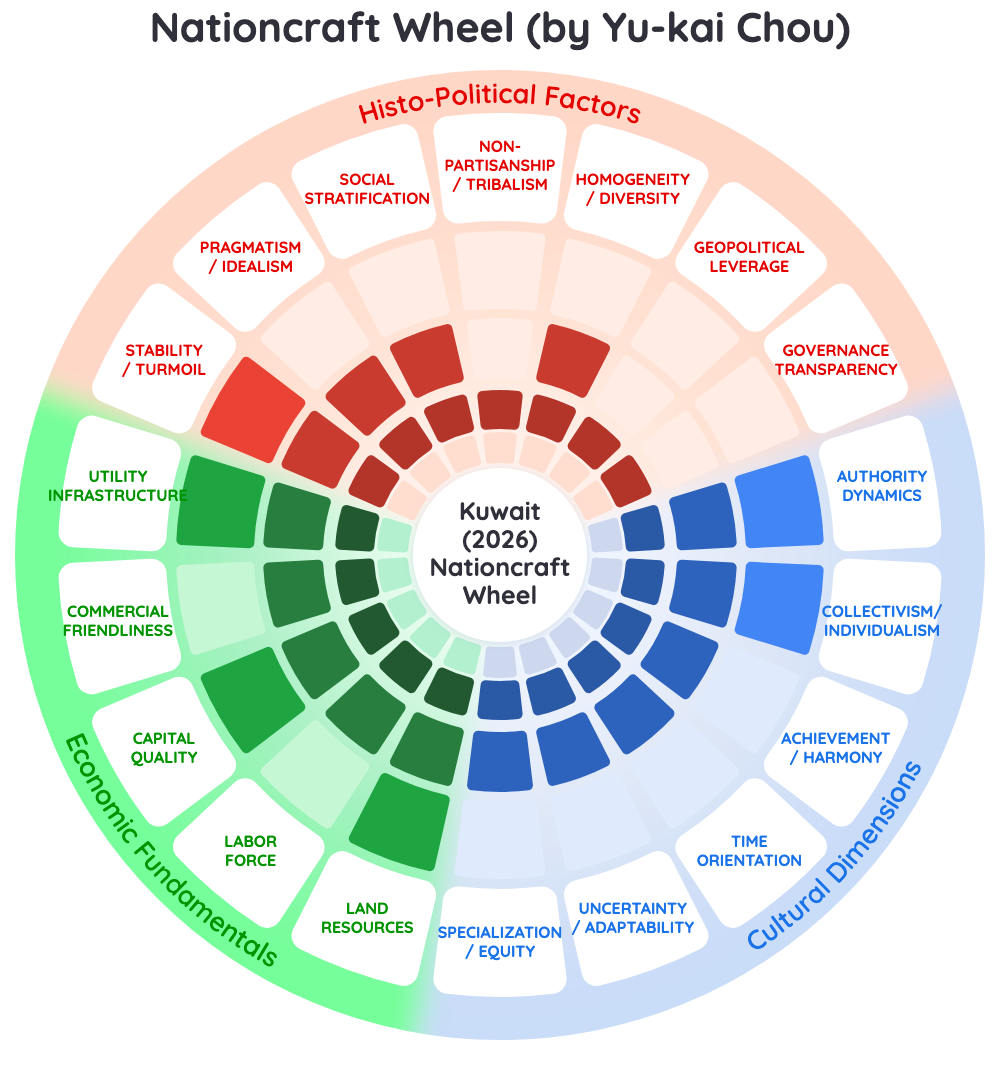

On September 1, Kuwait signed away the one rule that made its sovereign savings different from everybody else’s.
Decree-Law 81 of 2026 amended a 1976 statute so that the General Reserve, the account that pays the bills, may now borrow from the Future Generations Fund, the account that was never supposed to be touched. The decree is careful. Loans are capped, recorded as debt owed to the fund, repayable first out of any surplus, and cannot be written off except by a new law. On paper it is one of the more disciplined drawdown mechanisms any petrostate has written.
The problem is not the caps. The problem is that Kuwait dissolved the body that would have argued about them twenty-eight months earlier, and that body was the whole reason the ring-fence held for fifty years.
I call this the Future Generations Trap. A country builds a world-class instrument for converting a depleting asset into a permanent one, scores a 9 on capital quality for its trouble, and then discovers that the instrument was never the achievement. The argument around it was. Kuwait had the Gulf’s only legislature that could refuse a finance minister, and the fund survived the 1980s crash, the 2014 crash and the 2020 crash because refusing was possible. The elected chamber went in May 2024. The vault opened in September 2026. Those two dates are the analysis.
This piece reads Kuwait through all 18 Nation Variables, shows which variable interactions turned a savings rule into a line of credit, and tests ten historical reform packets against the profile. Seven fail. Three are worth studying. The distinction matters more than usual here, because Kuwait is the rare case where the money is not the constraint and has not been for sixty years.
⚡ Speed Run Notes
- Decree-Law 81/2026 lets Kuwait’s General Reserve borrow from the Future Generations Fund for the first time since 1990. Caps are real: 10% of net assets, one year capped at five-year average returns.
- The Future Generations Trap: V16=9 capital and V14=10 resources sit on V13=3 transparency and V10=2 factional politics. The fund is institutional; its oversight was political, and that layer was suspended in May 2024.
- A cap defined as a share of audited net asset value is only as strong as the audit the public can read. Kuwait has never published the fund’s size. The two headline caps are currently unverifiable from outside.
- The fiscal squeeze is real and mostly imported: the FY2025/26 deficit hit KD 7.1 billion, oil receipts came in 11.2% under budget, and Gulf crude exports fell roughly 47% after the Strait of Hormuz closed to traffic.
- Kuwait already runs the ED-004 rentier signature at full strength: V14≥9 and V1≥8, distribution instead of taxation. ET-001 resource curse needs V13≤3, which Kuwait now meets.
- Seven playbooks fail here, including Vision 2030 (SP-037) and Dubai (SP-012). Three repay study: Norway’s fund rule (SP-106), Botswana’s revenue protocol (SP-004), and Azerbaijan (SP-053) as the outcome to avoid.
Table of Contents
- Understanding Kuwait’s Savings Machinery Through Nationcraft
- What Is the Nationcraft Framework?
- Why This Kuwait Variables Analysis Matters Right Now
- The 18 Kuwait Nation Variables
- The Future Generations Trap
- Detailed Justifications: Variable by Variable
- What Decree-Law 81 Actually Changes
- Strategic Implications
- Seven Reformer Playbooks Kuwait Should Reject
- Three Playbooks Kuwait Should Actually Study
- Governance Strategy Recommendations
- Comparative Context
- The Nationcraft Framework in Practice
About Yu-kai Chou

Yu-kai Chou is a Human-Systems Architect & Behavioral Designer and the creator of the Nationcraft Framework — an 18-variable diagnostic for matching a country’s structural profile to the reform packets that have historically worked under similar conditions. He has consulted for governments in eight nations, including Ukraine, the United Kingdom, the Kingdom of Bahrain, Singapore, Taiwan, the Netherlands, Kazakhstan, and South Korea, and has worked directly with President Zelenskyy’s team on post-war reconstruction priorities for Ukraine.
Chou’s prior framework — the Octalysis Framework — has been applied by LEGO, Microsoft, Porsche, Coca-Cola, Salesforce, and MrBeast, impacting over 1.5 Billion Users. He has taught the methodology at Harvard, Stanford, Yale, Tesla, Google, BCG, and IDEO.
His work has been cited by Harvard, Stanford, MIT, Forbes, Wall Street Journal, Wired, US Department of Energy, NIST, NSF, NCBI, US Department of Education, ClinicalTrials.gov, and Google Scholar — with 3,700+ more academic publications. Explore his books here.

Chou’s Gulf advisory experience is with the Kingdom of Bahrain, not Kuwait, and the distinction is the reason this analysis is written the way it is: what follows is a reading of Kuwait’s published record rather than a report from inside its ministries. Two things in that record are unusually legible from outside. Kuwait ran the only Gulf legislature with the standing to reject a budget, and it ran the oldest sovereign wealth fund in the world. The Nationcraft Framework exists to ask what happens to a country’s reform options when one of those two structures is removed and the other is left in place.
Understanding Kuwait’s Savings Machinery Through Nationcraft
Most resource states are analysed as though the central question is whether they saved. Kuwait settled that question in 1953, when the Kuwait Investment Board began placing oil receipts into foreign assets eight years before the country was independent. It settled it again in 1976, when Decree-Law 106 created the Future Generations Fund and ordered ten percent of all state revenue into it every year, in surplus and deficit alike.3 Nothing in Kuwait’s file suggests a country that failed to plan.
That is exactly what makes it a useful case. If saving were sufficient, Kuwait would be the richest per-capita success story in the Nationcraft corpus. It is not, and the Nationcraft reading explains why: a fund is a mechanism, and mechanisms inherit the governance of whoever can reach them. Kuwait’s V16 capital quality scores 9, one of the highest in the 147-country corpus, and its V13 governance transparency scores 3. A 9 sitting on a 3 is not a contradiction. It is a description of an asset that is excellently managed and poorly watched, which is a stable arrangement right up until someone needs the money.
The second structure is the one outsiders consistently underrate. Kuwait’s National Assembly, established under the 1962 constitution, was the only legislature in the Gulf that could interpellate ministers, reject a budget and force a government to resign, and it used all three powers repeatedly. It also spent four decades fighting the executive specifically over money: over public debt legislation, over whether the Future Generations Fund could be touched, over the terms of the distributive bargain. The friction was constant and frequently paralysing. It was also the only thing in the system that could say no.
On May 10, 2024, an amiri order dissolved the Assembly and suspended several provisions of the 1962 constitution for a period not exceeding four years, pending a review of the democratic process.5 The Assembly’s own internal regulations were subsequently suspended, and the freeze runs until either that four-year window expires or a new Assembly is elected.6 Nationcraft treats that as a V1 event, not a news event: it moved Kuwait’s authority dynamics to a clean 10 and removed the institutional counterweight that the entire savings architecture had been calibrated against.
What Is the Nationcraft Framework?
The Nationcraft Framework is an 18-variable diagnostic for nation-states. Each variable is scored 1 to 10 and describes a structural property of a country rather than a policy preference: how authority is distributed (V1), how far the time horizon of decision-making extends (V4), how transparent governance is (V13), how good the capital stock is (V16), and so on across three clusters covering histo-political factors, cultural dimensions and economic fundamentals.
The premise is that configuration is strategy. Scores are never averaged, because the whole diagnostic value lives in the interactions: a country with V14=10 land resources and V13=8 transparency is Norway, and a country with V14=10 and V13=3 is a resource curse candidate, and no single-number index can tell those apart. The framework then matches the resulting profile against a library of historical reform packets, each carrying the variable preconditions under which it actually worked.
That matching step is what separates Nationcraft from the usual practice of importing whichever reform story is fashionable. A packet that produced results in one configuration will produce something else entirely in another, and the corpus records both. Across the Nationcraft Nation Variables Library the recurring finding is that most failed reforms were not badly executed. They were correctly executed against the wrong variable profile.
Kuwait is a useful stress test of that claim because its economic fundamentals are close to ideal and its histo-political factors are not, so every recommendation that treats the country as a money problem misses, for the simple reason that the money has been there since the first commercial cargo shipped in 1946 and has never been the thing in short supply.
Why This Kuwait Variables Analysis Matters Right Now
Three things landed inside eighteen months, and the order they landed in is the story.
First, the fiscal position turned. Kuwait closed FY2025/26 with a deficit of KD 7.1 billion, about 23.1 billion dollars, 13.2 percent wider than the year before and the widest since the pandemic. Revenue came in at KD 16.457 billion against a budgeted KD 18.231 billion, with oil receipts 11.2 percent below plan at KD 13.584 billion. Spending was not the culprit: it landed 3.8 percent under budget at KD 23.598 billion.9 The budget had assumed 68 dollars a barrel, the finance ministry’s own stated breakeven was 90.5, and wages and subsidies were budgeted at 79.5 percent of all spending against 9.1 percent for capital projects.10 A deficit of roughly 20 percent of GDP is now projected for FY2026/27.11
Second, the shortfall was mostly imported. Following strikes on Iran that began on February 28, 2026, Iranian forces declared the Strait of Hormuz closed, and cross-strait traffic largely halted. Gulf crude exports fell roughly 47 percent, from about 17 million barrels a day in 2025 to around nine million by August 2026, with direct crude movements through the strait averaging 2.2 million barrels a day.12 Kuwait has no export route that avoids Hormuz. This is the V12 score of 2 expressed as cash: a country can hold several hundred billion dollars in foreign assets and still be unable to move its only product.
Third, the legal architecture changed twice. Law 60 of 2025 restored public borrowing after an eight-year gap, setting a ceiling of KD 30 billion and permitting maturities out to fifty years; Kuwait returned to international markets and issued 11.25 billion dollars of sovereign bonds across three tranches.78 Then, on September 1, 2026, Decree-Law 81 opened the Future Generations Fund.1
Read as a sequence: the oversight body was suspended in May 2024, external borrowing was re-enabled in 2025, and internal borrowing against the citizens’ savings was enabled in 2026. Nothing in that sequence requires bad faith to explain. It requires only that the institution which used to slow each step down is not in the room.
The 18 Kuwait Nation Variables
These are Kuwait’s canonical Nation Variables scores as held in the Nationcraft corpus. Read them as a shape, not a scorecard. The shape here is unusual: the economic fundamentals cluster is close to the top of the corpus, and the histo-political cluster is close to the bottom, with almost nothing in between.
| Variable | Score | What the score describes |
|---|---|---|
| V1 Authority Dynamics | 10 | Amiri decree is the operative instrument; the elected chamber is dissolved and parts of the 1962 constitution suspended |
| V2 Collectivism vs Individualism | 10 | Citizenship is a collective entitlement structure: family, tribe and diwaniya networks mediate nearly everything |
| V3 Achievement vs Harmony | 5 | Status attaches to position and lineage more than to output; low competitive pressure inside the citizen economy |
| V4 Time Orientation | 5 | The long horizon is institutional, held in a fund, not behavioural; annual budgeting runs short |
| V5 Uncertainty Adaptability | 5 | Wealth absorbs shocks, which removes the pressure that normally forces adaptation |
| V6 Specialization vs Equity | 6 | Distribution favours breadth of entitlement over concentration of expertise |
| V7 Stability vs Turmoil | 7 | No violent contestation, but chronic executive-legislative deadlock, now resolved by suspension rather than settlement |
| V8 Pragmatism vs Idealism | 5 | Policy is reactive to oil receipts rather than to a stated doctrine |
| V9 Social Stratification | 6 | Citizen and non-citizen tiers are legally distinct; the bidoon question is unresolved |
| V10 Non-Partisanship vs Tribalism | 2 | Formal parties are absent while tribal, sectarian and merchant blocs organise everything |
| V11 Homogeneity vs Diversity | 6 | A citizen minority inside a large expatriate majority, with a sharp legal boundary between them |
| V12 Geopolitical Leverage | 2 | One export route, through one strait, guaranteed by external security partners |
| V13 Governance Transparency | 3 | The sovereign fund’s holdings are not published; the Audit Bureau reports into a chamber that is not sitting |
| V14 Land Resources | 10 | Roughly a hundred billion barrels of proven reserves against a small citizen population |
| V15 Labor Force Quality | 4 | The citizen workforce is concentrated in public employment; the productive private workforce is largely non-citizen |
| V16 Capital Quality | 9 | Seventy years of professional foreign asset management, and a fund older than any sovereign peer |
| V17 Commercial Friendliness | 6 | Capable financial sector, slow licensing, foreign ownership constrained relative to Gulf neighbours |
| V18 Utility Infrastructure | 7 | Reliable power and water at heavy subsidy, with demand growth outrunning capacity additions |
Two readings fall straight out of the table. The first is the gap between V16 at 9 and V15 at 4: Kuwait’s capital is world class and its citizen labour force is not deployed against it, which is the classic rentier split. The second is the gap between V14 at 10 and V12 at 2, which says the country’s single greatest asset confers almost no bargaining power, because the asset cannot move without someone else’s permission.
The Future Generations Trap
The trap has a precise mechanism, and it is not corruption.
Kuwait solved the hard half of the resource problem early. Converting a depleting physical asset into a permanent financial one is genuinely difficult, and most resource states never manage it. The 1976 statute did it with a rule so simple it survived every political configuration the country produced: ten percent of revenue in, nothing out. The Future Generations Fund was not drawn on through the 1980s oil collapse, the reconstruction after 1991, the 2014 price crash or the 2020 demand shock. It was last tapped around the Iraqi invasion, which is the kind of exception that proves a rule rather than eroding it.
What made that rule binding was never the statute alone. Moody’s description of the pre-amendment position is the clearest statement of the actual mechanism: the legislation explicitly prohibited the government from withdrawing from the reserve, so any use of its assets required separate legislative approval.4 That is the sentence to hold on to. The protection was a requirement to go and ask a legislature. What made it binding was that any move against the fund had to survive a chamber that could interpellate the finance minister, that contained blocs with independent power bases, and that had demonstrated across four decades that it would use those powers. The V10 score of 2 is usually read as a weakness, and in most contexts it is. In this one specific respect it was load-bearing: a fragmented, factional, tribally organised Assembly was very hard to buy as a bloc, which made the veto expensive to overcome.
Remove the chamber and the arithmetic inverts. The same V10=2 fragmentation that once made the fund hard to reach now means there is no organised constituency to defend it, because the constituencies were organised inside an institution that no longer convenes. V13=3 completes the mechanism: the caps in the new decree are expressed as percentages of figures the public cannot see. The annual limit is one hundred percent of the fund’s average audited returns over five years, and the stock limit is ten percent of audited net asset value.2 Both numbers live in audited statements that Kuwait does not publish. An outside reader cannot compute either ceiling, which means an outside reader cannot tell whether a given drawdown is inside it.
That is the Future Generations Trap in one sentence: a savings rule that was enforced by an institution rather than by disclosure will survive exactly as long as the institution does, and not one day longer. The fund is still excellently run. It is simply no longer ring-fenced by anything a citizen can check.
The trap also explains why the caps being genuinely careful does not resolve the question. Decree-Law 81 requires approval by both the Council of Ministers and the board of the Kuwait Investment Authority, sets conditions on each loan’s amount, purpose, repayment period and return, bars new loans while either ceiling is breached, records the money as a debt owed to the fund, gives it repayment priority from surpluses, and forbids write-off except by law.2 Every one of those is a real constraint. All of them are administered by the executive, reviewed by bodies the executive appoints, against figures the executive does not publish. Careful design and external verifiability are different properties, and only the second one survives a change of intent.
Detailed Justifications: Variable by Variable
The authority cluster: V1, V7, V10
V1 at 10 is not a judgement about legitimacy, it is a measurement of where a binding decision comes from. Since May 2024 the answer has been the amiri decree, and Decree-Law 81 is the clearest illustration available: a fifty-year-old financial rule was amended by an instrument published in the official gazette, effective on publication, with no legislative stage at any point.1 Nationcraft scores that at the ceiling. Countries that reach V1=10 gain execution speed and lose error correction, which is the trade every high-V1 case in the corpus eventually pays for.
V7 at 7 deserves more care than it usually gets. Kuwait has no insurgency, no coup history, no street violence of consequence. What it has had is forty years of executive-legislative deadlock: assemblies dissolved and re-elected, governments resigning ahead of interpellations, major legislation stalled for entire parliamentary terms. The 2024 suspension did not settle that conflict, it paused one side of it. A V7 of 7 with a suspended legislature is a different object from a V7 of 7 with a functioning one, because the disagreements that used to be expressed in a chamber do not stop existing when the chamber closes. They relocate.
V10 at 2 is the variable most outsiders misread. Kuwait has no legal political parties, and yet its politics is unusually organised: tribal blocs, Shia and Sunni Islamist currents, and old merchant families all function as durable coalitions. Nationcraft scores V10 low because loyalty attaches to the bloc rather than to the institution, and because policy bargaining runs through the blocs. Two consequences follow. Distribution is the only reliably tradeable currency, which is why every fiscal correction attempt since 2016 has died at the wage and subsidy line. And because no bloc can govern alone, no bloc can be held responsible for an outcome.
The culture and time cluster: V2, V3, V4, V5, V8
V2 at 10 and V9 at 6 have to be read together. Kuwaiti citizenship is not just a legal status, it is a share certificate in the national income, and the entitlements attached to it are collective rather than earned. That makes V2 unusually high even by Gulf standards, and it interacts badly with V3 at 5: if status and income attach to membership, the return on competitive individual achievement inside the citizen economy is low, and it shows up downstream in V15.
V4 at 5 is the most counter-intuitive score on the wheel, because the Future Generations Fund is one of the longest-horizon institutions any state has ever built. The resolution is that V4 measures the horizon of decision-making, not the existence of a long-horizon asset. Kuwait outsourced its patience to a statute in 1976 and did not need to practise it afterwards. A budget process that assumes 68 dollars a barrel against a 90.5 breakeven is a short-horizon behaviour, and it coexisted with the fund for years without either one correcting the other.10 That is precisely why V4=5 and V16=9 can sit on the same wheel. When the institutional horizon is amended, there is no behavioural horizon underneath to catch it.
V5 at 5 and V8 at 5 describe the same absorptive quality from two directions. Wealth has consistently allowed Kuwait to buy out of adjustment, so the adaptive reflex is untested rather than absent. Successive plans to introduce a value-added tax and to restructure subsidies have been announced, deferred and re-announced across a decade. A country that can pay to avoid a decision will, and V5 stays where it is.
The economic cluster: V14, V15, V16, V17, V18
V14 at 10 and V16 at 9 are the two highest scores on Kuwait’s wheel and they are causally linked: seventy years of converting the first into the second is the achievement the country should actually be known for. How large is it? Nobody outside the state can say, and the estimates are worth sitting with. Moody’s put the Kuwait Investment Authority’s government financial assets at roughly 750 billion dollars at the end of 2025, about 475 percent of GDP.4 The National Bank of Kuwait, working from independent estimates, put the new ten percent borrowing ceiling at roughly 110 billion dollars, or KD 34 billion, which implies a fund of about 1.1 trillion.2 Those two respectable estimates are a third of a trillion dollars apart. That gap is not sloppiness by either analyst. It is what a national balance sheet looks like when the country does not publish one, and it is the reason a cap expressed as a percentage of that balance sheet cannot currently be checked by anyone.
V15 at 4 is the structural weakness that the money has been covering. The citizen labour force is concentrated in public employment, while the private economy runs on a non-citizen workforce with no path to citizenship, which means the country’s human capital investment and its productive labour market are two largely separate populations. Nationcraft scores that low regardless of education spending, because V15 measures deployment and not credentials. V6 at 6 is the same fact from the entitlement side.
V17 at 6 and V18 at 7 are the scores most responsive to ordinary administrative reform, and they are the least discussed. Kuwait has a genuinely capable banking sector, and it has licensing timelines and ownership restrictions that its neighbours removed a decade ago. Utility provision is reliable and heavily subsidised, with demand growth persistently ahead of capacity additions, which converts a V18 strength into a recurring fiscal liability.
V13 at 3 is where all of this converges. The sovereign fund does not publish its holdings, the State Audit Bureau reports to a chamber that is not sitting, and the two caps introduced in September 2026 are denominated in unpublished figures. Every other variable on this wheel can be argued about from public evidence. This one cannot, which is itself the finding.
What Decree-Law 81 Actually Changes
It is worth setting out precisely what the decree does and does not do, because both the alarmed and the reassuring readings of it have been overstated.
| Provision | Before September 1, 2026 | After Decree-Law 81/2026 |
|---|---|---|
| Access to the Future Generations Fund | Closed to the General Reserve; last exception around the 1990 invasion | Permitted “by way of exception” as a loan to the General Reserve |
| Who authorises a drawdown | No standing mechanism | Council of Ministers and the Kuwait Investment Authority board, with conditions set per loan |
| Annual ceiling | Not applicable | 100% of the fund’s average returns over the last five audited fiscal years |
| Stock ceiling | Not applicable | 10% of the fund’s net asset value per the last audited statements |
| Status of the money | Not applicable | Recorded as a debt owed to the fund, with repayment priority from budget surpluses |
| Forgiveness | Not applicable | Cannot be written off or cancelled except by a new law |
| Public verification of either ceiling | Fund size unpublished | Fund size still unpublished |
The alarmed reading, that Kuwait has raided its children’s savings, is wrong on the text. This is a structured, capped, repayable facility, and the explanatory memorandum’s stated purpose of giving the state an organised borrowing mechanism instead of unregulated withdrawals is a real distinction.2 The reassuring reading, that the caps make the question moot, is wrong on a different axis. Six of the seven rows above are commitments made by an executive to itself, and the seventh row, the one that would let anyone outside the executive check whether the other six are being honoured, is the only row where nothing changed on September 1.
Strategic Implications
The fiscal problem and the governance problem run on different clocks. The deficit is acute and largely exogenous: Hormuz closed, volumes fell, receipts followed. That is a problem measured in quarters, and a country with Kuwait’s V16 can absorb quarters almost indefinitely. The governance problem is measured in decades, because what was amended in September was not a budget line but the rule that made the savings a separate category of money. Conflating the two produces the most common error in commentary on this decree, which is to treat a permanent institutional change as a temporary liquidity measure.
The ED-004 rentier signature is now running without its brake. The corpus pattern for rentier state stability requires V14≥9 and V1≥8, with the state buying consent through distribution instead of raising revenue through taxation, and Kuwait is listed in the pattern’s own example set. What the pattern predicts is that the distributive floor becomes politically untouchable while the revenue side stays hostage to a single price. Kuwait has demonstrated this for a decade: wage and subsidy commitments held through three oil crashes. The new facility does not change that dynamic, it finances it.
The ET-001 resource curse preconditions are now met, which was not true a decade ago. ET-001 requires V14≥8, V13≤3 and V8≤4, with amplifiers for entrenched elites and single-commodity dependence above half of exports. Kuwait meets the first on 10, meets the second on 3, and sits one point outside the third on V8=5. Its historical immunity came from the fourth listed immunity factor, a sovereign wealth fund with independent management, plus a small population relative to resource wealth. The fund’s independence is precisely the property that a Council of Ministers loan facility modifies. This is the same interaction that shows up in the Iraq rentier sovereignty analysis and in Nigeria, with the difference that Kuwait starts from a vastly better asset position and therefore has far longer to notice.
V12=2 is the variable no amount of money can fix, and it is the one that caused this. Kuwait’s entire export volume transits one strait. A country holding somewhere between 750 billion and 1.1 trillion dollars in foreign assets discovered in 2026 that its income is hostage to a waterway it does not control and cannot route around. Compare Saudi Arabia’s single-artery exposure, which at least has an east-west pipeline to the Red Sea, or Kazakhstan’s multi-vector routing, which was built specifically to avoid depending on one neighbour. Kuwait’s options here are diplomatic rather than financial, which is an uncomfortable position for a country whose instinct is to solve problems with the balance sheet.
The four-year clock is the only scheduled event in the system. The May 2024 order set a suspension of not more than four years, which places an outer bound of May 2028. Whatever is borrowed before then will be borrowed under rules that no elected body ratified, and will have to be explained to whichever body eventually sits. That is a foreseeable collision, and foreseeable collisions are where Nationcraft usually finds the reform window.
Seven Reformer Playbooks Kuwait Should Reject
Each of these is a real packet from the Nationcraft corpus, each worked somewhere, and each fails against Kuwait’s specific variable profile for a specific reason. The reason matters more than the verdict, because the failure modes are transferable.
| Packet | Where it worked | Kuwait’s blocking variables |
|---|---|---|
| SP-037 Vision 2030 Transformation | Saudi Arabia, 2016– | V12=2 vs 9; V15=4; no domestic execution base |
| SP-012 Dubai Transformation | UAE (Dubai), 1971–2010 | V17=6, V5=5; ownership and visa regime not comparable |
| SP-116 Hamad LNG & Soft-Power Diversification | Qatar, 1995–2013 | Requires a second, un-transited export windfall Kuwait does not have |
| SP-014 Chicago Boys Reform | Chile, 1975–1990 | V13=3, V16 mismatch; no tax base to liberalise into |
| SP-105 Zayed Oil-to-Modern State | UAE, 1971–2004 | Federal bargain absent; Kuwait is already built |
| SP-036 Qaboos Modernization | Oman, 1970–2010 | Sequenced from a near-zero base; V18=7 already high |
| SP-062 Morales Resource Nationalism | Bolivia, 2006–2019 | Nothing left to nationalise; KPC is already state-owned |
SP-037, Vision 2030 Transformation
The most frequently suggested template for any Gulf state, and the least importable here. Saudi Arabia’s packet runs on V12=9 geopolitical leverage and demographic scale: mega-projects, a listed national oil company and a sovereign fund deployed as a development engine all presuppose the ability to attract capital and labour on your own terms. Kuwait scores V12=2. It also scores V15=4, which is the deeper problem, because Vision-style programmes are executed by a domestic professional class and Kuwait’s is concentrated in the ministries the programme would have to reform. A smaller country running this packet buys the mega-projects and imports the execution, which converts a savings problem into a spending problem.
SP-012, Dubai Transformation
Free zones, freehold property for foreigners, visa liberalisation and a common-law financial centre produced the most-copied city-state story of the last thirty years. The packet’s preconditions include V17 commercial openness and a V5 appetite for regulatory experiment that Kuwait does not currently show at 6 and 5 respectively, and its social bargain, a small citizen minority accepting an overwhelming expatriate majority with no political claim, is exactly the arrangement Kuwait’s V9=6 and V11=6 politics has spent two decades resisting. Importing the packet without that bargain gets the costs and not the growth.
SP-116, Hamad LNG and Soft-Power Diversification
Qatar’s transformation was funded by the North Field, a second resource windfall that arrived after the first one had already built the state. Kuwait has no equivalent in reserve, and critically, Qatar’s LNG also transits Hormuz, so the packet does not solve the constraint that is actually binding in 2026. A diversification strategy that leaves V12 at 2 has not diversified the thing that broke.
SP-014, Chicago Boys Reform
Shock liberalisation, uniform tariffs, mass privatisation and pension reform under an authority that could ignore objections. The superficial fit is V1, and it is a trap. Chile’s packet worked on an economy with a real tax base, a private sector to privatise into, and V16=2 at the start, meaning there was capital formation to unlock. Kuwait has V16=9 and almost no domestic non-oil private sector of scale. Running this packet in a rentier economy privatises state assets into the same merchant networks that already hold the licences, which is the failure mode the corpus records under elite capture rather than liberalisation.
SP-105, Zayed Oil-to-Modern State
The UAE packet built a state from V18=1 infrastructure and V15=2 human capital, using oil to fund universal citizen welfare and phased diversification. Kuwait ran an analogous programme thirty years earlier and finished it: V18 is already 7 and the welfare architecture is already universal. Re-running a state-building packet on a built state produces additional entitlement without additional capacity.
SP-036, Qaboos Modernization
Oman went from three schools to a thousand and from ten kilometres of road to fifteen thousand. That packet is a sequencing lesson for countries starting near zero. Kuwait’s equivalents are long since built, and the Omani element that does transfer, a deliberate reduction of oil dependence in the revenue mix from ninety to seventy percent, is a target rather than a method.
SP-062, Morales Resource Nationalism
Renegotiating extraction contracts to lift the state’s share, then routing the proceeds into direct transfers, delivered real poverty reduction in Bolivia before the gas ran short. It has nothing to offer Kuwait, where the state share is already effectively a hundred percent through Kuwait Petroleum Corporation and transfers are already universal. The packet’s recorded failure mode, consumption of a windfall that was assumed to be permanent, is the one Kuwait is closest to repeating, which makes it useful as a warning and useless as a plan.
Three Playbooks Kuwait Should Actually Study
These three fit for different reasons. Two are positive matches on the variables that matter, and the third is in the corpus as an outcome rather than a model: the case that shows what this configuration produces when nothing changes.
SP-106, Norway Oil Fund Sovereign Wealth Packet, 1990–2010
The obvious comparison, and the interesting part is not the fund. Norway’s packet and Kuwait’s architecture do the same job: convert petroleum revenue into foreign financial assets, keep it out of the domestic economy, and preserve it across generations. Kuwait started thirty-seven years earlier. What Norway added, and Kuwait did not, was that the fund’s value is published, its holdings are disclosed at the individual security level, and the rule limiting what the budget may draw is debated in parliament every year rather than fixed by statute and then forgotten.
The variable difference is exactly V13: Norway scores 10 against Kuwait’s 3, and V10 at 9 against Kuwait’s 2. Those two scores describe a fund whose constraint lives in public visibility rather than in institutional obstruction, which is why the Norwegian rule has survived changes of government while Kuwait’s survived only as long as its chamber. The transferable element is not the fiscal rule, which is a number and would be arbitrary in a different context. It is the sequence: publish first, then constrain, because a constraint on a number nobody can see is a promise rather than a rule. That step costs nothing, requires no legislature, and can be taken before any other reform on this list.
SP-004, Botswana Diamond Management Packet, 1966–1999
Botswana is the corpus’s cleanest demonstration that resource outcomes are governed by revenue protocol rather than by resource size. It started as one of the poorest countries on earth with V16=1 and V18=2, and it built the Pula Fund, a rule that mineral revenue funds investment and not consumption, an anti-corruption body with genuine enforcement powers, and a public accounts practice strong enough that the rules bound the government that wrote them.
It fits Kuwait on the two variables usually treated as fixed. V14 at 9 against Kuwait’s 10 makes it the same kind of problem, and V12 at 1 against Kuwait’s 2 makes it the same kind of weak external position, so the packet was never underwritten by leverage. Botswana’s V13 of 7 was not inherited, it was constructed, and constructed by a government with V1=7 authority that chose to bind itself. That is the piece worth studying: the Sustainable Budget Index classified spending by whether it built something, and it was published, so the classification could be argued with. Kuwait has a far better asset base and a far worse protocol.
SP-053, Azerbaijan Oil Fund and Authoritarianism, 1994–2020
This one is in the study column for an unusual reason: it is the nearest thing the corpus holds to a completed run of Kuwait’s current configuration. Azerbaijan built SOFAZ, a genuinely competent sovereign fund, alongside V13=3 transparency and V1=9 authority, and the combination produced exactly what the pattern predicts. The fund performed. It also became the financing mechanism for whatever the executive decided, with the showcase capital, the infrastructure programme and the military build-out all drawn against it, and no domestic body positioned to ask whether the sequencing served the population that owned the asset.
Kuwait’s scores now sit within a point of Azerbaijan’s on the variables that drove that outcome: V1 10 against 9, V13 3 against 3, V14 10 against 9, V16 9 against 5. The divergence is that Kuwait’s fund is an order of magnitude larger and its citizen population much smaller, which buys decades rather than years. The reason to study SP-053 is not to copy it. It is that the corpus already contains the answer to what a well-run fund does under V13=3, and the answer is that competence in asset management does not substitute for visibility, at any size.
Governance Strategy Recommendations
These are written for a general reader trying to judge what would actually constitute reform here, and they are ordered by what can be verified from outside rather than by fiscal weight. That ordering is deliberate. Kuwait does not have a money problem, so any recommendation whose effect is to improve collection or cut outlays is answering a question the country has not been asked. What it has is a visibility problem, and every item below moves a decision from a closed room toward a place where a citizen, a journalist or a future Assembly can see it and contest it.
| Step | What physically changes | Who can then say no | Variable moved |
|---|---|---|---|
| Publish the fund’s audited net asset value and annual return series | The two caps in Decree-Law 81 become computable by anyone | Any citizen, journalist or analyst who can do arithmetic | V13 3→5 |
| Publish each drawdown within a fixed window of the Council of Ministers decision | A loan against the fund becomes a dated public fact rather than a year-end discovery | The public, before the next drawdown rather than after | V13, V4 |
| Publish State Audit Bureau reports directly rather than through a chamber that is not sitting | The existing audit function regains an addressee | The Audit Bureau, whose findings currently have nowhere to land | V13, V7 |
| Restore the elected Assembly, or set a dated election before the May 2028 outer bound | Borrowing against the fund acquires a body that can refuse it | An elected chamber with interpellation powers | V1 10→8, V7 |
| Require ratification of accumulated drawdowns by the first sitting Assembly | The 2024–2028 borrowing becomes reviewable rather than settled | The incoming chamber, with the option to refuse | V13, V10 |
| Open the licensing and foreign-ownership regime to a published, time-bound standard | Market entry stops depending on who you know | Applicants, via an appealable decision | V17 6→7, V15 |
The first row is the whole argument in miniature, and it is worth being exact about why. A ceiling of ten percent of net asset value is not a constraint if the net asset value is not published. It is a statement of intent expressed in the grammar of a constraint, and the difference only becomes visible at the moment somebody wants to exceed it. Publishing the number converts the same sentence into something a citizen can check against a bank statement, and it requires no constitutional change, no legislative session and no external agreement. Norway publishes its fund’s value continuously and has lost nothing by it.
The fourth row is the one that carries real weight, and it is also the one most often softened into vagueness. Restoring the chamber is not a matter of improving consultation or of broadening participation. It is a question of whether there exists any body with the standing to refuse a drawdown, because everything else in Decree-Law 81 is the executive making commitments to itself. A country can have excellent intentions, competent managers and careful caps, and still have no answer to the question of what happens when the intentions change. Kuwait had an answer for fifty years and currently does not.
The last row is the only item here with a direct growth argument attached, and it belongs at the bottom rather than the top. V17 at 6 and V15 at 4 describe a private economy that citizens do not enter because the state pays better and entry is slow, and both of those are fixable with published, appealable administrative standards. That is genuinely worth doing. It is also the kind of reform that a state can do while changing nothing about who decides, which is why it should not be mistaken for the main event.
Comparative Context
Kuwait’s profile is most legible next to the states that share its inputs and diverge on one variable. The table below holds V14 roughly constant and varies the governance and leverage scores, which is the comparison that actually predicts outcomes.
| Country | V13 transparency | V16 capital | V12 leverage | What the combination produced |
|---|---|---|---|---|
| Norway (SP-106 benchmark, 1990) | 10 | 9 | 6 | A fund constrained by disclosure; rule survived every government |
| Botswana (SP-004 benchmark) | 7 | 1 | 1 | Weak inputs, strong protocol; escaped the resource curse anyway |
| Kuwait (2026) | 3 | 9 | 2 | Best-in-class asset, unpublished, newly borrowable |
| Azerbaijan (SP-053 benchmark) | 3 | 5 | 7 | Competent fund became the executive’s financing arm |
| Saudi Arabia (2026) | 5 | 9 | 7 | Leverage funds a transformation programme Kuwait cannot copy |
Read down the V13 column and the pattern is not subtle. The two cases that held their savings rules across decades score 10 and 7. The two that converted a fund into an executive facility score 3. Kuwait’s inputs are the best on the table and its protocol column is the weakest, which is the specific combination the corpus flags rather than a general warning about autocracy. Algeria reaches a similar place from a different direction, with hydrocarbon receipts underwriting a political settlement that nobody votes on, and the Venezuela reform playbook analysis records the end state of the same trajectory once the asset base itself degrades.
The instructive contrast in the other direction is Singapore, which has no resources at all, scores V14 near the bottom, and built sovereign investment vehicles of comparable sophistication while publishing enough for outside scrutiny to function. Nationcraft does not read that as a moral difference between the two countries, but as a demonstration that V13 does work which V14 cannot do on your behalf, however large V14 happens to be.
The Nationcraft Framework in Practice
The Kuwait case is a good illustration of why the Nationcraft method starts with configuration rather than with a problem statement. Almost every published prescription for Kuwait in the last two years has been fiscal: introduce VAT, restructure subsidies, reduce the public wage bill, diversify the revenue base. Those may all be reasonable. None of them is responsive to what actually changed, because none of them touches V13 or V1, and it was the interaction of those two with a fifty-year-old statute that produced September’s decree.
This is the pattern the framework keeps surfacing. A country presents an economic symptom, the economic symptom attracts economic advice, and the variable that governs whether any of that advice can be implemented or sustained goes unexamined. The origins of Nationcraft in Octalysis behavioural design are directly relevant here: the framework grew out of asking what actually motivates a population to accept structural change, and the answer has never been the quality of the technical plan.
The 18 Nation Variables are also why this analysis lands on disclosure rather than on austerity. In a country scoring V16=9 with a fund older than most of its peers’ states, the binding constraint is not money and cannot be fixed with money. Set Kuwait next to the United States Nation Variable analysis, where V13=7 and V10=2 combine into a country that argues about everything in public and decides very little, and the trade becomes visible. Nationcraft does not rank those configurations. It predicts what each one can and cannot execute.
Explore More Nationcraft Analyses
Every country analysis in this series applies the same 18 variables to a different configuration, and the value compounds when they are read against each other. The full set lives in the Nationcraft Nation Variables Library, and the resource-state cases are the closest neighbours to this one: DR Congo’s cobalt trap shows the same V14-high, V13-low interaction without the savings institution, and Ecuador’s emergency ratchet tracks what happens when emergency instruments become the ordinary way of governing.
Frequently Asked Questions
Did Kuwait spend its Future Generations Fund?
No. Decree-Law 81 of 2026 permits the General Reserve to borrow from the fund under caps, records the money as a debt owed to the fund, gives it repayment priority from budget surpluses, and forbids write-off except by a new law. As of mid-September 2026 it is a mechanism rather than a transaction. The analytical point is about what the mechanism means over time, not about a withdrawal that has been made.
How large is the Future Generations Fund?
There is no official figure. Reuters and Bloomberg describe the Kuwait Investment Authority’s sovereign portfolio as exceeding one trillion dollars, and the National Bank of Kuwait, working from independent estimates, put the implied ten percent borrowing ceiling at roughly 110 billion dollars. Those are estimates from banks and media rather than published accounts, which is itself the central finding of this analysis: the caps in the new decree are denominated in a number the public has never been shown.
Why does the dissolved parliament matter to a financial rule?
Because the rule was enforced by the parliament rather than by disclosure. Kuwait’s National Assembly could interpellate ministers, reject budgets and force resignations, and it used those powers against executive attempts to reach the fund and to expand borrowing across four decades. A statute can be amended by decree; a chamber that has to be persuaded cannot. When the chamber was suspended in May 2024, the practical constraint went with it, and the statutory constraint was amended twenty-eight months later.
Is Kuwait’s deficit its own fault?
Mostly not, in the short run. The FY2025/26 shortfall was driven by oil receipts landing 11.2 percent under budget, itself the product of a slower OPEC+ unwind and the collapse in Gulf export volumes after the Strait of Hormuz closed to traffic in 2026. Spending came in under budget. The structural criticism is different and longer-dated: a budget assuming 68 dollars a barrel against a 90.5 dollar breakeven was fragile before the strait closed, and a decade of deferred tax and subsidy decisions is a domestic choice rather than an imported shock.
What would count as real reform in Kuwait?
Under the Nationcraft reading, anything that moves a decision from a closed room to a place where it can be contested. Publishing the fund’s audited value, publishing each drawdown, giving the State Audit Bureau a public addressee, and restoring an elected chamber with the standing to refuse a borrowing request would all qualify, because each one creates somebody outside the executive who can see the decision and object to it. Measures that improve collection or trim outlays without changing who can see or refuse are fiscal management. They may be sensible, but they leave the variable that produced this situation exactly where it was.
Related Reading
- The Nationcraft Framework: 18 Variables, 8 Goals, 100+ Proven Reform Packets
- Nationcraft Nation Variables Library
- Nationcraft Analysis: Egypt Garrison Economy 2026
- Nationcraft Analysis: Yemen Frozen War Trap 2026
- Nationcraft Analysis: Zambia Model-Debtor Trap 2026
Footnotes
- Decree-Law No. 81 of 2026, amending Decree-Law No. 106 of 1976 on the Future Generations Reserve, published in a supplement to the official gazette on September 1, 2026. Decree text as reproduced by Arab Times: arabtimesonline.com.
- Borrowing conditions, ceilings and the implied KD 34 billion / 110 billion dollar cap: National Bank of Kuwait, Daily Economic Update, September 2, 2026, nbk.com; and “Kuwait sets strict limits on borrowing from Future Generations Reserve,” Times Kuwait, September 1, 2026, timeskuwait.com.
- “Kuwait allows borrowing from Future Generations Fund,” AGBI, September 7, 2026, recording the first borrowing since the fund’s inception in 1976: agbi.com.
- Moody’s assessment, including the estimate of roughly 750 billion dollars in KIA-managed government financial assets at end-2025 and the pre-amendment requirement of separate legislative approval, as reported in “Kuwait’s sovereign wealth fund borrowing can reach 50% of GDP, Moody’s says,” Times Kuwait: timeskuwait.com.
- Dissolution of the National Assembly and suspension of constitutional provisions for a period not exceeding four years, May 10, 2024: International IDEA Global State of Democracy tracker, idea.int.
- “Kuwait suspends National Assembly’s internal regulations amid parliamentary freeze,” Arab Times: arabtimesonline.com.
- “Kuwait sets KD 30bn debt cap with 50-year borrowing plan,” Kuwait Times: kuwaittimes.com.
- “Kuwait issues $11.25bn bonds,” Kuwait Times, on the three-tranche sovereign issuance: kuwaittimes.com.
- Ministry of Finance final accounts for FY2025/26: “Kuwait’s actual budget deficit widens 13.2 pct in 2025-2026 fiscal year,” Xinhua, July 8, 2026, english.news.cn; line-item detail via Zawya and Times Kuwait.
- FY2025/26 budget assumptions, including the 68 dollar oil price, the 90.5 dollar breakeven stated by the finance minister, and the 79.5 percent wages-and-subsidies share of spending: “Kuwait’s Cabinet passes 2025-2026 budget with KD 6.3bn deficit,” Kuwait Times, February 2, 2025, kuwaittimes.com.
- FY2025/26 deficit at 15 percent of GDP and the roughly 20 percent projection for FY2026/27: National Bank of Kuwait, Daily Economic Update, September 2, 2026 (see footnote 2).
- Strait of Hormuz closure and export volumes: “How a 95 percent drop in Hormuz traffic changed global shipping,” Al Jazeera, August 27, 2026, aljazeera.com; and “Iran shuts Hormuz strait: But wasn’t it already closed?”, June 11, 2026.