
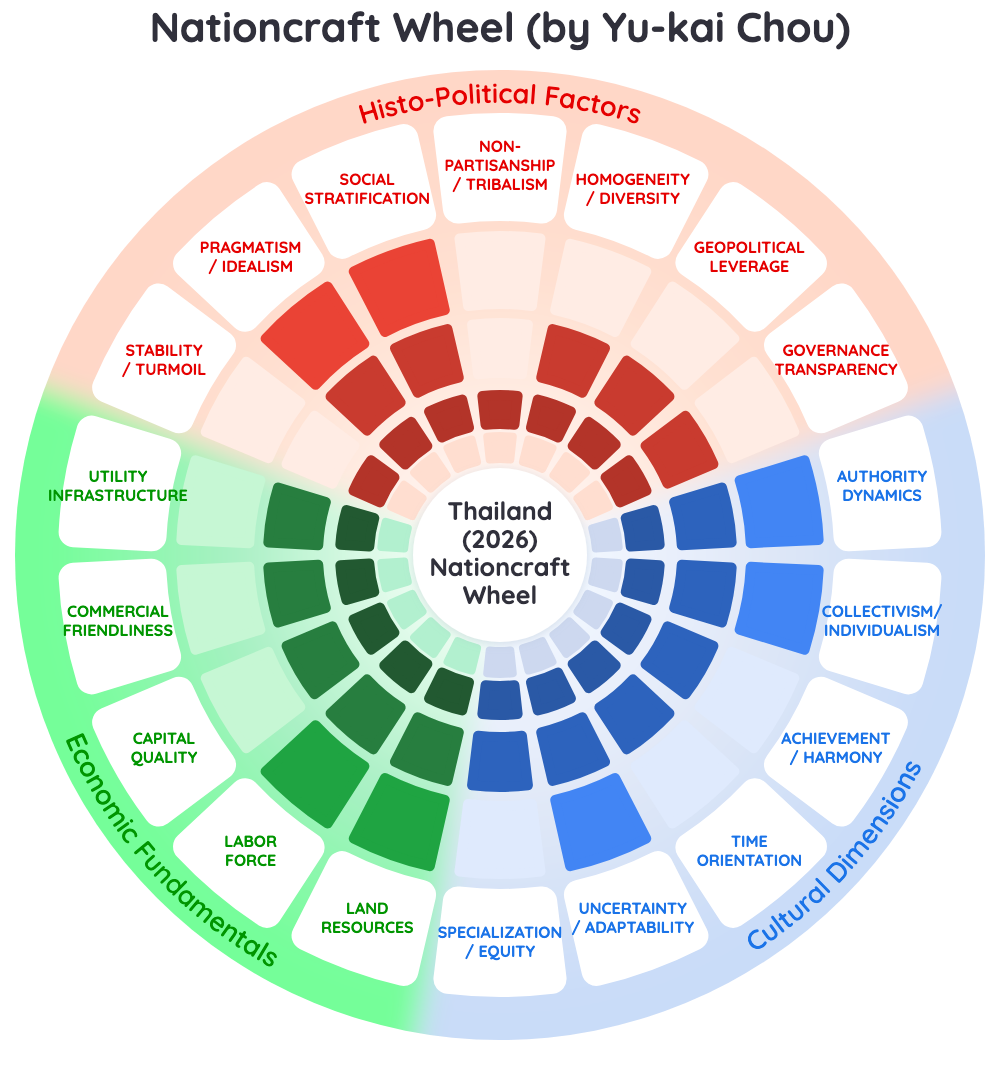

Thailand runs one of Southeast Asia’s most capable states and one of its least stable governments at the same time, and that contradiction is not an accident. It is the design. Since 2006 the country has cycled through two military coups, roughly a dozen constitutions in its modern history, and a conveyor belt of prime ministers removed not by voters but by judges. The economy keeps compounding. The government keeps collapsing. Something is holding those two facts together, and it is not incompetence.
I call the pattern the Judicial Veto Trap: a guardian apparatus built to protect the constitution becomes the mechanism that unmakes every elected government that wins under it. Thailand’s Constitutional Court, backed by a politically active military and an unassailable palace, has spent two decades dissolving the parties that win elections and unseating the leaders who form governments. The ballot decides who governs. The bench decides how long. And because the bench sits outside the electoral cycle, no election can break the loop.
On July 9, 2026 the same court handed Prime Minister Anutin Charnvirakul a rare victory, upholding his 400-billion-baht emergency borrowing decree.1 That a $12 billion fiscal program survived only because nine judges said it could is not the exception to the trap. It is the trap operating on a good day. This analysis runs Thailand through the Nationcraft Framework to show why imported reform templates keep breaking against this specific variable profile, and which historical packets actually fit a country whose problem is not its economy, its people, or its policy, but who is allowed to decide that a decision is final.
The stakes are concrete. Thailand is a middle-income economy of nearly 70 million people, a treaty ally of the United States, a hedge partner of China, and the second-largest economy in ASEAN. A country this pivotal spending twenty years unable to convert votes into stable authority is not a domestic curiosity. It is a structural failure with regional weight, and the reform question is sharper than “how does Thailand grow.” It is “how does Thailand let a government finish a term.”
⚡ Speed Run Notes
- Thailand’s paradox is a high-capacity state (Nationcraft V1 Authority 8/10, V15 Labor 7/10) locked in chronic turmoil (V7 Stability 3/10). The binding constraint is not the economy. It is who holds the final veto.
- The Judicial Veto Trap: the Constitutional Court and military keep dissolving winning parties and unseating elected PMs, so no result sticks. Factionalism (V10 2/10) judged by opaque courts (V13 4/10) is the engine.
- Thailand fails the Nationcraft coup signature (RC-001) on 3 of 5 conditions. Its instability comes from institutional strength, not state collapse, which is why it is durable, not terminal.
- Study Spain (SP-017) and Portugal (SP-078): both removed guardian veto players from politics: a monarchy that guaranteed democracy, a 1982 amendment that abolished the military’s council.
- Reject Turkey’s guardian-military template (SP-013), Peru’s self-coup (SP-033), Egypt’s coup-restoration (SP-065), and El Salvador’s court-packing (SP-064). Each answers instability with more guardianship.
- The July 9, 2026 decree ruling was a win for an elected government, and a reminder that in Thailand a $12 billion program lives or dies on nine unelected votes.
Table of Contents
- Understanding Thailand’s Governance Landscape Through Nationcraft
- What Is the Nationcraft Framework?
- Why This Thailand Variables Analysis Matters
- The 18 Thailand Nation Variables
- The Judicial Veto Trap
- Detailed Justifications: Thailand Variable by Variable
- Why Thailand Fails the Coup Signature
- Strategic Implications
- Best-Match Historical Packets
- Governance Strategy Recommendations
- Comparative Context
- The Nationcraft Framework in Practice
- Explore More Nationcraft Analyses
- Frequently Asked Questions
About Yu-kai Chou

Yu-kai Chou is a Human-Systems Architect & Behavioral Designer and the creator of the Nationcraft Framework — an 18-variable diagnostic for matching a country’s structural profile to the reform packets that have historically worked under similar conditions. He has consulted for governments in eight nations, including Ukraine, the United Kingdom, the Kingdom of Bahrain, Singapore, Taiwan, the Netherlands, Kazakhstan, and South Korea, and has worked directly with President Zelenskyy’s team on post-war reconstruction priorities for Ukraine.
Chou’s prior framework — the Octalysis Framework — has been applied by LEGO, Microsoft, Porsche, Coca-Cola, Salesforce, and MrBeast, impacting over 1.5 Billion Users. He has taught the methodology at Harvard, Stanford, Yale, Tesla, Google, BCG, and IDEO.
His work has been cited by Harvard, Stanford, MIT, Forbes, Wall Street Journal, Wired, US Department of Energy, NIST, NSF, NCBI, US Department of Education, ClinicalTrials.gov, and Google Scholar — with 3,700+ more academic publications. Explore his books here.

This Thailand analysis draws on Chou’s Nationcraft advisory work across Asia, including engagements in Taiwan, Singapore, and South Korea, where the recurring question is how a capable state converts electoral energy into durable authority. Thailand is the sharpest version of that question in the region: not a country that lacks capacity, but one whose guardian institutions keep spending that capacity to overturn the very elections they administer. Reading Thailand through the Nationcraft variables makes the difference between a stability problem and a legitimacy problem impossible to blur.
Understanding Thailand’s Governance Landscape Through Nationcraft
Most commentary on Thailand reaches for one of two stories. The first is the growth story: a manufacturing and tourism powerhouse, the “Detroit of Asia,” a top global destination that welcomed roughly 33.5 million foreign visitors in 2025.2 The second is the coup story: a country that cannot go a decade without soldiers in the streets. Both are true, and told separately, both are useless. The country’s actual condition only becomes legible when you ask why those two stories coexist without resolving.
The Nationcraft Framework exists to force exactly that question. Rather than scoring a country on a single axis of “good governance” or “development,” Nationcraft profiles a nation across 18 structural variables and then asks which historical reform packets succeeded under a similar configuration. The premise is that configuration is strategy. A reform that transformed one country can be inert or actively destructive in another, because the variables that made it work were specific to the first country and absent in the second. Thailand is a case study in what happens when reformers ignore that premise for twenty years.
Read through Nationcraft, Thailand’s profile is not the profile of a weak state. It is the profile of a strong state with a contested sovereign. The capacity variables are high. The legitimacy and cohesion variables are low. And crucially, the country’s most powerful institutions are not the elected ones. That inversion is the whole game, and it is what the rest of this analysis works through.
What Is the Nationcraft Framework?
The Nationcraft Framework is an 18-variable diagnostic system for national reform. It treats a country the way a behavioral designer treats a complex system: not as a list of problems to fix one at a time, but as an interacting configuration where the same intervention produces different outcomes depending on the surrounding variables. The framework grew out of the same systems thinking behind Octalysis, the behavioral-design model I built for products and organizations, applied to the hardest motivational problem there is: moving an entire population through structural change without losing them.
The 18 variables span three domains. The first covers authority and social structure: how power is held and legitimated (V1 Authority Dynamics), how collective versus individual the society is (V2), how it balances achievement against harmony (V3), its time horizon (V4), and its tolerance for uncertainty (V5). The second covers political dynamics and cohesion: specialization versus equity (V6), stability versus turmoil (V7), pragmatism versus idealism (V8), social stratification (V9), non-partisanship versus tribalism (V10), homogeneity versus diversity (V11), geopolitical leverage (V12), and governance transparency (V13). The third covers economic and physical endowment: land and resources (V14), labor-force quality (V15), capital quality (V16), commercial friendliness (V17), and utility infrastructure (V18).
Each variable is scored on a 1-to-10 scale, but the score is never the point. The point is the interaction. A Nationcraft diagnosis looks for the two or three variables whose specific values create the binding constraint, then matches the country against the historical Success Packets, the canonical reform episodes, that share that constraint. For a fuller walkthrough of the method, the library of country analyses shows the framework applied across dozens of nations. This piece applies it to Thailand in 2026, and readers who want the standing reference profile can consult the full 18-variable Thailand profile.
Why This Thailand Variables Analysis Matters
Thailand matters as a Nationcraft case because it isolates a variable that most reform debates never name: the location of the final veto. Development economics can tell you Thailand should be richer than it is. Political science can tell you the coup cycle is real. Neither tradition has a clean way to say what the Nationcraft Framework says plainly, which is that Thailand’s binding constraint is a low V10 (factionalism) processed through a low V13 (opaque, judicialized governance) by institutions that no voter can reach.
The timing sharpens the point. The July 2026 decree ruling was a good outcome for the elected government, and it still demonstrates the pathology. Prime Minister Anutin Charnvirakul, who took office in September 2025 and holds power through a royalist Bhumjaithai-led coalition after the February 2026 election, needed the Constitutional Court to bless a $12 billion program that had already passed through cabinet.1 He is the third prime minister in barely a year, following the court’s suspension of Paetongtarn Shinawatra in mid-2025.3 A system where governance is provisional until the bench signs off is a system where the Nationcraft variables that matter most are the ones outside the ballot box.
Get the diagnosis wrong and the prescription is worse than useless. Treat Thailand as a growth problem and you fund infrastructure while the next government is dissolved. Treat it as a corruption problem and you hand the guardian institutions a sharper sword. The reason to run the variables carefully is that almost every intuitive fix for Thailand feeds the trap.
The 18 Thailand Nation Variables
Here is Thailand’s full Nationcraft profile for 2026. These scores are consistent with the standing corpus values and the prior published Thailand analysis, cross-checked against 2026 economic and political data. Read the table as a shape, not a scoreboard: the story is in the gap between the high-capacity variables and the low-legitimacy variables.
| Variable | Score | Reading |
|---|---|---|
| V1 Authority Dynamics | 8/10 | Highly centralized; palace, military, and judiciary form a guardian bloc above elected government. |
| V2 Collectivism vs Individualism | 8/10 | Strong in-group and patron-client networks; deference to hierarchy. |
| V3 Achievement vs Harmony | 6/10 | Face-saving and harmony norms temper open contestation. |
| V4 Time Orientation | 6/10 | Long dynastic and institutional horizon set against very short government tenures. |
| V5 Uncertainty & Adaptability | 7/10 | Bureaucracy and economy absorb shocks well; high functional resilience. |
| V6 Specialization vs Equity | 6/10 | Competent technocracy; uneven regional equity between Bangkok and the periphery. |
| V7 Stability vs Turmoil | 3/10 | Roughly a dozen constitutions, repeated coups, serial prime-ministerial removals. |
| V8 Pragmatism vs Idealism | 7/10 | Elite pragmatism; coalitions form around deals, not doctrine. |
| V9 Social Stratification | 7/10 | Steep; entrenched Bangkok establishment versus the rural North and Northeast. |
| V10 Non-Partisanship vs Tribalism | 2/10 | Deep color-coded factionalism: Shinawatra populism, royalist conservatives, and a progressive bloc. |
| V11 Homogeneity vs Diversity | 6/10 | Thai-Buddhist majority with a long-running Malay-Muslim insurgency in the deep South. |
| V12 Geopolitical Leverage | 4/10 | Hedges between the US and China; heavy energy-import exposure limits autonomy. |
| V13 Governance Transparency | 4/10 | Middling corruption perception; selective, judicialized, and opaque enforcement. |
| V14 Land Resources | 7/10 | Rich agriculture and tourism geography. |
| V15 Labor Force Quality | 7/10 | Skilled manufacturing and services workforce; strong human capital base. |
| V16 Capital Quality | 5/10 | Solid banking sector; middle-income capital depth. |
| V17 Commercial Friendliness | 6/10 | Open economy; attracting an EV and AI-driven investment cycle. |
| V18 Utility Infrastructure | 6/10 | Good core infrastructure; exposed to imported-energy price shocks. |
Nine of the eighteen variables sit at 6 or above. The economy and the state machinery work. But V7 at 3 and V10 at 2 are not just low numbers; they are the two lowest in the profile, and they sit next to a V13 of 4. That triangle of turmoil, tribalism, and opaque adjudication is where the Nationcraft diagnosis lives.
The Judicial Veto Trap
Every country’s Nationcraft profile hides a paradox, and naming it precisely is the analytical work. Thailand’s is the Judicial Veto Trap: the institutions built to guard the constitution have become the instrument that voids the results the constitution produces. It is a trap because each intervention is locally justified and systemically corrosive. The court is always ruling on something real: a conflict of interest, a campaign promise deemed unconstitutional, a procedural flaw, and each ruling deepens the underlying condition it claims to protect against.
The mechanism runs on the interaction of three variables. V10 at 2 means the society is split into mobilized, mutually distrustful camps with no shared referee they all accept. In a country with a high V13, that distrust would be adjudicated by transparent institutions whose neutrality is broadly credited. But Thailand’s V13 is 4, which means the adjudicating institutions are themselves seen as partisan actors. Layer that onto a V1 of 8, where the palace and military sit structurally above the elected government, and you get a guardian bloc with both the power and the perceived license to overturn elections in the name of order.
The record is not subtle. The Constitutional Court and allied bodies have dissolved Thaksin Shinawatra’s Thai Rak Thai (2007) and its successor People’s Power Party (2008), removed Prime Minister Samak Sundaravej over a cooking show (2008), removed Yingluck Shinawatra (2014) just before the military finished the job with a coup, dissolved the reformist Future Forward Party (2020), dissolved the election-winning Move Forward Party and banned its leaders (2024), removed Prime Minister Srettha Thavisin over a cabinet appointment (2024), and suspended Paetongtarn Shinawatra (2025).45 Two of those episodes were followed or bracketed by outright military coups, in 2006 and 2014.6 The through-line is constant: the party that wins the most votes is the party most likely to be dissolved.
This is where behavioral design clarifies what political science describes. The guardian bloc is driven by Core Drive 8: Loss Avoidance, the most powerful and least rational of motivators. The Bangkok establishment is not defending a policy program; it is defending against the loss of a status order that elections keep threatening. Loss Avoidance makes actors accept large systemic costs to prevent a specific feared loss, which is exactly why the guardian bloc will destabilize the whole country to stop one faction from consolidating power. The same behavioral design lens that explains why users cling to sunk costs explains why an elite clings to a veto it cannot safely surrender.
Detailed Justifications: Thailand Variable by Variable
A Nationcraft diagnosis earns its conclusions by defending the scores. Here is the per-variable reasoning for the variables that carry the analysis, with the behavioral observation each score rests on.
The authority variables (V1, V7)
V1 Authority Dynamics (8). Authority in Thailand is not primarily located in the elected government. The monarchy commands deep legitimacy reinforced by strict lèse-majesté enforcement, the military retains an appointed Senate’s worth of influence and a demonstrated willingness to seize power, and the judiciary functions as the establishment’s constitutional arm. This is a high V1, but of an unusual kind: centralized authority that is deliberately split from electoral mandate. That split is the precondition for everything else.
V7 Stability vs Turmoil (3). The turmoil score is not a measure of chaos in the streets; day to day, Bangkok functions. It measures the instability of governing arrangements. A country on its dozen-plus constitution, cycling three prime ministers in a year, cannot be scored above the bottom band on V7. What keeps it from a 1 or 2 is precisely the high-capacity variables around it: the state keeps running while the government keeps falling.
The cohesion variables (V10, V13)
V10 Non-Partisanship vs Tribalism (2). This is the lowest score in the profile and the most important. Thai politics is not a contest of programs; it is a contest of identities, coded by color and region. The Shinawatra-aligned bloc draws on the rural North and Northeast, the royalist-conservative bloc on the Bangkok middle class and establishment, and a younger progressive bloc on urban reformers. None accepts the others as legitimate winners. A V10 of 2 means there is no neutral ground on which a loss can be conceded, so every loss is contested by other means.
V13 Governance Transparency (4). Thailand sits in the middle of global corruption-perception rankings, but the Nationcraft reading of V13 is about the perceived neutrality of enforcement, not just its volume.7 The problem is selectivity: the sense that anti-corruption and constitutional tools fall disproportionately on one faction. A V13 of 4 is what turns an independent judiciary from a stabilizer into a veto player, because independence without perceived impartiality reads as partisanship with a robe.
The capacity variables (V5, V15, V2, V9, V4)
V5 Adaptability (7) and V15 Labor (7). These carry the other half of the paradox. Thailand’s bureaucracy, banking system, and export economy adapt to shocks with real competence. The workforce is skilled enough to anchor automotive, electronics, and a rising EV and AI investment cycle. The economy grew 2.4% in 2025 and is projected to grow again in 2026, with unemployment under 1% and inflation near zero.2 High V5 and V15 are why the turmoil never becomes collapse: the system has enough shock absorbers to keep functioning through each political rupture, which paradoxically removes the pressure that might otherwise force a settlement.
V2 (8), V9 (7), and V4 (6). The social-structure variables reinforce the trap. High collectivism and steep stratification mean patronage networks, not programmatic parties, are the real units of politics, and a wide V4 gap (a monarchy that thinks in reigns paired with governments that think in months) means the guardian institutions can always claim the long view against the “short-termism” of elected politicians. That framing is the rhetorical cover the veto runs on.
Why Thailand Fails the Coup Signature
Here is the counterintuitive finding that most reform templates miss. Thailand does not actually fit the Nationcraft regime-change signature. The RC-001 “Violent Overthrow Signature” pattern flags high risk when a country meets four of five conditions: V7 at or below 3, V8 at or below 4, V10 at or below 2, V12 at or below 2, and V13 at or below 3. Thailand meets only two of them.
| RC-001 condition | Threshold | Thailand | Met? |
|---|---|---|---|
| V7 Stability | ≤ 3 | 3 | Yes |
| V8 Pragmatism | ≤ 4 | 7 | No |
| V10 Tribalism | ≤ 2 | 2 | Yes |
| V12 Geopolitical Leverage | ≤ 2 | 4 | No |
| V13 Transparency | ≤ 3 | 4 | No |
Two of five. By the collapse signature, Thailand is not a high-risk state, and yet it is one of the most coup-prone countries on Earth. That contradiction is the most important thing the Nationcraft Framework reveals about it. Thailand’s instability is not caused by the conditions that produce state collapse. Its V8 pragmatism (7) is too high, its V12 leverage (4) too solid, its economy too functional for the RC-001 mechanism to apply.
What this means is that Thai instability is not bottom-up collapse but top-down guardianship. The military and courts do not intervene because the state is failing; they intervene because they can, from a position of institutional strength, to correct electoral outcomes they dislike. That is a categorically different disease, and it explains the durability of the trap. Collapse-driven instability eventually resolves, through either reform or state failure. Guardian-driven instability is self-perpetuating, because the guardians are never weakened by the turmoil they create. They are its managers. Any reform packet designed for a collapsing state will misfire here, because Thailand is not collapsing. It is being managed into permanent provisionality.
Strategic Implications
The strategic implication follows directly: Thailand’s reform problem is not a capacity problem, a corruption problem, or a growth problem. It is a veto-location problem. The only reform that addresses the trap is one that moves the final veto from the guardian bloc back inside the elected, accountable system, or, more realistically, one that persuades the guardian bloc to stop using the veto by lowering its Loss Avoidance.
This reframes what “reform” even means for Thailand. The instinct of every technocrat, and of most foreign advisors, is to strengthen institutions: make the courts more independent, the anti-corruption bodies more powerful, the constitution more detailed. In Thailand, every one of those moves can deepen the trap, because the institutions being strengthened are the veto players. A more powerful Constitutional Court in a V10-of-2, V13-of-4 environment is a more powerful weapon for whichever faction controls it. The reform that helps a high-V13 country hurts a low-V13 one.
It also means the answer cannot come from a decisive leader “cutting through the gridlock.” The single most dangerous idea available to Thailand is that a strong enough figure could break the deadlock by concentrating power. That is the exact logic that produced the 2006 and 2014 coups, and it is the logic behind the strongman packets Thailand must reject. The trap does not close by adding a stronger veto player. It closes by retiring the veto itself.
Behavioral design offers the constructive frame here. If the guardian bloc’s Loss Avoidance is the engine, the reform sequence has to reduce the perceived loss of surrendering the veto before it asks anyone to surrender it. That is a sequencing insight, not a moral one, and it is exactly what the two fit packets below did.
Best-Match Historical Packets
The Nationcraft corpus holds a hundred-plus canonical Success Packets and a set of documented failure packets. Matched against Thailand’s actual variable profile of high capacity, guardian-dominated authority, and low cohesion, most of the obvious templates are misfits, and the few that fit are non-obvious. The table below summarizes the verdict; the sections after it explain the reasoning.
| Packet | Country / Era | Verdict | Why (Nationcraft reading) |
|---|---|---|---|
| SP-017 | Spain, 1975–1986 | Study | Monarchy guaranteed democracy instead of blocking it; Moncloa pact bought the veto players out of the veto. |
| SP-078 | Portugal, 1974–2000 | Study | 1982 amendment abolished the military’s guardian council; de-praetorianized politics under an external anchor. |
| SP-042 | Philippines, 1986–2010 | Cautionary | Democracy survived coups but weak institutions let oligarchy recapture it — Thailand’s failure mode. |
| SP-013 | Turkey, 1923–1938 | Reject | Military-as-guardian is Thailand’s disease, not its cure. |
| SP-033 | Peru, 1990–2000 | Reject | Fujimori’s self-coup destroyed institutions to end instability — the strongman temptation. |
| SP-065 | Egypt, 2013–2023 | Reject | Coup-restoration of order; Thailand’s own 2006/2014 move, and it entrenched the trap. |
| SP-064 | El Salvador, 2019– | Reject | Court-packing plus emergency powers weaponizes the judiciary Thailand already over-uses. |
| SP-002 | Singapore, 1965–1990 | Reject | Hegemonic single-party model cannot import into V10-of-2 pluralist factionalism. |
Packets Thailand should study
SP-017, Spain’s Post-Franco Transition. This is the closest structural match in the corpus, and the reason is the monarchy. Spain in 1975 had the ingredients of a Thai-style guardian trap: a powerful crown, a nervous military that attempted a coup as late as 1981, and deep left-right factionalism. What broke the pattern was King Juan Carlos choosing to be the guarantor of democracy rather than its veto player, and the 1977 Moncloa Pacts, in which the major factions negotiated an economic and political settlement together. In Nationcraft terms, Spain raised its effective V10 by manufacturing a cross-factional pact and repurposed its high-V1 crown as a stabilizer instead of a blocker. Thailand has the same crown-centered V1 of 8. The lesson is not that monarchy is the problem, but that a high-V1 monarchy can either anchor a veto trap or dissolve one, and the choice is the whole ballgame.
SP-078, Portugal’s Carnation Revolution packet. If Spain shows how to repurpose the palace, Portugal shows how to retire the military guardian. After the 1974 revolution, Portugal’s armed forces held formal guardianship through a body called the Council of the Revolution. The decisive reform was the 1982 constitutional revision that abolished that council and returned the military fully to civilian control, with the EU accession process (1986) providing the external anchor that made de-praetorianization credible and irreversible. This is the single most direct template for Thailand’s core problem: the deliberate, negotiated removal of a guardian institution’s veto, wrapped in an external commitment that raised the cost of reversing it. Thailand lacks Portugal’s EU anchor, which is a real constraint, but ASEAN credibility and investor confidence can play a weaker version of the same role.
SP-042, the Philippines, as a warning. The Philippines dynasty trap is the cautionary fit. People Power in 1986 removed a dictatorship and restored elections, and the 1987 constitution deliberately weakened the presidency. But because the underlying oligarchic structure was never dismantled, democracy survived while transformation failed, and dynasties recaptured the system. For Thailand, the Philippines is the reminder that removing the current veto is necessary but not sufficient. Retire the guardian bloc without rebuilding cross-factional trust and you get Manila: elections that happen, and elites that still win regardless.
Packets Thailand should reject
SP-013, Turkey’s Ataturk model. Turkey built a military that saw itself as the guardian of the secular constitutional order, empowered to intervene when politicians strayed. That is a precise description of the Thai military’s self-conception, and Turkey spent the second half of the twentieth century in its own coup cycle as a result. Importing more guardian-military logic into Thailand is prescribing the disease as the cure.
SP-033, Peru’s Fujimori packet. Fujimori ended hyperinflation and defeated an insurgency, and he did it partly through a 1992 autogolpe that dissolved Congress and concentrated power. Peru is the strongman temptation in its purest form, and its long hangover of corruption and institutional damage is the bill that always comes due. Thailand’s periodic fantasy that a decisive leader could simply end the gridlock is the Fujimori logic, and it produced the 2014 coup.
SP-065, Egypt’s Sisi packet, and SP-064, El Salvador’s Bukele packet. These are the two most seductive contemporary models, and both are traps for Thailand. Sisi restored order after revolutionary chaos through a military coup and consolidation, which is exactly what Thailand already did twice, to no lasting effect. Bukele achieved real security gains but did so by packing the courts and ruling through emergency powers, weaponizing the judiciary. A country whose central pathology is a judiciary already too willing to void elections cannot safely study a model built on capturing the courts. Both packets answer instability with more concentrated, less accountable power, which is the one thing Thailand’s variable profile says will deepen the trap.
SP-002, Singapore, and why capacity is not the missing piece. It is tempting to point Thailand at Singapore’s compressed-trust model of clean, competent, single-party technocracy. But Singapore’s packet depends on a V10 and V13 profile that Thailand does not have. Lee Kuan Yew’s model works on hegemonic trust in one party and genuinely clean institutions. Thailand’s V10 of 2 and V13 of 4 make that impossible to import: there is no single party the whole country trusts and no institution seen as neutral. The Singapore lesson for Thailand is diagnostic, not prescriptive, a reminder of what the missing variables are, not a model to copy.
Governance Strategy Recommendations
The Nationcraft prescription for Thailand is narrow by design, because the trap punishes broad ambition. The goal is not “better governance” in the abstract; it is retiring the guardian veto without triggering the guardian bloc’s Loss Avoidance. That requires sequencing, not a grand bargain announced at once. The table sketches the logic.
| Phase | Move | Nationcraft rationale |
|---|---|---|
| 1. Lower the stakes | Credible guarantees that no faction will pursue retribution against the establishment if it wins. | Directly reduces the guardian bloc’s Core Drive 8 Loss Avoidance; the Moncloa move. |
| 2. Build the pact | Cross-factional settlement on the rules, negotiated among all camps, not imposed by one. | Manufactures the V10 trust that elections alone cannot; raises the perceived legitimacy of any winner. |
| 3. Depoliticize the referee | Reform Constitutional Court appointment and jurisdiction so it is credibly neutral, not more powerful. | Targets V13; the point is impartiality, not independence — a subtle but decisive difference. |
| 4. Retire the veto | Constitutional revision removing the military and appointed bodies from the power to unmake governments. | The Portugal 1982 move; only durable once phases 1–3 have lowered the cost of losing it. |
| 5. Anchor externally | Bind reforms to ASEAN standing, investor confidence, and treaty commitments. | A weaker substitute for Portugal’s EU anchor; raises the cost of reversal. |
The sequence is deliberately front-loaded on trust and back-loaded on structure. Every failed Thai reform of the past twenty years has tried to do phase 4 first: rewrite the constitution to constrain the other side, without first lowering the stakes or building the pact. In a V10-of-2 country, structure-first reform is just the next round of the fight. The Nationcraft ordering insists that you cannot retire a veto that its holders are terrified to lose. You reduce the terror first.
None of this is easy, and the trap’s cruelty is that the guardian bloc has no near-term incentive to begin. The turmoil does not hurt it. But the long V4 horizon cuts both ways: an establishment that thinks in reigns can, in principle, recognize that a permanently provisional Thailand is a strategically declining one, losing ground to more stable neighbors even as its economy ticks along. That recognition is the only lever, and it is a Loss Avoidance lever too, the fear of long-run decline set against the fear of near-term loss.
Comparative Context
Thailand’s trap is clearer when set beside its neighbors, each of which faces a different failure mode under the Nationcraft lens. The contrasts sharpen what is specific about the Judicial Veto Trap. The three variables that carry the diagnosis draw the map.
| Country | V7 Stability | V10 Cohesion | V13 Transparency | Trap |
|---|---|---|---|---|
| Thailand | 3 | 2 | 4 | Guardian veto voids elections |
| South Korea | 6 | 4 | 6 | Crises resolved by credited courts |
| Peru | 3 | 3 | 3 | Revolving premiership, no anchor |
| Indonesia | 6 | 5 | 4 | Strongman re-concentration risk |
South Korea’s post-martial-law reckoning is the near-mirror: another high-capacity East Asian state with a coup-scarred past, but one that consolidated civilian control and now processes its crises, even a martial-law attempt, through courts and impeachment that the public broadly accepts. The difference is V13. Korea’s institutions are credited as neutral enough that judicial resolution stabilizes rather than inflames. Thailand’s are not, which is why the same institutional tools produce opposite outcomes.
Indonesia’s strongman trap shows the road not yet taken: a large, diverse democracy tempted toward re-concentrating power in a decisive executive. Where Indonesia risks sliding toward the strongman, Thailand has already tried that twice and found it solves nothing, because its problem was never a lack of a strong hand. Myanmar’s command trap is the abyss at the bottom of the same slope: what happens when the military stops managing instability from behind the curtain and simply seizes everything, collapsing a functioning state into civil war. Thailand’s guardian bloc has, so far, chosen management over seizure, and Myanmar is the reason that restraint matters.
The Latin American cases rhyme differently. Peru’s carousel of presidents is the closest analog to Thailand’s revolving premiership, a country where the removal of leaders has become routine and governance permanently provisional. Chile’s mano dura mirage and Argentina’s boom-bust pendulum show adjacent traps of security theater and macro instability, while Sri Lanka’s compliance paradox and Pakistan’s facilitation trap round out the set of high-capacity-or-high-potential states held back by who really holds power. Read together in the library of country analyses, they map a spectrum of ways a capable society can be prevented from governing itself.
The Nationcraft Framework in Practice
The reason to run Thailand through the Nationcraft Framework rather than a conventional country report is that the framework forces the analysis to a single load-bearing variable interaction instead of a laundry list. A standard report would recommend judicial independence, anti-corruption enforcement, constitutional clarity, and economic liberalization. Every one of those recommendations is defensible in isolation, and in Thailand’s specific configuration, most of them feed the trap. The framework’s discipline is that it refuses to prescribe until it has diagnosed the configuration, and the configuration here says the veto’s location, not the state’s capacity, is the constraint.
That is the same logic behind every entry in the Nationcraft corpus, and it is why the framework treats reform as a matching problem rather than a wish list. A packet that transformed Spain can be poison in Thailand and vice versa, because the variables that made it work were specific. The Nationcraft Framework is the tool for checking the match before spending a country’s scarce reform capital on a template built for someone else’s profile. Readers who want to see how the eighteen variables are defined and scored can start with the Nationcraft Framework overview, which anchors every country analysis on the site.
Explore More Nationcraft Analyses
Thailand is one profile in a growing atlas. The full Nationcraft Country Analyses library collects diagnoses across every region, each naming the specific variable trap that holds a country back and the historical packets that fit its configuration. If the Judicial Veto Trap interested you, the closest companions are South Korea’s post-martial-law reckoning, the Philippines dynasty trap, and Indonesia’s strongman trap, three other Asian states where the gap between who votes and who rules defines the reform problem.
Frequently Asked Questions
What is the Judicial Veto Trap in Thailand?
It is the pattern where an unelected guardian bloc (the Constitutional Court backed by the military and palace) repeatedly removes elected prime ministers and dissolves winning parties, so no ballot result becomes durable governance. In Nationcraft terms it is the collision of very low V10 (factionalism, 2/10) with low V13 (opaque governance, 4/10), adjudicated by institutions that sit outside the electoral cycle and above the elected government (V1 at 8/10).
Why does Thailand keep having coups despite a strong economy?
Because its instability is not caused by state failure. Thailand’s high capacity (V1 Authority 8, V5 Adaptability 7, V15 Labor 7) means the guardian institutions intervene from strength, not collapse. Thailand fits the Nationcraft coup signature RC-001 on only 2 of 5 conditions, which is why the turmoil (V7 at 3) is chronic rather than terminal. The economy keeps absorbing the shocks, which removes the pressure that might otherwise force a settlement.
Which reform packets should Thailand study?
Spain’s Post-Franco Transition (SP-017) and Portugal’s Carnation Revolution packet (SP-078). Spain shows a high-authority monarchy choosing to guarantee democracy rather than block it, plus a cross-factional pact; Portugal shows the negotiated abolition of a military guardian body under an external anchor. The Philippines Post-Marcos packet (SP-042) is the cautionary case of removing a veto without rebuilding trust.
Which reform models would make Thailand worse?
Any model that answers instability with more guardianship or a strongman: Turkey’s guardian-military template (SP-013), Peru’s Fujimori self-coup (SP-033), Egypt’s Sisi coup-restoration (SP-065), and El Salvador’s Bukele court-packing (SP-064). Each restores order in the short run while deepening the trap, because each adds a stronger, less accountable veto rather than retiring the veto.
What did Thailand’s Constitutional Court rule in July 2026?
On July 9, 2026 the court upheld the government’s 400-billion-baht ($12 billion) emergency borrowing decree, ruling unanimously that the 200-billion-baht relief portion was constitutional and by a 7:2 majority that the 200-billion-baht energy-transition portion also complied with Section 172 of the constitution. It was a win for Prime Minister Anutin’s elected government, and it still illustrates the trap: a $12 billion program’s fate rested on nine unelected judges.
Closing
Thailand is not a poor country, a chaotic country, or a badly run country. It is a well-run country that is not permitted to be governed by the people it elects, and until the guardian veto is retired rather than reinforced, its formidable capacity will keep compounding underneath a government that keeps falling. The Nationcraft Framework’s contribution is to name the constraint precisely enough that reformers stop prescribing the medicine that feeds the disease. The veto’s location is the whole problem. Everything else is a distraction from it.
Related Reading
- The Nationcraft Framework: the 18-variable diagnostic behind this analysis.
- Nationcraft Country Analyses library: the full atlas of country diagnoses.
- Nation Variable Analysis: Thailand (2026): the standing reference profile.
- South Korea Post-Martial Trap: the near-mirror case with a higher V13.
- Philippines Dynasty Trap: the cautionary failure mode.
- Indonesia Strongman Trap: the strongman road Thailand already tried.
Footnotes
- The Nation (Thailand), “Constitutional Court clears 400bn-baht emergency loan decree,” July 9, 2026. nationthailand.com. ↩
- Office of the National Economic and Social Development Council (NESDC), “Thai Economic Performance in Q3 2025 and Outlook 2025–2026,” November 2025 (GDP +2.4% in 2025; inflation and unemployment data). nesdc.go.th; see also Bank of Thailand, Economic Outlook, bot.or.th. ↩
- Wikipedia, “Paetongtarn Shinawatra” (Constitutional Court suspension, 2025). en.wikipedia.org. ↩
- Wikipedia, “Constitutional Court (Thailand)” (record of party dissolutions and prime-ministerial removals since 2006). en.wikipedia.org. ↩
- Wikipedia, “Move Forward Party” (2024 dissolution and leadership bans). en.wikipedia.org. ↩
- Wikipedia, “2014 Thai coup d’état.” en.wikipedia.org. ↩
- Transparency International, Corruption Perceptions Index, Thailand country profile. transparency.org. ↩