
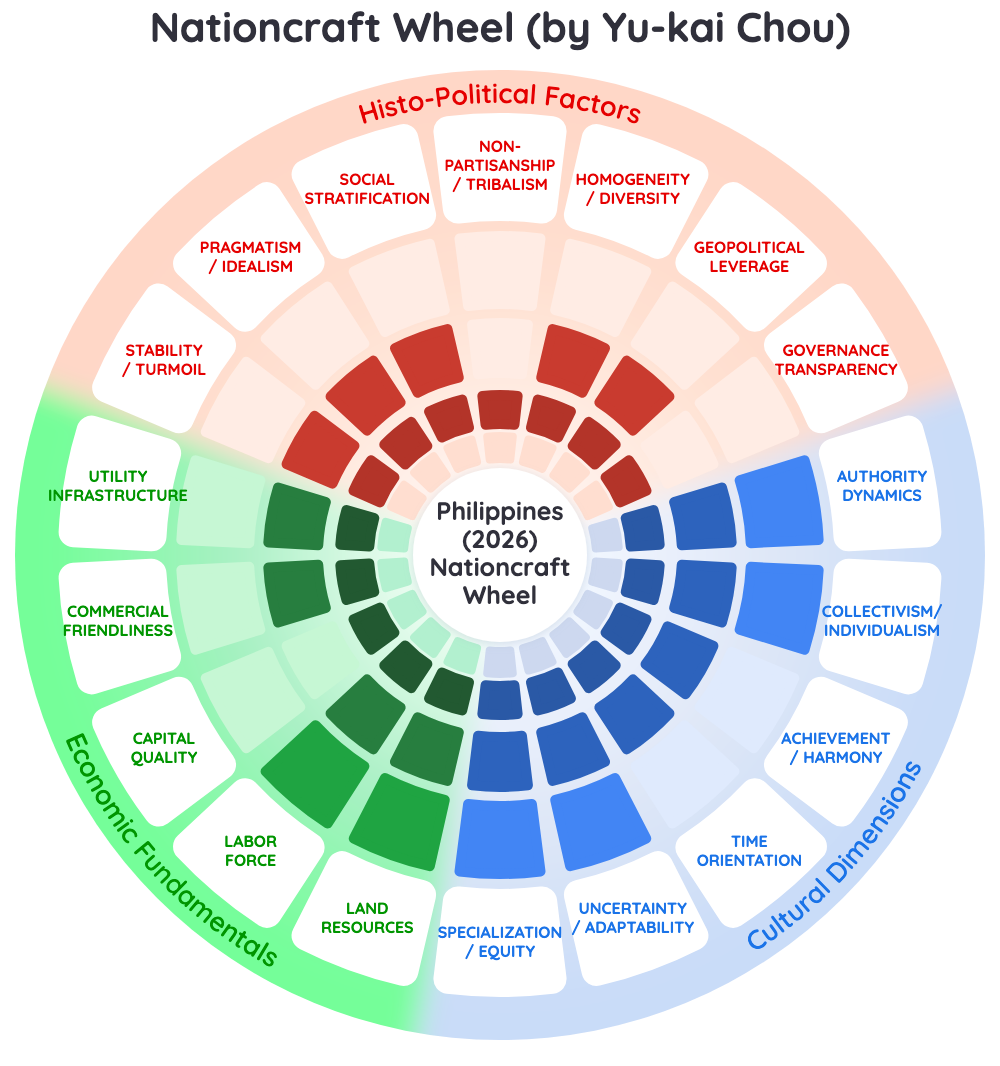

The Philippine Senate convened as an impeachment court on May 18, 2026 to try Vice President Sara Duterte. Western press is covering it as a constitutional crisis. From the Nationcraft side of the table, it looks like something else: a system performing exactly as its variable vector predicts. The Marcos-Duterte feud is not a malfunction of Philippine democracy. It IS Philippine democracy, executing its V-vector as designed.
Every cycle, reformist commentary on the Philippines reaches for the same imported templates. Lee Kuan Yew’s Singapore. Park Chung-hee’s South Korea. Saakashvili’s Georgia. Bukele’s El Salvador. The argument writes itself: bring in a technocratic strong hand, fire the corrupt cops, modernize the bureaucracy, watch the country pivot. None of those packets actually fits the Philippines’ 18-variable profile, and the reason they don’t fit is the same reason the Senate “lockdown” of May 11–13 happened the way it did. The country runs a V-vector (V1 high, V2 high, V10 low, V13 low) that turns collectivism into a force against cross-clan civic coordination, not for it.
I call this the Dynasty Trap. It is the structural lock that makes every imported reform packet either fail outright or get absorbed back into the dynastic spine the packet was supposed to break. The trap is not unique to the Philippines, but the Philippines runs the cleanest extant example of it.
The cost of getting this diagnosis wrong is not abstract. The 1987 Constitution was written specifically as an anti-Marcos architecture: weak presidency, single six-year term, robust impeachment, decentralized local government. Forty years in, that architecture is being used by the children of the people it was designed against. Any reform proposal that does not understand why is a proposal to repeat history.
⚡ Speed Run Notes
- The Philippines’ Nationcraft V-vector (V1 Authority 8, V2 Collectivism 8, V10 Non-Partisanship 3, V13 Transparency 3) locks collectivism along clan lines, not national lines. Every cross-clan reform routes back through the dynastic spine.
- The May 2026 Sara Duterte impeachment, the Sotto-to-Cayetano Senate leadership swap, and Bato dela Rosa’s ICC-fugitive return to vote are not anomalies. They are the V-vector executing in real time.
- Three imported packets do not fit: LKY Singapore (needs V13 floor), Park South Korea (needs V7 stability), Saakashvili Georgia (needs V8 pragmatism). All three become Marcos II if cloned here.
- Three packets actually fit: the Philippines’ own Post-Marcos Recovery Packet (SP-042: 1987 Constitution + Ramos liberalization), Mahathir’s Malaysia (SP-019), Bangladesh’s Grameen-BRAC parallel-state model (SP-025).
- The 1987 Constitution’s “weak presidency by design” was the right pattern for V1=8 + low V13. The mistake is treating it as failed instead of incomplete. Strengthen the institutional firewalls. Don’t replace them with another strong-leader template.
- Reform sequencing for the Dynasty Trap leads with judicial-capacity and audit institutions, not anti-corruption agencies. Build the floor V13 sits on before you build the agency that depends on V13.
Table of Contents
- Understanding the Philippines’ Governance Landscape Through Nationcraft
- What is the Nationcraft Framework?
- Why This Philippines Variables Analysis Matters Now
- The 18 Philippines Nation Variables
- The Dynasty Trap: How V1+V2+V10+V13 Lock the System
- Detailed Per-Variable Justifications
- Strategic Implications of the May 2026 Impeachment Trial
- Three Reform Playbooks the Philippines Should Reject
- Three Reform Playbooks the Philippines Should Actually Study
- Governance Strategy Recommendations
- Comparative Context: Indonesia, Malaysia, Thailand
- The Nationcraft Framework in Practice for the Philippines
- Explore More Nationcraft Analyses
- Related Reading
- Frequently Asked Questions
- Footnotes
About Yu-kai Chou

Yu-kai Chou is a Human-Systems Architect & Behavioral Designer and the creator of the Nationcraft Framework, an 18-variable diagnostic for matching a country’s structural profile to the reform packets that have historically worked under similar conditions. He has consulted for governments in eight nations, including Ukraine, the United Kingdom, the Kingdom of Bahrain, Singapore, Taiwan, the Netherlands, Kazakhstan, and South Korea, and has worked directly with President Zelenskyy’s team on post-war reconstruction priorities for Ukraine.
Chou’s prior framework, the Octalysis Framework, has been applied by LEGO, Microsoft, Porsche, Coca-Cola, Salesforce, and MrBeast, impacting over 1.5 Billion Users. He has taught the methodology at Harvard, Stanford, Yale, Tesla, Google, BCG, and IDEO.
His work has been cited by Harvard, Stanford, MIT, Forbes, Wall Street Journal, Wired, US Department of Energy, NIST, NSF, NCBI, US Department of Education, ClinicalTrials.gov, and Google Scholar — with 3,700+ more academic publications. Explore his books here.
This Philippines analysis sits inside a stretch of Nationcraft work (Taiwan, South Korea, Singapore, and the ongoing Ukraine post-war reconstruction case) where Yu-kai has spent the most diagnostic energy on the variable interactions that make Asian governance distinctive. The Philippines is the cleanest extant case of what happens when high collectivism organizes along clan lines instead of national lines. It is also the case where imported reformer scripts have failed most predictably for four decades. Both observations follow from the same V-vector.
Understanding the Philippines’ Governance Landscape Through Nationcraft
To read the Philippines accurately you have to stop asking “what kind of democracy is this?” and start asking “what kind of system is this, and which of its variables are doing the load-bearing work?” The Nationcraft Framework treats every country as an 18-variable configuration: a profile that constrains which reform packets historically deliver outcomes and which ones blow up on contact. Configuration is strategy, scores are not averaged, and the interactions between variables matter more than any single variable’s value.
For the Philippines, the configuration tells a very clear story. The country has world-class human capital (V15 Labor Force Quality = 8/10), substantial natural resources (V14 = 7/10), high uncertainty adaptability (V5 = 7/10), and an English-speaking workforce that powers the global BPO industry and produces over $40B in annual OFW remittances. None of that is in doubt. The doubt sits in V7 (Stability vs Turmoil = 4/10), V8 (Pragmatism vs Idealism = 4/10), V10 (Non-Partisanship vs Tribalism = 3/10), V13 (Governance Transparency = 3/10), and V16 (Capital Quality = 3/10). Five variables that together describe a country whose political operating system consistently underdelivers what its economic operating system could produce.
This is the gap that drives Filipino frustration. “Why are we poorer than Malaysia and Thailand when we have better English, a bigger diaspora, and more human capital?” The Nationcraft answer is uncomfortable: because V1 Authority Dynamics = 8/10 and V2 Collectivism = 8/10 are not being absorbed by V10 and V13. In countries where high authority and high collectivism couple with non-partisan civic institutions and transparent governance, the result is Singapore. In countries where they couple with tribal politics and low transparency, the result is the Marcos-Duterte feud playing out on the Senate floor in 2026.
What is the Nationcraft Framework?
The Nationcraft Framework is an 18-variable diagnostic system for matching a country to the historical reform packets that have worked under similar conditions. It treats a nation-state the way the Octalysis Framework treats a behavioral system: as a configuration of forces, not a single score. A country with V13 Governance Transparency = 3/10 cannot simply “raise transparency” the way a product team raises a feature flag. Transparency in this framework is the visible output of dozens of slower-moving variables (judicial capacity, audit institution independence, media plurality, civic literacy), and you cannot move it without moving them.
Each of the 18 Nationcraft variables sits on a 1–10 scale. V1 through V13 cover political-cultural variables (authority, collectivism, achievement, time orientation, uncertainty adaptability, specialization, stability, pragmatism, social stratification, tribalism, homogeneity, geopolitical leverage, governance transparency). V14 through V18 cover physical-economic variables (land resources, labor force quality, capital quality, commercial friendliness, utility infrastructure). The interactions matter more than the individual scores, which is why the framework calls itself configuration analysis rather than scoring.
The framework’s payload is the catalog of Success Packets and Failure Packets, roughly 140 historical reform sequences indexed by the V-vector preconditions that made them work or fail. LKY in Singapore (SP-002) is a packet. Park Chung-hee in South Korea (SP-008) is a packet. Saakashvili in Georgia (SP-051) is a packet. Bukele in El Salvador (SP-064) is a packet. The Aquino-Ramos transition in the Philippines (SP-042) is a packet. The framework’s basic operation, applied to a country, is: read the V-vector, then match the country to the historical packets whose preconditions fit. Anything else is genre fiction.
The Philippines analysis below uses the framework that way. We will read the V-vector first, then walk the packets, then sequence the reforms that match. The Nationcraft-Octalysis crossover essay covers the framework’s deeper origins; this piece is a country application.
Why This Philippines Variables Analysis Matters Now
Three things make this the right moment for a Nationcraft read on the Philippines.
First, the timing. On May 11–13, 2026, the Philippine Senate executed what local press has called a “Senate coup”: Senate President Vicente Sotto III was ousted and replaced by Alan Peter Cayetano with backing from Duterte-aligned lawmakers, on the same day the House of Representatives impeached Vice President Sara Duterte for the second time by a 257-25-9 margin.[1] Senator Ronald “Bato” dela Rosa, who is the subject of an ICC arrest warrant for his role in former President Duterte’s drug war, appeared on the Senate floor to vote. The Senate convened as an impeachment court on May 18; the trial proper begins July 6.[2] Every one of these moves is a V10=3 / V13=3 system executing in real time. The framework predicts not whether Duterte will be convicted but what kind of process will deliver whichever verdict arrives.
Second, the comparison. The Philippines’ V-vector overlaps with, but is not identical to, Indonesia (Suharto-era SP-023), Malaysia (Mahathir SP-019), and Thailand (Eastern Seaboard SP-020, plus the cycle dynamics in the Thailand February 8 vote analysis). Looking at the Philippines beside its regional peers is the only way to see what is properly Philippine and what is properly ASEAN-with-low-transparency. The conclusion: Indonesia, Malaysia, and Thailand all run higher V13 (8 / 6 / 5 respectively against the Philippines’ 3) and higher V10. The Philippines is the regional floor on governance transparency, not because Filipinos are uniquely corrupt. V13 is a structural variable, not a moral one. The reason is that the institutional architecture that absorbs and processes high V1+V2 differently in those neighbors does not exist here at the same density.
Third, the policy window. Whether the impeachment ends in conviction, acquittal, or a procedural deadlock, the post-trial 18 months will be a sequencing decision. If reformers spend that window cloning Saakashvili’s anti-corruption agency or Bukele’s emergency-powers playbook, the result is predictable: another strong-leader template absorbed into the Dynasty Trap. If reformers spend that window strengthening the institutional firewalls the 1987 Constitution built but never fully populated (Office of the Ombudsman, COA, Sandiganbayan, the judicial appointment pipeline), they have a chance. Knowing the difference is what the framework is for.
The 18 Philippines Nation Variables (2026)
Configuration is strategy. The scores below are not averaged or summed; the value of any single variable matters less than the interactions between variables, and the interactions are what generate the Dynasty Trap below. Sources cross-checked against Freedom House (Freedom in the World 2026), V-Dem Liberal Democracy Index 2026, Transparency International CPI 2025, World Bank GDP data, and ACLED political violence tracking.[3]
| # | Variable | Score | Behavioral evidence (2026) |
|---|---|---|---|
| V1 | Authority Dynamics | 8/10 | Strong-leader culture; presidency and dynastic clans concentrate power. |
| V2 | Collectivism vs Individualism | 8/10 | Strong collectivist identity, organized along extended-family / clan lines. |
| V3 | Achievement vs Harmony | 5/10 | Mixed — status competition is real, but face-saving softens it. |
| V4 | Time Orientation | 4/10 | Short-term; 6-year single-term presidency reinforces cycle thinking. |
| V5 | Uncertainty Adaptability | 7/10 | High — “bahala na” resilience; typhoon and crisis adaptation famous. |
| V6 | Specialization vs Equity | 7/10 | Moderately specialized; BPO and OFW skill stacks notable. |
| V7 | Stability vs Turmoil | 4/10 | Low — recurring impeachment crises, coup attempts, CPP-NPA and Moro insurgencies. |
| V8 | Pragmatism vs Idealism | 4/10 | Personalistic; voters reward charisma and surname over record. |
| V9 | Social Stratification | 6/10 | High — oligarchic families dominate land, media, retail. |
| V10 | Non-Partisanship vs Tribalism | 3/10 | Very tribal — politics organized around clans and patron-client ties. |
| V11 | Homogeneity vs Diversity | 5/10 | Linguistically and religiously diverse (Catholic majority, Muslim Mindanao). |
| V12 | Geopolitical Leverage | 4/10 | Modest — US treaty ally, EDCA bases; pressured in South China Sea. |
| V13 | Governance Transparency | 3/10 | Very low — endemic graft, weak audit, dynastic capture of LGUs. |
| V14 | Land Resources | 7/10 | Archipelagic, agriculturally rich, mineral deposits (nickel, copper). |
| V15 | Labor Force Quality | 8/10 | Very high — English-speaking, ~11M OFW diaspora, large BPO workforce. |
| V16 | Capital Quality | 3/10 | Low — domestic capital concentrated in dynastic conglomerates. |
| V17 | Commercial Friendliness | 4/10 | Below average — restrictive 60/40 constitution, bureaucratic friction. |
| V18 | Utility Infrastructure | 4/10 | Below average — chronic power outages, expensive electricity. |
The Dynasty Trap: How V1+V2+V10+V13 Lock the System
Most Nationcraft paradoxes are pair-wise. The Coup Cycle Trap is about V1 plus V7. The Resource Curse Trap is about V14 plus V13. The Compressed-Trust Paradox in Singapore is V1+V2+V8 doing the work of cross-clan civic infrastructure. The Dynasty Trap is a four-variable interaction, and that is why it is harder to see and harder to escape.
The four variables in the lock:
- V1 Authority Dynamics = 8/10. The Philippines runs an authority-respecting political culture. Presidential decrees move further than parliamentary deliberation; strong personalities outperform strong platforms. Filipinos do not romanticize the technocrat the way Singaporeans do.
- V2 Collectivism = 8/10. Filipinos are profoundly collectivist. Loyalty, debt of gratitude (utang na loob), and group identity move political behavior more than individual policy preference.
- V10 Non-Partisanship vs Tribalism = 3/10. The collectivism does not aggregate into national civic identity. It aggregates into clans. Politics is organized around extended families: Marcos, Duterte, Aquino, Estrada, Binay, Villar, Cayetano, Aquino again. Parties are dynastic vehicles, not platforms.
- V13 Governance Transparency = 3/10. The institutions that would expose and check tribal capture of the state are themselves captured by tribal logic. The Office of the Ombudsman, the Sandiganbayan, the COA, the courts: each is staffed and supervised through appointments that route through the same dynastic network. Transparency tools turn into patronage tools.
The lock works like this. High V1 and V2 mean Filipinos accept and even prefer that power concentrates somewhere visible and personal. The question is where it concentrates. With high V10 (cross-clan civic identity) and high V13 (transparency), it concentrates in institutions: a strong professional civil service, an independent judiciary, a credible election commission, audit bodies that can prosecute. That is the LKY recipe in Singapore (SP-002) and the Park-Lee recipe in South Korea (SP-008). With low V10 and low V13, V1 and V2 concentrate power somewhere else: in families. The family becomes the unit of trust, the unit of mobilization, the unit of resource distribution, and the unit of political competition. The state becomes the prize.
Once families are the operative unit, every cross-family reform (a non-partisan anti-corruption agency, an independent judiciary, a technocratic ministry, a meritocratic civil service exam, even a non-political central bank) is read by the dynastic networks not as a reform but as a competitive threat that must be staffed, captured, or starved. The reform’s institutional architecture survives. Its function gets routed back through the dynastic spine. This is why the Philippines has a constitutional Office of the Ombudsman, a Commission on Audit, a Sandiganbayan, a Civil Service Commission, and a Comelec, and still runs V13 at 3/10.
The May 2026 Senate “lockdown” is the trap operating in compressed time. Hours after the House impeached VP Duterte, the Senate’s Duterte-aligned bloc removed Senate President Sotto and installed Cayetano. Bato dela Rosa, an ICC fugitive, appeared on the floor to vote. None of this is irrational, and none of it is the system breaking. It is the system working: when the institutional process threatens the dynastic balance, the institutional process is reconfigured by the dynastic network. The 1987 Constitution permits this because no constitution can outrun a V10 of 3.
Detailed Per-Variable Justifications
Each variable’s score below is the behavioral observation it indexes, not a normative ranking. V13=3 is bad for prosperity outcomes; V14=7 is good. Reading the per-variable section as a report card misses the point. The right read is: which interactions does this set of values produce?
V1 Authority Dynamics (8/10) and V2 Collectivism (8/10)
The Philippines is high-V1 and high-V2. Filipinos defer to authority figures (fathers, priests, congresspeople, presidents) more than Western liberal democracies do. The deference is not blind, but the cultural floor of “respect for elders” and “respect for office” is real and shapes political behavior. Combined with V2’s collectivism, the country runs strong vertical loyalty: leaders attract followers, followers attach to leaders, and the leader-follower bond is sticky. This is why Filipino presidencies tend to be defined by the personality of the president (Marcos, Aquino, Estrada, Arroyo, Aquino II, Duterte, Marcos Jr) rather than the platform of a party.
V3 Achievement (5) and V4 Time Orientation (4)
Status competition is real but socially mediated. “Pakikisama” (going along) and face-saving constrain the achievement orientation. V4=4 is a structural feature: the 1987 Constitution’s single six-year non-renewable presidency was designed to prevent another Marcos but creates a near-permanent lame-duck dynamic in years 4–6 of every administration. Reform sequencing that requires more than 6 years runs into V4.
V5 Uncertainty Adaptability (7) and V6 Specialization (7)
“Bahala na” is a strength. Filipinos absorb typhoons, currency crises, regime changes, and pandemic disruptions with high social resilience. The BPO workforce, the global seafarer footprint, and the diaspora’s labor mobility are all V5+V6 outputs. The country is good at adapting; what it is not as good at is converting that adaptation into capital that stays at home (see V16).
V7 Stability vs Turmoil (4)
The Philippines runs structural political turmoil: impeachments, coup attempts (1989), People Power 2 (2001), election-period violence, and active insurgencies (CPP-NPA, MILF/BARMM transitions). V7=4 is not “any week could be a coup.” It is “the system absorbs more political shock than it processes.”
V8 Pragmatism vs Idealism (4)
This is the variable that breaks most imported reform packets. Pragmatism in the Nationcraft sense means: the median voter rewards technocratic delivery over personality or ideological purity. V8=4 means the Philippines does the opposite: voters reward personality, family name, and visible compassion (e.g. door-to-door arroz caldo distribution) over policy delivery. Bong-Bong Marcos’s 2022 election with 31 million votes was a V8=4 outcome, and so was Sara Duterte’s vice-presidential coalition with him. This is not a stupidity claim. It is a reading of which signals the V-vector privileges.
V9 Social Stratification (6) and V10 Non-Partisanship vs Tribalism (3)
V9=6 captures the country’s oligarchic structure: a small set of families control land, media, retail, telecoms, and power generation. V10=3 captures the political-organizational result: politics is the contest between those families, not between competing visions of national policy. Party-switching is endemic because parties are vehicles, not platforms. This is what makes the impeachment process such a clean test case. The lineup of senators voting for or against Sara Duterte reads more cleanly as a family allegiance map than as an ideological map.
V11 Homogeneity vs Diversity (5)
The Philippines is linguistically and religiously diverse: Tagalog, Cebuano, Ilocano, Hiligaynon, Bikol, Waray, Maguindanao, Tausug, and others; Catholic majority with substantial Muslim and Protestant minorities; regional identities (Ilocano-North, Visayan, Mindanao) that move politics. V11=5 is moderate, but combined with V10=3 it means coalition politics gets organized along clan-plus-regional lines instead of platform lines.
V12 Geopolitical Leverage (4)
The Philippines has the EDCA agreement with the US, hosts US base access in nine sites, and chairs ASEAN occasionally. It has weight, but it is squeezed: PRC pressure in the South China Sea, US transactional bilateralism under shifting administrations, and limited economic carrots to offer ASEAN partners. V12=4 is honest. The country leverages the US-PRC pivot more than it gets to set the pivot.
V13 Governance Transparency (3)
The load-bearing variable for the Dynasty Trap. CPI 2025 = 33/100, ranked 116 of 180. Audit findings against dynastic LGUs are routine but rarely produce prosecutions that survive the appellate chain. The Sandiganbayan convicts; the Supreme Court reverses. The Office of the Ombudsman’s productivity rises and falls with whichever administration appointed the sitting Ombudsman. V13=3 is the structural floor under everything else.
V14 Land Resources (7) and V15 Labor Force Quality (8)
Strong V14 (agriculture, fisheries, mineral deposits, geothermal, archipelagic position) and very strong V15 (English-speaking workforce, 11M OFW, BPO industry, global seafarer share). These are the variables that explain why the Philippines should be richer than it is.
V16 Capital Quality (3) and V17 Commercial Friendliness (4)
V16=3 is the other half of the Dynasty Trap. Domestic capital concentrates inside dynastic conglomerates (Ayala, SM, Aboitiz, Lopez, Razon, etc.) and does not flow to outsiders. The 1987 Constitution’s 60/40 foreign-ownership cap restricts cross-border capital. V17=4 measures the on-the-ground friction: permits, court enforcement of contracts, regulatory unpredictability. These are not independent from V13; they are V13 expressed in commercial life.
V18 Utility Infrastructure (4)
Power is unreliable and among the most expensive in ASEAN. Internet improving via Starlink and fiber rollouts but uneven. NAIA airport is a chokepoint. Inter-island connectivity is structurally hard. V18=4 is not where the country could be given V14 and V15.
Strategic Implications of the May 2026 Impeachment Trial
Read the impeachment as a Nationcraft event rather than a news event. The trial begins July 6, 2026 with these mechanics: conviction requires two-thirds of the 24-seat Senate (16 votes). On conviction, Sara Duterte loses the vice presidency and is barred from elected office for life. The Senate composition after the May 11–13 leadership swap favors the Duterte camp’s veto power: 16 affirmative votes are difficult.
The Dynasty Trap predicts three possible outcomes, all of which preserve the dynastic spine:
- Acquittal (the modal case). The Duterte family retains the vice presidency, the 2028 presidential bid stays live, and the Marcos-Duterte cold war continues with both clans intact and the institutional bench (Senate, courts, Comelec) further legitimized as a battleground rather than an umpire.
- Conviction. Sara Duterte is removed and barred. The Duterte dynastic infrastructure pivots to Sebastian “Baste” Duterte, Paolo Duterte, and the next generation. The institutional process is hailed as functioning, but V13=3 has not moved; the Senate that convicted Sara is the same Senate that ousted Sotto to manage the proceedings.
- Procedural deadlock / dismissal. The trial collapses on jurisdictional grounds (the existing case Duterte v. House at the Supreme Court is the live vehicle for this). All parties claim victory; nothing structural changes; both dynasties prepare for 2028.
What none of the outcomes do, on their own, is move V13. To move V13 you have to move the variables underneath it: judicial appointment independence, audit institution depth, civil service merit floor, media ownership concentration. Each of those moves on a decade horizon, not an impeachment horizon. The trial is a marker, not a lever.
The Nationcraft reform sequencing question for the post-trial window is not “how do we punish the losing family” but “how do we use the public attention of the trial to populate the institutional firewalls that the 1987 Constitution built but never finished.” That is a different conversation than the one cable news is having.
Three Reform Playbooks the Philippines Should Reject
Reformist columns in the Manila broadsheets reach for the same three or four templates every cycle. Each is wrong for the V-vector. Each has a clean reason it is wrong, drawn from the historical packet itself.
| Packet | Origin | Why advocates reach for it | Why it fails on PH V-vector |
|---|---|---|---|
| SP-002 Lee Kuan Yew Industrialization | Singapore 1965-1990 | “Strong-leader pragmatism plus CPIB anti-graft. Singapore was poorer than us in 1965.” | SP-002 requires V13 at a usable floor and V8 high (pragmatism-rewarding electorate). PH runs V13=3 and V8=4. A CPIB clone gets staffed by the dynastic network it was meant to police. |
| SP-008 Park Chung-hee Authoritarian Modernization | South Korea 1961-1979 | “Strong hand plus chaebol-style industrial policy. Korea was poorer than us in 1960.” | SP-008 requires V7 stability anchored by an external security guarantor (US, against North Korea) and V8 rising. PH V7=4 and V8=4. The “strong hand” lands inside the Dynasty Trap and becomes the dynastic capture instrument. |
| SP-051 Saakashvili Reform Packet | Georgia 2003-2012 | “Anti-corruption Trojan horse. Fire the traffic police, restart the customs service.” | SP-051 requires V8=high (pragmatism-rewarding electorate that tolerates technocratic shock) and a small-population state with low V9. PH runs 117M people, V8=4, V9=6. The Saakashvili package needs a small, pragmatic population; PH is large and idealistic. |
SP-002 LKY Singapore
The most-cited fantasy. “Why can’t we just do what Singapore did?” The LKY Success Packet ran 1965-1990 on a city-state V-vector: tiny population (~2M in 1965), V11 homogeneity managed via English-as-working-language, V13 raised through a single-party meritocracy that could fire and replace its entire civil service in a generation, V8 high because Singaporeans rewarded technocratic delivery over personality. Singapore’s CPIB anti-corruption agency works because the surrounding V-vector (particularly V8 and the absence of competing dynastic networks) lets it work. Drop CPIB into Manila and within two electoral cycles its director becomes another dynastic appointee whose investigation pipeline correlates with which family is in opposition this year. This is not speculative; the Office of the Ombudsman has run this cycle for 25 years.
SP-008 Park Chung-hee South Korea
The second-most-cited fantasy. “Park imposed discipline, built the chaebol, and made Korea rich. We need a Park.” The SP-008 packet ran on a V7-stabilized-by-external-anchor (US security guarantee against North Korea), a culturally homogeneous population (V11 very high), and a Confucian achievement-orientation that drove V3 well above 7. Park’s “strong hand” worked because the alternative was visible across the DMZ. The Philippines has no equivalent external anchor for V7. Cloning Park-style strong-hand modernization on this V-vector produces Marcos Sr., not Park: the strong hand is captured by the dynastic network rather than disciplining it.
SP-051 Saakashvili Georgia
The newest fantasy, often imported through TED talks and Bukele commentary. “Fire all the traffic police on Monday morning, hire a new force at 10x salary by Wednesday, watch corruption disappear.” Saakashvili’s reforms in Georgia worked because Georgia had ~5M people, V8 rising sharply with a Western-aspirant electorate, and a Rose Revolution mandate that compressed political capital into one administration. Philippines has 24x the population, V8 at 4, and a 6-year non-renewable presidency that cannot accumulate that scale of political capital. The Saakashvili template requires both a small unit of governance and a pragmatic electorate. The Philippines has neither.
For comparison, the Venezuela analysis walked through eight imported packets that fail on Venezuela’s V-vector for similar precondition-mismatch reasons; the Philippines analysis is more focused (three is enough to make the point), but the diagnostic move is the same.
Three Reform Playbooks the Philippines Should Actually Study
Three packets fit the V-vector. They are not glamorous, and they are not on the cover of The Economist, but they are the historical templates the Philippines’ configuration actually matches.
| Packet | Origin | V-vector fit | Transferable element |
|---|---|---|---|
| SP-042 Post-Marcos Recovery | Philippines 1986-1998 | The country’s own packet. Aquino + Ramos. 1987 Constitution + Brady Plan debt restructuring + Ramos liberalization + OFW Program + BPO industry seed. | Strengthen the institutional firewall design (weak presidency, term limits, decentralization) — populate it rather than replace it. |
| SP-019 Mahathir Industrialization | Malaysia 1981-2003 | Multi-ethnic dynastic management; V1 high; commodity-dependent diversification; Look East industrial policy. | Use industrial policy to bind dynastic elites to nation-scale projects; create non-extractive elite revenue streams. |
| SP-025 Bangladesh Garment & Microfinance | Bangladesh 1980-2015 | Low V16, high V15, parallel-state delivery via Grameen + BRAC. | Use parallel-delivery institutions (BPO, OFW networks, MFIs) as state-capacity substitutes while the state-capacity floor catches up. |
SP-042 The Philippines’ own Post-Marcos Recovery Packet
The packet the Philippines should study first is the one Filipinos already ran. The 1987 Constitution under Cory Aquino, the 1989 coup defenses, the 1992 transition to Fidel Ramos, the Brady Plan debt restructuring of the $26B Marcos legacy, the 1990s power-sector reform and telecoms privatization, the OFW Program systematization, and the early BPO industry seed are SP-042. The packet’s signature design choice (“weak presidency by design”) was correct for V1=8 and V13=3. The mistake of subsequent administrations has not been the architecture; it has been the failure to populate the architecture. The Ombudsman, the COA, the Sandiganbayan, the Civil Service Commission, the Comelec, the BSP independence: each was designed in 1987 as a firewall against single-family capture, and each was under-resourced or politically captured by the time the next dynastic cycle began.
The Nationcraft prescription is to study the SP-042 design choices, ratify the ones that worked, and finish populating the firewalls. This is unglamorous: bigger budgets for the COA, longer fixed terms for ombudspersons with confirmation by supermajority, judicial appointment commissions modeled on (but not identical to) the JBC reform, civil service merit pay floor reforms. The political marketing is hard. The framework match is exact.
SP-019 Mahathir Malaysia
Malaysia’s V-vector overlaps with the Philippines on V1, V9, V11 (multi-ethnic), V14, and crucially V10. Malaysia in 1981 had similar dynastic-political dynamics (UMNO and family networks), commodity dependence, and ethnic fault lines. Mahathir’s industrial policy worked not because he was a benevolent autocrat but because his Look East Policy and Heavy Industries Corporation tied dynastic elite revenue to non-extractive industrial projects: Proton, Petronas, Penang electronics. The dynastic elite remained an elite, but their incomes shifted from rent extraction to industrial co-investment. The Philippines has the V-vector ingredients to do this with renewable energy buildout, semiconductor packaging-and-testing, and shipbuilding revival. The trick is binding the existing oligarchs to projects whose ROI horizons are 15-20 years, longer than any single political cycle. Mahathir managed it. The Philippines could too, and the country’s existing oligarchic structure is the resource, not the obstacle.
SP-025 Bangladesh Garment & Microfinance
Bangladesh in 1980 had a V-vector closer to the Philippines than most regional comparisons: very low V13, high V15 (low-cost labor + diaspora), low V16, recurring political instability. The Grameen Bank model and BRAC’s parallel-state delivery built health, education, and microfinance institutions around the failing state apparatus rather than waiting for it to fix itself. The country’s garment sector grew from negligible to $30B+ in annual exports. The Philippine analog is hiding in plain sight: the BPO industry, the OFW remittance infrastructure, the cooperative banks, the largest condo-buyer base of OFW remitters financing real-estate-backed wealth circulation. The Nationcraft move is to institutionalize these parallel-state mechanisms as governance partners (not as charitable NGOs) while the state-capacity floor catches up underneath. The BPO industry should have a seat at the labor-policy table comparable to organized labor in OECD countries. The OFW remittance network should be a formal counterparty in fiscal planning.
Governance Strategy Recommendations: Sequencing for the Dynasty Trap
The sequencing question is the one the policy debate keeps skipping. Even reformers who agree the Saakashvili template is wrong tend to propose a list of fixes (“judicial reform, anti-corruption agency, election reform, charter change”) without specifying which fix has to land before which other fix. Sequence matters when the V-vector locks the way the Philippines’ does.
The Nationcraft sequencing for the Dynasty Trap is:
- Build the V13 floor first. Before any anti-corruption agency, judicial appointment commission, or charter change, raise the audit-and-prosecution institutional floor: longer fixed terms for Ombudsman and COA chair, supermajority confirmation, merit-floor staffing at the Sandiganbayan, public budget lines protected from line-item veto.
- Use industrial-policy carrots to align oligarchic incomes with cross-clan outcomes. Renewable energy buildouts, semiconductor packaging, shipbuilding, and inter-island infrastructure are decade-horizon projects whose ROI is long enough to make cross-cycle elite cooperation rational. This is the Mahathir move on the Philippines V-vector.
- Institutionalize parallel-delivery infrastructure. BPO industry, OFW remittance system, cooperative banks, MFIs. Treat them as governance partners; build the formal feedback loops; do not try to recapture their delivery functions inside a state apparatus running V13=3.
- Strengthen, do not replace, the 1987 Constitution’s firewall design. Charter change advocates frame the existing architecture as the problem. The Nationcraft read is the opposite: the architecture is right for the V-vector, and the gap is in implementation, staffing, and budget. Anti-charter-change is not anti-reform; it is correct reform sequencing.
- Defer “Saakashvili moves” until V8 has risen. Anti-corruption agencies, technocratic ministries, and aggressive enforcement work where the electorate rewards them. Build the electorate first via media reform, civic education, and visible delivery from steps 1-3. Then the technocratic agencies have political cover to operate.
This sequencing is conservative. It accepts that the trap is structural and that escape is a decade-plus project, not a single-administration project. It is also the sequencing that the Philippines’ historical SP-042 packet implicitly chose in 1987, and which subsequent administrations partially executed and partially abandoned.
Comparative Context: Indonesia, Malaysia, Thailand on the Same Variables
The Philippines is not the only ASEAN country with dynastic politics, high V1, and low V8. Reading the Philippines beside its regional peers (Indonesia, Malaysia, Thailand) clarifies which features are properly Philippine and which are properly “post-colonial Southeast Asia.”
| Variable | Philippines | Indonesia | Malaysia | Thailand | Read |
|---|---|---|---|---|---|
| V1 Authority Dynamics | 8 | 7 | 7 | 8 | All high; PH and Thailand the highest. |
| V2 Collectivism | 8 | 8 | 7 | 7 | Region-wide high; PH at the top. |
| V8 Pragmatism | 4 | 6 | 6 | 5 | PH the regional floor. |
| V10 Non-Partisanship | 3 | 5 | 4 | 4 | PH the regional floor. |
| V13 Governance Transparency | 3 | 5 | 5 | 5 | PH the regional floor. |
| V15 Labor Force Quality | 8 | 6 | 7 | 6 | PH at the top — the country’s biggest comparative asset. |
| V16 Capital Quality | 3 | 5 | 6 | 6 | PH the regional floor. |
The pattern: the Philippines runs the highest V15 in the region and the lowest V8, V10, V13, and V16. The story is not “Filipinos are different from their neighbors.” The story is “Filipinos export the world’s best low-cost professional labor while their domestic political architecture sits a half-step behind the regional median.” That gap is what the Dynasty Trap describes. Indonesia, Malaysia, and Thailand each have versions of the same trap, but the trap is shallower because V13 is 2 points higher.
For the Thailand cycle dynamics, the Thailand Nation Variables analysis and the February 8 vote analysis are the companion reads. The Coup Cycle Trap and the Dynasty Trap are first cousins; both run V1+V7+V10 interactions, but Thailand’s V7=3 puts coup events on a tighter cycle than the Philippines’ V7=4.
The Nationcraft Framework in Practice for the Philippines
The Nationcraft Framework’s working hypothesis is that every country has a configuration. The configuration constrains which reform packets work. Most of the time, the packet a country needs is not the packet making headlines this year. For the Philippines, the packet making headlines for the last 18 months has been some hybrid of Saakashvili anti-corruption and Bukele security-state. Both of which the V-vector predicts will become Marcos II in production.
The packet the Philippines actually needs is the one the country wrote for itself in 1987 and has under-resourced ever since: institutional firewalls strong enough that V1=8 and V2=8 concentrate power into positions instead of families. That is a decade-plus project, but it is the project the V-vector matches.
Reform commentary that ignores configuration ends up writing prescriptions that look impressive on the page and fail predictably in the field. The Nationcraft Framework’s contribution is to make the configuration legible so that the reform sequencing can match. Whether one calls this “diagnosis before treatment” or “configuration is strategy,” the move is the same: read the V-vector first, match the packets second, and resist the urge to import the template currently on the cover of The Economist.
For the broader frame on why this kind of analysis sits inside the same intellectual tradition as Octalysis, the Nationcraft-Octalysis crossover essay covers the framework’s behavioral-design origins.
Explore More Nationcraft Analyses
The Philippines piece is one of a growing library of country-specific Nationcraft applications. Each runs the same diagnostic move: read the V-vector, name the paradox, walk the rejected and fit packets, sequence the reforms. For ASEAN companions, the Taiwan Silicon Shield Paradox analysis covers a very different V-vector with much higher V8 and V13. The South Korea Post-Martial Trap analysis shows what a higher-V13 ASEAN+ neighbor looks like when V7 drops abruptly. Other recent applications include the Iran Coercion Spiral, the Cuba Doctrine Trap, the Somalia Mandate Trap, and the Ghana Bailout Cycle Trap. The full library lives at the Nationcraft country analyses page, which is updated with each new release.
Related Reading
- The Nationcraft Framework. The 18-variable diagnostic system and its full variable definitions.
- Nationcraft Country Analyses. The library of country-specific Nationcraft applications, including this one.
- UK Reform Surge 2026: The Compact Fracture. Another country running a four-variable lock, with very different scores but the same configuration-first reading.
- USA Nation Variables Analysis. The canonical Nation Variables page; useful as a contrast to the Philippines V-vector on V13 and V10.
- Why Do Asian Kids Study Like Crazy?. A cultural-foundations essay that touches on V2 and V3 dynamics across East Asia.
Frequently Asked Questions
What is the Philippines’ Dynasty Trap in the Nationcraft Framework?
The Dynasty Trap is the structural lock that occurs when V1 Authority Dynamics (8/10) and V2 Collectivism (8/10) interact with V10 Non-Partisanship vs Tribalism (3/10) and V13 Governance Transparency (3/10). Collectivism organizes around extended families instead of the nation-state, so every cross-clan reform — anti-corruption, judicial independence, technocratic ministries — routes back through the dynastic spine the reform was supposed to break.
Why doesn’t the Lee Kuan Yew Singapore reform packet work for the Philippines?
SP-002 (LKY 1965–1990) requires V13 Governance Transparency at a usable floor and V8 Pragmatism vs Idealism high enough that the public rewards technocratic delivery. The Philippines runs V13=3 and V8=4. A copy of LKY’s CPIB-style anti-graft agency lands inside a Dynasty Trap, not a meritocracy, and becomes another patronage instrument within two electoral cycles.
Which historical Success Packets best fit the Philippines’ V-vector?
Three: SP-042 (Post-Marcos Recovery Packet, the Philippines’ own 1986–1998 Aquino-Ramos sequence), SP-019 (Mahathir Industrialization Packet, Malaysia 1981–2003 — multi-ethnic dynastic management plus industrial policy), and SP-025 (Bangladesh Garment & Microfinance Revolution Packet, 1980–2015 — parallel-state delivery through Grameen and BRAC under a low-V13, low-V16 profile).
Will the May 2026 Sara Duterte impeachment trial change the Philippine political system?
Not structurally. The Senate’s May 11–13 leadership shake-up — Sotto replaced by Cayetano — and Bato dela Rosa’s return to vote are V10=3 and V13=3 executing in real time. Whether the Senate convicts or acquits, the dynastic spine running the proceeding stays intact. The 2028 presidential race will be another Marcos-Duterte coalition negotiation, not a platform contest.
Is the Nationcraft Framework saying Filipino dynastic politics is unfixable?
No. The framework is saying configuration is strategy, and configuration moves on a decade horizon, not an administration horizon. The 1987 Constitution’s “weak presidency by design” was a correct architectural response to V1=8 and V13=3. The reform task is to populate that architecture (Ombudsman, COA, Sandiganbayan, JBC, Comelec) at the staffing depth and budget the design assumed.
Where can I read other Nationcraft country analyses?
The full library lives at the Nationcraft Country Analyses page. Recent companions to this Philippines piece include the Iran Coercion Spiral, Cuba Doctrine Trap, Somalia Mandate Trap, Ghana Bailout Cycle Trap, Taiwan Silicon Shield Paradox, South Korea Post-Martial Trap, and Venezuela Reform Playbooks analyses.
Footnotes
- Second impeachment of Sara Duterte (Wikipedia summary): House voted 257-25-9 in February 2025; Senate convened as impeachment court on May 18, 2026; trial begins July 6, 2026.
- Al Jazeera, “Philippines launches VP Duterte impeachment trial amid political division,” May 18, 2026: covers the May 11-13 Senate leadership shake-up replacing Senate President Sotto with Cayetano, and Senator Bato dela Rosa’s return to vote.
- Freedom House: Freedom in the World 2026 — Philippines: classified “Partly Free” with a score of 55/100. Companion sources for the V-vector cross-check include V-Dem 2026 Liberal Democracy Index, Transparency International CPI 2025 (PH 33/100, rank 116/180), and World Bank Open Data on Philippine GDP per capita.
- The Diplomat, “Philippine Senate Kicks Off Impeachment Trial of Vice President Sara Duterte,” May 2026: covers the post-EDSA constitutional architecture and the impeachment mechanics.