
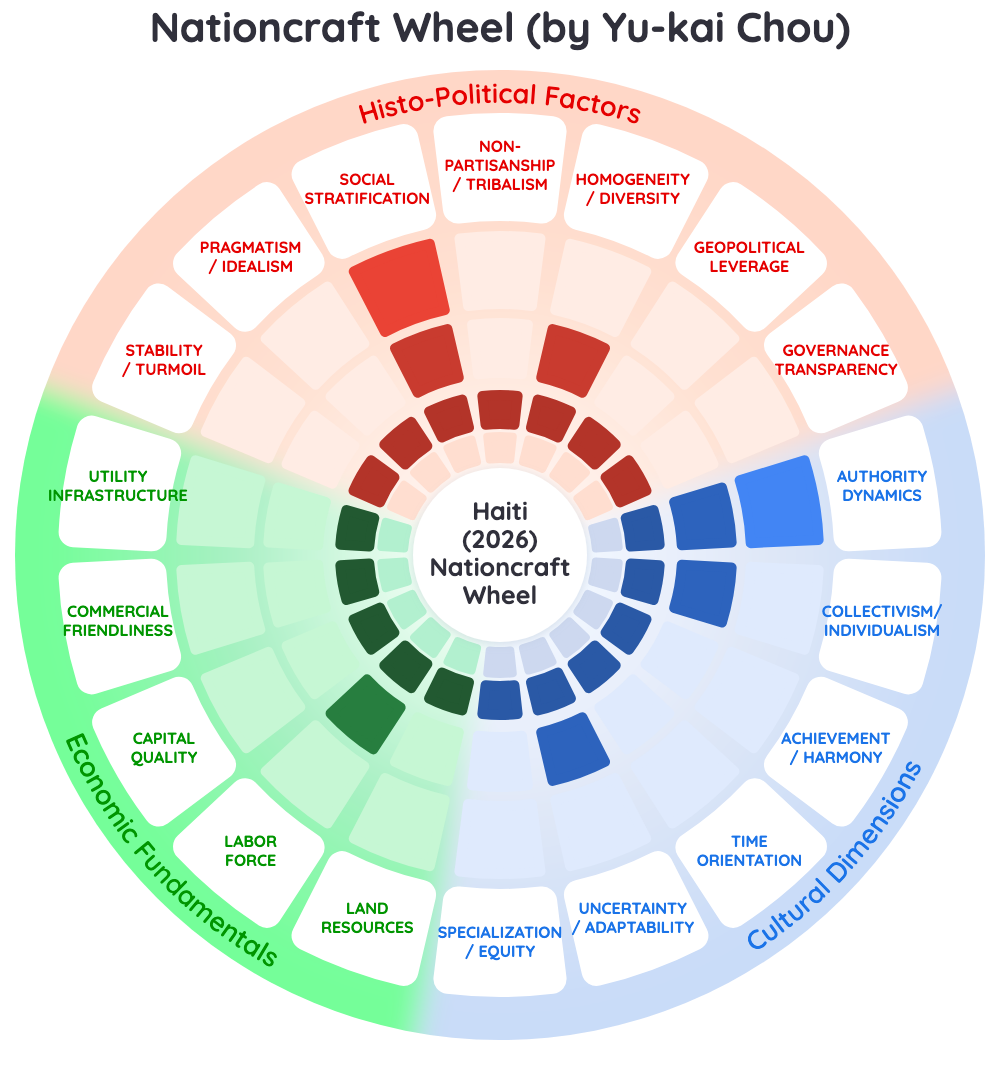

On July 27, 2026, Haiti’s Provisional Electoral Council did something both routine and damning: it published an election calendar.1 First round for president and parliament on December 13, 2026. Runoff on February 21, 2027. Final results on March 7. It would be the first national vote in a decade for a country that currently has zero elected officials at any level of government. The routine part is the paperwork. The damning part is the date itself, because the calendar Haiti actually promised earlier this year said August 30. That vote was suspended for the plainest possible reason: the state cannot secure it.2
Consider what the ballot is being asked to fix. Armed gangs hold an estimated 90 percent of Port-au-Prince and control territory in three of the country’s ten departments.3 Nearly 1.5 million Haitians are displaced, the highest count in the country’s recorded history.4 The international force authorized to break the gangs, the 5,550-strong Gang Suppression Force, had roughly 1,000 personnel on the ground as of July.5 The economy has contracted for seven consecutive years.6 And the plan, endorsed by Washington, the UN, and the CARICOM mediators who built Haiti’s transitional architecture, is that voting will convert this wreckage back into a legitimate state.
I call this the Ballot-First Trap, and Haiti is its purest live case. The trap works like this: a state that has lost the monopoly on violence is pressured to restore legitimacy through elections, because elections are the one legitimacy instrument the international system knows how to fund, schedule, and certify. But a ballot cast before the monopoly exists does not produce a mandate. It produces a contested prize. The winner inherits a title the gangs do not recognize, the losers inherit a grievance the system cannot arbitrate, and the armed actors who control the streets get to decide which voters reach which polling stations. Haiti has run this exact experiment repeatedly since 1990. The elected president of 1991 was overthrown seven months after inauguration. The elected president of 2000 left in a rebellion. The election of 2010 was brokered into a runoff amid fraud allegations, and the election of 2015 was annulled outright. The 2016 winner was assassinated in office, and no vote has been held since.
None of this means Haitians should not vote, and this analysis does not argue for indefinite delay. It argues something more specific: the December 13 date will either be preceded by a measurable transfer of coercive power from gangs to state, or it will join the August 30 date in the graveyard of Haitian electoral calendars. Which outcome occurs is visible in advance through eighteen variables. This is what the Nationcraft Framework is built to read, and Haiti’s readout is one of the starkest in the entire 147-country corpus.
⚡ Speed Run Notes
- Haiti scheduled December 13, 2026 for its first national election in a decade after the August 30 plan collapsed over security. The electoral council conditions the date on “an acceptable security environment.”
- Roughly 1,000 of 5,550 authorized international troops are deployed while gangs hold 90 percent of the capital and three of ten departments. The Nationcraft corpus calls this configuration Perpetual Fragility (ST-001).
- A ballot cast before the state regains the monopoly on violence produces a contested prize instead of a mandate. Haiti ran this loop in 1990, 2000, 2010, and 2015: winners couped, ousted, brokered, or annulled.
- Bukele’s El Salvador packet (SP-064) is the most tempting import and the worst V-fit: mass incarceration assumes police, prisons, and courts. Haiti’s V17=1, V18=1 state runs none of the three at scale.
- The packets that fit (Timor-Leste SP-074, Cote d’Ivoire SP-061, Dominican Republic SP-055) all sequenced security first. Their first credible elections came two-plus years after the monopoly question was settled.
Table of Contents
- Understanding Haiti’s Governance Landscape Through Nationcraft
- What Is the Nationcraft Framework?
- Why This Haiti Variables Analysis Matters
- The 18 Haiti Nation Variables
- The Ballot-First Trap
- Detailed Justifications: Reading the Variables
- Reformer Playbooks Haiti Should Reject
- Reformer Playbooks Haiti Should Actually Study
- Strategic Implications and Sequencing
- The Nationcraft Framework in Practice
- Frequently Asked Questions
About Yu-kai Chou

Yu-kai Chou is a Human-Systems Architect & Behavioral Designer and the creator of the Nationcraft Framework — an 18-variable diagnostic for matching a country’s structural profile to the reform packets that have historically worked under similar conditions. He has consulted for governments in eight nations, including Ukraine, the United Kingdom, the Kingdom of Bahrain, Singapore, Taiwan, the Netherlands, Kazakhstan, and South Korea, and has worked directly with President Zelenskyy’s team on post-war reconstruction priorities for Ukraine.
Chou’s prior framework — the Octalysis Framework — has been applied by LEGO, Microsoft, Porsche, Coca-Cola, Salesforce, and MrBeast, impacting over 1.5 Billion Users. He has taught the methodology at Harvard, Stanford, Yale, Tesla, Google, BCG, and IDEO.
His work has been cited by Harvard, Stanford, MIT, Forbes, Wall Street Journal, Wired, US Department of Energy, NIST, NSF, NCBI, US Department of Education, ClinicalTrials.gov, and Google Scholar — with 3,700+ more academic publications. Explore his books here.

This Haiti analysis draws on Chou’s advisory work with governments navigating contested authority and post-conflict sequencing, including direct work on Ukraine’s post-war reconstruction priorities, where the same question dominates: what order do you rebuild in when security, legitimacy, and the economy all demand to go first? Haiti is the hardest version of that question in the Western Hemisphere, and the Nationcraft corpus holds its answer in the form of packets from states that faced the same floor-level variables and escaped.
Understanding Haiti’s Governance Landscape Through Nationcraft
Haiti breaks most analytical frames people bring to it. The aid frame reads it as a poverty problem, yet Haitians abroad remit sums equal to roughly a sixth of GDP every year, which means the population generates capital; the country just cannot hold it.6 The security frame reads it as a gang problem, yet the gangs grew out of political machines that hired them, armed them, and then lost control of them after the 2021 presidential assassination removed the last coordinating client. The democracy frame reads it as an election deficit, and that frame is currently steering policy: restore the vote, restore the state.
The Nationcraft Framework reads Haiti differently. It treats a nation as a configured system: eighteen measured variables describing culture, political history, and economic endowment, which together determine which policies can execute and which will fail no matter how well they are designed. Policy effectiveness is decided by context-fit. A reform packet that rebuilt one country becomes noise in another because the variables that made it work are absent.
Haiti’s configuration is extreme in both directions, and the extremes are what make its trap legible. On one side sits Authority Dynamics at V1=8: two centuries of centralized presidential power, from the revolutionary generals through the Duvalier dictatorship’s total state, have produced a political culture that expects a strong center and organizes all competition around capturing it. On the other side sits the actual center: Stability vs Turmoil at V7=2, Governance Transparency at V13=1, Capital Quality at V16=1, Utility Infrastructure at V18=1. The culture is primed for a powerful state that no longer exists. That vacancy is the single most important fact in Haitian politics, because vacancies of authority do not stay vacant. Armed federations like Viv Ansanm, the gang coalition Washington designated a foreign terrorist organization in May 2025, have been filling the role the culture keeps expecting someone to fill: taxing commerce, controlling movement, dispensing brutal order.7
An election, in this reading, is an attempt to refill the authority slot by procedure. The Ballot-First Trap is what happens when the procedure runs while a rival authority still holds the ground.
What Is the Nationcraft Framework?
The Nationcraft Framework extends two decades of behavioral systems design from products and companies to nation-states. It scores a country on 18 Nation Variables across three clusters: Cultural (V1–V6: Authority Dynamics, Collectivism vs Individualism, Achievement vs Harmony, Time Orientation, Uncertainty & Adaptability, Specialization vs Equity), Histo-Political (V7–V13: Stability vs Turmoil, Pragmatism vs Idealism, Social Stratification, Non-Partisanship vs Tribalism, Homogeneity vs Diversity, Geopolitical Leverage, Governance Transparency), and Economic (V14–V18: Land Resources, Labor Force Quality, Capital Quality, Commercial Friendliness, Utility Infrastructure).
The scores are then matched against a corpus of over 140 Success Packets and Failure Packets: documented national transformations, from the Meiji Restoration to Rwanda’s reconstruction to El Salvador’s security state, each tagged with the variable preconditions that let it work or the variable deficits that made it fail. The discipline the corpus enforces is the one most policy debate skips: before asking whether a reform is good, ask whether this country, at these variable levels, can execute it. Readers coming from the gamification side can see the lineage in how Octalysis maps to nation-building and public policy: the same core insight, that systems succeed by fitting human motivation rather than fighting it, applied at the scale of states.
Two corpus objects matter most for Haiti. The first is FP-010, the Western Hemisphere Failure Packet: Haiti’s own documented trajectory from the Duvalier dictatorship through the 2010 earthquake to the post-2021 gang takeover, with the sobering ledger of 29 US military interventions and roughly $10 billion in post-earthquake pledges producing, in the packet’s words, zero indigenous state capacity. The second is ST-001, the Perpetual Fragility pattern: when four or more variables sit at floor levels, failure loops reinforce each other faster than any single reform can break them. Instability drives capital flight, which deepens poverty, which feeds instability. Aid substitutes for accountability, which weakens governance, which requires more aid. The corpus lists Haiti as a 40-year resident of this pattern, alongside Somalia, the DRC, Yemen, South Sudan, and Afghanistan.
Why This Haiti Variables Analysis Matters
The December 13 election is not a Haitian domestic event. It is the load-bearing assumption of the entire international strategy. Washington has pledged more than $300 million to the security mission and framed the transition around an elected handoff.3 The UN Security Council authorized the Gang Suppression Force explicitly to create conditions for elections.8 The World Bank’s growth projections for Haiti, a modest 0.6 percent in FY2026 accelerating afterward, are conditioned on “completion of elections.”6 CARICOM’s transitional roadmap ends at an inauguration. Every actor’s exit strategy runs through a polling station.
That is precisely why the variable readout matters. If the ballot is the plan, then the plan’s real dependency is whatever the variables say a credible ballot requires. Haiti’s readout says the requirement is coercive, not procedural: V7=2 means no election administration can protect itself, V17=1 means the roads and ports the ballot boxes travel are taxed by gangs, and V10=2 means every disputed count will be read through factional lenses with no trusted arbiter. The reader who absorbs the table below will understand the December date better than most of the officials defending it, because the table shows what has to move before the date can hold. This analysis also matters beyond Haiti: at least a dozen states in the corpus, from Somalia’s mandate trap to Libya’s post-Gaddafi fragmentation, have faced the same international reflex of scheduling legitimacy before securing it, and Haiti is the cleanest test of whether that reflex can ever work at V7=2.
The 18 Haiti Nation Variables
Scores run 1–9. Higher means more governable along that dimension. The scores come from the Nationcraft corpus’s 147-country dataset, cross-checked this week against UN, World Bank, and IMF-adjacent reporting; the full sourcing sits in the footnotes.
| Variable | Score | 2026 Reading |
|---|---|---|
| V1 Authority Dynamics | 8 | Culture expects a strong personal center (Duvalierist presidentialism); the slot is vacant and gangs are auditioning for it |
| V2 Collectivism vs Individualism | 6 | Lakou communal tradition, survival networks, diaspora solidarity funding roughly a sixth of GDP |
| V3 Achievement vs Harmony | 3 | Survival economy; formal achievement ladders never institutionalized |
| V4 Time Orientation | 2 | Planning horizon collapsed to days; 1.5 million displaced live contingently |
| V5 Uncertainty & Adaptability | 4 | Extraordinary endurance under chronic shock; coping capacity, not transformation capacity |
| V6 Specialization vs Equity | 2 | Informal economy dominant; formal specialization minimal outside a thin elite |
| V7 Stability vs Turmoil | 2 | 90 percent of the capital gang-held; zero elected officials; no president since 2021 |
| V8 Pragmatism vs Idealism | 2 | Maximalist, winner-take-all political culture; pacts collapse (Montana Accord vs transitional council factions) |
| V9 Social Stratification | 7 | Steep, accepted hierarchy: French-speaking elite over Creole-speaking majority; import-monopoly oligarchy |
| V10 Non-Partisanship vs Tribalism | 2 | Deep factionalism; gang federations mirror the fragmentation of the political class |
| V11 Homogeneity vs Diversity | 4 | Ethnically homogeneous yet functionally fragmented: language, class, and urban-rural cleavages divide the demos |
| V12 Geopolitical Leverage | 2 | Leverage only through negative externalities (migration, trafficking routes); aid-dependent otherwise |
| V13 Governance Transparency | 1 | Bottom-decile corruption rankings; PetroCaribe billions unaccounted; no functioning audit chain |
| V14 Land Resources | 3 | Severe deforestation and erosion; mineral deposits unproven at commercial scale |
| V15 Labor Force Quality | 5 | Young population and a large skilled diaspora against low literacy and relentless brain drain |
| V16 Capital Quality | 1 | No functioning capital market; banking minimal; the economy floats on remittances |
| V17 Commercial Friendliness | 1 | Ports, fuel terminals, and highways taxed by gangs; extortion is the de facto commercial code |
| V18 Utility Infrastructure | 1 | Electricity access below half the population; the capital’s grid effectively collapsed; water and sanitation in crisis |
Read the shape, not the average. Nationcraft scores are never averaged because configuration is strategy: the interaction between a high V1 and a floor-level V7 tells you more than any composite index could. Haiti’s shape is a culture built for centralized authority (V1=8) and communal endurance (V2=6, V5=4) stretched over a state whose delivery variables (V13, V16, V17, V18) have all hit 1. In the entire 147-country corpus, only a handful of states run four variables at absolute floor simultaneously. That is the ST-001 Perpetual Fragility signature, and it is the terrain on which someone has decided to hold an election.
The Ballot-First Trap
Every trap in the Nationcraft corpus is a variable interaction wearing a policy costume. The Ballot-First Trap is the interaction of four Haitian variables with one international habit.
Start with the variables. V7=2 means the state cannot guarantee physical security for registration drives, campaign events, ballot logistics, or count centers; whoever controls a neighborhood controls its turnout. V13=1 means no institution exists whose certification of a result would be believed by the losers; Haiti’s electoral disputes historically end in the streets because there is no court both sides trust. V10=2 means the political field is a scatter of personal vehicles and factional blocs that treat every contest as existential. And V8=2 means the culture of political maximalism converts narrow wins into total claims and narrow losses into total war. Now add the habit: the international system funds elections because elections are schedulable, certifiable, and photogenic, while monopolies on violence are expensive, slow, and morally uncomfortable to build. When the two meet, the calendar substitutes for the capability.
The corpus formalizes the correct order in pattern SC-002, Post-Conflict Reconciliation. Its required sequencing runs six steps: security stabilization first, then political settlement, then truth and justice processes, then economic reconstruction, then institutional reform, and only sixth, political normalization through elections. The pattern is blunt about step one: violence must stop. Haiti’s December 13 plan runs step six while step one is at 18 percent staffing.5 This is the same inversion visible in Myanmar’s command trap, where a junta schedules elections over territory it does not hold, and in Lebanon’s power-sharing trap, where procedural government persists precisely because the armed question stays unasked.
Haiti’s own history is the strongest dataset on what ballots do when they arrive before the monopoly. The table reads like a controlled experiment the country has been forced to repeat.
| Ballot | Security context | What followed |
|---|---|---|
| 1990 — Aristide wins Haiti’s first free election | Army intact, unreformed, unaccountable | Military coup seven months after inauguration; junta rule until the 1994 US intervention restored him |
| 2000 — Aristide returns with contested legislative results | Army disbanded (1995) but no capable police built in its place | Aid freeze, armed rebellion, second ouster in 2004; UN peacekeepers (MINUSTAH) arrive to hold the floor |
| 2006 — Préval elected | MINUSTAH’s roughly 9,000 uniformed personnel hold the ring | The one relatively stable handoff of the era, held under an external monopoly on violence |
| 2010–11 — Election amid earthquake rubble and cholera | State capacity shattered; UN mission stretched | Fraud allegations, an OAS-brokered runoff, and a presidency (Martelly) that ended ruling by decree |
| 2015–16 — First round annulled for fraud; rerun elects Moïse | MINUSTAH drawing down toward 2017 exit | Parliament lapses in 2020; Moïse rules by decree; assassinated July 2021; gangs seize the vacuum |
| 2026 (scheduled) — December 13 first round | ~1,000 of 5,550 GSF personnel deployed; 90 percent of the capital gang-held | The open question this analysis is about |
One row breaks the pattern, and it proves the rule. The 2006 election held because MINUSTAH was, for that window, the de facto monopoly on violence. The ballot did not create the stability; it spent stability that armed peacekeepers had already accumulated. When the external monopoly left in 2017, the state’s own coercive capacity had never been built to replace it, and the sequence that followed ran with grim logic: parliament gone by 2020, president assassinated by 2021, prisons emptied by 2024, capital gone by 2025. The 4,700 inmates who walked out of the National Penitentiary and Croix-des-Bouquets in 2024 are the inverse image of the December ballot: the state could not hold its own worst enemies inside walls it owned, and it now proposes to hold a national vote on streets it does not.
The trap has one more tooth. Because V1=8 keeps Haitian political culture organized around capturing a strong center, the presidency remains the supreme prize even while the state is prostrate. That means an election under current variables does not merely risk logistical failure. It re-arms the factional contest for the only asset left, and it hands the gangs, who control turnout geography across 90 percent of the capital, a seat at the table as kingmakers. Viv Ansanm’s leaders have already demanded a role in any political settlement. A ballot they can veto block by block is not a threat to their position; under these variables it is an offer.
Detailed Justifications: Reading the Variables
Eighteen scores are eighteen claims, and claims need evidence. This section walks the four clusters that decide the trap, with the corpus reading and the 2026 cross-check for each.
The cultural cluster: V1=8, V2=6, V4=2, V5=4
Haiti’s Authority Dynamics score of V1=8 confuses observers who equate authority with state capacity. The variable measures cultural orientation: how strongly the society expects, defers to, and organizes around centralized personal power. Two centuries of history built that expectation. The revolutionary state of 1804 was born military and centralist; the US occupation of 1915–34 governed through the center it found; François Duvalier perfected the total presidency, killing an estimated 30,000 Haitians through the Tonton Macoutes while making the state synonymous with one man. The Duvalierist state fell in 1986, but its psychological architecture never did. Haitian politics still treats the presidency as the single lever that moves everything, which is why every faction fights for it and why its five-year vacancy is a national emergency rather than a constitutional footnote.
Collectivism at V2=6 is the variable that keeps Haiti alive. The lakou tradition of communal land and mutual obligation, the survival networks of the displacement camps, and above all the diaspora: remittances equal to roughly a sixth of GDP arrive every year from Haitians abroad who never stopped considering themselves bound to home.6 This is real social capital, and it is the resource the fit packets below are designed to mobilize. But V4=2 and V5=4 mark its limits. A population whose planning horizon has collapsed to the next meal, the next checkpoint, the next displacement cannot hold long-term commitments, and adaptability at 4 is endurance rather than agility: Haitians absorb shocks that would break most societies, but absorption is not transformation.
The political cluster: V7=2, V8=2, V10=2, V13=1
Stability vs Turmoil at V7=2 is generous by a notch, and the sanity check behind this analysis flagged exactly that. The state has lost its capital, its prisons, its highways, and its fuel terminals. What keeps the score at 2 rather than 1 is the periphery: departments like Nippes and the far south still function at a level Somalia circa 1995 did not. But the trajectory matters more than the level. The corpus’s failure packet for Haiti, FP-010, records the trigger condition as chronic: 29 US military operations since 1915, each stabilizing the surface, none building the indigenous coercive institution that would make the next one unnecessary. Its critical insight deserves quoting because it is the entire case against ballot-first: external intervention without local capacity-building creates permanent dependency.
Pragmatism at V8=2 is the quiet killer in the profile. Compare the corpus’s escape cases: Rwanda’s reconstruction packet requires V8≥7, because pragmatic leadership is what converts victory into institutions instead of revenge. Haiti’s political class has run the opposite pattern for two centuries: maximal claims, zero-sum bargaining, agreements signed and abandoned. The Montana Accord’s civil-society roadmap and the CARICOM-brokered transitional council spent 2024 and 2025 fighting each other to a standstill while the gangs consolidated. The transitional council itself dissolved in February 2026 amid corruption allegations against members and a mandate challenge against the prime minister who inherited sole executive authority.69 Tribalism at V10=2 compounds it: dozens of personal parties, no institutionalized blocs, every coalition a temporary ceasefire. And Governance Transparency at V13=1 removes the referee: the PetroCaribe billions vanished without a single conviction that stuck, and the audit institutions that documented the theft could not enforce a consequence. An election needs losers who accept results. V13=1 means the machinery that would earn that acceptance does not exist.
The economic cluster: V14=3, V15=5, V16=1, V17=1, V18=1
Three economic variables at absolute floor is the material signature of state collapse. Commercial Friendliness at V17=1 is the most diagnostic: the gangs run a parallel fiscal state, taxing container traffic at the ports, fuel at the terminals, and passage on the national highways. Every formal business pays either protection or ransom; insurers have priced most of the capital out of coverage. Utility Infrastructure at V18=1 reflects a grid that delivers electricity to under half the population on the best day and effectively none of the capital on the worst.6 Capital Quality at V16=1 completes the floor: no functioning capital market, minimal banking penetration, and a national economy that would have imploded entirely without the remittance pipeline. The World Bank’s ledger for FY2025 reads: real GDP down 2.7 percent, the seventh consecutive annual contraction; inflation averaging 28.3 percent; the share of Haitians living on under $3 a day up from 42 percent in 2021 to 49 percent in 2025.6
Labor Force Quality at V15=5 is the one economic variable above floor, and it is the country’s hidden asset. Haiti’s population is young, its garment sector proved export-capable whenever security and trade access aligned, and its diaspora includes hundreds of thousands of educated professionals, the doctors, engineers, and administrators the state lost to brain drain, many of whom remit, advise, and wait. Every credible recovery scenario for Haiti runs through mobilizing that diaspora, which is a Core Drive 5 (Social Influence & Relatedness) design problem as much as an economic one: the pull of belonging and obligation is the motivational engine the remittance data already proves is running.
The vacancy: what V1=8 over V7=2 produces
The framework’s most Haitian finding is the gap between the authority the culture expects and the authority the state can exercise. This gap is not abstract. It is why gang leaders style themselves as political figures, give press conferences, and demand negotiation seats; the culture’s script has a role marked “strongman,” and someone will read for it. It is why the corpus’s Libya packet, FP-002, is such an uncomfortable mirror: Libya’s V1=9 under Gaddafi masked institutional emptiness, and when the person fell, there was no state behind the personality, only militias competing to inherit the script. Haiti’s version substituted a slow-motion collapse for Libya’s fast one, but the structural result matches: personal authority died with Moïse in 2021, and no institutional authority existed to catch the falling weight. An election is an attempt to cast a new lead for the strongman role. The Nationcraft reading says the role itself is the problem, and the packets that fit Haiti all share one feature: they rebuilt the institution before recasting the person.
Reformer Playbooks Haiti Should Reject
Haiti attracts imported solutions the way its harbor attracts container ships, and most arrive with the same defect: they assume a state. The corpus method, applied the same way as in the Venezuela reform playbooks analysis, is to test each tempting packet against the V-vector before anyone spends political capital on it. Five fail, each for a variable reason worth understanding, because the failure logic is what teaches the sequencing.
| Packet | Model | Key precondition | Haiti’s value | Verdict |
|---|---|---|---|---|
| SP-064 Bukele Security & Digital | El Salvador 2019– | Functioning police, prisons, courts to weaponize | V17=1, V18=1; prisons emptied 2024 | Reject |
| SP-006 Rwanda Post-Genocide Reconstruction | Rwanda 1994–2020 | Disciplined victorious cadre; V8≥7 pragmatism | No cadre; V8=2 | Reject |
| SP-033 Fujimori Shock Therapy | Peru 1990–2000 | Loyal capable military; functioning macro state | Army of ~2,000; V16=1 | Reject |
| SP-002 Lee Kuan Yew Industrialization | Singapore 1965–90 | V8≥8 pragmatism; state-controlled port; clean cadre | V8=2; port gang-taxed; V13=1 | Reject |
| FP-003 Coalition Provisional Authority | Iraq 2003–11 | (Failure packet) external rule replacing local structures | Warning, not template | Reject |
| SP-074 UN Trusteeship to Independence | Timor-Leste 1999–2020 | External monopoly first; elections after two years | Sequencing fits; scale caveat | Study |
| SP-061 Post-Civil War Recovery | Côte d’Ivoire 2011–20 | Authority question settled by force; technocratic core | Fits once monopoly resolves | Study |
| SP-055 Caribbean Growth Model | Dominican Republic 1996–2020 | Security floor; tourism/FTZ/diaspora assets | Destination packet; same island | Study |
SP-064: The Bukele import (El Salvador, 2019–present)
No playbook polls better in Haiti’s despair than Nayib Bukele’s. El Salvador was the hemisphere’s murder capital; a state of exception, mass incarceration, and a purpose-built mega-prison collapsed homicides to historic lows, and the region noticed. Haitian commentators, diaspora voices, and more than a few foreign columnists have asked the obvious question: why not here?
The corpus answer is that SP-064 is a story about instruments, and Haiti lacks every instrument in it. Bukele inherited a functioning coercive apparatus: tens of thousands of police and soldiers who obeyed orders, prisons that held people, courts that processed them, a dollarized economy whose infrastructure worked. His innovation was aiming that apparatus without restraint, which is why the packet’s own ledger lists destroyed due process and democratic institutions alongside the homicide collapse. Haiti’s apparatus consists of a police force bled by attrition and emigration, an army reconstituted in 2017 at roughly two thousand troops, and a prison system whose two main facilities lost about 4,700 inmates in a single 2024 weekend. A state of exception requires a state. Declaring one from a fortified office while gangs tax the port is theater, and theater against Viv Ansanm gets people killed. The deeper V-mismatch: El Salvador’s gangs were extortion networks living parasitically on functioning commerce (V17 mid-scale), while Haiti’s gangs are territorial governments replacing absent commerce (V17=1). You can raid a parasite; you must displace a government. The same import logic has already been stress-tested and found wanting elsewhere in the region, as the corpus documented in Chile’s mano dura mirage and in Ecuador’s emergency ratchet, where states far more capable than Haiti’s discovered that emergency powers substitute badly for institutional depth.
SP-006: The Rwanda fantasy (1994–2020)
Rwanda’s reconstruction is the packet reformers reach for when they want to believe total collapse can become disciplined growth inside a generation. It can, and the preconditions are brutally specific. The packet requires V8≥7 leadership pragmatism and a disciplined, victorious, internally accountable cadre, because Kagame’s RPF did not merely win the war; it arrived as a functioning proto-state with its own command culture, then imposed reconciliation from above through instruments like imihigo performance contracts. Rwanda also waited nine years after the genocide before holding its first post-war presidential election, a sequencing detail the ballot-first consensus never quotes.
Haiti has no RPF. There is no victorious disciplined organization anywhere on the field: the political class is fragmented (V10=2), the police are besieged, and the armed actors with the most operational discipline are the gangs themselves. Grafting Rwanda’s authority-led model onto V8=2 maximalism without a cadre produces a strongman bid, and Haiti’s history is a museum of how those end. The packet’s own caveat closes the door: it does not work without V8≥7. Haiti sits five points below the floor.
SP-033: The Fujimori temptation (Peru, 1990–2000)
Peru in 1990 looks superficially Haitian: 7,650 percent inflation, an insurgency controlling 40 percent of national territory, a state in freefall. Fujimori’s shock stabilization, autogolpe, and counterinsurgency broke both the hyperinflation and Shining Path, and the macro framework he built outlived his disgrace. For anyone arguing that Haiti needs one hard decade under one hard hand, this is the reference case.
The variable check fails on the instrument again. Fujimori’s counterinsurgency ran through a large, intact, obedient military and an intelligence service capable of the September 1992 raid that captured Abimael Guzmán; his economic shock ran through a finance ministry that could actually decree prices and collect some taxes. Haiti’s equivalent institutions either do not exist or answer to no one. And Peru’s insurgency was ideological, with a decapitable head; Haiti’s gang federations are economic, decentralized, and self-funding through territory. Remove one leader and the revenue model hires the next. The corpus’s neighboring analysis of Peru’s carousel trap adds the long-run bill: Fujimori’s institutional shortcuts helped produce the presidential revolving door Peru still spins in. Haiti, at V13=1, would pay that bill sooner and steeper.
SP-002: The Singapore mirage (1965–1990)
Every failing state gets told to find its Lee Kuan Yew, and Haiti has heard it for decades. The packet’s actual preconditions make the prescription almost satirical here: V8≥8 pragmatism (Haiti: 2), a clean technocratic cadre (V13=1), a state-controlled port at a global chokepoint (Haiti’s port is gang-taxed), and a small governable territory under existential discipline. What the LKY packet does offer Haiti is one transferable idea, and it is the opposite of the one usually cited: Singapore sequenced security first. The packet’s phase one, 1965–1970, is national service, internal security, and basic infrastructure, because Lee understood you cannot industrialize territory you cannot hold. The corpus’s Singapore LKY packet stress test walks why the model resists export even to capable states; for Haiti the honest takeaway is the ordering, never the toolkit.
FP-003: Maximum trusteeship done wrong (Iraq CPA, 2003–2011)
The final rejection points the other direction, at the internationals rather than the Haitians. As the Gang Suppression Force scales, the temptation will grow to solve Haiti by running it: an external administration with executive powers, vetting the political class, rebuilding from the org chart down. The corpus’s Coalition Provisional Authority failure packet is the standing warning. The CPA dissolved Iraq’s army and purged its administrative class in pursuit of a clean slate, discovered that the slate was the state, and spent the next eight years fighting the vacuum it created. The lesson for Haiti’s mission designers: the GSF’s job is to transfer a monopoly on violence to Haitian institutions, and every month it substitutes for those institutions instead of building them, it manufactures the dependency FP-010 already documented across 29 previous interventions. External force is scaffolding. Scaffolding that becomes the building is called a ruin.
Reformer Playbooks Haiti Should Actually Study
Rejecting five playbooks would be nihilism if the corpus stopped there. It does not. Three packets fit Haiti’s variables, and they fit because each one answers the specific question Haiti’s profile is asking: how does a state with floor-level delivery variables and a broken monopoly on violence sequence its way back? The answer, in all three, begins with who holds the guns and ends with who holds the ballots.
SP-074: Timor-Leste’s trusteeship sequencing (1999–2020)
Timor-Leste in September 1999 was closer to Haiti’s floor than any other case in the corpus: militias had razed the territory after the independence referendum, most infrastructure was ash, the administrative class was gone, and per-capita GDP sat near $400. What followed is the cleanest demonstration of correct sequencing on record. The Australian-led INTERFET force restored the monopoly on violence within months. A UN transitional administration then governed while building courts, a police service, and a treasury from zero. The constituent assembly election came in August 2001, two years into the sequence, under full international protection, and sovereignty transferred in 2002 to a state that could survive receiving it. When the new army and police fractured in the 2006 crisis, the internationals returned, restabilized, and exited for good in 2012, leaving behind the corpus’s most surprising line for a case this poor: democratic institutions that survived their first real stress test, plus a Petroleum Fund the packet rates a genuine success.
The fit for Haiti is the sequence, not the circumstances. Timor had unifying independence legitimacy and offshore oil; Haiti has neither, and eleven million people versus Timor’s one million makes trusteeship at that depth impossible. But the GSF’s mandate already contains a miniature of the Timor logic: restore security, protect institutions, hand off. The packet’s lesson is about thresholds and patience. INTERFET arrived at full strength in weeks; the GSF is at 18 percent after ten months.5 Timor’s first election waited two years behind the monopoly; Haiti’s is scheduled four months ahead of it. Same playbook, run in reverse order, and the corpus is unambiguous about which order works.
SP-061: Côte d’Ivoire’s post-monopoly recovery (2011–2020)
Côte d’Ivoire is the packet for the morning after: what to do once the contested-authority question finally resolves. Its 2010 election did not resolve the country’s crisis; the incumbent simply refused the result, which is the purest possible demonstration that ballots settle nothing when the loser retains an army. What resolved it was force, in April 2011, with international backing. Then came the packet Haiti should study: a technocratic government under a leader with unimpeachable economic credentials, an immediate IMF anchor, visible infrastructure delivery, and 9 percent growth within four years, which is the speed at which a commodity economy can reflate once security and credibility return together.
Haiti’s version of the preconditions is buildable. The technocratic bench exists in the diaspora; the international financing stands ready and the IMF’s staff-monitored program is already the de facto macro anchor, credited by the World Bank with helping pull inflation from 28 percent toward a projected 22.6 What Haiti must import deliberately is the packet’s honest caveat: Côte d’Ivoire’s growth ran ahead of its reconciliation, and the 2020 election showed the fracture still live underneath. For Haiti, at V10=2 tribalism, reconciliation cannot be the afterthought. The sequencing pattern SC-002 places justice processes third, before economic reconstruction, and Haiti’s version will have to decide what accountability means for gang commanders, for the politicians who armed them, and for the oligarchs who financed both.
SP-055: The Dominican destination (1996–2020)
The most galling comparison in Haitian life sits across a land border on the same island. The Dominican Republic’s Caribbean Growth Model packet, which Haiti’s own failure packet FP-010 names as its comparable success, built the hemisphere’s most sustained growth run on four engines Haiti also possesses in latent form: tourism assets, free trade zones, diaspora remittances converted into investment, and eventually mining. Per-capita income now runs roughly five times Haiti’s. The packet’s lesson is emphatically not that Haiti should copy Dominican policy tomorrow; it is that the destination is real and adjacent. The same beaches, the same diaspora density in the US, the same nearshoring geography that CAFTA gave the Dominicans, all of it sits on Haiti’s side of the island waiting for one input the Dominicans secured in 1996 and Haiti has never held for a full decade: a security floor stable enough for a tourist to land, a factory to insure, and a container to clear port untaxed by gunmen.
The regional pattern strengthens the point. The corpus’s Caribbean neighbors show divergent paths from similar floors: Cuba’s doctrine trap demonstrates how ideology can hold delivery variables down for decades, while the Dominican packet shows service-sector diversification compounding once basic stability held. Haiti’s V2=6 collectivism and V15=5 diaspora asset are, if anything, stronger raw inputs than the Dominicans started with. The variable gap is V7 and V17, which returns every road in this analysis to the same toll booth: the monopoly on violence, first.
Strategic Implications and Sequencing
Diagnosis without sequencing is commentary. Here is what the V-vector and the three fit packets imply, phase by phase, with the gate conditions that mark when each phase has actually completed. The structure follows SC-002’s canonical order, compressed to Haiti’s situation.
| Phase | Focus | Gate condition (measurable) | Packet reference |
|---|---|---|---|
| 1. Monopoly | GSF to authorized strength; hold ports, fuel terminals, airport road, National Route 1; vetted HNP units co-deployed from day one | Commercial traffic clears the port and highways without gang taxation for two consecutive quarters (V17 moves off 1) | SP-074 phase one; SP-002’s security-first rationale |
| 2. Settlement | Political pact binding the factions to one transition sequence; gang demobilization tracks for foot soldiers, prosecution tracks for commanders | Montana-lineage civil society, parties, and private sector sign one roadmap; DDR intake exceeds recruitment for two quarters | SP-061 preconditions; SC-002 step two |
| 3. Accountability | Justice for designated gang leadership and their financiers; asset recovery on PetroCaribe-era theft as the V13 signal | First convictions that hold, including one elite financier (V13 moves off 1) | SC-002 step three; SP-061’s warning about skipped reconciliation |
| 4. Reconstruction | Remittance-leveraged rebuilding: diaspora bonds, matching funds; grid and water restoration in secured zones; garment and agro corridors reopened | Electricity access crosses 60 percent in secured departments; one export corridor operating at pre-2021 volume | SP-055 engines; V2=6 and V15=5 mobilized via Core Drive 5 diaspora design |
| 5. Institutions | Electoral registry rebuilt for 1.5 million displaced; judiciary and audit chain restaffed; police academy throughput doubled | Registry audit accepted by all signatory factions; HNP attrition net-positive for a year | SC-002 step five; FP-003’s warning to build, never substitute |
| 6. Ballot | National elections under Haitian-led security with GSF overwatch | The vote every prior phase was purchasing: winners the gangs cannot veto, losers the system can afford | SC-002 step six; SP-074’s two-year patience |
Set honest expectations about the December 13 date against this table. Phase one’s gate alone is unmet by a wide margin: the force meant to establish the monopoly is at roughly 1,000 of 5,550, and its own Security Council briefings describe the shortfall as the binding constraint.5 The electoral council knows it, which is why its calendar announcement conditioned everything on “an acceptable security environment” and financing.1 The realistic scenarios are three. First, the date slips again, which is the trap admitting itself. Second, the date holds nominally through a geographically truncated vote, urban zones excluded or gang-mediated, producing a president elected by the fraction of the country the state can reach: a contested prize with a certificate. Third, the phase-one gate genuinely accelerates, through rapid GSF reinforcement in the autumn, and December 13 becomes the rare ballot that arrives on schedule behind a real monopoly. The third scenario is the only one that breaks the loop, and it is the only one whose prerequisites are fully visible in advance: troops, funding, and port control by October.
One behavioral note completes the picture, because Nationcraft is at bottom a motivation framework. Haiti’s elite factions calculate under loss aversion: each blocks reforms that risk its position more energetically than it pursues gains that would grow the whole. The sequencing table is designed against that psychology. Early phases deliver visible wins nobody loses (a working port enriches even the oligarchs), building the trust reserves the later, redistributive phases spend. Sequencing that demands elite sacrifice first, as ballot-first implicitly does by putting total power up for grabs immediately, guarantees the sabotage it then blames on Haitian culture.
The Nationcraft Framework in Practice
Haiti demonstrates the Nationcraft Framework’s core discipline better than any easy case could: the analysis changes the question. The policy debate asks whether Haiti should hold elections, a question that collapses into slogans on both sides. The variable analysis asks what an election requires, finds the requirements in V7, V13, V10, and V17, checks which historical packets moved those variables from Haiti’s levels, and returns a sequence with gates. The answer is never that Haitians are unready for democracy, a claim both false and ugly; Haitians risked their lives to vote in 1990 and would again. The answer is that the ballot is a precision instrument that assumes an operating environment the state must first provide, and that pretending otherwise has cost Haiti four broken electoral cycles, while the one workable handoff of the modern era, 2006, ran behind an external monopoly on violence.
The corpus pattern Haiti most needs to escape, ST-001 Perpetual Fragility, lists five escape conditions. Two are unavailable: resource discovery and regional integration anchors of the EU type do not exist for Haiti. One is dangerous: exceptional strongman leadership at V8=2 without institutions is how the trap resets. The remaining two, a sustained external security guarantee and generational change in conflict dynamics, are exactly what the GSF-plus-sequencing path attempts to combine: borrow the monopoly long enough to build a native one, and use the pause to move V13 and V17 far enough that the next generation’s fights happen inside institutions instead of over them. Sister analyses across the corpus show variants of the same escape attempt: Madagascar’s refoundation trap for what transitional councils do to legitimacy, and Niger’s sovereignty swap for the price of renting security from outside without a handoff plan. Haiti’s version will be judged by one number first: how many of the 5,550 are on the ground by November.
Explore More Nationcraft Analyses
This analysis is one entry in a growing atlas. The full Nationcraft country analyses library indexes every published country diagnosis with its named trap and V-vector wheel. For the nearest structural cousins to Haiti’s situation, start with the Somalia, Madagascar, and Ecuador entries linked above, then read the Venezuela playbook analysis for the fit-and-reject method applied to a state one stage earlier in collapse.
Frequently Asked Questions
What is the Ballot-First Trap in Haiti?
It is the structural bind where a state with no monopoly on violence is pushed to restore legitimacy through elections. Haiti’s Nationcraft profile pairs Stability vs Turmoil V7=2, Governance Transparency V13=1, and Commercial Friendliness V17=1 with an authority-primed culture at V1=8. Under those variables a ballot does not produce a mandate; it produces a contested prize that armed factions fight over. Haiti scheduled a first round for August 30, 2026, then postponed it to December 13 because security could not support it, which is the trap operating in real time.
Why might Haiti’s December 13, 2026 election make things worse?
Roughly 1,000 of the 5,550 authorized Gang Suppression Force personnel are deployed, gangs hold an estimated 90 percent of Port-au-Prince plus territory in three of ten departments, and nearly 1.5 million Haitians are displaced. Voting under those conditions means gangs decide where registration, campaigning, and polling can happen, which converts turnout geography into a weapon. Every previously contested Haitian election under weak security, in 1990, 2000, 2010, and 2015, ended in a coup, a rebellion, or an annulled result.
Could a Bukele-style crackdown work in Haiti?
The Nationcraft verdict is no under current variables. El Salvador’s SP-064 packet ran mass incarceration through police, prisons, and courts that already functioned, in a dollarized economy with working infrastructure. Haiti’s state fields none of those at scale: Commercial Friendliness V17=1, Utility Infrastructure V18=1, and roughly 4,700 inmates escaped its two main prisons in 2024. A state of exception requires a state. The instrument Haiti lacks is the precondition, and importing the slogan without the coercive apparatus produces theater instead of security.
Which reform playbooks actually fit Haiti’s profile?
Three sequence correctly against Haiti’s V-vector. Timor-Leste’s UN trusteeship packet SP-074: international force restores the monopoly on violence first, elections follow two years later under protection. Côte d’Ivoire’s post-civil-war recovery SP-061: settle the contested-authority question by force, then run technocratic reconstruction with international backing. And the Dominican Republic’s Caribbean growth model SP-055, the same-island packet built on tourism, free trade zones, remittances, and diaspora leverage, as the economic destination once a security floor exists.
What would have to happen before a Haitian election produces a real mandate?
The Nationcraft sequencing pattern SC-002 puts elections at step six of six, after security stabilization, political settlement, justice processes, economic reconstruction, and institutional reform. The minimum gates for Haiti: the Gang Suppression Force approaching authorized strength and holding the capital’s arteries, ports and roads operating without gang taxation so V17 can move off its floor, displaced voters able to return or register where they live, and a vetted police force that can protect the country’s polling stations. Until those gates pass, any date on the calendar is aspiration priced as policy.
Related Reading
- The Nationcraft Framework — the 18-variable diagnostic system behind this analysis
- Nationcraft Country Analyses Library — every published country diagnosis with its named trap
- Nationcraft Analysis: Somalia Mandate Trap 2026 — the nearest structural cousin: external missions, mandates, and a contested monopoly
- Nationcraft Analysis: Chile Mano Dura Mirage 2026 — why the Bukele import fails the V-check even in capable states
- Nationcraft Analysis: Cuba Doctrine Trap 2026 — the Caribbean’s other trap: ideology holding delivery variables down
- Nationcraft Analysis: Venezuela Reform Playbooks 2026 — the fit-and-reject method applied to a state one stage earlier in collapse
Footnotes
- The Haitian Times, “Haiti sets Dec. 13 date for first national election in a decade” (July 28, 2026): first round December 13, 2026; runoff February 21, 2027; results March 7, 2027; CEP conditions the calendar on security and financing. haitiantimes.com
- Human Rights Watch, World Report 2026, Haiti chapter: the electoral calendar is contingent on improvement in the security situation. hrw.org; see also CSIS, “Haiti Embarks on Another Rocky Political Transition” (2026). csis.org
- Council on Foreign Relations, Global Conflict Tracker: Instability in Haiti (updated 2026): gangs control an estimated 90 percent of Port-au-Prince and three of ten departments; GSF operations began June 2026; US pledges of $300 million plus equipment. cfr.org
- UN News, “Haiti: Harrowing needs must be met with long-term engagement” (June 5, 2026): nearly 1.5 million internally displaced per IOM; Port-au-Prince IDP count above 300,000 for the first time. news.un.org
- UN Security Council meeting coverage SC/16417 (July 2026): approximately 1,000 of 5,550 needed anti-gang personnel deployed. press.un.org; deployment context in Security Council Report, Haiti Monthly Forecast (April 2026). securitycouncilreport.org
- World Bank, Macro Poverty Outlook: Haiti (2026): real GDP contracted 2.7 percent in FY2025, a seventh consecutive year of decline; inflation averaged 28.3 percent in FY2025 with 22.0 percent projected for FY2026 under the IMF Staff-Monitored Program; poverty (under $3/day) rose from 42.2 percent in 2021 to 49.0 percent in 2025; remittances around 16 percent of GDP; the Transitional Presidential Council dissolved February 2026 without organizing elections, with the Prime Minister assuming executive functions amid a mandate challenge; elections planned for August and December 2026 subject to security and funding; FY2026 growth of 0.6 percent contingent on the expanded GSF. worldbank.org (PDF)
- US Department of State, “Terrorist Designations of Viv Ansanm and Gran Grif” (May 2025). state.gov
- UN Security Council Resolution 2793 (September 30, 2025), authorizing the transition of the Multinational Security Support mission into the Gang Suppression Force. docs.un.org; UN News on the adoption and the 5,550-strong force. news.un.org
- Al Jazeera, “Haiti’s transitional council hands power to US-backed PM” (February 7, 2026). aljazeera.com; on the GSF’s first arrivals, Al Jazeera (April 2, 2026). aljazeera.com; humanitarian baseline in WFP, “Haiti on the brink” (2026): 5.7 million facing acute food insecurity; Haiti the only country in the Americas with catastrophic IPC5 hunger. wfp.org; political transition context in the UN Secretary-General’s report S/2026/31 on BINUH. reliefweb.int