

On November 5, 2026, the IMF announced that Ghana had passed its first examination under a program that lends it nothing. No tranche was waiting. No disbursement depended on the grade.
The numbers behind that pass are the best Ghana has posted in a decade: growth of 6.2% year-on-year in the first half of 2026, inflation at 5.5% in October, a current account that ran a surplus near 8% of GDP in 2025 on the back of gold. Four years after defaulting on its external debt, Ghana looks like the IMF’s favorite student again.
Here is the problem, and it is the oldest problem in Ghanaian statecraft. The country did not take this exam voluntarily. It asked the IMF to keep grading it after the money stopped, because its own graders do not yet exist. That is the pattern I call the Imported Discipline Trap: a state that executes brilliantly whenever an external referee is watching, and has organized its politics around never having to build the referee at home.
The tell is sitting in plain sight in the IMF’s own mission statement. The reforms still outstanding after the first review are precisely the domestic enforcement institutions: the Fiscal Council that is not yet operational, the integrated tax administration system still in build, the delayed publication of the electricity company’s collections audit. Ghana passed the test while postponing the proctor.
This analysis reads Ghana’s 18-variable Nationcraft profile against the historical record of countries that tried to turn borrowed discipline into owned discipline. Five famous playbooks fail against this exact configuration. Three deserve serious study. And one date decides everything: the 2028 election.
⚡ Speed Run Notes
- Ghana just passed its first IMF review with no loan attached. Growth 6.2%, inflation 5.5%. The PCI is a referee without money, and Ghana still needed to hire the referee.
- The Imported Discipline Trap: V4=3, V10=3 and V13=3 mean fiscal discipline does not self-enforce here. Since 1983 Ghana has rented it from Washington instead of building it at home.
- The tell is what remains undone: the Fiscal Council, the ITAS tax system, the ECG audit. Every outstanding reform is a domestic referee. The state aced the exam while postponing the proctor.
- History grades this harshly. Argentina (FP-001) shows what borrowed discipline does when it meets patronage politics. Botswana (SP-004) shows the alternative: referees built before the windfall.
- Watch one date: the 2028 election. Ghana’s last three program exits died in election-year budgets. The PCI’s entire purpose is to survive one.
Table of Contents
- Understanding Ghana’s Governance Landscape Through Nationcraft
- What Is the Nationcraft Framework?
- Why This Ghana Variables Analysis Matters Right Now
- The 18 Ghana Nation Variables
- The Imported Discipline Trap
- Detailed Justifications: Reading the Scores
- Best-Match Historical Packets
- Governance Strategy Recommendations
- Strategic Implications
- Comparative Context
- Frequently Asked Questions
About Yu-kai Chou

Yu-kai Chou is a Human-Systems Architect & Behavioral Designer and the creator of the Nationcraft Framework — an 18-variable diagnostic for matching a country’s structural profile to the reform packets that have historically worked under similar conditions. He has consulted for governments in eight nations, including Ukraine, the United Kingdom, the Kingdom of Bahrain, Singapore, Taiwan, the Netherlands, Kazakhstan, and South Korea, and has worked directly with President Zelenskyy’s team on post-war reconstruction priorities for Ukraine.
Chou’s prior framework — the Octalysis Framework — has been applied by LEGO, Microsoft, Porsche, Coca-Cola, Salesforce, and MrBeast, impacting over 1.5 Billion Users. He has taught the methodology at Harvard, Stanford, Yale, Tesla, Google, BCG, and IDEO.
His work has been cited by Harvard, Stanford, MIT, Forbes, Wall Street Journal, Wired, US Department of Energy, NIST, NSF, NCBI, US Department of Education, ClinicalTrials.gov, and Google Scholar — with 3,700+ more academic publications. Explore his books here.

This Ghana analysis draws on Chou’s advisory work on reform sequencing with eight governments, where the recurring question is the one Ghana now faces: how a state converts externally supervised stabilization into motivation and institutions that hold after the supervisor leaves. The Nationcraft Framework was built to answer exactly that hand-off problem.
Understanding Ghana’s Governance Landscape Through Nationcraft
Ghana is West Africa’s showcase democracy. Nine consecutive competitive elections since 1992, four peaceful alternations of power between its two parties, no coup since 1981, a press that criticizes presidents by name and stays open.
It is also one of the world’s most experienced IMF clients. The IMF’s own country page keeps the score: eighteen arrangements since Ghana joined the Fund in 1957. The $3 billion Extended Credit Facility that concluded in July 2026 was simply the latest.
Those two facts are usually told as separate stories: a political success and an economic embarrassment. Nationcraft reads them as one story, because the same variable configuration produces both.
A competitive two-party democracy with winner-takes-all stakes (V10=3) and a short political time horizon (V4=3) will reliably spend its way through election years. Weak transparency institutions (V13=3) mean nobody inside the system can stop it. So the discipline gets outsourced, over and over, to the one referee Ghanaian politics cannot vote out of office: the IMF.
The 2026 Policy Coordination Instrument is the purest expression of this configuration ever signed. It is worth understanding in detail, because it is either the last chapter of the cycle or the eighteenth verse of the same song.
What Is the Nationcraft Framework?
The Nationcraft Framework is my diagnostic system for nation-state reform. It scores a country on 18 Nation Variables spanning culture (V1–V6), political history (V7–V13), and economic fundamentals (V14–V18), each from 1 to 9.
The core thesis: policy effectiveness is decided by context-fit, not policy quality. A reform that transformed one country will wreck another if the variable preconditions differ.
So Nationcraft matches a country’s current V-vector against 139 historical Success Packets and failure packets, each benchmarked at the moment of intervention. The question is never “what is best practice?” It is “what worked in a configuration that actually resembles this one?”
Configuration is strategy. The scores are never averaged into a single index, because the interactions carry the information. Ghana’s profile is a textbook case: its paradox lives in the gap between a strong resource base and three specific institutional scores.
Why This Ghana Variables Analysis Matters Right Now
In May 2026 I published Ghana’s Bailout Cycle Trap analysis, written while the country was still inside its lending program. That piece diagnosed the loop: crisis, rescue, recovery, election, crisis.
Six months later, the loop reached a genuinely new position. On July 27, 2026, the IMF Executive Board completed the sixth and final review of Ghana’s ECF and, the same day, took up the country’s request for a 36-month Policy Coordination Instrument, the non-lending arrangement that now anchors its reform agenda.
A PCI is an unusual instrument. It carries no money. It exists so that a country can keep the IMF’s monitoring, test dates and public report cards after the borrowing relationship ends.
On November 5, 2026, after a two-week mission to Accra, the Fund announced a staff-level agreement on the PCI’s first review, with Executive Board consideration to follow. The macro story was strong: growth of 6.2% in the first half, inflation at 5.5% in October, below the Bank of Ghana’s 6–10% medium-term band.
The same statement carried the caution. External reserves, which had nearly doubled to $11.9 billion by end-2025, declined through 2026 sharply enough to force corrective action. Foreign-exchange intermediation moved from the central bank to the new Ghana Gold Board, with higher gold-surrender requirements on large miners. And the structural list still open after review one reads like a blueprint of the referees Ghana has not built: the Fiscal Council, the ITAS tax platform, the Bank of Ghana’s liquidity framework, the ECG collections audit.
Ghana is now running the same experiment Sri Lanka’s Graduation Cliff analysis examined from the other side: what happens to program-forged discipline when the program ends. Ghana’s version is more radical. It kept the exam and gave up the money, which makes the 2026–2029 window the cleanest natural test of the Imported Discipline Trap anywhere in the world.
The 18 Ghana Nation Variables
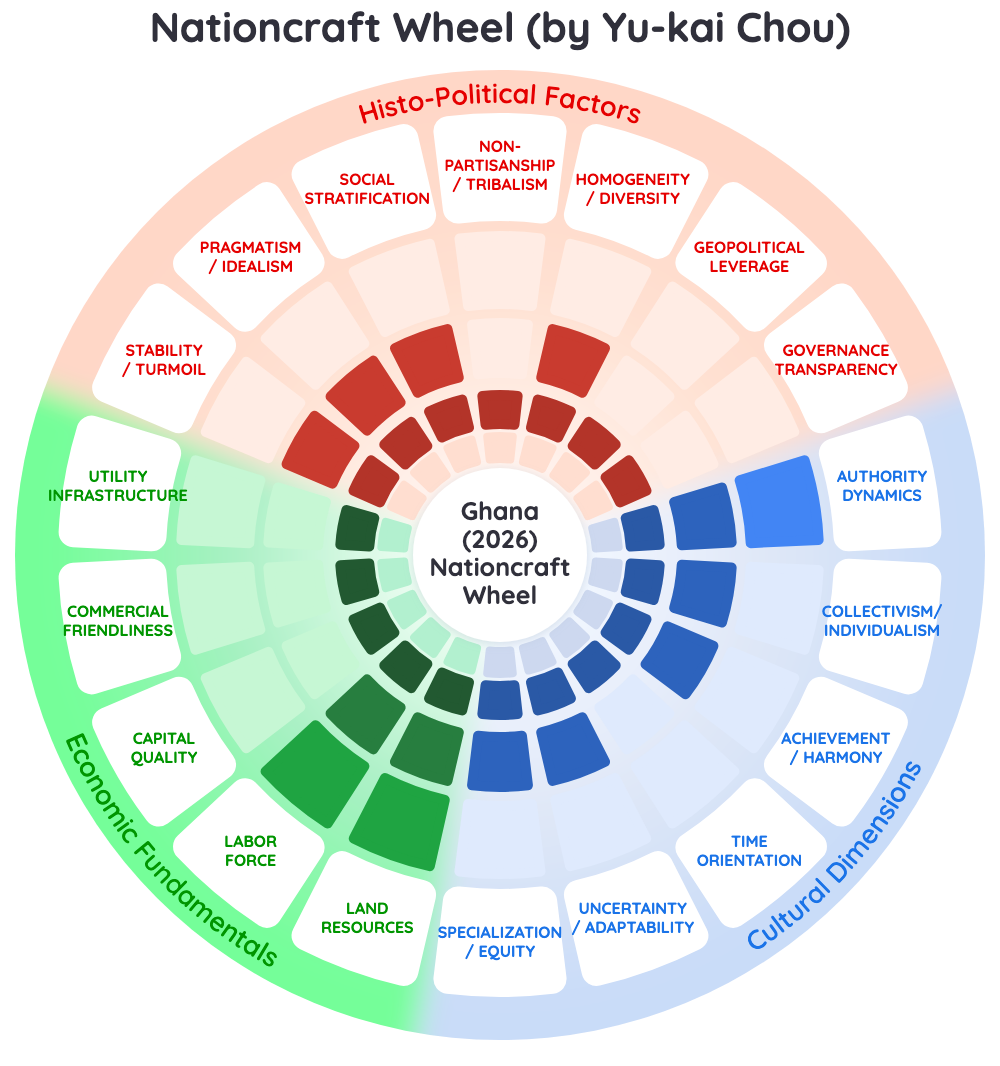
Here is Ghana’s full Nationcraft V-vector as of November 2026, drawn from the canonical corpus and sanity-checked against current IMF, Freedom House and Transparency International data.
| Variable | Score | Reading |
|---|---|---|
| V1 Authority Dynamics | 7/9 | Strong executive presidency; centralized appointment power across the state |
| V2 Collectivism | 6/9 | Communal norms and extended-family obligation networks |
| V3 Achievement vs Harmony | 4/9 | Status flows through consensus and connection as much as attainment |
| V4 Time Orientation | 3/9 | Short political horizon; election-cycle fiscal blowouts in 2012, 2016, 2020, 2024 |
| V5 Uncertainty Adaptability | 5/9 | Absorbed the 2022 default and restructuring without institutional rupture |
| V6 Specialization vs Equity | 4/9 | Equity-leaning distribution politics |
| V7 Stability vs Turmoil | 5/9 | Nine peaceful elections since 1992; no coup since 1981; fragile neighborhood discount |
| V8 Pragmatism vs Idealism | 4/9 | Ideology-light but patronage-heavy policymaking |
| V9 Social Stratification | 6/9 | Visible elite-mass gap, widening with the gold boom |
| V10 Non-Partisanship vs Tribalism | 3/9 | NPP/NDC winner-takes-all duopoly; wholesale patronage rotation at each transfer |
| V11 Homogeneity vs Diversity | 4/9 | Akan plurality with significant regional and ethnic diversity |
| V12 Geopolitical Leverage | 2/9 | Price-taker in gold, cocoa and oil; no strategic veto to trade |
| V13 Governance Transparency | 3/9 | CPI stuck in the low 40s; delayed audits; a Fiscal Council on paper only |
| V14 Land & Resources | 7/9 | Africa’s largest gold producer; world’s second cocoa exporter; offshore oil |
| V15 Labor Force Quality | 7/9 | Anglophone, regionally strong workforce; heavy emigration pressure |
| V16 Capital Quality | 2/9 | Post-default markets; banks and institutional investors still scarred by the domestic debt exchange |
| V17 Commercial Friendliness | 3/9 | Licensing friction, costly credit, large informal sector |
| V18 Utility Infrastructure | 3/9 | ECG’s losses and arrears are the IMF-flagged single largest fiscal risk |
Read the shape, not the average. A V14=7 resource endowment and V15=7 workforce sit on top of a V13=3, V16=2, V17=3, V18=3 institutional floor. The engine is strong and the brakes are missing.
The Imported Discipline Trap
Name the configuration precisely: V4=3 + V10=3 + V13=3, under V1=7. A short time horizon, winner-takes-all party competition, weak transparency institutions, and a presidency strong enough to override whatever internal objections exist.
In that configuration, fiscal discipline is not a policy choice. It is a public good that no domestic actor has an incentive to supply.
Whichever party holds power faces a V10=3 logic: the opposition will spend its way to the 2028 election if given the chance, so unilateral restraint is unilateral disarmament. V4=3 means the payoff from restraint arrives after the next election, which in Ghanaian political time is never. V13=3 means no court of audit, no fiscal council and no tax register will embarrass a government in real time.
So Ghana imports the missing institution. The IMF plays the role that the Fiscal Council, an independent revenue authority and a published audit regime would play in a V13=7 country. This is why Ghana keeps returning: eighteen arrangements is not eighteen failures of knowledge. It is one stable equilibrium, repeating.
Behavioral science has a name for the underlying mechanics. The distinction between intrinsic and extrinsic motivation predicts that an externally imposed control system produces compliance that evaporates when the controller leaves, and can actively crowd out the internal motivation that would have sustained the behavior. In the Octalysis Framework this is the Core Drive 8 (Loss & Avoidance) problem: behavior held in place purely by fear of a monitor’s verdict collapses the moment the monitor’s verdict stops mattering.
Ghana’s fiscal behavior has been Core Drive 8 behavior for forty years. The deficits always narrowed while a program ran and always exploded within two years of its end: after the 2012 exit, after the 2019 exit, after every exit with an election in the window.
The PCI is Ghana’s most sophisticated response yet, and the trap’s most elegant form. Rather than internalizing the discipline, the state has arranged to keep the external monitor on retainer, unpaid, indefinitely. The exam continues so that the studying never has to become a habit.
And the reforms that would make the discipline domestic sit, uncompleted, at the bottom of the review list. That is not an accident of sequencing. In this V-configuration, building your own referee is the one move no incumbent has an interest in finishing.
Detailed Justifications: Reading the Scores
The mobilization cluster: V1=7, V2=6, V15=7
Ghana can execute. When President Mahama’s government needed to deliver the ECF’s final-review targets in 2026, it did, and the Fund said so in writing: growth above projection, inflation crushed from 54% in December 2022 to 5.5% by October 2026.
V1=7 gives the presidency the machinery to drive a program through the state. V2=6 supplies social cohesion that keeps austerity from turning into unrest, a cushion Sri Lanka (V7=3 at its 2019 benchmark in FP-007) did not have. V15=7 means the technocratic bench, from the finance ministry to the Bank of Ghana, is real.
This cluster is why Ghana is every program’s star performer. Nationcraft scores it honestly: execution capacity is not the constraint and never has been.
The capture cluster: V4=3, V10=3, V13=3
The constraint is here. Ghana’s party duopoly rotates thousands of patronage positions with each transfer of power, down to district assemblies and procurement boards.
That rotation is why V10 scores 3 despite admirable non-violence: the parties alternate cleanly precisely because winning delivers the whole state. The 2024 election-year deficit, the fourth consecutive election blowout, is the V4=3 receipt.
V13=3 completes the mechanism. The Auditor-General’s findings rarely lead to prosecution. The Fiscal Responsibility Act of 2018 had a fiscal council attached; it went dormant within two years. The 2026 version remains, in the IMF’s own language, not yet operational.
The scarred-capital cluster: V16=2, V17=3, V18=3
V16=2 is the deepest wound. The 2022-23 Domestic Debt Exchange forced banks and other domestic bondholders to swap performing bonds for haircut paper, and the 2024 Eurobond restructuring closed external markets for years.
A state that cannot borrow domestically without wrecking its own banks, and cannot borrow externally at all, has exactly one financing margin left: commodity receipts. Which is why the GoldBod arrangement matters so much, and why V18=3 is so dangerous. ECG, the state electricity distributor, loses money on collections at a scale the IMF names as the largest single fiscal risk in the system.
The endowment cluster: V14=7, V12=2, V5=5
Gold saved Ghana’s recovery. The current account surplus of nearly 8% of GDP in 2025 was built, in the Fund’s words, on robust gold exports at historically high prices, and reserves rebuilt, by the IMF’s own account, from $1.4 billion at end-2022 to $11.9 billion at end-2025 on that flow.
But V12=2 means Ghana sets none of the prices it lives on. The same IMF statement that praised the recovery flagged gold, cocoa and oil price exposure as the central vulnerability. A V14=7 endowment priced by other people, flowing into a V13=3 institutional floor, is the resource-curse entry condition that Mozambique’s Pre-Spent Windfall analysis mapped at the extreme end.
Best-Match Historical Packets
Nationcraft’s packet-matching pass asks which historical reform programs faced a configuration genuinely similar to Ghana’s 2026 vector, and which merely look relevant. Five famous playbooks fail the precondition test. Three fit well enough to study seriously.
| Packet | Country / era | Key precondition vs Ghana 2026 | Verdict |
|---|---|---|---|
| SP-106 Oil Fund Sovereign Wealth | Norway 1990–2010 | V13=10, V4=9, V16=9 vs Ghana’s 3, 3, 2 | Reject |
| SP-053 Oil Fund & Authoritarianism | Azerbaijan 1994– | Fund without transparency; V13=3 twin | Reject (cautionary twin) |
| FP-001 Convertibility Collapse | Argentina 1991–2002 | Imported anchor meets patronage federalism | Reject (the trap’s endgame) |
| SP-111 Chrétien-Martin Deficit Elimination | Canada 1993–1998 | V13=9, V7=9 made self-imposed rules credible | Reject |
| FP-007 Economic Collapse | Sri Lanka 2019–2022 | What a botched exit looks like in real time | Reject (anti-pattern) |
| SP-038 Rawlings Structural Adjustment | Ghana 1983–2000 | Ghana’s own proof of execution under an anchor | Fit, with a warning label |
| SP-004 Botswana Diamond Management | Botswana 1966–1999 | Referees built before the windfall; V8=9 pragmatism | Fit |
| SP-109 Banking Crisis & Fiscal Consolidation | Sweden 1990–1996 | Crisis converted into a permanent fiscal framework | Fit (the institutional product to study) |
Rejected: SP-106, the Norway oil fund
Every Ghanaian windfall debate eventually invokes Norway, and Nationcraft rejects the comparison on arrival. Norway’s Government Petroleum Fund worked because it was laid on top of V13=10 transparency, V4=9 time orientation and V16=9 capital markets at its 1990 benchmark.
The packet’s own lesson notes say it plainly: exceptional consensus and fiscal restraint capability allowed Norway to save during high prices. Ghana’s V4=3 and V10=3 are the inverse of that precondition. A Norwegian-style fund installed into this configuration would be a patronage pool with a Nordic name.
Rejected: SP-053, the Azerbaijan oil fund
Azerbaijan is the version of the fund playbook that actually matches a V13=3 transparency score, which is exactly why it is the cautionary twin. SOFAZ accumulated more than $40 billion and stabilized the macro numbers, while diversification failed completely and institutional development never came.
The GoldBod deserves reading against this packet. Ghana has just routed its dominant export’s foreign exchange through a new state board created in April 2025, which the IMF says cannot yet be meaningfully assessed for fiscal risk. A revenue chokepoint of national scale, inside a V13=3 state, is how resource governance goes the Baku direction quietly.
Rejected: FP-001, Argentina’s Convertibility
Argentina 1991 is the purest historical case of imported discipline, which makes it the most important rejection on this list. The currency board outsourced monetary credibility to a legal dollar peg, inflation died, and the IMF applauded for a decade.
The packet’s critical insight reads like a telegram to Accra: currency boards fail without fiscal discipline, because the imported anchor requires the spending control that patronage politics cannot deliver. When the anchor met the first real shock, Argentina got a $100 billion default, 25% unemployment and five presidents in two weeks. Argentina’s Anchor Trap analysis traces how the country is still re-running versions of the same bet today.
The PCI is a vastly softer anchor than convertibility, and that softness cuts both ways. It cannot blow up the way the peg did. It also cannot compel anything, which means it will hold only as long as holding it is politically free.
Rejected: SP-111, Canada’s Program Review
Canada 1993–1998 is the best modern case of a democracy eliminating a 5.6%-of-GDP deficit by its own hand, no IMF involved. That is precisely the move Ghana would need, and precisely the one this configuration cannot yet make.
The packet’s variable lesson is explicit: V13=9 transparency plus V7=9 stability made markets believe the plan. Ghana’s V13=3 means a home-grown program review would carry no credibility with its own citizens, let alone with markets that watched the 2023 domestic default. Canada is the destination, not the route.
Rejected as anti-pattern: FP-007, Sri Lanka’s collapse
Sri Lanka 2019 shows the exit done catastrophically: sweeping tax cuts immediately after escaping Fund supervision, reserves burned defending the currency, then the fastest collapse in South Asian history.
The variable overlap with Ghana is uncomfortable. V4=4 time orientation, V13=4 transparency and a post-exit election dynamic drove the tax cuts. Ghana’s 2028 election sits in the same structural position as Sri Lanka’s 2019 one. The difference, so far, is that Ghana kept the examiner.
Fit with a warning label: SP-038, Ghana’s own Rawlings packet
The strongest precondition match for Ghana 2026 is Ghana 1983. The Economic Recovery Program took the country from a 30% GDP collapse and 123% inflation to the IMF’s global poster child, doubled cocoa production, and ended in a democratic transition.
Note what the packet says made it work: a leader who took ownership rather than appearing as the IMF’s puppet, and cocoa price increases that bought rural support. Ownership is the exact variable the PCI era will test again.
And note the warning: SP-038 is the packet that taught Ghana the trap. The 1983 generation proved the state performs superbly under external anchor. Every government since has drawn the cheaper lesson that the anchor, not the performance, is the replaceable part.
Fit: SP-004, Botswana’s diamond management
Botswana at independence was poorer than Ghana has ever been, with 12 kilometers of paved road. It built the Pula Fund, fiscal rules and an anti-corruption agency with teeth, and rode diamonds to a hundred-fold income gain by 1999.
The sequencing is the entire lesson, and the packet states it as a hard constraint: the playbook does not work if transparency sits below 6 at resource discovery, because capture becomes inevitable. Botswana’s institutions predated the windfall. Ghana’s windfall is here now, flowing through GoldBod, while the institutions wait at the bottom of a review list. The Small-State Borrowed Buffer comparison examined how Botswana’s V13=7 start separated it from every resource peer; Ghana’s assignment is to retrofit what Botswana pre-built.
Fit: SP-109, Sweden’s fiscal framework
Sweden entered the 1990s with a banking collapse, an 11%-of-GDP deficit and a failed currency defense at 500% marginal interest rates. What it built on the way out is the single most relevant institutional product for Ghana’s PCI era: a surplus target, an expenditure ceiling and a fiscal council that locked discipline in structurally, so that no future government could quietly repeat the boom.
The packet’s fiscal lesson says the framework, not the crisis response, is what prevented recurrence. That framework is literally what Ghana’s PCI reform list prescribes. The precondition gap is real: Sweden ran on V10=9 cross-party trust and V13=9 transparency that Ghana does not have, which is why Sweden is a fit to study and adapt rather than copy. Sweden’s Trust Overdraft analysis shows what that inheritance looks like under stress three decades later.
Governance Strategy Recommendations
For anyone thinking seriously about Ghanaian reform, whether as a citizen, an analyst, a diaspora investor or a future policymaker, the Nationcraft reading orders the work by one rule: every step must move a piece of the referee function from Washington to a Ghanaian institution the public can see. The project is never the state’s extraction or control reach. The project is enforcement the population can use against its own government.
| Phase | What physically changes | Who benefits | Variables moved |
|---|---|---|---|
| 1. Publish everything already owed | The ECG collections audit and the Fiscal Risk Statement appear in public, on schedule, with names and numbers | Ratepayers and taxpayers get the first real-time view of the largest fiscal leak | V13: 3→4 |
| 2. Operationalize the Fiscal Council as an independent body | Appointed members with fixed terms, a budget line Parliament cannot zero, mandatory published costings of major fiscal bills before votes | Voters get an election-year scorekeeper no party controls | V13, V4 |
| 3. Put GoldBod under the same glass | Quarterly public reporting of volumes, prices, FX surrender flows and retained margins, audited externally, modeled on EITI templates | The public can trace the dominant export’s money; capture gets harder, not easier | V13, V14 governance |
| 4. Finish ITAS and broaden the base | A tax register that makes liability automatic and visible, shrinking discretionary exemptions that feed patronage | Honest firms stop subsidizing connected ones; V17 friction falls | V16, V17 |
| 5. Pre-commit the 2028 budget rules now | An expenditure ceiling for the election year legislated in 2027, with the Fiscal Council publicly scoring compliance monthly through the campaign | The election happens inside the rules instead of over them | V4, V10 |
Each row passes the test the packets teach. Strip the word reform away and look at what physically changes: in every phase, information and enforcement move toward the public, not toward the incumbent. That is the Botswana direction, not the Baku one.
Sequencing matters more than ambition. Phase 1 costs nothing and is already promised; failing it would tell every observer that the PCI is theater. Phase 5 is the real graduation exam, and it cannot be improvised in 2028. The whole point of an expenditure rule is that it exists before the temptation does.
Strategic Implications
The PCI expires in mid-2029. Between now and then, three scenarios cover the space.
Graduation. The Fiscal Council becomes real, the audits publish on time, the 2028 election happens inside a pre-committed ceiling, and the first review’s grades keep coming from Accra institutions rather than Washington missions. In this world the PCI was a bridge, and Ghana exits the eighteen-arrangement cycle as the first Imported Discipline Trap escape in the Nationcraft corpus.
Relapse. The 2028 campaign meets V10=3 incentives, the outstanding reforms stay outstanding, gold prices wobble, and the post-election government negotiates arrangement number nineteen, this time with money. Every structural score says this is the base case. It has happened after every program exit since 2012.
Drift. The most likely and least discussed path: the macro numbers stay good on gold, the reviews keep passing, and the referee institutions stay perpetually almost finished. No crisis, no graduation. The trap in its stable form, with the IMF as permanent unpaid proctor and the configuration unchanged for the 2032 cycle to test.
The diagnostic to watch is not growth or inflation. It is the gap between review grades and institution-building: every review that passes on numbers while the Fiscal Council stays dormant is evidence for drift, and drift is just relapse on a longer fuse.
Comparative Context
Ghana’s experiment sits inside a cohort of 2026 debtor states each solving the same referee problem differently.
| Country | Anchor arrangement | Domestic referee status | Nationcraft reading |
|---|---|---|---|
| Ghana | Non-lending PCI; exam without money | Fiscal Council dormant; audits delayed | Imported Discipline Trap, cleanest test case |
| Zambia | Post-restructuring program performance | Weak; creditor goodwill is the referee | Model-debtor behavior under watch |
| Sri Lanka | EFF in final stretch, exit 2027 | New fiscal rules, untested by an election | Graduation Cliff, one cycle ahead of Ghana |
| Senegal | Program derailed by hidden-debt disclosure | Audit institutions strengthened the hard way | Truth Tax: transparency arriving via crisis |
| Pakistan | Serial EFFs, chronic | Effectively none; the Fund is the budget process | The trap’s terminal form |
Three of these carry full Nationcraft treatments worth reading alongside this one: Zambia’s Model-Debtor Trap, Senegal’s Truth Tax Trap and Pakistan’s Borrower’s Gavel.
The cohort view sharpens Ghana’s position. It has the strongest execution record and macro numbers of the five, and the weakest excuse: a country that can deliver 6.2% growth and 5.5% inflation under observation has no capacity barrier to building its own observer. What Pakistan lacks structurally, Ghana lacks only politically.
West Africa supplies the regional stakes. Nigeria’s Reform Dividend Trap shows the neighborhood’s giant struggling to convert a brave reform burst into institutions, and Ghana’s success or relapse will be read across the region as the verdict on whether the democratic path pays.
The Nationcraft Framework in Practice
Ghana demonstrates why Nationcraft insists that configuration is strategy. Nothing in this analysis required discovering new facts about Ghana; every element has been reported for years. What the 18-variable lens adds is the interaction: V1=7 execution capacity plus V4=3, V10=3, V13=3 enforcement vacuum equals a state that performs for external referees and cannot yet grow its own.
That same interaction explains the packet verdicts. Norway’s SP-106 and Canada’s SP-111 fail here not because the policies are wrong but because they assume the V13 floor Ghana lacks. Botswana’s SP-004 and Sweden’s SP-109 fit because each is, at its core, a referee-construction program.
The framework’s promise is falsifiable, which is how I prefer it. If Ghana reaches 2029 with an operational Fiscal Council, published audits and an election survived inside a ceiling, this trap reading will have marked the turning point. If arrangement nineteen arrives in 2029 with fresh money, the configuration will have beaten the instrument again, exactly as scored.
Explore More Nationcraft Analyses
The full Nationcraft country analyses library now covers dozens of nation readings, each built on the same 18-variable method used here, from fellow program-exiters to resource-windfall cases across four continents.
Closing
Ghana has spent forty-three years proving it can pass any exam the IMF sets. The PCI finally asks the only question that matters: can it set its own?
The answer arrives on a knowable schedule. Watch the Fiscal Council’s first published costing, the ECG audit’s publication date, and the 2027 vote on 2028 budget rules. Those three documents, not the growth prints, are where the Imported Discipline Trap either breaks or resets.
Frequently Asked Questions
What is Ghana’s Imported Discipline Trap?
It is the pattern named in this Nationcraft analysis: Ghana’s configuration of short political horizons (V4=3), winner-takes-all party competition (V10=3) and weak transparency institutions (V13=3) means fiscal discipline does not self-enforce, so the state has repeatedly rented it from the IMF, through eighteen arrangements by the Fund’s own count, instead of building domestic enforcement institutions.
What is the IMF Policy Coordination Instrument Ghana signed in 2026?
A 36-month non-lending arrangement Ghana requested as its $3 billion Extended Credit Facility completed its final review at the IMF Executive Board on July 27, 2026. It provides monitoring, test dates and reviews, but no money. The first review reached staff-level agreement on November 5, 2026.
How is Ghana’s economy performing in late 2026?
Strongly on the surface: 6.2% year-on-year growth in the first half of 2026, inflation of 5.5% in October, and a 2025 current account surplus of nearly 8% of GDP driven by gold exports. Reserves, however, declined through 2026 after nearly doubling to $11.9 billion by end-2025, and structural reforms including the Fiscal Council remain incomplete.
Which historical reform packets fit Ghana’s profile?
Nationcraft’s matching pass finds three worth studying: Ghana’s own Rawlings-era SP-038 (proof of execution under an anchor, and the origin of the trap), Botswana’s SP-004 diamond management (referee institutions built before the windfall), and Sweden’s SP-109 fiscal framework (a crisis converted into a surplus target, expenditure ceiling and fiscal council). Norway’s oil fund (SP-106), Canada’s program review (SP-111) and Argentina’s convertibility (FP-001) are rejected on variable preconditions.
What should observers watch before Ghana’s 2028 election?
Three documents: publication of the delayed ECG collections audit, the first independent costing issued by an operational Fiscal Council, and whether 2027 legislation pre-commits an expenditure ceiling for the 2028 election year. Every previous Ghanaian program exit since 2012 has failed at the election-year budget.
Related Reading
- The Nationcraft Framework: 18 Variables, 8 Goals, 100+ Packets
- Nationcraft Country Analyses: The Complete Library
- Nationcraft Analysis: Liberia Concession Republic Trap 2026
- Nationcraft Analysis: Malawi Green Gold Trap 2026
- Nationcraft Analysis: Canada Branch-Plant Trap 2026
- Nationcraft Analysis: Bolivia Second Dose Trap 2026
Footnotes
- IMF Press Release No. 25/260, “IMF Executive Board Completes the Sixth and Final Review of the ECF Arrangement, Concludes the 2026 Article IV Consultation, and Approves a 36-month Policy Coordination Instrument for Ghana,” July 27, 2026. imf.org
- Citi Newsroom, “IMF reaches staff-level agreement with Ghana on first PCI review,” November 2026. citinewsroom.com
- Graphic Online, “IMF praises Ghana’s growth and fiscal position after first PCI review,” November 2026. graphic.com.gh
- IMF Factsheet, “Policy Coordination Instrument (PCI).” imf.org
- IMF, “Ghana and the IMF” country page (eighteen arrangements since 1957 membership). imf.org
- IMF Country Report, Ghana: 2026 Article IV Consultation and Sixth ECF Review, staff report and annexes, 2026. imf.org (PDF)
- GhanaWeb, “Ghana secures IMF staff-level agreement on first PCI review,” November 2026. ghanaweb.com