
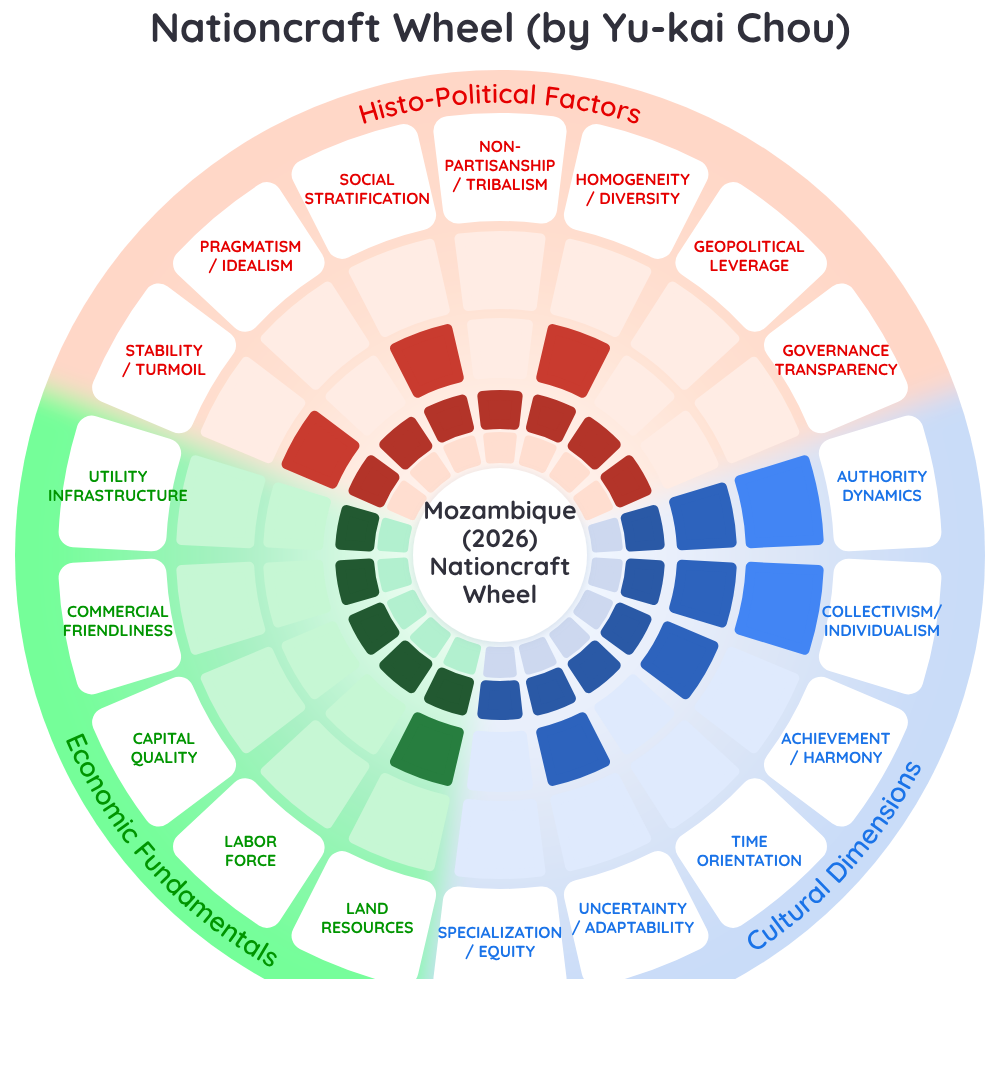

On January 29, 2026, TotalEnergies announced the full restart of its $20 billion liquefied natural gas (LNG) project in Mozambique’s far north, five years after an insurgent attack froze the largest private investment in Africa.[1] The announcement was treated in Maputo as the beginning of the country’s windfall era.
The Nationcraft reading is less comfortable: Mozambique has been spending this windfall since before it existed. In 2013, state officials secretly borrowed around $2 billion against the promise of the sea’s riches, hid the loans from parliament and donors, and detonated the country’s finances when the secret surfaced in 2016.[2]
Ten years later the gas is still mostly in the ground, and the habit is still in the budget. The 2026 state plan leans on LNG exports for its recovery line while growth forecasts get cut, the 2026 deficit sits near 113 billion meticais, and an International Monetary Fund (IMF) team flew home in September with a new program still unsigned.[3][4]
October 2026 adds a new central bank governor, sworn in on September 2, and a political system still processing a disputed election that left more than 300 people dead and the opposition leader awaiting trial.[5][6]
I call this configuration the Pre-Spent Windfall Trap. This analysis scores Mozambique across all 18 Nation Variables, shows why five of the most admired resource-and-reform playbooks would fail against this specific profile, and identifies the three packets whose starting conditions actually resemble Maputo’s position in 2026.
⚡ Speed Run Notes
- Mozambique’s gas windfall is already governing the country before a single Area 1 cargo ships: it was borrowed against in secret in 2013, and it anchors every budget’s recovery story today.
- The V-vector explains why: world-class resources (V14 at 6) sit on top of V13 (Governance Transparency) at 2, V16 (Capital Quality) at 2, and V17 (Commercial Friendliness) at 2.
- The Pre-Spent Windfall Trap: revenue that has not arrived finances the postponement of exactly the institutional repairs that would make the revenue safe to receive.
- Five famous playbooks fail this configuration: Qatar’s LNG leap, Azerbaijan’s oil fund, Rwanda’s command reconstruction, Deng’s gradualism, and Chad’s donor-policed revenue experiment.
- Three packets fit: Botswana 1966 (rules before revenue), Ghana 1983 (the nearest starting twin), and Namibia 1990 (a liberation party governing a resource economy democratically).
- The window is a clock: first LNG from the restarted project is still years out, which means the Botswana move is still available. It stops being available the day the money lands.
Table of Contents
- Understanding Mozambique’s Governance Landscape Through Nationcraft
- What Is the Nationcraft Framework?
- Why This Mozambique Variables Analysis Matters
- The 18 Mozambique Nation Variables
- The Pre-Spent Windfall Trap
- Detailed Justifications: Mozambique Variable by Variable
- Five Reformer Playbooks Mozambique Reform Should Reject
- Best-Match Historical Packets: Three Playbooks Worth Studying
- Strategic Implications
- Governance Strategy Recommendations
- Comparative Context: Mozambique Among Its Neighbors
- The Nationcraft Framework in Practice
- Explore More Nationcraft Analyses
- Frequently Asked Questions
About Yu-kai Chou

Yu-kai Chou is a Human-Systems Architect & Behavioral Designer and the creator of the Nationcraft Framework — an 18-variable diagnostic for matching a country’s structural profile to the reform packets that have historically worked under similar conditions. He has consulted for governments in eight nations, including Ukraine, the United Kingdom, the Kingdom of Bahrain, Singapore, Taiwan, the Netherlands, Kazakhstan, and South Korea, and has worked directly with President Zelenskyy’s team on post-war reconstruction priorities for Ukraine.
Chou’s prior framework — the Octalysis Framework — has been applied by LEGO, Microsoft, Porsche, Coca-Cola, Salesforce, and MrBeast, impacting over 1.5 Billion Users. He has taught the methodology at Harvard, Stanford, Yale, Tesla, Google, BCG, and IDEO.
His work has been cited by Harvard, Stanford, MIT, Forbes, Wall Street Journal, Wired, US Department of Energy, NIST, NSF, NCBI, US Department of Education, ClinicalTrials.gov, and Google Scholar — with 3,700+ more academic publications. Explore his books here.

This Mozambique analysis applies the Nationcraft Framework’s 18-variable diagnostic to the purest pre-revenue resource test in the corpus: a country whose defining fiscal catastrophe was caused by gas money that still has not arrived. The variable-to-packet matching below is the same method Chou uses in his government advisory work on reform sequencing.
Understanding Mozambique’s Governance Landscape Through Nationcraft
Most coverage of Mozambique in October 2026 splits into two stories that rarely meet. The energy press tracks the restarted LNG trains in Cabo Delgado and the floating platform already exporting offshore. The political press tracks a post-election crisis: a disputed 2024 result, mass protests, and an opposition leader notified in August 2026 that he will stand trial.[6]
A Nationcraft reading treats these as one story. Before asking what the government should do, it asks what kind of system is producing these outcomes, and it scores that system across 18 Nation Variables covering culture (V1 to V6), political history (V7 to V13), and economic fundamentals (V14 to V18).
Mozambique’s configuration is defined by one of the widest resource-to-institution gaps in the 147-country Nationcraft corpus. V14 (Land Resources) reads 6 on the strength of world-class gas, coal, graphite, and farmland. The variables that decide whether such endowments become a blessing read 2: V13 (Governance Transparency), V16 (Capital Quality), and V17 (Commercial Friendliness).
That gap is not an abstraction here. It has a name, a court record, and a body count. The hidden-debt scandal was V13 at 2 meeting V14’s promise, and the 2024-25 unrest was V10 (Non-Partisanship vs Tribalism) at 2 meeting a contested count.
What Is the Nationcraft Framework?
The Nationcraft Framework treats a nation the way a behavioral designer treats any complex system: diagnose the configuration first, prescribe second. It extends the Octalysis Strategy Dashboard to national scale, and its logic for applying the Octalysis Framework to nation-building is simple to state. Policy effectiveness is decided by context fit, and only secondarily by policy quality.
The framework scores a country on 18 Nation Variables, then matches that profile against a corpus of historical Success Packets. A Success Packet is a documented reform program, such as Botswana’s diamond management or Ghana’s Economic Recovery Program, recorded with the variable conditions that were present when it started.
Mozambique holds a special place in that corpus. Its own packet, SP-085, records one of the most spectacular post-war recoveries ever measured: roughly 7 percent average growth across two decades after the 1992 Rome peace agreement, a donor-darling reputation, and then the hidden-debt collapse. The packet’s recorded insight is the starting point for everything below: the resource curse arrived in Mozambique before the resources did.
The matching discipline is what separates Nationcraft from the standard policy conversation. The question is never whether a sovereign wealth fund or an anti-corruption drive worked somewhere. What matters is whether the country that made it work started from a configuration that resembles yours.
Why This Mozambique Variables Analysis Matters
Mozambique is negotiating the terms of its next decade right now, on three tables at once.
The first table is in Washington and Maputo. An IMF technical mission spent ten days in Mozambique in September 2026 discussing a new Extended Credit Facility (ECF), and Finance Minister Carla Loveira called it an important step toward a staff-level agreement, with a second mission expected in November to settle conditionality and performance targets.[4] The previous program, the first since the hidden-debt rupture, ran aground amid the fiscal slippage of the 2024 election year.[7]
The second table is in Cabo Delgado. The restarted Area 1 project and the Coral floating platforms set the clock on the country’s revenue future, while President Daniel Chapo told the UN General Assembly on September 24 that stabilization of the province remains incomplete.[8]
The third table is domestic. A new central bank governor took office on September 2, 2026 and moved within weeks on reserve requirements and foreign-exchange market reforms, while September inflation printed at 6.31 percent against a budget that assumed roughly 3.7.[5][9]
Decisions made at these three tables will either repeat the SP-085 pattern at larger scale or break it. Which way they go depends on whether they are designed against Mozambique’s actual V-vector or against a generic resource-state template.
The 18 Mozambique Nation Variables
Here is Mozambique’s full 2026 profile from the Nationcraft corpus, scored 1 to 10. Higher scores mean the variable makes the nation easier to govern and reform. The scores describe governability rather than virtue.
| Variable | Score | 2026 reading |
|---|---|---|
| V1 Authority Dynamics | 8 | Frelimo party-state dominance since 1975; deference to the presidency and party hierarchy is the operating norm |
| V2 Collectivism vs Individualism | 7 | Lineage networks and village-level communal obligation carry welfare the state does not |
| V3 Achievement vs Harmony | 4 | Survival and consensus orientation; open competition is socially constrained |
| V4 Time Orientation | 3 | Horizons compress to the donor cycle, the election, and the next gas announcement |
| V5 Uncertainty & Adaptability | 5 | Enormous household coping capacity through war, cyclones, and floods; low institutional appetite for structural change |
| V6 Specialization vs Equity | 3 | Thin specialist class; the informal economy dominates employment |
| V7 Stability vs Turmoil | 4 | Civil war 1977-92 (around one million dead), renewed insurgencies 2013-19 and since 2017, and the 2024-25 post-election unrest |
| V8 Pragmatism vs Idealism | 3 | Liberation-era ideology and patronage logic outrank tested adjustment |
| V9 Social Stratification | 6 | A party-connected elite sits far above the rural majority |
| V10 Non-Partisanship vs Tribalism | 2 | The Frelimo-opposition cleavage maps onto center-periphery and north-south divides; the 2024 dispute deepened it |
| V11 Homogeneity vs Diversity | 5 | More than 40 ethnic groups under a Portuguese lingua franca; Christian, Muslim, and traditional communities coexist |
| V12 Geopolitical Leverage | 1 | Ports serve landlocked neighbors and the gas attracts majors, yet debt distress and aid dependence strip bargaining power |
| V13 Governance Transparency | 2 | The $2 billion hidden-debt scandal is the signature exhibit; audit findings rarely produce consequences |
| V14 Land Resources | 6 | World-class Rovuma basin gas, coal, graphite, farmland, fisheries, and hydropower |
| V15 Labor Force Quality | 3 | Young and fast-growing workforce with one of the world’s lowest human-capital indices; corrected from a stale 7 this cycle[10] |
| V16 Capital Quality | 2 | Debt distress since the 2016-17 default; shallow credit markets; rationed foreign exchange |
| V17 Commercial Friendliness | 2 | Licensing friction and discretionary allocation make formal business a privilege of the connected |
| V18 Utility Infrastructure | 2 | Electricity access has climbed to about two-thirds of the population, with rural access far behind, and grid reliability, roads, and water infrastructure stay thin and storm-damaged[13] |
Current macro numbers put magnitudes on those institutional scores.
| Indicator | Position (latest available, October 2026) |
|---|---|
| Real GDP growth | 1.9% in 2024 after a 4.9% fourth-quarter contraction; 2025 cut to about 1.6% after a first-half contraction; the 2026 plan targets 2.8%[3][7] |
| Inflation | 6.31% year-on-year in September 2026, against a budget assumption of roughly 3.7%[9][3] |
| Fiscal position | Promulgated 2026 budget: about 520.6 billion meticais of expenditure and a deficit near 113 billion meticais, after revenue was marked down 14.9 billion against the first draft[3] |
| IMF status | Ten-day technical mission concluded September 2026; second mission on conditionality expected November; staff-level agreement still pending[4] |
| Debt management | Early repayment of $698.6 million to the IMF’s concessional trust in March 2026, presented as prudence while market access stays impaired[11] |
| LNG status | Area 1 restart announced January 29, 2026 after a five-year force majeure; first exports from the restarted project still years away[1] |
The Pre-Spent Windfall Trap
Every Nationcraft analysis looks for the variable interaction that keeps reproducing the country’s signature failure. For Mozambique, the interaction runs through money that does not exist yet.
The mechanism starts with V14 at 6. The Rovuma basin discoveries of 2010-13 rank among the largest gas finds of this century, and every actor in the system has known it for fifteen years. The discovery changed behavior long before it changed revenue.
Now add V13 at 2 and V16 at 2. In 2013-14, officials of the previous administration arranged roughly $2 billion in secret, state-guaranteed loans for security-linked ventures, payable from the prosperity the gas was about to deliver. When journalists and the IMF uncovered the loans in 2016, donors froze support, the metical collapsed, and the state defaulted.[2] The windfall had been spent years before the first offshore project even reached a final investment decision.
Then add V4 (Time Orientation) at 3. Each government’s planning horizon runs to the next election and the next gas milestone, so the budget’s recovery story is always anchored on revenue arriving just over the horizon. The 2026 plan projects recovery on the strength of LNG exports and energy investment while this year’s revenue gets marked down.[3]
That is the Pre-Spent Windfall Trap: anticipated revenue substitutes for institutional repair. Because the gas will supposedly fix the fiscus, the V13 transparency machinery, the V16 capital discipline, and the V17 business environment can all be deferred until it does. The deferral then guarantees that when revenue finally lands, it lands in the same discretionary machinery that produced the hidden debt.
The trap has a second, crueler loop in the north. The gas enclave model concentrated billions of dollars of construction inside a fenced peninsula in the country’s poorest, most neglected province. Cabo Delgado’s insurgency, which erupted in 2017 and froze the project in 2021, grew in exactly the gap between what the province was promised and what V13 at 2 delivered to it.[1]
Mozambique has run the enclave experiment before. The Mozal aluminum smelter of the late 1990s proved a mega-project can thrive inside a weak state without transforming it, and the cashew-sector collapse of the same era proved what happens to the smallholder economy while attention is elsewhere. The corpus packet SP-085 records both episodes. The gas era is the same configuration with three more zeros attached.
Detailed Justifications: Mozambique Variable by Variable
Cultural Dimensions (V1 to V6): followership without a specialist base
Mozambique’s cultural cluster would be an asset under almost any competent reform program. V1 (Authority Dynamics) at 8 reflects a political culture where the party-state’s writ is accepted across most of the territory, and V2 (Collectivism vs Individualism) at 7 reflects lineage and village networks that carried the society through a civil war the state did not survive intact.
The constraint sits in V4, V6, and V8. V4 (Time Orientation) at 3 is the trap’s enabling condition, since a polity that plans in election-length increments will always prefer anticipating revenue to building institutions. V6 (Specialization vs Equity) at 3 and V15 (Labor Force Quality) at 3 mean the technocratic bench is thin, so complex instruments such as a sovereign wealth fund depend on a handful of officials whose independence V13 cannot protect.
V5 (Uncertainty & Adaptability) at 5 splits across levels. Households absorb cyclones, displacement, and inflation with remarkable resilience, while institutions treat any structural change as a threat to the allocation machinery.
Histo-Political Factors (V7 to V13): the leaking core
V7 (Stability vs Turmoil) at 4 records a state that has never collapsed but has never been at peace either: the 1977-92 civil war, the Renamo insurgency of 2013-19, the Cabo Delgado insurgency since 2017, and the deadliest post-election unrest in the country’s multiparty history in 2024-25, with a toll above 300.[6]
V10 (Non-Partisanship vs Tribalism) at 2 is the political half of the diagnosis. The ruling party has won every national election since 1994, the opposition’s strongholds sit in the center and north, and the 2024 result, declared at 65.17 percent for Daniel Chapo against 24.19 percent for Venâncio Mondlane, was rejected by the runner-up and contested in the streets.[6] Mondlane’s trial notification in August 2026 keeps the cleavage at the center of politics through the reform window this analysis examines.
V13 (Governance Transparency) at 2 needs the least argument. The hidden-debt case produced criminal convictions in Maputo and New York, nine-figure penalties on the arranging bank in London, and a decade of litigation, while the procurement culture that produced it remains substantially intact.[2] V12 (Geopolitical Leverage) at 1 completes the cluster: a state in debt distress, dependent on donors and security partners, negotiates its resource terms from weakness.
Economic Fundamentals (V14 to V18): a rich country’s geology under a poor country’s plumbing
V14 (Land Resources) at 6 is carried by the Rovuma gas, the Moatize coal basin, graphite deposits feeding the battery supply chain, vast under-farmed arable land, and the Cahora Bassa dam. The score stops short of higher readings because climate exposure is extreme and much of the endowment sits in conflict-affected or infrastructure-poor regions.
V16 (Capital Quality) at 2 and V17 (Commercial Friendliness) at 2 describe the plumbing. Since the 2016-17 default, Mozambique has priced out of normal sovereign markets, domestic credit is shallow and expensive, and foreign exchange is rationed through a managed metical. The new central bank leadership’s first moves in September and October 2026, easing reserve requirements against new lending and opening foreign-exchange market reforms, read as an explicit acknowledgment of both scores.[5]
V15 (Labor Force Quality) deserves a note of method. The corpus carried Mozambique at 7, and this cycle’s sanity check corrected it to 3: the country’s human-capital indicators sit in the world’s bottom decile, with mean schooling around four years.[10] A V15 of 3 changes the packet matching materially, which is why the correction matters beyond bookkeeping.
Five Reformer Playbooks Mozambique Reform Should Reject
When a poor country sits on world-class gas, the same five success stories arrive with every delegation. Each one is real, and each one fails the variable match. The table shows the decisive gaps, and the sections after it explain them.
| Packet | Required configuration | Mozambique 2026 | Decisive gap |
|---|---|---|---|
| SP-116 Hamad LNG Diversification (Qatar 1995) | V16 10, V15 manageable by import, tiny citizen population | V16 2, V15 3, ~35 million people | Capital quality and scale |
| SP-053 Oil Fund & Authoritarianism (Azerbaijan 1994) | V1 9 with a fund the ruler chooses to protect | V13 2 with no protective mechanism | A fund without transparency becomes a second budget |
| SP-006 Rwanda Post-Genocide Reconstruction (1994) | V10 read as 1 under a single command, total elite turnover | Competitive, regionally split politics | Command cohesion Mozambique neither has nor should want |
| SP-003 Deng Xiaoping Open Reform (China 1978) | V1 10, V2 10, V10 9 party machine | V1 8, V2 7, V10 2 | No unified machine; enclave SEZs already tried as Mozal |
| SP-099 World Bank Pipeline Experiment (Chad 2003) | External conditions substituting for V13 | The same substitution already failed here | Imported rules cannot outlive the ruler’s incentive to break them |
SP-116: Qatar’s LNG leap required capital quality Mozambique will not have for a generation
Qatar is the comparison every Rovuma optimist reaches for, since Doha turned LNG into a global brand inside two decades. The corpus scores Qatar 1995 at V16 (Capital Quality) of 10, with sovereign credit, bottomless co-investment capacity, and a citizen population small enough to saturate with services.
Mozambique’s V16 of 2 inverts every term of that equation. The state cannot co-invest, so project terms are negotiated from V12 at 1, and the fiscal take arrives late and leveraged. Qatar also spent its wealth on importing a workforce, while Mozambique must employ a population of some 35 million whose V15 reads 3.[12] The packet is a description of what capital abundance buys. It contains no instructions for a capital-starved state, which is why the Kuwait future-generations analysis in this series treats Gulf fiscal machinery as a separate genus.
SP-053: Azerbaijan’s oil fund is the warning label, with the label usually ignored
Azerbaijan did the formally correct thing in 1999 and created a sovereign oil fund, SOFAZ, with published accounts. The corpus records what happened anyway: with V13 at 3, the fund financed prestige projects and the apparatus, diversification failed completely, and the packet’s recorded insight is that oil wealth transformed infrastructure while buying no institutional development at all.
This is the packet Mozambique is most likely to copy by default, because it photographs well. A Mozambican sovereign fund already exists on paper. The Azerbaijan record says the instrument is inert without the one thing Mozambique’s V13 of 2 cannot yet supply: a mechanism that can rule against the fund’s own managers. Cite the fund, pass the law, and nothing changes until audits bind and allocations publish.
SP-006: Rwanda’s reconstruction packet rode a command cohesion Mozambique’s politics forbid
Rwanda’s post-1994 packet, with performance contracts and zero-tolerance enforcement, is the donor favorite for post-conflict states. Its starting conditions were singular: one victorious movement holding total control after state collapse, able to impose measurable targets on every official.
Mozambique’s politics are competitive in exactly the way that packet cannot tolerate. The opposition commands real pluralities across the center and north, and the 2024-25 crisis demonstrated that attempts to settle the contest by force produce bodies, not cohesion.[6] I traced what the Kigali model requires in the Rwanda star-pupil analysis, and the conclusion transfers directly: the performance machinery is inseparable from the political monopoly, and a country whose crisis is contested legitimacy cannot fix it by pretending the contest away.
SP-003: Deng’s gradualism needs a party machine, and Mozambique already ran the enclave half
Deng Xiaoping’s packet gets invoked for its special economic zones, and Mozambique has been building export enclaves since Mozal in 1998. The missing nine-tenths of the packet is the part that mattered: a disciplined national party (V10 at 9 in the corpus’s China 1978 baseline, examined against the present day in the China analysis) transmitting price signals and accountability through every province, and a household responsibility system that put the first gains into peasant hands.
Mozambique’s V10 of 2 cannot run that transmission, because the party that dominates the state does not command the half of the country that votes against it. Its enclaves therefore stay enclaves, and its smallholders, the majority of the workforce, got the cashew collapse instead of a responsibility system. The lesson Deng actually offers Mozambique is the agriculture-first sequencing, and it arrives below through Ghana’s packet, which started from a configuration Maputo shares.
SP-099: Chad already tested whether imported revenue rules can substitute for V13, and the answer was no
The closest historical experiment to Mozambique’s situation was run one timezone away. Chad’s 2003 oil pipeline came with World Bank-designed revenue management rules, offshore escrow, and a published allocation formula, the strongest external substitute for domestic transparency ever attached to an African resource project.
President Déby renegotiated the rules within three years, redirected the money, and the corpus records the verdict: more than $10 billion in oil revenue, a Human Development Index unchanged, and the packet’s recorded insight that institutions cannot be bought with aid conditions. Mozambique has already demonstrated the same theorem from the other side, since the hidden loans of 2013 were arranged while the country sat inside an IMF program under full donor supervision.[2] External conditionality is a complement to domestic accountability. It has never once functioned as a replacement.
Best-Match Historical Packets: Three Playbooks Worth Studying
Rejecting five famous models is only useful if the corpus offers better matches, and for Mozambique it offers three. Each started from a configuration that rhymes with Maputo’s 2026 position, and each carries a caution that belongs in the same breath.
| Packet | Starting configuration vs Mozambique 2026 | What transfers | Caution |
|---|---|---|---|
| SP-004 Botswana Diamond Management (1966) | V15 2 vs 3, V16 1 vs 2, V17 3 vs 2, V18 2 vs 2 — poorer than Mozambique is now | Windfall rules written and tested before the revenue arrives | Botswana’s V13 was strong at independence; Mozambique must build the mechanism it inherited |
| SP-038 Rawlings Structural Adjustment (Ghana 1983) | V1 7 vs 8, V2 7 vs 7, V7 3 vs 4, V17 3 vs 2 | Exchange-rate unification, producer-price restoration, owned leadership of a donor program | Requires a pragmatism pivot (Ghana’s V8 hit 8; Mozambique’s is 3) |
| SP-057 SWAPO Liberation to Governance (Namibia 1990) | Liberation party, resource economy, V13 5 vs 2 | Governing democratically after liberation; transparent resource partnership; losing elections survivably | Reconciliation without redistribution left extreme inequality |
SP-004: Botswana is the packet with a deadline attached
Botswana at independence in 1966 was poorer than Mozambique is today on almost every variable: V15 at 2, V16 at 1, V18 at 2, twelve kilometers of paved road. Diamonds were discovered a year later, and the packet’s entire force is in its sequence. The Debswana 50-50 joint venture, the Pula Fund’s savings rules, and a working anti-corruption directorate were all in place before the revenue became large enough to corrupt the people writing the rules.
The corpus marks the precondition honestly: Botswana enjoyed unusual governance quality at independence, which Mozambique does not. That is precisely why the packet prescribes the pre-revenue window so insistently. Rules can be legislated, published, and stress-tested while the money is still small, and every year of LNG delay is, perversely, a gift of institutional runway. Mozambique’s restarted project will not ship its first cargo for years.[1] The Botswana move is available exactly that long.
SP-038: Ghana 1983 is the nearest starting twin for the fiscal reset
Ghana in 1983 looked like Mozambique in 2026 with the gas removed: output down 30 percent in a decade, an overvalued currency rationed through political channels, a collapsed export crop, and a governing movement with revolutionary credentials and empty coffers.
The Economic Recovery Program did three things this configuration could run. It unified the exchange rate and legalized forex bureaus, killing the premium that fed the connected. It restored producer prices to farmers, and cocoa production doubled. It traded patronage mass for human-capital depth by retrenching the civil service while reinvesting in basic education.
Each lever maps onto Maputo’s current table. The central bank’s October 2026 foreign-exchange reforms are a first step on the first lever.[5] The second lever runs through cashew, cotton, and food farm-gates that SP-085 records as the recovery’s great omission. The third addresses the wage bill the IMF has flagged as crowding out social transfers and investment.[7] Ghana’s binding precondition is the one to watch: Rawlings owned the program publicly, pivoting to a V8 pragmatism the corpus scores at 8, rather than performing it for donors. A program Mozambique’s leadership merely tolerates will die the way the Ghana bailout-cycle analysis shows programs die when ownership fades.
SP-057: Namibia shows a liberation party governing a resource economy without owning it
The nearest political mirror sits across the subcontinent. SWAPO, like Frelimo, won independence by armed struggle and has governed ever since. The packet records what Namibia did differently with that dominance: constitutional democracy maintained, reconciliation prioritized over score-settling, and the diamond endowment run through Namdeb, a transparent 50-50 state-De Beers partnership, with V13 at 5 rather than 2.
The transferable core is that liberation legitimacy and institutional openness can coexist. SWAPO’s margins have fallen election by election, and power has not left the constitutional track. For a Frelimo establishment that reads every opposition gain as an existential threat, Namibia is the proof that a liberation party can survive accountability, and the packet’s caution is equally instructive: reconciliation without broad-based economic inclusion left Namibia with world-leading inequality, the exact failure mode Mozambique’s smallholder-neglect pattern would reproduce.
Strategic Implications
Put the diagnosis and the packet matches together and Mozambique’s position clarifies into four statements.
First, the binding constraint is institutional, and it is specific: nothing that increases revenue helps while allocation remains discretionary. The hidden debt, the enclave boom, and the pre-spent budget lines are one mechanism wearing three costumes, V14’s promise flowing through V13 at 2.
Second, the pre-revenue window is the strategy, and it is closing on a known schedule. Every packet that beat the resource curse locked its rules before the money arrived. The years between the January 2026 restart and first cargo are the last interval in which transparency rules can be legislated cheaply, while the sums are small and the lobbies unformed.[1]
Third, the IMF negotiation is the trap’s test case rather than its solution. Chad proved external rules cannot substitute for domestic mechanisms, so the November 2026 conditionality round matters mainly for which domestic mechanisms it seeds: published allocations, protected audit tenure, parliamentary ratification of resource terms.[4]
Fourth, political reconciliation is an economic variable here. V10 at 2 after a lethal election dispute means every reform coalition is one verdict away from the streets. The Namibia packet says durable resource governance and competitive politics reinforce each other, and Mozambique’s reform window stays open only as wide as its political settlement.
Governance Strategy Recommendations
These recommendations are written for the general and reformist reader, from citizens and analysts to the diaspora, as a statement of what reform of Mozambique’s configuration would require. Each one is a system-opening move: every step either returns value to the population directly or subjects state discretion to a mechanism that can rule against it.
| Sequence | Move | Variable target | Who benefits, and through what mechanism |
|---|---|---|---|
| Year 1 | Publish every resource contract, loan guarantee, and gas revenue flow, on the Extractive Industries Transparency Initiative (EITI) standard the country already subscribes to | V13 | Citizens and press get the audit trail the hidden-debt era lacked; parliament and courts get documents they can rule against |
| Year 1 | Continue unifying the foreign-exchange market with published allocation results | V16, V13 | Importers and households; published auctions convert a patronage instrument into a price |
| Year 2 | Give the Administrative Tribunal and Auditor-General protected tenure and published findings, with prosecution referrals that do not route through the party | V13 | The population gets hidden-debt-prevention machinery: audits that bind, enforced by officials who answer to evidence |
| Year 2 | Restore farm-gate value in cashew, cotton, and food crops by cutting licensing and marketing margins | V17, V4 | Millions of smallholders see reform pay within one season, building the rural constituency SP-085’s recovery never built |
| Year 3 | Legislate gas-revenue rules before first cargo: parliamentary ratification of fiscal terms, a savings rule locked by law, and internationally co-managed custody on Santiago Principles lines while V13 is rebuilt | V14, V16, V4 | The population, through a Botswana-style rule that elections cannot quietly raid; co-management is the honest adaptation for a V13 of 2 |
The test applied to every row is openness. Publishing contracts removes the information asymmetry the hidden debt lived in, protected audit tenure adds a veto point against the executive rather than removing one, and farm-gate restoration returns value directly to the population.
Nothing here asks for a stronger center. Mozambique’s V1 at 8 already supplies more central authority than the reform program needs, and the configuration fails on accountability rather than command, so the repairs all run in the accountability direction. The Saakashvili packet deep-dive is the companion reading here: it shows why Georgia-style mass dismissals collapse into faction fights under a V10 of 2, which is why this sequence relies on published audits and protected tenure instead.
Comparative Context: Mozambique Among Its Neighbors
Mozambique’s configuration becomes clearer against its region, and the Nationcraft corpus has scored most of the neighborhood.
Angola is the twin experiment: another Lusophone liberation-party state whose oil arrived into a V13 of 2, rebuilt infrastructure, and built no institutions. The Angola prosecution-dividend analysis follows the attempt to repair transparency after the windfall was captured, which is the sequencing Mozambique still has time to avoid.
Zambia ran the debt-distress sequence to its end, defaulting in 2020 and restructuring as the region’s test case, traced in the Zambia model-debtor analysis. Mozambique defaulted earlier and smaller, and its restructuring bought time rather than repair.
Malawi next door shows the same postponement engine running on a crop instead of a gas field, diagnosed in the Malawi green-gold analysis: a lifeline that finances the deferral of every institutional fix. And Bolivia is the cautionary future, a gas exporter that spent its boom as entitlement and met the bust with empty stabilizers, examined in the Bolivia gas-dividend analysis. Bolivia is what Mozambique’s 2040s look like if the windfall arrives into today’s variables.
The Nationcraft Framework in Practice
This Mozambique reading demonstrates the move that defines every Nationcraft analysis: configuration is strategy. The 18 scores are never averaged into a ranking, because governance leverage lives in the interactions. A V14 of 6 under a V13 of 7 is a development plan, while the same V14 under a V13 of 2 is a countdown.
The same method runs through every entry in this series, from the Venezuela reform playbooks analysis that set the series template onward. Each analysis runs the identical sequence: score the variables, name the trap, reject the famous packets that misfit, and match the ones whose starting conditions rhyme.
For Mozambique, the output is a short list with a hard deadline. Botswana 1966 for the revenue rules, Ghana 1983 for the fiscal reset, Namibia 1990 for the political settlement, and all three legislated before the first Area 1 cargo turns the pre-spent windfall into a spent one.
Explore More Nationcraft Analyses
The Nationcraft country analyses library holds every published study in this series, each built on the same 18-variable method. For profiles adjacent to Mozambique’s situation, start with the DR Congo cobalt-trap analysis for another resource endowment trapped by its institutions, or the Liberia concession-republic analysis for a post-civil-war state renting out its endowments while rebuilding.
Closing
Mozambique’s tragedy has never been scarcity. It is timing: the country keeps receiving its future income first and its institutions never, so each windfall arrives pre-spent by the system it was supposed to transform.
The 2026 alignment is the rare one where the clock can be turned. The gas is restarted and still years from cash, the IMF table is open, the central bank is moving on prices and allocation, and a first-term government holds more V1 authority than any reform on this list requires. If the contracts publish this year, the audits bind next year, and the revenue rules pass before first cargo, the Rovuma gas can be remembered as the windfall Mozambique received only once, and kept.
Frequently Asked Questions
What is the Pre-Spent Windfall Trap in Mozambique?
The Pre-Spent Windfall Trap is this analysis’s name for the interaction between Mozambique’s enormous but undelivered gas wealth (V14 at 6) and its weakest Nation Variables: Governance Transparency (V13) at 2, Capital Quality (V16) at 2, and a short political time horizon (V4 at 3). Anticipated revenue substitutes for institutional repair, so the state borrows, budgets, and politics against money that has not arrived, and the repairs that would make the money safe keep being deferred. The $2 billion hidden-debt scandal of 2013-16 is the trap’s defining exhibit.
When will Mozambique actually receive its LNG revenue?
The Coral Sul floating platform has been exporting since 2022, with modest fiscal impact so far. The onshore Area 1 project led by TotalEnergies announced its full restart on January 29, 2026 after a five-year force majeure, and first exports from it remain years away, with significant state revenue arriving later still because early cash flows service the project’s financing. That gap between restart and revenue is the reform window this analysis centers on.
Which historical reform packets actually fit Mozambique’s profile?
Three packets start from conditions resembling Mozambique 2026. Botswana’s diamond-management packet (SP-004) supplies the central move: windfall-governance rules legislated before revenue scales. Ghana’s 1983 Economic Recovery Program (SP-038) matches closest on starting scores and supplies the fiscal-reset sequence of exchange-rate unification and farm-gate price restoration. Namibia’s liberation-to-governance packet (SP-057) shows a former liberation movement running a resource economy under democratic accountability.
Why did the hidden-debt scandal matter so much?
The roughly $2 billion in secret, state-guaranteed loans arranged in 2013-14 and revealed in 2016 triggered a donor freeze, a currency collapse, and sovereign default, and it demonstrated the configuration this analysis scores: gas-anchored expectations flowing through a V13 of 2. It was also a pre-revenue failure, since the borrowing was justified by gas income that had not arrived, which is why this analysis treats institutional repair before first cargo as the country’s central strategic task.
How does the Nationcraft Framework score Mozambique in 2026?
Mozambique scores strongest on Authority Dynamics (V1 at 8), Collectivism (V2 at 7), Social Stratification (V9 at 6), and Land Resources (V14 at 6), and weakest on Geopolitical Leverage (V12 at 1), with Governance Transparency (V13), Capital Quality (V16), Commercial Friendliness (V17), Utility Infrastructure (V18), and Non-Partisanship (V10) all at 2, and Labor Force Quality (V15) corrected to 3 this cycle. The profile describes a governable population and a rich geology under institutions that leak, which is why the prescriptions run through accountability rather than command.
Related Reading
- The Nationcraft Framework — the 18-variable method behind this analysis
- Nation Variables Library — every published country analysis in one place
- Nationcraft Analysis: Zimbabwe Restored Legacy Trap 2026 — a neighboring liberation-party state after the windfall logic failed
- Nationcraft Analysis: Iraq Rentier Sovereignty Trap 2026 — what a state becomes when resource rent replaces the tax bargain
- Nationcraft Analysis: Eritrea Permanent Siege Trap 2026 — the hardest version of liberation-movement governance
- Nationcraft Analysis: Sri Lanka Compliance Paradox 2026 — what program compliance can and cannot fix
Footnotes
- Al Jazeera, “TotalEnergies restarts $20bn LNG project in Mozambique after 5-year freeze,” January 29, 2026. aljazeera.com
- UK Financial Conduct Authority, “Credit Suisse fined £147,190,276 (US$200,664,504) and undertakes to the FCA to forgive US$200 million of Mozambican debt,” October 19, 2021, on the concealed loans at the heart of the roughly $2 billion hidden-debt scandal. fca.org.uk
- Club of Mozambique (Lusa), “Mozambique: Government cuts growth forecasts,” December 2025, on the revised 2026 budget and macro framework. clubofmozambique.com
- AIM via AllAfrica, “Mozambique: Government Closer to New Programme With IMF,” September 21, 2026. allafrica.com
- Banco de Moçambique, “Governor Navalha steps up engagement with business community, outlines foreign exchange market reforms and economic support measures,” October 2026. bancomoc.mz
- Al Jazeera, “What does Mondlane’s trial mean for Mozambique?,” September 8, 2026. aljazeera.com
- Club of Mozambique, “Mozambique President seeks IMF support for economic and political reforms,” October 2025, including the IMF’s assessment of 2024 fiscal slippage and payroll overspending. clubofmozambique.com
- Government of Mozambique, remarks by President Daniel Chapo at the UN General Assembly, September 24, 2026. portaldogoverno.gov.mz
- Banco de Moçambique, “Annual inflation slows to 6.31% in September,” October 2026. bancomoc.mz
- United Nations Development Programme, Human Development Report data for Mozambique. hdr.undp.org
- LUSA via AMAN, “IMF delegation begins working visit to Mozambique,” September 9, 2026, including the March 2026 early repayment of $698.6 million. aman-alliance.org
- World Bank, “Mozambique Overview” and country data, accessed October 2026. worldbank.org
- 360 Mozambique, “Mozambique: Electricity Access Reaches 66.9% – But Rural Electrification Remains a Challenge,” October 2026. 360mozambique.com