
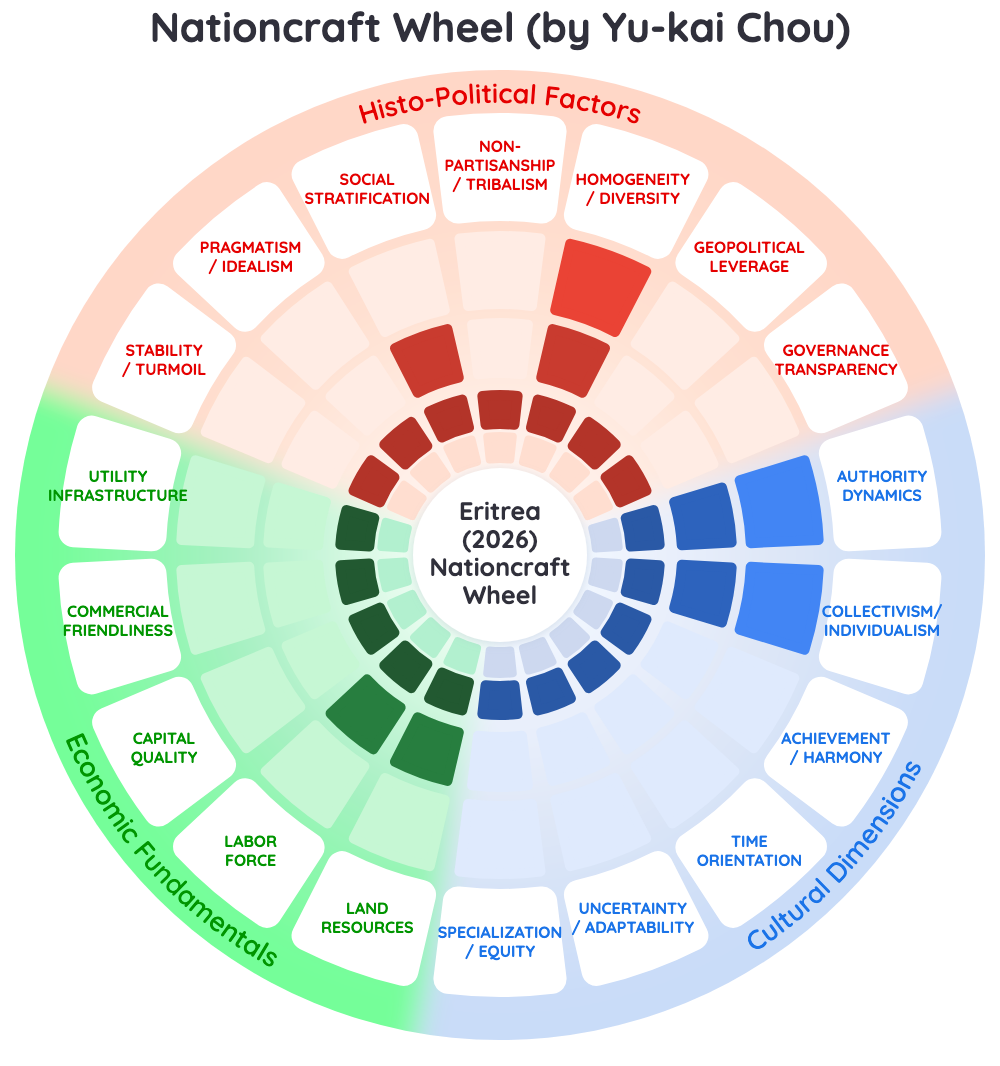

Ethiopia’s prime minister calls Red Sea access an existential matter and promises to pursue it through dialogue. Eritrea’s information minister answers that his country is “perplexed by Ethiopia’s misguided and outdated ambitions” and points at the port of Assab as the prize Addis Ababa is really eyeing.[1]
Between those two statements sits a nation whose population count is itself contested territory (the World Bank works with roughly 3.5 million), and which has spent 33 years preparing for exactly this moment. Preparation is the one thing Eritrea has never lacked.
Here is the puzzle that should bother anyone reading the war-risk assessments. The state that won a thirty-year independence war through discipline that became legend among liberation movements now watches its own people leave through every exit that opens. The mobilization that was supposed to protect the nation empties it instead.
I call this configuration The Permanent Siege Trap: a war-winning operating system that was never demobilized, running decades past the war it was built to win. The siege manufactures the exodus. The exodus then justifies the siege.
This analysis reads Eritrea through the 18 Nation Variables, shows why the trap is self-perpetuating rather than merely cruel, and tests eleven historical reform packets against Eritrea’s actual V-vector. Eight fail on preconditions Eritrea cannot currently meet. Three carry lessons a future Eritrean opening could actually use.
⚡ Speed Run Notes
- Eritrea runs the Permanent Siege Trap: V1=10 authority welded to V8=1 doctrine. Maximum steering power, pointed by ideology instead of feedback, for 33 years without a single election.
- The corpus’s own failure packet (FP-013) names the mechanism: total mobilization created the refugee crisis that justifies the mobilization. Roughly one in eight Eritreans had already left by 2020.
- The IMF publishes no Eritrea data at all for 2020–2030. When V13=1 opacity makes even the lender of last resort give up on your numbers, borrowing, insuring, and attracting capital are off the table.
- Eight celebrated playbooks fail against this V-vector, including the two the regime’s defenders cite most: Park-era South Korea (SP-008) and post-genocide Rwanda (SP-006). The preconditions are absent.
- The three worth studying: Uzbekistan’s succession opening (SP-045), Vietnam’s household-first Đổi Mới (SP-018), Namibia’s liberation constitutionalism (SP-057). Each put households first in year one.
- Ethiopia’s port hunger makes this urgent: the likeliest opening windows are succession, negotiated port commerce, or war. Only two of those leave a nation to reform.
Table of Contents
- Understanding Eritrea’s Governance Landscape Through Nationcraft
- What Is the Nationcraft Framework?
- What Eritrea Actually Looks Like in Numbers
- The Permanent Siege Trap
- Detailed Justifications: Reading All 18 Variables
- Strategic Implications
- Best-Match Historical Packets
- Eight Reformer Playbooks Eritrea Reform Should Reject
- Three Playbooks Eritrea Should Actually Study
- Governance Strategy Recommendations
- Frequently Asked Questions
About Yu-kai Chou

Yu-kai Chou is a Human-Systems Architect & Behavioral Designer and the creator of the Nationcraft Framework — an 18-variable diagnostic for matching a country’s structural profile to the reform packets that have historically worked under similar conditions. He has consulted for governments in eight nations, including Ukraine, the United Kingdom, the Kingdom of Bahrain, Singapore, Taiwan, the Netherlands, Kazakhstan, and South Korea, and has worked directly with President Zelenskyy’s team on post-war reconstruction priorities for Ukraine.
Chou’s prior framework — the Octalysis Framework — has been applied by LEGO, Microsoft, Porsche, Coca-Cola, Salesforce, and MrBeast, impacting over 1.5 Billion Users. He has taught the methodology at Harvard, Stanford, Yale, Tesla, Google, BCG, and IDEO.
His work has been cited by Harvard, Stanford, MIT, Forbes, Wall Street Journal, Wired, US Department of Energy, NIST, NSF, NCBI, US Department of Education, ClinicalTrials.gov, and Google Scholar — with 3,700+ more academic publications. Explore his books here.

This Eritrea analysis applies the same V-vector method Chou has used in cabinet-level advisory work on reform sequencing across eight governments, several of them on the receiving end of Red Sea and Horn of Africa trade routes. Eritrea is the corpus’s hardest test case for a specific question: what does reform diagnosis look like when a state’s own founding discipline is the thing blocking its development?
Understanding Eritrea’s Governance Landscape Through Nationcraft
Most country analyses in this series diagnose states that changed too often. Eritrea presents the opposite pathology.
Since formal independence in 1993, won by referendum after a 30-year war, the country has had one president, one party, zero national elections, and one constitution that was drafted in 1997 and never implemented. Human Rights Watch’s World Report 2026 chapter describes the same machinery it described a decade ago: indefinite national service, sealed civic space, total information control.[2]
The People’s Front for Democracy and Justice (PFDJ) governs as the direct successor of the Eritrean People’s Liberation Front (EPLF), the movement that won the war. That continuity matters more than any org chart.
The EPLF’s wartime virtues were real: legendary battlefield discipline, underground hospitals and schools in Sahel trenches, self-reliance born of having no patron. The Nationcraft corpus records what happened when those virtues were installed as a permanent operating system in FP-013, the Independence to Authoritarianism Packet (Eritrea, 1993–2020), one of the corpus’s canonical failure packets.
FP-013’s critical insight deserves quoting in full, because everything else in this analysis hangs off it: “Eritrea proves that permanent emergency destroys the state it claims to protect. Isaias’s total mobilization created the refugee crisis that justifies the mobilization. The system is self-perpetuating collapse.”
In 2026 the stakes around that system have changed. Ethiopia’s Red Sea ambitions put Eritrea’s coastline at the center of the Horn’s most dangerous standoff, with analysts at RANE assessing a full invasion as unlikely this year while flagging proxy clashes that could escalate quickly.[3] A configuration built for siege is finally facing the scenario it was built for, and the cruel irony is that 33 years of siege economics left it weaker on every variable that decides such contests.
What Is the Nationcraft Framework?
The Nationcraft Framework scores every nation on 18 variables: six Cultural Dimensions (V1–V6) covering what the people are like, seven Histo-Political Factors (V7–V13) covering what the situation is like, and five Economic Fundamentals (V14–V18) covering the resource base.
The core claim of Nationcraft is that policy effectiveness is decided by context-fit rather than policy quality. A reform that transformed one nation can wreck another because the V-vector underneath it differs.
That is why this series tests historical Success Packets, documented reform programs with their preconditions, sequencing, and outcomes, against a country’s actual scores. The method grew out of the same behavioral-design lineage as the Octalysis Framework applied to nation-building: nations, like products, run on motivation structures, and those structures can be read.
Eritrea makes an unusually clean demonstration of the context-fit thesis. Its V-vector contains scores at both extremes of the framework’s range, which means most imported playbooks shatter against it in predictable places.
Why This Eritrea Variables Analysis Matters
Three audiences have concrete reasons to care about getting Eritrea’s diagnosis right, and none of them sit in Asmara’s ministries.
First, the Eritrean diaspora. Somewhere between half a million and a million Eritreans live outside the country, many taxed by the state they fled. When an opening comes, by succession, settlement, or collapse, this is the population that will fund and staff any reconstruction, the way overseas Vietnamese did after Đổi Mới.
Second, Horn of Africa analysts and policy readers. The war-risk literature treats Eritrea mostly as a military variable. Reading the full V-vector shows why the garrison state is simultaneously harder to invade and closer to internal exhaustion than the headline assessments suggest.
Third, students of the Nationcraft method itself. Eritrea versus Namibia is the cleanest natural experiment the corpus offers on liberation-movement governance: two armed movements, two independences won within three years of each other, two opposite institutional choices, two opposite outcomes. This analysis works that comparison through SP-057’s documented record rather than leaving it as a slogan.
What Eritrea Actually Looks Like in Numbers
Before the V-vector, the macro picture, or what exists of one.
The World Bank estimates real GDP growth of 2.9 percent in 2024 and about 3.2 percent projected for 2025, driven mainly by copper and gold output from the mining enclave.[4] Total GDP sits near $3.1 billion, up from roughly $2.7 billion a decade earlier.[5]
Inflation is genuinely unknowable from outside. The World Bank’s own documents carry two divergent series, one averaging over 20 percent for 2024 and another showing about 4 percent, and the IMF excludes Eritrea’s data and projections for 2020–2030 from its database entirely, citing constraints in data reporting.[4]
Sit with that for a second. The institution that maintains macro series for warring Yemen and collapsed Venezuela publishes nothing for Eritrea. The absence of numbers is itself the most eloquent number in this section, and it is a direct readout of V13.
Here is the full 18-variable diagnosis. Scores follow the standard Nationcraft 1–10 scale.
| Variable | Score | One-line evidence |
|---|---|---|
| V1 Authority Dynamics | 10 | One president since 1993; no national election ever held; rule by decree |
| V2 Collectivism vs Individualism | 8 | War-forged solidarity fused with state-enforced mass mobilization |
| V3 Achievement vs Harmony | 3 | No competitive achievement channel; assigned roles and survival dominate |
| V4 Time Orientation | 3 | Indefinite service makes household planning horizons collapse |
| V5 Uncertainty & Adaptability | 3 | Doctrinal rigidity; sealed information environment |
| V6 Specialization vs Equity | 2 | No meaningful private sector; conscript labor allocation |
| V7 Stability vs Turmoil | 2 | Artificial stasis via repression; border war killed ~70,000; 2025–26 war risk |
| V8 Pragmatism vs Idealism | 1 | Self-reliance doctrine over evidence; aid refused or expelled |
| V9 Social Stratification | 5 | PFDJ/military hierarchy over a poverty-compressed society |
| V10 Non-Partisanship vs Tribalism | 1 | Politics as total monopoly; all identity outside the party-state treated as enemy |
| V11 Homogeneity vs Diversity | 8 | War-forged national identity over nine ethnic groups and a Christian-Muslim split |
| V12 Geopolitical Leverage | 1 | 1,000+ km of Red Sea coast that converts into nothing while isolation holds |
| V13 Governance Transparency | 1 | IMF publishes no Eritrea data 2020–2030; no public budget; last place in press freedom |
| V14 Land Resources | 4 | Bisha copper-zinc-gold; Colluli potash undeveloped; rich fisheries |
| V15 Labor Force Quality | 4 | Literate, disciplined base; deployment collapsed by conscription and exodus |
| V16 Capital Quality | 1 | No functioning capital access; deficit monetization; diaspora tax as fiscal tool |
| V17 Commercial Friendliness | 1 | Business licensing frozen; import controls; forex rationing |
| V18 Utility Infrastructure | 1 | Chronic power scarcity outside mining enclaves; decayed colonial-era grid |
Count the extremes. One score of 10, one 8-pair on the cultural side, and six scores at the absolute floor of 1. No other profile in the 147-country corpus is this bimodal.
Bimodality is the tell. Eritrea is a nation of high-capability people locked inside floor-capability institutions, and the gap between those two facts is the trap.
The Permanent Siege Trap
Every named pattern in this series is a specific interaction of three to five variables. The Permanent Siege Trap runs on four.
V1=10 × V8=1: steering without feedback. Total authority can be an asset. The corpus’s Technocratic_Authoritarian cluster, high V1 Authority Dynamics plus high V8 Pragmatism, powers several of its most dramatic success stories, from Meiji Japan (V1=10, V8=7) to Mirziyoyev’s Uzbekistan (V1=9, V8=7).
Eritrea holds the V1 and inverted the V8. Self-reliance began as a survival adaptation during the independence war, when no superpower would arm the EPLF. Hardened into doctrine, it expelled USAID in 2005, restricted humanitarian programs during food crises, and priced every policy question in loyalty rather than results.
A V1=10 state with V8=1 doctrine has maximum power to execute and no mechanism to notice it is executing the wrong thing. FP-013’s variable-requirements line is blunt about the exit: transitioning out of emergency rule requires roughly V8≥5. Eritrea sits four points below the threshold, and V8 is a leadership-embodied variable, which is why every credible opening scenario in this analysis routes through leadership change rather than policy persuasion.
V2=8 + V15=4: solidarity capital, squandered. Eritrean collectivism is the real thing, forged by a war in which whole villages fed the front. That V2=8 could power a Vietnam-style household mobilization tomorrow.
Instead it powers national service. The legal term is 18 months under Proclamation 82/1995. In practice, Human Rights Watch documents service stretching for years and sometimes decades, at token pay, in everything from trenches to construction sites, since the state of emergency that began with the 1998 border war.[2]
The result shows up in V15 Labor Force Quality at 4: a literate, disciplined workforce whose deployable share shrinks every year, because the state conscripts what it trained and the conscripts leave. FP-013 records roughly 12 percent of the population gone by 2020. The University of Asmara, once the country’s flagship, stopped enrolling undergraduates in the mid-2000s.
V12=1 despite 1,000 kilometers of coastline: position without exchange. Geography handed Eritrea what Ethiopia pays for. Landlocked Ethiopia spends on the order of $1.5 billion a year routing trade through Djibouti,[6] while Eritrea’s ports of Massawa and Assab sit far below capacity.
Leverage is position multiplied by exchange, and a sealed state multiplies by zero. The Gulf money that briefly flowed through Assab during the mid-2010s Yemen campaign produced no lasting commercial corridor. So V12 Geopolitical Leverage reads 1 in a country whose coastline is the most coveted real estate in the Horn, and that gap between potential and realized leverage measures the trap as precisely as any refugee statistic.
V13=1 as the keystone. A state that publishes nothing cannot borrow, insure, attract, or verify. It can only command.
The IMF’s exclusion of Eritrea from a full decade of its database is the institutional version of a shrug.[4] Every reform packet in the corpus that involves outside capital, and most do, assumes a counterparty that can be audited. V13 Governance Transparency at 1 rules out the entire class before the conversation starts.
Read together, the four interactions close the loop that FP-013 named. The siege posture (V1=10, V8=1) degrades the economy (V16=1, V17=1, V18=1). The degraded economy pushes people out (V15 falling). The exodus proves the nation is under threat, which justifies the siege posture. In Core Drive 8 (CD8): Loss & Avoidance terms, the system runs on a sunk-cost engine of historic scale: 30 years of war and 70,000 border-war dead make demobilization feel like betrayal of the fallen, so the losses compound to protect the meaning of earlier losses.
That is what separates a trap from a tragedy. A tragedy has a villain or an accident. A trap has a mechanism, and mechanisms can be mapped.
Detailed Justifications: Reading All 18 Variables
The table gives the scores. This section gives the reasoning, grouped by the framework’s three families.
Cultural Dimensions (V1–V6): the people the war made
V1 Authority Dynamics = 10. The framework’s ceiling, shared by few corpus entries. No election since independence, no implemented constitution, no functioning legislature. The National Assembly last met in 2002. Cabinet reshuffles happen by unannounced decree. Authority is personal, total, and 33 years deep, and the population’s compliance is enforced rather than merely cultural, which distinguishes this 10 from Meiji Japan’s reverence-based 10 in SP-001.
V2 Collectivism vs Individualism = 8. Genuine communal solidarity, sharpened by war and maintained by shared hardship, sits underneath state-enforced mobilization. The distinction matters for reform design: the solidarity would survive the state that exploits it, which is an asset every studied packet below leans on.
V3 Achievement vs Harmony = 3. Individual achievement channels barely exist. Advancement routes through service assignments and party loyalty rather than performance. A society that still produces world-class cyclists and engineers exports that drive through the departure lounge instead.
V4 Time Orientation = 3. Indefinite service makes the future unplannable at the household level. You cannot save, court, build, or study toward a horizon you do not control. The regime plans in decades; the family cannot plan a season. That inversion, long-horizon state over no-horizon households, is one of the trap’s cruelest features.
V5 Uncertainty & Adaptability = 3. The information environment is sealed (the perennial floor of the world press freedom rankings), foreign media access is restricted, and doctrine punishes improvisation. The wartime EPLF was famously adaptive; the peacetime PFDJ institutionalized the opposite.
V6 Specialization vs Equity = 2. With no private sector to speak of, specialization has no market to serve. Engineers pour concrete on national-service projects. The mining enclave imports the specialized functions it cannot find locally.
Histo-Political Factors (V7–V13): the situation the doctrine made
V7 Stability vs Turmoil = 2. The score looks wrong on the surface: no civil war, no coups, no mass protest. The corpus rationale reads artificial stasis via total repression as maximum governance friction rather than stability, and the external record supports it: the 1998–2000 border war killed roughly 70,000 people, Eritrean forces entered the Tigray war of 2020–22, and 2025 brought reported nationwide mobilization while Ethiopia moved troops toward the border.[1]
V8 Pragmatism vs Idealism = 1. The framework’s floor, and the single most consequential score in this profile. Doctrine has repeatedly overridden evidence at national cost: refusing food aid during drought years, rejecting the constitution its own commission drafted, and holding the 2018 peace with Ethiopia at the level of photo opportunity while changing nothing internally, a sequence FP-013 tracks phase by phase.
V9 Social Stratification = 5. Liberation credentials function as an aristocracy of sorts, and the PFDJ-military elite controls scarce goods. Underneath that thin crust, shared poverty compresses everything. A 5 here reads as neither caste rigidity nor egalitarian openness: hierarchy exists, but it is narrow and personal.
V10 Non-Partisanship vs Tribalism = 1. The score reads as total political monopoly rather than ethnic fragmentation, which the state suppresses ruthlessly. The party-state is the only permitted political identity, and every identity outside it, including exiled parties and independent unions, is treated as an enemy formation. Politics in the plural sense does not exist, matching the configuration of North Korea’s Summit Mirage profile in the same corpus.
V11 Homogeneity vs Diversity = 8. Demographically Eritrea is moderately diverse: nine recognized ethnic groups, Tigrinya speakers around half the population, and a near-even Christian-Muslim split. The 8 reflects effective national identity rather than census categories, an identity forged by the independence war and shared across those lines. It is among the regime’s few honest achievements, and it is also fragile: reports of regional and religious grievance inside the conscript army have grown through the 2020s.
V12 Geopolitical Leverage = 1. Covered above as a trap component. The one addition worth making: leverage is now rising against Eritrea’s will, because Ethiopian port hunger converts Eritrean geography into a target rather than an asset. Unusable leverage attracts predators the way usable leverage attracts partners.
V13 Governance Transparency = 1. No budget published since the early 2010s. No independent auditor, no statistics office output an outsider can verify, no macro series in the IMF’s own database for 2020–2030.[4] Bottom-decile corruption perceptions. This is the variable every capital-dependent packet checks first, and Eritrea fails the check absolutely.
Economic Fundamentals (V14–V18): the base the siege ate
V14 Land Resources = 4. Real but narrow: the Bisha mine’s copper-zinc-gold output anchors the export ledger, the undeveloped Colluli potash deposit is among the world’s largest and shallowest, and the Red Sea fishery is barely touched. The World Bank identifies mining as the principal growth driver.[4]
V15 Labor Force Quality = 4. Adult literacy near 77 percent and a workforce whose discipline foreign mine operators praise, set against a closed flagship university, tertiary enrollment among the world’s lowest, and the continuous departure of exactly the cohort a reform economy would need first.
V16 Capital Quality = 1. No capital market, no meaningful banking access, financing by money creation, and a fiscal system partly run through a 2 percent tax on the diaspora it drove out. The World Bank notes deficit monetization as an ongoing constraint.[4]
V17 Commercial Friendliness = 1. Import licenses rationed, private construction banned outright for stretches of the 2000s and 2010s, forex access arbitrary. Entrepreneurship survives as micro-scale informality and as a diaspora phenomenon in Kampala, Khartoum, and Frankfurt.
V18 Utility Infrastructure = 1. Asmara’s power cuts are daily life; the national grid effectively excludes most rural areas; the Italian-built railway functions as heritage rather than logistics. The mining enclave generates its own power, which is the exception proving the rule.
Strategic Implications
Three implications follow from this V-vector, and each lands on a different reader.
For analysts weighing the war risk: the V-vector says Eritrea is simultaneously harder to conquer and weaker to sustain than headline force comparisons suggest. V2=8 solidarity and mountain geography make occupation a nightmare scenario for any invader; V16=1, V17=1, and V18=1 mean the defending state has no economic depth behind its front line. RANE’s assessment that Addis Ababa is likelier to pursue pressure and proxy action than full invasion in 2026 matches the variables: Ethiopia’s cheapest strategy against a garrison state is to let the garrison state keep paying its own costs.[3]
For diaspora and reform-minded readers: the trap analysis says the binding constraint is V8, and V8 flips with leadership, not with persuasion. President Isaias Afwerki turned 80 in February 2026. No succession mechanism exists in public. The Uzbekistan packet studied below is in this analysis precisely because it documents what became possible in a comparable configuration within months of a founder’s death, and what the opening still failed to deliver.
For students of governance design: Eritrea falsifies the claim that discipline plus authority equals development. The corpus is full of high-V1 states that grew. Every one of them paired the authority with V8 pragmatism of 7 or higher and at least one open exchange channel, capital, trade, or knowledge. Authority with the channels closed produced FP-013 in Eritrea and FP-018, the Kim Il-sung Juche Total Isolation Packet (North Korea, 1953–1994), in the corpus’s other hermit case. Configuration decides, which is the Nationcraft thesis in one line.
Best-Match Historical Packets
The Nationcraft corpus holds roughly 140 documented reform packets, each recorded with the V-vector that existed when the reform began. Matching is done on preconditions rather than outcomes: the question is never whether a packet worked, but whether it worked from a starting position resembling yours.
Eleven packets surface repeatedly when querying Eritrea’s configuration. The table sorts them by fit before the detailed rulings.
| Packet | Country & period | Verdict for Eritrea | Deciding variables |
|---|---|---|---|
| SP-045 Karimov-Mirziyoyev Transition | Uzbekistan, 2016–present | Study | V1=9×V8=7 at succession; closest structural analog |
| SP-018 Đổi Mới Reform | Vietnam, 1986–2010 | Study | Autarky exit sequencing; V2 collectivism as asset |
| SP-057 SWAPO Liberation to Governance | Namibia, 1990–2020 | Study | Liberation movement + constitutionalism, the road not taken |
| SP-008 Park Chung-hee Industrialization | South Korea, 1961–1979 | Reject | V3=9, V12 patron, export access all absent |
| SP-006 Rwanda Post-Genocide Reconstruction | Rwanda, 1994–2020 | Reject | Donor financing and V8=7 learning loop absent |
| SP-009 KMT Economic Miracle | Taiwan, 1949–1990 | Reject | Imported technocracy, US patronage, V8=7 absent |
| SP-001 Meiji Open Reform | Japan, 1868–1912 | Reject | Elite coalition and V6=8 specialization absent |
| SP-004 Botswana Diamond Management | Botswana, 1966–1999 | Reject | V13=7 clean institutions preceded the resources |
| SP-030 EPRDF Developmental State | Ethiopia, 1991–2018 | Reject | Aid-financed model; ended in the war Eritrea joined |
| SP-085 Post-Civil War Recovery | Mozambique, 1992–2015 | Reject | Requires negotiated settlement + donor channel |
| SP-056 Myanmar Opening (Pre-Coup) | Myanmar, 2011–2020 | Reject | Opening with security veto intact reversed in 2021 |
Two corpus failure packets frame the diagnosis rather than the prescription: FP-013 (Eritrea’s own record, 1993–2020) and FP-018 (North Korea’s Juche isolation, 1953–1994). Those two sit in this analysis as diagnosis rather than curriculum: Eritrea lives inside both records, and the eight rejections below all start from that fact.
Eight Reformer Playbooks Eritrea Reform Should Reject
Rejection here is a precondition finding, and it cuts in a specific direction. Several of these packets are the ones invoked to argue that Eritrea’s garrison discipline could yet become developmental. The variables say the argument fails, and it matters that Eritreans hear why before the next borrowed blueprint arrives.
1. SP-008: Park Chung-hee Industrialization (South Korea, 1961–1979)
The favorite analogy of every developmental-dictatorship apologist, and the corpus kills it cleanly.
Park’s South Korea started at V3=9 achievement culture (“ppalli-ppalli” hurry-hurry competition), V8=8 pragmatism (“economy first, politics later”), and a V12 position that included a US security guarantee, aid, and open access to American markets. The state pushed an already-competitive society through doors that patrons held open.
Eritrea’s V3=3 has no examination-hell competition to harness. Its V8=1 is the inverse of Park’s economy-first instinct. Its V12=1 means no patron, no aid channel, no preferential market anywhere.
Chase the analogy anyway and you get the militarized-economy version already visible in Egypt’s Garrison Economy Trap: officers running firms, without the export discipline that made Park’s chaebol face world prices. Same uniform, opposite feedback loop.
2. SP-006: Rwanda Post-Genocide Reconstruction (Rwanda, 1994–2020)
The seductive one, because the surface rhyme is real: disciplined ruling movement born of armed struggle, order-first governance, donor-praised cleanliness in service delivery.
The corpus records what the rhyme hides. Rwanda’s packet ran on V8=7 pragmatism, with Kagame’s government studying, borrowing, and reversing course when programs failed, and on a financing base of international aid that covered a large share of the budget for two decades. International guilt after 1994 functioned as V12 leverage, and Kigali spent it deliberately.
Eritrea refused that exact deal in its own post-war moment. Self-reliance doctrine treats budget aid as sovereignty leakage. Without the donor channel and without the learning loop, Rwanda’s playbook reduces to discipline alone, and discipline alone is what Eritrea has already run for 33 years. The full profile in Rwanda’s Star Pupil Trap analysis shows the model straining even with every precondition present.
3. SP-009: KMT Economic Miracle (Taiwan, 1949–1990)
Taiwan’s packet required three imports Eritrea cannot replicate: a refugee technocratic class (the K.Y. Yin and Li Kwoh-ting generation), massive US aid with the Korean War security umbrella, and a land reform executed by a state apparatus that had just learned from losing the mainland, V8=7 pragmatism written in blood.
FP-013’s implementation-tactics record for Eritrea lists the ruling coalition as the PFDJ, the military, and the president personally, with the pointed note that no technocratic bench exists independent of loyalty ranking. A miracle package without administrators is a press release.
The deeper mismatch is educational infrastructure: Taiwan entered its takeoff with Japanese-era schooling intact and expanding. Eritrea closed its only university and routes its graduates into indefinite service. The contrast with Taiwan’s Silicon Shield trajectory could not be starker.
4. SP-001: Meiji Open Reform (Japan, 1868–1912)
Meiji Japan is the corpus’s template for closed-state opening, which makes it the obvious reach for Eritrea. The preconditions fail in two places.
First, Meiji was an elite coalition project: competing domains, a merchant class, and a samurai bureaucracy (V6=8 specialization) that could staff modernization overnight. Eritrea’s V6=2 has no equivalent layers; three decades of enforced flatness leave no elite bargain to strike because only one man holds stakes worth bargaining.
Second, Perry’s black ships forced Japan to conclude that the closed model had failed, and the leadership acted on that conclusion within 15 years. That is V8=7 pragmatism under threat. Eritrea has faced its own black-ship moments, the 2018 peace being the clearest, and each time chose to reseal. Doctrine survived contact with opportunity, which is the V8=1 signature.
5. SP-004: Botswana Diamond Management (Botswana, 1966–1999)
With Colluli potash and Bisha metals waiting, the Botswana story gets told in every Eritrea investment memo. The corpus’s version has an inconvenient sequence: institutions came first.
Botswana entered independence with kgotla consultative tradition (V1=7 authority with consultation built in), leadership pragmatism at V8=9, and clean-hands administration that would score V13=7 before the first diamond revenue arrived in scale. The packet’s lesson is that resource wealth amplified existing governance quality.
Eritrea’s V13=1 inverts the sequence: revenue would arrive before any institution capable of accounting for it. The corpus documents that configuration too, in FP-009, the Heart of Darkness Packet (Democratic Republic of Congo, 1960–2020), where enclave extraction under opaque rule financed the state’s predation rather than its development. Mining contracts negotiated in secret by a state that publishes no budget follow the second path by default.
6. SP-030: EPRDF Developmental State (Ethiopia, 1991–2018)
The neighbor’s playbook, and the one Eritrea’s leadership knows most intimately, since both movements overthrew the Derg together in 1991.
The EPRDF packet posted a decade of double-digit growth on borrowed and donated capital: aid inflows, concessional infrastructure lending, and AGOA trade access, all downstream of a V12=6 position as the West’s Horn of Africa anchor. Its collapse is equally instructive: ethnic federalism formalized V10=4 divisions that detonated in the 2020 Tigray war, a war Eritrean conscripts were marched into.
Eritrea can replicate neither the financing nor, mercifully, the ethnic-federal fracture pattern. What remains transferable is the cautionary half, documented in Ethiopia’s Nobel Laureate Trap: growth built on external credit without institutional opening buys spectacular fragility.
7. SP-085: Post-Civil War Recovery (Mozambique, 1992–2015)
Mozambique’s packet is the standard donor-reconstruction template: negotiated peace between armed parties (Rome, 1992), demobilization under UN supervision, structural adjustment, and a long donor-darling run of 7 percent growth.
Every load-bearing element assumes counterparties. A negotiated settlement needs an armed opposition to negotiate with; Eritrea’s regime destroyed or exiled every candidate. Donor reconstruction needs a government that accepts donors; self-reliance doctrine is the founding refusal of exactly that. The packet’s sad coda, the hidden-debt scandal that cratered Mozambique’s credibility from V13=3, also reads as a warning label: reconstruction finance without transparency reform ends in the ditch even when it starts with peace.
8. SP-056: Myanmar Opening Period (Myanmar, 2011–2020)
The most important rejection in the set, because it looks the most like a plan someone will eventually propose for Eritrea: a managed opening, initiated from inside the regime, with the security apparatus retaining its veto.
Thein Sein’s Myanmar ran that play from 2011: released prisoners, licensed telecoms, welcomed investment, held elections. For a decade it was the reform-industry showcase. In 2021 the military exercised the veto it had never surrendered, and the packet’s entire decade of gains reversed in a morning.
The corpus’s verdict, detailed in the Myanmar Command Trap analysis, is structural: an opening that leaves coercive power unaccountable has not changed the configuration, only the weather. V1 stayed at 8 behind Naypyidaw’s civilian facade, V13 never passed 3, and the reversal was always one bad election away. Any future Eritrean opening designed to keep the security services outside civilian and judicial reach carries the same self-destruct timer.
Three Playbooks Eritrea Should Actually Study
Study, in this series, has a precise meaning. These are packets whose starting V-vectors overlap Eritrea’s on the variables that matter, whose early moves are documented finely enough to learn from, and whose benefits land on households first. None of them is a template to copy. Each is a demonstration of what a specific variable flip makes possible.
1. SP-045: Karimov-Mirziyoyev Transition (Uzbekistan, 2016–present)
The closest structural analog to Eritrea anywhere in the corpus, which is why it leads this section.
Karimov’s Uzbekistan was Central Asia’s sealed room: forced cotton labor, a black-market currency, closed borders with every neighbor, V13=3 opacity, and a security state that had crushed civil society for 25 years. The founder died in 2016. Within 24 months his successor unified the exchange rate, opened visa-free travel to 90+ countries, reopened regional borders, and, the population-level headline, abolished harvest forced labor to ILO verification.
Read the outcomes from the household side: remittances doubled, tourism tripled, trade with neighbors surged, and the weekly presidential receptions gave citizens their first grievance channel in a generation. Read the limits with equal honesty: political competition never arrived, corruption persists, and the 2022 Karakalpakstan crackdown showed the ceiling.
The Eritrean lesson is about windows. Uzbekistan’s V1=9 authority looked eternal until the week it wasn’t, and the successor’s V8=7 pragmatism, invisible while he served the founder, rewired the country’s daily life in two years. Eritrea’s founder turned 80 this year with no public succession plan. The packet says: prepare for the window, because the difference between Uzbekistan-2016 and continuation-in-a-different-uniform is decided by how ready the reform constituency is when it opens. Kazakhstan’s post-Soviet succession pivot, profiled elsewhere in this series, is the sibling case to watch.
2. SP-018: Đổi Mới Reform (Vietnam, 1986–2010)
Vietnam in 1986 shares more with Eritrea’s present than any comfortable comparison: a war-victorious party facing 700 percent inflation and famine risk, an exhausted patron, an economy of $100 GDP per capita, and a collectivist society (V2 high in both profiles) whose solidarity the state had spent a decade misallocating.
The packet’s genius is its sequencing, and the sequence starts at the dinner table. Phase one was agricultural de-collectivization: household contracts let farmers keep their surplus, and within five years famine risk was gone and the countryside had cash. Phases two and three, foreign investment law, US normalization in 1995, ASEAN, WTO, each unlocked because the previous phase had fed people and built constituencies who would defend the opening.
Outcomes, household-side again: poverty fell from 70 percent to 14 percent over the packet’s 24 years. Overseas Vietnamese, yesterday’s boat people, became one of the financing engines of the boom, a detail with obvious resonance for the million-strong Eritrean diaspora. The current chapter of that story is tracked in Vietnam’s Double-Digit Decree analysis.
The honest caveat is the precondition Eritrea lacks today: Đổi Mới was launched by a party with V8=7 collective pragmatism, a leadership layer capable of admitting the old model had failed while the founder generation still lived. Eritrea’s V8=1 personalism has no such layer in public view. That is why Vietnam is a study text for the day after the V8 flip, and a falsifiable predictor: whichever Eritrean government exists after that flip, its first-year test is whether household-level economics, service demobilization and farm-gate and small-trade liberalization, comes before prestige projects.
3. SP-057: SWAPO Liberation to Governance (Namibia, 1990–2020)
The counterfactual packet: the one that shows Eritrea’s founding configuration was never destined to become FP-013.
SWAPO fought a 23-year liberation war against apartheid South Africa, took power in 1990 with liberation legitimacy fully intact, and then did the thing the EPLF did not: implemented a liberal constitution, held elections on schedule, respected term limits, kept courts independent, and reconciled with the war’s losers instead of purging them. Liberation credentials and V1=6 authority coexisted with real accountability. The state captured diamond rents through the Namdeb joint venture while remaining auditable.
The costs are recorded with equal weight: reconciliation-over-redistribution froze one of the world’s worst inequality profiles (Gini around 0.59), diversification stalled, and youth unemployment stayed brutal. The packet’s critical insight even carries the warning that stability-first liberation governance gets questioned three decades on. Similar succession-era strains show up across the corpus’s liberation-party profiles, Zimbabwe’s included.
Why study it, then? Because 1997 was a real fork. Eritrea’s own constitutional commission, drafting in the same post-liberation moment SWAPO faced, produced a document with elections, term limits, and judicial independence, ratified by the National Assembly and then shelved forever. Namibia is the demonstration that a liberation movement implementing that document loses nothing it values except impunity. For diaspora constitutionalists who keep the 1997 text alive, SP-057 is the evidence file: the road not taken stays takeable, and its known costs, inequality above all, are design problems the next constitution can attack directly.
Governance Strategy Recommendations
A note on addressee before the substance. These recommendations describe what reform would require, written for the reformist reader: the citizen, the diaspora organizer, the analyst, the future transitional cabinet. They are sequenced by dependency, since the Nationcraft method treats ordering as half the design.
Every entry passes one filter: it must open the system, moving a right, a freedom, or a verifiable fact toward the population. Measures that would merely help the current apparatus tax, monitor, or endure better are excluded on principle, however “modernizing” their labels sound.
| Sequence | Opening move | Variable targeted | Who benefits, concretely |
|---|---|---|---|
| 1 | End indefinite national service: statutory 18-month cap restored, dated discharge papers, back-pay schedule | V4, V15 | Every household regains a planning horizon; the workforce re-enters the economy |
| 2 | Publish the budget and mining receipts; invite one external audit with published findings | V13 | Citizens and diaspora see where Bisha revenue goes; every later reform becomes verifiable |
| 3 | Implement the 1997 constitution: elections on a dated calendar, term limits, courts empowered to rule against the state and enforce it | V1, V10 | Politics becomes plural; authority becomes removable by ballot rather than by funeral |
| 4 | License private enterprise and end forex rationing, household and small-trader tier first | V17, V6 | Shopkeepers, farmers, and returning conscripts get legal livelihoods |
| 5 | Open Massawa and Assab to commercial transit under published tariffs and an independent port authority answerable to the legislature the constitution creates | V12, V16 | Port jobs and transit revenue flow to a budget citizens can now read |
| 6 | Diaspora re-entry compact: property restitution, dual citizenship clarity, end of the coercive 2 percent levy | V15, V16 | The exiled 12 percent become investors and returnees instead of hostages-at-distance |
The sequencing logic compresses to one sentence per step. Demobilization first because every other reform needs the people it releases; transparency second because capital, domestic or diaspora, needs something to verify; the constitution third because steps four through six create money, and money without the courts and ballots of step three becomes the DRC’s enclave pattern rather than development.
Two design warnings from the packet record. First, per SP-056, an opening that exempts the security services from step three’s courts is Myanmar with a countdown attached. Second, per SP-045’s limits, economic steps without the political step deliver real household gains and then hit a hard ceiling; Uzbekistan is living that ceiling now. Partial opening is better than none for the people living under it, and it is still not the destination.
What This Means Practically for Eritrea Reform
Diagnosis without operational meaning is commentary. Three practical readings follow.
Watch the V8 carriers, because V8 is the hinge. FP-013’s transition rule (exit requires V8≥5) plus the SP-045 precedent says the realistic openings are succession, incapacity, or a negotiated regional bargain that outlives the founder. The practical corollary for diaspora institutions: build the shadow bench now, the constitutional lawyers, port economists, and demobilization planners who made Uzbekistan’s first 24 months possible, because windows reward the prepared and punish the improvising.
Read Ethiopia’s pressure through the trap’s lens. A negotiated ports-for-revenue arrangement, on published terms, with tariffs a future legislature can inspect, would crack the isolation that sustains V12=1 and V16=1 while leaving sovereignty intact. The same arrangement negotiated in secret by the current configuration would be one more enclave deal. The difference between those outcomes is step two of the sequence above, which is why transparency ranks as security policy here.
Price the status quo honestly. The regime’s implicit bargain says siege discipline buys survival. The V-vector prices that bargain: six variables at 1, a workforce leaving at conscription age, and a coastline turning from asset into target. On current settings, FP-013’s phrase self-perpetuating collapse is a forecast rather than a description of the past. The only cheap moment to exit a compounding loss is now, which is as close as this series comes to an axiom, and readers of Core Drive 1 (CD1): Epic Meaning & Calling will recognize why exiting is so hard: the siege is welded to the meaning of the martyrs, and any reform design that ignores that meaning will be experienced as desecration rather than relief. The reform story that wins in Eritrea will honor the liberation by completing it.
Comparative Context
Placing Eritrea beside the corpus’s other sealed and post-liberation profiles sharpens what is and is not unique here.
| Profile | V1 Authority | V8 Pragmatism | V13 Transparency | Configuration verdict |
|---|---|---|---|---|
| Eritrea 2026 | 10 | 1 | 1 | Permanent Siege Trap: sealed, personalist, pre-succession |
| North Korea (FP-018 benchmark, 1953) | 10 | 4 | 1 | Juche isolation; the configuration Eritrea most resembles |
| Cuba 2026 (corpus record) | 10 | 2 | 2 | Doctrine Trap: sealed but institutionalized, party outlives leaders |
| Vietnam 1986 (SP-018 benchmark) | 9 | 7 | 4 | Đổi Mới launch position: sealed but pragmatic, collective leadership |
| Uzbekistan 2016 (SP-045 benchmark) | 9 | 7 | 3 | Succession opening: the window Eritrea’s structure points toward |
The column that separates the traps from the transitions never changes: V8. Sealed states with V8 near 7 opened when leadership or circumstance permitted. Sealed states with V8 at 1 or 2 waited for biology.
One more comparison earns its place: Cuba’s Doctrine Trap differs from Eritrea’s siege in that Cuban institutions, party congresses, ministries with careers, survive their founders, giving reform a machine to eventually capture. Eritrea’s institutions are one man’s shadow, which makes its eventual transition both more dangerous and more open-ended than Havana’s, closer to the succession cliff mapped in the Cuba Doctrine Trap analysis than either government would admit. Small-state readers comparing survival strategies will find the opposite corner of the design space, openness as the survival strategy, in this series’ Bahrain-Botswana-Mauritius comparison.
The Nationcraft Framework in Practice
Eritrea is one of more than seventy profiles in this series, and it teaches the method’s hardest lesson with unusual clarity: variables interact, and interactions dominate averages.
Average Eritrea’s 18 scores and you get a number resembling several unremarkable low-income states. Read the configuration, V1=10 welded to V8=1, V2=8 solidarity feeding a V15=4 exodus, V14=4 resources locked behind V13=1 opacity, and you get a machine no averaged summary would predict: the corpus’s purest case of strength composed entirely of assets pointed the wrong way.
That is the working thesis of Nationcraft as a discipline: configuration is strategy. The full 147-country evidence base behind that thesis lives in the Nationcraft country analyses library linked below, and the method itself is documented at the framework hub for readers who want to run their own diagnostics.
Closing
The Permanent Siege Trap ends one of three ways: succession that opens, bargain that opens, or war that decides. Eritreans deserve better odds than one-in-three, and the odds move with preparation done outside the palace: constitutions kept alive, benches built, packets studied.
The siege was the means. Somewhere in 33 years it was allowed to become the meaning. The most hopeful line in the entire corpus record is quiet and structural: the same V2=8 solidarity that holds the trenches also rebuilt Vietnam and governed Namibia. The asset survives its misuse.
Explore More Nationcraft Analyses
The library at yukaichou.com/nationcraft-country-analyses holds every published profile. Adjacent to this one: Somalia’s Mandate Trap for the Horn’s opposite failure mode (fragmentation where Eritrea has monopoly), Yemen’s Frozen War Trap for the Red Sea’s other shore, and the Ukraine recovery analysis for how war-forged solidarity meets reconstruction finance when the configuration is open.
Frequently Asked Questions
What is the Permanent Siege Trap?
The Permanent Siege Trap is the named paradox of Eritrea’s Nationcraft profile: a war-winning mobilization system (total authority, enforced solidarity, self-reliance doctrine) kept running for 33 years after the war it was built to win. The configuration V1=10 × V8=1 gives the state maximum power to execute and no feedback mechanism, so the siege produces the mass exodus that is then cited as proof the siege is still necessary. The corpus’s FP-013 packet calls it self-perpetuating collapse.
Why was Eritrea’s 1997 constitution never implemented?
Eritrea’s constitutional commission drafted and ratified a constitution in 1997 providing elections, term limits, and judicial independence. The 1998–2000 border war with Ethiopia became the stated justification for indefinite emergency rule, and the document was shelved. Human Rights Watch’s World Report 2026 confirms it remains unimplemented, with no national elections ever held. The Namibia packet (SP-057) shows a liberation movement implementing exactly such a document while keeping its political standing, which is why this analysis treats 1997 as a fork rather than an inevitability.
Could Eritrea follow Vietnam’s Đổi Mới path?
Only after its binding constraint flips. Vietnam’s 1986 launch position matched Eritrea on collectivist solidarity and post-war exhaustion, but its leadership scored V8=7 on pragmatism, a collective party layer able to admit the old model had failed. Eritrea’s V8=1 personalism has no such layer in public view. SP-018 is study material for the day after that flip: its household-first sequencing (feed people, then open trade, then integrate) is the best-documented exit from autarky in the corpus, cutting poverty from 70 percent to 14 percent.
What would ending indefinite national service actually require?
Mechanically: restoring the statutory 18-month cap of Proclamation 82/1995, issuing dated discharge papers, and sequencing releases with job-market openings so demobilization feeds livelihoods rather than emigration queues. Structurally: because conscription is the regime’s labor system and social-control instrument at once, a credible end requires the transparency and legalization steps around it. This analysis sequences it first among six opening moves because every other reform needs the people it would release.
How does Eritrea compare to North Korea in the Nationcraft Framework?
The two share the sealed-state configuration: V1=10 authority, floor-level V13 transparency, autarkic doctrine, and politics as total monopoly (V10=1 in both current corpus records). The differences cut both ways. Eritrea lacks nuclear leverage and a patron, so its isolation buys less security. It also lacks North Korea’s dynastic succession machinery, which makes its coming transition less predictable and potentially more open, closer to Uzbekistan’s 2016 window than to Pyongyang’s 2011 handover.
Related Reading
- The Nationcraft Framework — the 18-variable method behind this analysis
- Nationcraft Country Analyses Library — every published national profile in one place
- Nationcraft Analysis: Ethiopia Nobel Trap 2026 — the neighbor whose port hunger frames Eritrea’s 2026
- Nationcraft Analysis: North Korea Summit Mirage 2026 — the corpus’s other hermit configuration
- Nationcraft Analysis: Vietnam Double-Digit Decree 2026 — where the Đổi Mới packet’s story stands today
- Nationcraft Analysis: Angola Prosecution Dividend 2026 — another liberation-movement state, tested on accountability
Footnotes
- Al Jazeera, “Ethiopia rules out conflict with Eritrea over Red Sea access,” March 20, 2025 — Abiy Ahmed’s no-conflict pledge, the “existential matter” framing, Eritrean Information Minister Yemane Gebremeskel’s “perplexed by Ethiopia’s misguided and outdated ambitions” response, reported Eritrean mobilization and Ethiopian troop movements. aljazeera.com
- Human Rights Watch, World Report 2026, Eritrea chapter (published January 13, 2026) — indefinite national service beyond the legal 18 months of Proclamation 82/1995, extended without criteria since the 1998 state of emergency; closed civic space. hrw.org
- RANE Worldview, “Assessing the Risk of an Ethiopia-Eritrea War in 2026” — full-scale invasion assessed unlikely in 2026; escalating proxy-clash risk along the border. worldview.stratfor.com; see also Atlantic Council AfricaSource, “Ethiopia and Eritrea are on the brink of war again.” atlanticcouncil.org
- World Bank, Macro Poverty Outlook: Eritrea (April 2025 update) — real GDP growth 2.9% (2024), ~3.2% projected (2025), mining-driven; divergent inflation series; deficit monetization and infrastructure constraints. worldbank.org (PDF). IMF World Economic Outlook Statistical Appendix (October 2025) notes Eritrea’s data and projections for 2020–2030 are excluded from the WEO database owing to data-reporting constraints.
- World Bank Data, Eritrea country page — GDP (current US$) rising from ~$2.7 billion to ~$3.1 billion over the past decade. data.worldbank.org
- Bloomsbury Intelligence & Security Institute (BISI), “Escalating Tensions Between Ethiopia and Eritrea Over Red Sea Access” — Ethiopia’s ~$1.5 billion annual Djibouti port costs; the September 1, 2025 Abiy statements on correcting the loss of sea access. bisi.org.uk
- Africa Defense Forum, “Eritrea-Ethiopia Port Dispute Heats Up” (February 2026) — the Assab dispute’s military dimension through early 2026. adf-magazine.com
- Nationcraft corpus records cited throughout: FP-013 Independence to Authoritarianism Packet (Eritrea, 1993–2020); FP-018 Kim Il-sung Juche Total Isolation Packet (North Korea, 1953–1994); SP-001, SP-004, SP-006, SP-008, SP-009, SP-018, SP-030, SP-045, SP-056, SP-057, SP-085; FP-009 Heart of Darkness Packet (DR Congo, 1960–2020). Methodology at the Nationcraft Framework hub.