
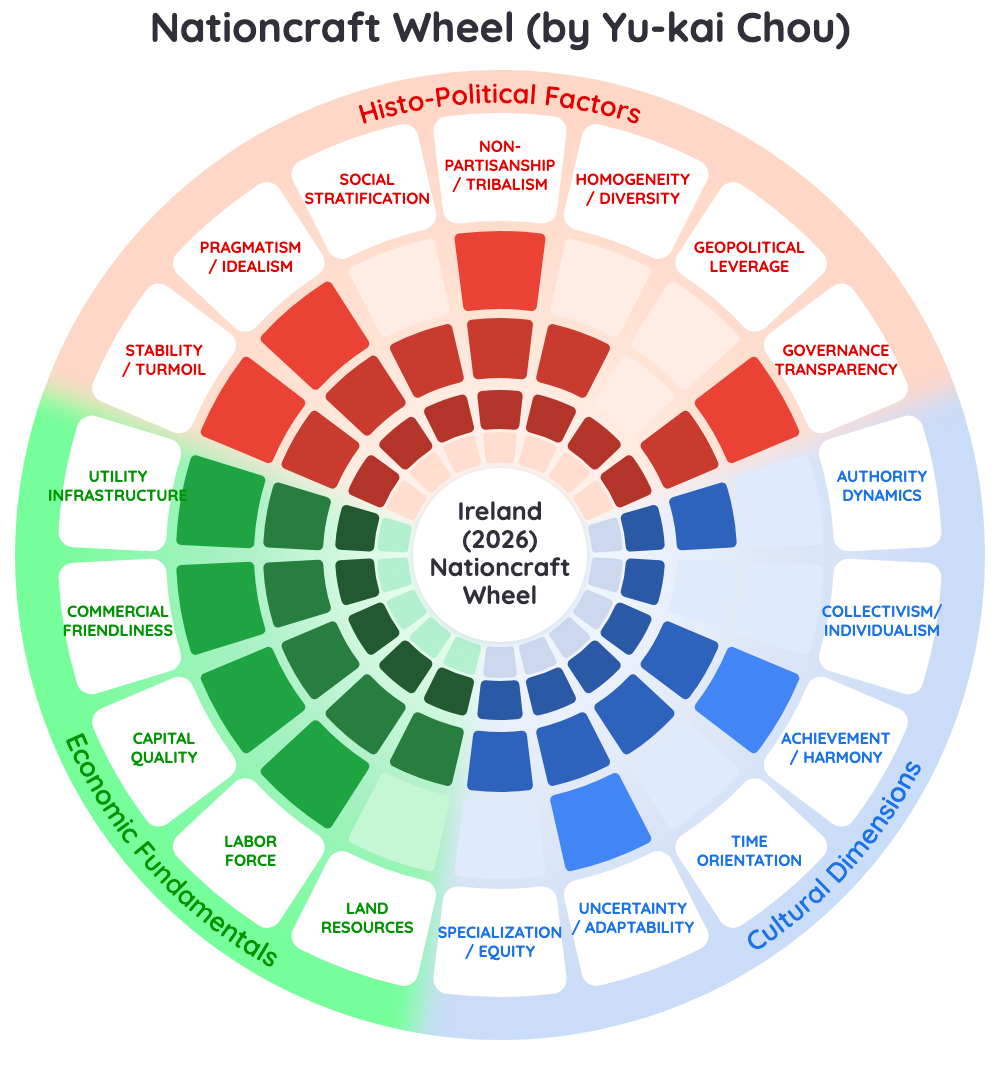

On 6 October 2026, Ireland’s finance minister stood up in the Dáil and announced a problem most countries would trade an airport for: the State expects to run a €6.7 billion surplus this year and €9.5 billion next year, and it still is not sure it should spend the money.[1]
Budget 2027 handed out €8.65 billion in new measures, cut capital gains tax, raised the minimum wage, and still banked another billion into a sovereign fund.[2] The applause was real, and so was the unease underneath it.
Here is the unease, stated plainly. Roughly half of Ireland’s corporation tax is paid by about ten foreign-owned corporate groups, and the Irish Fiscal Advisory Council classifies roughly half of the entire corporation tax take as windfall revenue that cannot be explained by the domestic economy.[6][7] The surplus Ireland is celebrating is, to a first approximation, a transfer decided in American boardrooms and Washington committee rooms.
I call this configuration the Windfall Trap: the better Ireland’s foreign-investment engine performs, the more the Irish state depends on a tax base it does not control, and the less pressure its politics feels to fix the things the windfall was supposed to pay for. Housing, the electricity grid, and water are where the gap shows. The money arrives faster than the country can physically absorb it, and the arrival itself anaesthetises the urgency.
This analysis runs Ireland through the 18 Nation Variables, shows why the trap is a variable interaction rather than a policy mistake, and names which historical reform packets Ireland should study and which flattering comparisons it should refuse.
⚡ Speed Run Notes
- Ireland scores V16=9 and V17=9, a maximal commercial engine by Nationcraft scoring, sitting on V12=3 geopolitical leverage. The engine is world-class and the steering wheel is in someone else’s hands.
- About ten corporate groups pay roughly half of Ireland’s corporation tax, and the Fiscal Council calls roughly half the take windfall. The 2026 surplus is real money resting on other people’s decisions.
- The Celtic Tiger packet (SP-016) already ran, 1987-2007. Ireland’s mistake is treating a completed packet as a permanent personality instead of banking its proceeds.
- Reject the Singapore, Hong Kong, and Qatar playbooks. Study Norway’s oil fund rule (SP-106), Finland’s post-Nokia pivot (SP-110), and Canada’s program review (SP-111).
- The reform test for Ireland is physical, V18 territory: homes built, grid connections energised, water treated. A state this rich failing at delivery is a motivation problem, which is Nationcraft’s home ground.
Table of Contents
- Understanding Ireland’s Governance Landscape Through Nationcraft
- What Is the Nationcraft Framework?
- What Ireland Actually Looks Like in Numbers
- The Windfall Trap
- Detailed Justifications: Reading the 18 Variables
- The Celtic Tiger Packet Is Already Spent
- Five Reformer Playbooks Ireland Should Reject
- Three Playbooks Ireland Should Actually Study
- Strategic Implications
- Governance Strategy Recommendations
- Comparative Context
Author Credibility: Yu-kai Chou

Yu-kai Chou created the Nationcraft Framework, applying behavioral design to the hardest motivational problem there is — getting an entire population to move through structural reform without losing momentum. As of 2026, the framework has informed advisory work with eight governments: Taiwan, the Netherlands, the United Kingdom, Bahrain, South Korea, Singapore, Ukraine, and Kazakhstan. The same 8 Core Drives that have driven design at Microsoft, Porsche, and MrBeast now anchor nation-scale reform sequencing — diagnosing where motivation is broken, which Core Drives to lean into for each phase of reform, and how to sequence the political asks so the public stays bought in.
Published Nationcraft analyses include diagnostic playbooks for Venezuela’s post-Maduro reform window and Thailand’s reset-vs-cycle election dynamics, alongside cabinet-level advisory work on post-conflict recovery, reform-sequencing, and public-policy gamification. Chou also teaches the Octalysis methodology at Harvard, Stanford, Yale, Google, BCG, and IDEO — institutions where the human-systems lens applies whether the system is a product, a company, or a country.
His work has been cited by Harvard, Stanford, MIT, Forbes, Wall Street Journal, Wired, US Department of Energy, NIST, NSF, NCBI, US Department of Education, ClinicalTrials.gov, and Google Scholar — with 3,700+ more academic publications. Explore his books here.

On this topic specifically: most of the governments on that advisory list are small, open economies whose prosperity depends on staying attractive to capital they do not command, and the recurring question in those rooms is the same one Dublin faces now. What do you do when the money arrives before the capacity to use it? Ireland is the cleanest live case of that question anywhere in the developed world, which is why it earns a full Nationcraft treatment.
Understanding Ireland’s Governance Landscape Through Nationcraft
Ireland in 2026 is governed by a rotating Fianna Fáil and Fine Gael coalition, the two centrist parties that have alternated or shared power for a century. The Tánaiste and Finance Minister, Simon Harris, presented Budget 2027 alongside Public Expenditure Minister Jack Chambers on 6 October 2026.[4]
The headline politics are placid. V7=9 on Stability vs Turmoil is one of the highest scores in the corpus, and V10=8 reflects a party system where the historic rivals govern together and the main opposition operates entirely within constitutional rules.
Underneath the placid surface sits a structural oddity no other rich democracy shares at this scale. The Irish state’s revenue, and therefore its politics, floats on the tax affairs of a handful of American multinationals in pharmaceuticals and technology.
Nationcraft reads a country as a configuration of 18 variables rather than a list of policies. On that reading, Ireland is one of the most lopsided profiles in the entire 147-country corpus, and the lopsidedness is the story.
What Is the Nationcraft Framework?
The Nationcraft Framework scores every nation on 18 variables: six cultural (V1-V6), seven histo-political (V7-V13), and five economic (V14-V18). Each variable runs 1 to 9, and the central claim is that configuration is strategy. Scores are never averaged, because the interactions between variables decide what a country can actually execute.
Nationcraft then matches a nation’s profile against more than 100 historical Success Packets, documented reform programs with known preconditions and outcomes. A packet that transformed one country will fail in another if the variable preconditions are absent, which is why the framework spends as much energy rejecting flattering analogies as endorsing useful ones.
The approach grew out of the same behavioral-design thinking as Octalysis. The connecting argument is laid out in the bridge essay on applying Octalysis to nation building and public policy: nations, like products, fail at motivation long before they fail at resources.
Why This Ireland Variables Analysis Matters
Ireland is the developed world’s favourite policy anecdote. Low-tax advocates cite it as proof taxes decide everything, industrial strategists cite it as proof agencies like IDA Ireland can manufacture miracles, and both camps skip the variable preconditions that made the story possible.
Getting Ireland right matters for the dozens of countries that keep trying to copy it. It also matters for Ireland, because the next decade will test whether a state can convert a temporary fiscal windfall into permanent capacity, and that test is live right now, with Budget 2027 as the opening move.
What Ireland Actually Looks Like in Numbers
The 18 Nation Variables for Ireland, from the Nationcraft corpus, with 2026 evidence:
| Variable | Score | 2026 evidence |
|---|---|---|
| V1 Authority Dynamics | 4/9 | Consensus parliamentary democracy; rotating coalition; weak-centre, strong-negotiation culture |
| V2 Collectivism | 2/9 | Strongly individualist society with a communal overlay, visible in GAA clubs rather than state structures |
| V3 Achievement vs Harmony | 7/9 | Competitive FDI pursuit; education-driven mobility; emigrant-return achievement culture |
| V4 Time Orientation | 6/9 | Two statutory long-horizon funds pull forward; the electoral cycle pulls back |
| V5 Uncertainty Adaptability | 7/9 | Absorbed the 2008 crash, Brexit next door, and the OECD tax rewrite without regime stress |
| V6 Specialization vs Equity | 6/9 | Deep pharma, tech, and financial-services specialization atop a broad welfare state |
| V7 Stability vs Turmoil | 9/9 | Peaceful transfers of power without interruption; the Northern settlement holding |
| V8 Pragmatism vs Idealism | 8/9 | A “whatever works” policy culture; no ideological resistance to low corporate tax or foreign capital |
| V9 Social Stratification | 5/9 | Egalitarian instincts; housing access is the new stratifier between owners and renters |
| V10 Non-Partisanship | 8/9 | The two historic rivals govern together; opposition operates inside the rules |
| V11 Homogeneity vs Diversity | 6/9 | Roughly a fifth of residents born abroad; rapid diversification from the Tiger-era baseline |
| V12 Geopolitical Leverage | 3/9 | Small, militarily non-aligned; influence borrowed from EU membership and the US corporate nexus |
| V13 Governance Transparency | 8/9 | Top-ten corruption perception ranking; strong courts; a tribunal culture that airs its scandals |
| V14 Land Resources | 4/9 | No hydrocarbons; agriculture plus an offshore wind endowment that remains largely unbuilt |
| V15 Labor Force Quality | 7/9 | English-speaking, degree-dense workforce matched to the FDI sectors |
| V16 Capital Quality | 9/9 | Among the deepest per-capita stocks of foreign direct investment in Europe; sovereign funds accumulating |
| V17 Commercial Friendliness | 9/9 | The 12.5% and 15% corporate rates, common law, and the IDA machine; the state’s core competence |
| V18 Utility Infrastructure | 8/9 | Rated high, performing lower: grid connection queues, water capacity limits, housing shortfall |
Two scores deserve an asterisk. V18=8 is the corpus rating, and this analysis will argue the lived score is closer to 6, because the gap between Ireland’s rated infrastructure and its delivered infrastructure is precisely where the Windfall Trap bites.
And the pairing that defines the whole profile: V16=9 and V17=9 sitting on V12=3. Sweden, Denmark, and the Netherlands share that pairing on paper; none of them rests half its corporation tax on ten foreign boards, which is what makes Ireland’s version load-bearing.
The Windfall Trap
Every Nationcraft analysis names the paradox that organises the country’s situation. Ireland’s is the Windfall Trap, and it has three interlocking parts.
Part one: the revenue is real and the base is borrowed. Corporation tax came to close to €40 billion in 2024, swollen by roughly €11 billion of Apple escrow money the Court of Justice of the EU ordered recovered in September 2024.[5][6] About ten corporate groups supply roughly half the ongoing take, and the Fiscal Council labels roughly half of it windfall.[7]
Part two: the measurement is distorted and everyone knows it. Ireland invented its own statistic, modified gross national income or GNI*, because multinational accounting makes headline GDP useless; the domestic economy is barely more than half the headline number.[8] A state that needs a custom metric to see itself is a state whose V16=9 engine is only partly its own.
Part three: the comfort is the trap. V7=9 stability plus V10=8 consensus politics means no crisis forces sequencing discipline. Just over 30,000 homes were completed in 2024 while independent and official estimates of annual need start in the low forties of thousands, and grid and water constraints now show up in investment decisions.[9] The windfall pays for everything except the pressure to fix delivery.
| Exposure | Scale | Who actually controls it |
|---|---|---|
| Corporation tax concentration | ~10 groups pay roughly half of receipts[6] | US multinational boards; US tax law |
| Windfall share of corporation tax | Roughly half of the take, per the Fiscal Council[7] | Global profit-shifting rules (OECD Pillar Two) |
| GDP vs GNI* gap | Domestic economy barely more than half of headline GDP[8] | Multinational balance-sheet geography |
| Export concentration | Pharma and tech dominate goods exports | US demand and US trade policy |
| Housing and grid delivery | ~30,000 completions in 2024 vs need in the 40,000s[9] | Dublin — the one lever fully in Irish hands |
Read the last column top to bottom. Four of the five exposures are controlled outside the state, and the one Ireland fully controls is the one it is failing.
That is the Windfall Trap in a sentence: Ireland’s strongest variables (V16, V17) are rented, its weakest lever (V18 delivery) is owned, and the rent cheque keeps arriving just often enough to make the owned problem feel optional.
Detailed Justifications: Reading the 18 Variables
The cultural base: V1-V6
V1=4 marks Ireland as a low-authority, negotiated polity. Nothing in Irish politics moves by command; social partnership, citizens’ assemblies, and coalition arithmetic are how decisions happen.
V2=2 individualism and V3=7 achievement orientation explain why the FDI model felt culturally native. Irish ambition historically routed through emigration; the Tiger era redirected it home without changing its individual character.
V5=7 adaptability is the quiet asset. A country that absorbed the 2008 collapse, a British exit from the EU on its only land border, and a global rewrite of its signature tax policy, all without a populist rupture, has demonstrated V5 under live fire.
The political spine: V7-V13
V7=9 and V10=8 together produce the most consensual politics of any case in this series. Even Germany’s consensus machine generates more open conflict than Ireland’s rotating coalition.
V13=8 transparency matters for what Ireland is not. This is no captured petro-state; the windfall flows through audited accounts, a free press, and a Fiscal Council that publishes exactly how fragile the revenue is.[7]
V12=3 is the profile’s hard ceiling. Ireland has no military weight, no veto worth trading, and no resource anyone must buy; its leverage is borrowed from Brussels and rented from the goodwill of American capital.
The economic engine: V14-V18
V14=4 would be lower without the Atlantic wind endowment, which remains mostly paper. V15=7 is the one input Ireland built deliberately, through free secondary education from 1967 and university expansion, and it is the input every copycat skips.
V16=9 and V17=9 are the rented crown jewels. The capital stock is enormous and mobile; the commercial friendliness is real and replicable by competitors with one legislative session.
V18 is where rating and reality diverge. The corpus says 8; the connection queue at the grid operator, the capacity warnings from the water utility, and the housing completion numbers say 6.[9] This analysis treats the official 8 as a lagging indicator and the lived 6 as the reform target.
The interaction that generates the trap
Multiply the pieces. V17=9 attracts the revenue, V12=3 means the revenue’s continuation is decided elsewhere, V7=9 and V10=8 remove the crisis pressure that forces delivery reform, and V18’s real-world drag quietly caps how much windfall can be converted into anything permanent.
No single variable is a problem. The configuration is the problem, which is the core Nationcraft claim about why imported policy advice keeps failing.
The Celtic Tiger Packet Is Already Spent
Ireland is the source country of one of the canon’s most-cited packets: SP-016, the Celtic Tiger Packet (1987-2007). The preconditions were desperation and preparation: debt at 120% of GDP, 17% unemployment in 1987, an emigration surge, and the Tallaght Strategy under which the opposition supported austerity.
The policy core combined fiscal stabilization, social partnership wage deals, the 12.5% corporate rate, IDA Ireland’s FDI machine, EU structural funds, and an education investment that had been compounding since 1967. The sequencing mattered: fiscal credibility first, FDI boom second, overheating third.
| Milestone (SP-016) | GDP per capita | Unemployment | Phase |
|---|---|---|---|
| 1987 baseline | $8,500 | 17% | Crisis; Tallaght Strategy austerity |
| 1992 | $14,000 | 15% | Stabilized; Single Market opens |
| 1997 | $22,000 | 10% | Tiger roaring; tech FDI lands |
| 2007 | $50,000 | 4% | Peak before the property crash |
SP-016’s own lessons file lists what failed: the 2008 property and banking crash, rising inequality, and overdependence on a few multinationals. It also lists what cannot be copied: the English-language-plus-EU-access combination, EU funds at 1990s scale, and a low-tax edge now constrained by OECD rules.
The 2026 point is sharper. The packet is finished, and its unfixed residue, multinational overdependence, is exactly the Windfall Trap this analysis names. Ireland does not need to rerun SP-016; it needs a second packet for the problem the first one created.
Five Reformer Playbooks Ireland Should Reject
SP-002: The Lee Kuan Yew Industrialization Packet (Singapore, 1965-1990)
The most common lazy comparison, since both are small, English-speaking FDI champions. The packet’s own precondition file kills it: LKY’s model required V1=9 authority acceptance, and Ireland sits at V1=4.
Singapore built mandatory savings through the CPF, mass public housing through the HDB, and policy by command. An Irish government that tried any one of those instruments at Singaporean intensity would lose a confidence vote within the season, a dynamic examined in the Singapore stress test of the LKY packet.
SP-021: The Laissez-Faire Development Packet (Hong Kong, 1950-1997)
The libertarian favourite. Hong Kong’s positive non-interventionism worked because V14=1 forced efficiency and a colonial administration supplied rule of law without electoral pressure.
Ireland’s failure mode is the opposite of over-intervention: it is delivery too slow for the money available. Prescribing “government should do less” to a state that cannot build homes fast enough is prescribing less of what is already missing. The packet’s post-1997 trajectory also shows the model could not survive political integration with a different system.
SP-116: The Hamad LNG & Soft-Power Diversification Packet (Qatar, 1995-2013)
Superficially tempting, since Qatar also converted an external windfall into funds and global standing. The difference is the windfall’s root: Qatar owns its gas in the ground, V14 territory, while Ireland’s windfall is V17 territory, a tax arrangement other governments can repeal.
Sovereign-wealth strategies built on owned resources tolerate political error; strategies built on rented tax bases do not. The deeper study of that distinction is Kuwait’s future generations trap, where even an owned resource could not discipline the spending politics.
SP-089: The Baltic Tiger Transformation Packet (Lithuania, 1990s-2010s)
The austerity-and-flat-tax school cites the Baltics as the honest version of Ireland. The precondition mismatch is total: Lithuania’s packet ran on post-Soviet desperation, internal devaluation, and a population willing to emigrate as a shock absorber.
Ireland in 2026 runs surpluses, sits inside the euro, and suffers from inward, not outward, population pressure on housing. An internal-devaluation playbook has nothing to devalue.
SP-059: The Orbán & EU Convergence Packet (Hungary, 1990s-2010s)
Hungary’s gradualist FDI-led convergence looks like Ireland’s story in a cheaper key, and some advisers read it as evidence that doubling down on FDI courtship is always the move. The packet’s own lesson file warns that FDI dependence preserved elite networks that later resisted institutional consolidation, the dynamic unpacked in Hungary’s two-thirds trap.
Ireland’s V13=8 makes the illiberal turn unlikely, but the economic half of the warning lands: deepening dependence is not a strategy for escaping dependence. More IDA is not the answer to a problem IDA’s success created.
Three Playbooks Ireland Should Actually Study
SP-106: The Oil Fund Sovereign Wealth Packet (Norway, 1990-2010)
Norway channelled petroleum revenue into a foreign-invested fund precisely to stop the windfall from inflating the domestic economy and corroding the non-oil tax base. Ireland has already imitated the furniture: the Future Ireland Fund and the Infrastructure, Climate and Nature Fund, both managed by the NTMA, received another €1 billion in Budget 2027 on top of the €4.8 billion transfer already planned.[3][10]
What Ireland has not imitated is the rule. Norway’s discipline is a fiscal handrail that defines how much windfall the annual budget may touch; Ireland’s funds coexist with budgets that still spend windfall on permanent current commitments. Copy the constraint, and the funds become a packet; skip it, and they are a gesture. The contrast with what unmanaged windfalls do to a trading economy is the subject of the Netherlands’ second Dutch disease.
SP-110: The Post-Soviet Nokia Miracle Packet (Finland, 1991-2000)
Finland is the study case for concentration risk because it lived both halves: the miracle of one dominant corporate engine, then the stall. Its packet answer was to push R&D spending to 3.5% of GDP, the OECD’s highest, and to keep education investment running through the worst fiscal years.
The transferable move for Ireland is pre-positioning. Finland built the knowledge base before Nokia fell, which is why the fall produced a startup ecosystem instead of a lost decade. Ireland’s equivalent is spending windfall on research capacity, energy, and universities now, while the ten big payers are still paying.
SP-111: The Chretien-Martin Deficit Elimination Packet (Canada, 1993-1998)
The least glamorous and most Irish-compatible packet in the canon. Canada ran a Program Review that tested every federal program against six questions and consolidated 5.6% of GDP without triggering recession, inside a consensual federal democracy, V1 and V10 conditions close to Ireland’s own.
Ireland’s version would run the review on delivery rather than deficit: every euro of capital allocation tested against whether it physically converts into homes, grid, or water inside the decade. The packet proves a low-authority democracy can do disciplined prioritisation without a crisis, which is exactly the muscle the Windfall Trap atrophies.
| Packet | Core move | Precondition fit for Ireland | What transfers |
|---|---|---|---|
| SP-106 Norway Oil Fund | Ring-fence windfall behind a spending rule | V13=8, V16=9 ✓; funds already exist | The rule, not just the fund |
| SP-110 Finland Nokia Miracle | Build the next engine before the current one stalls | V15=7, V5=7 ✓; R&D intensity below Finnish bar | Counter-cyclical R&D and education investment |
| SP-111 Canada Program Review | Test every program against explicit criteria | V1=4, V10=8 ✓; consensual democracy match | Delivery-focused review of capital spending |
| SP-002 Singapore LKY | Command-driven capacity building | ✗ requires V1=9; Ireland V1=4 | Rejected |
| SP-116 Qatar LNG | Monetise owned resources into soft power | ✗ windfall is V17-rented, not V14-owned | Rejected |
Strategic Implications
For readers, analysts, and anyone advising on Irish policy, the Nationcraft reading produces four implications.
First, the surplus is a clock, not a cushion. Every structural feature of the windfall, OECD floor rates, US repatriation politics, pharma tariff reviews, points the same direction across the next ten years. The question is not whether the take normalises; it is whether Ireland’s physical capacity is built before it does.
Second, the binding constraint is delivery, and delivery is motivational. Ireland does not lack money, skills (V15=7), or institutions (V13=8). It lacks a political system under pressure to say no to anything, which is a Core Drive problem: all carrot, no countdown. Reform designs that add urgency mechanics, statutory delivery deadlines with published scorecards, convert V13 transparency into V18 output.
Third, concentration risk is a national-level single point of failure. The small-state borrowed buffer comparison showed how states with thin margins survive by diversifying their dependencies; Ireland has been running the opposite experiment, letting one dependency compound because it keeps paying.
Fourth, Ireland’s warning lights are visible in its neighbours. The UK’s honeymoon ledger shows what happens when a new government inherits commitments its revenue cannot carry, and Sweden’s trust overdraft shows how a high-trust state can coast on institutional reputation while delivery quietly decays. Ireland is currently drawing on both accounts.
Governance Strategy Recommendations
Written for the general reader and the future Irish reformer, not as a memo to the sitting coalition. The beneficiary test for every item below is the same: does this put a home, a grid connection, or an honest number in front of an Irish household?
| Phase | Move | What physically changes for the population |
|---|---|---|
| 1. Honest accounting | Budget on GNI* and non-windfall revenue; publish the windfall share on budget day itself | Citizens see the real size of their economy and the real fragility of the surplus[7][8] |
| 2. Rule the windfall | Adopt a Norway-style spending rule: windfall receipts flow to the funds and capital, never to permanent current spending | Services stop being built on revenue that can vanish; the funds compound for the next generation[10] |
| 3. Delivery review | A Canada-style program review aimed at output: consenting, grid connection, water, and housing pipelines tested against published completion criteria | Homes and connections arrive faster; the state’s one fully-owned lever starts moving |
| 4. Build the second engine | Finnish-scale R&D and energy investment, with offshore wind converting V14=4 potential into owned supply | Jobs and exports that survive a multinational departure; cheaper power for households |
Note the sequencing logic, which is Nationcraft’s standard credibility-first pattern: honest numbers make the rule politically survivable, the rule frees capital for delivery, and delivery capacity is what makes the second engine buildable at all.
None of this requires new authority. V1=4 Ireland cannot and should not command its way through; every step above runs on the consensus machinery the country already has, pointed at outputs instead of allocations.
Comparative Context: Ireland Among the Small Rich Democracies
Ireland’s nearest Nationcraft neighbours are instructive in both directions. Spain’s rented border is the same grammar of dependence, a core national function outsourced to an external partner, applied to migration instead of revenue.
France’s censure ratchet shows the opposite fiscal pathology: deficits without the windfall, and a political system too fractured to consolidate. Ireland holds the better hand by a wide margin, which is precisely why wasting it would be the greater failure.
Across the Atlantic, the United States variable analysis matters to Dublin for an uncomfortable reason: the American V-profile is the upstream weather system for Ireland’s V16 and V17. A US tax or tariff decision is, functionally, an Irish budget event.
The honest summary of the comparison set: no other rich democracy has Ireland’s upside concentrated in so few counterparties, and none has its downside so fully within its own power to fix.
The Nationcraft Framework in Practice
This analysis applied the standard Nationcraft sequence to Ireland: score the 18 variables, find the paradox in their interaction, test historical packets against preconditions, and sequence recommendations by credibility rather than ambition.
The Ireland case also sharpens a general Nationcraft lesson. A country’s most impressive variable scores can be liabilities in disguise when their continuation depends on actors outside the configuration, and the framework catches this because it scores control, V12, separately from capability, V16 and V17.
Closing
Ireland is not in crisis, and that is the problem worth writing about. The Windfall Trap is what success looks like when it is allowed to quiet the urgency of the next reform, and the escape runs through the most boring instruments in governance: an accounting convention, a spending rule, a program review, and a construction pipeline.
The country that executed SP-016 from a standing start in 1987 is self-evidently capable of all four. The open question is whether it will do them without the 17% unemployment that forced the last round of discipline.
Explore More Nationcraft Analyses
The full library of Nationcraft country analyses now covers dozens of nations. For profiles adjacent to Ireland’s, start with the Netherlands, the United Kingdom, and Sweden entries linked above, or browse the library for the resource-windfall cases that rhyme with Dublin’s tax windfall.
Frequently Asked Questions
What is the Windfall Trap in Ireland’s Nationcraft profile?
It is the interaction where Ireland’s strongest variables, V16=9 capital quality and V17=9 commercial friendliness, generate revenue controlled by foreign decisions (V12=3), while the comfort of that revenue removes pressure to fix the one lever Ireland fully owns, domestic delivery (V18). The better the engine performs, the weaker the incentive to reduce dependence on it.
Why does Ireland’s GDP overstate its real economy?
Multinational accounting, intellectual property moves, and contract manufacturing inflate Irish GDP far beyond domestic activity. The CSO publishes modified gross national income, GNI*, to correct for this, and the domestic economy measured that way is barely more than half the headline figure.[8]
Is Ireland’s corporation tax boom sustainable?
The Fiscal Council classifies roughly half the take as windfall, and about ten corporate groups pay roughly half of receipts.[6][7] Nothing in that structure is guaranteed beyond the planning horizon of the firms and foreign governments involved, which is why this analysis treats the surplus as a clock.
What should Ireland do with the windfall?
Study SP-106, Norway’s oil fund packet: the lesson is the spending rule, not the fund. Ireland already has the Future Ireland Fund and the Infrastructure, Climate and Nature Fund; binding annual budgets to non-windfall revenue is the step that would turn furniture into strategy.[10]
How does Ireland compare with other small rich democracies?
It pairs a maximal commercial engine (V17=9) with nearly the weakest geopolitical leverage (V12=3), and no neighbour hangs as much of its revenue on that combination. Sweden, the Netherlands, and the UK each show one of Ireland’s risks in isolation; Ireland is running all three at once, cushioned by a surplus none of them has.
Related Reading
- The Nationcraft Framework: the 18 variables, 9 goals, and the Success Packet method.
- Nationcraft Country Analyses Library: every published national profile in one place.
- Nationcraft Analysis: Netherlands Second Dutch Disease 2026: what windfalls do to trading economies.
- Nationcraft Analysis: Kuwait Future Generations 2026: when even a sovereign fund cannot discipline spending.
- Nationcraft Analysis: Singapore LKY Packet Stress Test 2026: the comparison Ireland keeps being offered.
- Nationcraft Analysis: UK Honeymoon Ledger 2026: the neighbour running the same decade without the surplus.
Footnotes
- RTÉ News, “Budget 2027: the main points,” 6 October 2026 · rte.ie
- The Irish Times, “Budget 2027 main points,” 6 October 2026 · irishtimes.com
- TheJournal.ie, “Budget 2027: the main points,” 6 October 2026 · thejournal.ie
- Department of Finance, “Tánaiste Simon Harris and Minister Jack Chambers publish Summer Economic Statement 2026” · gov.ie
- Court of Justice of the European Union, Press Release No 141/24, Apple state aid judgment, 10 September 2024 · curia.europa.eu
- Revenue Commissioners, Corporation Tax payments and returns statistics · revenue.ie
- Irish Fiscal Advisory Council, Fiscal Assessment Reports · fiscalcouncil.ie
- Central Statistics Office, National Accounts (GDP and modified GNI*) · cso.ie
- Central Statistics Office, Building and Construction (new dwelling completions) · cso.ie
- National Treasury Management Agency — manager of the Future Ireland Fund and the Infrastructure, Climate and Nature Fund · ntma.ie