

On September 13, 2026, President Bernardo Arévalo went on national television to say something remarkable: the roadblocks strangling Guatemala’s highways were being financed, in his telling, by local politicians working with drug traffickers and gangs.[1]
Five days earlier, Congress had capped fuel prices by decree in a single emergency debate, 130 votes, backed by a fund of up to 2.5 billion quetzales.[2][3] A subsidy passed in one night, in a country that has failed for thirty years to pass a serious tax reform, a land reform, or a justice reform.
That asymmetry is the real story, and it runs deeper than one fuel crisis. Guatemala can always find money to quiet the street.
It can never find money to fix the reasons the street erupts, because the people who would demand those fixes keep leaving. Close to two million people of Guatemalan origin live in the United States, and the money the diaspora sends home has grown into the economy’s largest external income stream.[8]
I call this configuration The Escape-Valve Trap: emigration and remittances vent exactly the pressure that would otherwise force the system open. Guatemala’s own entry in the Nationcraft corpus, packet SP-096, lists “migration as safety valve” among the historical triggers of its post-war era.
The valve keeps the boiler from exploding. It also keeps anyone from fixing the boiler.
This analysis reads Guatemala through the 18 Nation Variables, shows why the trap survived even the 2023 election that was supposed to break it, and tests nine historical reform packets against Guatemala’s actual V-vector. Six fail on preconditions Guatemala does not meet. Three carry lessons the current reform window, the first real one since 2019, could actually use.
⚡ Speed Run Notes
- Guatemala runs the Escape-Valve Trap: V13=2 captured institutions stay captured because V15=7 labor exits instead of protesting. Remittances then fund the calm that makes reform look unnecessary.
- The September 2026 fuel crisis is the trap in miniature: a price cap passed overnight (Decree 21-2026) while the structural reforms that would make fuel shocks survivable stay untouched.
- The May 2026 handover of the Public Prosecutor’s Office from Consuelo Porras to Gabriel García Luna is the biggest institutional opening since CICIG was expelled in 2019.
- Six celebrated playbooks fail against this V-vector, including the loudest regional temptation: Bukele’s El Salvador packet (SP-064) trades away the one asset Guatemala’s opening actually has.
- The three worth studying: Georgia’s anti-corruption blitz (SP-051), Costa Rica’s institutions-first pivot (SP-031), and Ukraine’s build-new-agencies sequencing (SP-117).
- The binding constraint is time: Arévalo’s term ends January 2028, and every prior Guatemalan opening closed when its champion left office with nothing institutionalized.
Table of Contents
- Understanding Guatemala’s Governance Landscape Through Nationcraft
- What Is the Nationcraft Framework?
- Why This Guatemala Variables Analysis Matters
- What Guatemala Actually Looks Like in Numbers
- The Escape-Valve Trap
- Detailed Justifications: Reading All 18 Variables
- Strategic Implications
- Best-Match Historical Packets
- Six Reformer Playbooks Guatemala Reform Should Reject
- Three Playbooks Guatemala Reform Should Actually Study
- Governance Strategy Recommendations
- Frequently Asked Questions
About Yu-kai Chou

Yu-kai Chou is a Human-Systems Architect & Behavioral Designer and the creator of the Nationcraft Framework — an 18-variable diagnostic for matching a country’s structural profile to the reform packets that have historically worked under similar conditions. He has consulted for governments in eight nations, including Ukraine, the United Kingdom, the Kingdom of Bahrain, Singapore, Taiwan, the Netherlands, Kazakhstan, and South Korea, and has worked directly with President Zelenskyy’s team on post-war reconstruction priorities for Ukraine.
Chou’s prior framework — the Octalysis Framework — has been applied by LEGO, Microsoft, Porsche, Coca-Cola, Salesforce, and MrBeast, impacting over 1.5 Billion Users. He has taught the methodology at Harvard, Stanford, Yale, Tesla, Google, BCG, and IDEO.
His work has been cited by Harvard, Stanford, MIT, Forbes, Wall Street Journal, Wired, US Department of Energy, NIST, NSF, NCBI, US Department of Education, ClinicalTrials.gov, and Google Scholar — with 3,700+ more academic publications. Explore his books here.

This Guatemala analysis applies the Nationcraft Framework’s context-fit method to the reform question Chou’s advisory work in eight governments keeps returning to: what happens when a nation finally wins an election for change and then has to convert one mandate, one prosecutor’s office, and one narrow window into institutions that outlast the person who opened them. No country in the Americas is running that experiment more visibly in 2026 than Guatemala.
Understanding Guatemala’s Governance Landscape Through Nationcraft
Guatemala is Central America’s largest economy and its most stubborn puzzle. Growth has been steady for two decades.
Inflation is tame. The currency barely moves.
The Banco de Guatemala reported 4.3 percent real growth for 2025 and projects 2026 growth between 3.1 and 5.1 percent, with inflation at 2.27 percent in June 2026, comfortably below target.[4] On the macro dashboard, Guatemala looks like a well-run country.
Underneath that dashboard sits a state that collects one of the lowest tax takes in Latin America, an impunity rate for most serious crimes that hovers near total, and a political class that spent 2023 and 2024 openly trying to annul a presidential election it had lost. The macro numbers are calm because millions of Guatemalans solved their personal version of the national problem by leaving.
The Nationcraft Framework exists for exactly this kind of case. A country’s headline indicators can be healthy while its structural configuration is trapped, and the difference only becomes visible when you score the structure directly. That is what the 18 Nation Variables do.
Guatemala’s 2026 story has three moving pieces. First, a president elected on an anti-corruption landslide who spent his first two years besieged by his own prosecutor’s office. Second, the May 2026 replacement of Attorney General Consuelo Porras, sanctioned by multiple governments for obstructing corruption cases, with Gabriel García Luna, who took office pledging to dismantle what he called his predecessor’s repressive legacy.[5][7] Third, a street-level fuel crisis that showed how quickly the political system can act when the incentive is quieting protest rather than fixing structure.[2]
Read together through the Nationcraft lens, these three pieces describe a nation at the most consequential fork it has faced since the 1996 peace accords.
What Is the Nationcraft Framework?
The Nationcraft Framework is a context-fit diagnostic for national reform. It scores a nation on 18 structural variables, called Nation Variables or V-scores, grouped into three families: cultural (V1–V6), histo-political (V7–V13), and economic (V14–V18).
The core thesis of Nationcraft is that policy effectiveness is decided by context-fit rather than policy quality. The same reform that transformed one nation fails in another because the receiving configuration differs, and the 18 variables are how you read that configuration before betting a country’s decade on a borrowed playbook.
Against a scored V-vector, Nationcraft then matches Success Packets: documented historical transformations, each with its own preconditions, sequencing logic, and outcome trajectory. The question is never whether a packet worked. The question is whether its preconditions exist in the country trying to copy it.
Guatemala puts the method under real strain, because nearly every packet its elites and its critics invoke fails the precondition test in a different, instructive way.
Why This Guatemala Variables Analysis Matters
Timing, mostly. Countries spend decades structurally frozen and then hit short windows where the configuration itself is in play. Guatemala is inside one now.
The 2023 anti-corruption mandate, the May 2026 recovery of the prosecutor’s office, and the 2026–27 judicial selection cycle all land inside a single presidential term that ends in January 2028. Whether those pieces become institutions or anecdotes will set Guatemala’s V13 and V10 trajectories for a generation.
There is also a methodological reason. Guatemala is a clean live case of strong endowments held down by captured institutions, so if the Nationcraft claim that context-fit decides reform outcomes says anything useful, it should say it here, before the window closes, in a form falsifiable by events.
What Guatemala Actually Looks Like in Numbers
Two tables anchor everything that follows. The first is the current-events dashboard, drawn from primary sources dated 2025 and 2026.
| Indicator | Value | Period / Source |
|---|---|---|
| Real GDP growth | 3.7% → 4.3% | 2024 → 2025, Banco de Guatemala[4] |
| 2026 growth projection | 3.1–5.1% (central ~4.1%) | Banguat monetary policy report, June 2026[6] |
| Inflation | 1.65% → 2.27% | Dec 2025 → June 2026, below the 4%±1 target band[6] |
| Family remittances | US$12.98B in H1 2026 (+7.0% y/y) | Banguat, through June 30, 2026[6] |
| Fuel price cap | Q39/gal regular & diesel, Q41 premium | Decree 21-2026, passed Sept 8, 2026, fund up to Q2.5B, through Dec 31, 2026[2][3][10] |
| Protest wave | Blockades from about Aug 31; eight roads shut on the worst day | Aug–Sept 2026 fuel-price protests[1] |
| Presidential term | Jan 14, 2024 – Jan 14, 2028 | Bernardo Arévalo, Movimiento Semilla |
| Attorney General | Gabriel García Luna since May 17, 2026 | Replaced Consuelo Porras at end of term[5][7] |
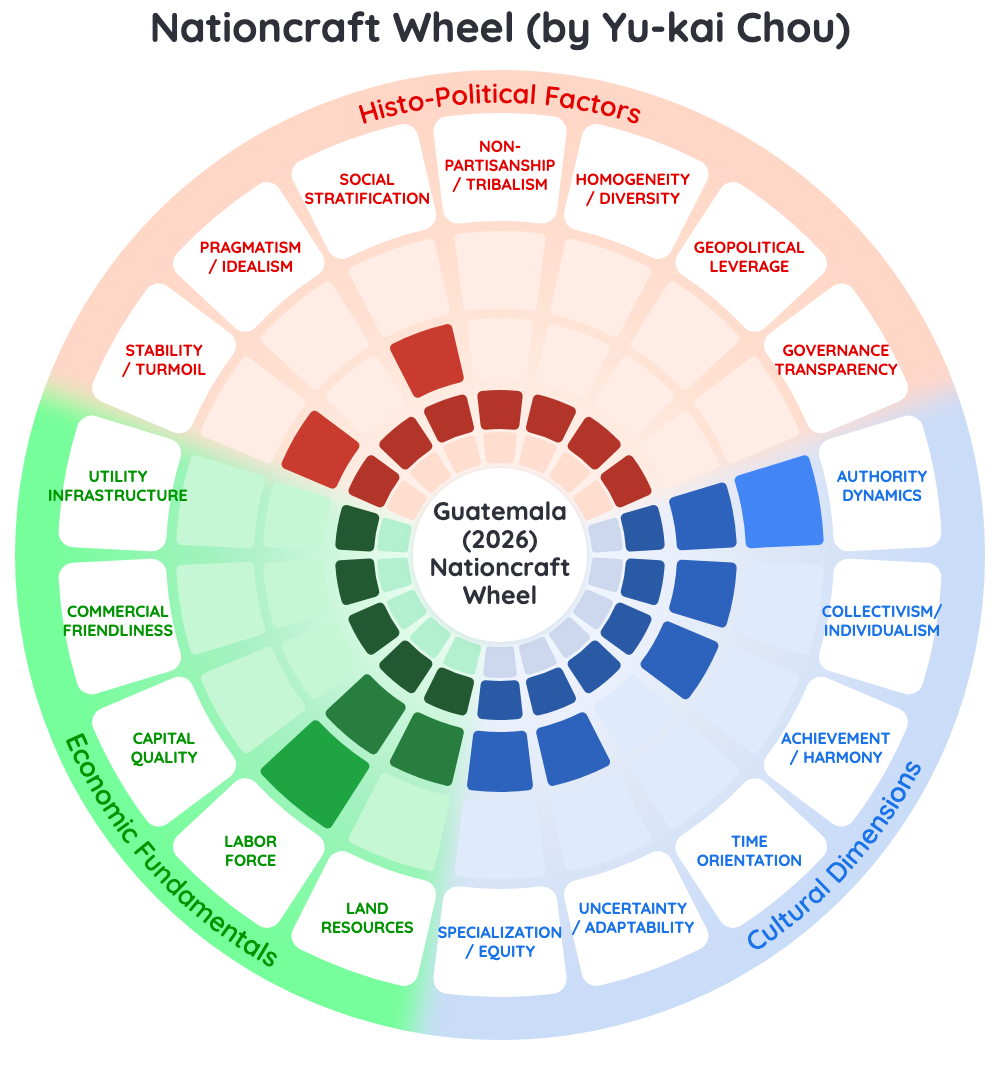
The second table is Guatemala’s full Nationcraft V-vector, scored 1–10 from the framework’s 147-country corpus and sanity-checked against 2026 conditions.
| Variable | Score | Reading |
|---|---|---|
| V1 Authority Dynamics | 7/10 | Hierarchical, caudillo-inflected; elites and military retain deep informal power |
| V2 Collectivism | 6/10 | Maya communal structures and dense family networks; roughly 44% indigenous |
| V3 Achievement vs Harmony | 4/10 | Status flows through land and lineage more than merit |
| V4 Time Orientation | 3/10 | Short-horizon extraction; chronic public under-investment |
| V5 Uncertainty Adaptability | 6/10 | A vast informal economy absorbs shocks households cannot avoid |
| V6 Specialization vs Equity | 4/10 | Export agriculture, maquilas, and informality; thin formal specialization |
| V7 Stability vs Turmoil | 4/10 | Postwar peace holds, but the 2023–24 electoral crisis and 2026 blockades show the floor |
| V8 Pragmatism vs Idealism | 3/10 | Elite veto over reform; the CICIG expulsion is the defining data point |
| V9 Social Stratification | 6/10 | Entrenched ladino-over-Maya hierarchy dating to the colonial encomienda |
| V10 Non-Partisanship vs Tribalism | 2/10 | Parties as disposable vehicles; the “pacto de corruptos” as the real coalition |
| V11 Homogeneity vs Diversity | 3/10 | More than 20 Maya language communities beside ladino, Xinka, and Garifuna populations |
| V12 Geopolitical Leverage | 2/10 | Small, US-dependent; migration is the main card in Washington |
| V13 Governance Transparency | 2/10 | Bottom-quartile corruption perception; structural impunity; MP weaponized through May 2026 |
| V14 Land Resources | 6/10 | Fertile volcanic soils, coffee, sugar, cardamom, nickel, Maya heritage tourism |
| V15 Labor Force Quality | 7/10 | Young, abundant, work-proven labor; a diaspora US employers actively recruit |
| V16 Capital Quality | 2/10 | Shallow credit markets; remittances substitute for a financial system |
| V17 Commercial Friendliness | 2/10 | Red tape plus an extortion economy taxing small business |
| V18 Utility Infrastructure | 3/10 | Road and port bottlenecks; uneven electricity beyond the capital corridor |
Look at the shape rather than the average. Guatemala pairs genuinely strong endowments (V14=6 land, V15=7 labor, V2=6 social cohesion at community scale) with floor-level institutional scores (V13=2, V16=2, V17=2, V10=2).
In the Nationcraft corpus, that specific shape, strong human and natural endowments welded to captured institutions, almost always produces one outcome: the endowments leave, capital quietly and labor on foot.
The Escape-Valve Trap
Every trapped configuration in the Nationcraft corpus has a mechanism that keeps it trapped. Thailand’s is the coup cycle.
Venezuela’s was the oil rent. Guatemala’s is subtler, and in some ways crueler: the exit door works.
Here is the loop, step by step.
Step one: capture blocks opportunity. With V13=2 transparency, V17=2 commercial friendliness, and V16=2 capital access, a talented young Guatemalan faces a domestic economy where formal jobs are scarce, credit is unavailable, extortion taxes any visible success, and courts protect the connected. The rational move for millions has been to leave.
Step two: exit drains the constituency for reform. The people with the most energy, the most grievance, and the most to gain from a functioning state are precisely the ones who emigrate.
Political pressure that would accumulate in a sealed system escapes northward instead.
Step three: remittances anesthetize the remainder. Nearly thirteen billion dollars arrived in the first half of 2026 alone.[6] That money feeds families, builds houses, and keeps consumption growing.
It also detaches household welfare from state performance. When your standard of living depends on a cousin in Los Angeles rather than a ministry in Guatemala City, the ministry’s failure stops being your emergency.
Step four: the calm ratifies the capture. Steady growth and low inflation, both real, both remittance-fueled, let the political class point at the dashboard and ask what crisis anyone is talking about. The configuration that produced the exodus gets re-elected and re-insured.
Then the loop repeats, one generation deeper. A nation exporting its reformers imports patience with the unreformed.
The 2023 election looked like the loop breaking. Bernardo Arévalo, an anti-corruption academic nobody’s machine had priced in, surged into the runoff and won it decisively. The system’s response was instructive: the Porras prosecutor’s office spent the transition attempting to suspend his party, raid electoral tribunals, and delay his inauguration, which ultimately happened hours late on January 14–15, 2024.[7][9]
For two years the elected government and the inherited prosecutor’s office fought openly. The trap held not through one caudillo but through what Guatemalans call the pacto de corruptos, the cross-party arrangement in which V10=2 party fragmentation is a feature: parties are cheap vehicles, and the real coalition is the one defending impunity.
What changed in May 2026 is that the siege engine changed hands. Porras’s term expired; Arévalo named García Luna; the office that had been the pact’s shield became, at least nominally, the reform camp’s sword, and everything in this analysis turns on what gets institutionalized before January 2028.[5]
Detailed Justifications: Reading All 18 Variables
Numbers alone convince nobody, so this section walks the full vector, family by family, with the observations behind each score.
Cultural family (V1–V6): communal strength under a hierarchical ceiling
V1 Authority Dynamics = 7. Guatemala’s default authority pattern is steeply hierarchical: landowner over laborer, capital over highlands, ladino elite over Maya majority.
Formal democracy has alternated presidents since 1986, yet each president governs atop informal structures, business chambers, military networks, organized crime, that outrank most ministries in practice. A 7 captures strong deference to concentrated power without the total command of a 9 or 10 system.
V2 Collectivism = 6. At community scale, Guatemala is impressively collective: Maya municipalities run communal land arrangements, rotating civic duties, and self-organized security. The score stops at 6 because the collectivism rarely scales past the community boundary; national solidarity across the ladino-indigenous line remains thin.
V3 Achievement vs Harmony = 4 and V4 Time Orientation = 3 travel together.
Status still flows through land, lineage, and connection more than merit, and the elite’s planning horizon is the harvest and the concession, which is how a country with V14=6 land wealth ends up with one of the region’s weakest public-investment records. Congress financing a fuel subsidy overnight while education and infrastructure stay starved is V4=3 behaving exactly to type.[2]
V5 Uncertainty Adaptability = 6. Guatemalan households are world-class improvisers because they have had to be: roughly seven in ten workers operate informally, and families treat migration itself as a diversification strategy. This adaptability is genuine capacity, and the trap runs on it.
V6 Specialization vs Equity = 4. The formal economy specializes narrowly (agro-exports, maquila textiles, call centers) while most labor pools in low-productivity informality. Neither specialized enough to climb value chains nor equitable enough to build broad demand.
Histo-political family (V7–V13): the postwar settlement that settled nothing
V7 Stability vs Turmoil = 4. The 1996 peace accords ended a 36-year civil war that killed roughly 200,000 people, overwhelmingly Maya civilians by the UN-backed truth commission’s accounting.
The peace has held for three decades, which matters. But 2015’s uprising against the La Línea customs-fraud network, the 2023–24 attempt to overturn an election, and the August–September 2026 blockades all show how thin the floor is.[1]
V8 Pragmatism vs Idealism = 3. The decisive test came in 2019: CICIG, the UN-backed anti-impunity commission that had helped topple a sitting president and convict networks across the elite, was expelled rather than renewed.
Given a working instrument against corruption, the system chose the corruption. That single revealed preference anchors the 3.
V9 Social Stratification = 6 and V11 Homogeneity vs Diversity = 3. A colonial-rooted hierarchy sits atop one of the hemisphere’s most diverse societies, more than 20 Maya language communities alongside ladino, Xinka, and Garifuna populations. Diversity is a latent asset; stratification keeps converting it into exclusion instead.
V10 Non-Partisanship vs Tribalism = 2. Guatemalan parties are famously disposable; most exist for one or two cycles as vehicles for a patron.
The durable structure is the trans-party pact defending impunity. When the loyalty network is organized around protection from prosecution, V10 sits at the floor.
V12 Geopolitical Leverage = 2. Guatemala matters to Washington primarily as a migration source and transit corridor, which makes the diaspora simultaneously the economy’s engine and the state’s only bargaining chip. That is leverage of a kind, but it is leverage that depends on the trap continuing.
V13 Governance Transparency = 2. Bottom-quartile corruption perception, near-total impunity for most crimes, and, until May 2026, a prosecutor’s office sanctioned by multiple democracies for obstructing justice.[5][9] The García Luna handover is upside risk to this score, and the Nationcraft rule is strict: one appointment is a person, and V13 measures institutions. The score moves when selection systems, case outcomes, and budget protections move.
Economic family (V14–V18): rich land, exported labor, missing capital
V14 Land Resources = 6. Volcanic soils that grow some of the world’s best coffee and cardamom, sugar, nickel deposits, two coastlines, and a Maya heritage tourism endowment most countries would build a brand on.
V15 Labor Force Quality = 7. The corpus scores Guatemalan labor high on abundance, youth, and demonstrated work ethic, the same labor US employers absorb by the hundreds of thousands.
The schooling deficit is real, yet the variable measures the workforce’s usable energy, and Guatemala’s runs high. The tragedy of the Escape-Valve Trap is that this 7 is Guatemala’s most exported product.
V16 Capital Quality = 2. Domestic credit is shallow, investment rates are chronically low, and the de facto financial system is the remittance channel, which finances consumption and housing but rarely aggregates into productive investment. A country cannot borrow its way up a value chain through Western Union.
V17 Commercial Friendliness = 2. Beyond the formal red tape sits the informal tax code: extortion.
A small business that becomes visibly successful attracts gangs in the cities and predatory fixers everywhere. V17=2 is why V15=7 labor cannot simply stay home and build.
V18 Utility Infrastructure = 3. The capital corridor functions; the highlands wait. Road quality, port throughput, and electricity reliability all fall off sharply outside the central axis, which is also a map of who the state historically served.
Strategic Implications
Three implications fall directly out of this V-vector, and they frame every packet judgment that follows.
First, Guatemala’s problem is institutional, so its solution must be institutional. The endowments are already strong: V14=6, V15=7, V2=6.
Any playbook whose main engine is macroeconomic stabilization or resource extraction solves a problem Guatemala does not have. Inflation is 2.27 percent.[6] The disease lives in V13, V17, V16, and V10.
Second, the reform window is a personnel window until it becomes a rules window. Everything currently improving, the presidency, the prosecutor’s office, runs on individuals whose terms expire. Arévalo leaves in January 2028 and cannot run again.
The 2023 mandate becomes durable only if it is converted into selection systems, budget protections, and published metrics that survive hostile successors. Guatemala has watched openings close before: the CICIG decade produced convictions and then was deleted by one non-renewal.
Third, the diaspora must be redesigned from valve to circuit. No plausible Guatemalan future excludes emigration and remittances; they are the load-bearing wall of household welfare.
The strategic question is whether the diaspora’s money, skills, and expectations flow back only as consumption or also as investment, standards, and political demand. Configurations like Albania’s departure dividend show both the danger and the beginnings of the redesign.
Best-Match Historical Packets
The Nationcraft corpus holds 139 Success Packets. Guatemala’s own entry, SP-096, the Post-Civil War Development Packet (1996–2020), is classified as a Post-Conflict Limited Recovery: growth without development, peace without justice, land inequality untouched, violence transformed into gang form, and migration institutionalized as the safety valve.
SP-096 is the packet Guatemala must exit. The table below tests nine candidate packets against the 2026 V-vector; the two sections after it argue the six rejections and three fits in depth.
| Packet | Source case | Verdict for Guatemala | Deciding variables |
|---|---|---|---|
| SP-064 Security & Digital | El Salvador 2019– | Reject | V11, V10, V13 — and it spends the opening’s only asset |
| SP-014 Chicago Boys | Chile 1975–1990 | Reject | V9=6, V13=2 — preconditions absent, side effects amplified |
| SP-002 LKY Industrialization | Singapore 1965–1990 | Reject | V8=3, V13=2 vs a packet that assumes clean administration |
| SP-021 Laissez-Faire Development | Hong Kong 1950–1997 | Reject | V17=2, V13=2 — deregulating a captured market deregulates capture |
| SP-097 Migration & Maquila | Honduras 1990–2020 | Reject | It is the Escape-Valve Trap, written down as strategy |
| SP-118 Estenssoro NEP Shock | Bolivia 1985–1989 | Reject | V16=2 but no hyperinflation — wrong disease |
| SP-051 Saakashvili Reform | Georgia 2004–2012 | Study | V13 floor-to-mid blitz — with its second-half warning |
| SP-031 Demilitarization & Eco-Tourism | Costa Rica 1948–1990 | Study | The neighbor that converted a junction into institutions |
| SP-117 Post-Euromaidan Reform | Ukraine 2014–2022 | Study | Build new agencies beside captured ones; survive the backlash |
Six Reformer Playbooks Guatemala Reform Should Reject
Rejection here is a precondition finding. Each of these packets produced real results in its source configuration. Each fails against Guatemala’s actual scores.
SP-064: The Bukele Security & Digital Packet (El Salvador, 2019–present)
This is the loudest voice in Guatemala’s ear, because next door it visibly delivered the one good Guatemalans rank first: safety. The packet’s engine is mass incarceration under emergency powers plus a personalist digital brand, and its precondition is a society homogeneous enough (El Salvador has no comparable indigenous-ladino divide) and a gang phenomenon centralized enough to be decapitated in one campaign.
Guatemala’s V11=3 diversity and territorially fragmented criminal markets fail that precondition on the merits. But the deeper failure is what the packet costs: it works by dissolving exactly the checks Guatemala’s reform camp just spent three years bleeding to defend. A country that only now recovered an independent-minded prosecutor’s office would be trading its sole institutional gain for a security model that requires the referee to disappear.
For a population whose core grievance is a state above the law, adopting a playbook that puts the state further above the law deepens the disease under an anesthetic of order. The regional evidence on this pattern, including Chile’s mano dura mirage, is that the demand for iron fists outlives every iron fist’s results.
SP-014: The Chicago Boys Packet (Chile, 1975–1990)
The Chilean liberalization produced durable macro discipline and export growth, and it did so under two preconditions Guatemala lacks: an enforced political order that suppressed distributional conflict for fifteen years, and a professional technocracy insulated from capture. Guatemala’s V13=2 and V10=2 mean privatization and deregulation would be executed by the very networks reform is aimed at, and its V9=6 stratification means the packet’s signature side effect, concentrated gains, would land on an already explosive inequality.
Chile paid for that side effect decades later in nationwide unrest. Guatemala would pay for it immediately.
SP-002: The Lee Kuan Yew Industrialization Packet (Singapore, 1965–1990)
Every developing-country elite cites Singapore, and the Nationcraft corpus is blunt about why the packet rarely transfers: its engine is not low taxes or port geography but an incorruptible administrative machine built first, V13 and V8 near the ceiling, before industrial bets were placed. Guatemala inverts both preconditions (V8=3, V13=2). A state that cannot yet run honest customs cannot run LKY-style industrial policy; the concessions would be captured on day one.
Singapore is what a reformed Guatemala might study in thirty years. It is unusable as a starting move.
SP-021: The Laissez-Faire Development Packet (Hong Kong, 1950–1997)
SP-021 is the mirror-image error. If the state is the problem, shrink the state, and Guatemala’s business chambers have preached versions of this for decades. Hong Kong’s minimal-state model sat on British-administered courts and clean commercial enforcement: V13 and V17 at levels Guatemala has never recorded.
With V17=2, the market Guatemalans actually face is priced by extortionists and gatekeepers. Removing the state from that market does not free it; it hands it to the strongest private coercion available. Guatemala has effectively run a natural experiment in stateless commerce for decades, and the extortion economy is the result it got.
SP-097: The Migration & Maquila Packet (Honduras, 1990–2020)
This packet matters because it is the codified version of Guatemala’s default path: export labor, import remittances, assemble textiles in free zones, and call the resulting stability development. Honduras ran it fully and arrived at deeper dependence, thinner institutions, and larger caravans.
For Guatemala, SP-097 is a photograph of the Escape-Valve Trap taken from the far side, the same mechanism that produces Mexico’s borrowed calm one border north. This is the one packet Guatemala is already running by default, and formalizing a trap only digs it deeper.
SP-118: The Estenssoro NEP Packet (Bolivia, 1985–1989)
Decree 21060 killed Bolivian hyperinflation in weeks and remains the region’s cleanest stabilization story. It is included here because fiscal hawks periodically prescribe shock discipline for Guatemala, and the prescription misreads the chart: Guatemala’s inflation is 2.27 percent and its debt is moderate.[6] The Nationcraft rule is to match the packet to the binding constraint, and Guatemala’s binding constraint is capture (V13), never macro chaos. Austerity theater would spend scarce political capital relieving a symptom Guatemala does not have, the same category error diagnosed in Bolivia’s gas dividend trap from the opposite direction.
Three Playbooks Guatemala Reform Should Actually Study
Study, in Nationcraft terms, means the packet’s preconditions overlap Guatemala’s actual V-vector closely enough that its sequencing logic transfers, provided its documented failure modes travel with it.
SP-051: The Saakashvili Reform Packet (Georgia, 2004–2012)
Georgia in 2003 was a Guatemala-class case on the variables that matter: bottom-floor transparency, a captured bureaucracy, and a public that had stopped expecting anything from the state. The packet’s core lesson is that V13 can move from floor to middle within a single term when the reform hits visibly, totally, and where citizens touch the state daily. Firing the entire traffic police in one stroke worked because a half-purged force would have re-infected the new one.
The corpus records the transferable tactics plainly: radical moves beat incremental ones when the institution is rotten through, visible results build the coalition that protects the next move, and simplification beats complexity because complexity is where capture hides. For García Luna’s prosecutor’s office and Arévalo’s ministries, that maps to picking two or three citizen-facing systems, customs, business registration, police units in extortion corridors, and cleaning them completely rather than improving everything slightly.
The packet’s second half is the warning label. Georgia’s reformers, unchecked, drifted into prosecutorial excess and centralized power, and paid for it politically.
The lesson for a reform camp holding the prosecutor’s office is uncomfortable and essential: the blitz must be aimed at opening the system, with courts able to rule against the government and acquittals accepted as proof of process rather than betrayal. A cleanup that becomes a weapon recreates the machine it replaced, with new operators.
SP-031: The Demilitarization & Eco-Tourism Packet (Costa Rica, 1948–1990)
Costa Rica is the standing refutation of every essentialist excuse for Central American dysfunction. Same isthmus, same coffee economy, same 1940s instability, and after its short 1948 civil war it made one structural choice: abolish the army and spend the savings on schools, health, and an electoral tribunal nobody could capture. Two generations later it sits at V13=6 and V10=6 while its neighbors sit at 2.
Guatemala cannot re-run 1948, and the packet’s specific policy (demilitarization) is not the transferable part. The transferable part is the mechanism: at a rare political junction, convert the windfall of the moment into institutions that compound, and pick investments whose beneficiaries are too broad to expropriate. Education and an untouchable electoral authority created constituencies that defended them forever after.
Guatemala’s 2026 junction, a mandate president plus a reclaimed prosecutor’s office plus a mobilized public, is the closest thing to a 1948 moment the country has had since the peace accords. SP-031 is the proof, from one border away, that the junction can be converted rather than survived.
SP-117: The Post-Euromaidan Reform Packet (Ukraine, 2014–2022)
Ukraine after 2014 faced Guatemala’s exact institutional geometry: a mobilized reformist public, a state honeycombed by capture, and an old elite that retained the courts, the prosecution, and most of parliament. The packet’s signature move is the one Guatemala most needs to study: rather than waiting to reform captured institutions from within, build new, ring-fenced ones beside them, an independent anti-corruption bureau, a specialized prosecutor, eventually a dedicated court, each with transparent competitive selection, international observers on the panels, and published caseloads.
The sequencing logic matters as much as the institutions: crisis stabilization first, then banking cleanup, then the anti-corruption architecture, each phase creating the constituency for the next. And the backlash pattern matters most of all, because Ukraine’s old networks counterattacked through the constitutional court and nearly killed the system more than once; it survived because its metrics were public and its foreign and civic stakeholders were wired into its defense.
Guatemala’s version of that defense is the diaspora, the business chambers that want rule of law, and the US relationship, exactly the coalition that surfaced during the 2023–24 transition siege. The full mechanics are traced in Ukraine’s escrowed recovery analysis; what transfers to Guatemala is the architecture, built while the window was open, that made reform survivable under fire.
Governance Strategy Recommendations
These recommendations are addressed to Guatemala’s reform coalition in the broadest sense, the citizens, jurists, business owners, diaspora, and officials who want the system opened, and every step is chosen by one test: does it move accountability, rights, or opportunity toward the population rather than capacity toward whoever holds the apparatus.
| Sequence | Move | Variables targeted | Packet source |
|---|---|---|---|
| 1 (now–mid 2027) | Institutionalize prosecutorial independence: transparent merit selection for fiscal posts, published case metrics, protected budget — rules that would bind a hostile AG, and this friendly one, equally | V13, V8 | SP-117, SP-051 |
| 2 (before the 2027-28 cycle) | Open the comisiones de postulación: livestreamed judicial selection, published scoring, civil-society observers — the courts chosen in this window rule until the mid-2030s | V13, V10 | SP-117 |
| 3 (two to three visible wins) | Saakashvili-style total cleanups of two citizen-facing systems: customs and business registration are the corpus-indicated picks | V13, V17 | SP-051 |
| 4 (parallel) | Break the extortion tax on small business with protected reporting channels, specialized prosecution, and municipal transparency — measured by businesses operating openly, never by arrest counts alone | V17, V7 | SP-051, SP-031 |
| 5 (build the circuit) | Diaspora re-entry rails: audited, household-owned investment vehicles, credit histories built on remittance flows, and dual-community infrastructure matching funds — voluntary and transparent, so the valve starts returning pressure as investment and expectations | V16, V15 | SP-031 mechanism, SP-096 exit |
| 6 (compact) | A tax-for-services compact: revenue increases explicitly escrowed to schools, clinics, and roads with independent public audit — the Costa Rican move of creating beneficiaries too broad to expropriate | V4, V18, V9 | SP-031 |
Two disciplines govern the whole sequence. Every rule written in this window must be one the reform camp is willing to live under when it loses an election, because a rule designed to bind only opponents re-creates the capture it replaced.
And every win must be published as a metric ordinary people can check, case clearance rates, days to register a business, extortion reports resolved, because the Escape-Valve Trap runs on the belief that nothing here will ever work. The counter-loop runs on visible proof that something did. The prosecution-led version of that proof, and its limits, is exactly what Angola’s prosecution dividend analysis warns about: trials alone, without opened selection systems behind them, produce a dividend that expires with the prosecutor.
What This Means Practically for Guatemala Reform
Practically, the September 2026 fuel episode is the pattern to break, and it is breakable. A subsidy was the right emergency valve for households facing a Hormuz-driven price spike; the trap is that the emergency valve is the entire repertoire. The same congressional energy that passed Decree 21-2026 in one night has never been applied to the selection rules, audit systems, and service compacts in the table above.[2][3] The pattern where each emergency ratchets spending while structure stays frozen is the one Ecuador’s emergency ratchet documents from the same fuel-subsidy starting point.
For the reform coalition, the practical checklist for the next sixteen months is short. Convert the prosecutor’s office from a person into a system. Get the judicial selection reforms in place before the next comisiones cycle.
Land two total cleanups where citizens touch the state. Publish the metrics. Build the first diaspora investment rail.
Sixteen months is not long enough to fix Guatemala. It is long enough to make Guatemala’s fixes hard to reverse, and that is the only race that matters before January 2028.
Comparative Context
Guatemala’s V-vector reads differently against each neighbor, and the corpus scores make the comparisons precise.
| Country | V7 Stability | V10 Non-Partisanship | V13 Transparency | V17 Commercial | Configuration |
|---|---|---|---|---|---|
| Guatemala | 4 | 2 | 2 | 2 | Escape-Valve Trap, window open |
| Honduras | 3 | 2 | 2 | 2 | SP-097 migration-maquila path, fully run |
| El Salvador | 3 | 2 | 2 | 2 | SP-064 security-first bargain |
| Nicaragua | 3 | 1 | 2 | 2 | Closed personalist consolidation |
| Costa Rica | 7 | 6 | 6 | 6 | SP-031 institutions-first, two generations on |
The table’s lesson is that Central America is running four different packets from nearly identical starting hands, and only the institutions-first hand has compounded. Farther afield, the fragility patterns rhyme: Haiti’s ballot-first trap shows where the road leads when elections outrun institutions entirely, and Peru’s carousel trap shows that even middle-income status does not save a system whose parties are disposable vehicles. The Venezuela reform playbooks case sits at the far end of the same road: it is what the packet-sorting exercise looks like once the window has already collapsed, the outcome Guatemala’s sixteen months exist to avoid.
Within that field, Guatemala’s distinguishing 2026 feature is rare and perishable: it currently holds a popular mandate and the prosecutor’s office at the same time, which none of its trapped peers can say.
The Nationcraft Framework in Practice
Nations, like products, live or die on whether the people inside them stay motivated to keep playing; the case for treating public policy as motivational design is argued in full in Nationcraft and the Octalysis Framework applied to nation-building.
The Escape-Valve Trap is, at bottom, a motivation diagnosis: Guatemala’s system pays out effort abroad and punishes it at home, so players change servers. Reform, in Nationcraft terms, means re-pricing the home game — visible wins, credible rules, and a reason for the most capable players to build where they were born.
Closing
Guatemala’s tragedy has never been a shortage of capable people; it exports them by the hundreds of thousands. The Escape-Valve Trap explains why their departure has stabilized the very system that pushed them out, and the 2026 window explains why that loop is, for the first time since the CICIG era, actually contestable.
The V-vector says the endowments are ready. The packets say the sequencing is known. What remains is the sixteen-month race between institutionalization and the calendar — and the full corpus of analyses in the Nationcraft country analyses library exists so that races like this one are run with the evidence in hand.
Explore More Nationcraft Analyses
The library above holds every published country analysis. The nearest structural relatives to Guatemala’s configuration are the remittance-and-calm cases (Mexico, Albania), the subsidy-politics cases (Bolivia, Ecuador), and the reform-under-siege cases (Ukraine, Angola), all linked in context throughout this analysis.
Frequently Asked Questions
What is the Escape-Valve Trap?
The Escape-Valve Trap is the named paradox of Guatemala’s Nationcraft profile: emigration and remittances vent the social pressure that would otherwise force captured institutions open. Talented, aggrieved citizens exit instead of demanding reform; their remittances then fund household stability that makes the unreformed system look calm. The valve prevents the explosion, and it also prevents the repair.
Why is the May 2026 Attorney General change so important?
Because for Guatemala’s reform camp the Public Prosecutor’s Office was the pact’s most powerful weapon. Under Consuelo Porras, sanctioned by multiple governments for obstructing corruption cases, it dismantled anti-impunity units and pursued the president’s own party.
Her term ended May 17, 2026, and Gabriel García Luna took office pledging to reverse that course. It is the first time since CICIG’s 2019 expulsion that the mandate and the prosecution point the same direction.
Should Guatemala copy El Salvador’s Bukele model?
The Nationcraft precondition test says no. The Bukele packet (SP-064) requires a homogeneity and a centralized gang structure Guatemala lacks (V11=3, fragmented criminal markets), and its method dissolves the independent institutions that are Guatemala’s only recent gain. A country whose core disease is a state above the law cannot cure itself with a playbook that raises the state further above the law.
What role should remittances play in Guatemala’s reform?
Remittances, nearly US$13 billion in the first half of 2026 alone, are the load-bearing wall of household welfare and cannot be treated as a problem to eliminate. The strategic redesign is from valve to circuit: audited diaspora investment vehicles, remittance-based credit histories, and matching-fund infrastructure programs so the diaspora’s money and expectations return as investment and political demand rather than consumption alone.
Which historical reform packets fit Guatemala best?
Three study cases fit the 2026 V-vector: Georgia’s SP-051 anti-corruption blitz (move V13 through total, visible cleanups, while heeding its over-centralization warning), Costa Rica’s SP-031 institutions-first pivot (convert a rare political junction into broad-beneficiary institutions), and Ukraine’s SP-117 sequencing (build new ring-fenced accountability agencies beside captured ones and wire stakeholders into their defense).
Related Reading
- The Nationcraft Framework: 18 Variables, 8 Goals, 100+ Proven Reform Packets
- Nationcraft Country Analyses Library
- Nationcraft Analysis: Venezuela Reform Playbooks 2026
- Nationcraft Analysis: Mexico Borrowed Calm 2026
- Nationcraft Analysis: Colombia Pendulum 2026
- Nationcraft Analysis: Angola Prosecution Dividend 2026
Footnotes
- The Rio Times, “Guatemala’s President Alleges Paid Blockades but Names Nobody,” September 2026. riotimesonline.com
- AP / Local10 (Spanish), “Congreso de Guatemala fija un tope al precio de los combustibles,” September 9, 2026. local10.com
- The Rio Times, “Guatemala’s Congress Capped Fuel Prices, but Not at the Pump Yet” (Decree 21-2026 mechanics), September 2026. riotimesonline.com
- Banco de Guatemala, “Estudio de la Economía Nacional 2025” (2024–2025 growth and inflation). banguat.gob.gt
- JusticeInfo.net, “Guatemala: the fall of Consuelo Porras,” 2026. justiceinfo.net
- Banco de Guatemala, “Informe de Política Monetaria, junio 2026” (2026 projections, June inflation, H1 remittances). banguat.gob.gt
- The Associated Press (via WSB-TV), “Guatemala’s president replaces attorney general after years-long struggle,” May 2026. wsbtv.com
- Pew Research Center, “Facts on Hispanics of Guatemalan origin in the United States.” pewresearch.org
- Human Rights Watch, World Report 2026: Guatemala. hrw.org
- teleSUR English, “Guatemala Sets Temporary Fuel Price Caps,” September 2026. telesurenglish.net