

In March 2024 the two men who now run Senegal were in the same prison cell’s shadow, released days before an election they went on to win together. Bassirou Diomaye Faye became president; Ousmane Sonko, the movement’s founder and the more popular of the pair, became his prime minister. They inherited a country that had just discovered its books were a fiction, with public debt nearly double what the previous government had reported. Two years later they are on opposite sides of the table, and the fight between them is the single biggest obstacle to fixing the very crisis they were elected to fix.
This is the shape the Nationcraft Framework calls the Tandem Trap. Senegal scores high on the variables that make a democracy admirable, with real stability and a genuinely functioning parliament, and low on the variables that give a state room to maneuver in a crisis. When a reformist ticket that swept both the presidency and the legislature splits at the top, that strong parliament stops being a check and starts being a brake. The unity that won everything is now the thing blocking anything.
Most coverage reads Senegal as either a democratic success story wobbling or an emerging-market debt story unraveling. Both are real, and neither explains why the political drama and the economic emergency keep feeding each other. The answer is structural, and it has a name. This is the Tandem Trap, and Senegal is living inside it.
⚡ Speed Run Notes
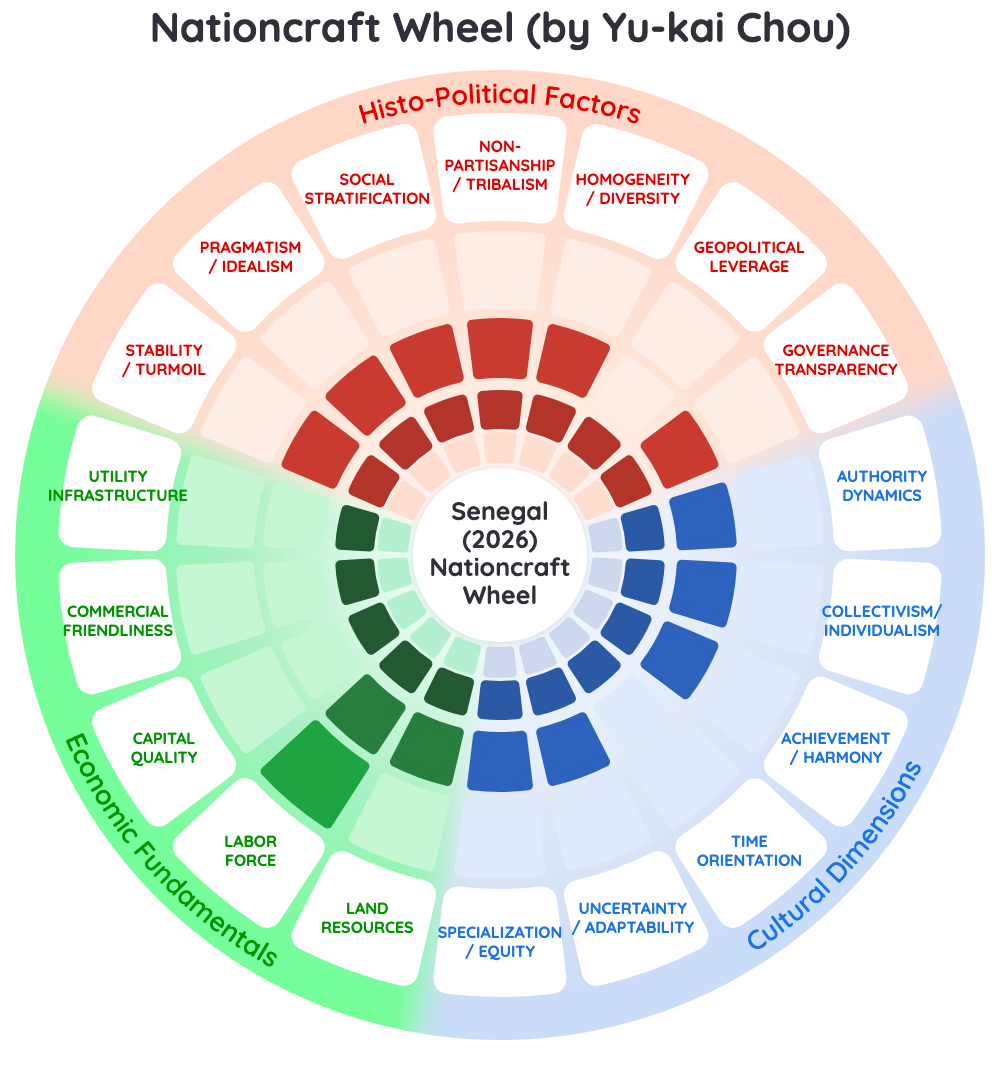
- Senegal’s Nationcraft signature pairs democratic strength (V7 = 6 stability, V13 = 5 transparency) with economic fragility (V12 = 1 leverage, V16 = 2 capital), so its crisis runs through politics, not the printing press.
- The Faye-Sonko tandem won the presidency and parliament as one movement, then split over the IMF. Sonko now runs the legislature and threatens no-confidence votes against the government Faye leads.
- A 2024 audit revised debt from ~74% to ~132% of GDP, the largest debt misreporting in IMF history; the Fund froze a ~$1.8bn program. Meanwhile Sangomar oil and GTA gas pushed 2025 growth toward 8%.
- Because Senegal uses the euro-pegged CFA franc, it cannot print its way out. The escape valve is not inflation but arrears, austerity, and a fight over who authors the pain.
- The packets that fit impose discipline from inside the movement (Bolivia, Georgia, Botswana, Senegal’s own Senghor-Wade packet), not the single-strongman models (Singapore, Rwanda, Bukele) the profile rejects.
Table of Contents
- Understanding Senegal’s Governance Landscape Through Nationcraft
- What Is the Nationcraft Framework?
- Why This Senegal Variables Analysis Matters
- What Senegal Actually Looks Like in Numbers
- The 18 Senegal Nation Variables
- Detailed Justifications: Reading the Variables That Matter
- The Tandem Trap
- Three Patterns: Consolidation, Paralysis, and Aid Dependency
- Reformer Playbooks Senegal Should Reject
- Reformer Playbooks Senegal Should Actually Study
- Governance Strategy Recommendations
- Comparative Context
- What This Means Practically for Senegal
- The Nationcraft Framework in Practice
- Explore More Nationcraft Analyses
- Related Reading
- Frequently Asked Questions
- Footnotes
About Yu-kai Chou

Yu-kai Chou is a Human-Systems Architect & Behavioral Designer and the creator of the Nationcraft Framework — an 18-variable diagnostic for matching a country’s structural profile to the reform packets that have historically worked under similar conditions. He has consulted for governments in eight nations, including Ukraine, the United Kingdom, the Kingdom of Bahrain, Singapore, Taiwan, the Netherlands, Kazakhstan, and South Korea, and has worked directly with President Zelenskyy’s team on post-war reconstruction priorities for Ukraine.
Chou’s prior framework — the Octalysis Framework — has been applied by LEGO, Microsoft, Porsche, Coca-Cola, Salesforce, and MrBeast, impacting over 1.5 Billion Users. He has taught the methodology at Harvard, Stanford, Yale, Tesla, Google, BCG, and IDEO.
His work has been cited by Harvard, Stanford, MIT, Forbes, Wall Street Journal, Wired, US Department of Energy, NIST, NSF, NCBI, US Department of Education, ClinicalTrials.gov, and Google Scholar — with 3,700+ more academic publications. Explore his books here.

This Senegal analysis applies the Nationcraft Framework to a failure mode I have watched inside more than one reformist government: the moment when the people who won together discover that winning was the easy part. Senegal is the cleanest current example, because nothing here is broken in the ordinary African sense. There is no coup, no fraud, no collapse. There is a democracy strong enough to argue with itself all the way into paralysis, at the exact moment its inherited debt and its new oil demand a single steady hand.
Understanding Senegal’s Governance Landscape Through Nationcraft
Senegal has spent sixty years being the exception. It is the West African state that never had a successful coup, that handed power peacefully from Senghor to Diouf to Wade to Sall and, in 2024, to Faye. When the region is discussed as a story of fragility, Senegal is the counter-example everyone reaches for. That reputation is earned, and it is also the reason the current crisis is so hard for outsiders to read. The instinct is to look for the familiar African failure and, not finding it, to conclude that nothing serious is wrong.
The Nationcraft read is different. A country is a configuration of eighteen structural variables, and Senegal’s configuration is genuinely unusual for its region. It pairs strong democratic-process variables with weak economic-capacity variables. The state can run a clean election and a peaceful transfer, and it cannot easily run a deficit, defend a currency, or fund itself without help. That mismatch does not produce the loud failures of a fragile state. It produces a quieter one, in which a capable political system spends its capability arguing about an economic problem it lacks the room to solve painlessly.
What makes 2026 the moment worth analyzing is that the two halves of Senegal’s profile have collided. The democratic strength and the economic weakness are no longer running on parallel tracks. The hidden-debt inheritance forced a choice about the IMF, that choice split the ruling movement, and the split is now playing out through exactly the strong institutions that make Senegal admirable. The framework’s job here is to explain why the collision was structurally likely, and what actually gets a country out of it.
What Is the Nationcraft Framework?
The Nationcraft Framework is an 18-variable diagnostic for nation-states. Each variable, labeled V1 through V18, captures one structural dimension of how a country actually behaves: how power concentrates (V1 Authority Dynamics), how much the culture prizes the group over the individual (V2 Collectivism), how it handles time and risk (V4 Time Orientation, V5 Uncertainty and Adaptability), how transparent its governance is (V13 Governance Transparency), how strong its financial and monetary capital is (V16 Capital Quality), how much leverage it has over the outside world (V12 Geopolitical Leverage), and so on through land, labor, commerce, and infrastructure.
The point of the framework is not to rank countries. It is to match them. A reform packet that transformed one nation routinely fails in another, and the framework’s claim is that the failures are predictable: a packet works when the target country’s variables resemble the variables of the country where the packet first succeeded. Lee Kuan Yew’s playbook needs a Lee Kuan Yew profile. Shock therapy needs a shock-therapy profile. Import a template built for a different configuration and it does not merely underperform. It backfires, because it assumes capacities the country does not have.
So every Nationcraft analysis ends with the same two questions. Which historical packets fit this country’s variables, and which famous packets will break against them? For Senegal, the answer to the second question includes several of the strongman and technocrat models that its neighbors and its critics keep recommending. The framework grew out of the same behavioral-design work behind Octalysis and public policy: motivation and structure decide whether a reform holds, not the elegance of the plan on paper.
Why This Senegal Variables Analysis Matters
Senegal matters out of proportion to its size. It is a country of roughly eighteen million people, but it carries three kinds of significance at once. It is West Africa’s democratic reference point, so its trajectory is read across the continent as a verdict on whether elected, accountable government can also deliver. It is a live sovereign-debt story, watched by every emerging-market investor deciding how to price a government whose numbers turned out to be false. And it is a new petro-state, with first oil and first gas both arriving inside the last two years, which makes it a test of whether a democracy can manage a resource windfall better than the autocracies that usually strike it.
The Nationcraft lens sharpens all three. Plenty of countries have found hidden debt, fought the IMF, or discovered oil. What determines the outcome is rarely the headline event. It is the variable profile underneath it. A state with strong monetary capital and a pragmatic technocracy can absorb a debt shock and negotiate calmly. A state scoring V16 = 2 on capital and V12 = 1 on leverage has almost no cushion, which is why the politics matter so much: with no economic room to maneuver, the only variable left to move is the political one. Senegal is spending that scarce political capacity on an internal feud. Understanding why, and what a better use of it would look like, is the reason this analysis exists.
What Senegal Actually Looks Like in Numbers
Before the variables, the ledger. Senegal’s 2026 economy is a study in contradiction: booming headline growth on top of a solvency crisis. First oil from the Woodside-operated Sangomar field began in June 2024, and first gas from the Greater Tortue Ahmeyim project offshore came in early 2025, pushing GDP growth to around 6% in 2024 and a forecast near 8% in 2025 on the hydrocarbon ramp.5 Growth is expected to cool sharply toward 2.5% in 2026 as the one-off production jump normalizes and fiscal drag sets in.2
The strain is in the debt lines, and it is severe. Shortly after taking office in 2024, Faye ordered an audit of the public finances. It found that the real debt figure had been understated for years: public debt was revised from roughly 74% of GDP to close to 100% at end-2023, and total public-sector debt was later put near 132% of GDP, with previously hidden liabilities worth around a quarter of GDP.1 The IMF, which described the episode as the largest case of debt misreporting in its history, suspended a program worth about 1.8 billion dollars, and rating agencies cut Senegal deeper into junk.4 For two years the government insisted it would repay in full; in mid-2026, after the cabinet reshuffle, it opened the door to renegotiation and to a new Fund program.4
The table below translates that ledger into the Nationcraft variables it stresses. Each figure maps to a structural score, and those scores are what the rest of the analysis runs on.
| 2026 indicator | Reading | Nationcraft variable stressed |
|---|---|---|
| Debt / GDP after audit | ~74% reported to ~132% real; hidden loans ~25% of GDP | V13 Governance Transparency = 5 |
| IMF program | ~$1.8bn frozen; new deal needs debt judged sustainable | V12 Geopolitical Leverage = 1 |
| Sovereign rating | Cut deeper into junk after the audit | V16 Capital Quality = 2 |
| GDP growth | ~8% (2025) on oil and gas, slowing to ~2.5% (2026) | V14 Land Resources = 6 |
| Executive structure | President Faye vs Assembly President Sonko, same party | V1 Authority Dynamics = 6 |
| Governing coalition | PASTEF supermajority now opposing its own president | V8 Pragmatism vs Idealism = 4 |
| Currency | Euro-pegged CFA franc; no independent printing press | V17 Commercial Friendliness = 3 |
The 18 Senegal Nation Variables
Here is the full Nationcraft profile for Senegal in 2026. Scores run on the framework’s standard scale, where low numbers mark a structural weakness on that dimension and high numbers mark a strength or an intensity. Read the vector as a shape, not a report card: the story is in which variables cluster together, and Senegal’s cluster is a democracy’s strengths sitting on an economy’s weaknesses.
| Variable | Score | One-line reading |
|---|---|---|
| V1 Authority Dynamics | 6 | Strong presidency, now split between president and assembly leader |
| V2 Collectivism vs Individualism | 6 | Sufi brotherhoods, family and community solidarity, teranga culture |
| V3 Achievement vs Harmony | 4 | Harmony-leaning; consensus and accommodation prized |
| V4 Time Orientation | 3 | Short horizon; the hidden debt was short-termism made visible |
| V5 Uncertainty & Adaptability | 5 | Society absorbs shocks; institutions respond reactively |
| V6 Specialization vs Equity | 4 | Equity-leaning; subsidies and patronage distribution |
| V7 Stability vs Turmoil | 6 | No successful coup ever; peaceful alternations the norm |
| V8 Pragmatism vs Idealism | 4 | Split embodied: Faye pragmatic on the IMF, Sonko sovereigntist |
| V9 Social Stratification | 5 | Moderate; caste traditions and a coastal–interior divide |
| V10 Non-Partisanship vs Tribalism | 4 | Brotherhood clientelism offset by strong national identity |
| V11 Homogeneity vs Diversity | 4 | Religiously homogeneous, ethnically plural, low cleavage conflict |
| V12 Geopolitical Leverage | 1 | Small economy; minimal leverage over external creditors |
| V13 Governance Transparency | 5 | Mid and rising: the new government’s own audit exposed the debt |
| V14 Land Resources | 6 | Agriculture, phosphates, fisheries, and now offshore oil and gas |
| V15 Labor Force Quality | 7 | Skilled administrative class and diaspora, eroded by emigration |
| V16 Capital Quality | 2 | Junk-rated; thin financial system; CFA-franc dependence |
| V17 Commercial Friendliness | 3 | Heavy state role; large informal economy |
| V18 Utility Infrastructure | 3 | Improving power access but real gaps remain |
Detailed Justifications: Reading the Variables That Matter
Eighteen variables define the profile, but five of them do the analytical work in Senegal’s case. They are the ones that explain why a strong democracy produces a weak crisis response.
V13 Governance Transparency (5): the variable that changes everything
Transparency is the difference between Senegal’s story and most debt crises. In many countries a debt scandal is something outsiders uncover and the government resists. In Senegal the government uncovered it. Faye ordered the audit that exposed his predecessor’s concealment, published the revised numbers, and cooperated with the IMF’s misreporting review. That is a V13 = 5 act, and it is why the framework does not read Senegal as a case of hidden rot but as a case of honest reckoning. The score is mid rather than high because the concealment happened at all, under the prior administration, and because transparency at the top has not yet reached the whole state. But the direction is unusual, and it matters: a country that will show you its own bad books is a country an anchor can actually work with.
V16 Capital Quality (2): a state with no financial cushion
Capital Quality measures the strength and credibility of a country’s monetary and financial plumbing. Senegal’s is thin. Its debt is junk-rated, its domestic financial system is shallow, and it shares the CFA franc, which the regional central bank manages under a hard euro peg. A V16 = 2 state cannot absorb a solvency shock the way a deep, credible one can. It has no reserve of market confidence to draw down, which is why the audit’s revelation moved so fast from an accounting event to a financing emergency. This is the variable that removes Senegal’s room to maneuver and forces everything onto the political track.
V12 Geopolitical Leverage (1): why going it alone has no runway
Leverage is a country’s ability to extract better terms from the outside world. Senegal’s is minimal. It is a small economy with no indispensable export chokepoint and no great-power patron committed to covering its bills. Its cards are real but modest: a migration-management relationship with Europe, a new role as a gas exporter, and a position as the stable anchor of a jittery West African neighborhood. None of that substitutes for the balance-of-payments support an IMF program unlocks. V12 = 1 is why Sonko’s instinct to reject conditionality has such a short runway. There is no deep external patron waiting to fund a sovereign refusal of the Fund.
V1 Authority Dynamics (6): strong, and now split in two
Authority in Senegal is genuinely strong, but 2026 did something rare to it. The single strong center divided. Faye holds the presidency and its formal power; Sonko holds the National Assembly presidency, won on 132 of 133 votes, plus the deeper asset of being the movement’s founder and its more popular figure.3 The result is two legitimate authority centers inside one party, each able to block the other. A V1 = 6 that sits in one pair of hands is decisive. The same score split across a president and a parliament chief who no longer trust each other is a recipe for stalemate, because each has enough authority to stop the other and neither has enough to override.
V15 Labor Force Quality (7): strong on paper, draining in practice
Senegal’s labor score reflects a real asset, a French-educated administrative class and a large, skilled diaspora, and it should be read with a caveat. Broad human-capital indicators are more modest than a 7 implies, and the country’s talent is chronically leaving. Young Senegalese who cannot find opportunity at home take the Atlantic migration route, and graduate underemployment feeds the same outflow. That is the Brain Drain Spiral in the corpus, and it is why the strength on paper does not translate into state capacity on the ground. Senegal produces capable people and then exports them, which is a different problem from not producing them at all, and a more fixable one.
Set those five readings together and the tragedy sharpens. Senegal has the honesty (V13 = 5), the stability (V7 = 6), and the human material (V15 = 7) that most crisis states lack. What it does not have is the financial cushion (V16 = 2) or the external leverage (V12 = 1) to make the crisis easy, and its one remaining lever, a strong and unified authority, has just split in half. The strengths cannot compensate for the weakness, because the weakness governs the exact maneuver the moment requires.
The Tandem Trap
Here is the paradox stated plainly. Senegal’s reformist unity is what makes its reform impossible. The trait that should help, a movement so aligned that it swept both the presidency and the parliament, has trapped the outcome it was meant to secure, which is a decisive fix to the debt crisis. The tandem that won everything now blocks anything.
The mechanism is a two-step. Step one is the mandate. Faye and Sonko ran as a single force, and Senegal’s voters gave them the presidency in 2024 and a legislative supermajority afterward. On paper this is the dream scenario for reform: one movement, both branches, a fresh anti-corruption mandate, and no need to bargain with a hostile opposition. Step two is the split. The hidden-debt inheritance forced a real choice, because the CFA peg means Senegal cannot inflate the problem away and must instead either negotiate with the Fund or default toward it. Faye chose negotiation and installed a technocratic prime minister, the former regional central-bank economist Ahmadou Al Aminou Lo, to carry it.4 Sonko chose sovereignty, called the IMF path a disgrace, refused to put PASTEF in the cabinet, and took the legislature instead.1
What makes this a trap rather than an ordinary disagreement is that the supermajority is now aimed inward. Sonko has said his parliamentary strength lets him bring down the government as many times as necessary, and because the government is his own party’s, every no-confidence threat is a threat against the president he helped elect.3 A hostile opposition can be out-voted. A hostile co-founder who controls your own supermajority cannot. The very concentration of the mandate, the thing that was supposed to make reform easy, is what makes the deadlock airtight. That is the Tandem Trap: not a failure of legitimacy, but a surplus of it, held by two men who no longer agree on what to do with it.
Three Patterns: Consolidation, Paralysis, and Aid Dependency
The Nationcraft corpus keeps a library of historical patterns, each keyed to a variable signature. Senegal is a rare case that sits on three of them at once, which is what makes its situation hard to see clearly. Read any one pattern alone and you get a partial story. Read the overlap and the trap comes into focus.
| Pattern | Signature (corpus) | Senegal’s scores | Match? |
|---|---|---|---|
| PT-001 Democratic Consolidation | V7 ≥ 6, V13 ≥ 5, V8 ≥ 6, V10 ≥ 5 | V7 = 6, V13 = 5, V8 = 4, V10 = 4 | Partial: the beacon, on process but not on consensus |
| ST-003 Governance Paralysis | V10 ≤ 3, V8 ≤ 3, V7 = 4–6 | V10 = 4, V8 = 4, V7 = 6 | Adjacent: paralysis without the usual tribal cause |
| ED-001 Aid Dependency Trap | V12 ≤ 2, V16 ≤ 3 | V12 = 1, V16 = 2 | Yes: the structural vulnerability under the IMF fight |
The PT-001 match is what makes Senegal admirable and what misleads observers. On the visible variables of stability and transparency, it looks like a textbook consolidated democracy, the regional success story. But consolidation in the corpus also requires pragmatic acceptance of outcomes (V8) and losing parties accepting defeat (V10), and Senegal’s scores there are only middling. The country has the institutions of consolidation without, right now, the elite consensus that makes them run smoothly.
The ST-003 match is the disturbing one, and the way Senegal matches it is the whole insight. Governance Paralysis in the corpus is normally caused by deep tribal fragmentation, states so ethnically divided that no coalition can hold. Senegal does not have that. Its V10 = 4 is too high for the classic version. And yet it has produced the paralysis anyway, because the deadlock is running inside a single movement rather than between rival ethnic blocs. Senegal has found a new route to the same trap: not fragmentation between groups, but rupture within one. That is why the Tandem Trap deserves its own name. The corpus pattern predicts paralysis from division, and Senegal has manufactured it from what used to be unity.
The ED-001 match is the ground both stories stand on. With V12 = 1 leverage and V16 = 2 capital, Senegal genuinely sits on the Aid Dependency signature, which is exactly why the IMF question is so charged. Sonko’s refusal of conditionality is an attempt to escape a real trap, the one in which a government answers to donors instead of citizens. The problem is that the exit he prefers, going it alone, is unavailable to a country with this little leverage. The Nationcraft Framework treats these patterns as interacting: the aid-dependency vulnerability creates the fight, the fight triggers the paralysis, and the paralysis makes the vulnerability worse.
Reformer Playbooks Senegal Should Reject
When a country is in trouble, its commentators reach for famous models. For Senegal, most of the famous ones are misfits, because they assume a single commanding center that Senegal’s divided authority denies. Naming them matters, because importing the wrong packet wastes the scarce political capital a real fix would need.
The Lee Kuan Yew packet (SP-002, Singapore)
Singapore’s transformation ran on extreme pragmatism, with the corpus scoring Lee Kuan Yew’s Singapore at V8 = 9, plus a one-party technocracy that adjusted policy without ideological friction. Senegal scores V8 = 4 and runs a genuinely contested, multiparty system with a divided executive. The packet’s core engine, rapid evidence-driven correction inside a single unchallenged authority, is exactly what Senegal’s structure prevents. Admiring Singapore is fine; importing it into a democracy with two rival power centers produces the rhetoric of decisiveness without the machinery.
The Bukele packet (SP-064, El Salvador)
Nayib Bukele is the tempting analogy for any leader facing a mess, because he consolidated power, packed the courts, and delivered a visible result. But the corpus scores Bukele’s El Salvador at V1 = 8 precisely because he concentrated all authority in one office with a compliant supermajority. Senegal’s supermajority is not compliant; it is split against the president who leads it. The Bukele model requires the one thing Senegal structurally lacks, an undivided executive, and pursuing it would mean Faye trying to break his own party rather than lead it.
Poland’s shock therapy (SP-005, Poland)
Poland’s shock therapy worked because the old system was fully discredited and, above all, because an EU accession anchor supplied both discipline and reward. Senegal has no accession prize. Its V12 = 1 leverage gives it no equivalent external commitment device that voters can see as a destination rather than a submission. Shock therapy without the anchor reproduces the pain of adjustment with none of the payoff, which is the trap a country like Tunisia keeps circling as it argues about the same Fund.
Vision 2030 and the strongman-developer models (SP-037 Saudi Arabia, SP-006 Rwanda)
Saudi Arabia funds its transformation from oil rents and a sovereign wealth fund, scoring V1 = 10 on an absolute monarchy that can simply decide. Rwanda’s post-genocide reconstruction ran on V1 = 8 concentrated authority under Paul Kagame, with democratic development explicitly deferred. Both are coherent packets, and both are unavailable to Senegal for the same reason: they assume a single decider. Senegal’s oil is real but nascent, its capital score is V16 = 2 with no fund yet, and its authority is deliberately shared. A country like Nigeria shows how thin new petro-revenue spreads across a big, plural state; Senegal cannot buy its way to consensus the way an autocracy buys compliance.
The Bolivarian model (SP-095, Venezuela)
It gets proposed in disguise every time someone suggests Senegal use its new oil and gas to fund a sovereign break from the lenders. The corpus flags Venezuela’s Bolivarian packet as explicitly not replicable, the case where resource nationalism and institutional capture turned the richest country in the region into a humanitarian catastrophe. Mentioning it mostly clarifies the risk on the far end of Sonko’s sovereignty instinct: hydrocarbons plus defiance minus discipline is the exact recipe the corpus warns against, and the reason the Venezuela reform analysis reads as a warning rather than a template.
Reformer Playbooks Senegal Should Actually Study
The fitting packets share a feature the misfits lack. Each one shows how to impose fiscal and institutional discipline from inside a legitimate reformist movement, without it reading as either a foreign surrender or a strongman’s power grab. They are less glamorous than Singapore and more useful.
| Packet | Country / era | Why it fits Senegal’s variables |
|---|---|---|
| SP-118 | Bolivia, 1985 (Decree 21060) | Killed a crisis from inside the ruling coalition; the founder’s own legitimacy inoculated the shock against the “foreign imposition” framing |
| SP-051 | Georgia, 2004–2012 (Saakashvili) | Radical anti-corruption cleanup with fast, visible wins, feasible under a fresh mandate the public already trusts |
| SP-004 | Botswana, 1966–1999 | Built transparency and a savings rule before spending the resource windfall; the template for managing new oil and gas |
| SP-040 | Senegal, 1960–2000 (Senghor–Wade) | Senegal’s own stability packet: elite accommodation and the norm of peaceful transfer, the very habit the tandem rupture threatens |
Bolivia’s Decree 21060 (SP-118): discipline from inside the movement
Bolivia in 1985 was running one of the worst hyperinflations of the twentieth century. Victor Paz Estenssoro killed it with a single decree, and the corpus is precise about why it held: the reform was executed from inside the ruling coalition, by the founder of the governing party, which inoculated it against the “neoliberal imposition” framing that sinks so many stabilizations. An external anchor supplied the commitment device, but the ownership was unmistakably domestic. This is the single most relevant packet for Senegal, because it answers Sonko’s actual objection. The way to accept the discipline of an IMF program without it reading as surrender is to author it from inside PASTEF, so the movement owns the fix rather than swallows it. Bolivia’s lesson is that legitimacy is the thing that makes hard money survivable, and Senegal’s tandem holds more legitimacy than almost any reform government on earth. It is spending that asset fighting itself; Bolivia spent it disarming its critics.
Georgia’s Saakashvili cleanup (SP-051): fast, visible anti-corruption wins
Georgia after the Rose Revolution took a fresh mandate and spent it on a radical, visible anti-corruption drive, firing an entire corrupt traffic police overnight and delivering wins the public could see within months. That is the complement Senegal needs. Faye and Sonko won on an anti-corruption promise and have the mandate to deliver it; the audit that exposed the hidden debt was exactly the kind of visible early win Georgia used to build support. The lesson is to keep converting the mandate into cleanups the public can feel, rather than into a leadership feud the public has to watch. Concentrated legitimacy is a wasting asset. Georgia spent it fast and on results; Senegal is letting it drain into a standoff.
Botswana’s diamond model (SP-004): transparency before the windfall
Botswana is the packet for the part of Senegal’s story that has barely started. At independence it was one of the poorest countries on earth, and then it found diamonds. What the corpus emphasizes is the sequencing: Botswana built its transparency institutions and a sovereign savings rule before the resource money arrived at full flow, which is why the windfall funded development instead of a resource curse. Senegal is at that fork right now, with Sangomar and GTA revenue ramping just as its fiscal credibility is under repair. The Botswana lesson is that the rule for spending the oil and gas has to be written and made transparent before the cash is in hand, because a low-capital state that improvises resource spending is the one that ends up like the extraction-and-fragmentation cases rather than like Gaborone. Getting this right is how Senegal keeps its new revenue from becoming the next chapter of the crisis instead of the way out of it.
Senegal’s own Senghor–Wade packet (SP-040): the habit it is risking
The last fitting packet is Senegal’s own history. The corpus records the Senghor–Wade stability packet as the achievement that made Senegal exceptional: a norm of elite accommodation, an alliance with the Sufi brotherhoods, and above all the practice of peaceful, contested transfers of power that no coup ever interrupted. That norm is precisely what the Tandem Trap threatens. The lesson from Senegal’s own past is that its stability was never automatic; it was manufactured, repeatedly, by leaders who chose accommodation over rupture at moments when rupture was available. Faye and Sonko are being asked to make that same choice now. The strongest argument for de-escalation is not foreign advice. It is Senegal’s own record, which shows that the country’s exceptional stability has always been a decision, and can be unmade by one.
Governance Strategy Recommendations
The Nationcraft prescription is not “take the IMF deal” or “reject it.” It is more specific, and it works with Senegal’s variables instead of against them. The goal is to get the discipline of a stabilization program without triggering the sovereignty rupture that Sonko’s wing cannot accept and the paralysis that follows from it.
| Move | Nationcraft rationale | Variable it works around |
|---|---|---|
| Author the fiscal fix from inside PASTEF | Bolivia-style ownership inoculates discipline against the “surrender” framing | V8 = 4, V12 = 1 |
| Write a transparent resource-revenue rule now | Botswana sequencing: fix the spending rule before the oil money peaks | V13 = 5, V16 = 2 |
| Front-load one visible anti-corruption win | Georgia-style, converts the shared mandate into legitimacy, not feud | V13 = 5, V1 = 6 |
| Protect the poorest through any adjustment | Buys the social consent that makes discipline survivable | V2 = 6, V6 = 4 |
The through-line is ownership and sequencing. Senegal cannot run the strongman playbook, because its authority is shared, and it cannot run the sovereign-defiance playbook, because its leverage is near zero. What it can do is the hardest and least glamorous thing: negotiate the external discipline it needs while making that discipline unmistakably its own, co-owned by both wings of the movement rather than imposed by one on the other. Write the oil-and-gas spending rule while the audit’s credibility is fresh. Spend the mandate on a cleanup the public can see. Cushion the adjustment so the V2 = 6 social contract stays an ally rather than becoming an opposition. None of this requires Senegal to stop being sovereign or to stop being democratic. It requires the tandem to remember that its power was always meant to be pointed at the problem, not at each other.
Comparative Context
Senegal’s trap is a distinctive variation on patterns that repeat across the developing world. The debt-and-discipline cluster is the closest family. The bailout churn documented in Ghana and the model-debtor bind of Zambia are the West African and Southern African siblings that show how the same low-capital signature keeps producing debt crises with different faces. The compliance dilemma of Sri Lanka, a debt crisis that came from doing what lenders asked, is the cautionary tale Sonko cites to justify going it alone; the Nationcraft answer is that the choice is not binary, and the task is to fit the path to Senegal’s numbers rather than to pick a side in an argument about the Fund.
The governance-paralysis family sharpens the political half. The power-sharing deadlock of Lebanon shows where an inability to compromise eventually leads, though Lebanon reaches paralysis through sectarian division while Senegal reaches it through intra-party rupture. The sovereignty gambles of the Sahel, from the concession pressures in Kenya to the outright realignment in Niger, are the regional backdrop against which Sonko’s rhetoric plays, and the reminder that a small state’s autonomy is only ever as large as its leverage allows.
What This Means Practically for Senegal
In the near term, the visible test is the IMF program. Reopening talks after two years of refusal is the right move for a country with Senegal’s leverage, and the technocratic prime minister is a credible signal to creditors. The risk is that the signal is only half the government. As long as Sonko’s parliamentary wing treats any Fund deal as a betrayal, every step toward an agreement is also a step toward a no-confidence confrontation, and creditors price that political risk into the terms. The practical implication is that the economic negotiation cannot be separated from the internal one. Senegal has to settle who owns the fix before it can credibly promise anyone that the fix will hold.
The medium-term risk is not a dramatic collapse; Senegal’s V7 = 6 stability makes that unlikely. The risk is a slow erosion of the thing that made Senegal special. Each round of the feud spends a little more of the elite-accommodation norm that the Senghor–Wade packet built, and norms of that kind are far easier to spend than to rebuild. A Senegal that spends 2026 and 2027 in a leadership standoff does not become a failed state. It becomes an ordinary one, a country where the democracy still functions but no longer delivers, and where the oil money arrives and dissipates without changing the trajectory. That is a quieter loss than a coup, and a more permanent one.
The practical advice for anyone close to Senegal is to stop framing this as Faye versus Sonko and start framing it as the movement versus the trap. The two men do not have to agree on everything. They have to agree on a division of ownership for the fix, so that discipline can be authored domestically and defended jointly. Get that right and Senegal keeps both its democracy and its solvency, and turns its new resources into the recovery its people voted for. Get it wrong and the country proves that even the best democratic mandate in Africa can be wasted on a fight.
The Nationcraft Framework in Practice
Senegal is a clean demonstration of why the Nationcraft Framework exists. Read only the politics and you get a soap opera about two former allies, with no economic stakes attached. Read only the economics and you get a debt story with no explanation for why a competent government cannot simply resolve it. Read the eighteen variables together and the two stories become one: a high-transparency, high-stability, low-capital, low-leverage profile whose one decisive lever, a strong and unified authority, has split exactly when it was needed most.
The framework’s discipline is that it refuses to import admiration. Singapore, Rwanda, and El Salvador are genuinely impressive, and they are genuinely wrong for Senegal, because their packets assume a single commanding center Senegal does not have and should not want. The packets that fit, Bolivia’s inside-the-coalition shock, Georgia’s visible cleanup, Botswana’s disciplined windfall, and Senegal’s own history of accommodation, are the ones that solve Senegal’s real constraint, which is not a shortage of talent or honesty but a shortage of ways to be disciplined without one wing of the movement branding the other a traitor. That is the kind of match the framework is built to surface, and it is why a full library of these country analyses is more useful than any single case.
Explore More Nationcraft Analyses
Every country in the Nationcraft Country Analyses library is a different configuration of the same eighteen variables, and the traps rhyme across regions. The resource-and-reform cluster is especially close to Senegal’s story: the gas-dividend gamble in Bolivia, the reformist-coalition strain in Malaysia, and the cobalt-governance test in the Democratic Republic of Congo. Reading them alongside this one shows how the same handful of low-capital, low-leverage signatures produce very different-looking crises with the same underlying grammar.
Related Reading
- The Nationcraft Framework: the 18-variable diagnostic behind this analysis.
- Nationcraft Country Analyses: the full library of country diagnoses.
- Ghana: The Bailout Cycle Trap, the West African debt sibling that keeps returning to the Fund.
- Zambia: The Model Debtor Trap, being the good student and still getting stuck.
- Lebanon: The Power-Sharing Trap, where an inability to compromise hardens into paralysis.
Frequently Asked Questions
What is Senegal’s Nationcraft profile in one sentence?
Senegal is West Africa’s most consolidated democracy (V7 = 6 stability, V13 = 5 transparency) sitting on a fragile economic base (V12 = 1 leverage, V16 = 2 capital, V17 = 3 commercial friendliness), and in 2026 the very institutional strength that makes it admirable has become the mechanism paralyzing its response to an inherited debt crisis.
What does the Tandem Trap mean?
The Tandem Trap is the pattern where a unified reformist ticket wins a sweeping mandate, then splits at the top so completely that its own supermajority becomes a veto engine. Senegal’s President Bassirou Diomaye Faye and his former mentor Ousmane Sonko ran as one movement, won the presidency and parliament together, and are now on opposite sides of the IMF question, with Sonko using the legislature he controls to threaten the government Faye leads.
Why can’t Senegal just copy Singapore or Rwanda?
Lee Kuan Yew’s packet (SP-002) ran on very high pragmatism and a one-party technocracy, and Paul Kagame’s Rwanda packet (SP-006) runs on concentrated single authority. Senegal scores V8 = 4 on pragmatism and has a deliberately divided executive, with power split between President Faye and Assembly President Sonko. The packets that work under one commanding center misfire in a system built to check itself.
Which historical packets fit Senegal and which do not?
Packets that impose fiscal discipline from inside the reformist movement fit: Bolivia’s inside-the-coalition shock (SP-118), Georgia’s Saakashvili anti-corruption cleanup (SP-051), Botswana’s diamond-management model (SP-004), and Senegal’s own Senghor–Wade stability packet (SP-040). Packets that assume a single commanding center or an external accession prize do not fit: Singapore’s Lee Kuan Yew packet (SP-002), El Salvador’s Bukele packet (SP-064), Poland’s shock therapy (SP-005), Saudi Vision 2030 (SP-037), Rwanda’s reconstruction packet (SP-006), and Venezuela’s Bolivarian model (SP-095).
Is Senegal actually in a debt crisis if it just found oil and gas?
Both are true at once. A 2024 audit revised Senegal’s public debt from roughly 74% of GDP to nearly 132%, the IMF called it the largest case of debt misreporting in its history and suspended a roughly 1.8-billion-dollar program, and ratings fell into junk. At the same time, first oil from Sangomar (June 2024) and first gas from Greater Tortue Ahmeyim (February 2025) pushed growth toward 8% in 2025. The windfall is arriving exactly as the state’s fiscal credibility is at its lowest.
What would break the Tandem Trap?
Authoring the fiscal fix from inside PASTEF so it cannot be branded a foreign surrender, the way Bolivia’s founder-led stabilization inoculated a shock against the “imposition” framing. In practice that means a discipline package co-owned rather than imposed on the Sonko wing, a transparent resource-revenue rule for the new oil and gas, and one visible anti-corruption win that converts the mandate into legitimacy rather than into a feud.
Footnotes
- Carnegie Endowment for International Peace, “Senegal’s Debt Crisis Has Moved Its Leaders From Partners to Rivals,” June 2026 (Faye’s audit revised debt from ~74% to near-100% of GDP at end-2023 and toward ~132% of public-sector debt; Sonko opposed IMF restructuring as a “disgrace” citing sovereignty while Faye signalled willingness to negotiate; PASTEF’s split). Link
- World Bank, “Senegal Overview” (macro data: hydrocarbon-driven growth in 2024–2025, projected slowdown to ~2.5% in 2026, fiscal deficit and debt-transparency reform agenda, 2026 revenue-mobilization budget). Link
- Al Jazeera, “Senegal’s President Faye sacks PM Sonko and dissolves government,” May 23, 2026, and Bloomberg, “Senegal’s Sonko Reelected Pastef Chief as Rift With Faye Grows,” June 6, 2026 (Sonko sacked as PM; elected National Assembly President on 132 of 133 votes and sworn in May 28; re-elected PASTEF chief; warned his majority could bring down the government “as many times as necessary”). Link
- allAfrica, “Senegal Opens Door to Debt Renegotiation Amid New IMF Talks,” June 29, 2026, and Al Jazeera, “Why is Senegal squaring up to the International Monetary Fund?” November 28, 2025 (IMF suspended ~$1.8bn program after the hidden-debt discovery, described as the largest debt misreporting in its history; Senegal shifted from full-repayment insistence to renegotiation after Sonko’s exit; new PM Ahmadou Al Aminou Lo, former BCEAO official, with finance minister Cheikh Diba retained). Link
- World Oil, “Senegal accelerates industrialization amid oil, gas production surge,” October 29, 2025, and Policy Center for the New South, “Senegal in the Offshore Oil and Gas Era,” May 2025 (Sangomar first oil June 2024 with ~34.5M barrels in 2025; Greater Tortue Ahmeyim LNG first production early 2025, Phase 1 ~2.4 Mt/yr; hydrocarbon-led growth toward ~8% in 2025). Link