

On 4 November 2026, South Africans vote in municipal elections that almost every party is treating as a referendum on an arrangement none of them chose.
The Government of National Unity was not a vision. It was arithmetic. On 29 May 2024 the African National Congress took 40.18% of the national ballot and 159 of 400 seats, down from 230 in 2019, and for the first time in thirty years the party that ended apartheid could not govern alone.
What followed has been read, correctly, as a democratic achievement. Cyril Ramaphosa was re-elected president on 14 June 2024 by 283 votes to 44, with the Democratic Alliance and Inkatha Freedom Party inside the tent and uMkhonto weSizwe and the Economic Freedom Fighters outside it. Power changed shape without violence, which is rarer than it should be.
But run the country through the Nationcraft Framework and a harder problem shows up. South Africa’s structural profile is wired for a single commanding centre of authority. The election did not replace that centre with a different one. It emptied it.
Call it the Empty Chair Trap: a state whose every institutional reflex sends the hard decision upward to a chair that no longer has anyone authoritative sitting in it.
⚡ Speed Run Notes
- South Africa scores V1 Authority Dynamics 8/10, a system built to route hard calls to one commanding centre. The 2024 election emptied that chair without redesigning the wiring around it.
- The GNU is stable and stuck at once. V10 Non-Partisanship 5/10 lets rivals share a cabinet; V4 Time Orientation 3/10 means nobody will spend capital on anything maturing after 4 November 2026.
- Proof it is a chair problem, not a capacity problem: electricity and rail both improved sharply once decisions moved into chartered technical entities outside the contested chair.
- Eskom went from 33 loadshedding-free days in FY2023/24 to 348 in FY2024/25. Same politics, same fiscus, different decision venue.
- Shock-therapy packets (SP-051 Georgia, SP-005 Poland) are structurally rejected: they need a unitary mandate South Africa cannot manufacture, and V9 8/10 means the pain lands where there is no buffer.
- The fitting packets (SP-004 Botswana, SP-017 Spain, SP-113 Denmark) all do the same thing: bind the decision to a rule instead of to a person.
Table of Contents
- Understanding South Africa’s Governance Landscape Through Nationcraft
- What is the Nationcraft Framework?
- Why This South Africa Variables Analysis Matters
- The 18 South Africa Nation Variables
- The Empty Chair Trap
- Detailed Justifications: The Variables That Do the Work
- Strategic Implications
- Five Reformer Playbooks South Africa Should Reject
- Three Best-Match Historical Packets
- Governance Strategy Recommendations
- Comparative Context
- The Nationcraft Framework in Practice
- Explore More Nationcraft Analyses
- Frequently Asked Questions
- Related Reading
- Footnotes
About Yu-kai Chou

Yu-kai Chou is a Human-Systems Architect & Behavioral Designer and the creator of the Nationcraft Framework, an 18-variable diagnostic for matching a country’s structural profile to the reform packets that have historically worked under similar conditions. He has consulted for governments in eight nations, including Ukraine, the United Kingdom, the Kingdom of Bahrain, Singapore, Taiwan, the Netherlands, Kazakhstan, and South Korea, and has worked directly with President Zelenskyy’s team on post-war reconstruction priorities for Ukraine.
Chou’s prior framework — the Octalysis Framework — has been applied by LEGO, Microsoft, Porsche, Coca-Cola, Salesforce, and MrBeast, impacting over 1.5 Billion Users. He has taught the methodology at Harvard, Stanford, Yale, Tesla, Google, BCG, and IDEO.
His work has been cited by Harvard, Stanford, MIT, Forbes, Wall Street Journal, Wired, US Department of Energy, NIST, NSF, NCBI, US Department of Education, ClinicalTrials.gov, and Google Scholar — with 3,700+ more academic publications. Explore his books here.

South Africa is the case I return to whenever someone argues that governance failure is a competence problem. It is not, and this country proves it: the same state that could not keep the lights on in 2023 kept them on for 348 days of the following financial year, with the same civil servants and a worse parliamentary arithmetic. What changed was where the decision sat. That is a Nationcraft question, not a management one, and it is why the 2026 municipal vote matters more than its billing suggests.
Understanding South Africa’s Governance Landscape Through Nationcraft
Most commentary on South Africa in 2026 sorts into two piles. One says the Government of National Unity is a fragile marriage of convenience about to break. The other says it is a maturing coalition democracy finding its feet.
Both read the politics and skip the structure.
The Nationcraft Framework asks a different question. Given this country’s specific structural profile (its authority wiring, its cohesion, its time horizon, its state capacity), what class of reform has historically worked, and what class has historically failed no matter how well designed?
South Africa’s answer is unusually clear, and it is not the answer either commentary pile expects. The country is not short of capacity. It has an independent judiciary, a free press, a central bank with genuine autonomy, a deep capital market, and an Auditor-General that publishes findings governments would rather bury. On the Nationcraft state-capacity variables (V13 Governance Transparency 6/10, V15 Labor Force Quality 7/10, V16 Capital Quality 6/10, V18 Utility Infrastructure 7/10) it outperforms almost every peer in its income band.
What it is short of is a place to put a decision.
That distinction runs through everything below. It also explains why South Africa’s two genuine success stories of the last two years, electricity and freight rail, look nothing like the failures beside them.
What is the Nationcraft Framework?
The Nationcraft Framework is an 18-variable diagnostic for nation-states. Each variable (V1 through V18) is scored 1 to 9 and describes a structural property of the country rather than a policy preference: how authority is routed, how cohesive the society is, how long a horizon its actors plan over, what the state can physically do.
The framework’s central rule is that configuration is strategy, and scores are never averaged. A country is not “a 6.” It is a specific shape, and reform packets fit or fail against that shape.
The second half of the framework is a library of Success Packets: 140 documented national transformations, each recorded with the structural preconditions that were present when it worked. Chile’s Chicago Boys packet (SP-014, 1975-1990) is in there. So is Singapore’s Lee Kuan Yew industrialization packet (SP-002, 1965-1990), Poland’s shock therapy (SP-005, 1990-2004), and South Africa’s own Post-Apartheid Transformation Packet (SP-048).
The diagnostic move is to compare a country’s live V-vector against the V-vector that was present when a packet succeeded elsewhere. Where the vectors diverge on the variables that carried the mechanism, the packet is rejected, however fashionable it is, and however well it worked somewhere else. This is the same discipline applied in the Venezuela reform playbooks analysis, where eight widely-recommended packets were rejected and three were kept.
Rejection is the framework’s main product. Most reform failure is not bad policy. It is good policy imported into a structure that cannot metabolise it.
Why This South Africa Variables Analysis Matters
Three things make the 2026 window unusually consequential.
First, the clock. Municipal councils serve five-year terms, and the last local government elections were held on 1 November 2021. Section 159(2) of the Constitution and section 24(2) of the Municipal Structures Act put the legal window at 2 November 2026 to 30 January 2027. President Ramaphosa announced 4 November 2026 on 30 April 2026, and the Minister of Cooperative Governance and Traditional Affairs gazetted that date on 7 August 2026 in Government Gazette No. 55162.1 The Constitutional Court has already held that the window cannot be extended. Every actor in the GNU knows the date, which is precisely the problem.
Second, the arithmetic will get worse, not better. The 2024 national result produced a four-way fracture: ANC 159 seats, DA 87, MK 58, EFF 39, IFP 9.2 Municipal results are typically more fragmented than national ones. A country whose V1 Authority Dynamics sits at 8/10 is about to distribute authority further.
Third, the reforms that worked are reversible. Electricity and logistics improved because specific decisions were moved into specific institutions. Those moves are young (the National Transmission Company South Africa launched on 7 October 2024, the rail Network Statement was published in December 2024) and young institutional settlements are exactly what a fragmented municipal outcome puts at risk.
The 18 South Africa Nation Variables
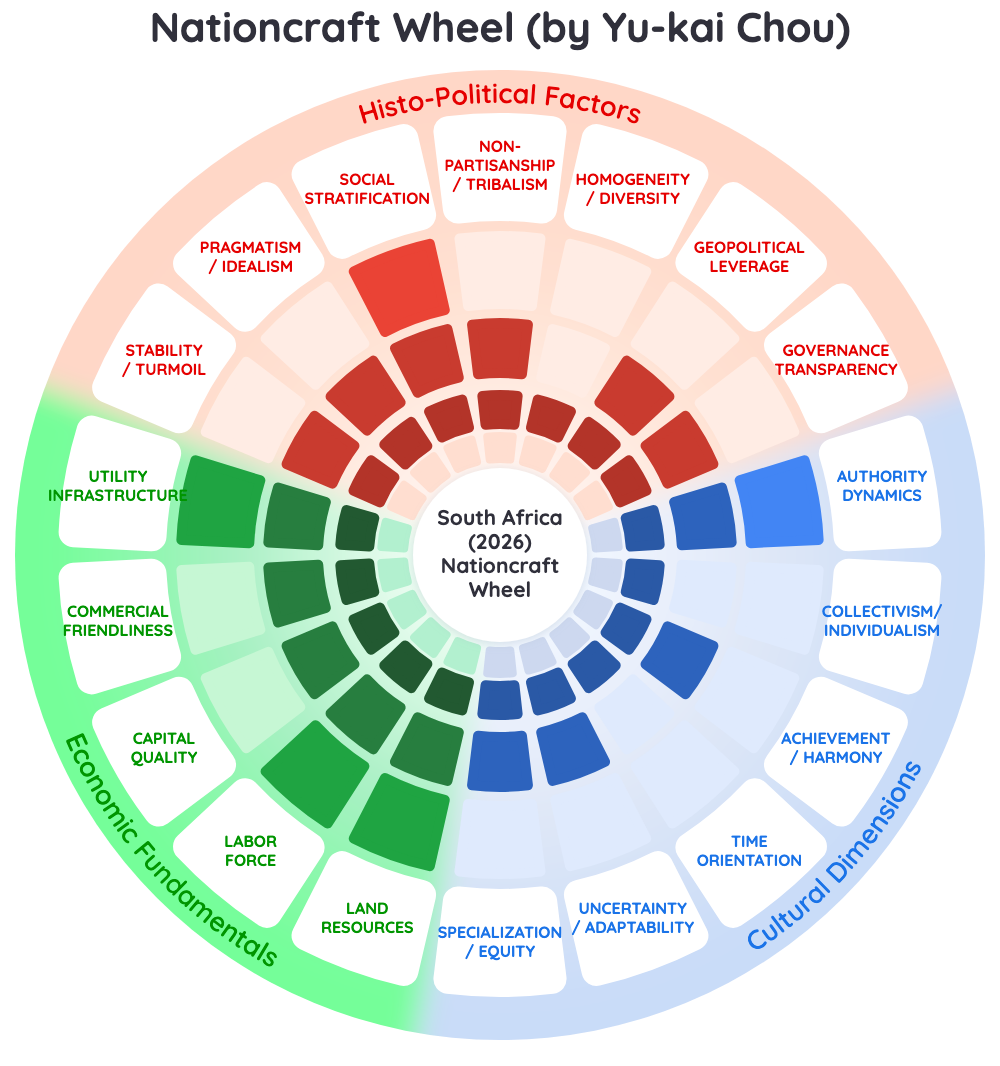
These are South Africa’s canonical Nationcraft scores. A full V-score sanity check was run on 16 August 2026 against Freedom House Freedom in the World 2026, Transparency International’s CPI 2025, the IMF’s 2024 Article IV, OECD’s 2025 Economic Survey, National Treasury budget documents, Eskom system statements and Parliamentary Budget Office data. It returned 0 MAJOR issues, so no score below has been adjusted.
| Variable | Name | Score | Reading |
|---|---|---|---|
| V1 | Authority Dynamics | 8/10 | System routes hard decisions to one commanding centre |
| V2 | Collectivism vs Individualism | 3/10 | Individualist-leaning; rights-based, litigious civil society |
| V3 | Achievement vs Harmony | 6/10 | Achievement-tilted |
| V4 | Time Orientation | 3/10 | Short horizon; electoral cycle dominates planning |
| V5 | Uncertainty & Adaptability | 6/10 | Absorbs shocks without institutional rupture |
| V6 | Specialization vs Equity | 5/10 | Equity instruments alongside meritocratic sorting |
| V7 | Stability vs Turmoil | 5/10 | Constitutionally stable, socially volatile |
| V8 | Pragmatism vs Idealism | 6/10 | Pragmatic; the GNU itself is the evidence |
| V9 | Social Stratification | 8/10 | Among the most stratified societies measured |
| V10 | Non-Partisanship vs Tribalism | 5/10 | Mid-scale; rivals can share a cabinet |
| V11 | Homogeneity vs Diversity | 3/10 | Highly diverse; 12 official languages |
| V12 | Geopolitical Leverage | 6/10 | G20 presidency and BRICS up; AGOA uncertainty down |
| V13 | Governance Transparency | 6/10 | Strong disclosure capacity, weak prosecution throughput |
| V14 | Land Resources | 8/10 | PGMs, coal, gold, agriculture |
| V15 | Labor Force Quality | 7/10 | Bimodal; world-class stratum above a large excluded majority |
| V16 | Capital Quality | 6/10 | JSE depth, independent SARB, sophisticated banking |
| V17 | Commercial Friendliness | 6/10 | Improving with open-access rail; administratively heavy |
| V18 | Utility Infrastructure | 7/10 | Recovered sharply from the 2023 trough |
Read the shape, not the scores. Four variables carry the whole diagnosis: V1 8/10, V4 3/10, V9 8/10, V11 3/10. Everything else is context.
The Empty Chair Trap
Here is the mechanism in one paragraph.
A V1 Authority Dynamics score of 8/10 does not mean “the country has a dictator.” It means the institutional grammar assumes a single authoritative centre. Closed-list proportional representation means members of parliament answer to party lists rather than to constituencies. Cadre deployment means senior administrative posts are filled through a party centre. Budget authority, state-owned enterprise oversight and provincial intervention powers all concentrate upward. When something genuinely hard needs deciding, every path terminates at the same chair.
For thirty years, one party occupied that chair, and the debate was about what it did there.
Since June 2024, the chair has been occupied by a coalition. And a coalition is not a smaller version of a single authority. It is a structurally different object: it can veto, but it cannot originate. Any decision that imposes concentrated costs on one partner’s base gets vetoed by that partner, because the partner’s only asset going into 4 November 2026 is differentiation.
The result is not bad decisions. It is an absence of decisions in exactly the places where V1 8/10 wiring insists a decision must be made centrally.
The 2025 Budget is the clean demonstration. National Treasury proposed a VAT increase from the standing 15% rate. The proposal was reduced from a reported two percentage points to half a point, then abandoned entirely: on 24 April 2025 government announced VAT would remain at 15% from 1 May 2025, and the Budget was re-tabled on 21 May 2025 without it.3 A national budget went through multiple tablings in a single year, not because anyone thought the fiscal arithmetic was wrong, but because no actor could impose a concentrated cost and survive the coming municipal vote.
That is V4 Time Orientation 3/10 meeting V1 8/10 in a room with no single decider. It is a close cousin of the dynamic diagnosed in the France fragmentation trap, where a fragmented assembly converts every budget into a confidence question, and of the Kosovo coalition stalemate, where formation itself becomes the governing activity.
South Africa’s version is milder in one specific respect, and that matters. V10 Non-Partisanship 5/10 sits at mid-scale, well above Nigeria’s 1/10 or the United States’ 2/10. South African rivals genuinely can sit in one cabinet without the arrangement becoming performance art. The GNU has survived a budget crisis, National Health Insurance disputes and expropriation fights without formal breakdown.
So the trap is not collapse. It is a functioning government that cannot originate.
Detailed Justifications: The Variables That Do the Work
V1 Authority Dynamics: 8/10
The score describes the wiring, not the occupant. That is the distinction most 2026 analysis misses. Closed-list PR, cadre deployment, centralised SOE oversight and constitutional intervention powers all point authority up the same channel. The 2024 election did not rewire any of that; it removed the actor at the top of the channel. A country with a low V1, Sweden at 3/10 or the Netherlands at 4/10, handles a coalition comfortably because its institutions were designed to distribute decisions in the first place. South Africa’s were not.
V4 Time Orientation: 3/10
At 3/10 South Africa plans on the same horizon as Nigeria (3/10) and the United States (3/10), against Singapore and Japan at 10. This is the variable that converts a survivable coalition into a stuck one. With a hard-gazetted election date on 4 November 2026, every partner’s dominant strategy is to bank visible wins and refuse invisible ones. Reforms that pay off in 2029 have no constituency inside the cabinet room. The same short-horizon pathology drives the Brazil renewal deficit, where each administration spends its capital undoing the last one’s signature programme.
V9 Social Stratification: 8/10
Official unemployment was 32.6% in 2024 on OECD figures, and the expanded rate, which counts discouraged work-seekers, was 41.9% in the fourth quarter of 2024 according to the Parliamentary Budget Office.4 Roughly two in five working-age South Africans who want work are outside it. V9 at 8/10 is not a moral observation; it is a constraint on what reform can survive. Any packet that front-loads pain has to be absorbed by households with no buffer, which is why austerity-first sequencing has such a poor record in high-V9 states. The Romania austerity backlash is the recent European illustration of the same arithmetic.
V11 Homogeneity vs Diversity: 3/10
Twelve official languages and no majority group. In Nationcraft terms, a low V11 removes the fallback that lets high-V1 states survive an empty chair: there is no default shared identity that quietly supplies legitimacy when the formal authority is contested. Japan at V11 9/10 can tolerate weak central direction for years because social coordination happens beneath politics. South Africa cannot borrow that.
V13 Governance Transparency: 6/10
The gap inside this score is the interesting part. South Africa produces world-class disclosure: the Zondo Commission documented state capture in forensic detail, the Auditor-General publishes damning municipal audits annually, and the press reports both without restriction. Transparency International’s CPI 2025 nonetheless put South Africa at 41/100 and rank 81 of 182, unchanged year on year.5 Disclosure without consequence produces exactly that: the country knows precisely what happened and prosecutes little of it. The National Prosecuting Authority Amendment Act of 2024, which established the Investigating Directorate against Corruption as a standing unit inside the NPA, is the structural response, and it is the right shape: it converts a presidential proclamation into a standing institution.6
V18 Utility Infrastructure: 7/10, and the proof of the thesis
This is the variable that swung, and how it swung is the most important evidence in this analysis.
In the 2023/24 financial year, South Africa had 33 loadshedding-free days and 2,321.3 hours of loadshedding. In 2024/25, it had 348 loadshedding-free days, with electricity available roughly 96.4% of the time.7 Eskom reported 105 consecutive loadshedding-free days as at 29 August 2025 and 175 consecutive days as at 7 November 2025, with month-to-date Energy Availability Factor at 71.50%.8
That turnaround happened under a weaker government than the one that presided over the collapse. Same engineers, same balance sheet, worse parliamentary arithmetic, opposite outcome.
What changed was venue. The Electricity Regulation Amendment Act 38 of 2024 restructured the market, and the National Transmission Company South Africa was launched on 7 October 2024 as a separated entity with its own board and mandate.9 Decisions about grid access and generation procurement stopped terminating at the contested political chair and started terminating at a chartered technical one.
Freight rail repeated the pattern. The final Network Statement was published in December 2024, and eleven private operators have been conditionally approved across 41 routes on six corridors, with Transnet guiding to 168 Mt of rail volumes in 2025/26.10 Still far below the network’s historic capacity, and Transnet’s own debt reached R144.8 billion by March 2025, but the direction reversed, and it reversed through the same mechanism.
Two sectors, one method: take the decision out of the empty chair and bind it to a rule.
Strategic Implications
| Structural fact | What it forecloses | What it opens |
|---|---|---|
| V1 8/10 with a coalition occupant | Any reform requiring a single decisive centre to absorb political cost | Reforms that relocate the decision into a chartered institution |
| V4 3/10 with a gazetted 4 Nov 2026 date | Anything whose benefits land after the municipal vote | Sequencing that front-loads a visible win to buy the next horizon |
| V9 8/10 | Austerity-first and shock-therapy sequencing | Employment-side reform where the first beneficiary is the excluded majority |
| V11 3/10 | Appeals to a shared national default in place of formal authority | Explicit, rule-bound bargains that do not depend on trust |
| V13 6/10 (disclosure ≫ prosecution) | More commissions of inquiry as a reform strategy | Permanent prosecutorial capacity with independent tenure |
| V15 7/10 + V16 6/10 | Blaming outcomes on missing capability | Technical delivery vehicles staffed from the existing professional stratum |
The strategic read is narrow and, I think, unusually actionable. South Africa’s reform space in 2026 is not defined by what is desirable. It is defined by what can be decided without a decider.
Five Reformer Playbooks South Africa Should Reject
Each of these is a real, documented Success Packet that worked somewhere. Each fails against South Africa’s 2026 V-vector for a specific structural reason.
| Packet | Country / period | Requires | Why it misfits South Africa 2026 |
|---|---|---|---|
| SP-051 | Saakashvili Reform Packet, Georgia 2004-2012 | Unitary post-revolutionary mandate | No actor can supply one; V9 8/10 has no shock absorber |
| SP-005 | Poland Shock Therapy, 1990-2004 | A credible external anchor and a compressed pain window | No EU-equivalent anchor; V4 3/10 cannot hold the window open |
| SP-102 | Thatcher Neoliberal Revolution, UK 1979-1990 | A single-party executive majority | The GNU is the precise inverse of the precondition |
| SP-002 | Lee Kuan Yew Industrialization, Singapore 1965-1990 | V2 collectivism 8/10, V4 long horizon 10/10, small homogeneous polity | South Africa is V2 3/10, V4 3/10, V11 3/10, inverted on all three carriers |
| SP-014 | Chicago Boys Reform Packet, Chile 1975-1990 | Insulation of technocrats from electoral accountability | Constitutionally unavailable, and the Chile mano dura mirage documents the long-run bill |
SP-051: Saakashvili Reform Packet (Georgia, 2004-2012)
Georgia in 2003 was a failed state: roughly 70% of the economy informal, police entirely corrupt, daily blackouts. The Rose Revolution produced the most radical anti-corruption and deregulation programme attempted anywhere, and it worked. It is the packet most often recommended to South Africa by people impressed with the Zondo findings.
It does not fit, for two reasons. Saakashvili fired the entire traffic police in one act because a revolutionary mandate let him. South Africa’s V1 8/10 wiring assumes such authority exists but its 2026 occupancy means no one holds it. And Georgia absorbed the transition pain across a population that was already at the bottom; South Africa’s V9 8/10 means the pain lands on 41.9% expanded unemployment with no cushion beneath it.
SP-005: Poland Shock Therapy (1990-2004)
Balcerowicz worked because the EU accession process supplied both an external anchor and a deadline that survived changes of government. South Africa has no equivalent. AGOA renewal has stalled and South African participation was in doubt through late 2025, which is the opposite of an anchor: it is a source of additional uncertainty. Without an anchor, V4 3/10 closes the pain window before the gains arrive. The Bulgaria borrowed-anchor trap is the study of what happens when the anchor is real but the domestic horizon is short; South Africa has the harder version, where the anchor is absent too.
SP-102: Thatcher Neoliberal Revolution (United Kingdom, 1979-1990)
Comprehensive privatisation of state-owned enterprises, monetarist inflation control and legislative weakening of union power. Every element of that packet presupposes a governing party that can legislate against a mobilised interest group and win the next election anyway. The GNU cannot legislate against any of its own members’ bases. Recommending SP-102 to South Africa in 2026 is recommending the one thing the arithmetic forbids.
SP-002: Lee Kuan Yew Industrialization (Singapore, 1965-1990)
The most-cited packet in governance discourse, and the worst structural match here. Singapore ran V2 collectivism at 8/10, V4 time orientation at 10, V6 specialization at 9/10 and a small, dense, largely coordinated polity. South Africa inverts three of those four. The Singapore LKY packet stress test works through why the packet travels so badly even to countries that admire it.
SP-014: Chicago Boys Reform Packet (Chile, 1975-1990)
Technocratic insulation delivered real macro results and a distributional legacy Chile is still litigating fifty years later. South Africa’s constitutional order makes the insulation unavailable, and its V9 8/10 makes the legacy unaffordable. This one is rejected twice over.
Three Best-Match Historical Packets
The fitting packets share one property. None of them depends on a strong leader. All of them bind a contested decision to a rule.
| Packet | Country / period | Mechanism | V-fit with South Africa 2026 |
|---|---|---|---|
| SP-004 | Botswana Diamond Management, 1966-1999 | Resource revenue bound to a fiscal rule outside annual politics | V1 7/10 and V9 8/10 both near-identical to South Africa; V14 8/10 resource base matches |
| SP-017 | Post-Franco Transition, Spain 1975-1986 | Pacted transition; explicit multi-party bargains; guarantor institutions | Designed for exactly the empty-chair condition; low-trust, multi-bloc, no single decider |
| SP-113 | Flexicurity Labor Market, Denmark 1994-2005 | Employment security decoupled from job security; tripartite rule-setting | Directly addresses V9 8/10 and V15 7/10 bimodality without front-loading pain |
SP-004: Botswana Diamond Management Packet (1966-1999)
Botswana is the closest structural sibling in the corpus. It runs V1 at 7/10 against South Africa’s 8/10, V9 at 8/10 identical, V4 at 5/10, a longer horizon, and that difference is the lesson rather than a disqualifier.
What Botswana did was remove mineral revenue from annual political discretion and bind it to a sustainable-budget rule that successive governments inherited rather than renegotiated. The rule was the decider. No individual had to spend capital defending it each year, because defending it was not on the agenda.
South Africa’s application is not diamonds. It is the fiscal framework itself. The 2025 budget episode showed that a discretionary annual VAT decision cannot survive the GNU. A binding, multi-year fiscal rule with an independent scoring body would move the same decision out of the empty chair. This is the same structural insight the Zambia model-debtor analysis reaches from the debt-restructuring side.
SP-017: Post-Franco Transition Packet (Spain, 1975-1986)
This is the packet built for the empty chair. Spain after Franco had a vacated authoritative centre, deep ideological division, low inter-bloc trust and no single actor able to impose an outcome. The packet’s mechanism was the pacted transition: explicit written bargains between rivals, a guarantor institution standing outside the party contest, and a deliberate agreement about which fights would not be had during the transition window.
The corpus records what worked: the monarch’s role as guarantor of the transition, a pacted process that avoided violent rupture, an autonomy settlement that defused separatism, and an external anchor that supplied framework and incentives. It also records the controversial part: the “forgetting pact” that bought reconciliation at the cost of accountability, which is precisely the trade South Africa already made once in SP-048 and should not repeat.
The transferable element is narrower and cleaner: write the coalition bargain down, and put a guarantor outside the parties on the enforcement. South Africa’s GNU operates on a thin statement of intent. Spain’s transition ran on documents. A country at V11 3/10 with no shared default identity cannot rely on the unwritten understandings that a homogeneous polity can. The Lebanon power-sharing trap is the cautionary version, a written settlement that froze the sects instead of sequencing them, so the pact has to be time-boxed to the transition rather than made permanent.
SP-113: Flexicurity Labor Market Packet (Denmark, 1994-2005)
Denmark’s flexicurity model decoupled employment security from job security: employers got genuine flexibility to hire and fire, workers got portable income support and active retraining, and the terms were set tripartitely rather than imposed. It sits inside the corpus Labor Market Modernization Playbook (PB-07) as the primary evidence base.
South Africa’s V9 8/10 and its bimodal V15 7/10 are precisely the problem flexicurity is shaped for: a protected insider labour market sitting on top of a 41.9% expanded-unemployment outsider population. The usual objection is that Denmark ran V9 at 3/10 and could afford generous transfers. That objection is real and constrains the scale, not the shape.
The structural reason it fits the empty chair is that tripartite rule-setting does not require a commanding centre. It requires a table. South Africa already has the institution for it in NEDLAC, and V10 5/10 says the parties can actually sit at one.
Governance Strategy Recommendations
Four moves, in sequence. The sequence matters more than the content, because V4 3/10 means the window is short and the first move has to buy the second.
1. Extend the venue-shift method deliberately, before November. Electricity and rail were not a strategy; they were two improvisations that happened to share a method. Name the method, and apply it to the next two candidates, water infrastructure and municipal revenue collection, while the evidence is fresh and both major partners can claim credit. This is the visible win that funds everything after it.
2. Bind the fiscal framework to a rule with independent scoring. The 2025 budget sequence proved that annual discretionary consolidation cannot survive a coalition at V4 3/10. A multi-year rule with an independent fiscal institution scoring compliance converts a recurring political crisis into a technical report. SP-004 is the precedent.
3. Write the coalition bargain down and time-box it. A pacted agreement per SP-017: what will be decided jointly, what each partner may differentiate on publicly, what will not be reopened before 2029, and who arbitrates. At V11 3/10 there is no shared default to fall back on, so the bargain has to be explicit. Time-boxing is what prevents the Lebanon outcome.
4. Take the employment reform to NEDLAC, not to cabinet. SP-113’s mechanism is the table, not the policy. Routing labour-market modernisation through tripartite negotiation removes it from the empty chair entirely and gives it a legitimacy the cabinet cannot currently confer.
What is deliberately absent from this list: a grand national dialogue, a new commission of inquiry, and a constitutional amendment. All three route back to the chair. At V13 6/10 South Africa’s binding constraint is not that it lacks findings: it is that findings do not convert. Another inquiry adds disclosure to a country already drowning in it.
Comparative Context
South Africa’s profile sits in a specific neighbourhood, and the comparisons cut in useful directions.
Against Nigeria (V1 9/10, V9 8/10, V10 1/10, V4 3/10): the same stratification and the same short horizon, but Nigeria’s V10 at 1/10 makes cross-factional cooperation nearly impossible. South Africa’s 5/10 is its single largest structural advantage over its continental peer, and the Nigeria reform dividend trap shows what happens when reforms are executed without it.
Against India (dominant party loses its majority, governs in coalition): the closest recent analogue in mechanism. The India mandate trap examines a governing party discovering that a coalition mandate cannot be spent like a majority one. India’s advantage is a longer time horizon; its disadvantage is a more centralised executive habit.
Against Malaysia: a reform coalition of former rivals that found itself unable to deliver the reform that formed it. The Malaysia reformasi coalition trap is the closest cautionary case for the GNU specifically, and its lesson is that a coalition’s founding promise decays fastest in its first electoral test.
Against Kenya: the Kenya concession trap documents a government that reverses under pressure and thereby teaches the street that pressure works. South Africa’s VAT reversal has the same structure. It was the right outcome and a costly precedent, and the GNU has not yet reckoned with the second half of that sentence.
Against Botswana and Namibia: the two Southern African liberation-to-governance cases in the corpus. Namibia’s SWAPO packet (SP-057) records peaceful transition, institutions that held, and mining revenue captured, a milder version of South Africa’s own SP-048 arc. Botswana’s SP-004 is the one that solved the discretion problem, which is why it leads the fit list rather than the comparison section.
The Nationcraft Framework in Practice
Everything above follows one Nationcraft discipline: diagnose the structure first, then filter the packet library against it, and treat rejection as the primary output.
The reason this matters for South Africa specifically is that the country attracts more unsolicited reform advice than almost any other middle-income state, and most of it is structurally illiterate. Recommending Singapore’s packet to a V2 3/10, V4 3/10, V11 3/10 country is not a difference of opinion. It is a category error. So is recommending Thatcher’s packet to a coalition, or Saakashvili’s to a society with no shock absorber.
The Nationcraft Framework does not tell South Africa what it should want. It tells South Africa which of the things it already wants are reachable from where it actually stands. That is a smaller claim than most governance advice makes, and a considerably more useful one.
The 4 November 2026 result will change the arithmetic again. It will not change V1 8/10, V9 8/10 or V11 3/10, and it will not fill the chair. The reform method that has already worked twice in this country, moving the decision and binding it to a rule, is the one that survives whatever the municipal count produces.
Explore More Nationcraft Analyses
The full library of country diagnostics, each built on the same 18-variable method, is at Nationcraft country analyses. Closely related to this one:
- Nationcraft Analysis: Nigeria Reform Dividend 2026. The continental peer with the same stratification and a worse cohesion score.
- Nationcraft Analysis: India Mandate Trap 2026. A dominant party learning to spend a coalition mandate.
- Nationcraft Analysis: Ghana Bailout Cycle 2026. What happens when fiscal discipline is a programme rather than a rule.
Frequently Asked Questions
What is the Empty Chair Trap?
It is the condition where a country’s institutions are built to route hard decisions to a single commanding authority (V1 Authority Dynamics 8/10 in South Africa’s case) but no actor holds that authority. The failure mode is not bad decisions. It is decisions that never get made, because the wiring offers no alternative venue.
Is South Africa’s Government of National Unity going to collapse?
The Nationcraft reading says paralysis is likelier than collapse. V10 Non-Partisanship at 5/10 is high enough for rivals to share a cabinet, and V8 Pragmatism at 6/10 keeps both major partners attached to office. The binding risk is V4 Time Orientation at 3/10: every partner optimises for 4 November 2026 rather than for anything maturing after it.
Why does the Nationcraft Framework reject shock therapy for South Africa?
Shock-therapy packets such as SP-051 (Georgia) and SP-005 (Poland) need a unitary mandate able to absorb 18 to 36 months of unpopularity, plus ideally an external anchor holding the window open. South Africa’s V1 8/10 wiring assumes that mandate exists but the 2024 result means no actor can supply it, and V9 8/10 means the pain lands on households with no buffer.
What actually worked in South Africa in 2024 and 2025?
Electricity and freight rail, and both worked the same way. The decision moved out of the contested political chair into a chartered technical entity: the National Transmission Company South Africa launched 7 October 2024, and the rail Network Statement published December 2024. Eskom went from 33 loadshedding-free days in FY2023/24 to 348 in FY2024/25.
Which historical packets fit South Africa’s 2026 profile?
Three: SP-004 (Botswana Diamond Management, 1966-1999), SP-017 (Post-Franco Transition, Spain 1975-1986), and SP-113 (Flexicurity Labor Market, Denmark 1994-2005). Each binds a contested decision to a rule or a table instead of to a person, which is the only class of reform an empty chair can carry.
What are the Nation Variables?
They are the 18 structural dimensions of the Nationcraft Framework, each scored 1 to 9, covering authority, culture, cohesion, resources and state capacity. Scores are never averaged, because configuration is strategy. The framework matches a country’s V-vector against 140 documented Success Packets to identify which reforms have historically worked under comparable structural conditions.
Related Reading
- The Nationcraft Framework: the 18 Nation Variables and how packet-matching works.
- Nationcraft Country Analyses: the full published library.
- Nationcraft Analysis: Venezuela Reform Playbooks 2026
- Nationcraft Analysis: Malaysia Reformasi Trap 2026
- Nationcraft Analysis: Bosnia Dayton Deadlock 2026
- Nationcraft Analysis: Kosovo Coalition Stalemate 2026
Footnotes
- Municipal election date set for 4 November 2026, announced 30 April 2026. Electoral Commission welcomes the announcement of 4 November 2026 as the date for upcoming Local Government Elections, South African Government; SAnews: President sets 4 November 2026 as date for Local Government Elections. ↩
- 2024 National Assembly results and presidential election, 29 May and 14 June 2024. 2024 South African general election. ↩
- 2025 Budget: VAT held at 15% from 1 May 2025; Budget re-tabled 21 May 2025. National Treasury. ↩
- Expanded unemployment 41.9%, Q4 2024. Parliamentary Budget Office, Quarterly Economic Brief, March 2025. Official rate 32.6% (2024) per IMF 2024 Article IV. ↩
- CPI 2025: 41/100, rank 81 of 180. Transparency International, Corruption Perceptions Index 2025: South Africa. ↩
- National Prosecuting Authority Amendment Act, Act No. 10 of 2024, assented 27 May 2024 (Government Gazette No. 50713), establishing the Investigating Directorate against Corruption. Department of Justice and Constitutional Development. ↩
- FY2023/24 and FY2024/25 loadshedding comparison. Eskom generation recovery statement. ↩
- Consecutive loadshedding-free days and Energy Availability Factor, 2025. Eskom system performance statement. ↩
- Electricity Regulation Amendment Act 38 of 2024. South African Government legislation portal. National Transmission Company South Africa launch, 7 October 2024: NTCSA official launch media statement. ↩
- Rail open-access reform and 2025/26 volume guidance. Transnet; OECD electricity-sector reform context in OECD Economic Surveys: South Africa 2025. ↩