

Actionable Gamification Book: Yu-kai Chou’s Octalysis Framework

Actionable Gamification: What the Book Covers and Why Teams Still Use It
Most gamification books stop at points, badges, and leaderboards. Actionable Gamification was written to explain what actually drives behavior underneath those surface mechanics.
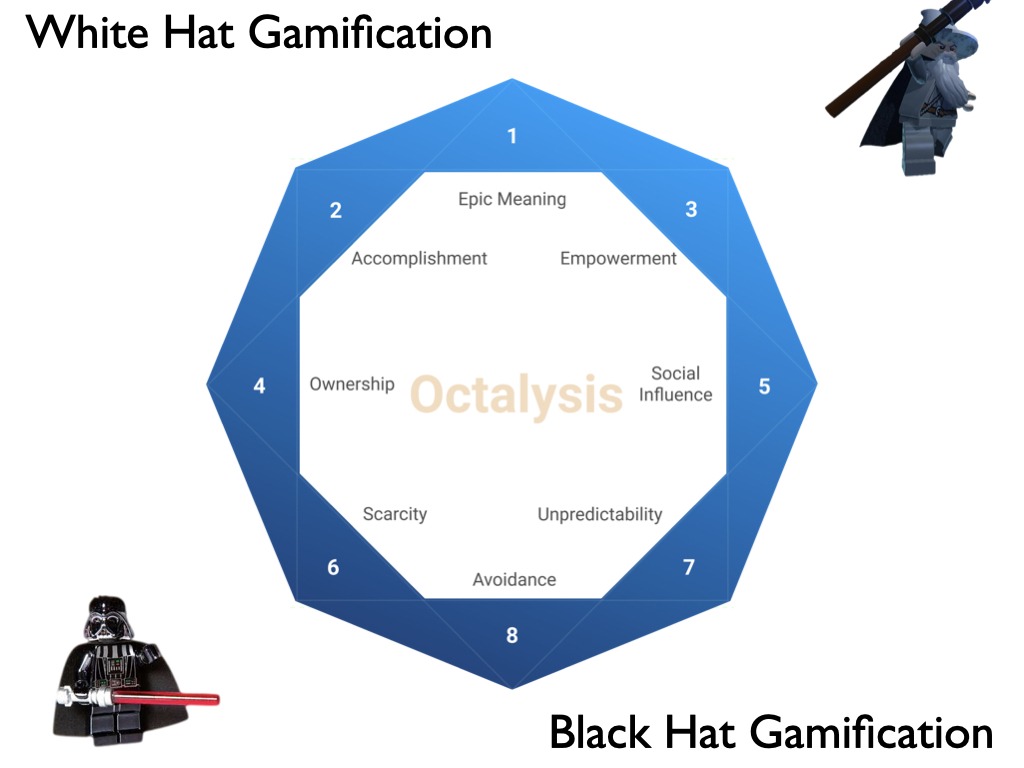
Yu-kai Chou uses the Octalysis Framework to break motivation into 8 Core Drives, then shows how those drives shape products, workplaces, education, loyalty, and community design. The result is a working model of why people choose to return, contribute, and care, and what to design once you understand that.
⚡ Speed Run Notes
- Best for: product teams, UX designers, educators, loyalty strategists, and community builders.
- Main promise: understand the human motivation underneath the surface mechanics.
- Core model: the 8 Core Drives of the Octalysis Framework.
- Good fit if: you want a practical framework with case examples, more than motivational theory.
- Formats: print, audiobook, and digital editions are all available.
Table of Contents
- What the book actually teaches
- Proof and context
- Selected endorsements
- Reader reactions
- Who this book helps most
- Choose your format
Yu-kai Chou is the creator of the Octalysis Framework and the author of Actionable Gamification and 10,000 Hours of Play.
His work on behavioral design has been referenced by organizations and publications including Harvard Business Publishing, MIT research, Yale SOM, Wired, and The Wall Street Journal.
For readers who want the broader context around Yu-kai’s books, talks, and research references, the best hub is Books by Yu-kai Chou plus the source roundup on academic and government citations.
About the Creator of the Octalysis Framework

Yu-kai Chou is the original creator of the Octalysis Framework and the author of the book this page is about, Actionable Gamification: Beyond Points, Badges, and Leaderboards. He has been working on gamification design since 2003 — years before the term entered mainstream vocabulary — and his framework has been applied by LEGO, Microsoft, Porsche, Coca-Cola, Salesforce, and MrBeast, impacting over 1.5 Billion Users.
Chou has taught the Octalysis methodology at Harvard, Stanford, Yale, Google, BCG, and IDEO.
What the Book Actually Teaches
The central argument is simple. If a design only manipulates extrinsic rewards, it may create short bursts of activity but it usually fails to create durable engagement.
Actionable Gamification gives readers a framework for diagnosing that problem. Instead of asking, “What badge should we add?”, it asks, “Which human drives are active here, and which ones are missing?” That shift is what made the book useful to product teams, educators, and consultants in the first place.
The 8 Core Drives covered in the book:
- 🎯 Epic Meaning & Calling — people feel part of something bigger than themselves.
- 🏆 Development & Accomplishment — progress, mastery, and visible improvement.
- ⚡ Empowerment of Creativity & Feedback — experimenting, building, and seeing the result.
- 📦 Ownership & Possession — control, investment, and attachment.
- 👥 Social Influence & Relatedness — belonging, mentorship, comparison, and community.
- ⏰ Scarcity & Impatience — valuing what is limited, gated, or just out of reach.
- 🎲 Unpredictability & Curiosity — staying engaged because the next moment still feels open.
- ⚠️ Loss & Avoidance — protecting progress, status, or momentum.
The book also distinguishes between White Hat and Black Hat motivation, so readers can design for long-term trust instead of short-term compulsion.

Proof and Context
The book’s reach is easy to verify. Here are the most useful places to check it.
- Sales context: Yu-kai keeps a public roundup on verifying major claims and numbers, including the book’s Amazon #1 Bestseller ranking.
- Academic and professional references: see examples from Harvard Business Publishing, MIT, Lawrence Berkeley National Laboratory, and NCBI.
- Teaching context: Yu-kai’s work has also been cited in settings like Yale SOM and U.S. Department of Education research.
- Book listing: readers who want storefront reviews and current edition details can use the main Amazon page.

Selected Endorsements
Susie Wee — Former VP of Cross-Product Experiences at Google
“Octalysis is a powerful and pragmatic framework to understand human nature and positive motivators that encourage people to do their best work.”
David Webster — Head of UX, Google Labs (formerly Partner & Executive Director, IDEO)
“Yu-kai’s Octalysis framework is a powerful addition to the tool kit of any creative professional. It provides a designer-friendly structure to connect information and insights with just the right amount of rigor to provoke fresh ideas.”
Chuck Pickelhaupt — VP of Emerging Technology R&D, Fidelity Investments
“Yu-kai’s book makes gamification practical. It is chock full of specific examples, suggestions for implementations, and pitfalls to avoid.”
Nir Eyal — Author of Hooked
“Yu-kai is at the cutting edge of the field of behavioral design.”
Reader Reactions
The strongest reader feedback on this book tends to sound like relief. People finally get a vocabulary for motivation they can actually use.
Simon (Verified Purchase):
“Before this book, I used to think ‘motivation’ was a single thing that worked the same way for everybody. Now, I will never see it like that anymore, but instead as a powerful tool to drive people’s behavior in pretty much any field or market.”
Moon Park (Verified Purchase):
“This was an inspiring and eye opening book. Chou does a great job of clarifying and classifying human motivation.”
Ian Mann (International Strategy Consultant):
“If gamification is justifiable in any part of your business, this book is a good, basic, starter’s guide.”
For the current storefront review feed, use the Amazon listing.
Who This Book Helps Most
- Product and UX teams that want a framework for diagnosing weak engagement loops.
- Educators and learning designers who need motivation tools beyond grades and compliance.
- Loyalty, marketplace, and community teams building systems that rely on repeat contribution.
- Consultants and strategists who need a vocabulary for explaining why one experience works and another stalls.
- Readers new to gamification who want one framework deep enough to keep using after the first read.
Choose Your Format
Print edition works well for readers who like annotating frameworks, diagrams, and case examples.
Audiobook edition fits commutes and repeat listening, especially if the goal is to absorb the Core Drives language before applying it.
Digital edition is the lightest option when you want searchable reference access while building or auditing a product.
Get Your Copy
If your real question is “why does this system motivate people at all?”, this is the right starting book.


Explore More by Yu-kai Chou
- 🎯 The Octalysis Framework — Explore the complete framework discussed in the book
- 🧠 What is Gamification? — The definitive explanation with examples
- 🎓 Top 10 Education Gamification Apps — See Core Drives in action in learning
- ⚡ Best Gamified Productivity Apps — Apply gamification to your daily workflow
- 💰 $1.06 Billion Case Study — The real-world ROI of Octalysis design
- 📊 90+ Gamification Examples — Comprehensive list of cases and stats
- 🎮 Deep Dive: The 8 Core Drives
- Core Drive 1: Epic Meaning & Calling
- Core Drive 2: Development & Accomplishment
- Core Drive 3: Empowerment of Creativity & Feedback
- Core Drive 4: Ownership & Possession
- Core Drive 5: Social Influence & Relatedness
- Core Drive 6: Scarcity & Impatience
- Core Drive 7: Unpredictability & Curiosity
- Core Drive 8: Loss & Avoidance