


What is a good reason to learn the Octalysis Framework? One answer is seeing how it was applied in the Caixa case, where public materials from Octalysis Group and Yu-kai Chou’s video breakdown describe one of the biggest gamification case studies ever shared publicly.
This is not useful because the headline number sounds huge. It is useful because it shows what happens when a complex organization diagnoses the real motivational bottleneck instead of throwing surface mechanics at a performance problem. That distinction is what separates enterprise theater from enterprise transformation.

⚡ Speed Run Notes
- A billion-dollar case study is never a mechanic win, it is a diagnosis win. The teams that move nine-figure outcomes did not find a clever reward loop. They found the correct motivation problem to solve in the first place.
- Scale exposes weak design fast. At small scale, novelty can hide a bad system. At enterprise scale, only the Core Drives that truly change behavior keep working.
- This case mattered because it changed feedback cadence, not just incentives. The design made work more visible, more social, and more immediately felt, which is exactly where most enterprise systems fail.
- The numbers need to be read carefully. Public sources use slightly different figures depending on whether they are referring to total workforce, active participants, branch count, reporting window, or exchange-rate framing. The useful lesson is not the slogan, it is the design pattern.
- The real takeaway is replicable. You may not be running a state-owned bank, but you can still learn how Epic Meaning, Ownership, progress feedback, and social collaboration were combined to make routine work feel worth doing.
Table of Contents
About Yu-kai Chou

Yu-kai Chou created the Octalysis Framework after studying gamification since 2003 — years before the term entered mainstream vocabulary. As a Human-Systems Architect & Behavioral Designer, his framework has been applied by LEGO, Microsoft, Porsche, Coca-Cola, Salesforce, and MrBeast, impacting over 1.5 Billion Users.
Chou has taught the Octalysis methodology at Harvard, Stanford, Yale, Tesla, Google, BCG, and IDEO.
His work has been cited by Harvard, Stanford, MIT, Forbes, Wall Street Journal, Wired, US Department of Energy, NIST, NSF, NCBI, US Department of Education, ClinicalTrials.gov, and Google Scholar — with 3,700+ more academic publications. Explore his books here.

The Mission Impossible Challenge
This case became memorable because the problem was brutally operational, not theoretical. Caixa had to align a huge workforce, many locations, many systems, and a demanding commercial goal inside a very short launch window.
- Yu-kai’s Part 1 breakdown describes the challenge as roughly 83,000 employees across 4,500 locations, with the company trying to reach 9 billion reals in recurring profit and giving the team about 3 months to launch.
- The Octalysis Group case page uses a slightly different public framing, citing 77,000+ employees across 4,500 branches and a 49% net-income increase in six months.
- The key point is not that every public source rounds the same way. It is that all of them describe an unusually large, high-pressure enterprise rollout.
The reason this brief became a textbook case is not the size of the workforce. It is what the workforce was attached to. Caixa ran more than 70 internal systems that did not talk to each other. The launch required parallel API integration into a single gamification platform. There was no pilot. The CEO refused one. Half-measures read as half-commitment to a bank that had seen plenty of corporate initiatives die before they were measured. The team had three months to design, integrate, train, and go live across 4,500 branches at the same instant. That is the part most public summaries leave out. The math of “billion-dollar gamification” is not the part that makes this case rare. The operational courage of refusing a pilot is.
Case Study Highlights
| Public source | What it explicitly claims |
|---|---|
| Yu-kai video breakdown | Frames the rollout around roughly 83,000 employees, 4,500 locations, a 3 month launch challenge, and an outcome discussed as about US$1.06B with a 46% lift. |
| Octalysis Group case page | Uses a public framing of 77,000+ employees across 4,500 branches and describes a 49% net-income increase in six months with roughly US$1B in added revenue. |
- Public case materials describe a company-wide rollout at Caixa Econômica Federal, implemented with Funifier and framed through the Octalysis Framework.
- The public employee count varies by source, generally landing in the 76,000 to 83,000 range depending on whether the reference is total workforce or active participants. See the video overview and the Octalysis Group case page.
- The public profit framing also varies slightly by reporting window and currency conversion, with Yu-kai’s video discussing a 46% lift and the Octalysis Group case page describing a 49% increase in six months, both pointing to an outcome around US$1B+ in added annual revenue.
- Across the public tellings, Caixa moved from No. 2 to No. 1 public bank in Brazil during the period highlighted in the case.
How the Design Actually Worked
If you only know the headline, you only know that gamification “worked.” That is not useful. What is useful is the design pattern, because the pattern is what generalizes. The Caixa rollout, branded internally as “Tamo Junto 9Bi+” (informally, “9 Billion Together”), was not a points scheme. It was a layered motivation system that solved three different problems at once: how to make routine work feel visible, how to make collective effort feel like a shared mission, and how to keep employees coming back without burning them out.
The Name as an Accountability Lever
The name itself was the first design decision. “Tamo Junto 9Bi+” served six Core Drives simultaneously: Epic Meaning through “Together,” Accomplishment through a clear measurable goal, Ownership by giving employees a project to belong to, Social Influence through collective framing, Scarcity through a time-bound number, and Loss Avoidance in a way that surprised even the design team. When bureaucratic gatekeepers tried to slow the rollout, the response was simple: “This is the 9 Billion Project. The CEO is watching. If it fails, it will be clear who slowed it down.” The naming alone made the project politically expensive to obstruct.
The Mechanics That Carried the Load
Underneath the name, the system was a small library of Octalysis game techniques layered on top of real banking work:
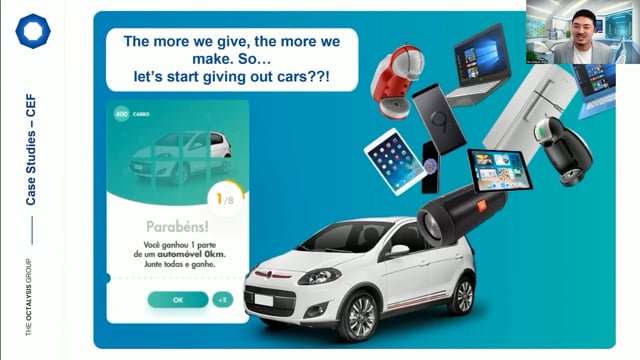
- Quest Cards. Each KPI activity, tracked through the integrated systems, dropped a collectible card. Cards were fragments of physical rewards: a quarter of a TV, a half of a coffee maker. Employees felt rewarded continuously, but the bank only paid out when an entire set was completed. That is prize pacing — the reason the program could afford to feel generous without actually being generous. More than a million instant rewards were distributed during the campaign, with hundreds of thousands of prizes redeemed by employees over the course of the rollout.
- Variable card drops. The card you earned for the same activity was not always the same card. The randomness mattered. It is the difference between routine and a system that feels alive.
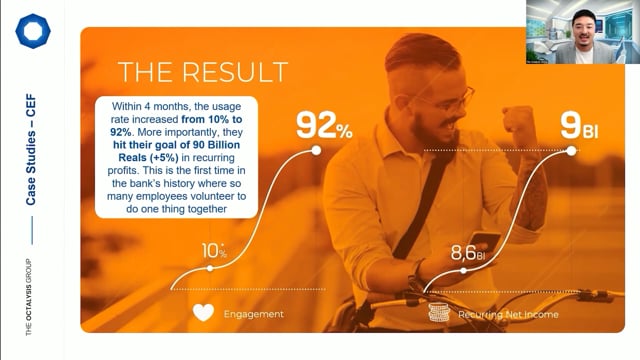
- Easter Egg instant wins. Occasionally, an employee would simply win an entire reward outright. A small contractor won a television in week one. The entire floor saw it. Coworkers who had ignored the system started playing the next morning. Voluntary participation moved from 10% to 92% — not because the program was sold harder, but because peers started winning visibly. Coworker envy is a Social Influence & Relatedness effect that Octalysis explicitly anticipates.
- Puzzle piece trading. When duplicates piled up, employees could trade across departments. The economy got more efficient. The experience got more social. Two design problems solved with one mechanic.
- The Big Burn. When major company milestones were hit, employees could burn extra pieces and convert them to lottery tickets, including a chance at a car. The Big Burn absorbed excess currency from the economy, the gamification equivalent of preventing inflation, while creating the highest-stakes engagement window of the year.
- Appointment Dynamics. New features released at scheduled moments. A floor manager later told the design team that she once heard every phone on her floor ring at the same instant — 60,000 employees had set alarms for a feature unlock. So many logged in at once that the servers nearly fell over. Expensive on infrastructure. Cheap on engagement.
Why the System Did Not Burn Out
The Caixa design uses heavy Black Hat mechanics: scarcity, FOMO, randomness, lottery. On their own, those mechanics produce short-term spikes followed by collapse. Caixa avoided that pattern because the Black Hat layer was sitting on top of a White Hat foundation. Real progress was visible. Mastery was earnable. Ownership of the cards and the project was genuine. Employees who had previously felt invisible to management now had their work tracked, recognized, and celebrated in real time. That is the part that compounds. Year-one profits rose 48% from 8.6 billion to 12.7 billion reais. By 2021, recurring profits had doubled from the 2017 baseline, with no observed burnout, even through COVID. The takeaway is not that Black Hat is fine. It is that Black Hat without White Hat collapses, and White Hat without Black Hat is too quiet to move a workforce of 83,000.

The three drives at the top of the octagon are the foundation Caixa built first: meaning, visible progress, and real choice. The three at the bottom are the urgency layer that made 83,000 people actually move.

Watch the Full Breakdown
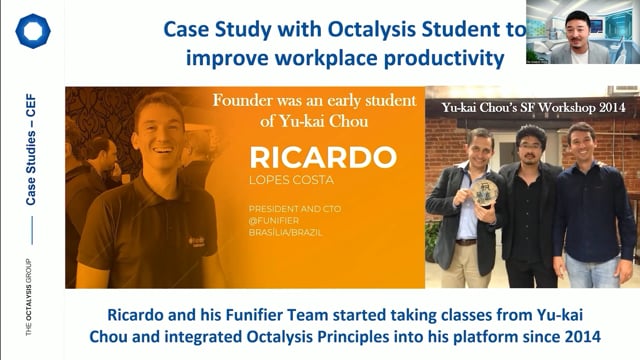
The full public walkthrough is split into three videos. If you want the operational context instead of just the headline number, these are worth watching:
Which Core Drives Powered It
This case was not about sprinkling points on top of banking work. It was about using motivation design to change how effort was framed, tracked, and socially reinforced.
- Epic Meaning & Calling: “Tamo Junto 9Bi+” framed routine work as a shared mission, not a stack of isolated quotas.
- Development & Accomplishment: KPI activity from 70+ legacy systems became visible and trackable in real time. Effort produced legible progress for the first time.
- Empowerment of Creativity & Feedback: Trade-or-burn decisions in Phase 2 and Phase 3 gave employees real strategic choice in how to play the system, not a single fixed loop.
- Ownership & Possession: Partial card sets created psychological ownership of the unfinished puzzle. People do not abandon three-quarters of a TV.
- Social Influence & Relatedness: Cross-department trading turned the system into a shared social space. The Easter Egg moment converted lurkers via visible peer wins.
- Scarcity & Impatience: Time-bound 9B target. Rare cards inside sets. Locked phases that opened only when company-wide milestones were hit.
- Unpredictability & Curiosity: Random card drops, Easter Egg instant wins, the lottery feature. The slot-machine layer that kept routine work alive.
- Loss & Avoidance: “Do not waste the three-quarters of a TV you already earned.” The 9B accountability framing also weaponized this drive against gatekeepers — failure would name them publicly.
That is why this case is more useful than a generic “points, badges, leaderboards” example. It shows how the White Hat side of gamification can scale in a workplace when the design is built around meaning, visibility, mastery, and social momentum.
“Gamification is fundamentally about understanding human motivation. The technology is just the delivery mechanism.”
— Yu-kai Chou, from Actionable Gamification
Reading the Numbers Carefully
The biggest mistake readers can make with this page is treating one headline number as the only story. Different public sources emphasize different cuts of the same project:
- The Part 1 video frames the result as $1.06B USD and a 46% lift, while also using the larger 83,000 employees figure.
- The Octalysis Group case page frames the public result as 49% net-income growth in six months, involving 77,000+ employees, and describes the revenue impact as about US$1B.
- The stable conclusion across both is that the rollout was huge, fast, and commercially meaningful. The exact headline depends on the reporting frame, not on whether the project mattered.
If you are citing this case, cite the line you are using right where you use it. That is the cleanest way to preserve trust on a flagship case-study page.
What Designers Should Learn
If you strip away the headline number, the deeper lesson is still strong. Great behavioral design does three things at once:
- It makes success emotionally legible.
- It tightens the feedback loop so effort feels connected to results.
- It gives people a reason to care beyond compliance.
That is why this case remains useful. It is not simply a story about a bank. It is a story about what happens when routine work is redesigned so motivation becomes part of the operating system.
One more honest note. Looking at the Caixa design after the fact, the weakest of the eight Core Drives was Epic Meaning. “Hit nine billion together” is a great rallying cry, but it still points at corporate profit. If I were redesigning this from scratch, I would tie a charitable component to the card economy. Every redeemed set could donate to local Brazilian causes — unbanked communities, regional education, public health. That single overlay would change the meaning of every card from “I am earning a TV” to “I am earning a TV and helping my country.” The design worked spectacularly without it. It would have worked even better with it. Good design that is honest about its own gap is what becomes great design the next time around.
If you want to apply this thinking to your own product, workplace, or learning system, start with the framework itself, then study more enterprise examples before designing your own mechanics.
→ See the framework that powered this case
If the Caixa rollout is the proof, the Octalysis Framework is the design system underneath it. Read the full framework explainer to see how the eight Core Drives map onto your own product, workplace, or learning system.
Related Reading
- The Octalysis Framework for Gamification & Behavioral Design
- Top 10 Enterprise Gamification Examples
- 90+ Gamification Examples & Cases with ROI Stats
- White Hat vs Black Hat Gamification
- Books by Yu-kai Chou