

Foursquare, once a dominant location-based social network, saw its user engagement plummet over time.
Its decline shares a surprising number of parallels with the initial boom and subsequent wane of another location-based phenomenon: Pokémon Go.
Both platforms initially succeeded by mastering extrinsic motivation but ultimately failed to build a sustainable, intrinsically motivated user experience. Here’s the behavioral design breakdown using the Octalysis Framework.
Author Credibility: Yu-kai Chou

Yu-kai Chou created the Octalysis Framework after studying gamification since 2003 — years before the term entered mainstream vocabulary. As a Human-Systems Architect & Behavioral Designer, his framework has been applied by LEGO, Microsoft, Porsche, Coca-Cola, Salesforce, and MrBeast, impacting over 1.5 Billion Users.
Chou has taught the Octalysis methodology at Harvard, Stanford, Yale, Tesla, Google, BCG, and IDEO.
His work has been cited by Harvard, Stanford, MIT, Forbes, Wall Street Journal, Wired, US Department of Energy, NIST, NSF, NCBI, US Department of Education, ClinicalTrials.gov, and Google Scholar — with 3,700+ more academic publications. Explore his books here.

What Foursquare Did Well: Extrinsic Motivation
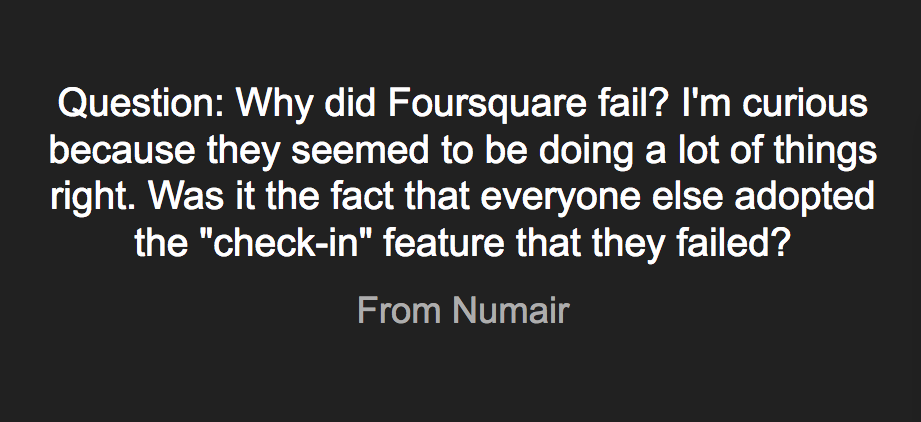
Foursquare’s early design leaned heavily on extrinsic, Left Brain Core Drives. It heavily relied on:
- Core Drive 2: Development & Accomplishment through points, badges for check-ins, and the coveted status of “Mayor.”
- Core Drive 4: Ownership & Possession by encouraging users to “own” a location by becoming its Mayor, creating a collection of visited spots.
- Core Drive 5: Social Influence & Relatedness, specifically the Black Hat elements of competition and envy, as users competed for Mayorships on public leaderboards.
This model, much like Pokémon Go’s initial “catch ’em all” collection loop, was highly effective at driving initial user actions.
But what happens when the extrinsic rewards lose their appeal?
Engagement falters when you realize you can’t realistically become the Mayor, the loyalty discounts aren’t compelling, or your friends don’t particularly care about your check-ins.
Once the novelty wears off, a system built purely on these mechanics feels like a chore.
What Foursquare Didn’t Do Well: Intrinsic Motivation
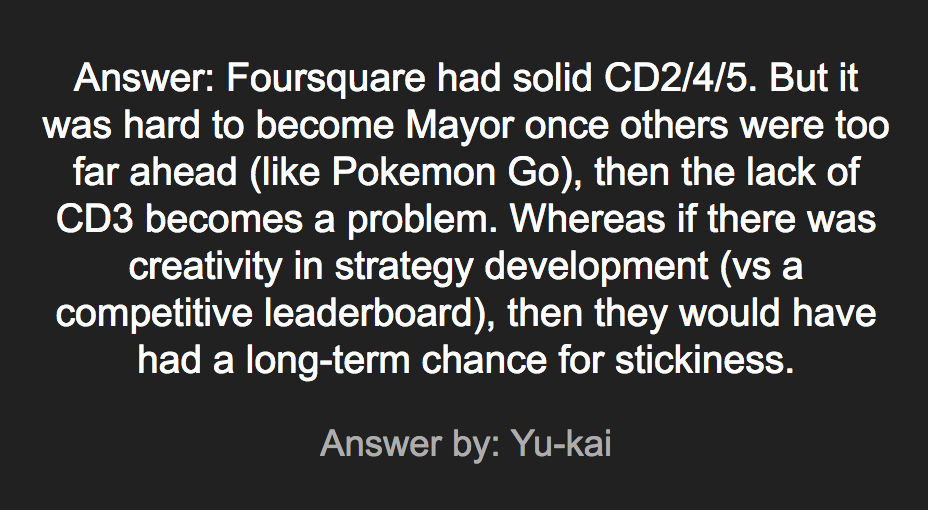
The experience lacked the Right Brain, intrinsic Core Drives needed for long-term engagement. The platform fell short on:
- Core Drive 5: Social Influence & Relatedness (White Hat): There were few meaningful tools for collaboration, mentorship, or genuine social connection beyond the competitive check-in.
- Core Drive 3: Empowerment of Creativity & Feedback: There was no meaningful strategy or creative outlet for users. The primary action was repetitive and lacked depth.
This is the same trap Pokémon Go fell into. As I analyzed in the article, “Why Pokémon GO is Failing,” the game’s design eventually turned exploration into a grind:
Walking in nature is intrinsically interesting, but Pokemon Go is making players feel like this: “now I have to go for a walk just to collect Pokemon.” The extrinsic design bias in the game motivated us to start walking in our surroundings to add to our collection set. But after a while the extrinsic motivation has completely taken over our intrinsic desire to explore our surroundings. Now going out to hunt for Pokemon feels like a chore rather than a fun game. Motivation wanes.
Foursquare suffered the same fate. Once Mayors were established, it became nearly impossible for casual users to dethrone them, killing the sense of optimistic challenge.
Without a deeper, creative, or socially meaningful layer to the experience, users lost their motivation to continue playing the “check-in game.”
Balancing Intrinsic and Extrinsic Motivation
The lesson from both Foursquare and Pokémon Go is clear: a successful long-term design requires a strong Core Activity Loop built on intrinsic motivation.
Extrinsic rewards are fantastic for the Onboarding and Discovery phases of a player’s journey, but they are not enough to sustain engagement through the Scaffolding and Endgame phases. Platforms that neglect Core Drive 7: Unpredictability & Curiosity — the delight of the unknown — will always see engagement decay once novelty fades.
A well-designed system must provide avenues for creativity, meaningful social connection, and unpredictable delight to keep users engaged for the long haul.
Related Reading
- The Octalysis Framework for Gamification & Behavioral Design
- White Hat vs Black Hat Gamification
- 4 Experience Phases of a Player’s Journey
- What is Gamification?
- 27 Game Techniques Pokemon Go Used to Capture the World
- Books by Yu-kai Chou