

April 11, 2026
I’ve sat through countless pitches about gamification. The conversation usually goes like this: “We’re adding points to our platform!” Then badges. Then leaderboards. Then… silence. Users don’t care, engagement tanks, and everyone wonders what went wrong.
The mistake isn’t gamification itself. It’s trying to build a skyscraper by only constructing the top floor.
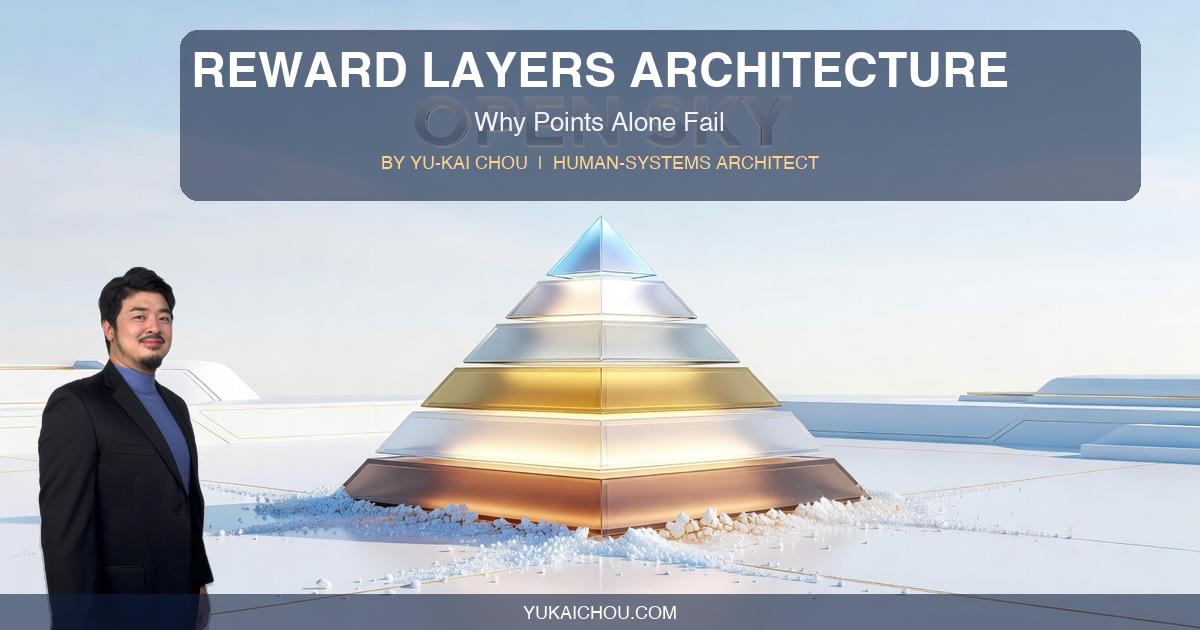
Let me introduce you to the Reward Layers Architecture. This framework changed how I think about motivation, progression, and what actually makes people keep coming back. It’s why some systems feel magnetic while others feel like pointless busywork.
⚡ Speed Run Notes
- Three reward layers exist: Real Rewards (career, money, opportunity), Meta 1 (credentials, recognition, certificates), and Meta 2 (points, badges, XP). Most gamification only builds Meta 2 and wonders why nobody cares.
- Layers must connect: Points → Badges → Credentials → Real Opportunities. Without this chain, Meta 2 rewards feel like Monopoly money: fun to accumulate, worthless to spend.
- The “skyscraper top floor” mistake: building points and badges (Meta 2) without connecting them to credentials (Meta 1) or career outcomes (Real) is like constructing a penthouse with no building underneath it.
- Points alone fail because they’re infinitely inflatable. When everyone has 10,000 points, the points mean nothing. Scarcity and meaning come from the layers above.
- The diagnostic: if removing all your gamification elements wouldn’t change user outcomes, your layers aren’t connected to anything real.
Table of Contents
- The Three Layers That Actually Matter
- The #1 Gamification Failure: Building Only Layer 3
- Why MBA Programs Actually Work
- The Temporal Bridge: Why Meta 2 Can’t Be Ignored
- The Snowball Effect at the Real Reward Layer
- Currency With 3-5 Uses: The Multiplayer Problem
- The Hades Model: Failure Must Never Equal Zero
- Worst Case Scenario Bingo: Making Rejection Fun
- The Core Insight: Points Aren’t Gamification
- Frequently Asked Questions
About the Creator of the Octalysis Framework

Yu-kai Chou created the Octalysis Framework after studying gamification since 2003 — years before the term entered mainstream vocabulary. As a Human-Systems Architect & Behavioral Designer, his framework has been applied by LEGO, Microsoft, Porsche, Coca-Cola, Salesforce, and MrBeast, impacting over 1.5 Billion Users.
Chou has taught the Octalysis methodology at Harvard, Stanford, Yale, Tesla, Google, BCG, and IDEO.
His work has been cited by Harvard, Stanford, MIT, Forbes, Wall Street Journal, Wired, US Department of Energy, NIST, NSF, NCBI, US Department of Education, ClinicalTrials.gov, and 3,700+ more academic publications. If you want to learn to design these reward layers end-to-end, the Octalysis Certificate program walks through every layer with worked case studies. Explore his books here.
The Three Layers That Actually Matter
Imagine three tiers stacked on top of each other. Each one is a different distance from your actual life, your actual goals, your actual future.
Layer 1: Real Rewards. This is the closest to your life. Job opportunities. Money in your account. A better career. A partner who loves you. These are outcomes that reshape your real world. They matter because they cascade into everything else.
Layer 2: Meta Rewards 1. One step removed. Grades. Certificates. Diplomas. Rankings. These things don’t directly pay your rent, but they’re bridges: they signal to the world that you’ve achieved something. Employers see that certificate. Universities see that grade. These prove competence to others.
Layer 3: Meta Rewards 2. The outermost layer. Points. Badges. XP bars. Leaderboard positions. These live entirely in the system. They don’t automatically translate into anything else. They’re fun, they’re immediate, they feel rewarding, but on their own, they’re hollow.
Here’s the critical insight: all three layers need to connect.

The #1 Gamification Failure: Building Only Layer 3
This is where 90% of gamification projects die.
Someone adds points. Maybe badges. Maybe an achievement system. They celebrate the launch. Three months later? Nobody’s using it. People went back to the old way of working. Or they quit entirely. Those points don’t lead anywhere. They don’t earn you recognition from peers. They don’t unlock job opportunities. They don’t increase your salary. They don’t improve your dating profile. They just… exist. Float around in the system like digital confetti.
If your Meta Reward 2 isn’t connected to Meta Reward 1, it’s background noise. And if Meta Reward 1 isn’t connected to Real Rewards, then the whole tower collapses.
I see this in corporate training constantly. “Complete these modules and earn 500 points!” Employees complete them. Nothing changes. Nobody cares about their points. There’s no certificate that helps them get promoted. There’s no recognition from leadership. There’s no path to a better job. The points are orphaned.
Here’s the deeper structural reason these systems fail: when you bolt points onto work people are already required to do, the points stop functioning as a reward and start functioning as a metric. The right design question isn’t “what should we reward with points?” It’s “what voluntary actions do we wish people did more of, and what would make them choose to do them today?” Meta 2 currency is the answer to that second question. Never the first. Reward the discretionary growth behavior, never the mandatory output.
Why MBA Programs Actually Work
Let’s look at a system that got this right, even if it wasn’t intentional.
An MBA from a top program isn’t magical because of what happens in the classroom. It’s magical because of what happens after. The program connects to every single layer.
Real Reward layer: Networking access. Direct recruiter relationships. Job placement support. Alumni networks that lead to six-figure roles. These are Real Rewards: actual career changes that reshape lives.
Meta Reward 1 layer: The diploma itself. The prestige. The signaling power. It’s a credential that matters to employers and society.
Meta Reward 2 layer: Grades matter, sure. But mostly as a means to the other two. The real draw is what you’re working toward.
The program succeeds because it obsesses over the Real Reward layer. Every decision (curriculum, guest speakers, career services, alumni events) is optimized for job placement and career growth. The credentials and grades naturally follow.
You can’t reverse-engineer this. You can’t take a terrible program with no job placement and slap prestigious-sounding grades on it and expect the same effect.
The Temporal Bridge: Why Meta 2 Can’t Be Ignored
Here’s a subtle but important piece: the timeframe for each layer is completely different.
Meta Reward 2 (points, badges, XP) operates on a fast cycle. Daily. Hourly. Sometimes by the minute. You do something, you get feedback immediately. Your brain loves this. It’s why slot machines work. It’s why checking email feels rewarding even when nothing important happened.
Meta Reward 1 (certificates, rankings, recognition) moves more slowly. Quarterly. Annually. “You’ve earned your certification.” “You’ve climbed to this rank.” The feedback loop is longer, but it still feels achievable.
Real Rewards operate on the longest timescale. Career changes take years. Serious wealth building takes decades. You can’t rely on that alone to keep someone motivated today.
This is where Meta 2 becomes essential: not because points are inherently valuable, but because they bridge the gap. They keep you engaged through the months and years it takes to reach Meta 1 and Real Rewards. Without them, people burn out before they see results.
Think about fitness. The Real Reward is being healthy, fit, attractive: outcomes that reshape your life. But that takes a year of consistent work. Meta 1 might be a five-pound loss, a new personal record, fitting into an old pair of jeans. But even that takes weeks. Meta 2 is the daily scale check, the workout streak, the calories tracked. That daily feedback keeps you showing up until you reach the larger milestones.
You need all three operating simultaneously, each at their natural speed.
The Snowball Effect at the Real Reward Layer
Once Real Rewards start flowing, the system begins to feed itself.
You get a certificate. That certificate leads to a job interview. The interview leads to a job. The job gives you access to a better professional network. That network leads to even better opportunities. Better opportunities lead to bigger achievements, which lead to more network growth.
This is self-reinforcing. This is what people actually chase. Not the points: the compounding effect of real opportunities.
I see this in venture capital. You have one successful exit. That exit gives you credibility. Credibility attracts better founders. Better founders lead to better investments. Better investments lead to more exits. The system snowballs because each Real Reward opens new doors.
The same pattern appears in sales teams that actually work. Your first closed deal leads to a case study. The case study leads to referrals. Referrals lead to easier closes. Easy closes lead to bigger deals. Bigger deals lead to team leadership opportunities. Leadership leads to equity, strategic control, better options. Each Real Reward spawns more opportunities.
But if your system only rewards the metric (only celebrates the close, only gives badges for calls made) the snowball never starts rolling. The Real Reward layer stays frozen.
Octalysis-wise, the snowball is Core Drive 2 (CD2): Development & Accomplishment compounding into Core Drive 4 (CD4): Ownership & Possession into Core Drive 5 (CD5): Social Influence & Relatedness. Each Real Reward earned becomes a permanent asset that opens future doors. That’s the design target — not “more points,” but more permanent assets the user owns and can leverage.
Currency With 3-5 Uses: The Multiplayer Problem
Here’s something most gamification designers get wrong: not everyone values the same thing.
I call this the Currency 3-5 Uses Rule. A single currency, whether it’s points, money, or status, needs to provide 3 to 5 different uses. If it has only one use, it’s brittle. If everyone wants the same reward, you’ve created artificial scarcity and frustration.
Different player types want different things:
- Top performers want recognition and networking access; they don’t care about grade conversion.
- Struggling students want remedial resources and one-on-one mentorship.
- Balanced performers want certification that helps with jobs.
- Social learners want community recognition and group achievements.
If your only reward is “convert points to a certificate,” you’re leaving motivation on the table. Some player types will never activate.
There’s a second design rule that lives next to optionality: every currency needs sinks. In game economy terms, a sink is anywhere currency gets destroyed: spent, consumed, expired, redeemed. A reward currency with rich sources but no sinks inflates fast. Five thousand points means a lot in week one and almost nothing by month six. Before you ship any Meta 2 system, run the projection math: if a typical user earns this much per week, how much will they have in a year? At that volume, does the currency still feel rewarding? If the answer is no and you haven’t built sinks, you’ve already shipped reward fatigue.
In an educational system, Meta Reward 1 should offer: LinkedIn recommendations, job board access, recruiter introductions, networking event invitations, and yes, formal certificates. Different paths for different goals. Different value propositions for different people.
In a workplace gamification system, earned currency might translate to: professional development funding, conference attendance, flexible hours, project choice, or leadership opportunities. Each person selects what’s actually meaningful to them.
You need optionality built into every layer.
The Hades Model: Failure Must Never Equal Zero
Let me tell you about one of the smartest game design decisions I’ve ever seen.
In Hades, when you die (and you will die, constantly), you still get permanent progress. The 2024 sequel, Hades II, doubled down on this idea. Path of Stars and arcana cards make every failed run permanently expand what’s possible on the next attempt. The game tracks two resource types. Permanent powerups that persist across runs: new weapons unlocked, relationship progress with characters, story progression. And temporary boosters that only help the current run: boons from gods, items you collect.
Even dying moves you forward. It’s why people run Hades 100+ times without quitting. Failure isn’t punished with zero progress; it’s reframed as “this didn’t work, but you’re stronger now.”
This applies directly to performance systems, sales teams, and education.

In sales: stop tracking only closed deals. Track doors knocked, conversations had, training completed, objection handling improved. These are permanent powerups. The deal? That’s the temporary booster. A rep might not close this deal, but every conversation is progress that builds toward future closes. They see that. The system sees that. Failure doesn’t equal zero.
In education: don’t just track test scores. Track learning velocity, questions asked, resources engaged with, problem attempts. A student might bomb the exam, but those learning behaviors are permanent progress. They’re getting smarter. The system should celebrate that, not just the letter grade.
In skill development: track practice hours, drills completed, feedback received. Someone might lose the tournament, but those training hours? That’s permanent growth. The loss is temporary. The improvement is permanent.
This is why the Hades model works. It makes failure interesting instead of demoralizing. Every action contributes to permanent progress, even the ones that didn’t achieve the immediate goal.
Worst Case Scenario Bingo: Making Rejection Fun
I picked this up from a sales training program that redesigned how teams think about rejection.
Create a bingo card of the worst possible rejections. “Told me my product is useless.” “Hung up on me mid-pitch.” “Got critiqued by the CEO.” “Had to follow up three times.” “Was ghosted after promising a call back.”
Now here’s the twist: when someone hits those rejections, they cross off a square. They’re playing for the full card. They’re competing with colleagues over who gets the most rejections.
This transforms Core Drive 8 (CD8): Loss & Avoidance into Core Drive 3 (CD3): Empowerment of Creativity & Feedback, plus Core Drive 7 (CD7): Unpredictability & Curiosity, plus Core Drive 5 (CD5): Social Influence & Relatedness.
Suddenly, rejection becomes interesting. It becomes fun. It becomes playful. People stop avoiding tough conversations because those conversations are now part of a game. The worst outcomes become content. Teams share the funniest rejections. The scariest conversations become stories with a punchline.
Make rejection more interesting, more fun, more playful. That’s the insight. Not “rejection isn’t real” (obviously it is). But “rejection in service of a game? That’s hilarious. Let’s chase that.”
You can apply this to anything uncomfortable: cold outreach, asking for feedback, admitting mistakes, attempting difficult tasks. Build a bingo card. Make the failure interesting. Make the attempt itself rewarding.
The Core Insight: Points Aren’t Gamification
Let me be blunt: points, badges, and leaderboards are not gamification. They’re the weakest possible layer of engagement. They’re the outermost shell that most people slap on and hope for the best.
Real gamification connects all three layers into a chain. Meta 2 → Meta 1 → Real. Each one feeds into the next. Each one creates momentum toward the previous. You’re not building a leaderboard; you’re designing a path from immediate feedback to long-term life transformation.
Points are only meaningful if they lead to recognition. Recognition is only meaningful if it leads to opportunity. Opportunity is only meaningful if it leads to real changes in someone’s life.
Break any link in that chain, and the whole system feels hollow. This is why the Octalysis Framework emphasizes understanding human motivation before layering on mechanics. Without that foundation, you’re just stacking rewards on sand.
If you’re ready to design that foundation properly, the Octalysis Certificate program walks practitioners through end-to-end reward architecture with worked cases — including the Meta 1 / Real Reward bridges most teams skip.
Frequently Asked Questions About Reward Layers Architecture
What if we can’t control Real Rewards?
You have more leverage than you think. Even as a training platform, you can facilitate connections to job boards, enable recruiter access, create alumni networks, track job placement outcomes, and amplify alumni success stories. Even small moves toward connecting Meta 1 to Real Rewards transform user perception of your platform’s value.
What if I genuinely can only control Meta 2?
Make Meta 2 transparent about the layers above it. Even if you can’t issue certificates or job offers, you can map your points and badges to the credentials and outcomes that already exist outside your system. “Earn this badge → here’s the LinkedIn post template that wins recruiter attention → here are three companies that screen for this skill.” You become a translation layer between Meta 2 activity and the Real Rewards your user is already trying to reach. That’s a real product, not gamification theatre.
How do I know if my layers are actually connected?
Run the removal test: if you deleted all your points and badges tomorrow, would users still see value in your platform? If yes, your Real Rewards layer is strong. If no, your gamification is decorative. The goal is building a system where Meta 2 is a visible indicator of progress toward valuable outcomes.
Can I start with just Meta 2 and add layers later?
You can, but communicate the roadmap. If users earn points today with a clear promise that those points will unlock credentials and opportunities in 6 months, anticipation sustains engagement. If points exist with no visible connection to anything real, they become noise within weeks.
How many Meta 2 elements should I have?
Start with 3–5 meaningful progression indicators, not 50 badge types. Each Meta 2 element should map to a specific behavior you want to encourage and connect to a specific Meta 1 outcome. Quality of connection matters more than quantity of badges.
What’s the biggest mistake in reward layer design?
Treating each layer independently. Points teams, credential teams, and career services teams often work in silos. The result is three disconnected systems. Reward layers only work when a single design vision connects all three tiers into a coherent progression that users can see and understand.