
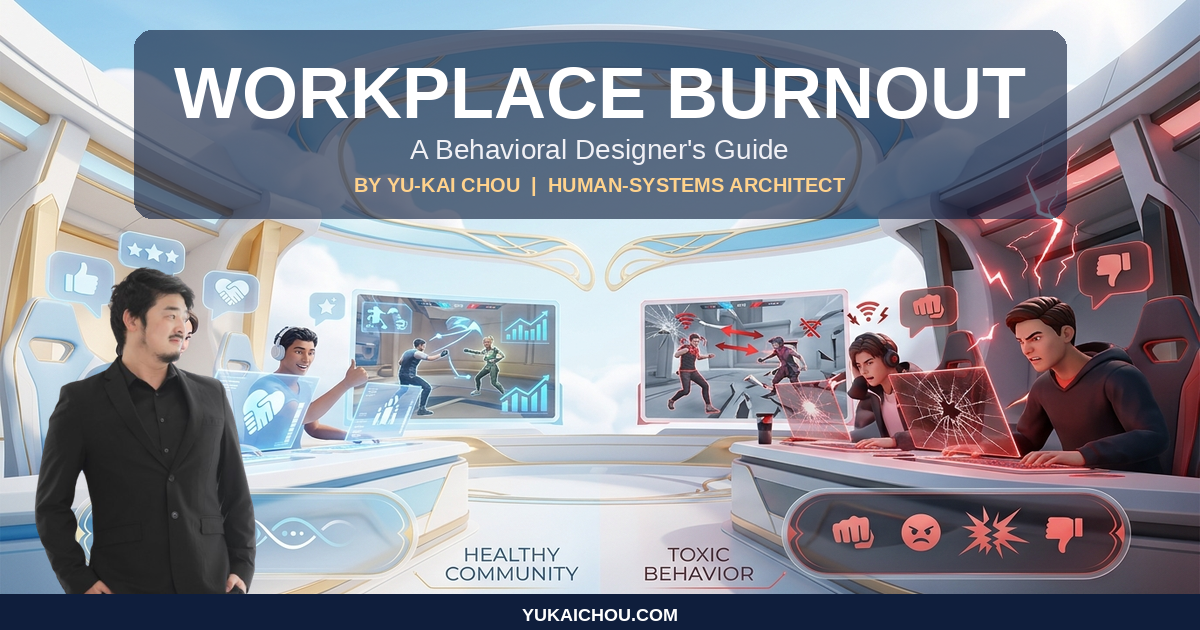

Three out of four burnout interventions you have seen at work in the last decade have been aimed at the wrong target. Yoga app subscriptions. Free meditation memberships. Resilience webinars at 5pm on a Friday. The people who built the canonical burnout science have a name for this category of fix: The Maslach Critique. The interventions assume the problem is the worker, and the data has said the opposite for forty years.
Christina Maslach started measuring burnout in 1976. By 1981 she had the diagnostic instrument that every other field still uses (the Maslach Burnout Inventory, or MBI). By 1997, with Michael Leiter, she had named the structural cause: a chronic mismatch between the person and six specific dimensions of the job. In 2019 the World Health Organization put burnout in the ICD-11 as an occupational phenomenon, not a personal mental-health diagnosis. That last word matters. Burnout is what a workplace does to a person, not what is wrong with the person.
That distinction is the load-bearing wall of the rest of this guide. If you accept it, the design playbook changes. You stop asking employees to be more resilient and start auditing six structural conditions. You stop measuring engagement scores and start measuring whether the people producing them are running on emotional fumes. You stop sending the MBI as a survey and start using it as a diagnostic instrument on your own design.
I’m going to walk you through the three burnout dimensions, the six worklife areas that produce them, the brain biology underneath, the rival theories that compete for the same explanatory turf, and the part nobody in the corporate-wellness industry wants to print: the design crosswalk that turns Maslach’s structural insight into Octalysis Framework language. By the end you will know which Core Drives produce each burnout dimension, what to redesign first, and why the most common workplace burnout interventions miss the only three levers that actually move the score.
Speed Run Notes
- Burnout is not personal weakness. It is the body’s response to chronic workplace conditions that breach Maslach’s six worklife domains: workload, control, reward, community, fairness, and values.
- The three burnout dimensions (Exhaustion, Cynicism, Inefficacy) load on different Core Drives. Treating burnout as one thing misses that each dimension demands a different design fix.
- The WHO 2019 ICD-11 classified burnout as an occupational phenomenon. The diagnosis is not depression. The cause is workplace structure, not the individual’s mental health.
- The Maslach Burnout Inventory measures depletion. The Six-Area Worklife model explains why. Together they form the only burnout framework with three decades of cross-industry validation.
- The fix-the-worker industry (yoga apps, mindfulness training, resilience webinars) is structurally indistinguishable from blaming the worker. Maslach’s prescription is to redesign the six areas, not the human.
- Octalysis Crosswalk: Exhaustion = sustained Core Drive 8 + Core Drive 6. Cynicism = Core Drive 1 + Core Drive 5 eroded. Inefficacy = Core Drive 2 + Core Drive 3 stalled. The fix is structural, not personal.
In This Article
- What Is Workplace Burnout?
- The Three Dimensions of Burnout
- The Six Areas of Worklife Mismatch
- The Maslach Burnout Inventory (MBI)
- What Maslach & Leiter Got Right
- Where the Burnout Model Falls Apart
- What’s Really Happening Inside the Brain
- Burnout vs Other Theories
- Burnout in the Real World
- The Elephant in the Room
- How to Apply Burnout with the Octalysis Framework
Author Credibility: Yu-kai Chou

Yu-kai Chou created the Octalysis Framework after studying gamification since 2003 — years before the term entered mainstream vocabulary. As a Human-Systems Architect & Behavioral Designer, his framework has been applied by LEGO, Microsoft, Porsche, Coca-Cola, Salesforce, and MrBeast, impacting over 1.5 Billion Users.
Chou has taught the Octalysis methodology at Harvard, Stanford, Yale, Tesla, Google, BCG, and IDEO.
His work has been cited by Harvard, Stanford, MIT, Forbes, Wall Street Journal, Wired, US Department of Energy, NIST, NSF, NCBI, US Department of Education, ClinicalTrials.gov, and Google Scholar — with 3,700+ more academic publications. Explore his books here.

What Is Workplace Burnout?
Burnout is a syndrome — a clustered pattern of symptoms produced by chronic, unmanaged workplace stress. Maslach’s canonical definition has held for almost five decades: burnout is a three-dimensional psychological response to sustained interpersonal and emotional job stressors, characterized by (1) emotional and physical exhaustion, (2) cynicism and depersonalization toward the work and the people the work serves, and (3) reduced sense of personal accomplishment or professional efficacy.
What makes Maslach’s contribution different from earlier stress models is the unit of analysis. Where Hans Selye’s General Adaptation Syndrome located the problem in the individual’s biological stress response, Maslach located it in the relationship between person and job. The person is fine. The job is fine. The fit between them, repeated over months and years, is what breaks.
The clinical reception followed the data slowly. In 1981 the Maslach Burnout Inventory was published; by the 2000s it had been translated into more than twenty languages and used in thousands of cross-cultural validation studies. In 2019 the WHO incorporated burnout into the ICD-11 under code QD85, classified as an occupational phenomenon resulting from chronic workplace stress that has not been successfully managed. The WHO specifically excluded it from the mental-disorders section. The category is structural, not psychiatric.
This matters for design because the diagnosis decides the intervention. A psychiatric label points toward therapy and medication. An occupational label points toward redesigning the workplace. Most corporate wellness programs sell the former under the language of the latter, which is why their effect sizes on burnout outcomes are reliably small. Yu-kai’s design corollary: if your intervention does not touch the structural variables Maslach named, you are treating a workplace problem with personal medicine.
The Three Dimensions of Burnout
The three dimensions are not three names for one feeling. They are three separate processes that can run independently and that respond to different design fixes. Yu-kai’s clinical experience working with high-burnout organizations (technology, healthcare, education, government) repeatedly confirms that the dimensions decouple under intervention. You can lift exhaustion without touching cynicism. You can rebuild efficacy while exhaustion still runs high. Treating burnout as a single thing is the first mistake; understanding which dimension is loading hardest is the start of a real fix.
Dimension 1: Exhaustion
Exhaustion is the easiest dimension to recognize and the one corporate wellness programs primarily target, which is why most programs fail. The body and the emotional system have been over-extended for too long. Recovery happens slower than depletion. Sleep is no longer restorative. The morning shower stops working as a transition; the worker arrives at work already tired. By 11am the cognitive cost of small decisions feels disproportionate.
Three findings have replicated across decades of MBI research. First, exhaustion is the dimension most strongly tied to physical health outcomes (cardiovascular disease, immune suppression, type-2 diabetes risk). Second, exhaustion precedes the other two dimensions chronologically in most longitudinal studies; cynicism and inefficacy tend to grow as defensive responses to ongoing exhaustion. Third, exhaustion is also the dimension most responsive to short-term workload interventions, which is why a vacation can reset it temporarily even when the underlying structural conditions have not changed.
The trap is that organizations measure exhaustion, fix it temporarily with time off, and conclude they have fixed burnout. They have not. They have removed the most visible symptom. The cynicism and inefficacy will return within two to four weeks if the six worklife mismatches remain unaddressed.
Dimension 2: Cynicism (Depersonalization)
Cynicism is the defensive psychological move that exhausted workers make when they cannot leave. The mind builds emotional distance between the worker and the work. Patients become “the room in bed 7.” Students become “the kid in the back row.” Customers become “tickets.” Colleagues become “headcount.” The depersonalization protects the worker’s emotional reserves but corrodes the meaning of the work itself.
In Maslach’s original research with helping professionals (nurses, social workers, police), cynicism showed up as the marker that distinguished sustainable workers from those who quit within twelve months. The exhausted worker who maintained warmth toward the people served had a high probability of recovery. The exhausted worker who started narrating colleagues and patients in third-person dismissive language had a high probability of either leaving the profession or staying in it as a functionally hardened version of themselves.
The corporate translation: cynicism is what happens when employees stop believing the mission statement. The Yu-kai design diagnosis: a high cynicism score correlates with eroded Core Drive 1 (CD1): Epic Meaning & Calling and broken Core Drive 5 (CD5): Social Influence & Relatedness. The fix is structural reconnection of work to consequence, not a “values workshop.”
Dimension 3: Reduced Professional Efficacy
Inefficacy is the slowest dimension to develop and the hardest to reverse. It is the loss of belief in one’s own competence at the work. A senior engineer who shipped landmark products begins to doubt whether they can lead a small feature. A surgeon who has performed five thousand procedures starts losing sleep before routine cases. A teacher with twenty years of certificates of excellence wonders whether they should have ever entered the classroom.
Inefficacy is corrosive because it is self-confirming. Workers under chronic exhaustion produce lower-quality output, which lowers their self-rated competence, which lowers their motivation to push for the small wins that would restore competence, which extends the period of low-quality output. The loop closes around itself. By the time inefficacy is the dominant dimension, the worker is often already past the point where short interventions can pull them back.
The MBI scores inefficacy reverse-coded: high efficacy scores low on the burnout subscale. The 2016 MBI manual and the 2019 ICD-11 both treat inefficacy as the dimension most tied to the long-term identity damage of burnout. People recover from exhaustion. They develop strategies to manage cynicism. Inefficacy, once internalized, becomes a story the person tells about themselves: “I’m not good at this work anymore.” That story takes years to unwind even after the structural conditions improve.
The Six Areas of Worklife Mismatch
If the three dimensions are the symptoms, the six areas are the causes. Maslach and Leiter’s 1997 book The Truth About Burnout introduced the Six-Area Worklife model after fifteen years of data analysis revealed that the same six structural mismatches appeared in every burnout-prone industry studied: healthcare, education, social services, law, technology, finance. The six are not independent risk factors. They are the load-bearing structural conditions a workplace either gets right or breaks against. A mismatch in any single area can produce burnout. A mismatch in three or more areas at once produces it reliably.
Yu-kai’s clinical observation, repeated across over two decades of advising organizations: most leadership teams can name workload and reward as the obvious two. The other four (control, community, fairness, values) are systematically underestimated, and that is exactly where most of the actual burnout signal lives.
Area 1: Workload
Workload mismatch is the area corporate culture is most willing to name and least willing to fix structurally. The mismatch is not just about volume. Three sub-conditions all count as workload mismatch: (1) the absolute amount of work exceeds what is doable in the available hours; (2) the type of work does not match the worker’s skills, forcing constant cognitive overhead; (3) the emotional cost of the work, often invisible in the org chart, exceeds what the worker can recover from between shifts.
The third sub-condition is the one organizations consistently mis-measure. A nurse performing thirty patient interactions a day and a software engineer holding four customer escalation calls back-to-back have different headcount footprints but comparable emotional-labor loads. The 2024 Gallup State of the Global Workplace report tracked the steepest burnout-risk rise in jobs that are objectively part-time in hours but heavy in emotional regulation: teachers, social workers, frontline customer support.
The design corollary: workload audits that count only hours and tickets miss the variable that actually predicts exhaustion. If your workload metric does not include an emotional-regulation cost component, you are measuring the wrong thing.
Area 2: Control
Control mismatch is the gap between what the worker is held accountable for and what the worker is empowered to decide. A manager with thirteen direct reports but no authority to change their compensation, hiring criteria, or workload. A nurse expected to maintain patient satisfaction scores but with no power to change the staffing ratio that determines whether patients wait three minutes or thirty for help. A teacher rated on test scores but with no input on curriculum, pacing, or class size.
Karasek’s Job Demand-Control model published in 1979 first quantified this. The combination of high demands plus low control is the highest-risk job design profile for cardiovascular disease, depression, and burnout. The combination of high demands plus high control is the design profile of work that engages without depleting. The latter is what people mean when they say their job is “challenging in a good way.”
Restoring control means giving real decision rights, not consultation rights. Asking for the worker’s opinion before making a decision the worker cannot change does not restore control. It increases the control mismatch by surfacing the absence of authority.
Area 3: Reward
Reward mismatch covers three things: financial reward below market for the work performed, social reward (recognition, appreciation) absent from the daily work, and intrinsic reward stripped out by the system. The last one is the most overlooked. Workers who once experienced the work itself as rewarding (the diagnosis that landed correctly; the line of code that solved an elegant problem; the student who finally grasped the concept) lose access to that intrinsic reward when the system between them and the outcome thickens.
Daniel Pink’s 2009 synthesis in Drive pulled together decades of motivation research showing that financial reward, beyond an adequacy threshold, is a weak predictor of sustained engagement. What matters more is recognition that the work mattered and that someone noticed. Maslach’s finding from the helping professions: a single sincere thank-you from a patient could restore weeks of intrinsic reward for a nurse. Twenty years of staff-of-the-month plaques could not.
The trap: organizations defaulting to financial reward as the universal answer to burnout dilute the variable they have the most cost-effective lever on (recognition that the work mattered) and waste budget on the variable that has the smallest sustained effect (small bonuses).
Area 4: Community
Community mismatch is the rupture of the social fabric of the workplace. Maslach and Leiter found this dimension growing in importance as remote and hybrid work increased the structural distance between coworkers. The mismatch shows up as: chronic unresolved interpersonal conflict; absence of meaningful social contact during the workday; isolation from the people the work serves; and the loss of informal peer support that buffered everyone against the other five areas.
The 2010s tech-industry experiment with “we are a family” rhetoric was an attempt to address community mismatch by branding rather than by structure. The branding failed because it tried to do with mission-statement language what only repeated, low-stakes social contact can do: build the trust that lets coworkers tell each other the truth about how the work is going. Where the structural conditions for that contact were absent (open-plan offices with chat-only norms; meetings replaced by Slack; performance reviews replaced by algorithmic ranking), community mismatch grew regardless of how much the company called itself a family.
Area 5: Fairness
Fairness mismatch is the worker’s perception that the decisions affecting their work life are not made by predictable, transparent processes that treat everyone consistently. The literature on organizational justice (Greenberg 1987, Colquitt 2001) decomposes fairness into four sub-types: distributive (who gets what), procedural (how decisions are made), interactional (how managers communicate decisions), and informational (what reasoning is shared).
What makes fairness so toxic for burnout is that small fairness violations compound. One promotion decision that felt arbitrary is forgotten in a month. Five over two years builds a permanent layer of skepticism toward the next decision. By the time fairness becomes an item on the survey, the workforce has already adapted by withdrawing the kind of effort that requires belief that the system will recognize it.
Yu-kai’s clinical observation: fairness mismatch is the area leaders are most likely to deny exists. Leaders believe their decisions are made on objective merit. Workers experience the decisions as opaque, inconsistent, and sometimes politically motivated. Both can be honest, because fairness is about the perception of process, not about the leader’s intentions. Closing the fairness gap requires showing the work of decision-making, not asserting that the work was fair.
Area 6: Values
Values mismatch is the gap between what the organization says it stands for and what its day-to-day operating decisions actually optimize for. A hospital that says “patient care first” but staffs the night shift so thinly that each nurse cannot give any single patient real attention. A school that says “we develop the whole child” but evaluates teachers on standardized-test deltas. A tech company that says “user trust is our foundation” but builds dark-pattern subscription flows.
The values area generates burnout through a specific mechanism: moral injury. The worker can see the gap. Each shift requires choosing between what the worker believes the work should be and what the organization’s incentive structure forces. Over time, the worker either makes peace with the gap (cynicism), withdraws from caring (depersonalization), or breaks against it. The 2020-2022 healthcare worker exodus tracked values mismatch as the strongest single predictor of intent-to-leave, ahead of compensation or hours.
Maslach’s prescription for values mismatch is the hardest of the six because it requires either changing what the organization actually does (not what it says) or being honest with workers about the gap. Most organizations choose a third option (more values-statement workshops) and watch their burnout scores stay flat for years.
The Maslach Burnout Inventory (MBI)
The Maslach Burnout Inventory is the most widely used diagnostic instrument for burnout in the world, with more than three decades of cross-cultural validation and more than 5,000 published studies using it as the primary outcome measure. The first version was published by Maslach and Jackson in 1981. The current third edition (Maslach, Jackson, Leiter 2016) includes four variants for different worker populations.
The MBI-HSS (Human Services Survey) targets nurses, social workers, doctors, therapists, and other helping professionals where emotional contact with people-being-served is the central job feature. The MBI-ES (Educators Survey) adapts the items for teachers and faculty. The MBI-GS (General Survey) drops the helping-profession-specific item wording so it can be used in finance, technology, manufacturing, and government work. The MBI-SS (Students Survey) measures academic burnout in undergraduates and graduate students.
Across all four variants the scoring structure is identical. Twenty-two items (in the HSS) or sixteen items (in the GS) load onto the three subscales: Emotional Exhaustion, Depersonalization or Cynicism, and Personal Accomplishment or Professional Efficacy. Each item is rated on a 0-6 frequency scale from “never” to “every day.” The Personal Accomplishment subscale is reverse-coded so that higher scores on that subscale indicate lower burnout. Burnout cutoffs vary by version, but the standard interpretation is that a high score on Exhaustion plus a high score on Cynicism plus a low score on Personal Accomplishment together indicate severe burnout.
The 2019 WHO ICD-11 entry adopted Maslach’s three-dimensional structure verbatim as the diagnostic criteria. This means burnout is now formally recognized in international classification, but the criteria themselves trace directly back to Maslach’s instrument. The administrative implication for organizations is straightforward: the MBI is the field standard, the WHO recognizes the dimensions it measures, and any internal burnout survey that does not measure all three dimensions is missing a third of the picture.
One caveat that does not appear in most corporate-wellness summaries: the MBI was developed as a research instrument, not a clinical diagnostic. The cutoff scores that separate “high burnout” from “moderate” are statistical conventions, not biological thresholds. A person scoring just below the cutoff is not safe; a person scoring just above is not a clinical case. The instrument’s strength is measuring change over time within a population, not slotting individual workers into binary categories. Yu-kai’s design corollary: use the MBI to measure whether the redesign worked, not to label individual employees as “burned out” or “fine.”
What Maslach & Leiter Got Right
Forty-eight years after the first burnout paper, Maslach and Leiter’s framework remains the dominant research and design paradigm because three of their central claims have proven correct against repeated empirical pressure.
First, the three-dimensional structure replicates. Factor analyses across countries, languages, and industries return the same three independent factors. Exhaustion, Cynicism, and Inefficacy are statistically separable, which means they are not three names for one underlying construct. This is unusual for a psychological framework: many three-factor models collapse to one or two factors when tested cross-culturally. Maslach’s has not.
Second, the structural-cause hypothesis is supported by intervention studies. A 2017 Cochrane review of 58 randomized trials found that interventions targeting the workplace (workload, control, fairness) produced larger and more durable reductions in burnout than interventions targeting the individual (mindfulness, resilience training, cognitive-behavioral coaching). Person-focused interventions reduced exhaustion modestly in the short term but rarely shifted cynicism or efficacy. Organization-focused interventions moved all three dimensions and held the effect at one-year follow-up.
Third, the six-area model captures variance that other workplace-stress models miss. The Demand-Control model (Karasek 1979) captures workload and control. The Effort-Reward Imbalance model (Siegrist 1996) captures workload and reward. The Areas of Worklife model captures all six and explains more variance in MBI scores than any single rival model. When Leiter and Maslach (1999, 2004) built the Areas of Worklife Survey to measure the six areas, it predicted MBI scores six months later with effect sizes that no other workplace-survey instrument has matched.
The combined picture: Maslach and Leiter built a measurement instrument that survived four decades of psychometric attack, a structural-cause model that survived the rise of person-focused alternatives, and a treatment hypothesis (redesign the six areas, not the individual) that has been confirmed by the largest meta-analyses in the field. Most behavioral-science frameworks lose at least one of those three legs over time. Maslach’s has kept all three.
Where the Burnout Model Falls Apart
The places the Maslach framework strains are also the places the next decade of burnout research is concentrated. Three critiques have real weight; understanding them is what separates designers who use the framework rigorously from designers who quote it as if it were settled.
Critique 1: The construct overlap with depression
The clearest empirical critique came from Bianchi and Schonfeld in a series of papers between 2014 and 2021 arguing that burnout, as measured by the MBI, overlaps substantially with depression as measured by standard depression instruments. In their meta-analyses, the shared variance is large enough that some researchers have asked whether burnout is a distinct condition or whether it is depression in a workplace context.
The Maslach camp’s reply is partly statistical (the shared variance is real but does not exhaust the burnout construct; cynicism and efficacy carry information that depression instruments do not) and partly clinical (burnout responds to workplace redesign in ways that depression does not; depression responds to medication in ways that burnout does not). The current consensus is roughly that burnout and depression are highly correlated but distinct, the way anxiety and depression are highly correlated but distinct. A worker can be deeply burned out without meeting clinical criteria for major depressive disorder, and a worker can have major depression without working in a burnout-producing job.
The design corollary: do not use burnout-redesign interventions for depression. Do not use depression treatment for structural burnout. Misrouting between the two wastes resources and produces the wrong results.
Critique 2: The individual-versus-systemic line is blurrier than the model says
Maslach’s structural-cause hypothesis sometimes gets caricatured by both sides. The strong version (burnout is entirely about the workplace; the individual contributes nothing) does not match the data. Individual variables (perfectionism, conscientiousness, low self-compassion, history of trauma) do moderate how much burnout a given workplace condition produces.
The honest position is that individual variables shift the slope, not the intercept. A given workplace produces more burnout in a perfectionist than in a worker with lower self-imposed standards, but it produces some burnout in everyone if the structural conditions are bad enough. The corollary is that some person-focused interventions (especially self-compassion training, Neff 2003) reduce the slope, but they cannot make a structurally toxic workplace produce non-toxic outcomes for the average worker.
The design corollary: a balanced burnout strategy includes both structural redesign (the heavier lift) and selective person-focused support for workers whose individual variables make them more vulnerable. Anyone selling only one side is selling an incomplete product.
Critique 3: Cross-cultural validity questions
The MBI has been validated in more than thirty countries, but the factor structure and the cutoff scores do not transfer cleanly across all cultures. Studies in East Asian working populations (Japan, South Korea, Taiwan, China) frequently find that the Cynicism subscale loads differently. In some contexts, expressing cynicism toward work is suppressed by cultural norms even when the underlying experience is present. The instrument under-detects burnout in these populations.
Studies in collectivist cultures also find that the six areas of worklife operate differently. Community is weighted more heavily as a buffer. Fairness is evaluated by group-level rather than individual-level criteria. Values mismatches between organization and worker show up as family-level rather than personal-level stress.
The design corollary: do not import an American or Northern European burnout playbook unmodified into a different cultural context. The same instrument can produce different scores for the same underlying experience depending on how the culture handles expression of work-related distress.
What’s Really Happening Inside the Brain
The neurobiology of burnout is one of the active research fronts of the 2020s. Three brain systems carry most of the signal: the hypothalamic-pituitary-adrenal (HPA) axis, the allostatic load system, and the prefrontal-limbic circuitry. Understanding what is happening at this level changes how a designer reads a high MBI score. A burned-out worker is not “tired and grumpy.” They are running with a dysregulated stress-response system whose recovery curve has lengthened.
HPA axis dysregulation
The HPA axis is the body’s primary chronic-stress response system. Under acute stress, the hypothalamus signals the pituitary, the pituitary signals the adrenals, and the adrenals release cortisol. The cortisol mobilizes energy, sharpens attention, suppresses non-essential systems, and prepares the body to handle the demand. Under healthy conditions, cortisol rises in the morning, falls through the day, and resets overnight.
Under chronic workplace stress the curve flattens. Morning cortisol fails to rise as sharply. Evening cortisol fails to fall as completely. The diurnal rhythm that signals “now is the time to engage; now is the time to recover” stops giving clear signals to the rest of the body. Workers in this state report feeling tired all the time and unable to fall asleep at night. Sjors and colleagues (2014) and later replications have tracked this pattern specifically in workers scoring high on MBI Exhaustion.
The design corollary: if your team is consistently exhausted but cannot sleep, you are not seeing laziness. You are seeing HPA dysregulation produced by chronic structural conditions in the work itself.
Allostatic load
Allostatic load (McEwen 1998) is the cumulative biological cost of repeated adaptation to stress. The body’s stress-response system can buffer many acute events. What it cannot buffer is acute events arriving so frequently that the system never returns to baseline between them. Each event adds incremental damage to cardiovascular, immune, metabolic, and neurological systems. Over years, the cumulative load shows up as the disease burden that burnout-prone workers carry at higher rates than population baselines.
The healthcare-worker literature documents this most clearly. Nurses and physicians with sustained high MBI scores show measurably higher rates of cardiovascular disease, type-2 diabetes, immune dysfunction, and earlier all-cause mortality. The pathway is not “burnout causes heart attacks” in any direct sense. The pathway is “chronic structural conditions in the workplace produce sustained physiological stress, which produces measurable damage to the systems that determine long-term health.”
The design implication is one most organizations have not absorbed: workplace structural conditions are a health-and-safety issue, not just a wellbeing issue. The current corporate-wellness budget allocation (heavy on individual interventions, light on structural redesign) is misaligned with where the damage actually accumulates.
Prefrontal-limbic circuitry
Chronic stress preferentially impairs the prefrontal cortex (the brain’s executive-function and emotional-regulation hub) while preferentially activating the limbic system (the brain’s threat-detection and emotional-response hub). The functional result is that burned-out workers are running with reduced ability to do the cognitive tasks the job most needs (planning, prioritization, complex judgment) and elevated reactivity to emotional triggers in the work environment.
Arnsten’s neuroscience work (2009, 2015) has mapped the specific molecular mechanisms by which sustained stress hormones weaken prefrontal-cortex network connectivity. The implication for workplace design: the worker who once handled three projects in parallel is not “phoning it in” when they begin to drop balls; they are running with measurably reduced prefrontal capacity. Demanding more from them in this state accelerates the damage; reducing the load and restoring the structural conditions is what allows the prefrontal capacity to recover.
The integrative neurobiological picture: burnout is not in someone’s head. It is in their HPA axis, their allostatic load, and their prefrontal-limbic balance. The behavior changes are downstream consequences of measurable biological changes that were produced by sustained structural conditions in the workplace.
Burnout vs Other Theories
Burnout research sits in the middle of a crowded theoretical neighborhood. Four neighbors matter most: the Job Demands-Resources Model, Conservation of Resources Theory, Karasek’s Demand-Control-Support Model, and Siegrist’s Effort-Reward Imbalance Model. Designers who use Maslach’s framework without understanding the neighbors miss what each one adds.
vs Job Demands-Resources Model (Bakker & Demerouti)
The Job Demands-Resources Model, introduced by Demerouti, Bakker, and colleagues in 2001, is the most theoretically integrated workplace-stress framework currently in research use. It proposes a two-process structure: job demands deplete energy and lead to burnout through a health-impairment process; job resources fuel motivation and lead to engagement through a motivational process. Burnout and engagement are not opposite ends of one continuum; they are produced by separate processes that can run in parallel.
The Maslach framework and the JD-R framework are largely compatible. Maslach’s six areas of worklife map onto JD-R’s job demands (workload) and job resources (control, reward, community, fairness, values acting as resources when present and demands when absent). What JD-R adds is the two-process clarity: the same worker can be burned out and engaged at once, which feels paradoxical until you realize they are produced by different inputs.
The design corollary: a burnout intervention that increases resources but does not reduce demands moves engagement without moving exhaustion. A burnout intervention that reduces demands but does not restore resources moves exhaustion but does not restore engagement. Both processes have to be addressed.
vs Conservation of Resources Theory (Hobfoll)
Stevan Hobfoll’s Conservation of Resources Theory (1989, 2018) proposes that humans are motivated to acquire, retain, and protect resources, and that stress occurs when resources are threatened, lost, or fail to gain after investment. Under this lens, burnout is what happens when chronic resource loss outpaces the worker’s ability to invest in resource gain.
COR explains a pattern Maslach’s framework names but does not fully explain: the spiral of loss. Once burnout starts, exhaustion makes it harder to invest in the resources (sleep, social connection, recovery time) that would buffer further depletion. The worker drops gym attendance, then drops social calls, then drops the side project that fed intrinsic motivation. Each drop accelerates the next.
What COR adds: a framework for sequencing recovery interventions. The worker cannot rebuild every resource at once. Start with the resource that, if restored, makes restoring the next resource possible. For most burned-out workers, that bottom of the chain is sleep. Without restored sleep, every other recovery intervention is built on sand.
vs Karasek’s Demand-Control-Support Model
Robert Karasek’s Job Demand-Control model (1979) and its later extension with Theorell to include Social Support (Karasek & Theorell 1990) pre-dates the formal burnout literature and uses a different vocabulary, but it identifies two of the six worklife areas (workload as demand, control) and one buffer (community as support) that Maslach’s framework would later subsume.
The 1979 Karasek paper made a specific prediction that the largest burnout signal would come from the high-demand plus low-control quadrant of the job-design space. Three decades of subsequent research confirmed this prediction. The “active job” (high demand plus high control) produces engagement; the “high-strain job” (high demand plus low control) produces burnout. The “passive job” (low demand plus low control) produces a different kind of demotivation that the burnout instruments do not catch well.
Maslach’s framework absorbed Karasek’s insights and broadened them. The four additional areas (reward, community, fairness, values) explain variance Karasek’s two-variable model misses. The legacy of Karasek’s framework in current practice: when an organization can address only two structural variables at first, demand and control are the highest-impact starting point.
vs Effort-Reward Imbalance (Siegrist)
Johannes Siegrist’s Effort-Reward Imbalance model (1996) proposes that chronic stress arises from a mismatch between high effort invested and low reward received, where reward includes financial compensation, esteem, and career opportunity. The framework focuses sharply on the contractual reciprocity dimension of work that Maslach’s reward area names but does not decompose as deeply.
What ERI adds is a specific prediction about a personality moderator: “overcommitment,” the disposition to invest more effort than the situation requires. Overcommitted workers in low-reward environments produce the highest sustained stress signal, including the largest cardiovascular outcomes in the European working-population cohorts that Siegrist’s instrument has been validated in. The Whitehall II Study (Marmot et al., 1991 onwards) and several large German occupational cohorts have used ERI to predict coronary events with effect sizes that meet clinical-significance thresholds.
The design corollary: a workplace can solve the workload area, the control area, and the community area and still produce burnout if the effort-reward ratio is structurally broken. Siegrist’s framework is the sharpest tool for diagnosing whether the reward area is the bottleneck.
Burnout in the Real World
The Maslach framework was built on data from helping professionals, then extended to general workforces. Three industries carry the largest contemporary burnout signal in the published literature: healthcare, technology, and education. The patterns differ, and a designer who blurs them designs the wrong intervention for the wrong industry.
Healthcare Workers
The healthcare burnout literature is the deepest by far. A 2018 National Academy of Medicine consensus report estimated that 35-54% of US nurses and physicians were experiencing significant burnout symptoms, with rates climbing through the 2020-2022 pandemic period to peaks above 60% in some specialties. The Aiken et al. (2017) Lancet study showed that hospital units with the worst burnout scores had measurably worse patient outcomes: more medication errors, more hospital-acquired infections, lower patient-satisfaction scores.
What distinguishes healthcare burnout is the values area. Healthcare workers chose the profession largely from internal Core Drive 1 (Epic Meaning) motivation; the work is intrinsically meaningful in a way few other industries match. When the structural conditions force daily choices between what the worker believes good care looks like and what the staffing ratio or insurance reimbursement formula allows, the values mismatch produces moral injury at a scale most other professions do not encounter.
Effective interventions in healthcare have come from team-based redesign (changing nurse-to-patient ratios), giving clinicians real authority over their schedules, and structurally removing administrative burden that competes with patient time. Mindfulness apps for nurses, by contrast, have produced effect sizes near zero in controlled trials.
Tech Industry
The technology industry produces a different burnout signature. The dominant area is usually workload combined with control. Tech workers often have nominal autonomy (work-from-home, flexible hours) paired with structural inability to actually stop. The on-call rotation, the always-on Slack, the implicit norm of responding outside hours. Workload looks acceptable on paper because the hours are nominally bounded, but the emotional regulation cost of partial-availability extends the working day into recovery time.
The SPACE framework (Forsgren et al. 2021) for measuring developer productivity emerged in part from recognition that engineering teams had been measuring the wrong things. Activity metrics (commits, pull requests, story points) capture nothing about whether the structural conditions for sustained engineering work are present. The S in SPACE (Satisfaction and Wellbeing) maps directly onto burnout signal.
Effective tech-industry interventions include real on-call rotations with hard handoff boundaries, explicit norms about response time outside business hours, and removing meeting-heavy schedules that fragment the deep-work blocks engineering work depends on.
Education / Teaching
The teaching burnout literature is the second-deepest after healthcare. The dominant areas are reward and values. Teachers report sustained financial reward mismatch with the credentialing requirements and emotional labor of the work. They report values mismatch when accountability systems measure them on test-score deltas that do not capture the developmental relationships they entered the profession to build.
A 2024 Gallup survey of US K-12 teachers found 44% reporting frequent or constant burnout, with the largest single contributor being lack of administrative support for student behavior management (community + control overlap). Teacher attrition in the United States during 2020-2024 set post-WW2 records.
Effective interventions in education are difficult because the structural conditions (compensation, class size, standardized testing pressure) are largely set by state and federal policy outside the school’s control. The interventions schools can run (peer support cohorts, reducing administrative load, restoring teacher autonomy over instructional choices) move the dial modestly but cannot solve the upstream values mismatch.
Caregivers and Helping Professions
Beyond the three industries above, the helping professions broadly (social work, hospice care, family caregiving for elderly parents, parents of children with disabilities) carry sustained high burnout signal that the workplace-focused MBI under-detects. The caregiving load is real and structural, but the “workplace” being measured is sometimes the family system. The community area is often the worst-mismatched: caregivers report extreme isolation. The reward area is structurally broken because the work is unpaid or under-paid relative to its emotional labor.
The 2020 AARP Caregiving in the US report estimated 53 million Americans were providing unpaid care to an adult or child with special needs. The MBI-equivalent measures developed for this population (e.g., the Zarit Burden Interview) produce burnout signals at rates comparable to the healthcare workforce. The intervention question is harder because the structural conditions are family-system-level rather than employer-level.
The Elephant in the Room
The elephant the corporate-wellness industry will not put on its slide deck: most workplace burnout interventions are structurally indistinguishable from blaming the worker. The yoga membership, the meditation app subscription, the resilience training, the Employee Assistance Program counselor: each presents the problem as something inside the individual that the individual must work to fix. None of these touch the six structural areas where the data says the burnout signal actually lives.
This is not because the people running corporate-wellness programs are cynical. Most believe they are helping. The structural reason the industry has converged on individual-focused interventions is incentive alignment. Yoga apps scale across employees at low marginal cost; redesigning workload, control, reward, community, fairness, and values does not. Mindfulness training does not require leadership to admit that the structural conditions they own are producing the symptoms. Resilience webinars do not threaten the org chart.
The Maslach prescription was clear in 1997 and it is clear today: the worker is not the unit of intervention. The workplace is. Programs that target the individual produce modest, short-lived reductions in exhaustion and rarely move cynicism or efficacy at all. Programs that redesign the structural conditions move all three dimensions and hold the effect at twelve-month follow-up. The 2017 Cochrane review made this comparison explicit, and the evidence base has only grown since.
The publicity test, which Yu-kai has invoked across the V6 Persuasion & Influence pillars and the V7 Employee Engagement pillar, applies here in an especially sharp form. Would your burnout intervention survive being described accurately to the workers who will receive it? “We are not going to change your workload, your control over decisions, your compensation, your team relationships, the fairness of our review process, or the gap between our values statements and our operating decisions. Instead, we are paying for a meditation app and a resilience workshop, and we expect those to fix the burnout produced by the structural conditions we are not changing.” Few wellness programs would survive that level of honesty in their own internal communications. The fact that they are not described that way is what allows them to continue.
The cleaner ethic for any organization serious about burnout: name the structural conditions you are not changing, name the reasons (real or strategic) you are not changing them, and stop pretending the individual-focused interventions are the answer. Workers can handle the honesty. What they cannot handle indefinitely is the gap between the wellness program’s rhetoric and the structural conditions it has not touched.
How to Apply Burnout with the Octalysis Framework
The Octalysis Framework is the eight Core Drives of human motivation: Core Drive 1 (CD1): Epic Meaning & Calling, Core Drive 2 (CD2): Development & Accomplishment, Core Drive 3 (CD3): Empowerment of Creativity & Feedback, Core Drive 4 (CD4): Ownership & Possession, Core Drive 5 (CD5): Social Influence & Relatedness, Core Drive 6 (CD6): Scarcity & Impatience, Core Drive 7 (CD7): Unpredictability & Curiosity, and Core Drive 8 (CD8): Loss & Avoidance. Each Core Drive can be designed for White Hat motivation (sustainable, empowering) or Black Hat motivation (urgent, depleting).
The Burnout-Octalysis Crosswalk: each of the three burnout dimensions is produced by a different pattern of Core Drive over-use or under-use. Treating burnout as a Core Drive design problem changes what counts as an intervention.

Exhaustion: Reduce sustained Core Drive 6 and Core Drive 8
Exhaustion is the signature of chronic Black Hat motivation. Core Drive 6 (CD6): Scarcity & Impatience, when sustained rather than pulse-applied, keeps the cortisol curve running flat. Core Drive 8 (CD8): Loss & Avoidance, when the worker is constantly running from negative consequence rather than toward positive outcome, depletes the same biological systems.
The design fix for exhaustion is structural removal of sustained Black Hat pressure. This means: stop using deadline urgency as the default motivation mechanism for every project. Stop running performance review systems where the dominant signal is fear of falling out of the top quartile. Stop building incident-response cultures where every page is an existential alarm. Sustained CD6 and CD8 worked for a quarter and broke for a decade; the design move is to pulse-apply them sparingly and back the rest of the work with White Hat motivation.
Practical signal: if a worker cannot remember the last quarter that did not feel like a crunch, the system is over-using CD6 and CD8 and exhaustion will not respond to wellness interventions until the structural over-use is removed.
Cynicism: Restore Core Drive 1 and Core Drive 5
Cynicism grows from two eroded Core Drives. Core Drive 1 (CD1): Epic Meaning & Calling erodes when the worker loses the line from their daily work to the outcomes the work was supposed to produce. The nurse who entered the profession to care for patients no longer sees patient outcomes, only billing codes. The engineer who joined to ship products no longer ships, only writes tickets that wait six quarters in a roadmap. Core Drive 5 (CD5): Social Influence & Relatedness erodes when the team that once produced peer support has been fragmented by remote work, role churn, or interpersonal conflict that the system did not resolve.
The design fix for cynicism is structural reconnection. Restore the line from work to consequence: weekly demos that show the team what their work produced for the people it was supposed to serve. Restore peer support structures: standing team rituals that are not status meetings, with enough psychological safety that people can talk about how the work is actually going. CD1 cannot be restored by a values workshop; it has to be restored by showing the work mattering.
Inefficacy: Rebuild Core Drive 2 and Core Drive 3
Inefficacy is the loss of belief in one’s own competence. The Core Drives that produce that belief in a healthy work environment are Core Drive 2 (CD2): Development & Accomplishment and Core Drive 3 (CD3): Empowerment of Creativity & Feedback. Healthy CD2 is the progression structure: visible accomplishment, ranked tasks the worker can win at, mastery that compounds. Healthy CD3 is the feedback loop: the worker tries something, sees the consequence, learns, adjusts.
Inefficacy grows when both Core Drives stall. The worker stops seeing accomplishment because the system measures inputs rather than outputs. The worker stops getting useful feedback because the loop has been replaced by a once-yearly performance review or an algorithmic ranking. The fix is structural restoration of small, frequent, real feedback on real work, paired with visible progression structures that let the worker see their own competence growing.
Yu-kai’s clinical observation: inefficacy is the slowest dimension to recover because the worker has internalized a story about their own competence. Restoring CD2 and CD3 has to be paired with explicit reframing of the story; the worker needs to be told, sometimes repeatedly, that they are good at the work and that the system’s failure to show that to them was a design problem, not a competence problem.
Throughout: Core Drive 4 and Core Drive 7
Two Core Drives apply across all three burnout dimensions as moderators rather than direct producers. Core Drive 4 (CD4): Ownership & Possession is the psychological-ownership margin that buffers all six worklife areas. Workers who feel real ownership of their work (the territory, the team, the outcome) tolerate higher demands without burning out. Workers who feel like interchangeable cogs burn out at lower demand levels because the same workload feels like obligation rather than possession.
Core Drive 7 (CD7): Unpredictability & Curiosity, when managed correctly, supplies the absorption side of the engagement measurement that Schaufeli’s UWES captures. Healthy CD7 (the legitimate problem to solve, the interesting question the work surfaces) protects against the boredom side of the engagement-burnout spectrum. Unhealthy CD7 (constant fire drills, manufactured urgency that disguises as interesting problems) accelerates exhaustion.
The design corollary across all four Apply sections: burnout is what happens when the system over-uses CD6 and CD8 while under-feeding CD1, CD2, CD3, and CD5, with CD4 and CD7 running in unmanaged directions. The fix is rebalancing the Core Drives across the team’s actual lived experience, not adding a new wellness benefit on top of the broken structure.
Practical Steps for Designing Out Burnout
The Burnout-Octalysis Audit is the practical translation of everything above into a sequence an organization can actually run. Six steps, ordered by structural impact and reversibility. Skipping any step is the most common reason burnout interventions fail.
- Measure all three dimensions, not one. Administer the appropriate MBI variant (HSS, ES, GS, or SS) or the Areas of Worklife Survey at team level, not just at individual level. Track Exhaustion, Cynicism, and Inefficacy separately. The team-level scores are the diagnostic signal; individual-level scores are confidential to the worker. If your current engagement survey only produces a single composite score, you are flying blind on which dimension is loading hardest and which structural area is the cause.
- Map the team scores onto the six worklife areas. High Exhaustion most often points to Workload and Control mismatches. High Cynicism most often points to Values and Community mismatches. High Inefficacy most often points to Reward (recognition) and Control mismatches. The mapping is not deterministic, but it gives the diagnostic team a starting hypothesis about which structural variable to investigate first.
- Apply the publicity test before designing the intervention. Describe your planned intervention out loud, in plain language, to the workers who will receive it. If the description includes the phrase “we are paying for a wellness app instead of fixing the structural issue,” do not run the intervention. The Libertarian Paternalism pillar’s publicity test is the ethics filter that separates real burnout work from rebranded blame-the-worker.
- Run a structural intervention before a person-focused one. A 2017 Cochrane review and a 2020 follow-up both confirmed that organization-focused interventions move all three burnout dimensions and hold the effect at twelve-month follow-up, while person-focused interventions move only Exhaustion modestly and not durably. The sequence is: redesign the structural variable first; then offer person-focused support to workers whose individual variables make them more vulnerable to whatever structural conditions remain.
- Re-measure at six months on dimensions, not on satisfaction. The most common evaluation failure is asking workers whether they liked the intervention. Wellness surveys reliably return positive satisfaction scores even when MBI scores remain unchanged. The honest evaluation question is: did the targeted burnout dimension move? If Exhaustion was high and you re-measured at six months and Exhaustion is now within the moderate range, the intervention worked. If the satisfaction score is high but the dimension score is unchanged, the intervention was branding, not redesign.
- Iterate on the structural variable that moved least. Burnout is multivariate. The first intervention usually moves one or two dimensions and leaves the third stubbornly high. The third is the diagnostic signal for the structural area you have not yet addressed. The team that fixed Workload but still has high Cynicism has not yet addressed the Values or Community area. The team that fixed Community but still has high Inefficacy has not yet addressed the Reward (recognition) area. Sequential redesign is what produces sustained organization-level burnout reduction; one-and-done interventions do not.
Burnout Was the Beginning, Not the End
Maslach published the first burnout paper in 1976. Fifty years later, the framework has held up against four decades of psychometric scrutiny, the structural-cause hypothesis has been confirmed by the largest meta-analyses in the field, and the WHO has put the construct in the ICD-11 as an occupational phenomenon. The framework has earned its load-bearing position in workplace design.
What comes next is harder. The Maslach framework is the diagnosis; the design is what an organization does with the diagnosis. The behavioral-design discipline that the Octalysis Framework names is what turns the six worklife areas from a survey instrument into a structural redesign playbook. The crosswalk in this guide is one organization’s worth of accumulated practice; the actual work is running it in your own organization, on your own teams, with your own honesty about which structural variables you can change and which you cannot.
If you take one thing from this guide, take this: burnout is something workplaces do to workers, not something workers do to themselves. Every design choice you make from that premise is closer to the data than every design choice you make from the opposite premise. The wellness industry has spent thirty years assuming the opposite. The data has spent fifty years saying so.
Frequently Asked Questions
What are the three dimensions of workplace burnout according to Maslach?
The Maslach Burnout Inventory measures three independent dimensions: emotional and physical Exhaustion, Cynicism (also called depersonalization, the psychological detachment from work and the people it serves), and reduced Professional Efficacy (the loss of belief in one’s competence at the work). Each dimension is statistically separable, responds to different design interventions, and shows different recovery curves. Severe burnout is defined as high Exhaustion plus high Cynicism plus low Efficacy.
How is the Maslach Burnout Inventory (MBI) scored?
The MBI uses a 0-6 frequency scale (“never” to “every day”) on 16-22 items (depending on which variant). Items load onto three subscales: Emotional Exhaustion, Depersonalization or Cynicism, and Personal Accomplishment. The Personal Accomplishment subscale is reverse-coded, so high accomplishment scores indicate low burnout on that dimension. Cutoff scores for high, moderate, and low burnout are published in the 2016 MBI manual but should be treated as statistical conventions, not biological thresholds. Use the MBI to track change over time within a team rather than to label individuals.
Is burnout the same as depression?
Burnout and depression are highly correlated but distinct. The 2014-2021 work by Bianchi and Schonfeld documented substantial shared variance between the constructs, but the Maslach team’s response is that Cynicism and Inefficacy carry information that depression instruments do not, and that burnout responds to workplace redesign in ways that depression does not. A worker can be burned out without meeting criteria for major depressive disorder, and a worker can have major depression without working in a burnout-producing job. The interventions also differ: redesign the workplace for burnout; therapy or medication for depression.
What are the six areas of worklife mismatch?
Maslach and Leiter’s 1997 framework identifies six structural workplace conditions whose mismatch with the worker produces burnout: Workload (volume, type, or emotional regulation cost exceeds what the worker can sustain), Control (accountability without authority), Reward (financial, social, and intrinsic reward below what the work requires), Community (broken social fabric, isolation, unresolved conflict), Fairness (opaque or inconsistent decision processes), and Values (gap between organizational mission and operating decisions). Mismatch in three or more areas reliably produces burnout in the affected workers.
Did the WHO classify burnout as a medical condition in ICD-11?
The WHO classified burnout in the ICD-11 in 2019 under code QD85 as an occupational phenomenon, not a medical or mental-health diagnosis. The WHO explicitly placed it in the “factors influencing health status” chapter rather than in the mental-disorders chapter. The diagnostic criteria use Maslach’s three dimensions verbatim. This distinction matters because it locates the cause in workplace structure rather than in individual psychiatry, which has design implications: interventions should target the workplace, not the worker.
Why do mindfulness and resilience programs fail to fix burnout?
The 2017 Cochrane review of 58 randomized burnout-intervention trials found that person-focused interventions (mindfulness, resilience training, cognitive-behavioral coaching) produced modest, short-lived reductions in Exhaustion and rarely moved Cynicism or Inefficacy. Organization-focused interventions (changes to workload, control, fairness) moved all three dimensions and held the effect at twelve-month follow-up. The reason is structural: person-focused interventions do not change the workplace conditions producing the burnout, so the burnout returns once the intervention ends. Mindfulness training in a structurally toxic workplace is the wellness-industry equivalent of teaching someone to swim while continuing to fill the pool with water.
Which industries have the worst burnout rates?
The deepest published burnout signal is in healthcare (35-54% of US nurses and physicians in pre-pandemic estimates, peaking above 60% during 2020-2022), followed by education (44% of US K-12 teachers in 2024 Gallup data), then technology (varies widely by company; on-call rotation roles and customer-facing roles carry the highest signal), then helping professions broadly (social work, hospice care, family caregiving). The common structural pattern is high emotional-regulation cost combined with low control over the structural variables that determine workload.
How is burnout different from regular job stress?
Job stress is acute and can be productive (the demand activates engagement, the worker meets it, recovers, and is ready for the next demand). Burnout is what happens when the demand becomes chronic, recovery becomes incomplete, and the worker’s stress-response system enters a sustained dysregulated state. The biological markers also differ: acute stress produces sharp cortisol spikes with full recovery; chronic burnout produces flattened cortisol curves, sleep disruption, and measurable allostatic load. A useful diagnostic question is recovery time: a worker who fully resets between demands is stressed but not burned out; a worker whose recovery never quite completes between demands is in the burnout pathway.
Can a single worker recover from burnout while the workplace remains the same?
Partial recovery is possible (a long vacation can reset Exhaustion temporarily), but full recovery within an unchanged workplace is rare. The structural conditions that produced the burnout will reproduce it after the recovery period ends, often more quickly than the first time because the worker’s resilience to those same conditions has been depleted. Lasting recovery typically requires either changing the workplace conditions, moving to a different role within the organization with different structural conditions, or leaving the organization. The 2020-2022 healthcare-worker exodus tracked workers choosing the third option in unprecedented numbers because the first two were not available.
How does burnout connect to Octalysis Core Drives?
Exhaustion is the signature of sustained Black Hat motivation: chronic Core Drive 6 (Scarcity & Impatience) and chronic Core Drive 8 (Loss & Avoidance) deplete the same biological systems they activate. Cynicism grows from eroded Core Drive 1 (Epic Meaning & Calling) and broken Core Drive 5 (Social Influence & Relatedness). Inefficacy is the loss of healthy Core Drive 2 (Development & Accomplishment) and Core Drive 3 (Empowerment of Creativity & Feedback). Core Drive 4 (Ownership & Possession) and Core Drive 7 (Unpredictability & Curiosity) modulate the other six across all three burnout dimensions. The structural redesign playbook is to reduce sustained CD6 and CD8 over-use while feeding CD1, CD2, CD3, and CD5 in healthy daily rhythms.
References
- Maslach, C. (1976). Burned-out. Human Behavior, 5(9), 16-22.
- Maslach, C., & Jackson, S. E. (1981). The measurement of experienced burnout. Journal of Occupational Behaviour, 2(2), 99-113.
- Maslach, C., & Leiter, M. P. (1997). The Truth About Burnout: How Organizations Cause Personal Stress and What to Do About It. Jossey-Bass.
- Maslach, C., Schaufeli, W. B., & Leiter, M. P. (2001). Job burnout. Annual Review of Psychology, 52(1), 397-422.
- Maslach, C., Jackson, S. E., & Leiter, M. P. (2016). Maslach Burnout Inventory Manual (4th ed.). Mind Garden.
- Leiter, M. P., & Maslach, C. (1999). Six areas of worklife: A model of the organizational context of burnout. Journal of Health and Human Services Administration, 21(4), 472-489.
- Leiter, M. P., & Maslach, C. (2004). Areas of worklife: A structured approach to organizational predictors of job burnout. In P. L. Perrewé & D. C. Ganster (Eds.), Research in Occupational Stress and Well-being, Vol. 3, 91-134.
- World Health Organization. (2019). ICD-11 for Mortality and Morbidity Statistics: QD85 Burnout. WHO.
- Demerouti, E., Bakker, A. B., Nachreiner, F., & Schaufeli, W. B. (2001). The Job Demands-Resources Model of burnout. Journal of Applied Psychology, 86(3), 499-512.
- Bakker, A. B., & Demerouti, E. (2017). Job Demands-Resources Theory: Taking stock and looking forward. Journal of Occupational Health Psychology, 22(3), 273-285.
- Schaufeli, W. B., & Bakker, A. B. (2004). Job demands, job resources, and their relationship with burnout and engagement. Journal of Organizational Behavior, 25(3), 293-315.
- Karasek, R. A. (1979). Job demands, job decision latitude, and mental strain: Implications for job redesign. Administrative Science Quarterly, 24(2), 285-308.
- Karasek, R., & Theorell, T. (1990). Healthy Work: Stress, Productivity, and the Reconstruction of Working Life. Basic Books.
- Siegrist, J. (1996). Adverse health effects of high-effort/low-reward conditions. Journal of Occupational Health Psychology, 1(1), 27-41.
- Hobfoll, S. E. (1989). Conservation of resources: A new attempt at conceptualizing stress. American Psychologist, 44(3), 513-524.
- Hobfoll, S. E., Halbesleben, J., Neveu, J. P., & Westman, M. (2018). Conservation of resources in the organizational context. Annual Review of Organizational Psychology and Organizational Behavior, 5, 103-128.
- Bianchi, R., Schonfeld, I. S., & Laurent, E. (2015). Burnout-depression overlap: A review. Clinical Psychology Review, 36, 28-41.
- Schonfeld, I. S., & Bianchi, R. (2016). Burnout and depression: Two entities or one? Journal of Clinical Psychology, 72(1), 22-37.
- McEwen, B. S. (1998). Stress, adaptation, and disease: Allostasis and allostatic load. Annals of the New York Academy of Sciences, 840(1), 33-44.
- Arnsten, A. F. T. (2009). Stress signalling pathways that impair prefrontal cortex structure and function. Nature Reviews Neuroscience, 10(6), 410-422.
- Sjors, A., Larsson, B., Persson, A. L., & Gerdle, B. (2014). An increased response to experimental muscle pain is related to psychological status in women with chronic neck-shoulder pain. BMC Musculoskeletal Disorders, 15(1), 360.
- Aiken, L. H., Sloane, D. M., Bruyneel, L., et al. (2014). Nurse staffing and education and hospital mortality in nine European countries. The Lancet, 383(9931), 1824-1830.
- National Academy of Medicine. (2019). Taking Action Against Clinician Burnout: A Systems Approach to Professional Well-Being. National Academies Press.
- Forsgren, N., Storey, M. A., Maddila, C., Zimmermann, T., Houck, B., & Butler, J. (2021). The SPACE of developer productivity. Communications of the ACM, 64(5), 46-53.
- Marmot, M. G., Smith, G. D., Stansfeld, S., et al. (1991). Health inequalities among British civil servants: The Whitehall II Study. The Lancet, 337(8754), 1387-1393.
- Gallup. (2024). State of the Global Workplace: 2024 Report. Gallup Press.
- Chou, Y. (2015). Actionable Gamification: Beyond Points, Badges, and Leaderboards. Octalysis Media.
Related Reading
- Employee Engagement: S-Tier Behavioral Designer’s Guide — Kahn’s three psychological conditions and the Gallup Q12 (engagement is the opposite end of the burnout-engagement spectrum)
- Self-Determination Theory: The Complete Guide to Ryan and Deci’s SDT Framework — Autonomy, competence, and relatedness as the motivation foundation
- The Octalysis Framework — The eight Core Drives of human motivation
- The Behavioral Framework Library — Every psychological and behavioral framework in the library