
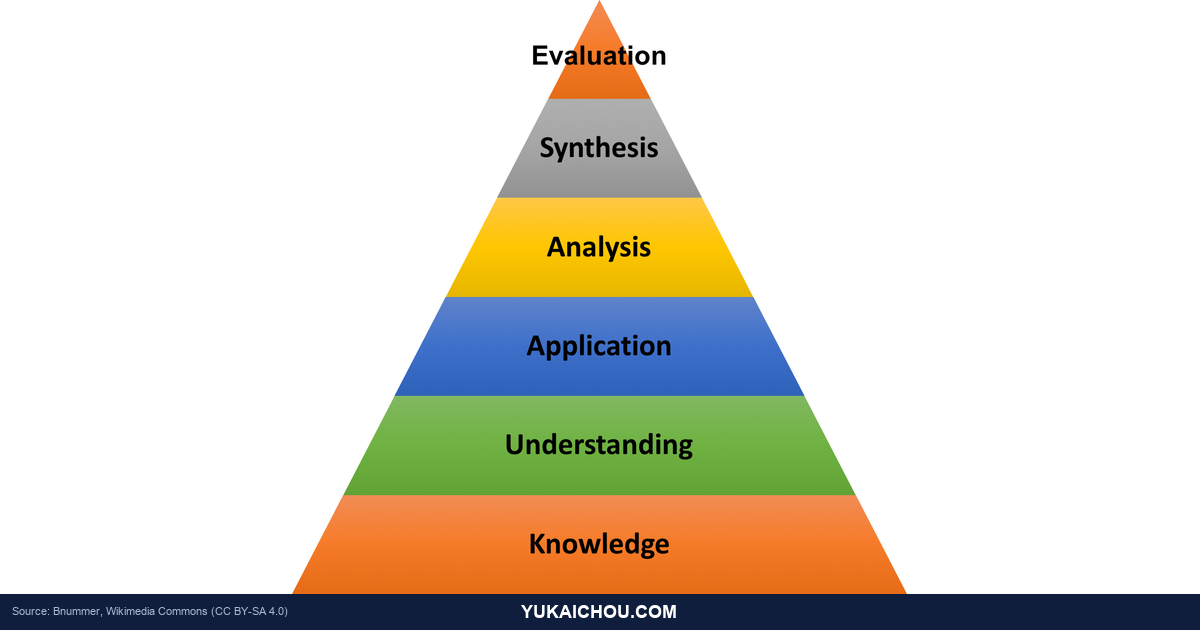

Walk into almost any school, corporate training department, or e-learning startup and you will find the same six words taped to a wall or buried in a slide deck: remember, understand, apply, analyze, evaluate, create. That is Bloom’s Taxonomy, and it is the most widely used framework in the history of education. A committee of examiners drew it up in 1956 to settle arguments about what test questions were actually measuring. Seventy years later it shapes lesson plans on six continents and quietly governs the design of nearly every learning app you have ever opened.
Here is what almost nobody tells you. Bloom’s Taxonomy is a map of what to learn at each level of difficulty. It says nothing at all about why a human being would climb it. It is a beautifully organized ladder with no answer to the one question every learner is silently asking: why should I take the next step? That silence is the reason most educational gamification fails, and it is exactly the gap a behavioral designer is trained to fill.
I have spent over two decades studying what actually moves people to act, and I built the Octalysis Framework to name those forces precisely. So I am not going to hand you another verb chart. I am going to show you what Bloom’s Taxonomy is, where the evidence supports it and where the famous pyramid quietly lies, what is happening in the brain as a learner moves up the levels, and then the layer Bloom’s committee never built: how each of his six levels maps onto the motivational Core Drives that decide whether anyone bothers to learn at all.
Last Updated: 2026-06-03
Speed Run Notes
- Bloom’s Taxonomy sorts learning objectives into six cognitive levels, from Remember at the bottom to Create at the top. It tells you what to teach at each rung. It says nothing about why anyone climbs.
- The 1956 original used nouns (Knowledge, Comprehension, Application, Analysis, Synthesis, Evaluation). Anderson and Krathwohl’s 2001 revision switched to verbs and moved Create to the top. Same skeleton, sharper language.
- The pyramid everyone shares was never in Bloom’s book. It was bolted on later, and it smuggles in two false claims: that the top is rarer than the base, and that you must finish each level before the next.
- Cognitive science says the levels are a loop, not a staircase. Creating something (the “top”) strengthens memory of the facts (the “bottom”) better than studying them directly. The generation effect runs the ladder in reverse.
- Nearly all learning apps gamify the bottom of Bloom (quiz streaks for Remember and Understand) because it is easy to score. That is why engagement is high and real skill is low.
- The S-Tier move is to design for the top. Create is where the intrinsic Core Drives live, and intrinsic motivation is the only kind that survives after the points stop.
In This Article
- What Is Bloom’s Taxonomy?
- The Six Levels of the Cognitive Domain
- The 1956 Original vs the 2001 Revision
- What Bloom Got Right
- Where Bloom’s Taxonomy Falls Apart
- What’s Really Happening Inside the Brain
- Bloom’s Taxonomy vs Other Frameworks
- Bloom’s Taxonomy in the Real World
- The Elephant in the Room
- How to Apply It with the Octalysis Framework
- Frequently Asked Questions
Author Credibility: Yu-kai Chou

Yu-kai Chou created the Octalysis Framework after studying gamification since 2003 — years before the term entered mainstream vocabulary. As a Human-Systems Architect & Behavioral Designer, his framework has been applied by LEGO, Microsoft, Porsche, Coca-Cola, Salesforce, and MrBeast, impacting over 1.5 Billion Users.
Chou has taught the Octalysis methodology at Harvard, Stanford, Yale, Tesla, Google, BCG, and IDEO.
His work has been cited by Harvard, Stanford, MIT, Forbes, Wall Street Journal, Wired, US Department of Energy, NIST, NSF, NCBI, US Department of Education, ClinicalTrials.gov, and Google Scholar — with 3,700+ more academic publications. Explore his books here.

What Is Bloom’s Taxonomy?
In 1948, a group of college examiners met at a convention and ran into a problem that sounds small but is not. They were all writing tests, and they had no shared language for what their tests measured. One professor’s “comprehension” question was another professor’s “recall” question. Grades meant different things in different rooms. Benjamin Bloom, an examiner at the University of Chicago, chaired the committee that spent the next eight years trying to fix this. The result, published in 1956, was Taxonomy of Educational Objectives, Handbook I: The Cognitive Domain.
The word “taxonomy” matters. Bloom did not call it a theory, a model, or a method. He borrowed the word biologists use for classification, the way they sort life into kingdom, phylum, class. A taxonomy is a filing system. Bloom’s goal was modest and precise: give educators a shared vocabulary for the kinds of thinking a question or an objective demands, so that “write an objective” stops being guesswork. He sorted cognitive objectives into six categories, ordered from simple to complex, and that ordering is the part the world remembers.
The original six, in order, were Knowledge, Comprehension, Application, Analysis, Synthesis, and Evaluation. Each category came with example verbs and sample test items, because the entire point was to make the abstract concrete for the person writing the exam. Bloom’s committee was not theorizing about how the mind learns. They were building a tool for measurement, and they were good at it. That distinction, taxonomy versus theory, is going to come back later, because most of the framework’s misuse traces directly to forgetting it.
Bloom went on to other work that matters enormously for anyone designing learning experiences. In 1984 he published the finding now called the “2 Sigma Problem”: students tutored one-on-one with mastery learning performed about two standard deviations better than students in a conventional classroom. The average tutored student scored higher than 98 percent of the classroom group. Hold that number. It is the single most important piece of evidence Bloom ever produced, and it is not about the taxonomy at all. It is about motivation, feedback, and pacing, the things the taxonomy leaves out.
The Six Levels of the Cognitive Domain
Here are the six levels in their modern form, each with what it actually demands of a learner and where designers consistently get it wrong. I am using the 2001 revised verbs, since that is the version in active use today.
1. Remember
Retrieving facts from memory. Naming the eight Core Drives, reciting a formula, recalling the date of an event. This is the base of the ladder, and it gets a bad reputation it does not fully deserve. You cannot analyze a system whose parts you cannot name. Remembering is not the enemy of deep learning; treating it as the destination is. The design failure here is mistaking recall for understanding because recall is the easiest thing on earth to score. A multiple-choice question that a student answers correctly proves they recognized an answer, not that they could generate it, and certainly not that they could use it.
2. Understand
Constructing meaning. Explaining an idea in your own words, summarizing, giving an example that was not handed to you. The tell that someone genuinely understands rather than merely remembers is that they can paraphrase without the original in front of them and produce a fresh example. This is where most “I get it” moments live, and also where most learners overestimate themselves. The feeling of understanding while reading a clear explanation is real, and it is not the same as the ability to reconstruct that explanation tomorrow with the book closed.
3. Apply
Using knowledge in a new situation. Taking a method you learned on one problem and running it on a different one. This is the first level where learning becomes visible in behavior rather than in a test answer, and it is the level where the cognitive cost jumps. Remembering and understanding can happen while you sit still. Applying forces you to act, to choose, to risk getting it wrong in a context the teacher did not pre-chew. Notice that this is also the first level where a feedback loop becomes essential, because applying without feedback is just guessing.
4. Analyze
Breaking something into parts and seeing how they relate. Distinguishing cause from correlation, separating an argument’s claims from its evidence, mapping which Core Drive a game mechanic is actually pulling. Analysis is where a learner stops consuming a body of knowledge and starts interrogating it. The common design mistake is to label a recall task “analysis” because it sounds more rigorous. Asking a student to list the parts of the eye is Remember wearing an Analyze costume. Asking them why a particular part fails first in low light is the real thing.
5. Evaluate
Judging based on criteria. Critiquing a design, defending a position, deciding which of two solutions is better and saying why. Evaluation requires that the learner hold standards in mind and measure something against them, which means they must already possess those standards. This is the level where expertise begins to show, because a novice can apply a rule but only someone with a developed mental model can judge when the rule should be broken. It is no accident that evaluation is hard to automate and hard to fake.
6. Create
Putting pieces together into something new. Designing a system, composing an argument, building a product, writing the thing rather than reviewing it. In the 2001 revision this moved to the very top, replacing the original “Synthesis,” and the placement carries a strong implied claim: that creating is the most cognitively demanding thing a person can do. We will challenge that claim shortly, because children create constantly and they are not operating at the ceiling of human cognition. But there is no argument that Create is where learning becomes ownership. The moment a learner builds something of their own, the material stops being the teacher’s and becomes theirs. Keep that word, ownership. It is about to do a lot of work.
The 1956 Original vs the 2001 Revision
For forty-five years, students wrote the six levels as nouns. Then in 2001 a team led by Lorin Anderson, a former student of Bloom’s, and David Krathwohl, a co-author of the original handbook, published A Taxonomy for Learning, Teaching, and Assessing. They made three changes, and each one is more significant than it looks.
First, they turned the nouns into verbs. Knowledge became Remember, Comprehension became Understand, and so on. This was not cosmetic. Objectives describe what a learner does, and a verb forces the writer to specify an action rather than a vague mental state. “The student will know photosynthesis” is unmeasurable. “The student will explain photosynthesis” can be checked.
Second, they reordered the top. In the original, Evaluation sat at the summit and Synthesis sat just below it. The revision renamed Synthesis to Create and promoted it above Evaluate. The reasoning was that generating something new draws on judging existing things, so creation must be the higher act. This is a defensible call and also the source of one of the framework’s deeper confusions, as we will see.
Third, and most overlooked, they added an entire second dimension. The revised taxonomy is not a list. It is a grid. One axis is the six cognitive processes. The other is a Knowledge Dimension with four types: Factual, Conceptual, Procedural, and Metacognitive. Every objective lives in a cell where a process meets a kind of knowledge. “Analyze (process) your own study habits (metacognitive knowledge)” is a different cell from “Analyze (process) the parts of a cell (factual knowledge).” Almost nobody uses this grid, which is a shame, because the Metacognitive row is where the most durable learning happens, and it is the row pop versions of Bloom erase entirely.
One more thing the popular telling forgets: the cognitive domain was only one of three. Bloom’s larger project covered the Affective domain (how people develop attitudes and values, published by Krathwohl, Bloom, and Masia in 1964) and the Psychomotor domain (physical skill, which Bloom’s team never finished and others completed later). The cognitive handbook became famous and the other two faded, which tells you something. We remember the part of Bloom that is easiest to test, and we forget the part about feelings. That pattern is the whole problem in miniature.
What Bloom Got Right
It is fashionable in some circles to dismiss Bloom’s Taxonomy as a relic. That is lazy. The framework earned its seventy-year run, and three of its contributions are genuinely durable.
It gave a shared language to a field that had none. Before 1956, two educators arguing about whether a question was “too easy” were often arguing past each other. After Bloom, they could point at a level and disagree precisely. A shared vocabulary is not a small thing; it is the precondition for any field improving, because you cannot fix what you cannot name. This is the same reason I gave the eight Core Drives numbers and names rather than leaving motivation as a fog of “engagement.”
It forced objectives to be observable. The move from “understand” to “explain, compare, predict” pushed a generation of teachers to write goals that could actually be checked against student behavior. Vague goals produce vague teaching. Bloom made vagueness harder.
It put complexity on a single axis that anyone could grasp in thirty seconds. Whatever its flaws, the idea that some thinking is more demanding than other thinking, and that you can roughly order it, is true and useful. A designer who knows the difference between asking a user to recognize a feature and asking them to combine features into a workflow is a better designer. Bloom’s levels are a fast, cheap way to ask “what am I actually demanding of this person right now?” That question alone has rescued countless lessons and onboarding flows from accidental shallowness.
Where Bloom’s Taxonomy Falls Apart
The taxonomy’s strength, its simple ladder, is also where it breaks. Three failures matter most, and each one is invisible until you have seen it.
1. The pyramid was never Bloom’s, and it lies twice
Open any search engine and the first image is a pyramid: Remember a fat band at the bottom, Create a thin sliver at the top. That pyramid does not appear in the 1956 handbook or the 2001 revision. It was added by later popularizers, and a pyramid is a loaded shape. It says two things that are not true. It says the top is scarce, that few will get there, which discourages the very people who could. And it says the bottom is the foundation everything rests on, which implies you must lay it completely before building up. Bloom’s committee ordered the levels by cognitive complexity. They never claimed the higher levels were rarer or that the structure carried weight like a building. The pyramid smuggled in a story of scarcity and prerequisite that the framework itself does not support.
2. The strict hierarchy does not hold
The most damaging reading of Bloom is that a learner must master each level before touching the next: remember fully, then understand fully, then apply, and only much later create. Decades of evidence say this is wrong. Children create stories and inventions before they can analyze grammar. Learners often understand a concept precisely because they tried to apply it and failed. The act of creating frequently drives the lower levels rather than waiting on them. The levels describe types of thinking, not a mandatory sequence. Treating Bloom as a locked staircase keeps learners grinding the bottom two steps for years and calling it “building fundamentals,” when the fastest path to those fundamentals often runs through the top.
3. It describes, it does not explain, and it says nothing about motivation
This is the deepest crack. Bloom’s Taxonomy is a classification, not a mechanism. It tells you that “evaluate” is more complex than “remember,” but not how a brain gets from one to the other, what makes the transition stick, or why a learner would invest the effort. It has no account of attention, no account of forgetting, and above all no account of desire. A learner who does not want to climb will sit at the bottom forever, and the taxonomy has nothing to say to them. That is not a small omission for a framework that governs how we design learning. It is the omission. A map of altitudes with no engine and no reason to drive.
A process account of that climb does exist, just not inside Bloom. David Kolb’s experiential learning cycle treats learning as a loop the learner walks: do something, review what happened, pull a general idea out of it, then take that idea back out for a test that becomes the next experience.
Bloom names the kind of thinking you are aiming at. Kolb describes the motion that gets a person there.
What’s Really Happening Inside the Brain
Bloom’s levels were drawn from the outside, by watching what tasks demanded. Modern cognitive science lets us look from the inside, and the view rearranges the ladder in a way Bloom’s committee could not have predicted.
Remembering and understanding are encoding and retrieval. New information is bound into existing networks, and the act of pulling it back out later is what strengthens the trace. Here is the finding that should unsettle anyone who treats Bloom as a one-way climb: retrieving information strengthens memory far more than re-reading it. This is the testing effect, demonstrated repeatedly by researchers such as Roediger and Karpicke. A learner who is forced to generate an answer remembers better than one who reviews the answer, even though reviewing feels more productive. The “higher” act of producing improves the “lower” act of retaining.
The generation effect goes further. When people produce material themselves rather than reading it passively, they retain more. Creating, the supposed summit, reaches all the way down and reinforces the supposed base. The prefrontal cortex and working memory carry the load during analysis, evaluation, and creation, and that load is real, which is why cognitive load management matters. But the relationship between the levels is not a clean upward flow of difficulty. It is a circuit. Effortful work at the top deepens the foundation at the bottom, which is the precise opposite of what the pyramid trains us to expect.
There is also an emotional layer Bloom’s cognitive handbook deliberately set aside. Memory consolidation is modulated by emotional salience and by reward. The brain encodes more durably what it cares about. This is the bridge to motivation, and it is the bridge the taxonomy refuses to cross. A learner moving up Bloom’s levels is not just doing harder cognitive work. They are spending willpower, riding curiosity, chasing a sense of progress or ownership. The cognitive ladder and the motivational engine are running at the same time, and only one of them is on Bloom’s diagram.
Bloom’s Taxonomy vs Other Frameworks
Bloom is the most famous classification of learning, but it is not the only one, and seeing it beside its rivals sharpens what it is and is not.
Bloom vs the SOLO Taxonomy
The SOLO Taxonomy, developed by John Biggs and Kevin Collis in 1982, classifies the structural complexity of a learner’s actual response rather than the intended objective. Its levels run from prestructural (missing the point) through unistructural and multistructural (one idea, then several unconnected ideas) to relational (ideas integrated) and extended abstract (generalized to new domains). The difference is direction. Bloom describes what you ask a learner to do; SOLO describes the quality of what they produced. SOLO is arguably the better assessment lens because it grades the evidence in front of you, while Bloom grades your intentions. A designer benefits from both: Bloom to set the target, SOLO to read the result.
Bloom vs Webb’s Depth of Knowledge
Norman Webb’s Depth of Knowledge model sorts tasks into four levels of cognitive depth, from recall to extended thinking. Its sharpest contribution is a correction to a Bloom misuse: depth is not the verb. “Analyze” can be shallow or deep depending on the task. Webb forces you to look at how much sustained reasoning a task genuinely requires rather than trusting the verb on the worksheet. If Bloom’s weakness is that its verbs get gamed, Webb is the antidote that asks what the work actually costs.
Bloom vs Cognitive Load Theory
John Sweller’s Cognitive Load Theory is the missing engineering manual for the lower half of Bloom. Working memory is tiny and easily flooded. If you ask a learner to operate at the Apply or Analyze level while their working memory is consumed by extraneous load (confusing instructions, cluttered interfaces, unmanaged complexity), they will fail, and you will blame the wrong thing. Bloom tells you which floor of the building you are on. Cognitive Load Theory tells you whether the elevator can carry the weight. They are complements, not competitors, and any serious learning design uses both.
Bloom vs the Octalysis Framework
This is the comparison that matters most, because the two frameworks are not rivals at all. They answer different questions and the gap between them is the entire subject of this article. Bloom’s Taxonomy describes the cognitive destination: what kind of thinking a learning objective targets. The Octalysis Framework describes the motivational fuel: which of the eight Core Drives makes a human want to move at all. Bloom is the staircase. Octalysis is the reason anyone climbs it. A curriculum built only on Bloom is a perfectly engineered ladder with nobody on it. A gamified app built only on Octalysis is a thrilling experience that teaches nothing durable. You need the destination and the fuel, and almost nobody designs with both at once.
Bloom’s Taxonomy in the Real World
Bloom is not academic furniture. It is running silently inside systems you use every week.
Curriculum and the classroom
This is Bloom’s native habitat. Standards documents, lesson plans, and exam blueprints are written in his levels, and accreditation bodies often require objectives mapped to them. Used well, this keeps a course from being all recall. Used badly, it becomes a verb-matching exercise where teachers reverse-engineer objectives to satisfy a rubric rather than to teach. The framework is only as good as the intent behind it, and bureaucracies have a talent for keeping the form while losing the function.
Corporate learning and development
Enterprise training teams lean on Bloom to justify that a course does more than dump information. The honest version designs role-relevant Apply and Analyze tasks. The common version slaps a Remember-level quiz on the end of a video and declares competency. Anyone who has clicked through mandatory compliance training knows exactly which version dominates, and knows exactly how much of it survives to Monday.
Ed-tech and gamified learning apps
Here is where the diagnosis gets sharp. Open the most successful learning apps and watch where the game layer sits. Streaks, points, leaderboards, and instant right-or-wrong feedback are bolted almost entirely onto the bottom two levels: Remember and Understand. They are spectacular at making memorization feel rewarding, which is genuinely valuable for vocabulary, facts, and drills. But notice what is rarely gamified: applying a concept to a messy real situation, analyzing why an approach failed, creating something original. The game lives at the base of Bloom because the base is the easiest thing to score with a checkmark. Engagement metrics soar while transfer to real performance stays flat, and the industry calls this success because the dashboard is green.
AI tutoring and the 2 Sigma promise
Recall Bloom’s two-standard-deviation finding. One-on-one tutoring with mastery learning crushed classroom instruction, and for forty years the result sat on a shelf because human tutors do not scale. The economics have now changed. An AI tutor can, in principle, give every learner the individualized pacing and immediate feedback Bloom’s tutored students enjoyed. But there is a catch the hype skips. Bloom’s tutors did not win on content delivery alone. They won by keeping the learner at the right cognitive level at the right moment, catching errors instantly, and sustaining motivation through a human relationship. The first two an AI can do today. The third, the motivational engine, is precisely what Bloom’s Taxonomy never modeled and what most AI tutors still ignore. An adaptive content engine without a motivational design will not reach two sigma. It will reach a very efficient version of the same disengagement.
The Elephant in the Room
Here is what the education-technology industry will not put on the conference slide: it gamifies the bottom of Bloom on purpose, because the bottom is the only part that is cheap to measure and cheap to sell.
A streak for completing daily flashcards is trivial to build and trivial to score. Either the learner showed up and tapped the right boxes or they did not. You can put that number on a dashboard, show it to an investor, and call it engagement. Now try to build a streak for “created an original solution to a problem nobody handed you.” You cannot, at least not with a checkmark, because creation does not have a single right answer to score against. So the industry quietly redefines learning as the part of Bloom it can instrument, ships a dopamine loop around recall, and lets everyone assume that high engagement means deep learning. It does not. It means the recall game is fun.
The deeper dodge is that the genuinely valuable levels, Apply through Create, require the one thing a points system cannot manufacture: intrinsic motivation. You can pay a person to memorize. You cannot pay them, in any lasting way, to care about creating something meaningful, because the moment the payment stops, so does the caring. The overjustification effect is brutal here: dangle enough extrinsic reward over an activity and you can actually destroy the intrinsic interest that would have driven the higher levels. So the apps that gamify recall with points are not just ignoring the top of Bloom. In the worst cases they are poisoning the soil the top grows in, training learners to chase the badge instead of the mastery, and then wondering why nobody transfers what they learned to real life.
None of this is an argument against gamifying learning. It is an argument against gamifying the wrong floor of it. The fix is not to remove the game. The fix is to move the game up.
How to Apply Bloom’s Taxonomy with the Octalysis Framework
The Octalysis Framework maps human motivation onto eight Core Drives, arranged around an octagon. The top drives are White Hat and intrinsic; the bottom drives are Black Hat and urgency-based. The left side is extrinsic and logical; the right side is intrinsic and emotional. If Bloom tells you which cognitive level you are designing for, Octalysis tells you which motivational force will get a human to engage at that level. Here is the full picture.

The Bloom × Octalysis Core Drive Crosswalk
Once you line up Bloom’s six cognitive levels against the eight Core Drives, something clicks into place. The levels people find most engaging and most durable are exactly the ones the intrinsic, Right-Brain Core Drives power. That is not a coincidence I imposed; it is what falls out of the map.
- Remember & Understand are powered by Core Drive 2 (CD2): Development & Accomplishment. Early wins, progress bars, the satisfaction of a correct answer. This is also where Core Drive 6 (CD6): Scarcity & Impatience and the urgency mechanics (streaks, daily timers) attach so easily, because recall is binary and easy to threaten with loss.
- Apply activates CD2 plus the first real dose of Core Drive 3 (CD3): Empowerment of Creativity & Feedback. The instant a learner uses knowledge in a live situation, they need a feedback loop, and a good feedback loop is the heart of CD3.
- Analyze & Evaluate run on CD3 and Core Drive 7 (CD7): Unpredictability & Curiosity. Breaking a system apart and judging it is driven by the itch to find out, the desire to see what is really going on under the surface.
- Create sits on the strongest stack of all: CD3, Core Drive 4 (CD4): Ownership & Possession, and Core Drive 1 (CD1): Epic Meaning & Calling. When a learner builds something, it becomes theirs (CD4) and, if the design is good, it matters to someone beyond them (CD1). These are the deepest, most lasting motivators a human has.
Read the crosswalk from top to bottom and the pattern is unmistakable. The lowest levels of Bloom lean on the most extrinsic, most easily-bought drives. The highest levels lean on the most intrinsic, least-buyable drives. Bloom, working from educational measurement in the 1950s, and Octalysis, built from billion-user products decades later, drew the same structure from opposite ends. When two maps made by people who never met line up that cleanly, it is strong evidence the territory is real.
Gamify the top, not the bottom
This is the inversion, and it is the single most important design move in this article. Almost all educational gamification piles its mechanics onto the bottom of Bloom because that floor is easy to score. That is backwards. The bottom of Bloom runs on extrinsic drives, and extrinsic motivation evaporates the moment the reward stops. The top of Bloom runs on intrinsic drives, and intrinsic motivation is self-sustaining. So the floor that most needs an external push (recall) is the floor where the push does the least lasting good, and the floor that needs no external push (creation) is the floor everyone leaves un-designed.
The S-Tier move is to invert it. Put your richest design energy at the top. Build experiences where learners create, own what they make, and feel it connects to something larger, and you are recruiting CD1, CD3, and CD4, the drives that keep working after the points are gone. You will still use CD2 and even a little CD6 to get someone over the cold-start hump at the bottom. But if your design peaks at the bottom, you have built a machine that produces engagement and not learning. Design for Create and the lower levels come along for the ride, because, as the brain science showed, creating strengthens remembering.
Bloom is a circuit, not a staircase
Drop the pyramid. The truer picture is a loop. The generation effect and the testing effect both show that effortful work at the top, producing and creating, feeds memory at the bottom more powerfully than studying the bottom directly. This is also how games have always taught. Nobody reads the rulebook cover to cover (Remember) before playing. You start playing (Apply, even Create), you fail, you get feedback, and the rules stick precisely because you used them under pressure. The game throws you near the top of Bloom on day one and lets the climb happen in reverse.
So stop sequencing learners up a ladder and start looping them. Let them make something badly and early. Let the creating drive the remembering. The warning light to watch for is the telltale of a bottom-gamified design: quiz completion and streak length climbing while real-world transfer stays flat. When your engagement chart is green and your outcomes chart is not, you have built a Remember-level dopamine loop with no Create-level payoff. Move the game up.
Practical Steps for Using Bloom’s Taxonomy Well
Theory is worth nothing on Monday morning if you cannot act on it. Here is how to put this to work whether you are designing a course, a training program, or a learning product.
- Map every objective to a level before you build anything. Write each learning goal and tag it Remember, Understand, Apply, Analyze, Evaluate, or Create. If more than half your goals cluster in the bottom two, you are building a recall machine. Decide on purpose whether that is what you want.
- Tag each level with its Core Drive, then check your motivation coverage. Beside every objective, write the Core Drive that will pull the learner through it. If your top-level objectives have no CD1, CD3, or CD4 design behind them, they will not happen, no matter how well you wrote the verb.
- Put a genuine create task in the first third, not the last. Resist the staircase instinct that says creation is the finale. Give learners something small to build early, even if it is rough, so the generation effect starts strengthening the fundamentals from day one.
- Audit where your game mechanics actually sit. List every point, streak, badge, and leaderboard, and mark which Bloom level it rewards. If they all reward Remember and Understand, you have found why engagement is high and skill is low. Move at least one mechanic up to reward Apply or Create.
- Manage cognitive load before you raise the level. Before asking a learner to Analyze or Create, strip out extraneous load: confusing instructions, cluttered screens, unmanaged complexity. A high Bloom level on top of an overloaded working memory produces failure, not learning.
- Measure transfer, not just completion. Completion and streaks measure whether the recall game is fun. Build at least one assessment that asks the learner to apply or create in a situation you never showed them. That is the only number that tells you learning happened.
- Use the Metacognitive row. The most durable learners think about their own thinking. Add objectives that ask learners to evaluate their own strategies and plan their own approach. This is the row the pop version of Bloom deletes, and it is the one that compounds.
Bloom’s Taxonomy Was a Map of Objectives, Not a Theory of Motivation
Bloom’s committee built something remarkable and honest: a filing system for the kinds of thinking we ask of learners. It gave a fractured field a shared language, and that language still works. The mistake was never Bloom’s. The mistake was ours, when we took a careful taxonomy of objectives and treated it as a complete theory of learning, drew a pyramid he never drew, and then designed seventy years of education around a ladder with no engine.
The taxonomy tells you where you are going. It is silent on why anyone would walk there, which is the question that decides everything. Bloom’s own two-sigma data pointed straight at the answer and his taxonomy never picked it up: tutored learners won on pacing, feedback, and motivation, the human forces that live off the diagram. Octalysis names those forces and lets you design them on purpose. Line the two up and the gap closes. The cognitive levels tell you what to build; the Core Drives tell you what will make a human climb.
If you take one thing from this, let it be the inversion. Stop gamifying the bottom of Bloom because it is easy to score, and start designing the top because that is where ownership, curiosity, and meaning live, and those are the only motivators that outlast the points. Build the experience where a learner makes something that is theirs and matters, and watch the remembering take care of itself. Bloom drew the map. The reason to make the journey was always going to be your job.
Frequently Asked Questions
What are the six levels of Bloom’s Taxonomy?
In the current revised version they are Remember, Understand, Apply, Analyze, Evaluate, and Create, ordered from least to most cognitively complex. The original 1956 version used nouns: Knowledge, Comprehension, Application, Analysis, Synthesis, and Evaluation. The revision turned them into verbs and promoted creating to the top.
Who created Bloom’s Taxonomy and when?
Benjamin Bloom chaired the committee of college examiners that published the cognitive-domain taxonomy in 1956. The widely used revision was published in 2001 by a team led by Lorin Anderson, a former student of Bloom’s, and David Krathwohl, a co-author of the original. The project also produced an affective domain (1964) covering attitudes and values.
What is the difference between the original and the revised Bloom’s Taxonomy?
Three changes. The revision switched the six categories from nouns to action verbs so objectives describe what a learner does. It renamed Synthesis to Create and moved it above Evaluate at the top. And it added a second dimension, the Knowledge Dimension (Factual, Conceptual, Procedural, Metacognitive), turning the single list into a two-dimensional grid that almost nobody actually uses.
Is Bloom’s Taxonomy a hierarchy you must climb in order?
No, and treating it that way is the most common misuse. The levels describe types of thinking, not a mandatory sequence. Evidence shows learners often understand a concept because they tried to apply it, and that creating something can drive the lower levels rather than wait on them. The strict staircase reading keeps learners stuck on the bottom rungs for years in the name of fundamentals.
Why is the Bloom’s Taxonomy pyramid misleading?
The pyramid shape was added by later popularizers and never appeared in Bloom’s own books. A pyramid implies two false things: that the top levels are rare and reserved for a few, and that you must complete each lower level before building the next. Bloom’s committee ordered the levels by complexity only. They never claimed scarcity at the top or a load-bearing prerequisite structure.
What is Bloom’s 2 Sigma Problem and why does it matter?
In 1984 Bloom reported that students tutored one-on-one with mastery learning performed about two standard deviations better than students in ordinary classrooms, with the average tutored student beating 98 percent of the classroom group. It mattered then as a challenge (how do you scale tutoring?) and matters now because AI tutoring can finally deliver individualized pacing and feedback at scale, though only if it also solves the motivation problem the taxonomy ignores.
How does Bloom’s Taxonomy apply to gamification?
Most learning apps gamify only the bottom of Bloom, Remember and Understand, because quiz answers are easy to score with points and streaks. That produces high engagement and low real-world skill. The stronger approach is to design game mechanics around the top, Apply through Create, where the intrinsic Core Drives (Ownership, Creativity, Epic Meaning) live, because intrinsic motivation is the only kind that lasts after the rewards stop.
How does Bloom’s Taxonomy relate to the Octalysis Framework?
They answer different questions and fit together. Bloom describes the cognitive destination, what kind of thinking an objective targets. Octalysis describes the motivational fuel, which of the eight Core Drives makes a person want to engage. Bloom is the staircase; Octalysis is the reason anyone climbs. Mapping each Bloom level to its Core Drive reveals that the highest levels are powered by the most intrinsic, most durable motivators.
Is Bloom’s Taxonomy still relevant today?
Yes, as a vocabulary and a checklist, not as a complete theory of learning. It remains the fastest way to ask what kind of thinking you are demanding of a learner and to avoid building a course that is all recall. Its limits are real: it describes rather than explains, and it says nothing about motivation. Pair it with cognitive load theory for the mechanics and a motivation framework for the engine, and it earns its place.
References
- Bloom, B. S. (Ed.) (1956). Taxonomy of Educational Objectives, Handbook I: The Cognitive Domain. David McKay.
- Anderson, L. W., & Krathwohl, D. R. (Eds.) (2001). A Taxonomy for Learning, Teaching, and Assessing: A Revision of Bloom’s Taxonomy of Educational Objectives. Longman.
- Krathwohl, D. R. (2002). A Revision of Bloom’s Taxonomy: An Overview. Theory Into Practice, 41(4), 212–218.
- Krathwohl, D. R., Bloom, B. S., & Masia, B. B. (1964). Taxonomy of Educational Objectives, Handbook II: The Affective Domain. David McKay.
- Bloom, B. S. (1984). The 2 Sigma Problem: The Search for Methods of Group Instruction as Effective as One-to-One Tutoring. Educational Researcher, 13(6), 4–16.
- Biggs, J. B., & Collis, K. F. (1982). Evaluating the Quality of Learning: The SOLO Taxonomy. Academic Press.
- Webb, N. L. (1997). Criteria for Alignment of Expectations and Assessments in Mathematics and Science Education. Council of Chief State School Officers.
- Sweller, J. (1988). Cognitive Load During Problem Solving: Effects on Learning. Cognitive Science, 12(2), 257–285.
- Roediger, H. L., & Karpicke, J. D. (2006). Test-Enhanced Learning: Taking Memory Tests Improves Long-Term Retention. Psychological Science, 17(3), 249–255.
- Slamecka, N. J., & Graf, P. (1978). The Generation Effect: Delineation of a Phenomenon. Journal of Experimental Psychology: Human Learning and Memory, 4(6), 592–604.
- Soderstrom, N. C., & Bjork, R. A. (2015). Learning Versus Performance: An Integrative Review. Perspectives on Psychological Science, 10(2), 176–199.
- Marzano, R. J., & Kendall, J. S. (2007). The New Taxonomy of Educational Objectives (2nd ed.). Corwin Press.
- Chou, Y. (2015). Actionable Gamification: Beyond Points, Badges, and Leaderboards. Octalysis Media.
Related Reading
- The Octalysis Framework: The 8 Core Drives of Human Motivation
- Self-Determination Theory: The Needs Behind Intrinsic Motivation
- The Behavioral Framework Library: Every Psychological Model a Designer Should Know