
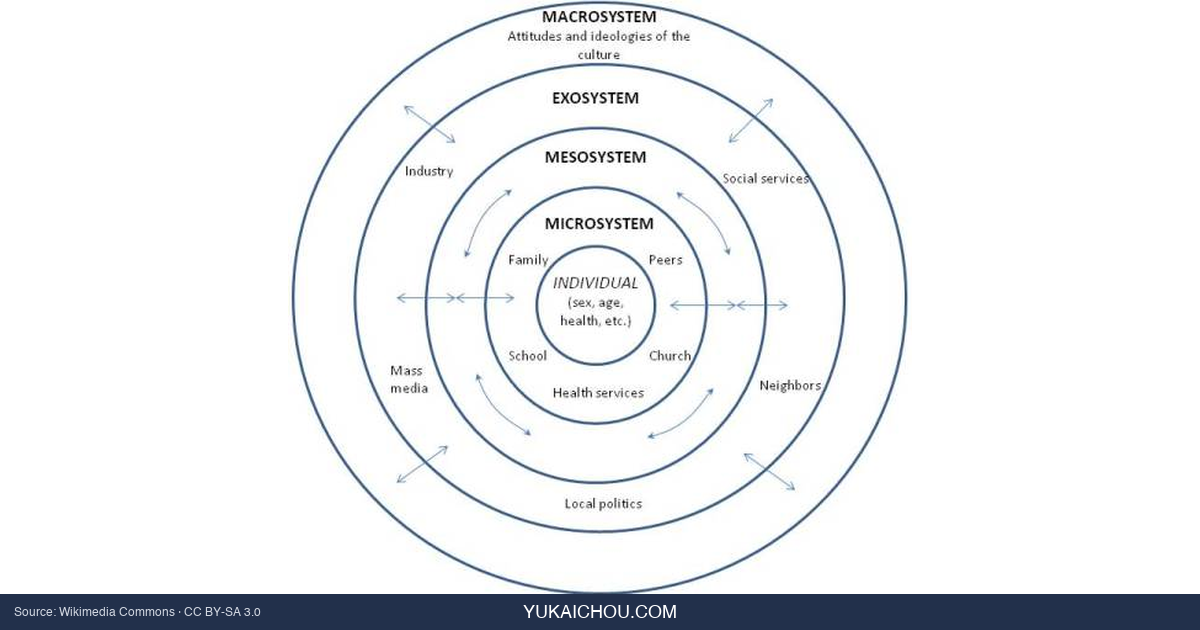

Short answer: Bronfenbrenner’s ecological systems theory says a person develops inside a set of nested environments, not in isolation. From the inside out, those rings are the microsystem, mesosystem, exosystem, macrosystem, and chronosystem.
The microsystem is the settings you are directly in, like family and school. The mesosystem is not a place at all but the links between those settings.
The exosystem is where it gets interesting: a parent’s workplace can reshape a child’s daily life even though the child never sets foot in it. The macrosystem is culture, and the chronosystem is time, because the same event at a different point in a life produces a different person.
In 1965, a developmental psychologist most people had never heard of helped launch a program that would reach tens of millions of American children. The program was Head Start, and the psychologist was Urie Bronfenbrenner. His argument to a skeptical government was deceptively simple: you cannot fix a child by fixing the child. A poor four-year-old does not carry her disadvantage inside her skull like a faulty part. She carries it in the apartment she sleeps in, the block she walks, the job her mother is too exhausted to keep, the policy written by people she will never meet. Help the child without touching those rings, Bronfenbrenner warned, and the gains evaporate the moment she goes home.
That idea became Ecological Systems Theory, and for forty years it has been the most cited and most misunderstood map in developmental psychology. Open any textbook and you will see the famous diagram: a set of nested circles, like a Russian doll cut in half, with the child in the center and ever-wider rings labeled microsystem, mesosystem, exosystem, macrosystem, chronosystem. Students memorize the rings for the exam and forget them by summer. What almost nobody remembers is the warning Bronfenbrenner spent the last decade of his life shouting: the rings were never the point. People took his diagram and dropped his engine.
I have spent more than twenty years studying what actually moves people to act, and I built the Octalysis Framework to map the eight Core Drives underneath that action. Here is why Bronfenbrenner matters to me as a behavioral designer, and why he should matter to you: almost every product, app, and engagement system ever shipped is built for the smallest ring. We instrument the individual user, optimize the individual session, celebrate the individual streak. Bronfenbrenner’s entire life’s work says that the individual is the one ring whose behavior is decided mostly by the rings around it, the ones your dashboard cannot see. This post walks through what he actually claimed, the correction he made to his own theory that almost everyone ignores, what the developing brain is really doing inside those rings, and then the part almost nobody designs on purpose: how to build for an ecology instead of for a lone unit of attention.
Speed Run Notes
- Bronfenbrenner’s ecological systems theory says a person develops inside nested environments: microsystem (direct settings), mesosystem (links between them), exosystem (settings you never enter but that shape you), macrosystem (culture), and chronosystem (time).
- The famous nested-circles diagram is the husk. Late in life Bronfenbrenner said the field copied his context and ignored his engine: proximal processes, the repeated back-and-forth between an active person and their world. That loop is what actually develops people.
- Most products are built for the microsystem because it is the only ring instrumentation can see. Retention usually lives one ring out, in the mesosystem, woven into relationships you do not own.
- The exosystem and macrosystem set the ceiling on every motivation you fire. A user’s boss, budget, culture, and life-stage decide whether your perfectly tuned feature survives contact with their actual life.
- Neuroscience caught up with Bronfenbrenner: serve-and-return interaction builds neural architecture, and chronic distal stress leaves biological marks. The far rings reach the body through the synapse.
- The S-Tier move: design the proximal process first, the reciprocal loop that makes the user more capable each cycle, then push it outward into the mesosystem so it is anchored by relationships your competitors cannot copy.
In This Article
- What Is Ecological Systems Theory?
- The Five Systems, From the Inside Out
- The Correction Almost Everyone Ignores: Proximal Processes
- What Bronfenbrenner Got Right
- Where Ecological Systems Theory Falls Apart
- What’s Really Happening Inside the Brain
- Bronfenbrenner vs Other Theories
- Ecological Systems Theory in the Real World
- The Elephant in the Room
- How to Apply Ecological Systems Theory with the Octalysis Framework
- Practical Steps for Designing Across the Rings
Author Credibility: Yu-kai Chou

Yu-kai Chou created the Octalysis Framework after studying gamification since 2003 — years before the term entered mainstream vocabulary. As a Human-Systems Architect & Behavioral Designer, his framework has been applied by LEGO, Microsoft, Porsche, Coca-Cola, Salesforce, and MrBeast, impacting over 1.5 Billion Users.
Chou has taught the Octalysis methodology at Harvard, Stanford, Yale, Tesla, Google, BCG, and IDEO.
His work has been cited by Harvard, Stanford, MIT, Forbes, Wall Street Journal, Wired, US Department of Energy, NIST, NSF, NCBI, US Department of Education, ClinicalTrials.gov, and Google Scholar — with 3,700+ more academic publications. Explore his books here.

What Is Ecological Systems Theory?
Ecological Systems Theory is Urie Bronfenbrenner’s claim that human development cannot be understood by studying the person alone, because the person is always embedded in a set of interacting environments that shape, and are shaped by, who they become. He laid it out in full in his 1979 book The Ecology of Human Development, and it landed like a corrective slap on a field that had spent decades putting children in laboratory rooms to see what they would do on their own.
Bronfenbrenner’s complaint about that lab tradition was sharp and famous. Developmental psychology, he wrote, had become “the science of the strange behavior of children in strange situations with strange adults for the briefest possible periods of time.” You learn how a child behaves in a sterile room with a researcher holding a clipboard. You learn almost nothing about how that child develops in the kitchen, on the playground, in the long ordinary hours that actually build a human being. The ecology was the missing variable, and he made it the whole subject.
The structure he proposed was a set of nested systems, each one containing the last, each one influencing the person at a different distance. Picture it as concentric rings with the individual at the center. The closest ring is made of the places where the person directly lives their life. The farther rings are made of forces that reach the person indirectly, through other people and institutions, all the way out to the culture itself and the dimension of time running through everything. It is a map of influence by proximity, and its genius is that it refuses to let you stop at the edge of the skin.
The reason it spread to education, social work, public health, family therapy, and eventually to anyone who designs experiences for humans is that it gave language to something practitioners already felt but could not name. A teacher knows that the brilliant lesson plan dies if the child came to school hungry and frightened. A doctor knows that the prescription fails if the patient cannot afford the co-pay or read the label. Bronfenbrenner gave them a framework for the obvious-but-ignored truth that the intervention you control is sitting inside a stack of systems you do not.
It helps to know where the idea came from, because Bronfenbrenner did not theorize this from an armchair. He was born in Moscow in 1917, raised partly on the grounds of an institution for people with developmental disabilities where his father worked as a physician, and he watched residents who had been misdiagnosed bloom once they were placed in a setting that expected more of them. The setting, not the diagnosis, predicted the outcome. He carried that observation into a career that culminated in helping design Head Start, and the whole theory can be read as a lifelong argument with the idea that a person’s fate is written inside the person. For Bronfenbrenner, the environment was never a backdrop. It was a participant in who you become.
The Five Systems, From the Inside Out
The model has five layers. Four of them were in the original 1979 work, and the fifth was added in 1986 when Bronfenbrenner realized his map had no clock. Here is each one, and the thing about each that designers usually miss.
The Microsystem: Where You Actually Live
The microsystem is the innermost ring, the set of environments where the person directly participates and has face-to-face contact: the family, the classroom, the peer group, the workplace, the sports team. This is the only ring where the action is immediate and reciprocal. Your mother does not influence you in the abstract here; she hands you breakfast, snaps at you, reads to you, ignores you. The microsystem is made of relationships and roles you are physically inside of.
Crucially, Bronfenbrenner insisted the microsystem is bidirectional. The child shapes the parent as surely as the parent shapes the child. A calm, easy baby and a colicky, screaming one pull radically different behavior out of the same exhausted adult. Development is not something done to a passive recipient by an active environment. It is a negotiation, and the person is one of the negotiators from day one.
The Mesosystem: The Connections Between Your Worlds
The mesosystem is not a new place. It is the set of links between the microsystems a person belongs to. The relationship between your home and your school. The conversation, or the silence, between your parents and your coach. The overlap between your work life and your family life. Bronfenbrenner called it a system of microsystems, and he argued that the connections between settings often matter as much as what happens inside any one of them.
A child whose parents and teachers talk to each other, share expectations, and present a coordinated front develops in a different ecology than a child whose home and school are sealed off from each other or actively at war. The mesosystem is invisible on any single-setting measurement, which is exactly why it is so easy to ignore and so powerful when you get it right. Strong links between a person’s worlds create a kind of scaffolding that no single world can build alone.
The Exosystem: The Rooms You Never Enter
The exosystem is made of settings the person never directly participates in, but whose decisions reach them anyway. The classic example is a parent’s workplace. A child does not go to the office, sit in the meetings, or hear the layoff announcement. But when the company cuts the parent’s hours, or the boss schedules a brutal late shift, or a promotion finally brings relief, that distant room reshapes the child’s daily life. The school board the student never attends, the local government, the parent’s social network: all exosystem.
This is the ring that breaks the comfortable illusion that you can understand a person by looking at the person. The exosystem is influence at one remove, decisions made by people who may not know you exist, landing on your life with full force. For anyone designing for a human being, the exosystem is the humbling reminder that your user is the downstream recipient of a dozen verdicts handed down in rooms you and they will never see.
The Macrosystem: The Cultural Blueprint
The macrosystem is the outermost environmental ring: the overarching pattern of culture, ideology, law, economics, and custom that gives all the inner rings their shape. It is less a setting than a blueprint, the set of assumptions a society holds about how families work, what childhood is for, what counts as success, what is normal. Two children with nearly identical microsystems will still develop differently if one grows up inside a culture that prizes fierce individual achievement and the other inside one built around collective obligation.
The macrosystem is the water nobody notices they are swimming in. It decides whether a teenager taking a gap year reads as wise or reckless, whether caring for aging parents reads as duty or burden, whether your product’s core behavior reads as cool, neutral, or shameful. You do not get to set the macrosystem. You get to land inside it, and the same exact design can thrive in one cultural blueprint and die in another.
The Chronosystem: The Dimension of Time
Bronfenbrenner added the chronosystem in 1986 because he realized his map was a still photograph of something that only exists as a film. The chronosystem is time as a system: the patterning of events and transitions across a person’s life, plus the sweep of historical change that the whole ecology rides on. The death of a parent hits a five-year-old and a fifteen-year-old as two different events. A pandemic, a recession, a technology that arrives in your childhood versus your retirement: all chronosystem.
Timing is everything in the chronosystem. The same event at a different point in a life produces a different person. The same feature shipped to a user at a different point in their life produces a different result. A study-planning app means one thing to a student in finals week and something else entirely to that same person three years later, sleep-deprived with a newborn. The chronosystem is the ring that insists you ask not just where your user is, but when.
Asking when raises the question the rings leave open: what does the person do about it?
Paul and Margret Baltes built a lifespan model on that one. Their selection, optimization, and compensation (SOC) framework starts from resources that are finite and shifting, then names the three moves a person makes inside them: narrow the goals that still matter, pour what capacity is left into those, and find new means when the usual ones stop working.
The chronosystem tells you the ground moves under your user. SOC describes how they hold the gain-to-loss ratio steady while it does.
The Correction Almost Everyone Ignores: Proximal Processes
Here is the part that got left out of the textbooks, and it is the part Bronfenbrenner cared about most.
By the 1990s, his theory had conquered the field, and he was miserable about how. Everyone had adopted the nested rings. Researchers slapped the circles onto their studies, labeled some variables “exosystem” and others “macrosystem,” and called it ecological. What they had taken was the map of context. What they had dropped was any account of how development actually happens inside that context. Bronfenbrenner watched his own theory get reduced to a filing system for environmental variables, and he spent his final years trying to put the engine back.
That engine is what he called proximal processes. In the revised version of the theory, which he named the bioecological model, the nested rings are demoted from the main event to the stage. The main event is the proximal process: the progressively more complex, reciprocal interaction between an active person and the people, objects, and symbols in their immediate environment. A toddler and parent in a back-and-forth game. A child puzzling over a problem and getting feedback. A reader and a hard book. These interactions are the primary mechanisms that turn genetic potential into actual ability, and Bronfenbrenner was explicit that they only work under one condition: they must occur on a fairly regular basis, over extended periods of time.
He formalized this as the PPCT model: Process, Person, Context, Time. Process is the engine, the reciprocal interaction. Person is who is in the loop, with their own temperament, biology, and agency. Context is the nested rings. Time is the chronosystem. Notice the order. Bronfenbrenner deliberately put Process first and Context third, an inversion of how his theory was being used, because he wanted to scream that the environment does not develop a person by simply surrounding them. The environment develops a person through the repeated reciprocal loop the person runs inside it. Context without process is scenery. Nothing grows.
A concrete picture helps. Take a child learning to read. You can give that child a house full of books, a well-funded school, and a culture that prizes literacy, and you have arranged a beautiful set of rings. None of it teaches the child to read. What teaches the child to read is the proximal process: an adult sitting beside them, night after night, pointing at words, waiting, correcting gently, then choosing a slightly harder book next week. The rings make that loop more or less likely to happen, but the loop is the thing that builds the reader. Strip the loop out and the richest ecology on earth produces a child surrounded by unread books. This is why Bronfenbrenner grew so frustrated. The rings had become an alibi for ignoring the only thing that actually does the developmental work.
This correction is the most useful thing in the entire theory for anyone who designs experiences, and it is the thing that gets cut from the lecture. Remember it, because the whole back half of this post turns on it: the rings tell you where to look, but the proximal process is the thing you actually build.
What Bronfenbrenner Got Right
The first thing he got right is so foundational it is now invisible: the idea that you cannot explain a person by examining the person in isolation. Before Bronfenbrenner, the dominant move was to study the individual, control for everything else, and treat context as noise to be filtered out. He flipped it. Context is not noise. Context is a large part of the signal, and a science that filters it out is studying a person who does not exist anywhere on earth.
The second thing he got right is the mesosystem insight, which I think is the most underrated idea in the whole model. The connections between a person’s settings are themselves a developmental force. This sounds modest until you sit with it. It means an intervention can succeed not by changing any single environment but by changing how two environments talk to each other. A child does better not because home improved or school improved, but because home and school started coordinating. Most people optimize settings. Bronfenbrenner saw that you can optimize the links between settings, and the links are often cheaper to change and more powerful than the settings themselves.
The third thing he got right is the exosystem, the insistence that forces you never see and never chose still author your life. This is uncomfortable and true. The parent’s job, the policy, the distant institutional decision: these are not abstractions, they are the actual mechanism by which inequality and opportunity flow downhill into a single life. Head Start exists because Bronfenbrenner took this seriously, and the program’s enduring logic is that you intervene across rings or you do not really intervene at all.
And the fourth thing, the one he had to fight his own followers to preserve, is that development is driven by an active, reciprocal process, not by passive exposure to a good environment. You do not develop a child by placing them in a rich setting and waiting. You develop them through the back-and-forth, the serve and return, the loop that gets a little harder each time. That is a claim about mechanism, not just context, and it is the part that turns a sociological map into a design principle.
Where Ecological Systems Theory Falls Apart
For all its reach, the theory has real weaknesses, and the honest version of this guide names them.
It Explains Everything, Which Means It Predicts Little
The most serious charge is that the model is nearly unfalsifiable. If every ring of the environment matters, and they all interact, and the person is active inside them, and time changes everything, then almost any outcome can be explained after the fact by pointing at some combination of systems. A theory that can absorb any result is comprehensive in a way that is also a liability. It tells you to look everywhere, which is true and important, but “look everywhere” is not a testable hypothesis. Critics like Jonathan Tudge have shown that most studies claiming to use the theory actually use only the convenient outer rings and skip the proximal processes entirely, partly because the full model is so sprawling that nobody can operationalize all of it at once.
It Started by Drowning the Person in Context
The original 1979 model leaned so hard into environment that it underweighted the individual: biology, genetics, temperament, agency. Bronfenbrenner himself eventually agreed with this critique, which is why the bioecological revision dragged the Person back to the center and added the explicit claim that proximal processes interact with a person’s own characteristics. But the version that escaped into the world and into every textbook is the early context-heavy one. The correction came late and traveled poorly, so the theory is still widely taught in the exact form its own author spent a decade disowning.
The Famous Diagram Freezes a Living Thing
The nested-circles image is a teaching gift and an analytical trap. Development is a dynamic flow, the proximal process running over months and years, and the circles show none of that motion. They show a frozen stack of containers. Generations of students have learned the diagram and concluded that the theory is about which box a variable goes in, when the actual theory is about a process the diagram literally cannot depict. The most memorable representation of the model is also the one most responsible for hollowing it out.
What’s Really Happening Inside the Brain
Bronfenbrenner was a social scientist, not a neuroscientist, and he died in 2005 just as the brain-imaging revolution was making his central claims physical. But the neuroscience that followed reads almost like a vindication written in a different language.
Start with proximal processes. Bronfenbrenner said the repeated reciprocal loop between an active person and their immediate world is the engine of development. Neuroscience now describes the same loop at the level of the synapse and calls it serve-and-return. When an infant babbles or points and a caregiver responds in kind, that back-and-forth literally wires neural architecture, strengthening the connections that get used and pruning the ones that do not. Researchers distinguish experience-expectant plasticity, where the brain waits for the ordinary input it evolved to expect, from experience-dependent plasticity, where it builds itself around the specific inputs a particular life provides. Both are the proximal process described in cellular terms. The brain is not filled by a good environment. It is constructed by repeated interaction with one, exactly as Bronfenbrenner insisted.
Now run the rings outward and watch the far ones reach the body. The exosystem and macrosystem are supposed to be distant, abstract, the kind of thing that cannot possibly touch a child directly. But chronic stress flowing down from those distant rings, a parent’s economic precarity, an unstable neighborhood, a hostile policy environment, registers in the body as elevated cortisol and a dysregulated stress-response system. The research on Adverse Childhood Experiences shows that early exposure to this kind of chronic adversity predicts physical and mental health outcomes decades later. The concept of allostatic load captures it precisely: the body keeps a running tab on the conditions of the outer rings, and the bill comes due in the tissue. The macrosystem is not abstract to a stress hormone.
There is a design lesson buried in the serve-and-return research that is too good to leave to neuroscientists. The reason serve-and-return builds the brain is that it is contingent: the response has to actually answer the serve, in time, in kind. A caregiver who responds at random, or with a delay, or with the wrong thing, does not build the same architecture as one whose response is tightly coupled to the child’s action. That is the difference between feedback and noise, and it is the exact difference between a product that develops its users and one that merely occupies them. Contingent, well-timed, on-target response is what turns interaction into development, in a nursery and in an interface alike.
This is the bridge that makes Bronfenbrenner more than a sociologist’s diagram. He claimed the distal shapes the proximal, that culture and policy and a parent’s faraway workplace eventually express themselves in a single developing person. Neuroscience supplies the mechanism: the rings reach the synapse through the stress axis and the reciprocal loop. The environment at every distance eventually becomes brain.
Bronfenbrenner vs Other Theories
vs Kurt Lewin: The Equation That Grew Up
Bronfenbrenner built directly on his mentor Kurt Lewin, whose field theory gave psychology the formula that behavior is a function of the person and the environment together. Lewin made the case that you cannot predict behavior from personality alone, because the situation is always in the equation. Bronfenbrenner’s whole project is that formula expanded and detailed: he took Lewin’s single environment term and unfolded it into nested systems, then added time. Where Lewin wrote a compact equation, Bronfenbrenner drew the full topography of what the environment actually is. The PPCT model is Lewin’s insight grown into a complete developmental map.
vs Vygotsky: The Same Insight at Two Zoom Levels
Lev Vygotsky and Bronfenbrenner are natural allies pointed at the same truth from different distances. Vygotsky zoomed all the way in on the microsystem, on the dyad of learner and more capable other, and showed how a child’s mind is constructed through social interaction inside the zone of proximal development. Bronfenbrenner zoomed all the way out and mapped the rings surrounding that dyad. Vygotsky describes the engine of the proximal process up close. Bronfenbrenner describes the nested context that engine runs inside. Read together, they are nearly a complete theory: the micro-mechanism and the macro-map of the same developing human.
vs Piaget: Lone Scientist or Embedded Person
Jean Piaget pictured the developing child as a solitary little scientist, constructing universal stages of logic largely on their own through interaction with the physical world. The stages were supposed to unfold in the same order everywhere, context be damned. Bronfenbrenner is the direct rebuttal. The same child does not develop the same way in every ecology, because the rings differ, the proximal processes differ, and culture shapes which capacities get built and rewarded. Piaget bleached the context out to find the universal child. Bronfenbrenner argued the context was never noise to be removed; it was the developmental medium itself.
vs Maslow: Needs Inside, Conditions Outside
Abraham Maslow placed the engine of motivation inside the individual, a hierarchy of needs ascending from survival to self-actualization. Bronfenbrenner does not contradict the needs so much as point out that the ecology decides whether they can ever be met. Safety, belonging, esteem, and the room to self-actualize are not delivered by the individual’s internal wiring alone; they are granted or withheld by the microsystem, gated by the exosystem, and framed by the macrosystem. Maslow tells you what a person reaches for. Bronfenbrenner tells you which hands the surrounding rings tie behind their back.
Ecological Systems Theory in the Real World
Education: Why Great Teaching Loses to a Bad Ecology
The community-school and wraparound-services movements are ecological systems theory in applied form. They start from the recognition that a microsystem intervention, a better teacher or curriculum, runs into a ceiling set by the other rings. So they work the mesosystem by tightening home-school links, and they reach into the exosystem by putting health clinics, food support, and family services inside the school building. The logic is pure Bronfenbrenner: stop trying to win inside one ring while the others quietly undo your work, and intervene across rings at once.
Public Health: The Social-Ecological Model
Public health took Bronfenbrenner’s rings and built an entire prevention paradigm on them. The Social-Ecological Model reframes the systems as levels of influence on health behavior, individual, relationship, community, and societal, and insists that durable behavior change requires moving more than one level. A campaign that only targets individual willpower, while the community and policy levels push the other way, is fighting the outer rings with the inner one. The research-to-policy pipeline that runs through this model is one of the clearest cases of an academic framework reshaping how a whole field intervenes.
Product and Workplace: Your User Has a Life You Cannot See
This is where the theory becomes uncomfortably relevant to anyone building software. Your product sits in exactly one ring of your user’s life, their microsystem, for the minutes a day they actually open it. Whether they keep opening it is decided largely in the rings you cannot instrument. A workplace tool lives or dies on the exosystem of the user’s manager and budget cycle, not on its onboarding flow. A fitness app’s real competitor is not another fitness app; it is the user’s mesosystem, the family dinner, the partner who resents the screen time, the job that ate the hour you assumed they had. The teams that win build for the ecology. The teams that lose optimize the one ring their analytics can measure and call the rest “out of scope.”
Marketing and Adoption: Nothing Spreads Through One Person
Adoption is the most ecological event in a product’s life, and most growth strategies treat it as an individual one. A person does not decide to start using a product in a vacuum; they decide inside a mesosystem of colleagues already using it, a macrosystem that has made the behavior feel either smart or embarrassing, and a chronosystem that put them in the exact life-stage where the need is live. This is why network effects, word of mouth, and social proof outperform feature lists. They are not marketing tricks layered on top of the product. They are the rings doing what the rings always do, carrying influence into a person through the people and culture around them. The growth teams that understand this stop asking only how to convert an individual and start asking how to make a behavior travel along the links between people. A referral is a deliberate attempt to manufacture a mesosystem connection. A status symbol is a bet on the macrosystem. The product that spreads is the one designed to ride the rings instead of fighting them one isolated user at a time.
The Elephant in the Room
The behavioral-design, ed-tech, and wellness industries build as if the user lives inside the product. Every dashboard is a microsystem dashboard, daily active users, session length, individual streaks, feature adoption, because the microsystem is the only ring instrumentation can see. The rings that actually decide whether a behavior survives never appear on a slide. The spouse who resents the screen time. The manager who did not budget for the tool past Q3. The cultural moment that makes the behavior feel aspirational or embarrassing. The newborn who just rewrote the user’s entire chronosystem. None of these are loggable events inside your walls, so they get filed under “out of scope,” and the product is optimized as if they do not exist.
Then the team acts surprised when a beautifully tuned microsystem loses to a user’s actual life. The streak was perfect. The notifications were timed to the minute. Retention still cratered, because the user got promoted, or had a baby, or their friend group moved to a different app, or their company stopped paying, and not one of those forces showed up in the funnel. Bronfenbrenner’s most unfashionable claim is that the forces deciding a life mostly operate where the individual cannot see them and the analyst cannot reach them. That is also the most expensive truth the engagement industry refuses to put on a roadmap, because the roadmap is built from things you can measure, and the deciding rings are precisely the things you cannot. Naming the elephant does not make the outer rings measurable. It makes you stop pretending the one ring you can measure is the whole animal.
How to Apply Ecological Systems Theory with the Octalysis Framework
Bronfenbrenner tells you the shape of the environment and that development runs on a reciprocal loop. He is almost completely silent on the question every designer actually faces: why would a person want to run that loop, and want to extend it outward, in the first place. That is the motivation question, and it is the question the Octalysis Framework was built to answer. The crosswalk below maps each ring to the Core Drives that fire inside it, and as far as I know it is the first systematic bridge between the two.

The Microsystem: The Daily Loop You Actually Own
The microsystem is the one ring your product genuinely sits inside, and the proximal process is your core engagement loop. When Bronfenbrenner describes the engine of development as a progressively more complex reciprocal interaction that recurs on a regular basis over time, he is, without knowing it, describing a well-designed feedback loop. The two Core Drives that live here are Core Drive 2 (CD2): Development & Accomplishment and Core Drive 3 (CD3): Empowerment of Creativity & Feedback. CD2 is the sense of getting better, of mastering something step by step. CD3 is the back-and-forth of trying, getting real feedback, and trying something harder. Together they are the proximal process restated as design: the loop has to answer the user, and it has to get a little harder each cycle, or development stalls and so does engagement. The mechanism of growth and the mechanism of retention turn out to be the same loop.
The Mesosystem: The Connections You Strengthen but Cannot Control
The mesosystem is where retention actually lives, and it runs on Core Drive 5 (CD5): Social Influence & Relatedness elevated by Core Drive 1 (CD1): Epic Meaning & Calling. A product used in isolation sits in one fragile microsystem. A product woven into the links between a user’s worlds, Strava connected to a running club, Duolingo to a family streak, a work tool to the whole team, is anchored by relationships you do not own and a competitor cannot copy. CD5 is the pull of the people your product connects the user to. CD1 is the sense that the activity is part of something larger than the lone user. The strongest products deliberately convert isolated microsystem use into mesosystem density, because a behavior braided into a person’s relationships is far harder to abandon than a behavior they perform alone. You cannot control the user’s other worlds. You can give them a reason and a way to connect your world to one of them.
The Exosystem and Macrosystem: The Forces You’ll Never See on Your Dashboard
The outer rings run on Core Drive 8 (CD8): Loss & Avoidance and Core Drive 6 (CD6): Scarcity & Impatience, and the sharp point is that these distal rings set the ceiling on every drive you fire. The user’s boss, budget, culture, and law decide how much motivation your design is even allowed to convert. This is also the cleanest White Hat versus Black Hat line in the whole crosswalk. White Hat design respects the exosystem: it assumes the user has a life and constraints you cannot see, and it builds for graceful re-entry, pausable streaks, and no punishment for the layoff or the newborn you will never know about. Black Hat design ignores the exosystem and treats the app as if it were the user’s whole world, manufacturing CD8 dread and CD6 urgency that ride roughshod over a life the design refuses to acknowledge. And the chronosystem sits underneath all of it: the same feature lands as help or as noise depending on when in the user’s life it arrives, so the question is never only what you are firing, but when in their story it shows up.
The Inversion: Design the Process, Then Push It Outward
The engagement industry builds for the microsystem and bills the user as a lone unit of attention, but Bronfenbrenner proved two things that break that model. First, development happens across nested rings, so the forces that decide the outcome mostly sit outside the one ring you can measure. Second, his own late correction, even inside the microsystem the engine is the proximal process, the reciprocal loop, not the static features and content most products ship and call an experience. So two failures hide in the standard playbook: we optimize the ring we can see and ignore the ones that decide, and even in that visible ring we ship context and forget process. The S-Tier move follows directly. Design the proximal process first, the serve-and-return loop that makes the user measurably more capable each cycle, then deliberately extend it outward into the mesosystem so it is anchored by relationships you do not own. We optimize the ring we can see. We are retained or abandoned by the rings we cannot.
Practical Steps for Designing Across the Rings
- Map the ecology before you design the feature. Draw the rings for your actual user. Who and what is in their microsystem when they use you? What links exist in their mesosystem, the other people and tools your product touches? What exosystem forces (a manager, a budget cycle, a family schedule) gate their use? What macrosystem norms surround the behavior? You will design differently once you can see the rings you were ignoring.
- Build the proximal process, not just the content. Find the single reciprocal loop at the heart of your product: an action, real responsive feedback, and a slightly harder next action. Then make that loop recur, in Bronfenbrenner’s exact words, on a fairly regular basis over an extended period. That is his literal condition for development. It is also your retention engine.
- Extend one microsystem thread into the mesosystem. Give the user a concrete reason and an easy way to connect the product to one relationship they already have, a teammate, a friend, a family member. One real mesosystem link is worth more than a dozen microsystem features, because it anchors the behavior in a world you do not have to defend alone.
- Respect the exosystem you cannot see. Build for the user who has a life. Pausable streaks, graceful re-entry, and no punishment for the absence you will never get an explanation for. The user who disappeared for three weeks because of a crisis should be able to return without being made to feel they failed.
- Time the feature to the chronosystem. Ask what life-stage your user is in and whether this specific feature lands as help or as noise at that moment. The same nudge that motivates a student in finals week insults a new parent running on no sleep.
- Instrument at least one mesosystem metric. Put a measure of cross-ring anchoring, invites accepted, real connections made, content shared into an actual relationship, right next to your microsystem numbers. You cannot improve the ring that retains if it never appears on the dashboard.
The Rings Were Never the Point
If you remember one thing from Bronfenbrenner, do not let it be the nested circles. The circles are the husk, the part that survived in textbooks precisely because it was easy to draw and easy to test on. The living core of his work is the thing he had to spend his final decade defending against his own followers: development is not what a good environment does to a passive person. It is what an active person and their world do to each other, over and over, in a loop that gets harder each time, across rings that reach all the way out to the culture and all the way down to the synapse.
For anyone who designs experiences for human beings, that is not a sociology lecture. It is the most precise instruction available. Build the loop. Make it reciprocal and make it recur. Then push it outward into the relationships you do not own, because the rings you cannot see are the ones that decide whether anything you built survives contact with a real life. Bronfenbrenner spent forty years trying to get a field to stop staring at the individual. The least we can do, as people who design for individuals every day, is finally look at the rings.
References
- Bronfenbrenner, U. (1979). The Ecology of Human Development: Experiments by Nature and Design. Harvard University Press.
- Bronfenbrenner, U. (1977). Toward an experimental ecology of human development. American Psychologist, 32(7), 513-531.
- Bronfenbrenner, U. (1986). Ecology of the family as a context for human development: Research perspectives. Developmental Psychology, 22(6), 723-742.
- Bronfenbrenner, U., & Ceci, S. J. (1994). Nature-nurture reconceptualized in developmental perspective: A bioecological model. Psychological Review, 101(4), 568-586.
- Bronfenbrenner, U., & Morris, P. A. (2006). The bioecological model of human development. In R. M. Lerner (Ed.), Handbook of Child Psychology (Vol. 1, pp. 793-828). Wiley.
- Bronfenbrenner, U. (Ed.). (2005). Making Human Beings Human: Bioecological Perspectives on Human Development. Sage.
- Lewin, K. (1936). Principles of Topological Psychology. McGraw-Hill.
- Vygotsky, L. S. (1978). Mind in Society: The Development of Higher Psychological Processes. Harvard University Press.
- Piaget, J. (1952). The Origins of Intelligence in Children. International Universities Press.
- Greenough, W. T., Black, J. E., & Wallace, C. S. (1987). Experience and brain development. Child Development, 58(3), 539-559.
- Shonkoff, J. P., & Phillips, D. A. (Eds.). (2000). From Neurons to Neighborhoods: The Science of Early Childhood Development. National Academies Press.
- Felitti, V. J., Anda, R. F., Nordenberg, D., et al. (1998). Relationship of childhood abuse and household dysfunction to many of the leading causes of death in adults: The Adverse Childhood Experiences (ACE) Study. American Journal of Preventive Medicine, 14(4), 245-258.
- McEwen, B. S. (1998). Protective and damaging effects of stress mediators. New England Journal of Medicine, 338(3), 171-179.
- Tudge, J. R. H., Mokrova, I., Hatfield, B. E., & Karnik, R. B. (2009). Uses and misuses of Bronfenbrenner’s bioecological theory of human development. Journal of Family Theory & Review, 1(4), 198-210.
- Darling, N. (2007). Ecological systems theory: The person in the center of the circles. Research in Human Development, 4(3-4), 203-217.
- Chou, Y. (2015). Actionable Gamification: Beyond Points, Badges, and Leaderboards. Octalysis Media.
Related Reading
- The Social-Ecological Model: how public health turned Bronfenbrenner’s rings into levels of influence
- Gilligan’s Ethics of Care: another framework about the relationships the standard dashboard cannot see
- The Octalysis Framework: the complete guide to the 8 Core Drives
- The Behavioral Framework Library: every framework pillar in one place