
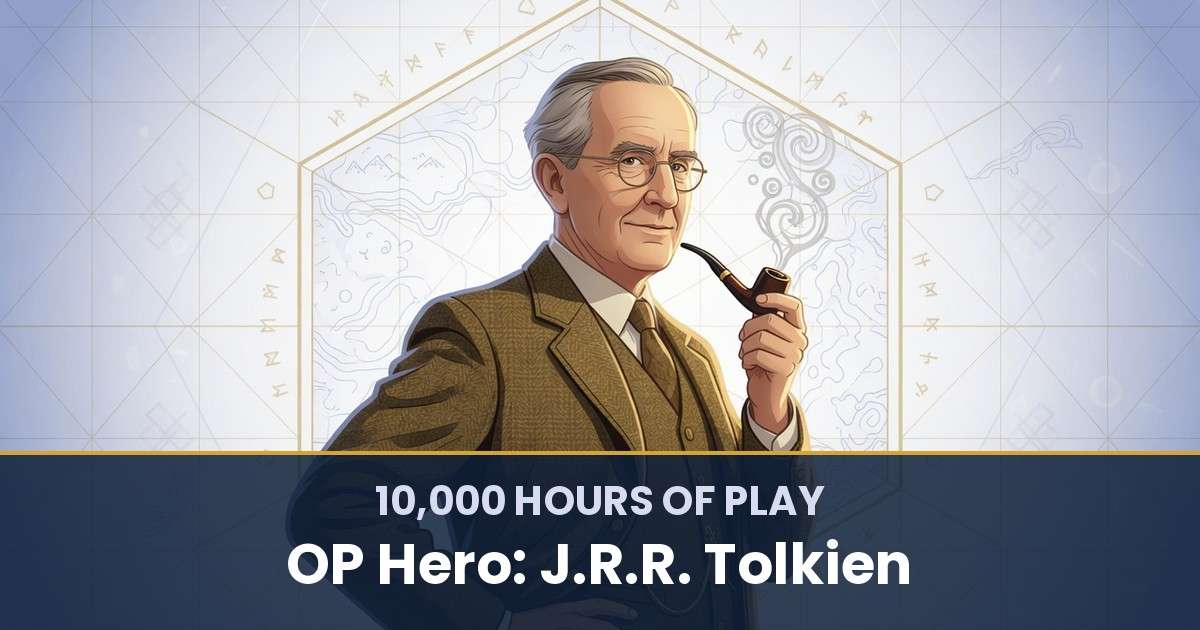
10,000 Hours of Play by OP Hero: J.R.R. Tolkien
He survived the Somme, then spent fifty-seven years building a world. How J.R.R. Tolkien played life as a game, read through the 10,000 Hours of Play framework.


In the winter of 1916, a 24-year-old signals officer lay in an English hospital bed, burning with trench fever, while the friends he had grown up with were being buried in the mud of the Somme. He had survived. Most of his closest circle had not.
What he did next is the part nobody expects. He did not put the war behind him and get on with a quiet academic life. He started inventing a world.
In the cheap notebooks of his convalescence, John Ronald Reuel Tolkien began writing the first tales of a mythology that would occupy the next fifty-seven years of his life. He had no contract, no audience, and no real reason to believe any of it would ever be read. He kept going anyway.
By the time he died in 1973, the languages he had built for fun had grown into Middle-earth, and Middle-earth had become the foundation of modern fantasy. This is how he played the game.
⚡ Speed Run Notes
- Tolkien’s real game was never “write a fantasy novel.” It was to build a complete world, languages first and stories second, and he chased that single project for over five decades.
- His rarest innate stat was linguistic pattern-sensitivity: as a child he invented languages for fun, long before he had any use for them.
- He turned the grief of the Somme into fuel. The legendarium began in a hospital bed, not a publisher’s office.
- His breakthrough wasn’t speed. It was the willingness to revise the same myth for decades until it felt true.
- The Inklings, and one friend in particular, C.S. Lewis, kept him writing when the work had no obvious payoff.
Table of Contents
About Yu-kai Chou

Yu-kai Chou is the author of 10,000 Hours of Play — the book that treats your life as the most important game you’ll ever build a character in, and gives you the 6-Step framework (Game · Attributes · Role · Skills · Allies · Quests) to play it on purpose. He has spent two decades developing the system through which this post analyzes its OP Hero, and applies it to his own life and to the lives of the people he advises around the world.
Chou’s other framework, the Octalysis Framework, has been applied by LEGO, Microsoft, Porsche, Coca-Cola, Salesforce, and MrBeast, impacting over 1.5 Billion Users. He has taught the methodology at Harvard, Stanford, Yale, Tesla, Google, BCG, and IDEO, and has advised governments in eight nations including Ukraine, the United Kingdom, the Kingdom of Bahrain, Singapore, Taiwan, the Netherlands, Kazakhstan, and South Korea.
His work has been cited by Harvard, Stanford, MIT, Forbes, Wall Street Journal, Wired, US Department of Energy, NIST, NSF, NCBI, US Department of Education, ClinicalTrials.gov, and Google Scholar — with 3,700+ more academic publications. Explore his books here.
What I keep coming back to in Tolkien’s build is his patience with a game that paid him nothing for decades. He treated coherence as the win condition, not completion, and that single reframing is why Middle-earth still feels real. If I had to lift one thing from his character sheet, it’s the Lich Grind discipline of going absurdly deep on the one project that feels like play, trusting that depth, not speed, is what compounds into something legendary.
Step 1: The Game — What J.R.R. Tolkien Was Actually Playing
Ask most people what Tolkien did and they’ll say he wrote The Lord of the Rings. That’s like saying Michelangelo painted a ceiling. True, and almost entirely beside the point.
Tolkien’s game was to build a secondary world so internally complete that it felt remembered rather than invented. He wanted a mythology England had lost, its own legends on the scale of the Norse sagas or the Finnish Kalevala. And he insisted, again and again, that the foundation was language. “The invention of languages is the foundation,” he wrote. “The stories were made rather to provide a world for the languages than the reverse.”
That sentence is the key to everything. He did not start with a plot and decorate it with pretty names. He started with the names, with the sounds and grammar of invented tongues, and then asked what kind of people would speak them, what history they would carry, what songs they would sing. The world grew downward from the words.
This is the part of the framework most people skip. Before Attributes, before Skills, before Quests, you have to know what game you are actually playing: the single thing you’ll keep chasing across decades. Tolkien knew his by his twenties. Everything else in his life arranged itself around that one decision.
It also explains why he was so slow. If your game is “publish a book,” you optimize for finishing. If your game is “make a world that is true,” you optimize for coherence, and coherence has no deadline. He was playing a game most authors never even see on the board.
Step 2: Attributes — The Innate Stats
Strip away the achievements and look at the boy. Two attributes were visible in Tolkien before he had any way to use them.
The first was linguistic pattern-sensitivity. Most children learn a language. Tolkien collected them, took them apart, and built his own for fun: Animalic, then Nevbosh, then the more serious Quenya and Sindarin. He wasn’t studying for a test. He was responding to sound the way a musician responds to a melody, feeling that certain combinations of letters were beautiful and others were simply wrong. You can’t teach that ear. He arrived with it.
The second was mythic vision: an instinct to imagine vast, connected histories behind small details. Where another writer sees a name on a map, Tolkien saw a thousand years of who lived there and why they left. His genealogies and timelines weren’t a chore he forced himself through; they were how his mind naturally ran.
This is exactly what the Talent Triangle Method is built to surface: the talents that show up early, cost you nothing, and feel like play rather than work. Tolkien’s were language and world-depth. He didn’t pick them. He noticed them, and then spent a lifetime compounding them.
There’s a third worth naming: a stubborn attachment to the ordinary. He loved trees, pipe-smoke, plain food, and small domestic comforts, and that love became the Shire, the still center of his entire mythology. His grandest invented world is anchored by the most unremarkable people in it. That tension, between the epic and the homely, was in his temperament long before it was on the page.
Step 3: Role(s) — The Character Class Across Chapters
Tolkien ran several character classes in sequence, and each one fed the next.
He started as the orphan scholar. His father died when he was four, his mother when he was twelve, and he was raised under the guardianship of a Catholic priest. Books and languages became the stable world that people couldn’t be. The role hardened into the philologist: the academic specialist in Old and Middle English who would eventually hold two Oxford chairs, Professor of Anglo-Saxon and later Merton Professor of English Language and Literature.
Then came the role he never asked for, war veteran. As a signals officer in the Lancashire Fusiliers he saw industrialized killing at the Somme and carried its imagery (the wasteland, the machine, the small soldier in a vast horror) for the rest of his life.
The Oxford don was his day job for decades. The professor’s chair paid the bills and, crucially, kept him swimming in the exact raw material his imagination ran on: dead languages, ancient poems, etymologies. He wasn’t moonlighting as a writer despite his academic career. The career was the forge.
The final class arrived late: novelist. For most of his life almost no one knew about the private mythology. The shift from scholar to storyteller is the same role-jump J.K. Rowling made from unpublished single mother to global author: a person who had quietly built the goods for years, then stepped into a public role the world had no category for yet. Tolkien published The Hobbit in 1937, at age 45. The world-builder had finally become an author.
Step 4: Skills — The Real-Life Game Skills J.R.R. Tolkien Mastered
Innate talent set the ceiling. Skills are what Tolkien actually built, deliberately, over years. Four stand out.
The first is Arcane Wisdom (Mage) — the ability to absorb a huge body of knowledge and synthesize it into something usable. Tolkien’s command of Old English, Old Norse, Gothic, Finnish, and Welsh wasn’t trivia. It let him construct invented languages with real internal history, so that Elvish felt like it had genuinely evolved across ages. The depth a reader senses in Middle-earth is mostly this skill, working underground.
The second is Loremaster (Druid), weaving compelling, inspiring stories out of raw material. He didn’t just build a world; he made you feel its loss and its longing. Songs, chronicles, and invented histories carried real emotional weight precisely because the scaffolding beneath them was so solid.
The third is Lich Grind (Warlock), intense and secluded periods of deep work. The legendarium was rewritten, expanded, and reworked across decades, mostly in private, mostly with no external reward. This is also where the Skills Spectrum matters: Tolkien chose to go absurdly deep on one thing rather than wide on many. He was a specialist’s specialist.
The fourth is Mastermind (Ranger), designing and executing a plan with many interlocking parts. Keeping thousands of years of invented history, dozens of languages, maps, and family trees consistent across The Hobbit, The Lord of the Rings, and the unfinished Silmarillion is a feat of architecture. The same long-game patience shows up in George R. R. Martin, another world-builder who learned that an epic’s depth is paid for in years most readers never see.
Step 5: Allies — The People Who Multiplied J.R.R. Tolkien
No solo player builds a world this big. Tolkien’s saga was sustained by a small, specific set of allies.
The most important was C.S. Lewis. The two met at Oxford, became close friends, and formed the core of the Inklings, an informal group that gathered to read work aloud and argue about it. When Tolkien’s confidence flagged during the long, uncertain writing of The Lord of the Rings, Lewis was the reader who kept telling him it mattered. Tolkien later said that without Lewis’s steady encouragement he would never have finished it.
The Inklings as a whole functioned as a feedback loop, a place to test chapters on smart, sympathetic, brutally honest peers before the rest of the world ever saw them. Owen Barfield, another member, sharpened Tolkien’s thinking about language and meaning. A creative circle like this multiplies everyone inside it, the same way a collaborative bullpen multiplied Stan Lee‘s output; the OP Hero who insists on building alone almost always builds smaller.
Then there was Edith, his wife and the emotional anchor of his adult life. He had loved her since he was sixteen; his guardian forbade contact until he turned twenty-one, and he proposed essentially the night he could. She was the inspiration for one of his legendarium’s great love stories, and the names Beren and Lúthien are carved on their shared gravestone. Allies aren’t only the people who edit your work. Some of them are the people who make the work survivable.
Step 6: Quests — The Milestones That Shaped the Saga
A life-as-game reading lives or dies on the specific quests. Tolkien’s were unusually long.
Quest 1: Survive the Somme (1916). He fought as a signals officer, contracted trench fever, and was invalided back to England late in 1916. Two of his closest school friends from his teenage club, the T.C.B.S., were killed that same year. The grief could have ended him. Instead he did something the canon would call Spirit of Nature (Druid) — meaning-making under stress, turning loss into a mission. In his hospital bed he began The Book of Lost Tales, the seed of the entire legendarium.
Quest 2: Write The Hobbit (published 1937). The famous origin: while grading exam papers, he scrawled on a blank page, “In a hole in the ground there lived a hobbit,” and then had to find out why. Allen & Unwin published the book in 1937, and its unexpected success turned a private scholar into a public author.
Quest 3: Compose The Lord of the Rings (1937–1949). His publisher wanted a simple sequel to The Hobbit. What they got, twelve years later, was a vast epic that nearly broke him to finish. Published in three volumes in 1954 and 1955, it has since sold more than 150 million copies and stands among the best-selling stories ever written.
The setback that never resolved: The Silmarillion. The deep myth-cycle he cared about most, the one beneath everything else, he never finished. It was published only in 1977, four years after his death, edited into shape by his son Christopher. His greatest quest stayed open at the final whistle, and the world is richer for the attempt. If you want to see how other lives map onto the same board, the full roster of OP Heroes is worth a slow read.
What You Can Steal From J.R.R. Tolkien’s Build
You are probably not going to invent a language family. That’s not the lesson.
The lesson is that Tolkien won by choosing a game with no deadline and then refusing to quit it for fifty-seven years. He compounded two innate talents instead of chasing new ones. He went deep where almost everyone goes wide. He turned his worst year into the start of his life’s work. And he let a small circle of honest friends keep him honest.
Here’s the steal: find the one project that feels less like a task and more like a world you want to live inside, and then protect it. Most people abandon that project the first time it stops paying off quickly. Tolkien’s whole life is proof that the slow, coherent, decades-long build is available to anyone patient enough to keep showing up, and that even the unfinished parts still count.
His character sheet wasn’t magic. It was a clear game, two compounded stats, four hard-won skills, a handful of true allies, and a refusal to stop. That’s a build you can copy.
Where this framework comes from

Want the full system this profile is built on?
Every OP Hero piece runs through the same 6-Step framework from 10,000 Hours of Play: Unlock Your Real-Life Legendary Success. The book covers the full system, walks through Yu-kai’s own life run as the first applied case study, and gives you the worksheets to audit your own build.
Related Reading
- All OP Hero Profiles: the full roster of legendary lives read through the 10K HP framework.
- The 10,000 Hours of Play Framework: the 6 Steps that structure every OP Hero profile.
- OP Hero: George R. R. Martin: another epic world-builder paying for depth in decades.
- OP Hero: J.K. Rowling: the scholar-to-author role-jump, from a different angle.
- OP Hero: Stan Lee: what a collaborative creative circle multiplies.
- The Skills Spectrum: specialist, dabbler, or master, and how to choose.