
Octalysis of SaveOhno.org – Gamified Platform For Climate Activism

This article was written by Dylan Husted, the President and Co-founder of SaveOhno. He is currently a second-year student at Babson College studying business/entrepreneurship, sustainability and computer science.
The facts about global climate change are overwhelming. We can only burn about 565 more gigatons into the atmosphere in order to live in a relatively safe environment.
At the current rate (31.6 gigatons per year), we will have burned 1,200 gigatons of carbon by 2050. That’s 112% over our 565 gigaton budget (source).
In addition, with developing countries transitioning from ‘developing’ to ‘developed’, global energy demand is expected to rise by about 48% by 2040 (source). This means that we are on pace for a tumultuous future.
Despite the alarming numbers the scientific community has presented, the US has taken little action on the issue.
To change that, organizations like 350.org and A Better Future Project are making amazing strides with climate activism. SaveOhno aims to help them by getting more college-age students involved through gamification.
With gamification, a complex global issue like climate change can be visualized, and climate activism can be virtualized and incentivized.
About the Creator of the Octalysis Framework

Yu-kai Chou created the Octalysis Framework after studying gamification since 2003 — years before the term entered mainstream vocabulary. As a Human-Systems Architect & Behavioral Designer, his framework has been applied by LEGO, Microsoft, Porsche, Coca-Cola, Salesforce, and MrBeast, impacting over 1.5 Billion Users.
Chou has taught the Octalysis methodology at Harvard, Stanford, Yale, Tesla, Google, BCG, and IDEO.
His work has been cited by Harvard, Stanford, MIT, Forbes, Wall Street Journal, Wired, US Department of Energy, NIST, NSF, NCBI, US Department of Education, Academia.edu, and 3,700+ more academic publications. Explore his books here.
What is SaveOhno.org?
SaveOhno was a nonprofit focused on the issue of climate change, and a Kickstarter campaign was launched for its gamified web platform. (Note: SaveOhno.org is no longer available.)
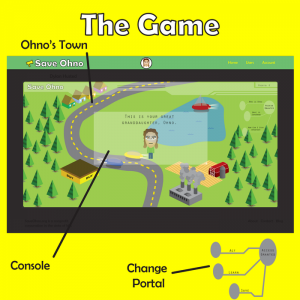
‘Ohno’ is a character that represents the user’s great granddaughter, and she’s living in a time that is seriously affected by the climate change being caused today.
It’s up to the user to change her fate by taking action in the real world, through SaveOhno.org. Every time a user signs a petition, goes to a protest or contacts a politician, Ohno’s life improves and the user gains badges and points to create a public profile of what they’ve done.
Level 1 Octalysis
To provide a deeper view of the gamification aspect of SaveOhno.org, Yu-kai Chou’s Octalysis Framework was used.
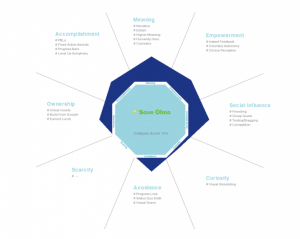
In general, the SaveOhno.org Octalysis framework has a strong emphasis on meaning, accomplishment, social influence and empowerment.
It also has elements of ownership and avoidance, but it lacks in curiosity and scarcity. Here’s a breakdown of each category:
Epic Meaning & Calling
The user is personally responsible for saving the future of Ohno, and the rest of society, from the terrors of global climate change. This creates a narrative where the user is ‘Humanity’s Hero.’
In addition, the users must cocreate to collectively save each other’s worlds (Ohno’s situation is unique to each user).
Development & Accomplishment
As the user takes action on the website, they receive PBL feedback (points, badges and leaderboards).
In addition, they track progress of initiatives they’ve started and supported through progress bars.
Social Influence & Relatedness
The accomplishments they earn are displayed on their public profile. They can brag about these accomplishments by sharing their profile over social media sites.
Users follow others and get followed by others to create a status feed of each other’s activity. If they see that their friends are active, they will be more inclined to be active as well.
Empowerment of Creativity & Feedback
SaveOhno.org educates people on climate change, and then provides them with the ability (i.e. empowers them) to take action.
They receive instant feedback every time they do something that SaveOhno.org provides for them (or when they create their own initiative, not provided by SaveOhno or its partner organizations).
Ownership & Possession
Users can make in-game purchases for Ohno (virtual goods). Over time, this (coupled with town improvements from user activity) creates a ‘build from scratch’ experience.
Loss & Avoidance
Ohno’s town regresses over time (progress loss). If a user goes inactive for a while, Ohno’s town will degrade.
Unpredictability & Curiosity
Ohno’s town progresses and regresses linearly, so it will be easy to predict cause and effect after using the website for a while.
At first, the user will be curious to see how Ohno’s life changes, but they will catch on to the pattern over time and begin to always know what’s next.
Even the ‘visual grave’ will likely not be a surprise, due to the linear degradation of Ohno and her town. This will be an element that will need improvement as SaveOhno moves forward.
Scarcity & Impatience
There aren’t really any elements of scarcity in the gamification of SaveOhno.org.
White Hat Balance
SaveOhno.org has a pretty balanced mix of left and right brain core drives, but heavily favors White Hat gamification over Black Hat gamification.
It may be worth incorporating more Black Hat techniques, perhaps as spontaneous motivators when user activity declines significantly due to a lack of unpredictability and scarcity (i.e. too easy).
Related Reading
- The Octalysis Framework for Gamification & Behavioral Design
- Core Drive 1: Epic Meaning & Calling
- White Hat vs Black Hat Gamification
- What is Gamification?
- Game Over for Climate Change!
- Books by Yu-kai Chou