
Belbin Team Roles: The S-Tier Behavioral Designer’s Guide

Through the 1970s, a researcher at a British management college ran the same experiment on repeat: assemble a team from the sharpest analytical minds available, drop them into a competitive business game, and watch what happens.
They kept losing.
Meredith Belbin named these all-brilliant teams after a moonshot. Apollo.
His own account of the research describes Apollo teams finishing near the bottom of an eight-team field while everyone watching expected them to win.
The teams that actually won were balanced ones, built from people whose instincts pulled in different directions.
Out of that decade of observation came the nine Belbin Team Roles, still the most widely used team-composition language in the working world.
Most write-ups list the nine roles and stop. This guide goes further: what the roles are made of, where the psychometric fight over Belbin’s inventory actually landed, and why I read his nine roles as a motivational portfolio he discovered a decade before motivation science had the vocabulary for it.
Speed Run Notes
- The model: nine behavioral roles that people naturally adopt in teams, derived from Meredith Belbin’s decade of management-game experiments at Henley through the 1970s. Balance across roles predicted winning; brainpower did not.
- The Apollo syndrome: teams built entirely from high-analytic stars were prone to destructive debate and finished near the bottom. It remains the most famous finding in team-composition research.
- Each role trades a strength for an allowable weakness. A Plant generates original ideas and loses track of details. Managing the weakness out of someone usually kills the strength that came with it.
- The evidence is contested. A 1993 psychometric critique found the self-perception inventory wobbly; a 2007 review of 43 studies concluded the model has adequate convergent validity on balance.
- The Octalysis read: the nine roles are eight Core Drives wearing job titles. A balanced team is a balanced motivational portfolio, and the Apollo syndrome is what motivational monoculture looks like.
- The practical move: stop staffing teams by skill alone. Map where each member’s motivational energy naturally flows, then check which phases of the work nobody is hungry for.
The terrain this guide covers, and where the depth sits:
- The experiments: Henley’s business games, the Apollo syndrome, and what actually predicted winning.
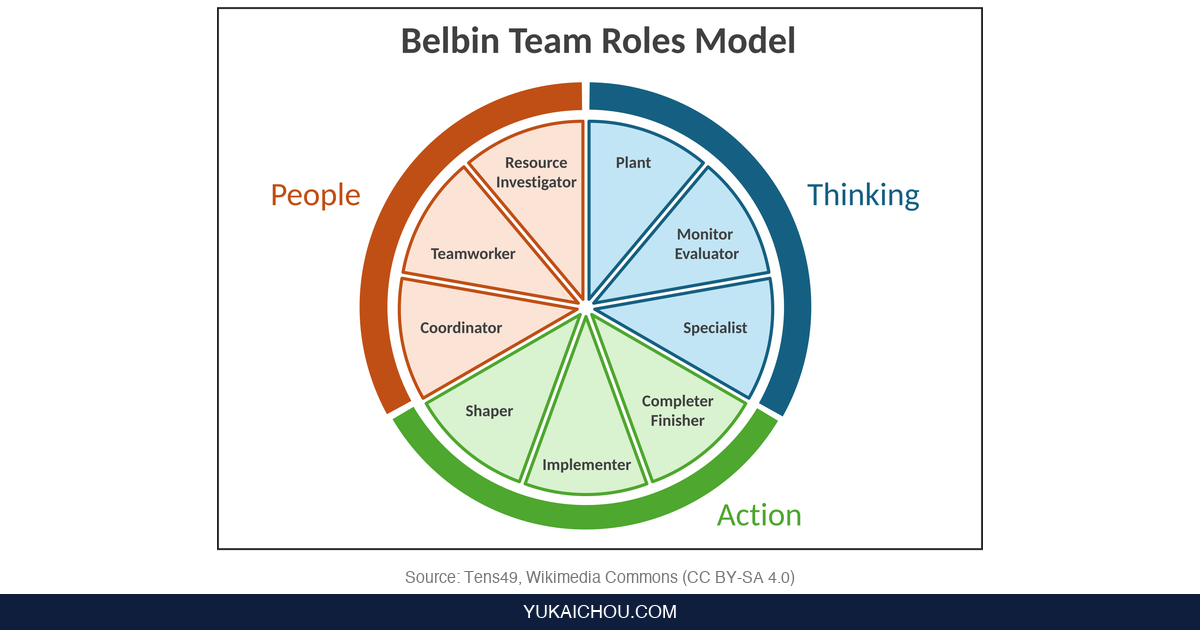
- The nine roles: Plant, Resource Investigator, Co-ordinator, Shaper, Monitor Evaluator, Teamworker, Implementer, Completer Finisher, Specialist — each with its allowable weakness and its Core Drive signature.
- The verdict: what Belbin got right, the Furnham psychometric fight, and the layer the model never names.
- The science: what modern neuroscience and Google’s Project Aristotle add to a 1981 model.
- The comparisons: Belbin against MBTI, the Big Five, Bartle’s Player Types, and psychological safety research.
- The applications: product teams, hiring, classrooms, and multiplayer game design.
- The Octalysis merge: the role-to-Core-Drive map, the motivational-portfolio thesis, and practical steps for running it on your own team.
In This Article
- What Are the Belbin Team Roles?
- The Henley Experiments and the Apollo Syndrome
- The Nine Team Roles, One at a Time
- What Belbin Got Right
- Where the Belbin Model Falls Apart
- What’s Really Happening Inside the Brain
- Belbin vs Other Frameworks
- Belbin Team Roles in the Real World
- The Elephant in the Room
- Applying Belbin Team Roles with the Octalysis Framework
- Practical Steps: Composing a Team That Wins
Author Credibility: Yu-kai Chou

Yu-kai Chou created the Octalysis Framework after studying gamification since 2003 — years before the term entered mainstream vocabulary. As a Human-Systems Architect & Behavioral Designer, his framework has been applied by LEGO, Microsoft, Porsche, Coca-Cola, Salesforce, and MrBeast, impacting over 1.5 Billion Users.
Chou has taught the Octalysis methodology at Harvard, Stanford, Yale, Tesla, Google, BCG, and IDEO.
His work has been cited by Harvard, Stanford, MIT, Forbes, Wall Street Journal, Wired, US Department of Energy, NIST, NSF, NCBI, US Department of Education, ClinicalTrials.gov, and Google Scholar — with 3,700+ more academic publications. Explore his books here.

What Are the Belbin Team Roles?
The Belbin Team Roles model says every effective team covers nine distinct behavioral contributions, and any one person naturally supplies only two or three of them.
A team role, in Belbin’s definition, is a tendency to behave, contribute, and interrelate with others in a particular way.
It describes behavior in a team context. It does not describe your job title, your seniority, or your skill set.
Two equally skilled engineers can play opposite roles: one keeps generating unconventional architectures while the other keeps stress-testing everything for flaws.
Belbin’s central claim was that no individual combines all the qualities a team needs, but a well-composed team can.
The claim came with teeth. In his Henley experiments, role balance predicted which teams won and which lost, while raw intellect predicted almost nothing.
That result is why the model survived four decades of management fashion cycles.
It is also why I treat Belbin as required reading for anyone doing behavioral design with groups, because the Octalysis Framework and Belbin’s roles turn out to be describing the same underlying machinery from two different altitudes. More on that merge later in this guide.
The Henley Experiments and the Apollo Syndrome
Belbin’s model was built from roughly a decade of controlled management-game experiments, and its most famous result is that teams composed entirely of brilliant people reliably underperformed.
A laboratory for watching teams lose
The research ran at the Administrative Staff College at Henley-on-Thames through the 1970s, where executives attending courses competed in business simulations in syndicate teams.
Belbin and his colleagues did something unusual for the era: they measured the members before composing the teams.
Participants took psychometric tests of mental ability and personality.
Observers logged team interactions in structured categories while the games ran.
Because the researchers controlled who sat on which team, they could compose teams deliberately and then watch the results against a scoreboard that produced actual finishing positions.
Design a team, predict its finish, check the prediction. Season after season.
That loop, repeated across years of course intakes, is what separates Belbin’s work from the armchair team taxonomies that came before and after it.
The team of stars that kept losing
The obvious hypothesis came first: staff a team with the highest-scoring analytical minds and it should win.
Belbin tested it directly by assembling teams of members who all scored high on mental ability.
He called them Apollo teams, and the results went the other way.
Belbin’s own account describes Apollo teams as difficult to manage, prone to destructive debate, and often finishing near the bottom of the eight-team field.
Members spent their energy dismantling each other’s arguments rather than building anything together.
Decisions stalled because winning the argument had quietly become the game each member was playing.
The phenomenon entered the literature as the Apollo syndrome, and it shows up today anywhere an organization staffs a strategy group, a task force, or an AI research pod purely on individual horsepower.
What actually predicted winning
The winning teams shared a shape. Talent level did not separate them.
They contained a spread of members whose natural contributions differed: someone generating ideas, someone evaluating them coolly, someone organizing the work, someone holding the group together, someone chasing loose ends outside the room, someone finishing what everyone else considered done.
Belbin distilled the recurring contribution patterns into eight named roles, published in Management Teams: Why They Succeed or Fail in 1981.
A ninth role, the Specialist, joined later as the model matured, and the modern names settled in later editions: the Chairman became the Co-ordinator, the Company Worker became the Implementer.
The full nine-role vocabulary that teams use today was consolidated in his 1993 book Team Roles at Work.
The Nine Team Roles, One at a Time
Each role pairs a distinct contribution with an allowable weakness, and the weakness is the price of admission for the strength.
Belbin grouped the nine into three clusters: thinking roles, action roles, and people roles.
The pairing matters more than the grouping.
Every role’s flaw is structural, meaning you cannot coach it away without damaging the contribution it funds.
Alongside each role below, I have added its motivational signature in Octalysis terms, because the mapping is where this model stops being a personality quiz and starts being a design tool.
1. Plant
The Plant is the team’s source of original ideas: creative, unorthodox, and most useful when the problem has no known solution.
Belbin planted one deliberately in experimental teams to supply innovation, which is where the name comes from.
The allowable weakness follows directly: Plants ignore incidentals, lose interest after the idea stage, and can be too absorbed to communicate well.
The motivational signature is Core Drive 3 (CD3): Empowerment of Creativity & Feedback, the drive to create, experiment, and see the result of your own combinations.
A Plant asked to maintain a checklist is a CD3 engine bolted to a task with zero creative surface, and the disengagement you observe is the predictable output.
2. Monitor Evaluator
The Monitor Evaluator is the team’s cold judge: strategic, discerning, and accurate when everyone else is excited.
This role weighs options slowly and is usually right.
The allowable weaknesses are a lack of drive to inspire others and a critical style that can read as dampening.
The signature runs on Core Drive 8 (CD8): Loss & Avoidance pointed at error, plus the quieter satisfaction of Core Drive 2 (CD2): Development & Accomplishment through being demonstrably right.
An Apollo team is what happens when everyone in the room competes for this role’s reward: the status of the sharpest critique.
3. Specialist
The Specialist brings deep, self-fed expertise in a narrow domain that the team cannot function without.
Belbin added this ninth role after the original research, recognizing that real organizations run on people whose contribution is depth itself.
The allowable weakness is a narrow front: Specialists contribute on their territory and drift when the conversation leaves it.
The signature blends Core Drive 4 (CD4): Ownership & Possession of a knowledge domain with CD3’s mastery expression.
A Specialist’s expertise is a garden they own, and the tending is the reward.
4. Shaper
The Shaper is the team’s forward pressure: challenging, dynamic, and at their best under adversity and deadline.
Shapers drag stalled teams over obstacles by force of urgency.
The allowable weaknesses are friction and occasional offense given in the push.
The signature is Core Drive 2 (CD2): Development & Accomplishment supercharged with Core Drive 6 (CD6): Scarcity & Impatience, which converts time pressure into fuel.
Remove all deadlines and constraints from a Shaper’s environment and you have removed their oxygen.
5. Implementer
The Implementer converts decisions into working procedure: disciplined, reliable, and efficient.
Teams route the unglamorous structural work here, and the model treats that as a distinct talent in its own right.
The allowable weaknesses are inflexibility and slowness to abandon a working system for a promising one.
The signature pairs CD2’s steady progress with CD4’s ownership of process: the system runs because it is their system.
Reorganize an Implementer’s process without warning and the resistance you meet is ownership defending its territory, which is worth respecting and designing around.
6. Completer Finisher
The Completer Finisher polishes and protects the output: painstaking, conscientious, and anxious in the useful direction.
This role finds the flaw the day before launch instead of the day after.
The allowable weaknesses are worry, reluctance to delegate, and perfectionism past the point of return.
The signature is CD8 pointed at defects, the same loss-avoidance current that powers the Monitor Evaluator, pointed at execution this time.
A team with no CD8 carrier ships fast and bleeds quality; a team with too many never ships.
7. Co-ordinator
The Co-ordinator holds the goal and distributes the work: mature, confident, and skilled at spotting what each member is for.
Belbin’s Co-ordinators were rarely the smartest members, and the teams they chaired won anyway.
The allowable weaknesses are a tendency to offload personal work and a style that can read as manipulative.
The signature is Core Drive 1 (CD1): Epic Meaning & Calling held on behalf of the group, braided with Core Drive 5 (CD5): Social Influence & Relatedness.
What feeds this role is the team meaning something and each member mattering to it.
8. Teamworker
The Teamworker is the social fabric: co-operative, perceptive, and the reason the Shaper and the Plant have not yet gone to war.
Belbin’s observers found Teamworker presence smoothed friction that otherwise consumed team energy.
The allowable weaknesses are indecision under pressure and conflict avoidance.
The signature is Core Drive 5 (CD5): Social Influence & Relatedness in its purest form: the state of the relationships is the scoreboard.
Teams notice the Teamworker’s contribution mostly by its absence, which is exactly why composition audits keep missing it.
9. Resource Investigator
The Resource Investigator is the team’s outward face: enthusiastic, exploratory, and back tomorrow with three contacts and an opportunity.
While the Plant generates ideas from the inside, the Resource Investigator imports them from the outside.
The allowable weaknesses are early over-optimism and enthusiasm that fades once the novelty does.
The signature runs Core Drive 7 (CD7): Unpredictability & Curiosity through a CD5 social channel: the unknown is interesting, and people are the best source of it.
Lock a Resource Investigator alone in a room with a spreadsheet and watch both drives starve at once.
What Belbin Got Right
Belbin’s deepest contributions hold up: composition is a design variable, contribution beats intellect, and weaknesses come welded to strengths.
Start with the move that made everything else possible: he treated team composition as something you design rather than something that happens to you.
Before Henley, the standing assumption was that team performance rode on the quality of the individuals, so you hired the best and hoped.
Belbin showed the arrangement of people carries independent causal weight, and he showed it with scoreboard finishing positions, a harder currency than satisfaction surveys.
Second, he decoupled contribution from capability.
The Apollo result embarrassed the meritocratic instinct that still runs most hiring: stack the team with the highest scorers and the team eats itself.
Google would rediscover a version of this finding three decades later with far better data, which says something about how far ahead of his tooling Belbin was working.
Third, the allowable weakness is a small piece of design genius.
By welding each flaw to its funding strength, Belbin gave managers a reason to stop sanding people into identical smoothness.
The concept quietly imports a mature idea from motivation science: behavior you keep observing is behavior that is feeding something, and starving it has costs.
Fourth, he separated the role from the person.
People carry a preferred role, a manageable role or two, and roles they should stay away from, which means a team of four can still cover nine roles without hiring five more bodies.
That single design choice is why the model scales down to a five-person startup as readily as a corporate program.
Fifth, the method deserves more credit than the model gets.
Belbin measured behavior from the outside, with trained observers logging contributions in real time, while most of the field then and now settles for asking people what they think they do.
Self-perception and observed behavior disagree constantly, and Belbin’s design caught the disagreement instead of averaging it away.
The full Belbin process still triangulates self-report against observer reports for exactly this reason, and any team running a lightweight version should keep that triangulation even if it keeps nothing else.
Where the Belbin Model Falls Apart
The model’s measurement instrument drew serious psychometric fire, its roles blur into ordinary personality dimensions, and it never names the layer underneath the roles.
The psychometric fight
In 1993, Adrian Furnham, Howard Steele, and David Pendleton put the Belbin Team-Role Self-Perception Inventory through standard psychometric testing and published the results in the Journal of Occupational and Organizational Psychology.
The verdict was rough: low internal consistency and an unclear factor structure, meaning the questionnaire’s scales did not hang together the way the nine-role theory implies.
Belbin’s reply in the same journal made a point that most retellings skip.
The self-perception inventory began life as an appendix in his 1981 book, a self-reflection aid, and was never built as a standalone psychometric test.
His research had leaned on observer assessments and measured team outcomes, so judging the theory by the questionnaire alone misses where the evidence actually lived.
The fight settled into a more useful place over the following decade.
A 2007 review by Aritzeta, Swailes, and Senior in the Journal of Management Studies worked through 43 empirical studies and concluded that, on balance, the model and its inventory have adequate convergent validity.
Read the whole arc and the honest summary is: the theory is stronger than its questionnaire, and both are stronger than the dismissals suggest.
The roles blur into personality
Construct-validity studies kept finding that the nine roles collapse onto a smaller set of ordinary dimensions from the Big Five personality model.
A Shaper looks like high extraversion with low agreeableness.
A Completer Finisher looks like high conscientiousness with a serving of neuroticism.
If the roles are repackaged trait combinations, the model loses its claim to be measuring something team-specific.
The defense has real substance: roles are contextual behavior, and people demonstrably shift roles when the team around them changes, which fixed traits cannot explain.
But the overlap is large enough that a designer should hold the nine labels loosely, as useful clusters and no more.
The missing layer
The deepest gap is the one the model never names: it catalogs what each role does without explaining what each role is for, from the inside.
Belbin tells you the Plant generates ideas and neglects details.
He never tells you what the Plant is hungry for, which is the information you need when your Plant goes quiet in month three.
The model is also a snapshot.
Google’s Project Aristotle, a two-year study across more than 180 of its own teams, landed on a conclusion that inverts the composition premise: who is on the team mattered less than how the team worked together, and the strongest single differentiator was psychological safety.
Composition models and norm models are usually presented as rivals, and I will argue later that they are actually two halves of one design problem.
But as it stands, Belbin hands you a seating chart and says nothing about the weather in the room.
What’s Really Happening Inside the Brain
Modern research on individual differences gives Belbin’s role clusters a plausible biological substrate he never had access to.
Belbin built the model from behavioral observation, decades before affective neuroscience matured.
The interesting thing is how well his clusters line up with what that research later found.
Reinforcement sensitivity research, launched by Jeffrey Gray’s work on approach and inhibition systems, describes stable individual differences in how strongly people respond to reward cues versus threat cues.
High approach-sensitivity maps cleanly onto the forward-driving roles: the Shaper’s charge and the Resource Investigator’s chase are what strong reward pursuit looks like in a meeting.
High threat-sensitivity maps onto the protective roles: the vigilance of the Completer Finisher and the skepticism of the Monitor Evaluator are what a sensitive alarm system looks like when it is pointed at work products instead of predators.
Error-monitoring research adds a sharper edge.
The brain produces a measurable electrical response within about a tenth of a second of detecting an error, and the strength of that response differs reliably between people, tracking with conscientiousness and anxiety.
Some brains are built with louder error alarms, and those people gravitate toward the roles where the alarm is an asset.
Novelty-seeking research, running from Cloninger’s temperament work through the dopamine literature, describes the exploratory appetite that shows up as the Plant’s idea generation and the Resource Investigator’s outward pull.
Affiliation research on the social bonding system describes the current the Teamworker and Co-ordinator run on: for some people, group cohesion registers as a first-order reward rather than a means to one.
None of this proves nine roles, and the count matters less than the mechanism.
What the biology supports is Belbin’s underlying bet: people arrive with durable, differing appetites, and a team is an arrangement of appetites before it is an arrangement of skills.
Belbin vs Other Frameworks
Belbin describes behavior between people, which is exactly what personality typologies miss and what norm-based team research needs as raw material.
vs MBTI
The Myers-Briggs Type Indicator sorts your inner preferences; Belbin describes your outer contribution when other people are in the room.
MBTI assigns you one fixed four-letter type, while Belbin explicitly gives you a portfolio of preferred and manageable roles that shifts with team context.
The psychometric records differ too: MBTI’s test-retest problem is famous, while Belbin’s inventory, for all the fire it took, earned that qualified 2007 rehabilitation.
For composing an actual team, Belbin’s unit of analysis is simply the right one.
vs the Big Five
The Big Five wins on science and loses on actionability.
Trait scores are the best-validated measurements in personality psychology, and they predict job performance modestly at the individual level.
But a hiring manager holding five trait scores still has to answer the team question: what will this person reach for in a room with these four others?
Belbin’s roles are that translation layer, which is why the honest position is to trust Big Five measurement and use Belbin vocabulary, treating roles as trait chords rather than new notes.
vs Bartle’s Player Types
Richard Bartle did for game players what Belbin did for managers: he watched real behavior in a shared environment and named the recurring motivational patterns.
Bartle’s player types segment the audience of an experience; Belbin’s roles segment the builders of one.
Both taxonomies are context-bound, both describe where a person’s energy goes when free to choose, and both eventually route back to deeper motivational drives.
A multiplayer designer needs both lenses at once: Bartle for who is playing, Belbin for whether the design team itself has the range to serve them.
vs psychological safety research
Amy Edmondson’s psychological safety work and Project Aristotle measure the conversational climate that determines whether a team can use whatever composition it has.
A perfectly balanced team in an unsafe climate is nine covered roles and zero spoken sentences.
An Apollo team with superb safety is still nine critics competing for one prize.
Composition determines what the team could contribute, and safety determines how much of it survives contact with the meeting. You need both dials, and they fail independently.
Belbin Team Roles in the Real World
The model earns its keep wherever a group must cover work that pulls in opposing directions: product teams, hiring plans, classrooms, and raid rosters.
Product and agile teams
A modern product squad is a Belbin diagram wearing standup clothes.
The discovery phase runs on Plant and Resource Investigator energy, delivery sprints run on Implementer and Completer Finisher energy, and the retro runs on Monitor Evaluator honesty cushioned by Teamworker repair.
Squads that feel mysteriously stuck are usually missing a role, and the gap is diagnosable from the failure texture.
Endless ideation with no shipping means no Implementer gravity.
Flawless process producing unremarkable output means nobody is playing Plant.
A backlog of almost-done work means the team never onboarded a Completer Finisher’s anxiety, and recurring quality escapes mean the same thing one release later.
Hiring and organizational design
Interview loops reward candidates who resemble the interviewers, which is how companies hire clone armies and then wonder where the friction went.
A Belbin lens converts hiring from resemblance-matching into gap-filling: audit the roles the current team already saturates, then weight the loop toward the missing contributions.
The same lens stress-tests goal systems like Management by Objectives, which cascade targets to individuals while team-shaped work quietly depends on unmeasured Teamworker and Co-ordinator labor.
Role-aware organizations name and value that labor instead of taxing it invisibly.
Education and student teams
Student group projects fail in exactly the ways Belbin predicts, because instructors compose groups by friendship or alphabet and grade them as if composition were luck.
Role-aware group formation gives each team an idea source, an organizer, and a finisher, and it gives students the vocabulary to negotiate contributions instead of defaulting to the diligent kid doing everything.
Structured rotation methods like Six Thinking Hats pair well here, because rotating modes teaches students which role feels like home.
The lesson transfers out of the classroom intact, because most of the model’s value arrives the moment a group can name its own differences.
Multiplayer and guild design
Multiplayer games rediscovered Belbin’s core finding through pure selection pressure: the tank, healer, and damage trinity is role balance compressed to three, and a raid of nine damage-dealers is an Apollo team with better graphics.
Role-queue systems in competitive games exist because player-composed teams kept assembling motivational monocultures and losing.
Guilds run the full nine: the strategist theorycrafting builds, the recruiter working external channels, the officer holding morale, the bank manager guarding the economy, the completionist chasing the last achievement.
Designers who give each of those appetites a surface get communities that self-organize and retain; designers who serve only the damage meter get social loafing and churn.
Remote teams and the AI teammate
Distributed work raises the stakes on role awareness, because remote settings mute the informal channels where role gaps used to announce themselves.
The Teamworker’s repair work happened in hallways; the Resource Investigator’s imports arrived over lunches that no longer exist.
A remote team that never names these contributions loses them silently, and the loss shows up months later as a cohesion problem nobody can locate.
Then there is the newest team member: as of 2026, most knowledge teams are effectively hybrid human-AI compositions, with agents drafting, checking, and shipping alongside people.
Run the Belbin lens over that arrangement and the division of labor becomes clear.
AI teammates absorb enormous amounts of Implementer and Completer Finisher work, the systematic execution and tireless checking, and they do it without needing those contributions fed.
What they cannot supply is the appetite side of the model: a stake in the goal, a hunger for the unknown, a felt responsibility for the room.
The human roles that appreciate in a hybrid team are exactly the appetite-heavy ones: the Plant’s generative wanting, the Co-ordinator’s held meaning, the Resource Investigator’s outward pull, the Teamworker’s care.
Composition planning in the AI era means staffing for appetites, because the mechanics are increasingly covered.
The Elephant in the Room
The Belbin model runs on a licensed commercial instrument whose psychometrics were publicly mauled, and it thrives anyway because it sells the one thing teams cannot buy elsewhere: a shared language for difference.
Belbin Associates, the company Meredith Belbin co-founded, licenses the inventory and reports, and the business survived its founder, converting to employee ownership in 2022 and continuing after his death in March 2025 at age 98.
Critics read the commercial layer as a warning sign, and the 1993 psychometric episode gave the reading ammunition.
Here is what the critics miss.
Teams do not adopt Belbin because the factor loadings are beautiful.
They adopt it because on Tuesday afternoon, when the deadline-driven member is grinding against the careful member, the model converts a personal conflict into a structural one.
She stops being obstructive and becomes the team’s Completer Finisher doing her job.
He stops being reckless and becomes the Shaper doing his.
The reframe lowers the social cost of difference, and that alone measurably changes how the next disagreement goes.
A model can be psychometrically wobbly and operationally priceless, and this one is both.
The elephant deserves naming, and then it deserves perspective: the map’s value was never the ink.
Applying Belbin Team Roles with the Octalysis Framework
Read through Octalysis, Belbin’s nine roles are eight Core Drives wearing job titles, which turns team composition from a personality exercise into motivational portfolio design.

The Octalysis Framework breaks human motivation into eight Core Drives, each a distinct reason a person does anything at all.
Belbin watched teams for a decade and cataloged nine recurring behavior patterns.
Put the two side by side and the roles stop looking like personalities and start looking like what they always were: stable preferences about which Core Drive a person wants the work to feed.
The role-to-drive map
| Belbin Role | Primary Core Drives | What the Work Must Feed |
|---|---|---|
| Plant | CD3, with CD7 | Creative surface: room to combine, invent, and see results |
| Resource Investigator | CD7, with CD5 | Fresh territory: new people, new information, an outside |
| Co-ordinator | CD1, with CD5 | A goal worth holding and people worth aligning to it |
| Shaper | CD2, with CD6 | Visible progress against resistance and a clock |
| Monitor Evaluator | CD8, with CD2 | Errors found before they cost, and credit for the finding |
| Teamworker | CD5 | Relationships that hold; friction caught early and repaired |
| Implementer | CD2, with CD4 | A system of their own that runs and keeps running |
| Completer Finisher | CD8, with CD2 | Defects prevented; the standard defended at the finish line |
| Specialist | CD4, with CD3 | A domain to own and deepen without dilution |
The mapping explains the allowable weaknesses with one stroke.
Each weakness is the shadow of an unfed or overfed drive rather than a character defect.
The Plant’s neglect of detail is CD3 refusing to spend energy where there is nothing to create.
The Completer Finisher’s reluctance to delegate is Core Drive 8 (CD8): Loss & Avoidance declining to hand its alarm system to someone with a quieter one.
Coach against the weakness directly and you are coaching against the person’s motivational engine, which is why those interventions keep failing.
The mapping also explains what Belbin called role sacrifice, the act of playing a needed role that is not naturally yours.
A sacrificed role is work that feeds someone else’s drive.
People can run that way for a sprint, and teams sometimes need them to.
Run it for quarters and the person is spending motivational energy without income, which is the precise mechanism behind the competent, committed teammate who quietly burns out in a role everyone agreed they were good at.
Good at and fed by are different claims about a person, and teams that conflate them pay for it in slow motion.
The Apollo syndrome is motivational monoculture
Octalysis also explains Belbin’s most famous result more precisely than Belbin did.
An Apollo team is nine people whose reward channel is identical: Core Drive 2 (CD2): Development & Accomplishment, earned through the status of the winning analysis.
Status of that kind is a scarce resource, and nine drives pointed at one scarce reward produce competition inside the team instead of against the problem.
Meanwhile every other drive on the octagon goes unstaffed: nobody’s curiosity is scouting the outside, nobody’s relatedness is repairing the room, nobody’s loss-avoidance is guarding the deadline while the debate rages.
Destructive debate, stalled decisions, bottom-of-table finishes. The exact failure texture Belbin logged is what a one-drive team should produce on paper.
Balanced teams win because their members are running on different fuels, so contribution niches never collide.
The same diagnosis covers the quieter monocultures Belbin’s readers tend to miss: a team of nine Teamworkers is lovely and decisionless, drifting toward groupthink because nobody’s drive is fed by breaking consensus.
Role hunger shifts across the journey
Octalysis analyzes experiences in phases, because the drives that carry a player through discovery differ from the drives that sustain an endgame.
Teams age the same way.
A project’s discovery phase is Plant and Resource Investigator territory: CD3 and Core Drive 7 (CD7): Unpredictability & Curiosity are the engines that turn ambiguity into options.
The build phase belongs to the Implementer’s systems and the Shaper’s clock.
The endgame belongs to the Completer Finisher’s alarm and the Specialist’s depth, with the Co-ordinator holding meaning steady the whole way through.
A team can be perfectly balanced on paper and still starve in a specific phase, because the phase determines which appetite is load-bearing this month.
Composition audits should therefore ask a sharper question than “do we cover the roles?” The question is “who feeds on the phase we are entering?”
Composition sets the portfolio, climate sets the yield
The Project Aristotle result slots into place here instead of competing with Belbin.
Composition determines the motivational portfolio a team is capable of running.
Psychological safety determines the fraction of that portfolio that survives out loud, because an unsafe room taxes precisely the contributions that feel risky: the Plant’s half-formed idea, the Monitor Evaluator’s unwelcome verdict, the Teamworker’s naming of tension.
Shared understanding does the same multiplying work on the coordination side, which is why team mental models research keeps finding that teams who agree on how the work works outperform teams who merely like each other.
And when a team runs role awareness well, leadership itself starts migrating to whoever’s role fits the moment, which is the phenomenon shared leadership research measures.
A team needs all three: the portfolio, the climate, and the shared map. No one of them can cover for the other two.
The design lesson
For a behavioral designer, Belbin’s model is a reminder that motivation design applies to the builders and the users alike.
Design the team the way you would design the experience: identify which Core Drives each member runs on, give every drive a legitimate surface to feed on, and watch the phases so the load-bearing appetite is never the missing one.
I have watched brilliant product organizations obsess over their users’ motivation while composing their own teams by availability and org-chart accident.
The octagon points both ways.
Practical Steps: Composing a Team That Wins
You can run a useful Belbin pass on any team in a week, without buying anything.
- Map the current portfolio. Have each member privately list the two roles that feel like home and the two that feel like sandpaper, using the nine descriptions above. Self-report is imperfect, so add one observer pass: which roles do teammates actually see each person playing?
- Find the empty seats. Compare the map against the nine roles and mark the contributions nobody owns. Diagnose recent failures against the gaps: unshipped ideas point at missing Implementer energy, shipped defects point at missing Completer Finisher energy.
- Check for monocultures. Count how many members share a primary drive. Three or more people running the same reward channel predicts internal competition on that channel and starvation everywhere else.
- Assign gaps as explicit hats. Small teams cannot hire their way to nine roles. Assign the missing role as a named, rotating responsibility so the contribution exists even when the appetite does not.
- Feed the drives you already have. Give the Plant protected creative surface, the Shaper a real clock, the Specialist a domain with their name on it, the Teamworker legitimacy for repair work that never appears on a roadmap.
- Match the phase. Before each project phase, name which roles are load-bearing next and shift airtime toward them. Discovery meetings run by Completer Finisher rules kill options early; launch weeks run by Plant rules ship late.
- Fix the climate alongside the chart. Composition work multiplies through safety. Pair the role audit with an honest check on whether risky contributions currently survive being said out loud.
Belbin Was the Beginning, Not the End
Belbin proved teams are designable; the frontier now is designing what his roles are made of.
Meredith Belbin died in March 2025, at 98, having spent half a century on one question: why do some teams work?
His answer, that no individual is complete but a team can be, moved team composition from luck to craft.
The nine roles were the first serious draft of a deeper map, drawn from the outside by a patient observer who could see the behavior but had no instruments for the appetites underneath it.
We have those instruments now.
Motivational design can name what each role feeds on, predict where a composition will starve, and build teams the way good games build parties: every seat a different appetite, every appetite fed.
If this guide made the people around your table more legible, the octagon is where the map keeps going. Get the full framework in my books, or start with the complete guide to Core Drive 5: Social Influence & Relatedness, the drive every team runs on whether anyone designs for it or not.
Frequently Asked Questions
What are the nine Belbin team roles?
The nine roles are Plant, Resource Investigator, Co-ordinator, Shaper, Monitor Evaluator, Teamworker, Implementer, Completer Finisher, and Specialist. Belbin grouped them into thinking roles, people roles, and action roles, and each pairs a distinct contribution with an allowable weakness.
Who was Meredith Belbin?
Raymond Meredith Belbin (1926-2025) was a British researcher and management consultant, widely called the father of team-role theory. He developed the model from management-game experiments at Henley through the 1970s and published it in Management Teams: Why They Succeed or Fail in 1981.
What is the Apollo syndrome?
The Apollo syndrome is Belbin’s finding that teams composed entirely of highly analytical members tend to underperform. His account describes such teams as prone to destructive debate, hard to manage, and often finishing near the bottom of the competitive field despite the strongest individual talent.
Is the Belbin model scientifically valid?
The evidence is mixed and better than the harshest critiques suggest. A 1993 psychometric assessment found the self-perception inventory weak, Belbin replied that it was never designed as a standalone test, and a 2007 review of 43 studies concluded the model has adequate convergent validity on balance.
What is an allowable weakness?
An allowable weakness is the flaw that comes welded to a role’s strength, such as the Plant’s neglect of practical detail or the Completer Finisher’s reluctance to delegate. Belbin argued teams should manage around these weaknesses rather than coach them away, because removing the flaw usually damages the strength funding it.
How is Belbin different from MBTI?
MBTI types your inner preferences and assigns one fixed type; Belbin describes your behavioral contribution in a team context and gives you a portfolio of preferred and manageable roles that can shift as the team changes. For composing working teams, Belbin’s unit of analysis is the team, which is the point.
Does a team need nine people to cover nine roles?
No. People carry a preferred role plus manageable secondary roles, so a team of four or five can cover all nine contributions. Belbin’s own research favored smaller teams; what matters is that every role is owned by someone, even as an explicit part-time hat.
What did Google’s Project Aristotle change about this?
Project Aristotle studied over 180 Google teams and found how a team works together mattered more than who was on it, with psychological safety as the strongest differentiator. The mature reading treats the two as complementary: composition sets a team’s motivational portfolio, climate sets how much of it gets used.
How do I use Belbin team roles without the paid inventory?
Run a lightweight pass: members privately pick their two most natural and two least natural roles from the public role descriptions, teammates add an observer view, and the group maps gaps and monocultures together. The licensed instrument adds observer-report rigor, but the vocabulary and the audit are freely usable.
References
- Belbin, R. Meredith. Management Teams: Why They Succeed or Fail. Heinemann, 1981.
- Belbin, R. Meredith. Team Roles at Work. Butterworth-Heinemann, 1993.
- Belbin, R. Meredith. Beyond the Team. Butterworth-Heinemann, 2000.
- Furnham, Adrian, Steele, Howard, & Pendleton, David. “A Psychometric Assessment of the Belbin Team-Role Self-Perception Inventory.” Journal of Occupational and Organizational Psychology, 66(3), 245-257, 1993.
- Belbin, R. Meredith. “A Reply to the Belbin Team-Role Self-Perception Inventory by Furnham, Steele and Pendleton.” Journal of Occupational and Organizational Psychology, 66(3), 1993.
- Broucek, Willard G., & Randell, Gerry. “An Assessment of the Construct Validity of the Belbin Self-Perception Inventory and Observer’s Assessment from the Perspective of the Five-Factor Model.” Journal of Occupational and Organizational Psychology, 1996.
- Swailes, Stephen, & McIntyre-Bhatty, Tim. “The ‘Belbin’ Team Role Inventory: Reinterpreting Reliability Estimates.” Journal of Managerial Psychology, 17(6), 2002.
- Aritzeta, Aitor, Swailes, Stephen, & Senior, Barbara. “Belbin’s Team Role Model: Development, Validity and Applications for Team Building.” Journal of Management Studies, 44(1), 96-118, 2007.
- Edmondson, Amy. “Psychological Safety and Learning Behavior in Work Teams.” Administrative Science Quarterly, 44(2), 350-383, 1999.
- Duhigg, Charles. “What Google Learned From Its Quest to Build the Perfect Team.” The New York Times Magazine, February 25, 2016.
- Hackman, J. Richard. Leading Teams: Setting the Stage for Great Performances. Harvard Business School Press, 2002.
- West, Michael A. Effective Teamwork: Practical Lessons from Organizational Research. BPS Blackwell, 3rd edition, 2012.
- Belbin Ltd. “The Sad Passing of Dr. R. Meredith Belbin (1926-2025).” belbin.com, March 2025.
Related Reading
- Psychological Safety: An S-Tier Behavioral Designer’s Guide. The climate dial that determines how much of a team’s role portfolio survives out loud.
- Team Mental Models: An S-Tier Behavioral Designer’s Guide. The shared-map research explaining why teams that agree on how the work works outperform teams that merely like each other.
- Bartle’s Player Types and the Octalysis Framework. The same move Belbin made, run on game players instead of managers.
- The Big Five: An S-Tier Behavioral Designer’s Guide. The trait chemistry underneath the role chords, and the best-validated measurement in personality science.
- Six Thinking Hats: An S-Tier Behavioral Designer’s Guide. Role rotation as a protocol, and a practical companion to role-aware meetings.
- Social Loafing: An S-Tier Behavioral Designer’s Guide. What happens in groups when nobody’s drive owns the outcome.