
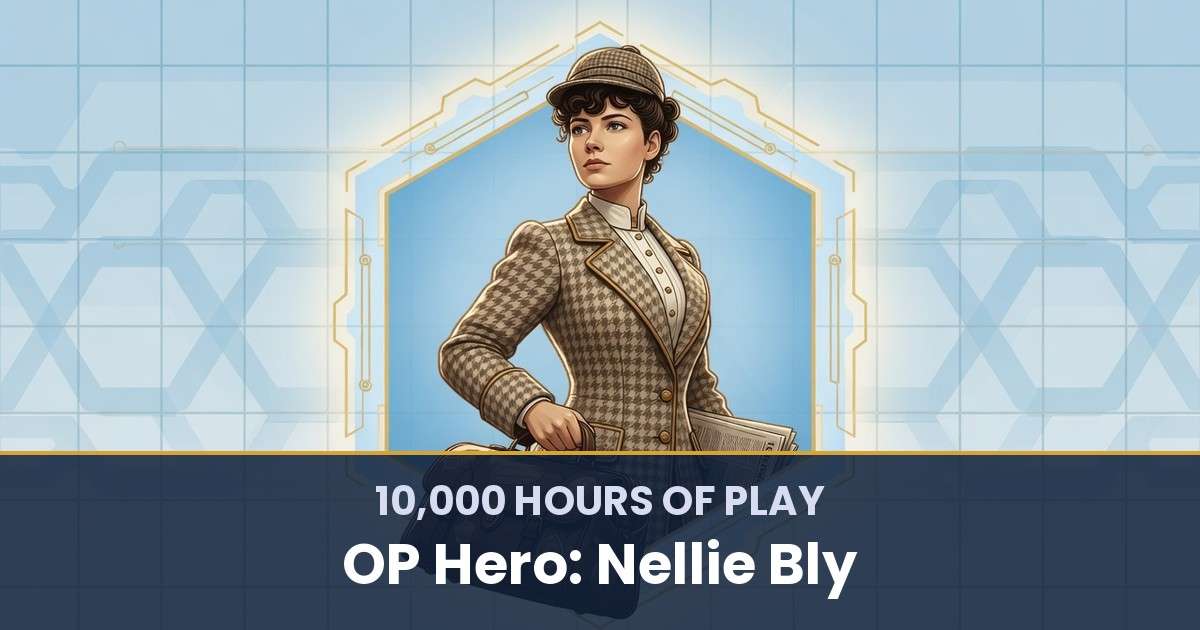


On the morning of October 9, 1887, readers of Joseph Pulitzer’s New York World met a headline that sounded like pulp fiction: “Behind Asylum Bars.”
The story under it was real. Its author had spent ten days committed inside the women’s insane asylum on Blackwell’s Island, and she had gotten in by performance: a 23-year-old with no steady income and no newsroom job had feigned insanity so convincingly that New York’s doctors locked her up.
Her name was Nellie Bly.
Two years later she raced Jules Verne’s fictional 80-day record around the actual planet and beat it. Then she came home, ran a steel factory, filed patents, and covered a world war.
Run that life through the 10,000 Hours of Play framework and the chaos snaps into a build: one Game played for four decades, a stack of Attributes visible before she ever held a job, and five canon Real-Life Game Skills that turned a shut-out outsider into the model for a new kind of celebrity reporter. Here is the character sheet.
⚡ Speed Run Notes
- Nellie Bly’s Game was access: get inside the places power hides, bring back proof, and publish it loudly enough that something changes. It took her from $5 a week in Pittsburgh to Pulitzer’s front page.
- Her breakout Quest: ten days feigning insanity inside the Blackwell’s Island asylum in 1887. A grand jury investigated, and Bly wrote that the city granted a million dollars more than ever before for care of the insane.
- In 1889–90 she circled the globe in 72 days, 6 hours and 11 minutes, beating Jules Verne’s fictional 80 days and a rival reporter racing the opposite direction.
- Five canon Skills carry the build: Masquerade, Courageous Heart, Beacon Flare, Cosmic Alignment, and Phoenix Rebirth.
- Her hardest chapter came as an industrialist: employee embezzlement helped sink her Iron Clad Manufacturing Co. She re-classed as a war correspondent and columnist and worked until her death in 1922.
Table of Contents
- About Yu-kai Chou
- Step 1: The Game Nellie Bly Was Actually Playing
- Step 2: Attributes, the Innate Stats
- Step 3: Role(s) Across Chapters
- Step 4: The Real-Life Game Skills She Mastered
- Step 5: The Allies Who Multiplied Her
- Step 6: The Quests That Shaped the Saga
- What You Can Steal From Nellie Bly’s Build
- Where this framework comes from
- Related Reading
About Yu-kai Chou

Yu-kai Chou is the author of 10,000 Hours of Play — the book that treats your life as the most important game you’ll ever build a character in, and gives you the 6-Step framework (Game · Attributes · Role · Skills · Allies · Quests) to play it on purpose. He has spent two decades developing the system through which this post analyzes its OP Hero, and applies it to his own life and to the lives of the people he advises around the world.
Chou’s other framework, the Octalysis Framework, has been applied by LEGO, Microsoft, Porsche, Coca-Cola, Salesforce, and MrBeast, impacting over 1.5 Billion Users. He has taught the methodology at Harvard, Stanford, Yale, Tesla, Google, BCG, and IDEO, and has advised governments in eight nations including Ukraine, the United Kingdom, the Kingdom of Bahrain, Singapore, Taiwan, the Netherlands, Kazakhstan, and South Korea.
His work has been cited by Harvard, Stanford, MIT, Forbes, Wall Street Journal, Wired, US Department of Energy, NIST, NSF, NCBI, US Department of Education, ClinicalTrials.gov, and Google Scholar — with 3,700+ more academic publications. Explore his books here.

What pulls me to Nellie Bly’s build is how she solved the access problem. Every door in her industry was closed to a young woman with no credentials, so she stopped asking for entry and made the story itself her qualification: check into the asylum, board the ship, take over the factory. The lesson I’d lift is her Masquerade discipline, because the role your current title describes was never the ceiling on the roles you’re allowed to play.
Step 1: The Game — What Nellie Bly Was Actually Playing
Every OP Hero plays one Game underneath all the visible ones. Bly’s was direct-action journalism: enter the closed system, document what it does to the people trapped inside, and convert the resulting attention into reform and personal fame.
The Game chose her early. She was born Elizabeth Jane Cochran on May 5, 1864, in Cochran’s Mills, Pennsylvania, and her father’s death while she was young collapsed the family’s finances and cut her schooling short.
In 1885 a Pittsburgh Dispatch columnist published a piece, remembered as “What Girls Are Good For,” arguing that women belonged in the home. She answered with a furious letter signed “Lonely Orphan Girl.”
Editor George Madden was struck enough to invite the anonymous writer to submit, then hired her full-time at five dollars a week and gave her a pen name lifted from a Stephen Foster song.
The prize she chased from that first byline stayed constant across four decades: access to hidden institutions, proof of wrongdoing, and feats nobody believed a woman could pull off.
Asylums, Mexican politics, a global race, a factory floor, a world war. Different boards, same Game.
Step 2: Attributes — The Innate Stats
In the 10K HP system, Attributes are the stats you’re dealt before training ever starts, and the Talent Triangle Method exists to find where those raw stats overlap with what the world rewards. Bly’s sheet reads like a rogue-scout hybrid rolled with loaded dice.
Risk appetite. She accepted physical danger as the entry fee for every major Quest: a madhouse with no guaranteed exit, a dictatorship’s press pool, a solo lap of the planet.
Audacity. After months in New York without steady work, she talked her way into the offices of the World and came out with one of the boldest assignments in American journalism.
Empathy. The asylum series worked because it centered the institutionalized women themselves. Readers felt the human cost, and that feeling is what made the scandal impossible to ignore.
Competitive drive. She chased records and firsts her whole career, and when a rival magazine sent another reporter racing the opposite way around the world, Bly outran her.
All four stats predate her first job. Training sharpened them later; the equipment was factory-installed.
Step 3: Role(s) — The Character Class Across Chapters
Roles are the classes a hero equips for a chapter of life, and Bly re-specced more aggressively than almost anyone in this series.
Chapter one: the undercover reporter. At the Dispatch and then the World, her class ability was disappearing into a persona and reporting from inside stories other journalists covered from the sidewalk.
Chapter two: the record-chaser. The 1889 world race converted her from journalist into public spectacle, a woman whose itinerary was front-page news.
Chapter three: the brand. Her byline became the product. The World printed her name in a headline at a time when women reporters rarely received credit at all.
Chapter four: the industrialist-inventor. Marriage to manufacturer Robert Seaman moved her into steel, and after his death she ran the Iron Clad Manufacturing Company and filed patents under her married name.
Chapter five: the war correspondent and columnist. In her fifties she reported from World War I’s Eastern Front, then wrote a column until her death.
That willingness to construct a persona deliberately, then swap it when the chapter ends, is the same craft that powers Harry Houdini’s OP Hero build. Both understood that the public plays along with whoever commits hardest to the character.
Step 4: Skills — The Real-Life Game Skills Nellie Bly Mastered
On the Skills Spectrum, Bly sits closer to the strategist end than her stunt-girl reputation suggests: a portable kit of five canon Skills, re-applied across journalism, business, and war.
Masquerade (Rogue) — adopting an alter ego and performing it at full fidelity. Getting committed to Blackwell’s Island meant convincing everyone from boarding-house strangers to examining doctors that she was insane, then holding the performance for ten days inside. Even “Nellie Bly” was an equipped persona: Elizabeth Cochran wore it for the rest of her life.
Courageous Heart (Paladin) — charging into hostile territory without backup. She reported from Mexico for roughly six months in her early twenties and kept writing about official corruption until she feared arrest under the Díaz regime. The asylum, the solo circumnavigation, and the war zone all run on the same stat.
Beacon Flare (Ranger) — PR that cuts through noise. Her asylum exposé ran as illustrated installments on October 9 and October 16, 1887, a serialized structure that let the whole city’s suspense build for a week between chapters.
Cosmic Alignment (Mage) — optimizing complex logistics. The world trip was a chain of ships, trains, and connections with almost zero slack, and she landed the circuit at 72 days, 6 hours and 11 minutes, precise enough that her paper could run a guessing contest on her arrival time.
Phoenix Rebirth (Paladin) — coming back from a devastating loss. When Iron Clad collapsed under financial turmoil, she fought in court to save what she could, then rebuilt her career from zero in the profession that first made her famous.
Step 5: Allies — The People Who Multiplied Nellie Bly
No OP Hero solos the endgame, and Bly’s ledger of Allies is short, strange, and decisive.
George Madden. The Dispatch editor read an angry anonymous letter and saw a reporter in it. His five-dollar-a-week bet, and the pen name he assigned, created Nellie Bly as a playable character.
Joseph Pulitzer and the World machine. Pulitzer’s paper gave her the platform, and its editors turned her reporting into events: illustrations, serialized installments, her name in the headline. The asylum story became a citywide sensation because the packaging multiplied the courage.
Jules Verne. Early in the world race, the novelist received her at his home in Amiens. The visit reframed the whole stunt as a torch-passing: the inventor of the 80-day fantasy meeting the 25-year-old setting out to beat it.
Robert Seaman. Her 1895 marriage to the industrialist, decades her senior, opened the door to her least likely chapter. After his death, the reporter became the boss of a steel-container company.
One pattern worth copying: every ally on this list multiplied work she had already started. The letter came before Madden, the audacity before Pulitzer, the race before Verne.
Step 6: Quests — The Milestones That Shaped the Saga
Quest 1: Ten days in the madhouse (1887). Bly feigned insanity, was committed to the women’s asylum on Blackwell’s Island, and documented the abuse she found inside. The exposé triggered a grand jury investigation, and the jurors asked her to accompany them to the island.
She later wrote that on the strength of her story, the appropriations committee granted a million dollars more than ever before for the benefit of the insane. The series became her book Ten Days in a Mad-House.
Quest 2: Around the world (1889–90). She left New York on November 14, 1889, chasing Phileas Fogg’s fictional 80-day benchmark, while Elizabeth Bisland of The Cosmopolitan raced westward in the opposite direction. The World sold the drama with a contest to guess her exact finishing time.
Bly was back on January 25, 1890: 72 days, 6 hours and 11 minutes after departure, with Bisland still en route. The book Around the World in Seventy-Two Days followed, and the public record chase built a template that Amelia Earhart’s OP Hero build would push into the sky four decades later.
Quest 3: The Iron Clad campaign (the failure). Running her late husband’s company, she manufactured steel barrels and containers and patented inventions of her own: U.S. patent 697,553 for an improved milk can and 703,711 for a stacking garbage can. Then employee embezzlement helped drag Iron Clad into financial collapse.
On July 12, 1911, a court ruling let her save one of her plants from bankruptcy. The industrial empire she had tried to build was gone anyway, and this Quest ends in a loss worth studying.
Quest 4: The comeback (1914–22). In her fifties she reported from the Eastern Front of World War I, and by 1918 she was back in New York writing for the Evening Journal, where her column championed abandoned children and worked to place them in homes. She died on January 27, 1922, at 57, still a working columnist.
What You Can Steal From Nellie Bly’s Build
Manufacture your own credential. Bly held no degree, no connections, and no portfolio while the industry’s doors stayed shut. The asylum assignment worked because the story itself became her resume, and nobody could argue with ten days of primary-source evidence.
Re-class when the chapter ends. Reporter, spectacle, brand, industrialist, correspondent: five Roles, one character. Each swap came after she had extracted everything the previous Role could teach her.
Let the record do the marketing. A verifiable number, publicly staked before departure, recruits everyone watching into your Quest. 72 days needed no adjectives, which is why her paper could sell a betting game on it.
Her profile now sits alongside the other OP Hero profiles, and it earns a specific seat there: the build for anyone starting outside every gate that matters.
So run her opening move on your own map. Find the door nobody guards because nobody expects you to walk through it, then walk through it with a notebook.
Where this framework comes from

Want the full system this profile is built on?
Every OP Hero piece runs through the same 6-Step framework from 10,000 Hours of Play: Unlock Your Real-Life Legendary Success. The book covers the full system, walks through Yu-kai’s own life run as the first applied case study, and gives you the worksheets to audit your own build.
Related Reading
- All OP Hero Profiles: the full hub of legendary builds analyzed through the 10,000 Hours of Play framework.
- 10,000 Hours of Play by OP Hero: Harry Houdini: the escape artist whose whole career ran on the same Masquerade Skill Bly used to enter the asylum.
- 10,000 Hours of Play by OP Hero: Amelia Earhart: the record-chaser who took Bly’s public-feat playbook into aviation.
- 10,000 Hours of Play by OP Hero: Mark Twain: a fellow nineteenth-century newspaperman who turned a byline into a brand.
- 10,000 Hours of Play by OP Hero: Rachel Carson: another writer whose reporting forced institutions to change.