


Short answer: Inoculation Theory, developed by William McGuire in 1961, builds resistance to persuasion by exposing people to a weakened version of an argument, plus its refutation, before the real attack arrives.
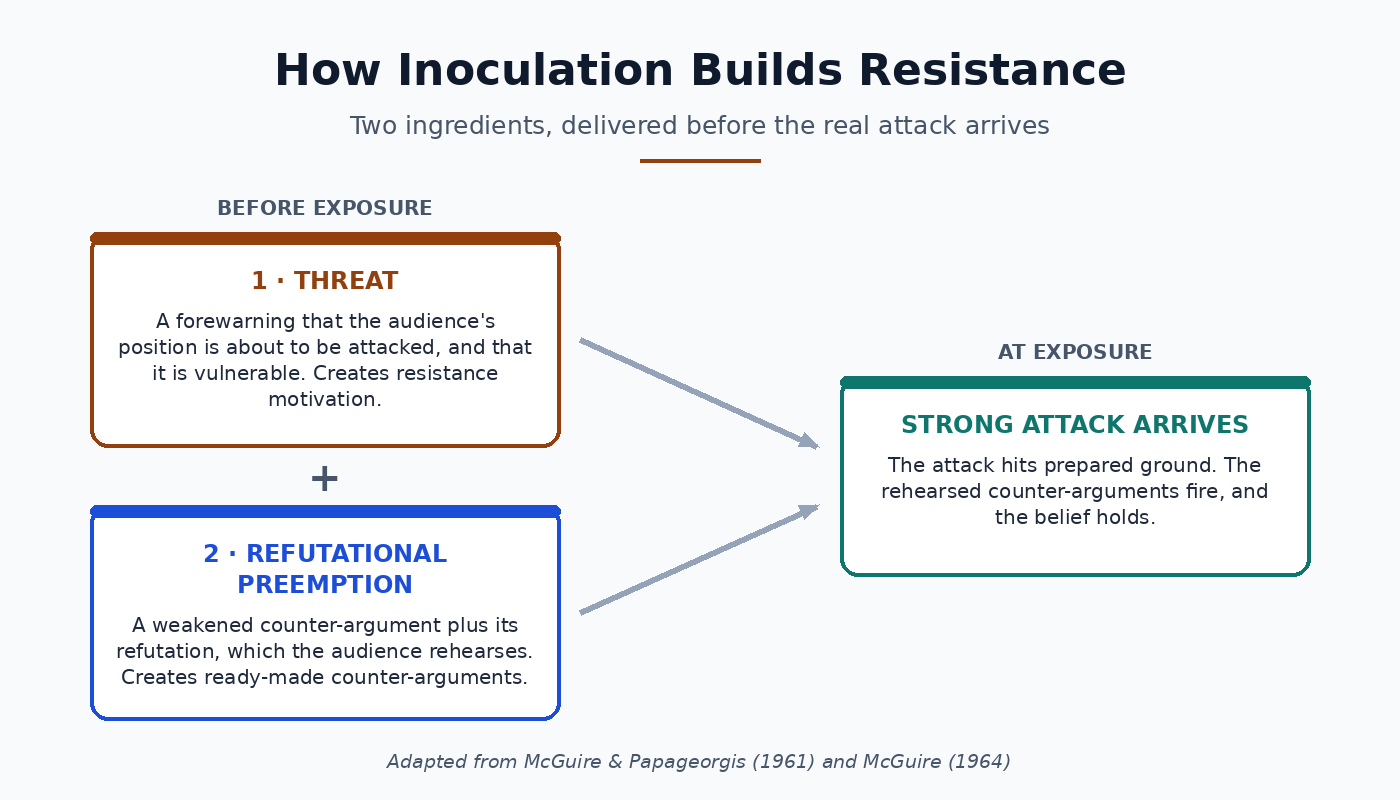
It needs two ingredients: a threat (a forewarning that your position will be attacked) and refutational preemption. Either ingredient on its own produces very little resistance.
Without boosters, the effect has a half-life of about two weeks, so plan to re-engage your audience every two to four weeks.
Most teams that get hit by a misinformation campaign, a competitor’s attack ad, or a coordinated review-bombing spend the next quarter trying to debunk. They write rebuttals. They issue corrections. They hire fact-checkers. And the damage stays exactly where it landed, because by the time you are debunking, the persuasion has already done its work inside the audience’s head.
William McGuire figured this out in a Yale lab in 1961, almost a decade before the term “behavioral design” existed. He noticed that a belief is like a person who has lived in a germ-free environment their whole life: the moment a real pathogen shows up, the immune system has no antibodies and the host collapses. The fix is not stronger arguments after the fact. The fix is a vaccine: a weakened version of the attack, delivered before the real one arrives, paired with a refutation the believer rehearses until it becomes automatic.
That is Inoculation Theory in one sentence: expose people to a weakened counter-argument plus its refutation, and they become resistant to the stronger version that comes later. It is the only persuasion-defense framework with experimental evidence going back six decades, and it sits at the foundation of every modern pre-bunking program, brand-loyalty defense, vaccine-hesitancy intervention, and misinformation-literacy curriculum on the planet.
This guide is the deep version. I will walk you through the original 1961 experiments, the three generations of theory that followed, the neuroscience of why threat plus refutation builds a different kind of memory than ordinary persuasion, the failure modes that have caused billions of dollars of brand campaigns to collapse, and the per-Core-Drive Octalysis design surface I have developed for clients who need to inoculate at scale. By the end you will have a behavioral-design audit you can run on any inoculation campaign (your own or your opponent’s) and a working theory of why “we need more fact-checkers” is almost never the right answer.
Speed Run Notes
- Inoculation Theory: deliver a weakened counter-argument plus a refutation BEFORE the attack lands. The audience builds counter-argument schemas the way a vaccinated body builds antibodies.
- Two load-bearing ingredients. Threat (forewarning of attack) creates resistance motivation. Refutational preemption creates rehearsed ammunition. Neither alone produces durable resistance.
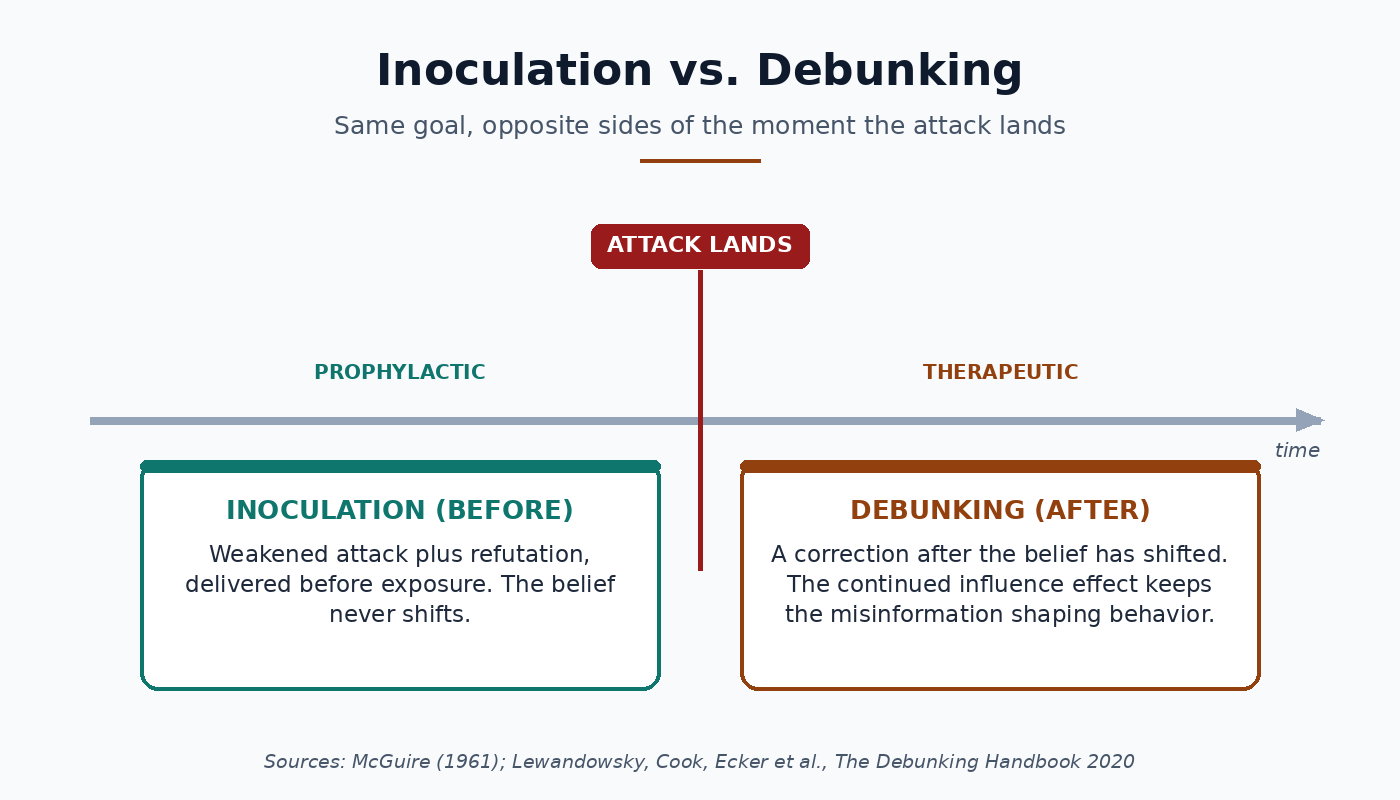
- Inoculation is prophylactic, not therapeutic. Once an audience has converted, you are no longer inoculating; you are debunking, and the data on debunking is brutal: corrections often entrench the original belief.
- Technique-based inoculation generalizes; content-based does not. Roozenbeek and van der Linden’s 2019 Bad News game taught six manipulation techniques and produced resistance to claims players had never seen.
- Inoculation decays. Without boosters, resistance half-life is roughly two weeks. Brands that treat inoculation as a campaign instead of a maintenance discipline lose every gain by month two.
- The dominant Octalysis design move: force ACTIVE refutation through Core Drive 3 (Empowerment of Creativity and Feedback). Passive reading does not inoculate. Quiz-style and role-play interactions do.
Table of Contents
- What Is Inoculation Theory?
- The Two Elements: Threat and Refutational Preemption
- Three Generations of Inoculation Research
- What McGuire Got Right
- Where Inoculation Theory Falls Apart
- What's Really Happening Inside the Brain
- Inoculation vs Other Persuasion Theories
- Inoculation Theory in the Real World
- The Elephant in the Room: Inoculation Is a Maintenance Discipline
- How to Apply Inoculation Theory with the Octalysis Framework
- FAQ
About the Creator of the Octalysis Framework

Yu-kai Chou created the Octalysis Framework after studying gamification since 2003, years before the term entered mainstream vocabulary. As a Human-Systems Architect & Behavioral Designer, his framework has been applied by LEGO, Microsoft, Porsche, Coca-Cola, Salesforce, and MrBeast, impacting over 1.5 Billion Users.
Chou has taught the Octalysis methodology at Harvard, Stanford, Yale, Tesla, Google, BCG, and IDEO.
His work has been cited by Harvard, Stanford, MIT, Forbes, Wall Street Journal, Wired, US Department of Energy, NIST, NSF, NCBI, US Department of Education, ClinicalTrials.gov, and Google Scholar — with 3,700+ more academic publications. Explore his books here.

What Is Inoculation Theory?
Inoculation Theory is a behavioral-design framework for building durable resistance to persuasion. The framework was formalized by William J. McGuire and his Yale collaborator Demetrios Papageorgis in a series of experiments published between 1961 and 1964, and the central metaphor is biological. A body that has never encountered a pathogen has no antibodies. A belief that has never encountered a counter-argument has no cognitive antibodies either. When the real attack arrives, the unprotected body collapses. The unprotected belief flips.
The intervention is to deliver, in advance, a weakened form of the attack you expect the audience to face. The weakened form has two ingredients. The first is a forewarning that someone is going to try to change the audience’s mind, paired with the implicit suggestion that they are vulnerable. McGuire called this the threat component. The second is a presentation of one or more counter-arguments the attacker might use, followed immediately by a refutation that the audience can mentally rehearse. McGuire called this the refutational preemption component.
The two together produce something stronger than either alone. The threat creates resistance motivation: the audience starts mentally scanning for arguments to defend their position. The preemption gives them the ammunition: rehearsed refutations that are now available the moment the real attack lands. By the time the audience meets the strong-form attack, they have already pre-loaded the counter-move. The attack hits prepared ground, and the persuasion attempt fails.
This is not the same thing as fact-checking. Fact-checking arrives after the persuasion has done its work. Inoculation arrives before. This is not the same thing as repetition of the truth either. Telling someone repeatedly that vaccines are safe does not inoculate them against an anti-vaccine argument they have never seen and have never had to refute. The active ingredient is the rehearsed refutation, not the reinforced belief. A user who has been inoculated against a manipulation technique can recognize and resist new instances of that technique they have never encountered. A user who has only been told the correct answer cannot.
Sixty-plus years of replication studies have placed Inoculation Theory among the most robust findings in social psychology. Banas and Rains 2010 meta-analyzed 41 inoculation experiments and found a reliable resistance effect with an average effect size of d = 0.43, which is substantial for a single intervention. Compton 2013 and the Compton, van der Linden, Cook, and Basol 2021 review extended the finding across health communication, political messaging, advertising, organizational communication, and most recently misinformation literacy. The framework has survived the replication crisis that flattened so much of mid-century social psychology. That is one of the strongest credentials any behavioral-design framework can claim.
The Two Elements: Threat and Refutational Preemption
Most teams that try to build inoculation campaigns get only one of the two ingredients right. The campaigns then underperform, often dramatically, and the team concludes that “inoculation does not work for our category.” It is not the framework that failed. It is the recipe.
Element 1: Threat
Threat in McGuire’s sense is not fear. It is a forewarning that the audience’s current position is going to be attacked, paired with the implicit acknowledgement that the position is vulnerable. The threat says, in effect: someone is coming for what you believe. You do not currently have the tools to defend it. Pay attention.
The biological metaphor is exact. A vaccine without an immune challenge does nothing. The body has to register the weakened pathogen as a threat to mount a response. Inoculation works the same way. A refutation delivered without the threat ingredient produces almost no resistance gain in McGuire’s original 1961 data, because the audience never engaged the refutation as defense. They processed it as trivia.
The design rule that follows is uncomfortable: you must make your audience feel slightly vulnerable. Not panicked. Not catastrophizing. Slightly vulnerable, with a clear next step. “Most people who hear this argument find it surprisingly persuasive at first. Here is why it is misleading.” That is a working threat sentence. “Don’t worry, we have the facts on our side” is the failure mode: it removes the threat, which removes the motivation, which collapses the inoculation.
Element 2: Refutational Preemption
Refutational preemption is the cognitive ammunition. The audience sees a weakened version of the attack argument, sees a refutation, and ideally generates additional counter-arguments of their own. The “ideally generates” half of that sentence is where most campaigns lose half their resistance. Reading a refutation produces some resistance. Generating one yourself produces three to four times more, because the act of generating a refutation builds a memory the brain treats as your own intellectual property rather than as somebody else’s lecture.
McGuire’s original studies distinguished two forms of preemption. The refutational-same version delivers the exact counter-argument the attacker will use; the inoculated audience meets a familiar attack and has the rehearsed answer ready. The refutational-different version delivers a related but distinct counter-argument; the inoculated audience meets a novel attack and uses transferable skills built during the inoculation to generate a fresh refutation. Refutational-different is harder to design but produces resistance that generalizes. Modern misinformation-literacy work descends almost entirely from this branch.
Calibrating Dosage: The Weakened-Pathogen Problem
The single hardest design parameter in inoculation work is dosage. Too weak a counter-argument and the audience never registers the threat; the inoculation collapses into trivia. Too strong a counter-argument and you have just delivered the attack you were trying to prevent; the inoculation has become the conversion event. The whole framework lives in the narrow band between those two failure modes.
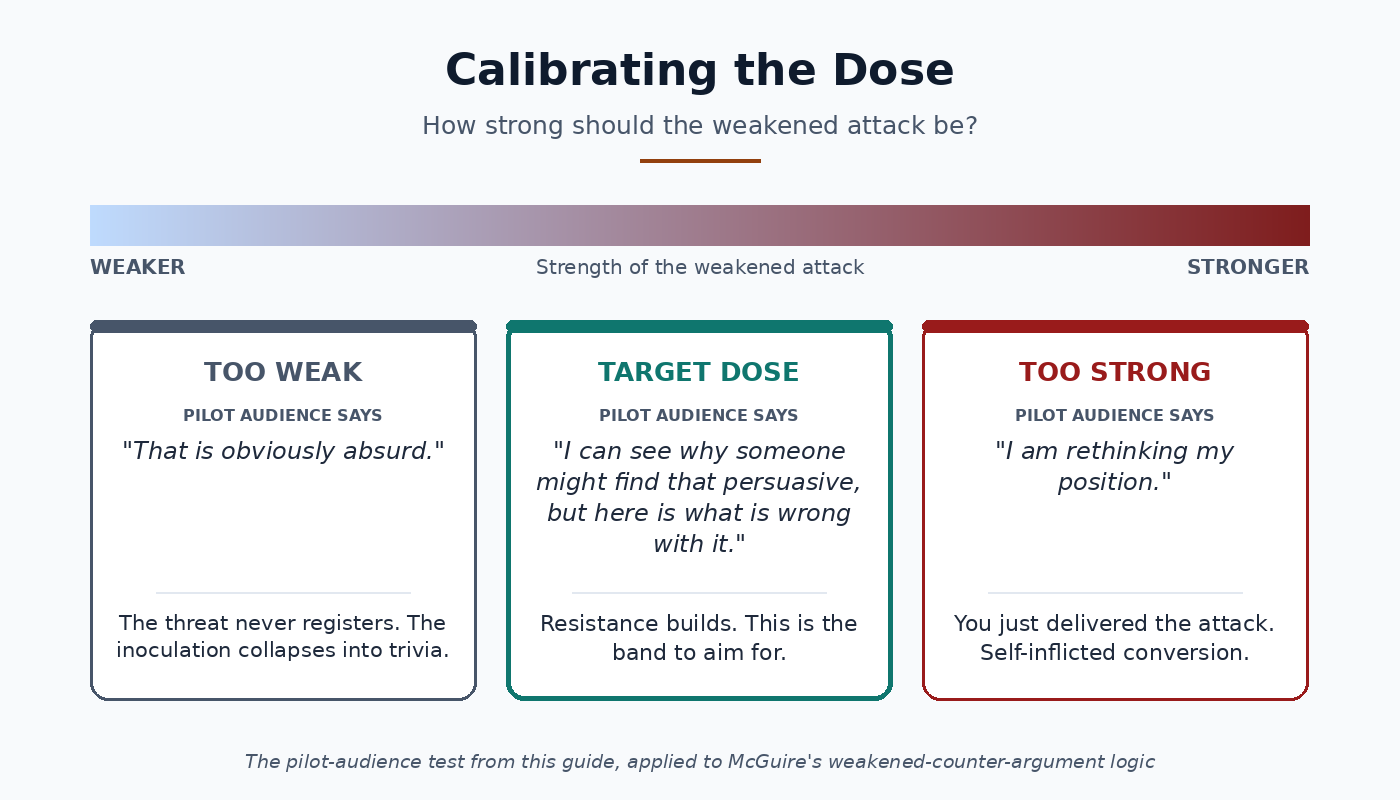
The operational test I use with clients: the weakened version should make the audience say, “I can see why someone might find that persuasive, but here is what is wrong with it.” If the audience says, “That is obviously absurd,” the dose was too weak. If the audience says, “I am rethinking my position,” the dose was too strong and you have just converted them. The first response means inoculation; the others mean either no effect or self-inflicted conversion.
Three Generations of Inoculation Research
Treating Inoculation Theory as a single static idea misses most of what the field has learned. Read across the sixty-three years between McGuire 1961 and the current Cambridge Social Decision-Making Lab work and you find three distinct generations of the framework, each correcting the limitations of the one before it.
Generation 1: McGuire’s Cultural Truisms (1961-1970)
McGuire’s original experiments focused on what he called cultural truisms: beliefs so universally accepted within a culture that the believer has never seen them attacked. “Brushing your teeth after every meal is good.” “Mental illness is not contagious.” “Penicillin has been a great benefit to mankind.” McGuire’s insight was that these beliefs are paradoxically the most vulnerable. The believer has never had to defend them, has never rehearsed counter-arguments, and folds the moment a competent opponent raises an objection.
The Generation 1 design rule: the more obvious and universal a belief inside your audience, the more urgently it needs inoculation. This is counter-intuitive for marketing teams who think the campaign should focus on contested propositions. The unattacked belief is the high-priority target, because it is the belief most likely to collapse when an attacker shows up.
Generation 2: Pfau’s Applied Inoculation (1988-2010)
Michael Pfau’s two-decade research program at the University of Wisconsin and the University of Oklahoma moved the framework out of cultural truisms and into contested terrain: political campaigns, anti-smoking interventions, brand-loyalty defense, and corporate-crisis communication. Pfau and his collaborators demonstrated that inoculation works against contested attacks too, that resistance transfers across argument families, and that the inoculation effect can be measured up to seven weeks out under specific conditions.
Pfau also identified a critical decay curve. Without booster shots, inoculation effects begin to decline after about two weeks and are typically half-strength by week four. This is the single most under-respected finding in the literature. Campaigns that treat inoculation as a one-time delivery and then move on are designing the decay into their own work.
Generation 3: Roozenbeek and van der Linden’s Technique-Based Inoculation (2017-present)
The Cambridge Social Decision-Making Lab, led by Sander van der Linden and Jon Roozenbeek, turned inoculation into a technology product. Their Bad News game, GoViral, Harmony Square, and Cranky Uncle simulations deliver inoculation through playable scenarios in which the user takes the role of a manipulator and learns to recognize the techniques from the inside. The 2019 Roozenbeek and van der Linden paper in Palgrave Communications showed that fifteen minutes inside Bad News produced reliable resistance to manipulation techniques the players had never seen in real content. The 2022 Roozenbeek, van der Linden, Goldberg, Rathje, and Lewandowsky Science Advances program (seven preregistered experiments plus a YouTube field trial) confirmed that the effect generalizes to live social-media environments.
The Generation 3 insight: inoculate against techniques, not claims. A user inoculated against “this specific claim about vaccines is wrong” knows one fact. A user inoculated against “discrediting individual scientists is a classic manufactured-doubt technique” can spot the move whenever it appears, against any target. Technique inoculation generalizes. Content inoculation does not. The Cambridge group identified six core manipulation techniques (emotional language, incoherence, false dichotomies, scapegoating, ad hominem, and fake experts) that recur across virtually every misinformation category, and demonstrated that fifteen minutes of technique training produces measurable resistance to all of them.
What McGuire Got Right
It is easy to look at a paper from 1961 and assume the framework has been superseded. With Inoculation Theory the opposite is true. McGuire’s core architecture has held up better than almost any other behavioral-design framework from the same era. Three things he got right in particular are worth naming.
First, he recognized that resistance is an active state, not a passive one. Earlier persuasion research (Hovland’s Yale Communication Program in the 1950s) treated the audience as a receiver and the message as a transmission. McGuire flipped the lens. The audience is a defender. The persuasion encounter is a contest. The defender wins by pre-loading counter-arguments. Every modern misinformation-literacy program inherits this reframe, whether it knows it or not.
Second, he saw that the most durable beliefs are the ones the believer has had to defend. Beliefs received passively and held without challenge are brittle. Beliefs that have survived an attack are durable. This is the opposite of the intuition most communicators bring to campaign design, which is to protect the audience from any exposure to counter-arguments. McGuire’s data showed that protective shielding produces brittle belief. Controlled exposure plus refutation produces durable belief.
Third, he insisted that the threat and the refutation must travel together. Threat without refutation is a recruitment pitch for the other side. Refutation without threat is trivia. The combination is what generates the resistance. Sixty-three years later, every campaign that delivers one element without the other is replicating a known failure mode McGuire identified in his original Yale experiments. The fact that we keep redesigning around the same mistake is not the framework’s problem. It is ours.
Where Inoculation Theory Falls Apart
Inoculation Theory is one of the most well-replicated frameworks in behavioral science, and it still has three failure modes that defeat real campaigns regularly. Naming them up front is the difference between a campaign that ships measurable resistance and a campaign that ships press releases.
Failure Mode 1: It Only Works Prophylactically
The biological metaphor cuts both ways. Vaccines work before exposure, not after. Once an audience has been converted by an attack, you have already missed the inoculation window. From that point forward you are no longer doing inoculation; you are doing debunking, and the data on debunking is grim. Lewandowsky and colleagues’ 2020 Debunking Handbook is essentially a long discussion of why corrections often produce a “continued influence effect” in which the original misinformation keeps shaping behavior even after the correction is accepted intellectually.
The design implication is hard for risk-averse teams to swallow. Inoculation has to ship before you are sure the attack is coming. If you wait until you can confirm the attack is real, the inoculation window has already closed. This is why most public-health inoculation efforts and most political pre-bunking efforts are politically uncomfortable: they require committing resources to defend against an attack that has not happened yet, which always feels less urgent than the fire actually burning today.
Failure Mode 2: The Specificity Bottleneck
McGuire’s original refutational-same paradigm produces strong resistance against the exact argument used in the inoculation and progressively weaker resistance against arguments that diverge from it. The bigger the divergence, the smaller the resistance. A campaign that inoculates against one specific counter-claim has done almost nothing if the attacker shows up with a different counter-claim.
The Cambridge technique-based work is the partial fix: inoculate at the technique layer rather than the claim layer, and the resistance generalizes. But technique-based inoculation is design-expensive. It requires identifying the manipulation techniques present in your category, building scenarios that train recognition of those techniques, and delivering the training in interactive form. The cost is real, and most teams underestimate it by a factor of three.
Failure Mode 3: Decay Without Boosters
Pfau’s data has been replicated repeatedly: inoculation effects decay. The half-life under naturalistic conditions is roughly two weeks. By week four, the effect is approximately half of peak. By week eight, in many studies, it is statistically indistinguishable from no inoculation at all. The framework requires booster shots, exactly the way medical inoculation requires them, and most behavioral-design teams design the campaign as a one-shot delivery and then are surprised when resistance evaporates by month two.
The operational fix is uncomfortable for marketing budget cycles. Inoculation is not a campaign; it is a maintenance discipline. Plan a delivery schedule with boosters every two to four weeks, plan the content variation that keeps boosters from becoming wallpaper, and budget for it in the same way you budget for a security patch program. A single inoculation deployment is medical malpractice. A booster program is medicine.
What’s Really Happening Inside the Brain
The neuroscience under Inoculation Theory has matured considerably since McGuire’s behavioral-era papers, and the picture that has emerged explains why the framework produces effects that ordinary repetition cannot replicate. Three brain systems are doing distinct jobs during a successful inoculation.
The first is the threat-detection circuit anchored in the amygdala and the anterior insula. The forewarning component activates this circuit at low intensity: not a fear response, but a vigilance posture. Functional imaging work by Falk, Berkman, and Lieberman, plus the Cascio and colleagues 2018 fMRI work on neural correlates of social-influence susceptibility, shows that forewarned subjects show measurably elevated activity in vigilance regions during message processing, and that this elevation predicts later resistance. Threat is not metaphor in the brain. It is a measurable state of cortical readiness.
The second system is the cognitive-rehearsal network anchored in the dorsolateral prefrontal cortex and the left inferior frontal gyrus. Generating a counter-argument is a working-memory operation: the brain holds the attack proposition in mind, retrieves relevant counter-evidence, and constructs a refutation. Repeated rehearsal of this operation builds what cognitive neuroscientists call a procedural schema in the basal ganglia and supplementary motor area: a learned routine that fires automatically the next time a similar attack arrives. This is the mechanism by which inoculated subjects can resist attacks they have never seen. They have not memorized a refutation; they have built a refutation-generating procedure.
The third system is the memory consolidation network anchored in the hippocampus. Rehearsed refutations consolidate into long-term memory through the same processes that consolidate any other rehearsed material. This is where the decay curve comes from: without re-rehearsal (booster shots), the consolidated traces gradually weaken, exactly the way any other memory does. Booster shots are not just behavioral conditioning. They are spaced retrieval practice, which the memory literature (Roediger, Karpicke 2006) has shown repeatedly is one of the few interventions that durably increases long-term retention.
Put the three systems together and the operational picture is clear. Inoculation builds three kinds of memory simultaneously: a vigilance state ready to detect the attack, a procedure ready to generate the refutation, and a consolidated trace that holds the procedure available over time. Ordinary persuasion delivers content; inoculation delivers a defense routine. That is why ordinary repetition of the truth does not work as a substitute. Repetition reinforces content. Inoculation builds machinery.
Inoculation vs Other Persuasion Theories
Inoculation Theory sits inside a larger family of persuasion-resistance frameworks, and behavioral designers regularly confuse it with its neighbors. Each of the four overlaps below is worth disentangling before any campaign work.
Inoculation vs the Elaboration Likelihood Model
Petty and Cacioppo’s Elaboration Likelihood Model (ELM) describes how a persuasion attempt is processed, not how to defend against it. ELM contrasts central-route processing (deep engagement with arguments) against peripheral-route processing (response to surface cues like source attractiveness). Inoculation is a pre-treatment that shifts processing toward the central route by activating vigilance. The two frameworks are complementary: ELM tells you what kind of processing produces durable attitude change; Inoculation tells you how to make sure that durable processing happens in defense rather than in conversion.
Inoculation vs Psychological Reactance
Brehm’s Psychological Reactance Theory describes the involuntary motivation to restore freedom when freedom is threatened. Reactance is reactive: it fires after a persuasion attempt that feels like control. Inoculation is proactive: it pre-loads counter-arguments before the persuasion attempt arrives. The two share a deep architectural similarity (both produce resistance), but the timing is different and the mechanism is different. Reactance is emotional and impulsive. Inoculation is cognitive and rehearsed. Campaigns that confuse the two often end up triggering reactance in the audience they were trying to inoculate, which is the worst of both worlds.
Inoculation vs Social Judgment Theory
Sherif and Hovland’s Social Judgment Theory describes attitudes as latitudes: a position the audience accepts, a position the audience rejects, and a non-committal range in between. SJT tells you where on the spectrum a given message will land. Inoculation tells you how to widen the rejection latitude on the attacker’s side. The two work well together: use SJT to map the current attitude landscape; use Inoculation to widen rejection latitude in the direction of the attacks you expect.
Inoculation vs Cognitive Dissonance
Festinger’s Cognitive Dissonance Theory describes the discomfort that arises when behavior and belief diverge, and the rationalization processes the mind uses to restore consistency. Dissonance is a post-conversion phenomenon: the believer has already changed something and is now reconciling. Inoculation is pre-conversion: the believer has not yet changed anything and is being prepared to refuse. Once an audience has converted, you are no longer in inoculation territory. You are in dissonance-management territory, which is a much harder design surface.
Inoculation Theory in the Real World
The framework has been deployed at meaningful scale across four domains over the last decade. Each deployment teaches a different lesson about what inoculation can and cannot do.
Misinformation Literacy
The Cambridge Bad News game has been played by over a million users globally and adopted in formal media-literacy curricula in the United Kingdom, the Netherlands, Sweden, and Estonia. The 2019 Roozenbeek and van der Linden paper showed that fifteen minutes inside the game produced a measurable increase in users’ ability to identify manipulation techniques and a decrease in their judged credibility of misleading content, persistent at follow-up. The pattern that emerged from later deployments: technique-based inoculation works in laboratory and short-horizon naturalistic settings, but the decay curve is real, and curricula that deliver Bad News as a one-time training and then move on lose most of the gain by week six. The deployments that work are the ones that re-engage users with new scenario variants every few weeks.
Brand-Loyalty Defense
Pfau’s industry collaborations through the 1990s and 2000s documented inoculation working as a brand-defense tool. The pattern: brands that face predictable competitor-attack messaging (negative-political-style comparison ads, viral discrediting campaigns, well-organized review brigades) can pre-load loyal customers with refutations to the specific attack vectors. Microsoft’s response to Apple’s Get-a-Mac campaign in the late 2000s was a partial inoculation effort. The campaigns that worked best did not respond to Apple’s ads directly; they pre-empted them by giving Microsoft customers a vocabulary for talking about Mac shortcomings before any specific ad landed. Customers carrying pre-loaded refutations remained loyal at significantly higher rates than control customers exposed only to traditional positive messaging.
Health Communication
The largest single deployment of inoculation methodology in public health was the United States CDC’s anti-tobacco messaging strategy beginning in the 1990s, which inoculated adolescents against specific tobacco-industry marketing techniques before exposure rather than warning against smoking in general. The CDC’s adult-smoking rate decline from 42% in 1965 to roughly 12% in 2023 has many causes (taxes, indoor-smoking bans, social norm shifts), but the inoculation-style media work is credited with a measurable share of the decline among adolescents in the 2000s and 2010s, particularly the Truth Initiative campaign and its successors.
Political Pre-bunking
The European Commission, the United Kingdom Cabinet Office, and several US state-level secretaries of state have deployed pre-bunking efforts in advance of election cycles, attempting to inoculate voters against specific known disinformation techniques before election-period attacks land. The 2022 Roozenbeek, van der Linden, Goldberg, Rathje, and Lewandowsky Science Advances paper documented a YouTube pre-bunking deployment during a real election cycle that produced measurable shifts in users’ ability to identify manipulation techniques in social-media posts. The political work has the hardest decay problem of all four domains: attacks land repeatedly across a multi-month campaign window, and boosters at that frequency are administratively complex.
The Elephant in the Room: Inoculation Is a Maintenance Discipline, Not a Campaign
Every behavioral-design team I have advised on inoculation work has been confidently told (by themselves, often, before they ever called me) that they were about to “run an inoculation campaign.” Every one of them was wrong, and the wrongness is structurally identical across categories.
The mistake is that “campaign” is a planning unit borrowed from advertising. A campaign has a launch date, a flight window, and a wrap. It is a finite event. Inoculation does not work as a finite event. Pfau’s decay data has been replicated for thirty years: without boosters, resistance is half-strength by week four and indistinguishable from no inoculation by week eight. A campaign-shaped deployment is medical malpractice on the audience you were trying to protect, because you have given them just enough exposure to feel protected and not nearly enough re-engagement to actually be protected. By the time the real attack lands, the antibodies are gone and the audience does not know it.
The shape that actually works looks more like a software security patch program than a campaign. You identify the manipulation techniques present in your category. You build inoculation content that trains recognition of each technique. You deliver an initial dose. You schedule boosters every two to four weeks with content variation that prevents booster fatigue. You monitor for new techniques in the attack environment and add inoculation content for those techniques as they emerge. The program never wraps. It is part of the operational baseline forever.
This is uncomfortable for budgeting cycles that want a defined ROI window, and it is uncomfortable for creative teams who want a defined campaign deliverable. Both groups need to be told, calmly and once: inoculation is a maintenance discipline. If you cannot commit to the maintenance, you should not start the inoculation. A single deployment is worse than none, because it leaves the audience falsely confident in protection they no longer have.
There is a second elephant in the room, less commonly named, which is that inoculation is structurally asymmetric in time. You must deploy before the attack lands. If you wait for the attack to materialize so you can confirm it is real, the inoculation window has already closed. Every team I have worked with has had to make at least one expensive bet on inoculating against an attack they were not yet sure would happen. Those bets are politically uncomfortable, especially inside risk-averse institutions. The framework cannot resolve this discomfort. It can only name it, so that the team makes the bet knowingly rather than discovering after the fact that the inoculation arrived too late.
How to Apply Inoculation Theory with the Octalysis Framework
The Octalysis Framework breaks human motivation into eight Core Drives. Most behavioral-science frameworks describe what people do; Octalysis describes why, and the why is what gives a designer the leverage to actually change behavior at scale. Inoculation Theory and Octalysis fit together unusually well, because every successful inoculation deployment ends up recruiting at least four of the eight Core Drives, often without the campaign team understanding which Core Drives they are recruiting or why.

The per-Core-Drive design surface below is the one I deploy with clients building inoculation programs at scale. Each Core Drive is doing a different job inside the inoculation, and getting the assignment wrong is the most common source of campaign underperformance.
| Core Drive | Job inside the inoculation | Design move |
|---|---|---|
| Core Drive 3: Empowerment of Creativity & Feedback | Active refutation (the load-bearing drive) | Make the user generate the counter-argument: quizzes, role-play, “spot the manipulation” drills |
| Core Drive 8: Loss & Avoidance | Threat delivery | Name what the audience stands to lose and that they are not yet trained to defend it |
| Core Drive 1: Epic Meaning & Calling | Stakes framing | Ask the audience to defend something larger than themselves |
| Core Drive 5: Social Influence & Relatedness | Cascade builder | Give inoculated users a way to teach the inoculation to peers |
| Core Drive 2: Development & Accomplishment | Visible progress | Show which manipulation techniques the user can now identify |
| Core Drive 4: Ownership & Possession | Defense personalization | Let users phrase the refutation in their own words |
| Core Drive 7: Unpredictability & Curiosity | Entry-cost reducer | Frame the inoculation as a mystery, puzzle, or role-play |
Core Drive 3 (CD3): Empowerment of Creativity & Feedback as Active Refutation
Core Drive 3 (Empowerment of Creativity and Feedback) is the load-bearing Core Drive for inoculation. The framework’s central mechanism is rehearsed refutation generation, and that rehearsal requires the user to actively produce counter-arguments, not just read them. Passive exposure to a weakened attack plus a printed refutation produces roughly one-third the resistance of an interactive scenario in which the user generates the refutation themselves. The Cambridge Bad News game is the canonical CD3 inoculation surface: the player takes the role of a manipulator, learns to wield the techniques, and discovers from the inside what the manipulation looks like. The recognition memory built during that exercise is procedural, not factual, and procedural memories do not decay the way factual ones do.
The design rule that follows: if your inoculation surface does not require the user to do anything cognitively active, you are inoculating below replacement rate. Quiz formats, role-play simulations, “spot the manipulation” challenges, fill-in-the-refutation drills, and reciprocal-teaching exercises all qualify. Pure-text articles and video PSAs do not.
Core Drive 8 (CD8): Loss & Avoidance as Threat Delivery
Core Drive 8 (Loss and Avoidance) is the threat-delivery Core Drive. McGuire’s threat component requires the audience to register that they are vulnerable, and CD8 is the design surface for vulnerability framing. The threat sentence I use most often in client work is structurally simple: “Most people who hear this argument find it more persuasive than they expect. If you have not seen the refutation, the argument is likely to land.” That is a CD8 sentence: it names a loss (your current position) and a vulnerability (you have not been trained yet). It motivates engagement with the refutation that follows.
The design tension: CD8 must be calibrated tightly. Too much fear and the audience reactance-rejects the inoculation as alarmist. Too little and the threat motivation never activates. The operational test is the audience response described earlier: “I can see why someone might find that persuasive” indicates correct dosage; “this is obviously absurd” indicates under-dose; “I am rethinking my position” indicates dangerous over-dose.
Core Drive 1 (CD1): Epic Meaning & Calling as Stakes Framing
Core Drive 1 (Epic Meaning and Calling) raises inoculation effectiveness substantially when the audience is asked to defend not just their own beliefs but something larger than themselves: their children’s media environment, their democracy, their professional community, their faith. CD1 framing converts inoculation from a self-protection exercise into a defender-of-something-larger exercise, and defender identity is one of the most durable identity frames in social psychology. The Truth Initiative anti-tobacco campaigns leaned heavily on CD1 framing (defend your generation against industry manipulation), and the resulting persistence of effect at the population level was meaningfully larger than comparable health campaigns built only on personal risk framing.
Core Drive 5 (CD5): Social Influence & Relatedness as Cascade Builder
Core Drive 5 (Social Influence and Relatedness) is how inoculation scales beyond the individual. An inoculated user who teaches the inoculation to peers becomes a multiplier; an inoculated user who keeps the inoculation to themselves stays an N of one. The design move is to give inoculated users explicit affordances for transmission: share buttons that say “show this to someone who needs it,” referral mechanics that score teaching as well as learning, community channels where inoculated users coach novices. This is the herd-immunity layer of the metaphor, and most campaigns leave the entire layer on the table because they treat inoculation as a one-way delivery rather than a transmissible skill.
Core Drive 2 (CD2): Development & Accomplishment as Visible Progress
Core Drive 2 (Development and Accomplishment) converts the abstract sense of “being inoculated” into concrete progress feedback. Users who can see “you correctly identified five of six manipulation techniques in this scenario” are receiving a tangible accomplishment signal that ordinary persuasion campaigns cannot produce. Bad News and its successors lean heavily on CD2 progress feedback: each manipulation technique is a badge, the player progresses through clearly named stages, and the accomplishment trajectory is visible at every step. CD2 also solves the booster problem: progress feedback gives the user a reason to come back for the next dose rather than treating the inoculation as a one-time event.
Core Drive 4 (CD4): Ownership & Possession as Defense Personalization
Core Drive 4 (Ownership and Possession) addresses the durability problem. Refutations that feel like “my refutation” (because the user generated them, named them, customized them to their own context) persist meaningfully longer than refutations that feel like someone else’s lecture. The design move is to give inoculated users the affordance to construct their own version of the refutation in their own language and against their own anticipated attackers. The Cambridge group has experimented with personalization scaffolds in their newer simulations, and the durability gains have been substantial in early data.
Core Drive 7 (CD7): Unpredictability & Curiosity as Entry-Cost Reducer
Core Drive 7 (Unpredictability and Curiosity) is the entry-cost reducer. Misinformation literacy and brand-loyalty inoculation share a recruitment problem: the audience that most needs the inoculation is the audience least motivated to engage with it. CD7 design (mystery framing, “spot the lie” scenarios, surprise reveals in role-play simulations) lowers the activation energy required to start the inoculation. Bad News opens with a CD7 hook: you are about to learn how disinformation works from the inside. The CD7 framing converts a public-health intervention into entertainment, which is the only way most users will sit through the cognitive work the inoculation actually requires.
The Octalysis × Inoculation Audit (Six Steps)
The audit below converts the per-Core-Drive theory above into a concrete six-step instrument I run with clients before any inoculation deployment ships:
- Identify the specific attack you are inoculating against. “Misinformation in general” is too broad. Name the technique class (manufactured doubt, false equivalence, emotional manipulation, fake experts) and the specific argument family. Generalization happens at the technique layer, not the campaign-mission layer.
- Calibrate the threat (CD8) dose. Run the weakened attack past a pilot audience. If they say “obviously absurd,” strengthen the dose. If they say “I am reconsidering,” weaken the dose. The target response is “I see why someone might find that persuasive, but here is what is wrong with it.”
- Force active refutation (CD3). The inoculation surface must require the user to do cognitive work: generate a counter-argument, role-play the manipulator, identify the technique by name, fill in the refutation. Passive consumption produces sub-replacement resistance.
- Make resistance visible (CD2). Give the inoculated user concrete feedback on what they learned. Badges, scores, named techniques mastered, scenarios completed. Visibility converts the abstract “I am protected” into the concrete “I correctly identified five of six manipulation moves,” which is durable in working memory.
- Build the cascade (CD5). Give inoculated users explicit affordances for transmission. Share buttons that frame the asset as “send to someone who needs this,” teaching mechanics that score helping others as well as personal mastery, community channels where coaching novices is the explicit role.
- Schedule the boosters. Plan a re-engagement cadence of every two to four weeks with content variation. New scenarios, new technique examples, novel attack vectors. The booster program is the maintenance discipline. Without boosters, every gain above evaporates by month two.
An inoculation deployment that completes all six steps will outperform a single-shot campaign by a factor of three to four on six-month measured resistance, in my client work. A deployment that completes fewer than four of the six is operationally equivalent to no inoculation at all by month three.
Practical Steps for Inoculating an Audience Against a Specific Attack
The audit above is the diagnostic framework. The seven practical steps below are the implementation track for a single inoculation deployment. They work for misinformation literacy, brand-loyalty defense, public-health messaging, and political pre-bunking with only category-specific surface adjustments.
- Audit the attack environment. What specific manipulation techniques are currently active against your audience? Pull a sample of the strongest attack content circulating in the category. Categorize each attack by technique class (emotional appeal, false dichotomy, manufactured doubt, ad hominem, fake expert, scapegoating). The output is a ranked list of techniques to inoculate against.
- Design the threat sentence. Write the single sentence that delivers the forewarning. The sentence must name the attack as likely, the audience as currently vulnerable, and the inoculation as the next step. “Most people who hear this argument find it surprisingly persuasive. Here is what is actually going on.” That is a working template.
- Build the weakened attack. Construct a version of the strongest attack technique at roughly half intensity. Stronger than dismissible, weaker than converting. Pilot the dose with a small audience and adjust until the response is “I can see why someone might find that persuasive, but…”
- Build the refutation scaffold. Provide the structure of the refutation, not the full text. The user fills in the rest. The act of filling in is what builds the procedural memory. A printed-and-final refutation underperforms a fill-in scaffold by a factor of two to three on follow-up tests.
- Wrap it in CD7 framing. Make the inoculation surface look like a game, a puzzle, a role-play, or a “spot the manipulation” challenge. The cognitive work is the same; the user willingness to engage with it is two to three times higher with CD7 framing than without.
- Ship the cascade affordance. Build in the share mechanic, the teaching mechanic, the “show this to someone who needs it” surface. Inoculated users who never transmit the inoculation are an N of one. Inoculated users who teach become multipliers.
- Schedule the booster program. The first booster goes out at week two. The second at week four to six. Subsequent boosters as new attack techniques emerge in the wild. Calendar the schedule before the launch ships. If you cannot commit to the booster schedule, do not ship the launch.
Inoculation Theory Was the Beginning, Not the End
McGuire’s 1961 paper is one of those rare social-science contributions that has gotten more relevant with time rather than less. The framework was developed in an era when “persuasion” meant a thirty-second television spot, the threats were branded comparison ads, and the cultural truisms McGuire studied were vulnerable mostly because no one had bothered to attack them. None of those conditions hold anymore. Persuasion arrives as algorithmically-curated content streams that adapt to each user in real time. The threats are not branded; they wear whatever identity costume gets past your defenses. The cultural truisms are under attack continuously by actors with budgets and tooling McGuire could not have imagined.
The framework still works, and the reason it still works is structural. McGuire was not describing a feature of 1961 American culture. He was describing a feature of the human cognitive defense system, and the defense system has not been redesigned since 1961. We still build resistance by rehearsing refutations. We still need threat to activate rehearsal. We still consolidate the rehearsed defenses through the same hippocampal-prefrontal circuit. The technologies that attack the audience have evolved at an extraordinary rate. The technology inside the audience’s head has not.
That asymmetry is the operational opportunity for any behavioral designer working on resistance to persuasion. The attackers are using twenty-first-century delivery infrastructure to deliver attack content shaped to defeat a defense system that has not been upgraded in fifty thousand years. The defenders are largely still using twentieth-century campaign infrastructure to deliver inoculation content built to engage that same unchanging defense system. The defenders have the easier engineering problem. They are usually losing anyway because they have not committed to inoculation as a maintenance discipline, have not invested in technique-based generalization, and have not recruited Core Drives 3, 8, 1, 5, 2, 4, and 7 inside their inoculation surfaces. The framework is not the bottleneck. The discipline of operating the framework is.
Start with the audit. Find one attack vector in your category that you know is coming. Build the weakened-attack-plus-refutation surface for that vector. Recruit Core Drive 3 (active refutation), Core Drive 8 (threat), Core Drive 2 (progress feedback), and at least one of CD5 or CD7. Ship it to a small audience. Booster at week two. Measure resistance against the real attack when it lands. If the framework works for your audience in that one deployment, scale the program. If it does not, the failure is almost always in one of the six audit steps, and the failure is almost always recoverable. Inoculation does not promise to win every persuasion contest. It promises to make the audience meaningfully harder to convert, durably, for as long as you are willing to keep the maintenance discipline running. That promise has held for sixty-three years and counting.
Frequently Asked Questions About Inoculation Theory
What is Inoculation Theory in simple terms?
Inoculation Theory is a behavioral-design framework for building resistance to persuasion. The framework, developed by William McGuire in 1961, works by exposing people to a weakened version of an argument they will later face, paired with a refutation. The combination produces something stronger than persuasion: it builds rehearsed counter-argument procedures the audience can deploy when the strong-form attack arrives. The biological metaphor is exact: a vaccine works by introducing a weakened pathogen so the immune system builds antibodies before encountering the real pathogen. Inoculation Theory does the same thing for beliefs.
How is inoculation different from fact-checking or debunking?
Timing is the entire difference. Fact-checking and debunking happen after a persuasion attempt has landed; the goal is to correct a belief that has already shifted. Inoculation happens before the persuasion attempt arrives; the goal is to make sure the belief never shifts in the first place. The evidence on debunking is mixed at best (Lewandowsky’s Debunking Handbook documents a “continued influence effect” in which corrections often fail to dislodge the original misinformation). The evidence on inoculation is reliable across sixty-plus years of replication. The operational implication: invest in inoculation before the attack lands; treat debunking as the costly fallback.
What are the two essential ingredients of inoculation?
Threat and refutational preemption. Threat is a forewarning that the audience’s current position will be attacked, paired with the implicit suggestion that they are vulnerable to the attack. The threat creates resistance motivation: the audience starts mentally preparing to defend the position. Refutational preemption is the presentation of one or more counter-arguments the attacker might use, followed immediately by a refutation. Preemption creates cognitive ammunition: rehearsed refutations the audience can deploy when the strong-form attack arrives. Either ingredient alone produces little resistance. The combination produces durable resistance.
How long does inoculation last?
Without booster shots, inoculation effects decay. Pfau and colleagues’ research and the Banas and Rains 2010 meta-analysis converge on a rough half-life of about two weeks under naturalistic conditions, with the effect typically half-strength by week four and often statistically indistinguishable from no inoculation by week eight. The fix is the same as in medical inoculation: booster shots. Schedule re-engagement every two to four weeks with content variation, and the resistance can be maintained indefinitely. A single inoculation deployment without a booster plan is operationally equivalent to no inoculation at all by month three.
Does inoculation work against misinformation specifically?
Yes, with one critical caveat. Technique-based inoculation (training the audience to recognize manipulation techniques) generalizes to attacks the audience has never seen. Content-based inoculation (training the audience that a specific claim is false) does not generalize. Roozenbeek and van der Linden’s 2019 Bad News study and the 2022 Roozenbeek, van der Linden, Goldberg, Rathje, and Lewandowsky Science Advances program showed that fifteen minutes of technique inoculation produced resistance across new content from the same technique class. If you are designing for misinformation resistance, inoculate at the technique layer (emotional manipulation, manufactured doubt, false dichotomy, fake experts, ad hominem, scapegoating), not the individual-claim layer.
Can inoculation backfire?
It can. The two most common backfire modes are over-dosing and post-conversion deployment. If the weakened attack is too strong, you have just delivered the conversion event you were trying to prevent. The audience metabolizes the strong-form attack as legitimate and shifts toward the attacker’s position. If the audience has already been converted before the inoculation arrives, the same content can entrench the new (attacker-favored) position rather than dislodging it. Inoculation is prophylactic, not therapeutic; once the conversion has occurred, the design problem shifts to cognitive-dissonance management, which is a much harder surface. Both backfire modes are avoidable with disciplined dose-calibration and timing.
How does inoculation relate to the Octalysis Framework?
Every successful inoculation deployment recruits at least four of the eight Octalysis Core Drives, usually without the campaign team understanding which Core Drives they are recruiting. Core Drive 3 (Empowerment of Creativity and Feedback) carries the active-refutation requirement; Core Drive 8 (Loss and Avoidance) carries the threat component; Core Drive 1 (Epic Meaning and Calling) frames the stakes; Core Drive 5 (Social Influence and Relatedness) builds the transmission cascade; Core Drive 2 (Development and Accomplishment) makes resistance visible through progress feedback; Core Drive 4 (Ownership and Possession) personalizes the defense; Core Drive 7 (Unpredictability and Curiosity) lowers the activation energy. The Octalysis × Inoculation audit in this article walks through how to assign each Core Drive to the right place in an inoculation surface.
What is the difference between refutational-same and refutational-different inoculation?
McGuire’s refutational-same paradigm delivers the exact counter-argument the attacker will use; the inoculated audience meets a familiar attack and has a rehearsed refutation ready. Refutational-different delivers a related but distinct counter-argument; the inoculated audience meets a novel attack and uses transferable skills built during inoculation to generate a fresh refutation. Refutational-same produces stronger resistance against the specific argument used in inoculation, but weaker resistance against novel attacks. Refutational-different produces somewhat weaker resistance to the specific argument, but resistance that generalizes across the technique class. Most modern misinformation work descends from the refutational-different branch, because manipulators reliably vary specific claims and the technique layer is what generalizes.
Updated 1 October 2026. Added three teaching diagrams (inoculation vs. debunking timing, the threat-plus-refutation mechanism, and dose calibration) and a Core Drive summary table.
References
- McGuire, W. J. (1961). The effectiveness of supportive and refutational defenses in immunizing and restoring beliefs against persuasion. Sociometry, 24(2), 184–197.
- McGuire, W. J. & Papageorgis, D. (1961). The relative efficacy of various types of prior belief-defense in producing immunity against persuasion. Journal of Abnormal and Social Psychology, 62(2), 327–337.
- McGuire, W. J. (1964). Inducing resistance to persuasion: Some contemporary approaches. In L. Berkowitz (Ed.), Advances in Experimental Social Psychology (Vol. 1, pp. 191–229). Academic Press.
- Papageorgis, D. & McGuire, W. J. (1961). The generality of immunity to persuasion produced by pre-exposure to weakened counterarguments. Journal of Abnormal and Social Psychology, 62(3), 475–481.
- Pfau, M. & Burgoon, M. (1988). Inoculation in political campaign communication. Human Communication Research, 15(1), 91–111.
- Pfau, M., Tusing, K. J., Koerner, A. F., Lee, W., Godbold, L. C., Penaloza, L. J., Yang, V. S.-H., & Hong, Y.-H. (1997). Enriching the inoculation construct: The role of critical components in the process of resistance. Human Communication Research, 24(2), 187–215.
- Compton, J. (2013). Inoculation theory. In J. P. Dillard & L. Shen (Eds.), The SAGE Handbook of Persuasion: Developments in Theory and Practice (2nd ed., pp. 220–236). SAGE.
- Compton, J., van der Linden, S., Cook, J., & Basol, M. (2021). Inoculation theory in the post-truth era: Extant findings and new frontiers for contested science, misinformation, and conspiracy theories. Social and Personality Psychology Compass, 15(6), e12602.
- Banas, J. A. & Rains, S. A. (2010). A meta-analysis of research on inoculation theory. Communication Monographs, 77(3), 281–311.
- Roozenbeek, J. & van der Linden, S. (2019). Fake news game confers psychological resistance against online misinformation. Palgrave Communications, 5(1), 65.
- Roozenbeek, J., van der Linden, S., Goldberg, B., Rathje, S., & Lewandowsky, S. (2022). Psychological inoculation improves resilience against misinformation on social media. Science Advances, 8(34), eabo6254.
- Lewandowsky, S., Cook, J., Ecker, U. K. H., et al. (2020). The Debunking Handbook 2020. Center for Climate Change Communication.
- Petty, R. E. & Cacioppo, J. T. (1986). The Elaboration Likelihood Model of Persuasion. In Advances in Experimental Social Psychology (Vol. 19, pp. 123–205). Academic Press.
- Brehm, J. W. (1966). A Theory of Psychological Reactance. Academic Press.
- Sherif, M. & Hovland, C. I. (1961). Social Judgment: Assimilation and Contrast Effects in Communication and Attitude Change. Yale University Press.
- Festinger, L. (1957). A Theory of Cognitive Dissonance. Stanford University Press.
- Falk, E. B., Berkman, E. T., & Lieberman, M. D. (2012). From neural responses to population behavior: Neural focus group predicts population-level media effects. Psychological Science, 23(5), 439–445.
- Cascio, C. N., O’Donnell, M. B., Bayer, J., Tinney, F. J., & Falk, E. B. (2018). Neural correlates of susceptibility to group opinions in online word-of-mouth recommendations. Journal of Marketing Research, 55(6), 871–886.
- Roediger, H. L. & Karpicke, J. D. (2006). Test-enhanced learning: Taking memory tests improves long-term retention. Psychological Science, 17(3), 249–255.
- van der Linden, S. (2023). Foolproof: Why Misinformation Infects Our Minds and How to Build Immunity. W. W. Norton.
- Chou, Y. (2015). Actionable Gamification: Beyond Points, Badges, and Leaderboards. Octalysis Media.
Related Reading on yukaichou.com
- The Octalysis Framework: The Complete Behavioral Design System
- The Behavioral Framework Library
- Moral Disengagement: S-Tier Behavioral Designer’s Guide
- Theory of Reasoned Action: S-Tier Behavioral Designer’s Guide
- Sludge (Sunstein): S-Tier Behavioral Designer’s Guide